Tag: hyperscale

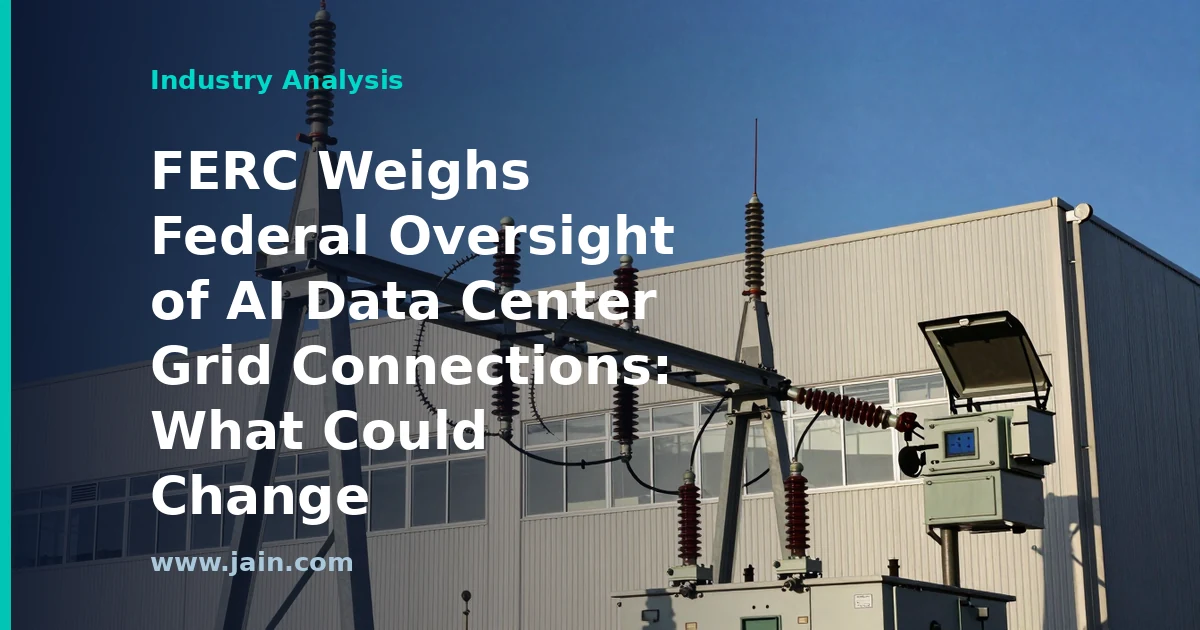
  • FERC Weighs Federal Oversight of AI Data Center Grid Connections: What Could Change

    FERC Weighs Federal Oversight of AI Data Center Grid Connections: What Could Change

    According to a May 12, 2026 report from Engineering News-Record, the Federal Energy Regulatory Commission (FERC) is weighing federal oversight of how AI data centers connect to the electric grid. The report signals that the commission — the U.S. regulator of interstate transmission and wholesale power markets — is considering a more direct role in the interconnection of the very large loads that hyperscale AI facilities represent.

    Executive Summary

    The headline development is straightforward but consequential: FERC is reportedly considering whether the federal government should assert oversight over AI data center grid connections — the physical and contractual arrangements that let a large computing facility draw power from the bulk electric system. Historically, connecting a new load (a consumer of power, as opposed to a generator) has been governed largely by state regulators and local utilities. A federal framework would be a meaningful shift in who sets the rules for the fastest-growing category of electricity demand in decades.

    Why it matters: power availability has become the binding constraint on AI infrastructure buildout. Data center developers routinely cite interconnection timelines and grid capacity — not chips or capital — as the limiting factor on new capacity. Whoever writes the rules for large-load interconnection will influence where hyperscale campuses get built, how fast they energize, and who pays for the grid upgrades they require. Based on the available report, FERC is weighing action, not announcing a final rule; the scope, mechanism, and timeline remain to be seen.

    Why the Grid Connection Became the Bottleneck

    AI training and inference clusters concentrate enormous electrical demand in single facilities — individual campuses now request capacity measured in the hundreds of megawatts, and some multi-site plans reach into the gigawatts. That is utility-scale demand appearing at a pace the interconnection process was never designed for. Utilities and grid operators must study whether the local transmission network can serve a new load without degrading reliability for existing customers, and those studies, plus any required upgrades, can take years.

    For the AI infrastructure sector, the interconnection queue is now a competitive battleground. Access to a firm, timely grid connection has become as strategically valuable as access to GPUs. Any change in who governs that process — and under what standards — goes directly to the economics of the buildout.

    The Jurisdictional Line FERC Would Be Redrawing

    FERC’s authority under the Federal Power Act covers interstate transmission and wholesale electricity sales; states and their utility commissions traditionally govern retail service, distribution, and the siting of both power plants and large customers. Load interconnection has mostly lived on the state side of that line. But recent disputes have pulled FERC in — most visibly the fights over co-located load, where a data center connects directly to a power plant (such as a nuclear station) and questions arise about whether it is fairly using, or bypassing, the shared transmission system. FERC’s 2024 rejection of an expanded co-location arrangement at a Pennsylvania nuclear plant, and its subsequent review of co-location rules in the PJM region, established the commission as an active referee in this space.

    Weighing broader oversight of AI data center connections would extend that trajectory. The legal theory matters: rules framed around transmission access and wholesale-market effects sit comfortably within FERC’s mandate, while anything resembling federal siting authority over customer facilities would be contested territory. Expect states, utilities, and hyperscalers to litigate exactly where that line falls.

    Winners, Losers, and the Price of Certainty

    A single federal framework could benefit large developers by replacing a patchwork of state-by-state and utility-by-utility processes with predictable national rules — much as FERC’s generator interconnection reforms sought to standardize the queue for power plants. Uniformity lowers diligence costs and could speed projects in regions where local processes are slow or opaque.

    The countervailing risk is that new federal process layers add time before they save it, and that cost-allocation rules — who pays for the transmission upgrades a gigawatt-scale campus triggers — shift in ways developers cannot yet price. Utilities in high-growth regions may welcome clearer rules for protecting existing ratepayers; states courting data center investment may resist anything that dilutes their leverage. Ratepayer advocates, who have pressed regulators to ensure ordinary customers do not subsidize hyperscale growth, would likely see federal engagement as validation of their concerns — though the substance of any rule will determine whether they view it as protection or preemption.

    What Is — and Is Not — Substantiated Here

    It is worth being direct about the sourcing: this is a single trade-press report that FERC is weighing oversight. The available material does not establish whether the commission has opened a formal proceeding, issued a proposed rule, or merely discussed the topic at a conference or in commissioner statements. “Weighing” can describe anything from staff inquiry to an imminent order. Readers should treat the direction of travel — growing federal attention to large-load interconnection — as well supported by the past two years of docket activity, while treating any specific regulatory outcome as unconfirmed until FERC itself acts.

    Background

    FERC was created to regulate the interstate wholesale electricity system, leaving retail service and facility siting to states — a division written long before any single electricity customer could demand a gigawatt. That division has come under strain as AI-driven data center growth produced the fastest load expansion the U.S. grid has seen in decades, with grid operators across the country reporting unprecedented volumes of large-load interconnection requests.

    The pressure surfaced first in co-location disputes: FERC’s 2024 rejection of an expanded data-center arrangement at a Pennsylvania nuclear station, followed by a broader review of co-located load rules in the PJM region, made the commission a central player in data center power policy. The reported deliberations over direct oversight of AI data center grid connections are the logical next chapter in that story.

    Source: FERC Weighs Federal Oversight of AI Data Center Grid Connections — Engineering News-Record report, May 12, 2026, on FERC deliberations over federal jurisdiction of large-load grid interconnection.

  • S&P Global Raises AI Infrastructure Forecast After 2025 Results Beat Expectations

    S&P Global Raises AI Infrastructure Forecast After 2025 Results Beat Expectations

    S&P Global, the ratings and market-intelligence firm, reported that AI infrastructure results for 2025 topped its expectations and, on the strength of those results, has upgraded its forecast for the sector. The announcement, published May 7, 2026, signals that one of the most closely watched independent forecasters now sees more AI-driven data center, compute, and power investment ahead than it previously modeled.

    Executive Summary

    Forecast upgrades come in two flavors: those driven by sentiment and those driven by results. S&P Global’s revision belongs to the second category — the firm says actual 2025 outcomes in AI infrastructure exceeded what its prior models anticipated, and it has raised its outlook accordingly. That distinction matters. A results-based upgrade means the checks cleared: capital was deployed, capacity was delivered or contracted, and revenue showed up in reported financials rather than in investor-day slideware.

    For the infrastructure ecosystem — data center operators, connectivity providers, power utilities, and the vendors that supply them — an independent forecaster moving its baseline upward extends the planning horizon for an already historic buildout. It also raises the stakes: the higher the consensus forecast climbs, the more painful any eventual shortfall in demand, power availability, or financing would be. The syndicated headline, however, carries no figures, so the size of the beat and the magnitude of the upgrade remain to be read in the underlying report.

    An Upgrade Anchored in Results, Not Hype

    Throughout the AI investment cycle, skeptics have argued that spending projections rest on circular enthusiasm — model builders forecasting demand for their own models. What distinguishes this announcement is its direction of inference: S&P Global is looking backward at 2025 actuals and concluding its earlier numbers were too low. When realized results outrun a forecast, the forecaster faces a choice between treating the beat as a one-time pull-forward of demand or as evidence the underlying trend is steeper. By upgrading, S&P Global has chosen the second interpretation.

    That said, extrapolation is exactly how forecasters get caught at cycle peaks. Strong 2025 results confirm that money was spent and capacity absorbed; they do not by themselves prove that the returns on that spending will justify the next round. Readers should distinguish between the fact of the beat — which is evidence — and the upgraded projection, which remains a model.

    What More Capex Means for Power and Land

    AI infrastructure is shorthand for a physical supply chain: chips, servers, the data centers that house them, the fiber that connects them, and — increasingly the binding constraint — the electricity that powers them. A raised forecast implies more of all of it. For data center markets already contending with multi-year utility interconnection queues, transformer lead times, and community pushback on siting, an upgraded demand outlook translates directly into more competition for powered land and grid capacity.

    For utilities and power developers, a higher independent forecast strengthens the case for generation and transmission investment that regulators must approve. For enterprise and colocation buyers, it points the other way: sustained demand above prior expectations tends to keep vacancy low and pricing firm, meaning tenants who deferred capacity decisions waiting for the market to loosen may be waiting longer than they planned.

    Winners, Losers, and the Widening Gap

    A rising forecast does not lift all boats equally. Operators with secured power, entitled land, and access to capital can convert an upgraded outlook into pre-leased expansion. Smaller players without those ingredients face the same rising input costs — power, equipment, construction labor — without the contracted revenue to offset them. The upgrade also sharpens the divide between markets: regions that can deliver megawatts on credible timelines will absorb a disproportionate share of the incremental demand the new forecast implies.

    The risk ledger deserves equal attention. Every upward revision embeds assumptions about continued hyperscaler spending, stable financing conditions, and AI applications generating enough end-customer revenue to sustain the cycle. If any of those assumptions weakens, capacity ordered against the upgraded forecast could arrive into a softer market. S&P Global’s own ratings business exists precisely because leverage built in good times gets tested in bad ones — a useful lens to apply to its market forecasts as well.

    Background

    The AI infrastructure buildout accelerated sharply after generative AI reached mass adoption, with hyperscale cloud providers and AI developers committing historic sums to chips, data centers, and power. Throughout 2024 and 2025, a running debate pitted those who saw the spending as a durable platform shift against those who warned of overbuild, with independent forecasters like S&P Global serving as referees between the narratives.

    S&P Global occupies an unusual vantage point in that debate: its ratings arm evaluates the creditworthiness of the utilities, data center operators, and technology firms doing the spending, while its market-intelligence arm models the demand itself. When a firm with exposure to both sides of the ledger raises its outlook based on realized results, it carries more weight than promotional projections — which is precisely why the details behind this upgrade merit close reading.

    Source: AI infrastructure results in 2025 top expectations, forecast upgraded — S&P Global, announcing an upgraded AI infrastructure forecast after 2025 sector results exceeded the firm’s expectations.

  • Johnson Controls Q2 Sales Rise 8% on Data Center Cooling Demand

    Johnson Controls Q2 Sales Rise 8% on Data Center Cooling Demand

    Johnson Controls, one of the world’s largest building-technology and HVAC companies, reported an 8% year-over-year increase in sales for its fiscal second quarter, with data center cooling demand cited as a principal driver, according to a May 7, 2026 report by Facilities Dive. Because Johnson Controls’ fiscal year ends in September, its second quarter covers roughly January through March 2026.

    Executive Summary

    The headline number — 8% sales growth at a company of Johnson Controls’ scale — is notable less for its size than for its attribution. When a diversified industrial that sells everything from fire-suppression systems to building controls credits data center cooling as the engine of a quarter, it quantifies something the industry has sensed for two years: AI-driven data center construction has become a primary demand source for the industrial HVAC sector, not a niche vertical.

    Cooling is the second-largest consumer of power and capital in a data center after the IT equipment itself, because nearly every watt a server draws becomes heat that must be removed. As hyperscale operators — the companies running the largest cloud and AI facilities — race to add capacity, the vendors who make chillers, air handlers, and thermal-management systems are seeing that race show up directly in their revenue lines. Johnson Controls’ quarter is one of the cleaner public data points yet on how large that effect has become.

    From Building Controls to AI Infrastructure Supplier

    Johnson Controls has spent recent years narrowing its portfolio toward commercial buildings and applied HVAC — the large, engineered cooling systems used in campuses, hospitals, and data centers — including divesting its residential and light-commercial HVAC business to Bosch and acquiring Silent-Aire, a maker of modular cooling and hyperscale data center equipment, in 2021. A quarter in which data center cooling is called out as the growth driver suggests that repositioning is doing what it was designed to do: concentrate the company’s exposure where capital spending is heaviest.

    That matters for how investors and customers should read the company. Johnson Controls is increasingly priced and evaluated not as a building-products conglomerate but as a supplier to AI infrastructure buildouts — a category that commands different growth expectations, and different scrutiny, than traditional construction-linked HVAC.

    The Economics of the Cooling Boom

    Data center cooling is attractive business for industrial vendors for structural reasons. The equipment is large, engineered-to-order, and often sold with long-term service contracts — chillers (machines that produce chilled water to absorb heat from server halls) run continuously for decades and require ongoing maintenance. Hyperscale projects are also ordered in fleets rather than units, which fills factory backlogs years ahead and gives manufacturers unusual visibility and pricing power compared with the one-building-at-a-time commercial construction cycle.

    The industry is simultaneously navigating a technology transition. As AI chips grow denser, air cooling reaches physical limits, and liquid cooling — circulating coolant directly to the chips or their racks — is taking a growing share of new deployments. That transition is an opportunity for incumbents with liquid-capable portfolios and a risk for anyone whose installed strength is concentrated in legacy air-based systems. The source report does not break down how much of Johnson Controls’ growth came from which technology, a distinction that matters for judging how durable the growth is.

    A Rising Tide Across the Vendor Field

    Johnson Controls is not alone in reporting data-center-driven strength; the same demand wave has lifted results across thermal-management and power-equipment vendors, and competitors such as Vertiv, Carrier, Trane Technologies, Schneider Electric, Munters, and Daikin all compete for slices of the same buildouts. The significance of this quarter is corroborative: each vendor that attributes measurable growth to data centers adds evidence that hyperscale capital spending is flowing through to the industrial supply chain broadly, rather than pooling with one or two specialists.

    For data center operators and enterprises planning capacity, the flip side of vendor prosperity is procurement reality: strong vendor demand typically means longer lead times and firmer pricing for large cooling equipment. Buyers who plan orders early, standardize designs, and lock delivery slots hold the advantage in a seller’s market.

    The Concentration Question

    The risk embedded in an 8% quarter driven by one end market is the same as its appeal: concentration. Data center demand is ultimately a derivative of a handful of hyperscalers’ AI capital-expenditure decisions. If AI infrastructure spending decelerates — because of monetization pressure, power-availability constraints, or efficiency gains that reduce cooling intensity per unit of compute — the vendors that re-oriented toward this vertical would feel it quickly. Nothing in the source report suggests that is imminent, but a growth story built on one customer class deserves to be monitored as one.

    The even-handed reading: this quarter substantiates real, current demand flowing to a major HVAC vendor. It does not, by itself, establish how long the cycle runs, and the headline-level detail available leaves the durability question open.

    Background

    Johnson Controls traces its roots to 1885, when Warren S. Johnson commercialized the electric room thermostat, and grew over the following century into one of the world’s largest building-technology companies, spanning HVAC equipment (including the York chiller brand), building automation, and fire and security systems after its 2016 merger with Tyco. In recent years the company has deliberately narrowed toward commercial and engineered building systems, selling its residential and light-commercial HVAC business to Bosch and investing in data center capabilities, most visibly through the 2021 acquisition of hyperscale cooling specialist Silent-Aire.

    That repositioning coincided with the AI infrastructure boom, in which data center construction — and the power and cooling systems it requires — became one of the fastest-growing capital-spending categories in the global economy, reshaping demand for the entire industrial HVAC sector.

    Source: Data center cooling drives Johnson Controls’ Q2 sales up 8% — Facilities Dive report (May 7, 2026) on Johnson Controls’ fiscal second-quarter results and the role of data center cooling demand.

  • North Carolina Bill Would Make Hyperscalers Pay Their Grid Costs

    North Carolina Bill Would Make Hyperscalers Pay Their Grid Costs

    North Carolina legislators have introduced an AI infrastructure bill that would push hyperscale data centers to shoulder the electricity system costs their load creates, according to a 5 May 2026 report from Data Center Knowledge. The measure places North Carolina among a growing set of states moving “large-load” cost allocation out of utility commission dockets and into statute.

    The available source is headline-level: it establishes that such a bill has been proposed and that hyperscale cost recovery is its target. It does not, in the material we reviewed, supply a bill number, sponsor list, megawatt threshold, contract terms, or a legislative calendar. This analysis therefore treats the policy direction as reported and the mechanics as open questions.

    Executive Summary

    The proposal addresses a problem that has moved quickly from technical to political: when a single data center campus requests hundreds of megawatts, the utility must build transmission lines, substations and generation to serve it. Those assets are paid for over decades through rates charged to every customer. If the campus is delayed, downsized or shut down, the bill does not disappear — it shifts to households and existing businesses. “Cost causation,” the regulatory principle that the party creating a cost should bear it, is the framework North Carolina is reportedly trying to codify.

    This matters because North Carolina is not a marginal market. Its low industrial power prices, data center sales-tax exemption and existing hyperscale footprint have made it a repeat destination for large campuses. A statutory cost-allocation regime in a top-tier state signals that the era of negotiating each large load quietly with a utility, case by case, is narrowing.

    For operators, the practical question is not whether they will pay — large customers already pay substantial demand charges — but how much risk they must pre-commit to and for how long. Minimum-take obligations, multi-year contract terms, collateral and exit fees are the levers that determine whether a state’s rules are a manageable cost of doing business or a reason to site the next campus elsewhere.

    Why Cost Causation Became a Statehouse Fight

    Regulated electric utilities are, in effect, planning institutions. They forecast demand years out, build generation and wires against that forecast, and recover the capital through rates approved by a state commission. The model works when load grows predictably. AI-era data center requests break that assumption in two directions at once: individual projects are enormous relative to a utility’s existing peak, and the interconnection queue is full of speculative requests that may never be built.

    Utilities have responded with “phantom load” screening and large-load tariffs designed to separate serious projects from optionality-shopping. But those instruments are negotiated inside regulatory proceedings that most voters never see. When residential bills rise for any reason — fuel costs, storm recovery, capacity additions — data centers become the visible explanation, whether or not they are the arithmetic one. Legislation is what happens when that political pressure outruns the docket process.

    The industry has a serious counterargument that deserves to be stated plainly: large, flat, high-load-factor customers can improve system utilization and spread fixed costs across more kilowatt-hours, which can put downward pressure on everyone’s rates. That is genuinely true when the load materializes and stays. The entire policy question is what happens when it does not — and who is holding the asset.

    Three States, Three Instruments

    Oregon’s POWER Act is the clearest existing template. It directs that very large energy users — data centers and cryptocurrency operations above a defined megawatt threshold — be placed in their own customer class with dedicated long-term contract terms, so that the costs of serving them are recovered from them rather than blended into general rates. The mechanism is structural: create a separate class, then let the commission set terms for that class.

    New Jersey’s approach has centered on a tariff mandate — instructing regulators to establish a distinct rate schedule for high-density load, which leaves more design discretion with the board while fixing the obligation in law. North Carolina’s reported bill sits somewhere in this family, but the reporting available does not specify which instrument it uses. The distinction is not academic. A separate-class statute changes who a customer legally is; a tariff-directive statute changes what a customer pays under rules regulators still write.

    Comparing the three exposes the real design variables: the megawatt trigger, whether existing and already-announced projects are grandfathered, the minimum-take percentage, contract duration, credit and collateral requirements, and the exit fee if a customer walks. Two states can adopt the same headline principle and produce very different investment climates depending on where those dials are set.

    Who Gains, Who Pays, and Who Hedges

    The clearest winners from codified cost allocation are ratepayer advocates and, less obviously, incumbent operators with signed interconnection agreements. Grandfathering provisions — common in this legislation — convert an existing position into a durable cost advantage over a new entrant facing minimum-take obligations and collateral posting. Rules that raise the price of entry protect whoever is already inside.

    The clearest losers are speculative developers holding land and queue positions without a committed tenant. A statutory minimum-take regime prices optionality directly, which is arguably the policy’s point. Utilities occupy an ambiguous position: they gain revenue certainty and reduced stranded-asset exposure, but lose flexibility to structure bespoke deals for anchor customers they want to attract.

    The predictable hedge is to go around the tariff entirely. Behind-the-meter generation, on-site gas, fuel cells and co-located generation reduce a campus’s exposure to regulated rates — and correspondingly reduce its contribution to the shared system it still relies on for backup and reliability. Whether North Carolina’s bill addresses standby service and backup rates for self-supplied campuses is one of the more consequential details not visible in the source reporting.

    The Case For and Against Legislating It

    The argument against writing this into statute is real. Utility commissions have staff, evidentiary records and the ability to adjust terms as load forecasts change; legislatures have none of that and revise slowly. A megawatt threshold that is sensible in 2026 may be poorly calibrated by 2030, and statutory language is harder to fix than a tariff sheet.

    The argument for it is equally real. Commission proceedings can be captured by the sophistication gap between utilities, hyperscalers and thinly-resourced consumer advocates, and they produce outcomes that are legally reversible in the next rate case. Legislation delivers durability, which is precisely what a developer underwriting a fifteen-year asset wants — even a developer who dislikes the specific terms.

    The measured read is that predictability may matter more to capital than stringency. Operators can price a known minimum-take obligation. What they cannot price is a jurisdiction where the rules are relitigated every eighteen months. If North Carolina’s bill produces clear, stable terms, it may prove less damaging to the state’s competitiveness than opponents suggest and less protective of ratepayers than supporters claim.

    Background

    North Carolina has hosted large data center investment since the late 2000s, when major cloud and platform companies built campuses in the state’s western foothills, drawn by inexpensive power, cool-season climate and a state sales-and-use tax exemption for qualifying facilities. That footprint has since expanded toward the Charlotte region and the Research Triangle. Electricity service across most of the state is provided by vertically integrated regulated utilities whose rates and resource plans are approved by the North Carolina Utilities Commission.

    The AI buildout changed the scale of the ask. Individual campus requests now arrive measured in hundreds of megawatts, comparable to serving a mid-sized city, and often on timelines far shorter than the multi-year cycles required to build generation and transmission. Utilities in several states have responded with dedicated large-load tariffs featuring long contract terms and minimum-take provisions. Oregon and New Jersey moved the question into legislation, and North Carolina’s proposed bill would extend that pattern to one of the Southeast’s most active data center markets.

    Source: North Carolina Targets Hyperscale Costs with Proposed AI Infrastructure Bill — Data Center Knowledge, 5 May 2026, reporting that North Carolina legislators have proposed requiring hyperscale data centers to bear the grid costs their load creates.

  • Data Center Backlash Grows as Big Tech Spends to Shape It

    Data Center Backlash Grows as Big Tech Spends to Shape It

    CalMatters published a report on May 4, 2026, headlined “The data center backlash is here — and Big Tech is spending big to shape it.” The story frames a growing wave of community opposition to hyperscale data center projects alongside what the outlet characterizes as significant expenditures by large technology companies to influence public perception, local politics, and permitting outcomes.

    Because only the headline and outlet are available in the source feed reviewed here, the specific dollar figures, named companies, jurisdictions, and campaign tactics referenced by CalMatters are not reproduced in this article.

    Executive Summary

    The CalMatters headline crystallizes a trend that has been building for at least two years: as artificial intelligence workloads push hyperscalers to site ever-larger campuses, the communities being asked to host them are pushing back on power draw, water consumption, tax abatements, noise, and land conversion. The report’s framing — that Big Tech is “spending big to shape” the response — asserts a coordinated influence effort rather than a series of isolated PR moves.

    Why it matters: data center siting has moved from a technical procurement exercise into contested civic politics. If the pattern CalMatters describes holds, project timelines, community-benefit agreements, and utility-rate designs will increasingly be decided in front of city councils and public-utility commissions rather than in back-of-house negotiations. That reshapes cost of capital, land option strategies, and the reputational exposure of every operator in the sector — not only the hyperscalers named in any given story.

    What is not yet substantiated from the source reviewed: the scale of spending, its recipients, which companies are most active, and whether the activity meets the legal threshold of lobbying, political advertising, or grassroots organizing under applicable state law.

    Why the Backlash Arrived Now

    Two forces converged. First, AI training and inference clusters draw hundreds of megawatts per campus — an order of magnitude above the 20 to 50 megawatt facilities that dominated the last cycle — which has pulled data centers onto grids and into rate cases that previously ignored them. Second, the queue of new interconnection requests in regions like Northern Virginia, Central Ohio, Georgia, and parts of California has spilled into residential-adjacent parcels, which surfaces zoning, noise, and traffic issues that colocation providers historically avoided by clustering in industrial zones. When a project competes with households for the same substation capacity, the fight becomes visible on the household’s electric bill.

    The CalMatters framing suggests operators have recognized this shift and are resourcing it accordingly. That is consistent with public lobbying disclosures across several states in prior reporting cycles, though the specific 2026 figures referenced by CalMatters are not in the material reviewed here.

    What ‘Spending to Shape’ Can Mean — And What It Cannot

    Influence spending is a broad category. It ranges from clearly disclosed activity — registered lobbyists, campaign contributions filed with state ethics agencies, membership dues to trade associations — to less transparent forms such as sponsored community events, funded economic-impact studies, and paid grassroots organizing. Each carries different legal, ethical, and reputational weight. A community-benefits fund is not the same instrument as an astroturf letter-writing campaign, and conflating them weakens both critique and defense.

    Fair questions cut both ways. Of industry: which expenditures are disclosed, which studies are independently peer-reviewed, and are the jobs and tax figures cited in siting hearings audited after the fact? Of critics: are the coalitions organic residents’ groups, or do they receive funding from competing land uses, ratepayer advocates, or ideological funders — and is that funding disclosed? Neither question should be used to dismiss the other side; both should be answered on the record.

    The Economics Underneath the Politics

    A single gigawatt-scale AI campus can represent 5 to 10 billion dollars of capital, decades of property-tax revenue, and a few hundred permanent jobs — a lopsided ratio that has always made data centers a peculiar economic-development target. Local officials get large capex announcements and modest payroll; residents get transmission upgrades that may or may not be socialized across the rate base. The math is defensible when the load is firm, the tax abatements are time-limited, and the utility recovers infrastructure costs from the specific customer causing them. It becomes politically fragile when any of those conditions slip.

    Operators who invest early in transparent cost-allocation frameworks, independently verified water and power reporting, and enforceable community-benefit agreements tend to face lower opposition later. Those who rely primarily on influence spending to smooth approvals may win individual projects but raise the ambient political risk premium for the whole sector.

    Implications for the Broader Infrastructure Stack

    The backlash is not confined to hyperscalers. Colocation providers, connectivity carriers building fiber to new campuses, and power developers proposing behind-the-meter gas or nuclear all inherit the reputational climate the largest builders create. If permitting friction rises, the winners are likely to be operators with existing entitled land, brownfield reuse expertise, and demonstrated ability to close power-purchase agreements without triggering rate-case fights. The losers are speculative greenfield developers dependent on speed-to-permit assumptions that no longer hold.

    For enterprise buyers and investors, the practical read is that siting risk deserves the same diligence weight as latency, power price, and fiber diversity. Contracts should account for the possibility that a project announced today may face a very different approval environment when it enters construction two years from now.

    Background

    Data centers evolved from single-tenant enterprise rooms in the 1990s to multi-tenant colocation campuses in the 2000s and hyperscale cloud regions in the 2010s. The current AI cycle, beginning roughly in 2023, has pushed unit sizes an order of magnitude higher and concentrated demand in a handful of metro areas already facing grid constraints. Communities that welcomed earlier generations of facilities as quiet, tax-generating neighbors have found the new class harder to absorb.

    CalMatters is a nonprofit newsroom covering California policy and politics; its coverage of data center siting has focused on the intersection of AI infrastructure demand, state climate goals, and local land-use authority. The May 4, 2026 article extends that beat into the influence-spending dimension of the debate.

    Source: The data center backlash is here — and Big Tech is spending big to shape it — CalMatters report on growing community opposition to data center projects and industry influence spending.

  • TVA Moves Data Centers Into a Separate, Higher Power Rate Class

    TVA Moves Data Centers Into a Separate, Higher Power Rate Class

    The Tennessee Valley Authority (TVA) will charge data centers more for power under a separate rate, according to an April 28, 2026 report by the Chattanooga Times Free Press. The federally owned utility, which supplies electricity across Tennessee and parts of six neighboring states, is effectively carving hyperscale computing load out of its general commercial and industrial rate structure and pricing it as its own customer class.

    Executive Summary

    According to the report, TVA — the largest public power provider in the United States — is establishing a distinct rate under which data centers will pay more for electricity than they would under existing industrial tariffs. A “rate class” is the category a utility assigns to groups of customers with similar usage patterns; creating a new one for data centers means the utility believes this load is different enough in size, growth, and risk to deserve its own pricing.

    Why it matters: this is one of the clearest signals yet that utilities are no longer treating gigawatt-scale computing demand as ordinary industrial load. When a system as large as TVA’s formalizes a premium rate for data centers, it sets a reference point that other utilities, regulators, and public power boards across the country can cite. For operators planning campuses in the Tennessee Valley — a region that has actively courted data center investment — the cost of power, typically the largest ongoing operating expense of a data center, just became a moving target.

    Pricing Hyperscale Load as Its Own Risk Category

    Utilities have historically loved large industrial customers: steady, predictable consumption spreads fixed grid costs over more kilowatt-hours, which can lower rates for everyone. Data centers complicate that logic. They arrive in enormous increments, request interconnection faster than generation and transmission can be built, and — critically — a project can be cancelled or relocated after a utility has committed capital to serve it. A separate rate class is the standard regulatory tool for isolating that risk: it lets the utility recover the cost of serving data centers from data centers, rather than socializing it across households and smaller businesses.

    The reported move fits a broader pattern. Utilities and regulators in several U.S. markets have been developing large-load tariffs with features like minimum-demand charges, longer contract terms, and collateral requirements. TVA formalizing a higher rate suggests the debate has shifted from whether hyperscale load should be treated differently to how much more it should pay.

    What a Premium Rate Means for Data Center Economics

    Electricity is usually the single largest recurring cost of operating a data center, and for AI-oriented facilities running dense, power-hungry hardware, the sensitivity is even greater. A structurally higher rate changes site-selection math: the Tennessee Valley’s traditional pitch — abundant, relatively inexpensive, largely carbon-light power from a mix that includes nuclear and hydro — becomes less differentiated if data centers pay a premium over the headline industrial rate. The report does not disclose the size of the premium, so the practical impact could range from a rounding error to a genuine deterrent.

    Operators have levers in response: negotiating long-term supply agreements, bringing their own generation or storage to the table, or shifting flexible workloads to hours when the grid has spare capacity. But each of those adds complexity and capital cost, and none fully escapes a tariff that applies by customer class. The likely near-term effect is that hyperscalers press for contract structures — rather than published rates — where their scale gives them negotiating room.

    A Public Power Precedent With National Reach

    TVA occupies an unusual position: it is a federally owned corporation that sets its own rates through its board rather than through a state public utility commission. That autonomy means it can move faster than investor-owned utilities, whose large-load tariffs must survive contested rate cases. If TVA’s data center rate takes effect as reported, it becomes an operating precedent other utilities can point to when they argue that hyperscale customers should carry a larger share of grid-expansion costs.

    There is a fairness argument on both sides worth stating plainly. Ratepayer advocates contend that residential customers should not fund transmission and generation built for a handful of technology companies. Data center operators counter that they are long-tenured, high-load-factor customers whose demand justifies infrastructure the whole region eventually benefits from, and that punitive pricing simply pushes investment — and its tax base and jobs — to neighboring territories. The reported story does not resolve which framing TVA’s rate design reflects, and the details of the tariff will determine whether it reads as prudent risk allocation or as a growth deterrent.

    Background

    The Tennessee Valley Authority was created by Congress in 1933 and grew into the largest public power system in the country, serving roughly ten million people through a network of local power companies. Its generation mix — including nuclear, hydroelectric, gas, and coal — and its historically competitive industrial rates helped make the Tennessee Valley a magnet for energy-intensive industry, and more recently for data center development tied to cloud and AI growth.

    That growth collided with a nationwide reality: electricity demand, flat for two decades, began rising sharply as hyperscale computing facilities requested interconnections measured in hundreds of megawatts. Utilities across the U.S. responded by rethinking how such load is priced and contracted, seeking to protect other ratepayers from stranded-cost risk. TVA’s reported creation of a separate, higher data center rate places it among the most prominent utilities to formalize that shift.

    Source: TVA to charge data centers more for power under separate rate — Chattanooga Times Free Press report, April 28, 2026, on TVA’s creation of a separate, higher electricity rate class for data centers.

  • Veolia and Amazon Partner on Reclaimed-Water Cooling for AWS Data Centers

    Veolia and Amazon Partner on Reclaimed-Water Cooling for AWS Data Centers

    Veolia, one of the world’s largest water and environmental services companies, announced on April 27, 2026 that it is working with Amazon to develop a reclaimed-water cooling system for data centers. The collaboration targets Amazon Web Services (AWS) facilities, aiming to substitute treated, recycled water for the potable water that many data centers currently draw for cooling.

    Executive Summary

    The announcement pairs the operator of some of the world’s largest water-treatment networks with the world’s largest cloud provider on one of the industry’s most scrutinized problems: how much drinking-quality water data centers consume to stay cool. Reclaimed water — wastewater that has been treated to a standard fit for industrial reuse, though not for drinking — can displace that potable draw, easing pressure on municipal supplies in the communities where hyperscale campuses cluster.

    For Amazon, the partnership supports its publicly stated goal of becoming “water positive” by 2030 — returning more water to communities than its operations consume — and, just as practically, it addresses a growing source of friction in siting and permitting new capacity. For Veolia, it signals a move to position water expertise as core infrastructure for the AI-era data center buildout. The release, however, is light on specifics: no named sites, volumes, timelines, or financial terms were disclosed.

    Why Water Is the Data Center Industry’s Quiet Constraint

    Power gets most of the headlines, but water is increasingly the constraint that shapes where data centers can be built. Many large facilities use evaporative cooling, which chills servers efficiently by evaporating water — often millions of gallons per year per site, much of it drawn from the same municipal systems that supply homes. In drought-prone regions, that draw has become a genuine permitting and community-relations issue, with local opposition to new campuses increasingly citing water alongside electricity and land.

    The industry measures this through water usage effectiveness (WUE) — water consumed per unit of computing energy delivered — and operators face growing pressure from regulators, investors, and neighbors to disclose and reduce it. A credible, scalable alternative to potable water is therefore worth real money: it can be the difference between a project that clears local approval and one that stalls.

    What Reclaimed Water Solves — and What It Doesn’t

    Reclaimed water is municipal or industrial wastewater treated to a quality suitable for non-potable uses such as irrigation and industrial cooling. Using it for data center cooling substitutes a resource that would otherwise be discharged for one that communities drink. That is a genuine improvement, and it is proven ground: power plants and heavy industry have run on recycled water for decades. The engineering challenge is real but tractable — reclaimed water’s chemistry can promote scaling, corrosion, and biological growth in cooling loops, which is precisely the treatment problem a company like Veolia exists to solve, along with the pipeline infrastructure needed to move recycled water from treatment plants to campuses.

    What reclaimed water does not do is reduce total water consumption. Evaporative cooling still evaporates the water, whatever its source. It changes which water is used, not how much — a meaningful distinction in water-stressed basins, where hydrologists note that treated wastewater returned to rivers also supports downstream flows. The release, as summarized, does not address consumption volumes or how the system compares with closed-loop and other low-water designs.

    The Strategic Logic for Both Sides

    For Veolia, hyperscale data centers represent a growth market adjacent to its core business: the company already operates treatment plants and industrial-water services worldwide, and packaging that capability for cloud providers moves it up the value chain from utility contractor to strategic infrastructure partner in the AI buildout. A named relationship with Amazon is also a powerful reference for selling similar systems to other operators.

    For Amazon, the calculus spans sustainability accounting and siting pragmatism. Progress toward its water-positive pledge requires exactly this kind of substitution at scale, and demonstrating a reclaimed-water pathway gives AWS a stronger story in front of the councils and water authorities that approve new capacity. If the partnership produces a repeatable template rather than a single showcase, it could modestly widen the map of viable data center locations — and put competitive pressure on other hyperscalers, some of which have taken the different route of designs that eliminate evaporative water use entirely.

    Background

    Data center water use moved from an engineering footnote to a public issue over the past several years, as hyperscale construction accelerated to serve cloud and AI demand and communities in water-stressed regions began scrutinizing how much potable water evaporative cooling consumes. The major cloud providers have responded with public commitments — Amazon’s is a pledge to be water positive by 2030 — and with a mix of recycled-water sourcing, more efficient cooling designs, and replenishment projects.

    Veolia, formed from more than a century of French municipal water operations and now one of the world’s largest environmental-services groups, has built its industrial business on exactly this kind of problem: treating and delivering non-potable water for cooling and process use. The April 2026 announcement extends that franchise into hyperscale computing, an infrastructure market whose growth currently outpaces most of the industrial sectors Veolia has traditionally served.

    Source: Veolia Works With Amazon to Develop Reclaimed Water for Cooling System for Data Centers — Veolia press release, April 27, 2026, announcing a collaboration with Amazon on reclaimed-water cooling for AWS data centers.

  • €50 Billion AI Data Center Campus Announced for Croatia: What We Know So Far

    €50 Billion AI Data Center Campus Announced for Croatia: What We Know So Far

    An entity calling itself the Transatlantic Investment Group announced on April 27, 2026 a €50 billion AI data center and innovation campus in Croatia. The announcement describes the project as the largest investment in Croatian history and among the largest private U.S. investments in Europe. Beyond that headline framing, the release provides few operational details — no named site, power figure, timeline, or anchor tenant.

    Executive Summary

    The announcement positions Croatia — an EU, eurozone, and Schengen member on the Adriatic — as the destination for one of the largest AI infrastructure commitments ever declared in Europe. A €50 billion figure, if realized, would place the project in the same conversation as the multi-hundred-billion-euro wave of AI campus announcements that has swept the U.S. and, increasingly, Europe and the Gulf since 2024.

    Why it matters: hyperscale AI buildout is going global. Power, land, and permitting constraints in Europe’s established data center markets — Frankfurt, London, Amsterdam, Paris, Dublin — have pushed developers toward secondary markets, and a commitment of this size in Croatia would be the strongest signal yet that the frontier has moved to Southeast Europe. But the announcement, as published, is a statement of intent. The distance between a declared figure and energized capacity is measured in grid connections, financing closes, and construction phases — none of which are detailed here. Readers should treat this as a significant claim awaiting substantiation, not a shovel-ready project.

    Why Croatia? The Logic of AI’s Geographic Spillover

    Europe’s traditional data center hubs are effectively full. Utilities in Dublin and Amsterdam have restricted new grid connections for large facilities, and Frankfurt and London face similar power and land pressure. That has redirected capital toward markets that can offer three things at once: available power, developable land, and EU regulatory standing. Croatia checks the third box cleanly — it is inside the EU single market, the eurozone, and Schengen — which matters for data sovereignty rules that push European enterprises and governments to keep AI workloads on EU soil.

    The strategic framing as a “private U.S. investment in Europe” also fits a broader pattern: American capital funding AI capacity abroad, both to serve regional demand and to diversify away from congested U.S. power markets. For Croatia, a country whose economy leans heavily on tourism, an anchor investment in digital infrastructure would be transformative — which is precisely why the announcement’s superlatives deserve careful measurement against what has actually been committed.

    What €50 Billion Buys — and What an Announcement Doesn’t

    At current costs, hyperscale AI capacity runs very roughly in the tens of millions of euros per megawatt once you include the chips inside. A €50 billion program therefore implies gigawatt-class ambitions — a campus that would rank among the largest in Europe and consume electricity on the scale of a sizable city. Nothing in the announcement explains where that power comes from, and in AI infrastructure, power is the project. Grid interconnection queues, not capital, are the binding constraint almost everywhere.

    Industry observers have also learned to discount announcement figures. Across the sector, headline commitments are typically phased over a decade, contingent on demand, and structured so that early phases are a small fraction of the total. That is not a criticism of this project specifically — it is how large campuses are legitimately built — but it means the meaningful milestones to watch are land acquisition, a signed grid agreement, a financing close, and a named hyperscale or AI-lab tenant. None appear in the source material.

    Winners, Losers, and the Regional Ripple

    If even a first phase proceeds, the beneficiaries are identifiable: Croatia’s grid operator and power producers (who would need to expand generation and transmission), regional construction and electrical trades, European chip-adjacent suppliers of cooling and power equipment, and connectivity providers building fiber routes to link the Adriatic to Frankfurt, Milan, and Vienna. An “innovation campus” component, if real, could seed a local AI workforce — though such components are also the easiest part of an announcement to promise and the last to be funded.

    The competitive question is who this capacity would serve. Europe’s AI compute demand is growing, and the EU has actively courted large-scale AI infrastructure through initiatives like its AI gigafactory push. But Croatia would be competing with Spain, the Nordics, and Southern European markets that offer abundant renewables and established subsea connectivity. A project of this scale succeeds or fails on tenant demand, and the announcement names none.

    Background

    Croatia joined the European Union in 2013 and adopted both the euro and Schengen membership in 2023, completing its integration into the EU single market. Its economy has historically leaned on tourism and shipping, with a small but growing technology sector; it has not previously hosted hyperscale data center capacity, which in Europe has concentrated in the so-called FLAP-D markets — Frankfurt, London, Amsterdam, Paris, and Dublin.

    That concentration is now breaking up. Power and land constraints in the established hubs, EU data sovereignty rules encouraging in-region AI capacity, and Brussels-backed initiatives to attract large-scale AI computing have pushed developers toward Southern and Eastern Europe. The Croatian announcement, if substantiated, would be the largest expression of that shift to date.

    Source: Transatlantic Investment Group Announces €50 Billion AI Data Center and Innovation Campus in Croatia — announcement dated April 27, 2026, describing the project as the largest investment in Croatian history and among the largest private U.S. investments in Europe.

  • Google Breaks Ground in Kronstorf: Austria Joins the Map

    Google Breaks Ground in Kronstorf: Austria Joins the Map

    Google has begun construction on a data center in Kronstorf, a municipality in the Linz-Land district of Upper Austria, according to a groundbreaking announcement posted to the Google Cloud Press Corner and distributed on 23 April 2026. The item marks the start of physical work on the site.

    The release as circulated is a headline announcement. It does not, in the version distributed through news syndication, state the campus size, planned power capacity, capital commitment, construction timeline, staffing, or whether the facility will underpin a new Google Cloud region for Austria.

    Executive Summary

    Groundbreaking is the point at which a data center stops being a land holding and becomes a construction project. For a hyperscaler — an operator running compute at global scale, such as Google, Amazon Web Services, Microsoft or Meta — it normally implies that land control, planning permission and, critically, a grid connection agreement are already settled. Those are the hard parts. Steel and concrete are comparatively easy.

    The significance of Kronstorf is geographic more than technical. Europe’s data center industry has historically concentrated in five markets known as FLAP-D: Frankfurt, London, Amsterdam, Paris and Dublin. Those markets are now constrained less by demand than by electricity — grid connection queues, local moratoria and planning resistance have pushed new capacity outward into secondary markets with available power. Upper Austria, sitting on a hydro-heavy generation mix and on fiber routes between Munich, Vienna and northern Italy, fits that pattern.

    What the announcement does not do is tell buyers anything actionable. Google has not, as far as the distributed release states, committed to a launch date or to an Austrian cloud region. Enterprises with Austrian data residency requirements should treat this as an encouraging signal about Google’s intentions, not as a procurement input.

    Why Austria, and Why Now

    The proximate driver of hyperscale expansion into new European markets is power availability, not proximity to customers. Latency between Kronstorf and Frankfurt is a rounding error for most workloads; the difference that matters is whether a transmission operator can deliver tens of megawatts on a schedule the builder can plan around. In several established hubs it cannot. Dublin’s grid operator has restricted new data center connections in the Greater Dublin area for years, and Amsterdam imposed a construction pause that reshaped Dutch development. Frankfurt and London face their own queue and land pressures.

    Austria offers a different profile. Its electricity generation is unusually hydro-weighted by European standards, which is attractive both for carbon accounting and for price stability relative to gas-linked markets. Upper Austria is an industrial region with existing heavy-load infrastructure — the kind of grid that was built for manufacturing and can, in principle, be repurposed for compute. Kronstorf sits between Linz and Steyr, close to that industrial corridor.

    None of this is stated in the release. It is the standard site-selection logic of the sector, and it is the most plausible reading of the decision. Readers should hold it as inference, not as a company claim.

    What a Groundbreaking Actually Signals

    Announcements of this kind are frequently over-read in both directions. A groundbreaking is a stronger signal than a land purchase or a memorandum of understanding: capital has been committed, contractors are mobilised, and the permitting and interconnection work that typically consumes years has largely concluded. Hyperscalers do not break ground on sites they intend to abandon, and the sunk cost from this point forward rises steeply.

    It is a weaker signal than a service commitment. Large data center builds commonly run two to four years from groundbreaking to first customer traffic, and campuses are usually delivered in phases, with later buildings contingent on demand and on the operator’s capital plan at the time. A groundbreaking therefore says a facility is being built; it does not say when it will serve traffic, at what capacity, or which Google products will run on it.

    The distinction matters most for the question of a Google Cloud region in Austria. A physical data center and a published cloud region are related but separate things — regions require multiple availability zones, a defined service catalogue and a launch commitment. The release, as distributed, does not make that commitment, and the absence should not be filled in by assumption.

    Winners, Losers, and the Local Ledger

    The clearest beneficiaries are Austrian enterprises and public-sector bodies with data residency obligations, who gain a credible prospect of in-country hyperscale capacity, and the regional construction and electrical trades, who capture the build phase — the largest and shortest-lived share of employment any data center generates. Local landowners and the municipal tax base typically benefit as well.

    The competitive read is that Google is buying optionality in the DACH region rather than responding to a single anchor customer. Microsoft and AWS both hold established positions in German-language markets, and Vienna already hosts commercial colocation from international operators. Entering Austria with owned capacity changes Google’s cost structure and its sovereignty story simultaneously — owned facilities are cheaper at scale than leased ones and easier to make claims about.

    The costs land locally and are worth stating plainly rather than defensively. Large sites consume grid capacity, land and, depending on the cooling design, water; operational employment is modest relative to capital deployed. Communities that raise these points are asking legitimate questions, and the honest answer is that this release provides no basis to evaluate them in either direction. When Google publishes capacity, cooling method and water sourcing, those figures should be tested — and so should any counter-claims made about them.

    Reading a Thin Announcement Fairly

    It would be unfair to characterise this release as evasive. Groundbreaking announcements are ceremonial by convention across the industry, and operators routinely withhold capacity figures for competitive and security reasons. Google’s more detailed European disclosures have historically followed at launch rather than at first excavation.

    It would be equally unfair to present the announcement as more than it is. What is substantiated: construction has started at Kronstorf, and Google is the party announcing it. What is not substantiated by the release text: megawatts, euros, jobs, dates, cooling design, power procurement, and any regional service commitment. Coverage that supplies those numbers should be checked against a primary source.

    For infrastructure buyers, the practical posture is patience. Treat Kronstorf as evidence of Google’s medium-term intent in Central Europe, factor it into three-to-five-year architecture planning, and revisit when the operator publishes a launch date or a region announcement.

    Background

    Google operates a global network of owned data centers supporting Search, YouTube, Workspace and Google Cloud, with a substantial European footprint including sites in Ireland, the Netherlands, Belgium, Finland and Denmark. Its cloud business competes with Amazon Web Services and Microsoft Azure, where physical proximity and in-country capacity increasingly matter for regulated customers subject to data residency rules.

    Austria has hosted commercial colocation and enterprise data centers for years, largely concentrated around Vienna, but has not been a primary hyperscale construction market. The wider shift of European capacity toward secondary markets has been driven principally by electricity: as grid connections in Dublin, Amsterdam and Frankfurt became constrained, operators moved toward regions with spare transmission capacity and favourable generation mixes. Upper Austria, with its hydro-heavy power supply and existing industrial grid, sits squarely in that category.

    Source: Google Breaks Ground on Data Center in Kronstorf, Austria – Google Cloud Press Corner — Google’s groundbreaking announcement for a data center site in Upper Austria, published 23 April 2026.