Global investment firm KKR has launched Helix, a new venture aimed at building AI infrastructure at hyperscale, and has tapped former Amazon Web Services CEO Adam Selipsky to lead the effort. The announcement, reported June 16, 2026 by Data Center Frontier, frames Helix as an attempt to build a “new hyperscale model” — a cloud-scale computing platform purpose-built for artificial intelligence workloads — with a capital commitment coverage characterizes as running into the billions of dollars.
Executive Summary
The announcement pairs two things the AI infrastructure market watches closely: very large pools of private capital and proven hyperscale operating talent. KKR is one of the world’s largest alternative-asset managers and an established data center investor, while Selipsky ran AWS — the world’s largest cloud provider — from 2021 to 2024. Putting a former AWS chief executive at the head of a purpose-built AI infrastructure venture signals that KKR intends Helix to be an operating platform, not merely a real-estate or lending vehicle.
Why it matters: AI demand has strained the traditional hyperscale playbook, in which a handful of cloud giants self-fund and self-build their own capacity. A wave of alternative models — specialized GPU clouds, build-to-suit developers, and now investor-led platforms — is competing to finance and operate the next generation of AI data centers. Helix is a bet that private capital can own more of that stack directly. That said, the launch coverage is light on specifics: no disclosed capital figure, sites, customers, or timeline accompany the framing, so the scale of the bet remains asserted rather than itemized.
Why Private Capital Wants Its Own Hyperscaler
For most of the cloud era, hyperscale infrastructure — the massive, standardized data center fleets run by Amazon, Microsoft, and Google — was financed from those companies’ own balance sheets. AI training and inference have changed the math: capacity needs are growing faster than even the largest corporate balance sheets comfortably absorb, and the industry has increasingly turned to infrastructure funds, private credit, and joint ventures to carry the cost. KKR has been on the supplying side of that shift for years, including its co-acquisition of data center operator CyrusOne in 2022.
Helix, as framed, moves KKR up the stack — from landlord and financier toward operator. The economic logic is straightforward: the further up the stack you operate, the more of the AI value chain you capture, but the more operational and demand risk you take on. A firm that owns the facility, the compute platform, and the customer relationship earns more than one that only owns the shell — and loses more if utilization disappoints.
The Selipsky Signal
Leadership is the most concrete fact in this announcement, and it is a meaningful one. Adam Selipsky led AWS through 2021–2024, a period spanning the launch of the generative-AI boom, and before that built Tableau into a major software company as its CEO. Hiring an executive of that profile is a costly, credible signal: it suggests Helix aspires to hyperscale-grade engineering and go-to-market discipline rather than a pure asset-aggregation play.
It is also a recruiting and customer-credibility asset. Enterprises and AI labs committing multi-year capacity contracts weigh whether a new platform will still exist — and perform — in five years. A founding CEO who has run the largest cloud in the world addresses that question more directly than a capital commitment alone. Still, a leader is not a product: the announcement does not describe what Helix will actually sell, to whom, or how it differs technically from the incumbents Selipsky used to compete for.
What Could a “New Hyperscale Model” Mean?
The phrase invites scrutiny because the field of would-be alternatives is already crowded. Specialized GPU cloud providers (sometimes called “neoclouds”) rent AI compute directly; build-to-suit developers construct campuses against long-term hyperscaler leases; sovereign and utility-linked ventures bundle power with compute. If Helix simply combines KKR capital with leased or built capacity, it joins an existing category rather than creating one. If it integrates power procurement, facility ownership, and a cloud-style software platform under one roof, it would be a genuinely different structure — closer to a privately held fourth hyperscaler.
The winners-and-losers question follows from which version materializes. An operating hyperscaler backed by KKR would compete with the very cloud giants that are also KKR’s counterparties elsewhere, and with the neocloud cohort for GPUs, power, and talent. A financing-first version would compete mainly with other infrastructure funds. The launch materials, as reported, support the ambition but not yet the mechanism — a distinction buyers and investors should keep in view.
Background
KKR, founded in 1976, is one of the world’s largest alternative-asset managers and a major force in infrastructure investing. Its digital-infrastructure portfolio includes the 2022 co-acquisition of hyperscale data center operator CyrusOne, positioning the firm as landlord and financier to the cloud industry well before this launch. Adam Selipsky spent over a decade at AWS across two stints, led Tableau as CEO in between, and ran AWS from 2021 until stepping down in 2024 — giving him firsthand experience of both the strengths and the strains of the incumbent hyperscale model.
The launch arrives amid a broader restructuring of how AI infrastructure gets financed. Surging demand for AI training and inference capacity has pulled infrastructure funds, private credit, and specialized GPU cloud providers into a market once dominated by three self-funding cloud giants, with capital commitments across the sector reaching historic scale.
A June 16, 2026 report from the Data Center Richness newsletter on Substack says Google is bringing liquid cooling into its legacy data halls — retrofitting existing, originally air-cooled facilities rather than confining liquid cooling to newly built AI campuses. The report positions the move as a marker that liquid cooling is graduating from a specialty technology for new AI construction into something operators must engineer into buildings that already exist.
Executive Summary
According to the report, Google — one of the world’s largest data center operators — is extending liquid cooling beyond greenfield construction and into older data halls in its existing fleet. Liquid cooling circulates fluid close to (or directly across) hot silicon instead of relying on chilled air, and it has become the default answer for the extreme heat produced by modern AI accelerators.
The significance is less about any single facility and more about direction of travel. Until recently, the industry’s working assumption was that liquid cooling arrives with new buildings designed around it, while legacy halls carry on with air. If a hyperscaler of Google’s scale is instead threading liquid into buildings that were never designed for it, that suggests demand for accelerator capacity is outrunning the pace of new construction — and that existing real estate, with its already-secured power and grid connections, is too valuable to leave running at air-cooled densities.
One caveat up front: this is a single analyst-newsletter report, not a detailed Google engineering disclosure. The headline claim is clear; the scope, sites, methods, and timeline behind it are not spelled out in the source material available.
From Greenfield Exception to Fleet-Wide Expectation
For most of the past two decades, data center cooling meant moving air: chilled air pushed through raised floors or hot-aisle containment, absorbing heat from servers and carrying it away. Liquid cooling — whether direct-to-chip cold plates that sit on processors or full immersion of hardware in dielectric fluid — was a niche reserved for supercomputers. AI changed the math. Modern accelerator racks concentrate far more heat in far less space than air can economically remove, so new AI facilities are now routinely designed liquid-first.
The retrofit story flips the remaining assumption. If liquid cooling only lived in new builds, older halls would gradually become second-class assets, suitable only for lighter workloads. Retrofitting says the opposite: the industry’s installed base is being upgraded in place. For an operator with Google’s fleet size, even partial retrofits could unlock meaningful accelerator capacity without waiting years for new construction.
Why Retrofit When You Can Build New? Power and Time
The economics here are straightforward even without disclosed figures. The scarcest resources in data center development today are grid power and time — utility interconnections and permits for new campuses can take years in major markets. A legacy data hall already has land, a building, a grid connection, and delivered megawatts. Converting some of that hall to liquid cooling lets an operator redeploy existing power toward denser, higher-value AI capacity on a much shorter clock than greenfield construction allows.
Retrofits are not free or trivial, though. Liquid cooling in an air-designed building typically means adding coolant distribution units (the pumping and heat-exchange gear that moves fluid between facility water systems and server cold plates), new piping runs, leak detection, and floor-loading and maintenance procedures the original design never contemplated — often while neighboring racks keep serving live traffic. The engineering challenge of doing this in production facilities is precisely why a credible report of Google doing it at fleet scale is notable.
What It Signals for the Rest of the Market
Hyperscaler practice tends to become industry expectation. If Google normalizes liquid retrofits, colocation providers and enterprise operators will face the same question from their customers: can your existing halls take liquid-cooled racks, or only your new ones? Operators who can answer yes gain a way to monetize older buildings at AI-era densities; those who cannot may see legacy space reprice downward relative to liquid-ready capacity.
The supplier picture shifts too. A retrofit wave would expand the addressable market for cooling-distribution hardware, piping, quick-disconnect fittings, and specialized integration services well beyond the new-construction pipeline — because the installed base of air-cooled data halls worldwide is vastly larger than any single year’s new builds. At the same time, air cooling is not disappearing: the bulk of general-purpose computing still runs comfortably on air, and most retrofits produce hybrid halls where liquid and air coexist. The realistic near-term future is mixed-mode facilities, not a wholesale replacement.
Background
Google operates one of the world’s largest data center fleets and has long treated infrastructure engineering as a competitive advantage, publishing influential work on efficiency and custom hardware. It was an early hyperscale adopter of liquid cooling, deploying it at scale with its TPU v3 AI chips in 2018 — years before the generative-AI boom made the technology an industry-wide priority.
Across the wider market, the surge in AI computing since 2023 has pushed rack power densities far beyond what conventional air cooling handles economically, making liquid cooling standard in new AI construction. The unresolved question has been what happens to the enormous installed base of air-cooled facilities — which is exactly the question a credible hyperscaler retrofit program begins to answer.
Amazon has signed a multibillion-dollar agreement with Corning to ramp up fiber-optics manufacturing, as first reported by Manufacturing Dive on June 10, 2026. The deal ties one of the world’s largest cloud and AI infrastructure builders to the world’s best-known maker of optical fiber, securing the connectivity layer — the glass strands that carry data between and within data centers — for Amazon’s ongoing AI expansion.
Executive Summary
The announcement is short on public detail but long on signal: Amazon is treating optical fiber the way hyperscalers have learned to treat power, land, and chips — as a scarce input to be locked down years in advance rather than bought on the spot market. A multibillion-dollar commitment to “ramp up” manufacturing suggests this is not a routine purchase order but a demand guarantee large enough to justify new or expanded production capacity on Corning’s side.
For the infrastructure industry, the deal matters in two directions. It confirms that AI data center construction is now pulling hard on the optical supply chain, not just on GPUs and megawatts. And it raises a practical question for every other buyer of fiber — carriers, colocation operators, and enterprises — about what capacity remains available, and at what price, once the largest customers have reserved theirs.
Fiber Is the Quiet Bottleneck of the AI Buildout
Public attention in the AI infrastructure boom goes to chips and electricity, but the third essential ingredient is optical connectivity. Modern AI training clusters link thousands of GPUs (graphics processing units, the chips that do AI computation) into what behaves like a single machine, and the traffic between those chips — so-called east-west traffic inside the data center — dwarfs the traffic going out to users. That traffic moves over optical fiber, and an AI-optimized facility can consume many times the fiber count of a conventional cloud data center, before counting the long-haul routes needed to knit multiple campuses together.
That demand profile changes the economics of fiber. Optical cable production is capital-intensive and slow to scale: drawing glass fiber requires specialized furnaces and facilities that take time to build and qualify. When demand surges faster than capacity, lead times stretch. A hyperscaler planning multi-year, multi-gigawatt campuses cannot afford to discover mid-project that cable is on allocation. Committing billions of dollars up front converts that risk into a contractual guarantee.
The Offtake Playbook Comes to Connectivity
The structure here follows a pattern hyperscalers have already applied elsewhere: long-term offtake agreements — commitments to buy future output — that give a supplier the demand certainty to invest in capacity. Amazon and its peers have signed similar multi-year deals for power generation and chip supply. Extending the playbook to fiber optics tells you the connectivity layer has crossed the threshold from commodity procurement to strategic sourcing.
For Corning, a guaranteed buyer of this size de-risks manufacturing expansion that would be hard to justify on spot demand alone — fiber makers were burned in past cycles when telecom demand collapsed after capacity had been built. For Amazon, the deal buys priority in the queue. The open question, unanswered in the initial reporting, is how much of Corning’s output this commitment effectively reserves, and for how long. Corning has struck capacity-reservation arrangements with other large buyers before, so the cumulative effect of these deals on remaining open-market supply is the number the rest of the industry would most like to see.
What Tighter Fiber Supply Means for Everyone Else
When the largest buyers pre-purchase capacity, smaller buyers face a different market. Regional carriers, colocation and interconnection providers, municipal broadband projects, and enterprises building private networks all draw on the same manufacturing base. If AI-driven hyperscale demand absorbs the industry’s expansion for the next several years, other buyers should plan for longer lead times and firmer pricing — and, like the hyperscalers, may need to move from transactional purchasing toward framework agreements of their own.
There is also a competitive-landscape angle. Corning is the most prominent name in optical fiber, but it is not the only one; other global cable makers may see openings with customers who want supply diversity, and the deal could catalyze capacity investment across the sector. Historically, that is how supply crunches resolve — though the telecom industry also remembers the early-2000s lesson that capacity built for a boom can outlive the boom. Whether AI connectivity demand proves durable enough to absorb an industry-wide ramp is the multibillion-dollar assumption embedded in deals like this one.
Background
Corning invented low-loss optical fiber in 1970 and has manufactured it through every networking cycle since — including the early-2000s telecom bust, when overbuilt fiber capacity took years to absorb, a memory that still shapes how cautiously fiber makers expand. Amazon, through Amazon Web Services, operates one of the world’s largest cloud platforms and has been investing heavily in data center capacity to serve AI workloads.
The two trends converged in the mid-2020s: AI cluster architectures multiplied the fiber content of each new data center just as hyperscale construction accelerated, and large buyers began reserving optical manufacturing capacity through long-term agreements — a market where Corning, as the sector’s most prominent supplier, sits at the center.
LG Uplus, one of South Korea’s three big mobile phone companies, is building a giant data center in Paju, just north of Seoul. A data center is a warehouse full of computers, and this one will run artificial intelligence.
The first building won’t open until next year, but one large customer has already rented all of it. The whole site is designed to draw 200 megawatts, roughly the electricity a small city uses.
The surprising part: its biggest advantage isn’t the computers. It’s a major hub of the high-voltage power grid right across the road. Near Seoul, that kind of electricity hookup is hard to get.
Korea JoongAng Daily reported on June 7 that LG Uplus (LG U+) has made its Paju AI Data Center the centerpiece of a plan to win 5 trillion won ($3.3 billion) in cumulative AI data center orders by 2030. The site in Wollong-myeon, Gyeonggi Province, has a confirmed 200-megawatt power supply and will eventually hold five buildings with about 152,000 square meters (1.64 million square feet) of floor space.
Building 1 was about 20 percent complete at a June 5 site visit and is due for completion in June 2027. It is a 50-megawatt structure carrying about 30 megawatts of IT load, and it is already fully contracted to an unnamed large customer. LG Uplus expects more than 1 trillion won in orders a year through 2030 and projects 15 to 20 percent average annual revenue growth for the business.
Executive Summary
LG Uplus is repositioning itself from a traditional data center operator into what it calls an “AI Factory Operator.” In this model, the company sells the power, cooling and operational reliability that AI workloads need, not just rack space. Paju is the template. The site pairs a 200-megawatt grid connection with a hybrid air-and-liquid cooling design built in from the foundation. The first building sold out before its concrete had cured.
The announcement matters for two reasons. First, it shows where the scarcity lies in AI infrastructure near a capital city. Demand is plainly there; the harder thing to secure is a large, high-voltage power connection at a usable address. Second, it gives buyers and investors specific markers to track: the order target, the revenue growth projection, the 2027 completion date, and the commercial verification of liquid cooling later this year.
Vice president Ahn Hyurng-gyoon tied the build to a shift from training AI models to running them, known as inference. He said monthly token-processing volumes had risen roughly 67-fold over the past year. Tokens are the small chunks of text that AI models read and write.
Near Seoul, the Scarce Input Is a Grid Connection
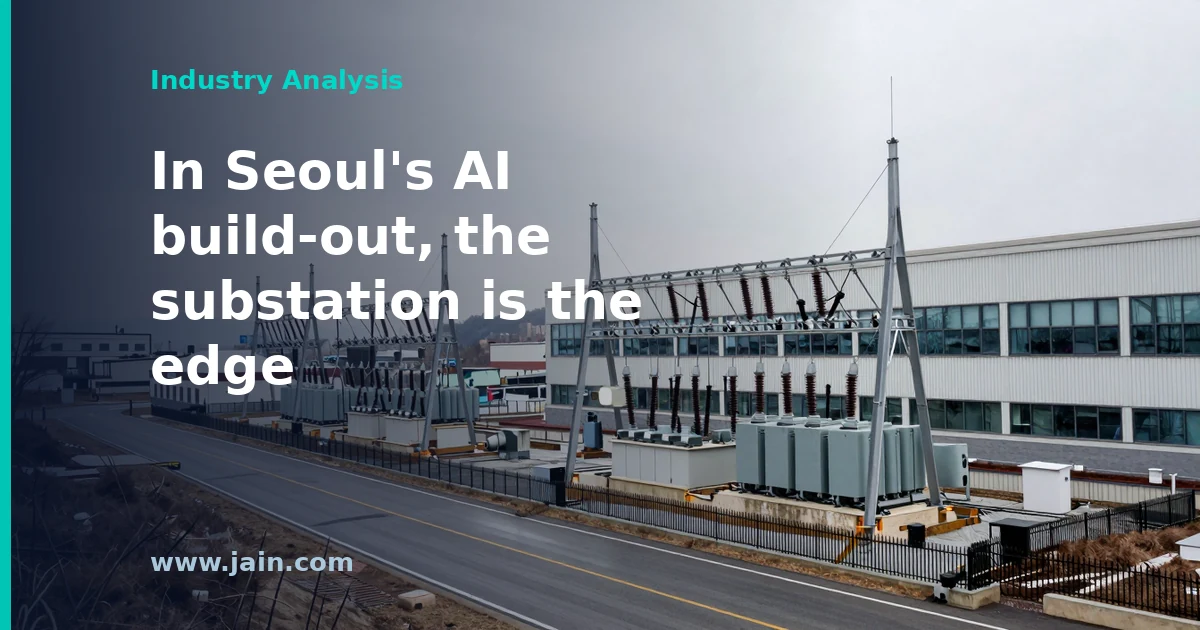
LG Uplus led its pitch with power, and the details explain why. The Paju site draws from a 345-kilovolt substation directly across the road. That is a backbone transmission voltage, the level that carries bulk electricity across the grid. A 154-kilovolt line serves as backup, and both run underground at a depth of about nine meters. The company says the 200-megawatt supply was locked in after a formal power-impact assessment last August. It says local opposition has been muted because the land sits inside a former LG Display industrial complex.
Those facts matter more than the building rising above them. Concrete, steel and chillers can be bought and scheduled. The right to draw hundreds of megawatts at a specific address cannot be hurried in the same way. Near a capital region, it depends on an existing substation with spare capacity and on neighbors who will accept the load. LG Uplus’s own framing makes the point. It claims Paju will be the only hyperscale-class facility of its size in the greater Seoul area. Because demand clearly exists, with Building 1 sold out about a year before completion, that is in effect a claim about who secured the grid capacity.
Three groups feel the consequence. AI tenants that want large capacity close to Seoul’s users and enterprises have few alternatives at this scale, which strengthens the operator’s position on pricing and contract length. Rival developers face the same constraint: their bottleneck is less capital or construction skill than sites already wired to high-voltage infrastructure, which makes former industrial land valuable. The uniqueness claim itself is LG Uplus’s assertion, and it will be tested as competitors bring their own capacity forward.
Fifty Megawatts on the Building, Thirty for the Servers
Building 1 is described as a 50-megawatt structure carrying about 30 megawatts of actual IT load, the power that reaches servers, storage and networking gear. The rest is not wasted. In data centers, that margin typically covers cooling, power conversion losses, and the redundant headroom that keeps a site running when a component fails. But the gap is a reminder that the headline megawatt figure on an AI campus is not the same as the compute it can host.
For buyers comparing providers, the IT-load figure is the one to ask for. If the same ratio held across the full site, 200 megawatts would mean something closer to 120 megawatts for servers. That is an extrapolation, not a company figure, and later buildings may be designed differently. Cooling is where LG Uplus is trying to narrow the gap. Paju is designed as a hybrid air-and-liquid facility, with floor loads, waterproofing and piping engineered for liquid from the start. Its primary method is direct-to-chip cooling developed with LG Electronics, in which a cold plate is attached to the processor and coolant carries heat away. The company says its tests showed about 24 percent better energy efficiency than air cooling.
Designing for liquid up front is the operationally significant choice. Retrofitting pipes and reinforcing floors under a live data hall is disruptive and costly, and the newest AI chips increasingly run too hot for air alone. All three computing floors of Building 1 are designed for direct-to-chip cooling, so a tenant can switch as its hardware changes. The caveat is timing. Full commercial verification in a live server room is scheduled for later this year. Immersion cooling, in which servers are submerged in non-conductive fluid, still awaits certification.
An Order Target Is Not Yet a Revenue Line
The 5 trillion won ($3.3 billion) goal counts cumulative orders through 2030. LG Uplus expects more than 1 trillion won in orders a year to get there, or roughly a fifth of the target annually. Orders are contracted future business, not booked sales. A multi-year colocation contract can carry a large headline value that turns into revenue slowly over its term. The company’s separate projection of 15 to 20 percent average annual revenue growth is a better guide to what will reach the income statement, but the starting revenue base was not given.
The strategic repositioning is the more durable story. LG Uplus opened Korea’s first internet data center in 1999 and now runs 16 facilities nationwide. Ahn argued that competitiveness now depends “not on the scale of the facility but on how stably you can operate the entire infrastructure.” He pointed to a 27-year record of 99.999 percent uptime, which works out to about five minutes of downtime a year. That is a credible differentiator for a carrier with decades of network operations. It is also a claimed record, and the company itself says sustaining it at 200 megawatts is harder.
The first building also shows concentration risk: all of it is contracted to one unnamed customer. That validates demand, but it also means Paju’s early economics rest on a single relationship whose terms have not been disclosed.
Background
LG Uplus is one of South Korea’s three major mobile carriers, alongside SK Telecom and KT, and part of the LG Group. It opened Korea’s first internet data center (IDC) in 1999 and now operates 16 data centers nationwide. Its Paju project draws on group affiliates: the cooling system was co-developed with LG Electronics, and the site sits inside a former LG Display industrial complex.
AI data centers differ from traditional ones mainly in power density. Chips that train and run AI models draw far more electricity and give off far more heat per rack. That makes grid connections and liquid cooling central to design choices that were once secondary.
Data Center Knowledge reported on June 5, 2026, that Google is pursuing what it frames as a ‘power-first’ data center model — an approach in which access to electricity, rather than proximity to fiber routes, land, or customers, becomes the primary factor deciding where and how new facilities get built. The framing positions the model as a potential template for an industry now defined by energy scarcity.
Executive Summary
The report’s headline poses power-first siting as ‘a new model for energy scarcity’ — and that question mark matters. What is being described is less a single project announcement than a strategic posture: when grid interconnection queues stretch for years and utilities cannot promise large blocks of firm capacity, the rational response for a hyperscaler (a company operating cloud infrastructure at global scale, such as Google) is to start the site-selection process with the question ‘where can we actually get megawatts?’ and let everything else follow.
If that is genuinely how Google is now sequencing its development decisions, it inverts decades of data center orthodoxy. Historically, operators picked locations for network latency, tax incentives, land cost, and workforce, then asked the local utility to deliver power — which utilities, until recently, could almost always do. The reported shift is a public acknowledgment that electricity has become the scarce input around which everything else in digital infrastructure must now be designed.
From Location, Location, Location to Megawatts, Megawatts, Megawatts
Site selection used to treat power as a utility in the literal sense: always there when you flipped the switch. The AI buildout broke that assumption. Training clusters demand campus-scale power draws that rival heavy industry, and in many popular data center markets the local grid simply cannot add that load quickly. A power-first model responds by making energy availability the first filter — screening geographies by generation capacity, transmission headroom, and interconnection timelines before considering the traditional criteria at all.
For laypeople, the analogy is a factory town: the plant goes where the resource is, and the rest of the operation organizes itself around that fact. The strategic consequence is a likely redrawing of the data center map away from saturated hubs toward regions with surplus generation or the ability to build it — a shift with real winners (energy-rich regions, utilities with spare capacity, landowners near transmission) and real losers (constrained legacy markets that can no longer trade on their connectivity advantages alone).
What Power-First Implies for Design, Not Just Siting
The editorial angle here is worth taking seriously: if energy is the binding constraint, it shapes design as much as geography. A facility conceived power-first tends to be engineered around its energy reality — sized to the block of capacity actually secured, potentially paired with on-site or contracted generation, and optimized to extract maximum compute per watt because every watt was hard-won. Efficiency stops being a sustainability talking point and becomes the core economic lever.
That logic also favors operators with the balance sheet to participate in energy development itself — funding new generation, signing long-duration power purchase agreements (contracts to buy a plant’s output for years in advance), or co-developing sites with utilities. Hyperscalers can play that game. Smaller operators and enterprises largely cannot, which suggests power scarcity could further concentrate AI-scale infrastructure among a handful of companies with the ability to originate their own electricity supply.
A Question Mark Doing Honest Work
It is equally important to note what this coverage is and is not. The available material is a report framing a strategic concept, with a headline that explicitly asks whether this constitutes a new model rather than declaring it one. From the source available to us, there are no disclosed site lists, capacity figures, investment commitments, or timelines to evaluate. ‘Power-first’ is a compelling frame, and it is consistent with pressures the whole industry acknowledges — but as presented, it remains a thesis about Google’s approach rather than a verifiable program with published specifics. Readers should hold both things at once: the underlying constraint is real and well-documented across the sector, while the specific contours of Google’s response are, on this evidence, still thinly detailed.
Background
Google was among the earliest builders of hyperscale data centers and has long treated energy procurement as a strategic discipline, including years of large-scale renewable purchasing and a stated goal of running on carbon-free energy around the clock. That history makes it a bellwether: when Google changes how it sequences power and siting decisions, the rest of the industry pays attention.
The broader context is the AI infrastructure boom that accelerated from 2023 onward, which pushed data center power demand up sharply and collided with a grid whose generation and transmission additions move on multi-year regulatory timelines. By 2026, power availability — not land, capital, or chips alone — had become the most commonly cited bottleneck for new capacity across the sector, setting the stage for strategies like the one described here.
Generac Power Systems announced on June 1, 2026 that it has signed a global supply agreement to provide backup power equipment to a company it describes as a leading hyperscale data center operator. The customer was not named, and the announcement, distributed via PR Newswire, did not disclose financial terms, unit volumes, or a delivery timeline.
Executive Summary
The announcement matters less for its disclosed details — which are minimal — than for what it signals about both parties. For Generac, a company best known for residential standby generators, a global agreement with a hyperscaler is a credibility milestone in the large commercial and industrial power market, where data centers have become the most sought-after customer class. Hyperscalers — the handful of companies operating cloud and AI computing platforms at global scale — historically sourced backup generation from a small set of heavy-industrial incumbents.
For the data center industry, the deal is another data point in a broader pattern: operators locking in multi-year, multi-region supply of critical electrical equipment rather than procuring project by project. When a hyperscaler signs a global agreement for backup power, it suggests that generator capacity, like transformers and switchgear before it, is now scarce enough to justify strategic sourcing. That framing should be tempered by what the release does not say — no customer name, no dollar value, no megawatt figure — which limits how much weight the announcement can bear.
Backup Power Moves From Commodity to Constraint
Every serious data center pairs its utility feed with on-site backup generation — typically large diesel or natural gas generator sets that carry the facility through grid outages. For most of the industry’s history this was routine procurement: generators were a mature, readily available product bought near the end of a project’s design cycle. The AI-driven construction boom changed that. As operators race to bring gigawatts of new capacity online, long-lead electrical equipment — transformers, switchgear, and increasingly generator sets — has become a pacing item that can delay a facility as surely as a missing utility interconnection.
A global supply agreement is the procurement response to that scarcity. Instead of bidding each project separately, an operator reserves manufacturing capacity across regions and years, trading flexibility for certainty of delivery. The fact that a hyperscaler apparently judged this worthwhile for backup power is itself evidence of how tight the market has become, and it mirrors similar forward-buying behavior seen across the data center supply chain.
What the Deal Means for Generac
Generac built its business on home standby generators and mid-sized commercial units, while the largest data center generator orders have traditionally gone to heavy-industrial manufacturers such as Caterpillar, Cummins, and Rolls-Royce’s mtu brand. Generac has spent recent years pushing into larger industrial applications, and a hyperscale win — if it translates into sustained volume — would validate that strategy in the most demanding segment of the market. Hyperscale operators qualify suppliers rigorously, so passing that bar is meaningful even before any units ship.
The caution is that the release discloses no volumes or revenue. Supply agreements can range from firm multi-year commitments to framework arrangements that simply make a vendor eligible for future orders. Without disclosed terms, investors and industry observers cannot yet distinguish between the two, and the announcement should be read as a positive signal rather than a quantified backlog addition.
Why Hyperscalers Are Diversifying Their Supplier Base
From the buyer’s side, adding a supplier makes straightforward sense. When incumbent generator manufacturers carry extended backlogs, a hyperscaler that depends on a narrow vendor list risks having construction schedules dictated by someone else’s factory queue. Qualifying an additional manufacturer at global scale adds resilience, creates pricing competition, and expands total available manufacturing capacity — the same playbook hyperscalers have applied to chips, power equipment, and construction contractors.
The competitive implication for the wider market is worth watching: enterprise and colocation buyers, who lack hyperscale purchasing power, may find themselves further back in the queue as manufacturers allocate capacity to their largest strategic accounts. Backup power availability could quietly become another dimension on which the largest operators out-execute smaller ones.
Background
Generac Power Systems, founded in 1959 and headquartered in Waukesha, Wisconsin, became a household name in residential standby generators — the units that keep homes powered through grid outages. Over the past decade it has expanded into commercial and industrial generation, energy storage, and grid services, seeking growth beyond the housing-linked residential market. The largest tier of that industrial market is data center backup power, a segment long dominated by heavy-equipment incumbents.
The announcement lands amid an unprecedented data center construction cycle driven by cloud growth and AI computing demand. That boom has strained the supply chains for electrical infrastructure of every kind, prompting the biggest operators to lock in equipment supply years ahead — the context in which a global backup power agreement with a hyperscaler is best understood.
Bloomberg published a deep-dive feature, “The Race to Rethink Data Centers for AI’s Power Surge” (May 31, 2026), examining how the electricity demands of artificial intelligence are pushing the industry to redesign data centers from the ground up. The syndicated item carries the headline and framing rather than the full text, but the thesis is clear: AI has turned the data center from a real-estate product into a power-engineering problem, and the industry is racing to catch up.
Executive Summary
The framing matters because it comes from a general-audience financial outlet, not a trade publication. When Bloomberg tells its readership that data centers must be rethought — not incrementally upgraded — it signals that AI infrastructure has become a mainstream capital-markets story. The “race” in the headline is real: operators, chipmakers, cooling vendors, and utilities are all redesigning around a single constraint, the availability and delivery of electric power.
For a decade, data center design evolved slowly because the workload was predictable: web servers, storage, and enterprise applications drawing modest, steady power per rack. AI training and inference clusters broke that model. Racks packed with modern AI accelerators draw many times the power of traditional server racks, concentrate that power in small footprints, and generate heat that air cooling struggles to remove. Every downstream system — electrical distribution, cooling, floor loading, even site selection — inherits that change. That is the ground-up redesign Bloomberg describes.
From Real Estate to Power Engineering
The traditional data center business resembled specialized real estate: build a shell near fiber routes, sell space and a service-level agreement. AI inverts the priority order. The scarce input is no longer land or connectivity but grid capacity — the megawatts a utility can actually deliver to a site, and how soon. In many major markets, interconnection queues (the utility’s waiting list to hook up large new loads) now stretch years, which means the design question starts with “where can we get power?” before anyone draws a floor plan.
That shift changes who holds leverage. Utilities and transmission owners, long treated as background vendors, now effectively gate the industry’s growth rate. Operators that secured power commitments early, or that can bring generation and storage to the site themselves, hold an asset that cannot be quickly replicated. This is why data center announcements increasingly lead with gigawatts rather than square feet.
The Density Problem: Why Air Is No Longer Enough
AI accelerators concentrate enormous computation — and therefore heat — into small spaces. Racks that once drew power in the single-digit kilowatts have given way to AI clusters drawing an order of magnitude more, and air cooling becomes physically impractical at those densities. The industry’s answer is liquid cooling: circulating coolant directly to chips or immersing hardware entirely, because liquids carry heat far more efficiently than air.
Retrofitting liquid cooling into a facility designed for air is expensive and disruptive — new piping, new heat-rejection equipment, reinforced floors, redesigned electrical distribution. That is what makes this a ground-up redesign rather than an upgrade cycle: much of the world’s existing data center stock was simply not built for what AI hardware now requires. New builds can be purpose-designed; legacy facilities face hard choices between costly conversion and serving the workloads they were built for.
Winners, Losers, and the Retrofit Divide
The redesign wave creates clear beneficiaries: liquid-cooling specialists, electrical-equipment manufacturers, builders of on-site generation and battery storage, and operators with new, high-density-capable campuses. Utilities in data-center-heavy regions gain large, creditworthy customers — along with political scrutiny over who pays for grid upgrades and how large loads affect residential rates.
The pressure falls on owners of older facilities and on markets where power is constrained. A bifurcation is plausible: purpose-built AI campuses commanding premium economics, while conventional facilities compete in the lower-growth market for traditional enterprise workloads. For the broader industry, the open question is pacing — whether power delivery, equipment supply chains, and skilled construction labor can scale as fast as AI demand projections assume, and what happens to capital deployed against those projections if demand growth moderates.
What It Means for Buyers of Capacity
Enterprises buying colocation or cloud capacity should read this as a warning about lead times and pricing. When power is the bottleneck, capacity in constrained markets gets scarcer and more expensive, and delivery dates slip to match utility timelines rather than construction schedules. Buyers planning AI deployments should ask providers pointed questions: how much power is actually contracted (not just applied for), what rack densities the facility supports today, and whether liquid cooling is installed or merely on a roadmap. The gap between a marketing deck and an energized megawatt is where AI projects stall.
Background
For most of the 2010s, data centers evolved gradually around predictable enterprise and cloud workloads, with racks drawing modest power and air cooling as the near-universal standard. The generative AI boom that began in late 2022 broke that pattern: training and serving large AI models requires dense clusters of accelerator chips whose power draw and heat output far exceed what conventional facilities were designed to handle. Since then, hyperscalers and data center developers have announced successive waves of AI-focused capacity, and the industry’s public conversation has shifted from square footage to megawatts — with power procurement, cooling technology, and grid constraints emerging as the defining issues of the buildout. Bloomberg’s May 2026 feature places that redesign race in front of a mainstream financial audience.
On May 29, 2026, the Uinta County Planning and Zoning Commission in southwestern Wyoming voted unanimously to approve the Prometheus data center, a proposed 1.25-gigawatt campus. The scale places the project among the largest single data center sites publicly disclosed in the Mountain West.
Executive Summary
Wyoming has quietly become one of the more permissive jurisdictions for hyperscale data center siting, and the Uinta County vote extends that pattern. At 1.25 gigawatts — enough electricity to power roughly a million homes at typical U.S. per-household draw — the Prometheus project sits in the top tier of announced campuses, closer in scale to the multi-hundred-megawatt AI training complexes now being built for hyperscalers than to traditional colocation facilities.
A unanimous local vote clears one gating item: land use. It does not clear the harder ones — power interconnection, water for cooling, transmission upgrades, and identification of the eventual tenant or tenants. For the industry, the significance is less about a single site and more about the accelerating pace at which rural counties are being asked to green-light multi-gigawatt loads that will materially reshape their electric grids.
Why Wyoming, Why Now
Wyoming offers what hyperscale developers increasingly value: cheap land, a cold climate that reduces cooling costs, an existing base of thermal and wind generation, and a permitting culture accustomed to large industrial projects from the extractive sector. Uinta County sits along the I-80 corridor near existing high-voltage transmission and natural gas infrastructure, which lowers the incremental cost of standing up new load. The state has no corporate income tax and has actively courted digital infrastructure, positioning itself against Virginia, Texas, and Arizona — jurisdictions where transmission queues and community pushback have lengthened project timelines.
The 1.25-Gigawatt Number in Context
A gigawatt is a thousand megawatts. Traditional enterprise data centers ran 5 to 20 megawatts; a decade ago, a 100-megawatt campus was considered large. AI training workloads have inverted those norms: individual buildings now draw 100 to 250 megawatts, and campuses are planned in gigawatt increments to accommodate future GPU refresh cycles. A 1.25-gigawatt approval does not mean 1.25 gigawatts will be built or energized on day one — it is a ceiling that lets the developer phase construction and lock in interconnection capacity before it is fully needed.
Local Approval Is the Easy Part
Planning commission approval is a necessary but not sufficient condition. The binding constraints on a project of this size are almost always upstream: whether the regional transmission operator can deliver the requested capacity, whether the utility will build the substations and lines, and whether state regulators will let the cost of those upgrades be socialized across ratepayers or require the data center to pay directly. Water for evaporative cooling — modest per unit of IT load, but non-trivial at gigawatt scale in a semi-arid basin — is a second live question. Neither is resolved by a zoning vote.
Winners, Losers, and the Ratepayer Question
Winners in the near term include the landowner, local construction trades, and the county tax base. Wyoming’s electric utilities gain a large new customer, which spreads fixed costs. The harder question is who ultimately pays for grid upgrades: if transmission build-out is rate-based, residential customers may see bills rise to serve a load that does not employ many of them. This is the same tension playing out in Virginia, Ohio, and Georgia, and it is the reason state public utility commissions — not planning boards — are becoming the real decision-makers on hyperscale siting.
Background
Wyoming has been a quiet but consistent recipient of data center investment since Microsoft’s Cheyenne campus expanded in the 2010s, followed by additional projects tied to Meta and cryptocurrency operators. The state’s low power costs, cool climate, and pro-development posture have made it a natural fit for compute-heavy workloads, though it has historically lagged the largest markets in absolute capacity.
The current cycle is different in kind. AI training and inference workloads are driving requests for gigawatt-scale campuses that until recently would have been considered utility-scale generation projects, not IT facilities. That shift is forcing rural counties, state utility commissions, and grid operators to make decisions with implications for electricity prices and system reliability far beyond the fenceline of any single site.
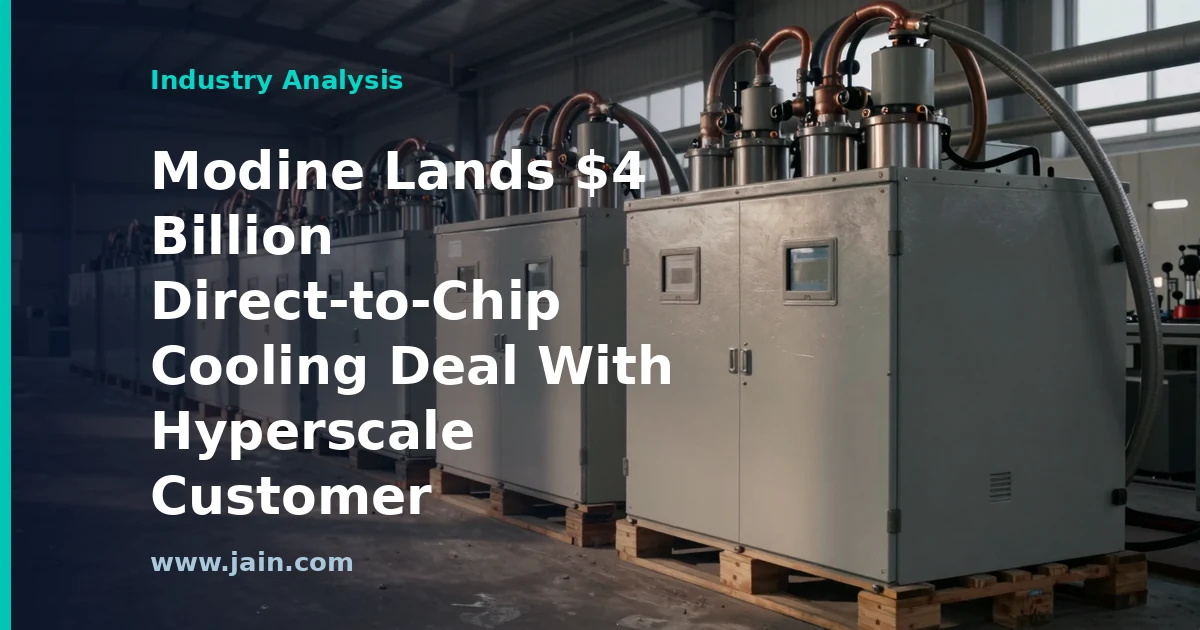
Modine Manufacturing has signed a cooling solutions agreement valued at $4 billion with a hyperscale data center customer, as reported by BizTimes Milwaukee on May 27, 2026. The agreement centers on direct-to-chip liquid cooling — technology that removes heat from processors through cold plates mounted directly on the silicon — and ranks among the largest single cooling-infrastructure commitments ever disclosed.
The customer was not named in the report, and details such as contract duration, delivery schedule, and the split between hardware, installation, and services were not disclosed.
Executive Summary
The announcement matters for two reasons. First, the sheer size: $4 billion for cooling alone would have been implausible only a few years ago, when cooling was a modest slice of data center capital budgets dominated by air-handling equipment. A commitment of this scale signals that liquid cooling has become a first-order line item in hyperscale AI buildouts, driven by processor power densities that air cooling cannot economically serve.
Second, the counterparty structure: a single hyperscale customer writing a multi-billion-dollar cooling commitment suggests the largest cloud and AI operators are now locking up thermal-management supply the way they already lock up power, land, and chips. For Modine — a century-old thermal-management company headquartered in Racine, Wisconsin — an agreement of this magnitude is potentially transformative relative to its historical revenue base, though how the value converts to recognized revenue over time is not yet clear from the report.
Cooling Graduates From Line Item to Mega-Contract
Direct-to-chip cooling circulates liquid coolant through cold plates that sit directly on top of processors, carrying heat away far more efficiently than blowing chilled air across server racks. The technology exists because modern AI accelerators draw so much power — and concentrate it in so little space — that traditional air cooling hits physical and economic limits. As rack densities climb from tens of kilowatts toward 100 kilowatts and beyond, liquid cooling shifts from an exotic option to a requirement.
A $4 billion commitment to a single cooling vendor is the clearest evidence yet of that shift. Hyperscalers historically procured cooling equipment project by project, from a fragmented field of suppliers. Consolidating that spend into one long-horizon agreement mirrors how they already contract for power and semiconductors: secure capacity early, at scale, before competitors do. If that procurement pattern spreads, the cooling industry’s competitive dynamics change — scale, manufacturing capacity, and balance-sheet strength start to matter as much as thermal engineering.
What the Deal Could Mean for Modine
Modine is best known as a legacy thermal-management manufacturer — its roots are in vehicle radiators — that has spent recent years repositioning toward data center cooling through its climate-solutions business and its Airedale data center cooling brand. A $4 billion agreement would be large relative to what mid-cap industrial suppliers typically book across multiple years, which is precisely why the announcement drew attention beyond the trade press.
The caveat is that headline contract values and recognized revenue are different things. The report does not say whether the $4 billion represents a firm purchase obligation, a framework agreement with volume expectations, or a ceiling contingent on the customer’s buildout pace. Investors have learned from other AI-infrastructure announcements that multi-year framework deals can be revised as deployment schedules shift. Until Modine discloses the structure, the number is best read as a statement of intended scale rather than booked backlog.
An Unnamed Customer and the Concentration Question
Hyperscale operators routinely require anonymity from suppliers, so the customer’s absence from the report is normal practice, not a red flag. But it leaves open a question that matters for assessing the deal: customer concentration. A supplier whose order book is dominated by one buyer gains scale but inherits that buyer’s capital-spending cycle. If the customer slows its AI data center buildout — for reasons ranging from power availability to shifts in AI demand — the supplier feels it directly.
The flip side is validation. Hyperscalers qualify cooling vendors through demanding technical and reliability reviews, because a cooling failure in a liquid-cooled AI cluster can take down hardware worth far more than the cooling system itself. Winning a commitment of this size implies Modine cleared that bar at scale, which itself is a competitive signal to the rest of the market.
The Competitive Ripple Across the Cooling Market
The direct-to-chip market has been contested by a mix of large incumbents and specialists, and a deal of this size resets expectations for what winning looks like. Rivals will face pressure to demonstrate comparable manufacturing capacity and to pursue their own anchor agreements with major operators. For buyers below hyperscale size — enterprises and smaller cloud providers — the concern runs the other way: if the biggest customers lock up vendor capacity, lead times and pricing for everyone else could tighten.
There is also an upstream effect. Direct-to-chip systems depend on coolant distribution units, quick-disconnect fittings, cold plates, and pumps — components with their own supply chains. A $4 billion program implies significant component demand over its life, which tends to pull investment into that supplier tier. The unanswered question is timing: without a disclosed delivery schedule, it is impossible to gauge how quickly that demand arrives.
Background
Modine Manufacturing is a Wisconsin-based thermal-management company whose history stretches back over a century, beginning with radiators for early automobiles. Like several legacy industrial firms, it has pivoted toward data center cooling as that market’s growth outpaced its traditional vehicle business, building out a climate-solutions portfolio that includes the Airedale data center cooling brand and, more recently, liquid-cooling capabilities aimed at AI workloads.
The backdrop is a structural shift in data center design. The AI buildout that accelerated from 2023 onward pushed rack power densities beyond what air cooling can serve, making liquid cooling — and direct-to-chip systems in particular — one of the fastest-growing segments of data center infrastructure spending.
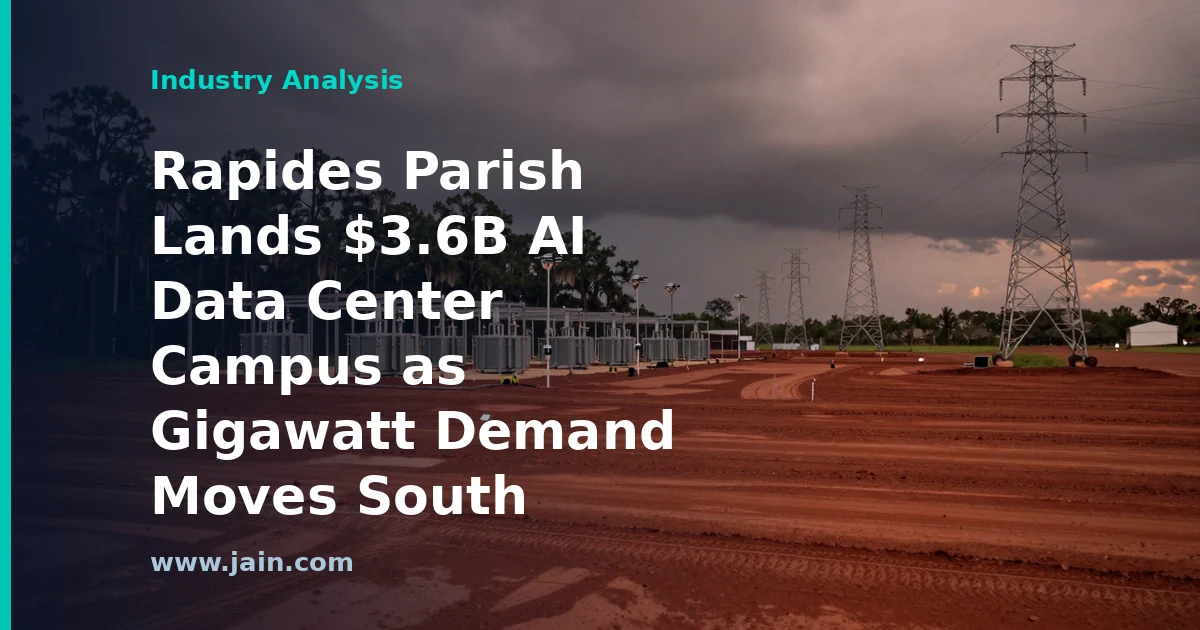
A $3.6 billion artificial-intelligence data center campus is planned for Rapides Parish in central Louisiana, according to a May 25, 2026 report by the Louisiana Illuminator. The project would rank among the largest private capital investments in the parish’s history and, per the reporting, involves a power arrangement with Cleco, the regulated utility serving the region.
Executive Summary
The reported plan places a multibillion-dollar AI campus in Rapides Parish, whose seat is Alexandria — a part of Louisiana that has not historically competed for hyperscale data center projects. At $3.6 billion, the investment is on the scale that typically implies hundreds of megawatts of computing load, purpose-built substations, and years of construction, though the report available to us does not specify capacity, acreage, or a construction timeline.
Why it matters: the announcement is another data point in a clear pattern. AI training and inference facilities are landing in the South — Louisiana, Mississippi, Texas, Georgia — where land is available, power can be contracted at scale, and state incentives are aggressive. For a mid-sized regulated utility like Cleco, a single customer of this size can reshape its entire resource plan. That dynamic, more than the campus itself, is the story worth watching.
Louisiana’s Second Act in the AI Land Rush
Louisiana entered the hyperscale conversation in late 2024, when Meta announced a roughly $10 billion AI data center campus in Richland Parish in the state’s northeast — at the time the largest such announcement in Meta’s fleet. That project demonstrated that Louisiana could deliver what hyperscalers need: large contiguous sites, a cooperative regulatory environment, and a utility (there, Entergy Louisiana) willing to build generation for a single anchor customer. A $3.6 billion campus in Rapides Parish suggests that playbook is now being run in Cleco territory as well.
For central Louisiana, the economic-development logic is straightforward. Data centers bring outsized capital investment and property-tax base relative to their headcount — construction employs thousands for several years, but steady-state operations typically employ dozens to a few hundred. Communities weighing these projects should therefore evaluate them primarily as tax-base and infrastructure plays rather than as mass employers, a distinction that matters when incentives are negotiated.
Why the Utility Is the Real Story
Cleco serves roughly the central third of Louisiana and is small compared with national investor-owned utilities. A data center campus at this investment level would likely represent a load addition measured in hundreds of megawatts — material against a system of Cleco’s size. In regulated markets, serving that load means new generation, transmission upgrades, or long-term power purchases, all of which flow through integrated resource plans and rate proceedings before the Louisiana Public Service Commission.
The central question in every such deal is cost allocation: does the data center customer pay the full incremental cost of the capacity built to serve it, or do some costs socialize across residential and small-business ratepayers? Utilities and regulators across the South are actively developing large-load tariffs — special rate classes with long contract terms, minimum-take provisions, and exit fees — precisely to answer that question. The report available to us does not disclose the structure of the Cleco arrangement, so the fairest reading is that this is the item most deserving of public scrutiny as the project moves through regulatory review.
The Economics of Gigawatt-Scale Siting
The South’s dominance in recent AI-infrastructure siting comes down to arithmetic. Training-class AI facilities are constrained less by fiber or labor than by time-to-power: how quickly a utility can deliver hundreds of megawatts of firm capacity. States with vertically integrated utilities can compress that timeline by building dedicated generation, something fragmented or capacity-constrained markets struggle to match. Add comparatively cheap land, natural-gas proximity, and sales-tax exemptions on data center equipment, and the region’s pipeline of announcements becomes easy to explain.
The risk side deserves equal weight. Multibillion-dollar campus announcements are commitments of intent, not completed buildings; across the industry, some announced projects have been resized, phased, or delayed as AI demand forecasts and chip supply evolve. A parish and utility that invest in infrastructure ahead of a project that later shrinks can be left carrying costs. Well-structured agreements put that risk on the developer through take-or-pay terms — which is why the unpublished details matter more than the headline number.
Background
Louisiana emerged as an AI-infrastructure destination in late 2024, when Meta selected Richland Parish for a roughly $10 billion data center campus backed by dedicated generation from Entergy Louisiana — at announcement, one of the largest data center commitments in the United States. The state offers hyperscalers large rural sites, abundant natural gas, sales-tax relief on data center equipment, and vertically integrated utilities that can build power for anchor customers.
Cleco, headquartered in Pineville in Rapides Parish itself, is central Louisiana’s regulated utility. For a utility of its size, a single hyperscale customer represents a step-change in load — the kind of demand shock that utilities across the South are now addressing through integrated resource plans and new large-load rate structures overseen by state regulators.