Tag: hyperscale

  • Skanska Signs $1.2B Deal to Build Four Data Centers in the Southeast US

    Skanska Signs $1.2B Deal to Build Four Data Centers in the Southeast US

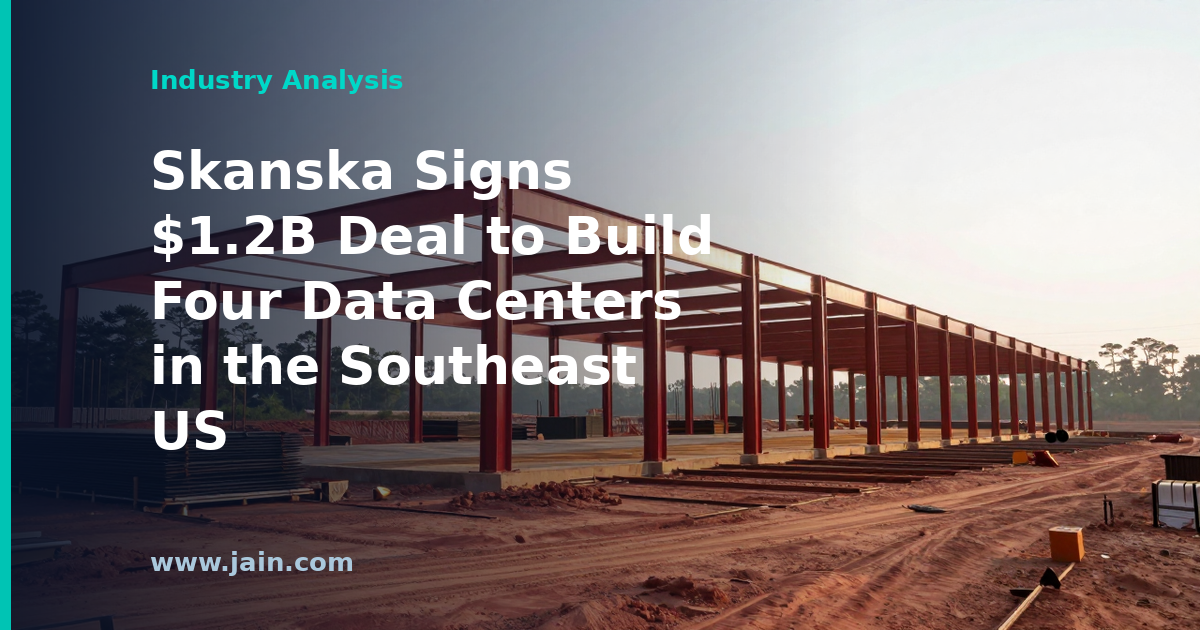
    Swedish construction group Skanska announced on August 20, 2026 that it has signed a contract with an existing client to build four new data centers in the southeast United States. The contract is worth USD 1.2 billion (about SEK 11.2 billion) and will be booked in Skanska’s US order bookings for the third quarter of 2026.

    The four facilities total approximately 75,000 square meters (808,000 square feet). Skanska’s scope covers the building shell plus interior fit-out for technical spaces, support areas, and offices. Construction begins in the third quarter of 2026 and is expected to finish in the third quarter of 2028.

    Executive Summary

    Skanska’s announcement is short on specifics — the client, the exact locations, and the facilities’ power capacity are all undisclosed — but the headline numbers tell a clear story: a single customer is committing to four buildings at once, worth $1.2 billion in construction value alone, on a two-year delivery clock. That is a program, not a project, and it reflects how hyperscale and large-enterprise data center buyers now procure capacity in multi-site batches rather than one building at a time.

    The deal also reinforces the southeast US as a serious data center growth corridor. As land, power interconnection queues, and community pushback tighten conditions in established hubs like Northern Virginia, developers have increasingly looked south for available land, comparatively faster utility timelines, and business-friendly permitting. A four-facility award in the region — from a repeat client, no less — suggests that migration of demand is continuing.

    For the construction industry, the contract underscores that data centers have become a core revenue engine for major contractors. Skanska separately announced an additional $238 million data center contract in Virginia, indicating a pipeline of repeat data center work across multiple US regions.

    A Program Buy, Not a Building Buy

    The most telling detail in this release is not the dollar figure but the structure: one client, four facilities, one contract. Data center customers with large, predictable capacity needs — typically cloud platforms, AI companies, or the developers who serve them — increasingly bundle construction into multi-site programs. Bundling locks in contractor capacity, standardizes designs across sites, and compresses delivery schedules, all of which matter when the constraint on growth is how fast physical capacity can be stood up rather than how much capital is available.

    The ‘existing client’ framing matters too. Repeat awards are how construction firms build durable data center franchises: a contractor that has already delivered for a customer carries proven designs, familiar subcontractor networks, and established safety and quality track records into the next award. For Skanska, converting one relationship into a four-building, $1.2 billion follow-on is evidence that this flywheel is working — though it also concentrates revenue exposure in a single customer relationship, a tradeoff worth noting.

    Why the Southeast, and What It Strains

    The southeast US has become one of the fastest-growing data center regions because the traditional hubs are congested. Northern Virginia — the world’s largest data center market — faces multi-year waits for grid interconnection (the process of getting a utility to deliver large blocks of power to a new site), rising land costs, and local zoning battles. States across the southeast have courted the industry with available land, tax incentives, and utilities willing to plan for large new loads.

    But four facilities landing at once in one region illustrates the strain this growth creates. Data centers are extraordinarily power-dense buildings, and every new campus adds load that regional utilities must generate, transmit, and balance. Meanwhile, the specialized trades that data center construction depends on — electricians, mechanical fitters, controls technicians — are in short supply nationally, and the southeast’s simultaneous boom in chip plants, battery factories, and other industrial projects competes for the same workers. The release does not say how these projects will be powered or staffed, and those are precisely the variables that determine whether a Q3 2028 completion date holds.

    The Economics of Shell and Fit-Out

    Skanska’s scope — shell construction plus interior fit-out of technical, support, and office spaces — works out to roughly $300 million per building, or on the order of $1,500 per square foot across the 808,000-square-foot program based on the disclosed figures. That is far above typical commercial construction costs, which reflects what a data center actually is: the building is effectively a machine, dense with structural, electrical, and mechanical infrastructure long before any servers arrive. It is worth remembering that construction cost is only one layer of total project cost; the IT equipment the eventual owner installs typically represents a further large investment not captured in a construction contract.

    For Skanska, the award lands in Q3 2026 order bookings, giving investors a concrete signal about the health of its US commercial pipeline. For the broader market, it is one more data point that data center construction spending remains robust — a useful counterweight to periodic debate about whether AI-driven infrastructure investment is decelerating. One contract cannot settle that debate, but a repeat client committing to four buildings through 2028 is not the behavior of a customer pulling back.

    Background

    Skanska, founded in Sweden and headquartered in Stockholm, is one of the world’s largest construction and development companies, with the United States among its most important markets. Data centers have become a growing line of business for major contractors as cloud and AI operators race to add physical capacity; alongside this award, Skanska announced a further $238 million data center contract in Virginia and a $957 million light rail contract in California, illustrating the breadth of its US order book.

    The US data center market has historically concentrated in hubs like Northern Virginia, but constraints on power, land, and permitting there have pushed a growing share of new development into the southeast, where utilities and state governments have actively courted the industry. Multi-building, single-client construction programs like this one have become a hallmark of how hyperscale capacity is now procured.

    Source: Skanska builds data centers in southeast USA worth USD 1.2 billion, about SEK 11.2 billion — Skanska press release via PR Newswire, August 20, 2026, announcing a four-facility data center construction contract with an existing client.

  • 3M and Microsoft Partner on AI Data Center Materials

    3M and Microsoft Partner on AI Data Center Materials

    On July 14, 2026, 3M and Microsoft announced a strategic partnership focused on advancing AI data center infrastructure and enterprise transformation. The announcement was carried on Microsoft’s own newsroom (Microsoft Source).

    The headline positions the collaboration around AI-era infrastructure — a domain where 3M has historically supplied materials, adhesives, films and thermal management products, and where Microsoft is one of the world’s largest hyperscale operators.

    Executive Summary

    The release frames a tie-up between an industrial materials incumbent and a hyperscale cloud operator at a moment when AI compute is straining the physical envelope of data centers. Power density per rack, heat rejection, and materials that can survive higher junction and coolant temperatures have all become gating factors for GPU deployments.

    What is substantiated in the headline is intent: a strategic partnership, AI data center infrastructure as the target, and enterprise transformation as a secondary theme. What is not yet substantiated — at least in the excerpt available to us — is scope: which 3M product lines, which Microsoft facilities, on what timeline, and under what commercial structure.

    For readers evaluating the announcement, the useful posture is neither dismissal nor hype. Materials science is a genuine bottleneck for AI infrastructure, and 3M has relevant portfolios. Whether this specific partnership delivers meaningful capacity or is primarily a marketing framing will depend on details the release, as published, does not spell out.

    Why Materials Suddenly Matter to Hyperscalers

    For most of the cloud era, hyperscale data centers were an integration problem: racks of commodity servers, air cooling, and steady incremental efficiency gains. AI training and inference clusters have changed the physics. Modern GPU accelerators dissipate hundreds to over a thousand watts each, and racks are moving from the 10–20 kW range typical of general-purpose cloud toward 50–100 kW and beyond. At those densities, the materials in contact with silicon — thermal interface materials, dielectric fluids for immersion cooling, cold-plate seals, and vapor-barrier films — become first-order engineering constraints rather than commodity inputs.

    3M’s historical relevance here is real: the company has long supplied fluorinated dielectric fluids used in two-phase immersion cooling, thermal interface products, and specialty films and tapes used inside servers and networking gear. Microsoft, for its part, has publicly experimented with immersion cooling in prior years. A partnership badged as targeting AI data center infrastructure sits squarely in this well-established technical overlap, even if the announcement itself does not enumerate specific product families.

    What a Strategic Partnership Actually Buys

    "Strategic partnership" is one of the more elastic phrases in corporate communications. In practice, such arrangements range from joint marketing and preferred-supplier status at the light end, to co-development agreements, capacity reservations, and equity or offtake commitments at the heavy end. The release headline as available does not disclose where on that spectrum this deal sits.

    For 3M, a formal alignment with a top-three hyperscaler is commercially valuable regardless of the exact contract structure: it validates its materials portfolio for AI workloads at a moment when the company has been repositioning after divesting parts of its business and navigating environmental litigation around per- and polyfluoroalkyl substances (PFAS). For Microsoft, tying a materials supplier more closely into its infrastructure roadmap is consistent with a broader hyperscaler trend of pushing further down the stack — into custom silicon, custom racks, and now, plausibly, custom materials specifications.

    Enterprise Transformation: The Ambiguous Second Leg

    The headline also references enterprise transformation, a phrase that in Microsoft’s usage typically implies Azure adoption, Microsoft 365, and Copilot-branded AI products. Read literally, it suggests 3M is also a customer — modernizing its own IT and manufacturing operations on Microsoft’s stack — not only a supplier.

    Two-way arrangements of this kind are common in hyperscaler deal-making: the supplier commits materials or capacity, and in return standardizes on the buyer’s cloud and AI platforms. Whether that reciprocity is present here, and on what scale, is not stated in the available excerpt. Buyers and investors should treat the enterprise-transformation framing as a signal to look for future disclosures around Azure commitments or Copilot deployments at 3M.

    Risks and Open Questions on Both Sides

    Any materials-heavy AI infrastructure story now runs into the PFAS question. Several of the dielectric and thermal fluids historically associated with immersion cooling belong to fluorochemical families that are under increasing regulatory scrutiny in the United States and European Union. 3M has publicly stated it intends to exit PFAS manufacturing by the end of 2025. A partnership announced in mid-2026 targeting AI infrastructure therefore raises a legitimate, non-inflammatory question: what chemistries are in scope, and how does the roadmap reconcile with that exit commitment? The release excerpt does not answer this.

    On Microsoft’s side, the risk is narrative. Hyperscalers have announced many AI-era infrastructure partnerships in the past two years — with utilities, nuclear developers, chipmakers, and cooling specialists. Each individually is plausible; collectively, they can create an impression of capacity certainty that specific contracts may not yet support. The measured read is that this announcement adds one more supplier relationship to that mosaic, and its weight will be visible only when product-level or facility-level detail follows.

    Background

    3M is a diversified U.S. industrial company whose materials science portfolio has long included products used inside data centers — thermal interface materials, films, adhesives, filtration and, historically, dielectric fluids associated with immersion cooling. The company has been repositioning in recent years, including a stated intent to exit PFAS manufacturing by the end of 2025 amid regulatory and litigation pressure.

    Microsoft is among the top three hyperscale cloud operators globally and has publicly committed to a large multi-year build-out to support AI training and inference workloads. That build-out has surfaced physical constraints — power, cooling, and materials — that were secondary concerns in the pre-AI cloud era, prompting a wave of supplier and infrastructure partnerships across the industry.

    Source: 3M and Microsoft announce strategic partnership to advance AI data center infrastructure and enterprise transformation — Microsoft Source, July 14, 2026.

  • New York Enacts First Statewide Hyperscale Data Center Moratorium

    New York Enacts First Statewide Hyperscale Data Center Moratorium

    On July 14, 2026, New York Governor Kathy Hochul announced what her office describes as the first statewide moratorium on new hyperscale data centers, pausing approvals for the largest class of AI and cloud campuses across the state.

    The announcement, made through the Governor’s official channels, frames the action as a siting policy intervention rather than a permanent ban, though the source material does not detail duration, thresholds, or exemptions.

    Executive Summary

    New York has become the first U.S. state to impose a statewide freeze specifically targeting hyperscale data centers — the campus-scale facilities, typically hundreds of megawatts and up, that host the workloads of the largest cloud and AI companies. Coming from the governor of a top-five state economy with meaningful grid, tax, and permitting leverage, the move sets a precedent other states will study closely.

    Why it matters: hyperscale siting has become the single most contested piece of digital infrastructure policy in the United States, colliding with electricity availability, water use, ratepayer equity, noise, and local land use. A statewide pause reframes what has been a patchwork of town-hall fights into a top-down policy question — and shifts near-term development attention toward states with clearer rules of the road.

    What we do not yet know from the release is nearly as important as what we do: the megawatt threshold that triggers the moratorium, its duration, whether projects already in queue are grandfathered, and what standards a lifted moratorium would impose. Until those details land, both celebration and alarm are premature.

    Why New York, and Why Now

    Hyperscale data centers — single campuses that can draw as much electricity as a mid-sized city — have moved from a niche real-estate category to a first-order infrastructure story in roughly three years, driven by generative AI training and inference demand. States that welcomed them early, notably Virginia, Texas, and Georgia, are now confronting transmission constraints, rising residential power bills, and organized community opposition. New York, which combines a constrained downstate grid with abundant upstate land and hydro, is a natural next frontier — and a natural place for a policy pause. A statewide moratorium, if that is what this ultimately is, is a signal that the state wants to define the terms of entry before, not after, a build-out.

    Precedent-Setting, but the Details Will Decide Everything

    The label “first statewide moratorium” is doing a lot of work in this announcement, and the substantive impact depends on parameters the release does not specify. A moratorium that applies only to facilities above, say, 500 MW and lasts six months while a siting framework is drafted is very different from an open-ended pause on anything over 50 MW. Similarly, whether the freeze covers utility interconnection queues, state environmental review, or only certain incentive programs will determine whether developers see this as a speed bump or a redirect. Reasonable observers on all sides should press for those specifics before drawing conclusions.

    Winners, Losers, and Second-Order Effects

    In the short run, incumbent New York operators with facilities already energized gain scarcity value; hyperscale tenants with existing leases become harder to displace. Developers holding land but not yet permits face the most uncertainty. Neighboring states with power headroom — parts of Pennsylvania, Ohio, and the Midwest — may see accelerated inbound interest, though transmission and gas-turbine lead times cap how quickly they can absorb it. Utilities, ratepayer advocates, and organized labor each have legitimate but different stakes in how a successor framework is written, and it would be a mistake to treat any one of those constituencies as speaking for “the community.”

    The Harder Question: What Comes After the Pause

    Moratoriums are easier to announce than to lift. The productive version of this policy ends with a clear standard: megawatt-tiered review, transparent grid-impact studies, water and noise limits, community-benefit expectations, and predictable timelines. The unproductive version leaves developers guessing and simply exports the load — and its emissions — across a state line. Both outcomes are on the table, and the release does not yet tell us which the administration is aiming for.

    Background

    New York has long been a major digital-infrastructure market, anchored by dense fiber and financial-services demand in the New York City metro and by cheaper power and land upstate. As artificial intelligence has driven a step-change in data center power requirements, states across the country have wrestled with how to review projects that can each request hundreds of megawatts of grid capacity — loads that historically took years or decades of organic growth to accumulate.

    Governor Kathy Hochul, in office since 2021, has repeatedly emphasized both climate targets under New York’s Climate Leadership and Community Protection Act and the state’s ambitions in advanced industries. A statewide moratorium on hyperscale siting sits squarely at the intersection of those two agendas, and it lands in a national environment where data center policy has moved from a specialist concern to a mainstream one.

    Source: First Statewide Moratorium on New Hyperscale Data Centers Launched by Governor Kathy Hochul — Official announcement from the Office of New York Governor Kathy Hochul, July 14, 2026.

  • Crusoe and Lancium Plan 1.0 GW AI Data Center in Childress, Texas

    Crusoe and Lancium Plan 1.0 GW AI Data Center in Childress, Texas

    Crusoe and Lancium announced plans for a 1.0 gigawatt (GW) artificial-intelligence data center campus in Childress, Texas, a small city in the state’s panhandle region served by the ERCOT power grid.

    The joint announcement, dated July 14, 2026, positions the site as a hyperscale-class AI compute campus, though the release itself provides only a headline-level description of the project.

    Executive Summary

    The Crusoe-Lancium announcement adds another gigawatt-scale AI campus to a Texas pipeline that has become the epicenter of North American data center growth. A 1.0 GW site is roughly the electrical footprint of a mid-sized city, and building one for AI training and inference workloads reflects the scale at which frontier model operators and their infrastructure partners are now planning.

    The pairing is notable on its own terms. Crusoe operates AI cloud infrastructure and has historically emphasized co-locating compute with abundant or otherwise stranded energy. Lancium specializes in “controllable load” data center designs intended to flex consumption in response to grid conditions. Together, the two companies are marketing a Childress campus that, at least conceptually, blends AI-optimized halls with a grid-friendly load profile.

    What the announcement does not resolve is arguably more important than what it discloses: capital structure, anchor tenants, interconnection queue position, water use, and construction phasing are all absent from the public headline.

    Why Childress, and Why Now

    Childress sits in the Texas panhandle, a region rich in wind generation and, increasingly, solar — but historically light on data center load. Developers have been pushing west and north out of the traditional Dallas-Fort Worth and Austin corridors in search of two things: available transmission capacity and land at prices that pencil for gigawatt campuses. A 1.0 GW footprint is difficult to interconnect anywhere on ERCOT quickly, but the panhandle’s generation surplus and long-distance transmission lines make it a plausible venue for large loads that can tolerate some siting distance from major metros.

    The timing tracks with a broader industry pattern. Hyperscale AI announcements in 2025 and 2026 have shifted from megawatt-scale expansions to gigawatt-scale campuses, reflecting both the power density of modern AI accelerators and the strategic value of securing capacity years ahead of demand.

    Controllable Load Meets AI Compute

    Lancium’s core pitch has been that data centers can be designed as “controllable load resources” — facilities that ramp consumption up or down to help balance a renewables-heavy grid, in exchange for lower effective power costs and faster interconnection. Historically, that model has been an easier fit for cryptocurrency mining than for latency-sensitive cloud workloads. Applying it to AI compute is more nuanced: training runs are batch-like and can, in principle, tolerate curtailment windows, while inference is closer to real-time and typically cannot.

    Neither company has publicly detailed how the Childress campus will split those workload types, or how curtailment obligations would flow through to tenants. That is a material question. If the campus behaves like a conventional 24/7 hyperscale load, the interconnection story is one thing; if it genuinely flexes, it is a different — and potentially more grid-constructive — proposition.

    Winners, Losers, and What Is Actually Substantiated

    The announcement, as issued, substantiates two things: that Crusoe and Lancium have publicly committed to the project’s existence and its nameplate scale, and that Childress has been chosen as the location. It does not substantiate a construction start date, a power-on date, an anchor customer, a capital partner, or a specific mix of on-site versus grid-supplied generation. Readers should treat 1.0 GW as a stated design intent, not a delivered capacity.

    If the project proceeds as announced, the near-term beneficiaries are the local tax base, regional construction trades, and equipment vendors ranging from switchgear manufacturers to liquid-cooling suppliers. Longer term, incumbent Texas colocation operators face increased competition for transmission upgrades and skilled labor. Ratepayers and grid operators face a familiar set of questions about who pays for interconnection upgrades and how quickly load can be absorbed without stressing reliability margins.

    Background

    Crusoe began as an operator known for using otherwise-flared natural gas to power computing, and has since repositioned around AI cloud infrastructure and large-scale training campuses. Lancium, founded in Texas, has focused on designing data centers as flexible grid participants — an approach shaped by the state’s high share of variable renewable generation and its independent grid operator, ERCOT.

    The broader context is a multi-year surge in AI compute demand that has pushed data center announcements from tens of megawatts to hundreds and now over a thousand. Texas, and the panhandle in particular, has emerged as a preferred venue because of transmission-connected wind and solar surpluses, available land, and comparatively fast large-load interconnection processes.

    Source: Crusoe and Lancium Announce 1.0 Gigawatt AI Data Center Campus in Childress, Texas — joint corporate announcement of a planned hyperscale AI campus in the Texas panhandle.

  • New York Pauses New Hyperscale Data Centers Over 50 MW

    New York Pauses New Hyperscale Data Centers Over 50 MW

    New York has become the first U.S. state to pause new hyperscale data center approvals above a 50-megawatt (MW) threshold, according to a July 13, 2026 report from Inside Climate News. The action targets the largest facilities — the class typically used for cloud and AI training workloads — rather than smaller enterprise or edge sites.

    The reporting frames the move as a state-level response to rapid growth in data center power demand. The underlying article is the sole dated source available to us; specifics on scope, duration, exemptions, and enforcement are not restated here beyond what the headline confirms.

    Executive Summary

    A hyperscale data center is a very large facility — commonly tens to hundreds of megawatts of IT load — operated by or for cloud and AI providers. A 50 MW site can draw roughly the power of a small city. New York’s decision to pause approvals above that line puts a hard ceiling on the class of build that has driven most of the industry’s recent capacity growth.

    The significance is less about one state’s queue and more about precedent. Utilities across the country are absorbing multi-gigawatt interconnection requests, and several governors and public service commissions are actively rewriting siting, tariff, and interconnection rules. If New York’s approach holds up politically and legally, other states facing similar grid stress may borrow the template.

    For operators, hyperscalers, and their real estate partners, the immediate question is routing: whether projects earmarked for New York shift to neighboring PJM and New England markets, to the Midwest, or to the Southeast — each of which has its own transmission and permitting constraints.

    Why 50 Megawatts, and Why Now

    Fifty megawatts is a meaningful line. It is well above a typical enterprise data hall and squarely in the range where a single customer campus starts to look like a large industrial load to a utility. Regulators drawing the line there are, in effect, saying that facilities of this size deserve a different review than a warehouse or office park — even if the underlying zoning treats them alike. The threshold also captures the vast majority of AI training and cloud region builds announced over the last two years, which is presumably the point.

    The timing tracks with a broader shift. Grid operators from ERCOT to PJM have published sharply revised load forecasts driven by data center interconnection queues, and several utilities have asked commissions to rewrite the rules for how large new loads are studied, priced, and prioritized against existing customers. A statewide pause is a blunter instrument than tariff reform, but it buys time to design the finer tools.

    Winners, Losers, and the Map of AI Capacity

    In the near term, the clearest beneficiaries are markets that can credibly offer power, land, water, and a permitting path in the next 18 to 36 months. That short list currently includes parts of Virginia (despite its own constraints), Ohio, Indiana, Georgia, Texas, and a handful of Midwestern and Mountain West locations with generation headroom. Operators who already control land and interconnection queue positions in those regions gain optionality; those who were counting on New York capacity face a re-plan.

    The losers are more nuanced. New York loses some tax base, construction spend, and long-term operations jobs, but keeps grid capacity for other uses — including electrification of heat and transport, which the state has committed to under its climate law. Hyperscalers lose a latency-advantaged East Coast site option, though metro New York’s colocation footprint for latency-sensitive workloads is largely unaffected because those buildings are typically well under 50 MW.

    The Precedent Risk for the Industry

    The industry’s stated position for years has been that data centers are good grid citizens: predictable loads, willing to pay for infrastructure, and increasingly matched with clean generation. New York’s pause is a signal that at least one state is not persuaded that the current pace can be absorbed without displacing other public priorities. Whether that view spreads depends on how the pause is structured — a narrow, time-boxed study period reads very differently from an open-ended moratorium — and on how the industry responds.

    There is a real opportunity here for operators willing to negotiate: bring-your-own-generation deals, firm demand response commitments, waste-heat reuse, and transparent water reporting are all on the table in other jurisdictions and could shape what a post-pause approval regime in New York looks like. The alternative — treating the pause as a political problem to be waited out — invites more states to adopt similar caps before the industry has a seat at the design table.

    Background

    Data centers are the physical buildings that house the servers, storage, and networking equipment behind cloud services, streaming, enterprise software, and — most recently — generative AI. Hyperscale facilities are the largest tier, built by or for a small group of very large operators, and they have grown from tens to hundreds of megawatts per campus over the last decade. Their power draw has become large enough to reshape utility planning in several U.S. regions.

    New York has among the most ambitious state climate mandates in the country, with statutory targets for electrification and emissions reduction. The state also hosts the NYISO grid, dense metro loads, and a mix of nuclear, hydro, gas, and growing renewable generation. Reconciling large new industrial loads with those commitments is the policy backdrop for the reported pause.

    Source: New York Becomes First State in the Nation to Pause New Hyperscale Data Centers — Inside Climate News reporting on a statewide pause of new hyperscale data center approvals above 50 megawatts, published July 13, 2026.

  • Meta Plans Billions for First Canadian AI Data Center, Its Largest Outside the U.S.

    Meta Plans Billions for First Canadian AI Data Center, Its Largest Outside the U.S.

    Meta is planning a multibillion-dollar investment in its first AI data center in Canada, according to a July 2026 report from Broadband Breakfast. The project is described as the largest data center Meta has built outside the United States, extending the company’s aggressive AI infrastructure expansion beyond its home market for the first time at flagship scale.

    Executive Summary

    The reported plan marks two firsts at once: Meta’s first data center in Canada, and its first time siting a facility of this magnitude — described as its largest outside the U.S. — beyond American borders. Meta has spent the past several years pouring capital into AI-optimized data centers, the specialized facilities packed with GPU accelerators (the chips that train and run large AI models) that underpin its Llama model family and AI products across Facebook, Instagram, and WhatsApp.

    Why it matters: hyperscalers — the handful of companies that build computing infrastructure at global scale — have concentrated their largest AI campuses inside the United States, where most of their power deals and construction pipelines already sit. A flagship-scale commitment to Canada suggests the constraints that matter most in AI buildouts, chiefly access to large blocks of electric power and developable land, are now strong enough to pull top-tier projects across the border. For the North American data center market, that is a meaningful signal about where the next wave of capacity may land.

    Why Canada Is Suddenly on the Hyperscale Map

    AI data centers are, before anything else, power projects. Training and serving large models requires hundreds of megawatts of continuous electricity — the load of a small city — and in many established U.S. markets, utilities are quoting multi-year waits for new grid connections. Canada offers what constrained U.S. hubs increasingly cannot: available generation capacity in several provinces, large tracts of industrial land, and a cool climate that reduces the cost of removing heat from dense computing halls. Cooling can consume a substantial share of a data center’s energy, so free cooling from cold ambient air is a genuine economic advantage, not a marketing point.

    Canada has hosted data centers for years, but mostly modest facilities serving domestic cloud and content needs. What the reported Meta project would change is the tier: a build described as the company’s largest outside the U.S. would put Canada into direct competition with the established international heavyweights — Ireland, the Nordics, Singapore — for flagship hyperscale investment.

    The Economics of a Multibillion-Dollar Build

    “Billions” in a data center context typically spans land, construction, electrical and cooling plant, and — the largest and fastest-growing line item — the AI computing hardware inside. For host communities, these projects bring a familiar trade-off: a surge of construction employment and long-term tax revenue, but a comparatively small permanent workforce, since modern data centers run with lean operations teams. The bigger local question is usually electricity: who supplies the power, on what terms, and whether the load arrives with new generation attached or competes with existing ratepayers for what is already on the grid.

    For the supplier ecosystem — utilities, electrical contractors, cooling vendors, fiber carriers, and construction firms — a project of this scale is a multi-year revenue anchor. Canadian connectivity providers would also benefit: hyperscale campuses pull long-haul fiber investment toward them, improving network economics for the surrounding region.

    What a U.S.-Anchored AI Buildout Going North Signals

    Meta’s AI infrastructure spending has been overwhelmingly domestic, and U.S. policy debate has often framed AI data centers as a national strategic asset. Choosing Canada for a record international build suggests that practical constraints — power availability, permitting timelines, land, and cost — are beginning to outweigh the convenience of building at home. Other hyperscalers face the same constraints, so if this project proceeds, it is reasonable to expect competitors to look harder at Canadian sites as well.

    There is also a sovereignty dimension. Canadian governments and enterprises have grown more vocal about wanting AI capacity on Canadian soil, both for data-residency compliance (rules requiring certain data to stay in-country) and for assurance that domestic AI development does not depend entirely on foreign infrastructure. A Meta facility would not by itself resolve those concerns — it would be Meta’s capacity, serving Meta’s workloads — but it would expand the skilled workforce, supplier base, and grid infrastructure that any future Canadian AI capacity would draw on.

    A Headline-Stage Announcement, Read Carefully

    It is worth being direct about the sourcing: this is a single dated report, and the available material confirms the broad strokes — Meta, Canada, billions, largest outside the U.S. — without the operational details that determine whether and when such a project delivers. Announced data center investments are directional commitments, and their scope and schedule routinely shift with power negotiations, permitting, and demand. The reported plan is a credible signal of intent from a company with a long record of completing large builds, but the substantive test will be the milestones that follow: a confirmed site, a grid interconnection agreement, and construction start.

    Background

    Meta Platforms — parent of Facebook, Instagram, and WhatsApp — has built and operated its own hyperscale data centers since opening its first facility in Prineville, Oregon in 2011, and now runs a global fleet spanning the U.S., Europe, and Asia. Since the generative AI boom began, the company has redirected tens of billions of dollars in annual capital spending toward AI-optimized facilities to train its open-weight Llama models and serve AI features across its apps, placing it among the largest data center builders in the world.

    Canada, despite abundant power in several provinces and a favorable climate, has historically attracted mid-sized cloud and enterprise data centers rather than flagship hyperscale campuses, which concentrated in the U.S., Ireland, the Nordics, and Singapore. A record-scale Meta build would mark a change in Canada’s standing in that global site-selection hierarchy.

    Source: Meta Plans Billions for First AI Data Center in Canada, Largest Outside the U.S. — Broadband Breakfast report on Meta’s planned multibillion-dollar Canadian AI data center, July 12, 2026.

  • Wyoming Officials Link Meta Data Center to Water Contamination

    Wyoming Officials Link Meta Data Center to Water Contamination

    Wyoming officials have publicly attributed contamination in a local water system to Meta’s 715,000-square-foot data center, according to a Fortune report dated July 11, 2026. The precise nature of the contamination, its geographic scope, and the regulatory pathway that follows are not detailed in the headline itself.

    Executive Summary

    A state-level attribution linking a hyperscale data center to municipal water contamination is unusual and, if substantiated by underlying agency findings, notable for the industry. Meta’s Wyoming facility is a large campus by any measure — 715,000 square feet is roughly the footprint of a mid-sized regional shopping mall — and any operational connection to public water quality would sit at the intersection of two of the industry’s most contested issues: consumption and discharge.

    For infrastructure buyers, developers, and municipal partners, the significance is less about a single site and more about the precedent. Water permitting for large campuses has become a gating factor in siting decisions across the western United States, and a documented contamination event — as opposed to a consumption dispute — would reshape how utilities, insurers, and regulators evaluate future projects.

    What A Contamination Claim Actually Implies

    Data centers interact with municipal water in two very different ways. Most public criticism focuses on consumption: evaporative cooling towers withdraw treated drinking water and release it as vapor. Contamination is a separate mechanism entirely, typically involving discharge of treated cooling water, chemical additives used to control scale and biological growth, backup generator fluids, or construction-era runoff. The Fortune headline does not specify which pathway Wyoming officials are pointing to, and that distinction will determine both the regulatory response and the difficulty of remediation.

    The underlying question — one the source article, not the headline, would need to answer — is whether officials are describing a discrete incident, a chronic exceedance of a permitted limit, or a correlation that investigators have not yet mechanistically explained. Each of those is a different story, with different implications for Meta and for the surrounding community.

    Wyoming’s Position In The Hyperscale Map

    Wyoming has courted large data center investment for more than a decade, leveraging cold climate, low power costs, and a light regulatory footprint. That pitch has attracted multiple hyperscalers and, with them, a growing base of local jobs, tax revenue, and infrastructure spending. A state-level attribution of harm to one of those anchor tenants is, therefore, politically noteworthy: it suggests the finding survived internal review by an administration that has generally welcomed the industry.

    For competing jurisdictions — Virginia, Texas, the Ohio Valley, the Pacific Northwest — a Wyoming contamination case would enter the record cited by community groups opposing new campuses. It would not, on its own, halt the buildout, but it raises the evidentiary bar operators face during permitting and community engagement.

    Reading The Story Fairly

    Two things can be true simultaneously. State officials making a formal attribution deserve to be taken seriously; agencies rarely name a specific operator without documentation they believe will survive scrutiny. At the same time, an operator has the right to see the technical basis, contest methodology, and propose alternative explanations before conclusions harden. The headline as circulated does not indicate whether Meta has responded, whether an enforcement action has been filed, or whether the finding is preliminary.

    Readers — and buyers evaluating hyperscale partners — should watch for the underlying agency documents, any notice of violation, and Meta’s technical response. Coverage that stops at the headline, on either side, is not enough to draw conclusions about culpability or scale of harm.

    Background

    Meta, the parent company of Facebook, Instagram, and WhatsApp, operates a large data center portfolio to support its consumer platforms and, increasingly, its AI workloads. The company has invested in Wyoming for years, with Cheyenne serving as a long-standing hub for its western infrastructure footprint.

    The broader industry is in the middle of a hyperscale buildout driven by generative AI demand. Water — both how much is consumed for cooling and what is returned to the environment — has emerged alongside power and land as one of the three constraints most likely to shape where the next generation of campuses is built.

    Source: Wyoming officials: Meta’s 715,000-square-foot data center responsible for water system contamination – Fortune. State officials attributed local water system contamination to Meta’s Wyoming hyperscale facility.

  • Blue Owl Launches Data Center Infrastructure Venture as AI Capital Race Deepens

    Blue Owl Launches Data Center Infrastructure Venture as AI Capital Race Deepens

    Blue Owl Capital, the New York-listed alternative asset manager, has unveiled an infrastructure venture catering to data centers, according to a Bloomberg report published July 8, 2026. The available material confirms the launch itself but discloses few specifics — no fund size, capital target, anchor tenants, or geographic focus were included in the source we reviewed.

    Executive Summary

    According to Bloomberg, Blue Owl Capital has launched a dedicated infrastructure venture aimed at data centers. Blue Owl is already one of the most active private-capital players in digital infrastructure, so a purpose-built vehicle is less a change of direction than a formalization of where the firm has been deploying money at scale.

    The significance is structural. When a major asset manager stands up a named venture for a single asset class, it signals that data centers have graduated from an opportunistic real-estate niche into a core institutional allocation — with dedicated teams, dedicated fundraising, and a mandate to deploy through cycles. For operators, hyperscalers, and competing capital providers, that changes who they negotiate with and on what terms. That said, the source material is thin: until Blue Owl or its investors disclose the venture’s size, structure, and pipeline, the announcement should be read as a statement of intent whose scale remains unverified.

    Institutional Capital Is Now Purpose-Built for the AI Buildout

    For most of the data center industry’s history, projects were financed by specialist REITs (real estate investment trusts — companies that own income-producing property) and corporate balance sheets. The AI era broke that model: individual campuses now carry price tags that rival power plants and airports, sums beyond what even large operators can carry alone. The gap is being filled by alternative asset managers — firms that invest institutional money such as pension and sovereign-wealth capital outside public markets.

    A dedicated venture, as opposed to deal-by-deal participation, matters because it creates standing capacity. Committed capital with a single mandate can underwrite faster, warehouse land and power positions, and fund multi-year construction schedules without reassembling an investor group for each project. If Blue Owl’s new vehicle follows that pattern, it institutionalizes a pipeline rather than a transaction.

    Blue Owl’s Path From Lender to Data Center Heavyweight

    Blue Owl did not arrive at this from a standing start. The firm, formed in 2021 from the merger of direct lender Owl Rock and GP-stakes investor Dyal Capital, acquired IPI Partners’ digital-infrastructure business in 2024 and has since backed some of the largest data center financings on record, including a joint venture reported at roughly $27 billion to fund Meta’s hyperscale campus in Louisiana and a multibillion-dollar vehicle behind a flagship AI campus in Abilene, Texas.

    Read against that history, a dedicated infrastructure venture looks like the next logical step: converting a string of headline deals into a durable franchise. The open question — unanswered by the available reporting — is whether the new venture sits alongside, absorbs, or competes with the strategies Blue Owl already runs, and whether it targets equity ownership, credit, or the net-lease structures (long-term leases where the tenant bears operating costs) the firm is known for.

    The Economics: Why Data Centers Fit This Capital

    Data centers leased to investment-grade hyperscalers behave, financially, like bonds with a building attached: long contracts, creditworthy counterparties, and predictable cash flows. That profile is exactly what insurance and retirement capital wants, and it explains why asset managers can raise enormous sums for the sector even as construction costs and power constraints mount.

    The winners in this arrangement are developers who gain a deep-pocketed capital partner, and AI companies who can expand without consuming their own balance sheets. The tension is on pricing and risk: as more institutional money chases the same tenants, yields compress, and capital may reach further down the credit spectrum — toward newer AI firms whose long-term ability to pay decade-long leases is less proven.

    Risks the Boom Should Not Obscure

    Purpose-built capital cuts both ways. Concentration is the obvious hazard: much of the sector’s contracted revenue traces back to a handful of hyperscalers and AI labs, so a slowdown in AI spending would ripple through every vehicle exposed to it. Technology risk is real too — facilities designed for today’s chip densities and cooling requirements may need costly retrofits within a lease term. And power, not money, is increasingly the binding constraint; capital that cannot secure grid connections cannot deploy. None of these risks is unique to Blue Owl, but a venture of this kind will be judged on how it prices them, and the launch reporting gives no visibility into that yet.

    Background

    Blue Owl Capital was formed in 2021 through the merger of Owl Rock Capital, a direct-lending specialist, and Dyal Capital, which buys stakes in other asset managers; it went public via SPAC and now manages well over $200 billion. Its push into digital infrastructure accelerated with the 2024 acquisition of IPI Partners’ data center investment business and a series of landmark hyperscale financings in 2025, spanning net-lease deals and development joint ventures with major cloud and AI tenants.

    The backdrop is a historic capital cycle: AI training and inference demand has pushed data center construction to record levels, with individual campuses drawing power measured in gigawatts and financing needs that have pulled in private equity, private credit, sovereign funds, and insurance capital alongside the traditional operators.

    Source: Blue Owl Unveils Infrastructure Venture Catering to Data Centers — Bloomberg report, July 8, 2026, on Blue Owl Capital’s launch of a dedicated data center infrastructure venture.

  • Anthropic’s $19B TeraWulf Lease Reroutes Miner Into AI Landlord

    Anthropic’s $19B TeraWulf Lease Reroutes Miner Into AI Landlord

    Anthropic, the AI lab behind the Claude model family, has signed a data center lease valued at roughly $19 billion with TeraWulf (Nasdaq: WULF), a bitcoin miner that has been repositioning itself as an AI infrastructure host. The agreement was reported by SiliconANGLE on July 5, 2026.

    The transaction makes Anthropic a long-duration anchor tenant on TeraWulf’s power-rich footprint, and it ranks among the largest single AI hosting commitments disclosed to date.

    Executive Summary

    The headline number — about $19 billion — is what an AI lab would normally spend building its own campus, not renting one. By pushing that spend into a lease with a listed bitcoin miner, Anthropic is trading capex for speed: TeraWulf already controls interconnected sites and substation capacity, which is the scarce input in the current AI build-out.

    For TeraWulf, the contract is a category change. A company whose revenue has been tied to bitcoin’s price now has a multi-year, investment-grade-style cash flow tied to a frontier AI customer. That is why WULF sits on many investor watchlists as a proxy for the miner-to-AI-landlord thesis.

    The deal also sharpens a broader trend: hyperscalers and AI-native labs are no longer waiting on traditional colocation supply. They are contracting directly with whoever holds the two things that matter most right now — energized land and a grid connection.

    Why an AI Lab Rents from a Bitcoin Miner

    Bitcoin miners spent the last cycle acquiring the exact ingredients AI now needs: cheap power contracts, substation rights, and shells that can dissipate very high rack densities. Retooling those shells for GPUs is non-trivial — liquid cooling, tenant-grade redundancy, and network fiber all have to be added — but it is far faster than greenfield permitting. For Anthropic, leasing from TeraWulf compresses time-to-first-megawatt in a market where a new build can take three to five years.

    The economics also matter. A lease shifts risk: Anthropic pays for capacity as it is delivered rather than tying up cash in construction, while TeraWulf finances the fit-out against a signed contract. That is the same playbook enterprise tenants use with traditional colocation providers; what is new is the scale and the counterparty.

    What $19 Billion Actually Buys

    The release frames the commitment as a lease value rather than an upfront payment, which typically means it spans many years of rent, power pass-through, and services. Without disclosed megawatts, PUE assumptions, or a term length, the figure is best read as a ceiling on Anthropic’s obligation and a floor on TeraWulf’s backlog — not a check written on day one.

    Even so, a nine- or ten-figure annualized run-rate at a single landlord is unusual. It implies gigawatt-class ambitions over the life of the contract, which in turn implies transmission upgrades and generation additions that neither party controls alone.

    Winners, Losers, and the Miner-to-AI Trade

    The clearest winner is any miner sitting on energized capacity in a utility territory friendly to large loads. TeraWulf’s deal will be used as a comparable by peers negotiating their own AI conversions, and it validates the equity story that has driven the miner-to-AI rerating. The clearest pressure point is on traditional wholesale data center developers, who now face a well-funded competitor class that already owns the power.

    For Anthropic, the strategic read is independence. Locking in dedicated capacity outside the big three clouds gives the company optionality on where its next generation of models trains and serves, and reduces the risk that compute becomes a chokepoint controlled by a strategic investor or competitor.

    The Grid Question Behind the Deal

    Every large AI lease today is really a bet on the interconnection queue. Utilities in the regions where miners cluster — parts of Appalachia, Texas, and the upper Midwest — are already signaling multi-year waits for new large-load connections. A lease of this scale will draw scrutiny from regulators, ratepayer advocates, and neighboring loads who compete for the same megawatts.

    None of that is a criticism of either party; it is the operating reality of the market. But it means execution risk on a deal of this size sits less with the tenant or the landlord than with transmission planners and permitting timelines that neither company can accelerate on its own.

    Background

    Anthropic, founded in 2021, has grown into one of a small group of frontier AI labs whose compute needs now rival those of the largest cloud tenants. Like its peers, it has relied on hyperscaler partners for training capacity while seeking to diversify its infrastructure footprint.

    TeraWulf emerged from the last bitcoin cycle with a portfolio of power-anchored sites in the eastern United States. As mining economics compressed and AI compute demand surged, the company — along with several listed peers — began marketing its energized capacity to high-performance computing and AI tenants, a pivot investors have tracked closely under the miner-to-AI-landlord thesis.

    Source: Anthropic inks $19B AI data center lease with TeraWulf – SiliconANGLE — report on Anthropic’s multi-billion-dollar hosting agreement with the Nasdaq-listed bitcoin miner.

  • Microsoft Claims Water-Positive Data Center Operations: What the Claim Really Covers

    Microsoft Claims Water-Positive Data Center Operations: What the Claim Really Covers

    Microsoft is claiming water positivity across its data center operations, according to a June 27, 2026 report from Data Center Dynamics. Water positivity means an operator replenishes more water to stressed watersheds than its facilities consume — a milestone Microsoft first committed to reaching by 2030 when it announced its water-positive pledge in 2020.

    The claim spans one of the world’s largest cloud footprints, and it arrives at a moment when AI-driven capacity growth has put data center water consumption under intense public and regulatory scrutiny. The available report is headline-level, so the scope, accounting method, and verification behind the claim remain to be detailed.

    Executive Summary

    Microsoft has publicly positioned its data center operations as water positive — consuming less water, net of replenishment projects, than it returns to the watersheds where it operates. If the claim holds up under scrutiny, it would represent the first time a hyperscale cloud operator has asserted that its fleet, as a whole, has crossed that line, and it would land years ahead of the company’s stated 2030 target.

    Why it matters: water has become the second front, after power, in the fight over data center siting. Communities from Arizona to the Netherlands have pushed back on facilities that draw millions of gallons for evaporative cooling, and regulators increasingly ask for water commitments alongside grid commitments. A credible water-positive benchmark from the market’s second-largest cloud provider would reset expectations for every operator negotiating a site — including colocation and wholesale providers who compete for the same land, power, and permits.

    The operative word is credible. Water positivity is an accounting construct, not a physical description of any single site, and its value depends entirely on scope, measurement, and where the replenishment actually happens. The source reporting available at publication does not yet answer those questions, and they are the right ones to ask of any operator making a similar claim.

    What “Water Positive” Actually Means — and What It Doesn’t

    Water positivity is a ledger claim: over a defined period, the volume of water an operator restores — through wetland restoration, leak-repair programs, irrigation efficiency projects, aquifer recharge, and similar investments — exceeds the volume its operations consume. Consumption here typically means water evaporated or otherwise not returned to the source, which for data centers is dominated by evaporative cooling, the technique of cooling air or water by letting some of it evaporate, trading water for large electricity savings.

    What the construct does not mean is that any individual data center stopped drawing water. A facility in a drought-stressed basin can keep consuming while the corporate ledger balances with a restoration project elsewhere. That is not inherently bad-faith accounting — carbon markets work on a similar logic — but water is far more local than carbon. A gallon replenished in one river basin does nothing for the aquifer under a different one. The strongest version of a water-positive claim is basin-matched: replenishment in the same watersheds where consumption happens, weighted toward the most stressed ones. Whether Microsoft’s claim is basin-matched is exactly the kind of detail the headline-level reporting leaves open, and it is the difference between a milestone and a marketing line.

    The Cooling Economics Behind the Claim

    Data centers face a three-way trade among water, energy, and capital. Evaporative cooling is cheap and energy-efficient but water-hungry. Closed-loop and air-cooled designs eliminate most on-site water consumption but raise electricity use or capital cost, and in hot climates they can strain the power budget that operators are already fighting to secure. Microsoft has spent several years publicizing designs that move toward zero-water cooling for new builds, alongside efficiency metrics like WUE — water usage effectiveness, the liters of water consumed per kilowatt-hour of IT load.

    A fleet-level water-positive result, if achieved early, most plausibly reflects three levers working together: newer builds consuming less per megawatt, replenishment portfolios scaling faster than consumption, and — the uncomfortable variable — how fast AI capacity growth adds consumption to the denominator. The AI buildout cuts both ways here. High-density AI halls increasingly use direct liquid cooling, which circulates coolant in a closed loop and can actually reduce on-site water consumption per unit of compute, but the sheer volume of new capacity can swamp per-unit gains. Any operator’s water math in 2026 is a race between those two curves.

    A Benchmark With Teeth — If the Methodology Is Public

    The industry consequence of this claim depends less on Microsoft than on procurement. Enterprise cloud buyers and public-sector tenders already ask for carbon disclosures; a hyperscaler asserting water positivity gives sustainability teams a new line item to demand from every provider. Google and Amazon have announced their own 2030-era water goals, so competitive pressure to demonstrate progress — not just pledge it — will rise. Colocation operators, who often lack the balance sheet for large replenishment portfolios, may feel the squeeze most: their water story is largely their cooling design, not an offsetting ledger.

    For communities and regulators, the useful move is to treat the claim as an invitation to standardize. Today there is no universally accepted audit standard for water positivity comparable to the frameworks maturing around carbon. Claims are only comparable across operators if consumption scope (owned versus leased capacity, construction water, upstream power-generation water), replenishment crediting rules, and basin matching are disclosed. An early, well-documented claim from a market leader could seed that standard. A thinly documented one would invite the same greenwashing skepticism that has dogged renewable energy certificates — and would make life harder for operators doing the work rigorously.

    Background

    Microsoft is one of the world’s largest data center operators, running cloud infrastructure across dozens of countries to serve its Azure, Microsoft 365, and AI businesses. In 2020 the company pledged to become water positive by 2030 as part of a broader sustainability program that also targets carbon-negative operations, and it has since promoted lower-water cooling designs for new facilities alongside a portfolio of watershed replenishment projects.

    The claim lands in an industry racing to build AI capacity while facing growing scrutiny over resource consumption. Water has joined electricity as a gating factor for new data center permits, and no common audit standard yet exists for corporate water-positivity claims — which makes the methodology behind any such announcement as consequential as the announcement itself.

    Source: Microsoft claims water positivity across data center operations — Data Center Dynamics report, June 27, 2026, on Microsoft’s claim of water-positive data center operations.