Digital Realty, a company that builds data centers and rents them out, wants to raise $3 billion from outside investors to pay for very large ones in the Americas.
Data centers are warehouse-sized buildings full of computers that run online services and artificial intelligence. The biggest ones cost so much that even large owners share the bill with investors.
Why it matters: how much money investors actually put in will help decide how many of these buildings get built, and how fast.
IPE Real Assets reported that Digital Realty Trust (DLR) is targeting $3 billion for a fund dedicated to hyperscale data centers in the Americas. Hyperscale facilities are the very large buildings and campuses leased to the biggest cloud and technology companies. The fund would pool capital from outside investors to finance them alongside Digital Realty’s own balance sheet.
The figure is a fundraising target, not a completed raise. No first close, named investors, specific campuses or capacity figures have been disclosed.
Executive Summary
Digital Realty is seeking $3 billion of outside capital for a vehicle focused on hyperscale data centers across the Americas. For a publicly listed real estate investment trust, a private fund is a way to fund capital-intensive campus development without relying only on new shares or corporate debt, while keeping a role as manager and co-owner.
The significance lies in who ends up setting the pace. For the projects routed through this vehicle, the scale of construction depends on how much investors commit and on what terms, not only on Digital Realty’s own capacity to borrow or issue stock. That gives limited partners, the institutions that supply fund capital, a meaningful influence over how much hyperscale capacity this structure can finance.
What the target does not yet show is equally important: how many megawatts the fund covers, which markets, whether tenants are already signed, and whether grid power is secured. Those details will determine whether $3 billion translates into near-term capacity or a longer pipeline.
A $3 Billion Target Is a Ceiling Investors Set
A fundraising target is an ambition, not a bank balance. When a sponsor such as Digital Realty says it is targeting $3 billion, it is telling prospective investors, typically pension funds, insurers and sovereign wealth funds known as limited partners, how large it hopes the vehicle will be. Commitments arrive over one or more closings, and the final total can land below, at or above the target. The committed figure, not the headline, determines how much development the fund can underwrite.
That is the mechanism behind the headline. For whatever share of Digital Realty’s Americas hyperscale pipeline flows through this vehicle, the pace of building (how many campuses break ground, and when) depends on how much outside equity arrives and on the terms investors accept. Borrowing can stretch fund equity further, but lenders generally size loans against the equity beneath them, so investor appetite still sets the base. Digital Realty’s balance sheet remains a funding source. The fund adds a second one whose size the company does not fully control.
The effects reach beyond the REIT. Hyperscale tenants, the cloud and AI companies that lease whole buildings or campuses, gain a capacity source that does not hinge solely on one listed company’s share price and credit. Utilities and equipment suppliers planning around these campuses gain another variable to track: capital availability alongside power availability.
Why a Listed Landlord Shares the Bill
Real estate investment trusts must pay out most of their taxable income as dividends, which limits the cash they can retain for construction. Large hyperscale developments are capital-intensive and take years to reach full rent, so funding them only through retained cash, new shares or corporate debt either dilutes existing shareholders or raises leverage. A private fund offers a third route: outside investors supply much of the equity, while the sponsor typically keeps a stake, manages the assets and collects fees.
The trade-off is that Digital Realty would share the economics of the assets it places in the vehicle. Fee income and a smaller capital outlay per project come at the cost of a smaller ownership slice. For shareholders, the question is whether fees and faster growth outweigh the returns passed to fund partners, a balance that depends on terms that have not been made public.
For institutions, a dedicated vehicle offers direct exposure to hyperscale data centers through an established developer-operator, rather than indirect exposure through listed REIT shares. How strongly they respond to the $3 billion target will be an early signal of how much private capital remains available for this segment.
What Would Make the Fund Matter
The dollar figure matters less than what those dollars buy. The details that would show the fund’s real reach (megawatts of capacity, specific campuses, pre-signed leases, secured grid connections) have not been disclosed. A fund backing pre-leased capacity with power already secured carries very different risk from one financing land that still awaits utility service and tenants.
The “Americas” label also deserves attention. It suggests a mandate that may extend beyond the United States, but no markets have been named. Power availability, permitting timelines and customer demand vary widely across the region, and the fund’s geographic mix will shape both its returns and where new hyperscale capacity actually appears.
Background
Digital Realty Trust, traded under the ticker DLR, is a real estate investment trust that develops, owns and leases data centers to enterprises and large cloud providers. As a REIT, it distributes most of its taxable income to shareholders, which shapes how it funds new construction.
The hyperscale segment, meaning very large facilities built for the biggest cloud and AI customers, is one of the most capital-intensive parts of digital infrastructure. Operators across the industry have increasingly paired their own balance sheets with joint ventures and private funds to finance campus-scale development, sharing ownership in exchange for access to institutional capital.
A large investment firm, Cerberus, and a company that builds giant data centers, Yondr, bought 40 acres of land in Manassas, Virginia. They plan a computer campus that would use about 72 megawatts of electricity, roughly what tens of thousands of homes use.
The surprising part is what they chose to brag about. It was not the land. It was that they can get electricity relatively soon, and even “soon” means 2029. In the world’s busiest data center region, getting power hooked up is now the hard part, and whoever has it holds the valuable ticket.
Cerberus Capital Management and Yondr Group have acquired a 40-acre site in Manassas, Virginia, where they plan to build a 72-megawatt hyperscale data center campus expected to begin operating in 2029, citybiz reported on August 3, 2026. The project will be developed through a partnership between funds and accounts managed by Cerberus and Yondr, which develops, owns and operates large data centers for cloud providers. Financial terms were not disclosed.
The partners said the site benefits from near-term power availability in a market where utility constraints have delayed many proposed developments. The campus is intended for cloud computing, enterprise applications and artificial intelligence workloads.
Executive Summary
A private investment firm managing roughly $72 billion and a specialist hyperscale developer have teamed up to build a 72 MW campus in Northern Virginia, the world’s largest data center market. “Hyperscale” refers to facilities built for the biggest cloud operators, such as those running AI and cloud services at global scale.
The notable feature is how the deal was framed. The partners did not lead with location, fiber or acreage. They led with power, saying the site has near-term electricity access where others are waiting, and Cerberus’s Tom Wagner tied the project’s value directly to “available power and a planned 2029 delivery schedule.” That framing reflects a market in which demand for computing, sharpened by AI, has outrun the supply of sites a utility can actually energize.
For hyperscale buyers, the deal adds a prospective block of capacity with a stated delivery date. For competing developers and landowners, it is a reminder that a site’s worth in Northern Virginia increasingly depends on when electricity arrives, not on how much land comes with it.
Power Timing Is the Product Being Sold
The partners’ own description of the deal makes the argument. The announcement says demand for computing power “has outpaced the availability of power-ready development sites,” and that this campus “benefits from near-term power availability in a market where utility constraints have delayed many proposed developments.” Wagner’s quoted rationale pairs two things only: available power and a 2029 delivery date. The acreage, 40 acres, gets a single mention. The land price is not disclosed at all.
That is the mechanism behind the headline. In Northern Virginia, raw land zoned for data centers is scarce but obtainable. A confirmed path to a utility connection on a known date is much scarcer, because substations, transmission lines and grid-operator studies take years. Dominion Energy, the main utility across much of the region, warned in 2022 that transmission limits could delay new data center connections in parts of Loudoun County. Since then, the regional grid operator, PJM, has been dealing with the load growth data centers bring. A site that can credibly promise electricity by a fixed year is effectively a place near the front of that line, and that is what the partners are marketing to prospective tenants.
Who feels it: hyperscale cloud and AI operators planning 2029 capacity get another option with a date attached. Developers holding land without a firm power timeline are at a disadvantage in the same tenant conversations. And landowners learn that the premium in this market attaches to power certainty, not to dirt.
What “Near-Term” Means in Data Center Alley
The phrase “near-term power availability” sits next to an operational date roughly three years after the announcement. That gap is instructive. In today’s Northern Virginia market, three years from land purchase to operation is being presented as an advantage. The partners have not broken down how much of that runway goes to permitting, construction, equipment delivery or utility work. But the framing implies that faster is not readily available locally.
The density is also worth noting. At 72 MW on 40 acres, the plan works out to about 1.8 MW per acre. That is consistent with multi-story or tightly packed campuses in a land-constrained region, where developers try to extract as much capacity as possible from each approved, power-served parcel.
A 72 MW Campus in a Gigawatt-Scale Conversation
AI infrastructure headlines increasingly feature campuses planned in the hundreds of megawatts or more. At 72 MW, this project is modest by that standard. That scale is not a weakness in this market. In Northern Virginia, a smaller campus close to dense fiber networks and existing cloud regions can be worth more to a tenant than a larger one far from users. The release describes a mix of cloud, enterprise and AI workloads, which suggests capacity aimed at serving customers and running trained models, rather than at a single enormous training cluster.
What remains open is how AI-ready the design will be. Modern AI servers pack far more power into each rack than traditional cloud equipment and often require liquid cooling. The partners have not said what rack densities or cooling approach the campus will support. That will determine how much of the 72 MW is truly suited to the AI demand the announcement cites.
Financial Sponsor Plus Specialist Developer
The structure pairs capital from funds and accounts managed by Cerberus, a firm founded in 1992 that manages approximately $72 billion across credit, private equity and real estate, with Yondr’s development and operating expertise. This division of labor, in which investors supply money and a developer supplies delivery, has become a common route for financial firms seeking exposure to digital infrastructure without building an operating platform themselves.
The risk profile depends on facts not yet public. If a hyperscale tenant is already committed, the project is closer to a financed build-to-suit, meaning a facility built for a known customer. If not, the partners are betting that power-ready capacity in Northern Virginia will find a buyer by 2029. Given the demand the release describes, that bet is reasonable, but it is still a bet.
Background
Northern Virginia, centered on Loudoun County’s “Data Center Alley” and extending into Prince William County and the Manassas area, hosts the world’s largest concentration of data centers. Its dense fiber networks and proximity to East Coast population centers made it the default home for cloud regions. In recent years, however, growth has run into limits on land and electrical infrastructure, with utility connection timelines becoming a central constraint on new projects.
Cerberus Capital Management, founded in 1992, manages approximately $72 billion across credit, private equity and real estate. Yondr Group develops, owns and operates hyperscale data centers globally, building purpose-designed campuses for large cloud providers and AI infrastructure operators. Their partnership follows a common model in which investment capital is paired with a specialist developer to deliver large-scale capacity.
A company called Cloud Capital raised $520 million by selling bonds that are paid back from the rent on one huge data center in Northern Virginia. A data center is a building full of computers, and a major technology company leases this one long-term. It uses 80 megawatts of power, roughly what tens of thousands of homes use.
Three separate credit-rating firms gave the bonds their highest possible grade, a first for this kind of deal.
The takeaway: lenders now see a finished, already-rented data center as one of the safest things to lend against. The cheapest money goes to buildings that are done.
Cloud Capital has completed a $520 million asset-backed securities issuance through its newly established Cloud Capital ABS Master Trust, Pulse 2.0 reported on August 2, 2026. The notes were issued as a single A-2-I tranche. They are backed by an 80-megawatt hyperscale data center in Northern Virginia that is leased long-term to an investment-grade hyperscale customer. Fitch Ratings, Morningstar DBRS and Kroll Bond Rating Agency each rated the notes AAA, which the company says is a first for a data center ABS.
Guggenheim Securities was sole structuring advisor and sole active bookrunner. Deutsche Bank Securities and Morgan Stanley were passive bookrunners. Net proceeds will support the expansion of Cloud Capital’s Core Strategy, a joint venture backed by Realty Income and a major global institutional investor.
Executive Summary
Cloud Capital has turned the rent from a single leased hyperscale data center into $520 million of top-rated bonds. It has also set up a master trust that lets it repeat the process with other buildings. The company says the deal is the first data center ABS to earn AAA from three independent agencies. It also says the deal matched the tightest spread for the asset class since the Middle East conflict began in 2026.
The significance is less about one building than about who gets cheap money in the AI-era buildout. Triple-A pricing is available to capacity that is already finished and contracted. The construction, power and leasing risk that defines a new project stays with equity investors and construction lenders. That makes an executed hyperscale lease a financing asset in its own right. It also gives owners of stabilized portfolios a lower-cost way to recycle capital into their next acquisitions.
Key details remain undisclosed, including the notes’ pricing, the tenant’s identity and the lease term. Those are the figures investors would need to judge how large a cost-of-capital advantage the structure really delivers.
Why Three Agencies Reached Triple-A
An asset-backed security, or ABS, is a bond repaid from a specific pool of cash flows rather than from a company’s general balance sheet. Here the pool is the rent from one building: an 80-megawatt hyperscale data center in Northern Virginia. The company says it is leased long-term to an investment-grade hyperscale customer. Hyperscalers are the handful of cloud and internet giants that run computing at enormous scale, and their own debt typically carries strong credit ratings. Fitch Ratings, Morningstar DBRS and Kroll Bond Rating Agency each assigned the notes their top grade, which Cloud Capital says makes this the first data center ABS rated AAA by three independent agencies.
The company attributes the rating to “a conservative capital structure, long-term contracted revenue and stabilized infrastructure assets.” Contracted revenue means the rent is fixed by a lease rather than dependent on finding tenants. Stabilized means construction is finished and the tenant is in place and paying. A conservative structure generally means the bonds are sized well below the asset’s value, which leaves a cushion before bondholders are exposed to any loss. Taken together, the credit case rests heavily on the tenant’s obligation to pay, with the building securing that promise.
The deal shows that triple-A money becomes available only after the hardest risks have been retired. A data center’s riskiest years come before it earns any rent. In that period the developer must secure land and grid power, build out electrical and cooling systems, and sign a tenant. None of that risk sits inside this transaction. The collateral is an operating, fully contracted building. That is why it could be rated at the top of the scale. It is also why, by the company’s account, it priced at a spread matching the tightest for data center ABS since the Middle East conflict began in 2026. A spread is the extra yield investors demand over a benchmark rate, and a tighter spread means cheaper borrowing.
This matters for the AI-era buildout. Demand for hyperscale capacity, driven in large part by AI alongside conventional cloud computing, is pushing developers to build at record pace. Yet the cheapest long-term money in this market reaches a project only after it has been built and leased. Until then, construction and lease-up are funded with equity and construction financing, which cost more. Once a site stabilizes, an owner like Cloud Capital can refinance it through a vehicle like this one and redeploy the proceeds. The release says net proceeds will support expansion of the company’s Core Strategy. The lowest cost of capital therefore goes to whoever holds the finished, leased building.
That has practical consequences. It favors owners with large stabilized portfolios; Cloud Capital says it has acquired 30 data center properties worth more than $12 billion since 2020. It raises the value of a signed hyperscale lease, because the lease is what unlocks the lowest-cost financing. It also deepens a market in which third-party owners supply hyperscale capacity funded by bond investors rather than by the tenant’s own balance sheet. One transaction does not establish a market-wide shift, but its structure makes the mechanism explicit.
A Master Trust Built for Repeat Issuance
The structure matters as much as the rating. A master trust is a single legal vehicle that can issue multiple series of notes over time against a growing pool of assets, so the owner does not need a new structure for every deal. Cloud Capital says this is its second ABS master trust. It describes it as the first programmatic data center ABS master trust established for a core joint venture. That venture is its Core Joint Venture Strategy, backed by Realty Income, the publicly traded net-lease real estate investment trust, and an unnamed major global institutional investor.
Jason Weaver, Cloud Capital’s head of capital markets, described the goal as a “repeatable financing platform” that diversifies funding and positions the company to “finance future growth at an increasingly competitive cost of capital.” The ambition is coherent, but its payoff depends on what comes next. The cost-of-capital benefit becomes demonstrable only if later series price as well as this one. It also requires more stabilized buildings to be added to the pool.
Reading the Claims Carefully
Several of the headline claims are relative rather than absolute. The spread claim compares this deal only with data center ABS priced since the Middle East conflict began, and no spread, coupon or maturity was disclosed. The “strong demand from a broad group of institutional investors” was not quantified with an order-book size or an oversubscription multiple. Guggenheim’s Matt Bissonette described the deal as “a new benchmark.” That assessment comes from the deal’s structuring advisor and lead bookrunner.
The collateral is also concentrated in one building, one tenant and one market. Triple-A ratings on a single-asset deal signal strong confidence in that tenant and lease. They also mean the notes’ performance depends on a single counterparty and on the long-term economics of Northern Virginia. It is the world’s largest data center market, and access to new grid power there has become a widely discussed constraint on growth. That constraint bears more on new development than on an operating, leased facility, but investors will weigh it when they assess renewal risk at the end of the lease.
Background
Cloud Capital was founded by Hossein Fateh, who previously co-founded DuPont Fabros Technology, a wholesale data center developer acquired by Digital Realty in 2017. The company says it has acquired 30 data center properties worldwide since 2020, with a combined value of more than $12 billion. Its Core Strategy centres on stabilized hyperscale facilities and is run through a joint venture backed by Realty Income and a major global institutional investor.
Data center asset-backed securities emerged in the late 2010s. Owners wanted long-term financing tied directly to leased facilities rather than to corporate balance sheets. Northern Virginia is the largest data center market in the world and hosts much of the capacity rented by the major cloud providers.
Two companies want to build up to 11 giant computer warehouses near the small town of Turkey, Texas. These are data centers, the buildings that run websites, apps and artificial intelligence. The price tag is more than $10 billion.
The twist is electricity. The companies say they will pay the full cost of the power setup, and one of them plans to supply electricity from solar panels and large batteries. They also say they will not draw from the town’s water system.
Texas’s governor has been asking big developers to do exactly that.
ETDatacenters reported on July 20, 2026 that QTS Data Centers, the Blackstone-owned US data center operator, and Lancium, an energy technology and infrastructure company, plan a hyperscale data center campus on Lancium’s Clean Campus in Hall County, near Turkey, Texas. The site covers roughly 465 acres and could hold up to 11 data center buildings. The project is expected to draw more than $10 billion in capital investment.
The two companies will jointly fund 100 percent of the energy infrastructure improvements. Lancium, which owns the campus, will provide the electrical and civil infrastructure and plans to supply power through solar resources and battery storage. QTS will design, build and operate the buildings. The companies expect up to 7,000 jobs at peak construction and about 350 permanent positions.
Executive Summary
The headline figure is $10 billion, but the more telling detail is how the work is divided. Lancium owns the land and supplies the electrical backbone. QTS builds and runs the data halls. Both companies pay for the energy infrastructure in full. The site’s value to QTS comes from the power arrangements attached to it, not from the acreage.
The structure also fits a policy moment. The companies’ commitments to self-fund infrastructure, supply their own power and avoid the municipal water supply align with Texas Governor Greg Abbott’s calls for data center developers to cover their own funding and energy needs. That makes the project a template other developers in the state may be measured against.
Much remains unstated. The companies have not disclosed the campus’s electrical capacity, a tenant, a construction timeline or how solar and batteries alone would serve a facility that runs around the clock.
The Power Comes First, the Buildings Second
In a conventional data center deal, the operator buys land, applies to the local utility for a grid connection, and waits. For large campuses, that wait for electricity has become the longest item on the schedule. Pouring concrete and installing servers take less time than securing hundreds of megawatts of reliable supply. The QTS–Lancium structure turns the usual sequence around. Lancium, as campus owner, provides the electrical and civil infrastructure: power delivery, site preparation, roads and utilities. QTS, one of the largest US operators, arrives to design, build and operate the buildings on ground whose energy plan is already Lancium’s responsibility.
That division of labor explains the headline. Powered land here means a site where the question of where the electricity comes from has an owner and a plan. It is the input QTS has chosen to partner for rather than build on its own. The more than $10 billion in expected capital will mostly flow into buildings and equipment. Whether any of it can be deployed still depends on the energy side, and that is why the energy company holds the land.
Several groups are affected. For landowners and energy developers, the deal shows that a site with a credible power plan can attract a top-tier operator. For operators, it suggests the competitive edge may lie in securing such sites early. This is one project, not proof of an industry-wide shift, but it shows clearly where the leverage sits.
Self-Funded Energy as a Policy Answer
Large data centers have raised a recurring worry: that the grid upgrades needed to serve them will be paid for, at least partly, by households and small businesses through their utility bills. By committing to fund 100 percent of the energy infrastructure improvements, QTS and Lancium are presenting a direct answer to that concern. The release explicitly links the approach to Governor Abbott’s calls for developers to take responsibility for their projects’ funding and energy needs.
That alignment is likely to matter for permitting, local acceptance and future negotiations with Texas regulators. A developer that can say it is not asking ratepayers to underwrite its load has a stronger public case than one that cannot. The commitment is only as meaningful as its scope, however, and the companies have not said which improvements it covers. Transmission lines, substations and on-site generation carry very different price tags.
Can Solar and Batteries Carry a Hyperscale Load?
The claim that deserves the closest reading is that Lancium will supply the site’s power through solar and battery storage, which the release says will enhance energy independence and grid stability. Solar generates only in daylight. Batteries at utility scale typically discharge over a period of hours, not days. A hyperscale data center, whether it serves cloud or AI workloads, draws power continuously. Covering nights, cloudy stretches and winter lows from solar and storage alone would require very large overbuilding. More commonly, a site also connects to the grid or to firm generation such as gas.
The release does not say whether the campus will connect to the grid, how much of its demand solar and batteries will meet, or what backs them up. None of this makes the plan unworkable. It means the energy-independence claim is a stated intention, not a demonstrated design. The answer will determine both the project’s cost and how much it actually eases pressure on the Texas grid.
Water and Jobs: What the Numbers Do and Do Not Say
Closed-loop cooling recirculates the same water instead of evaporating large volumes of it, and QTS says it will significantly reduce the campus’s impact on local water. The commitment to avoid Turkey’s municipal supply is concrete. Sourcing from on-site wells still draws on groundwater, however, and trucking water in has its own costs and logistics. Volumes have not been disclosed.
The job figures follow the typical data center profile: heavy construction employment, then a lean permanent staff. Up to 7,000 workers at peak construction against about 350 permanent roles works out to roughly $29 million of expected capital per permanent job. That is not a criticism. It is simply what capital-intensive infrastructure looks like, and it is worth keeping in mind when local economic benefits are weighed against resource use.
Background
QTS Data Centers is a US data center operator owned by the investment firm Blackstone. It builds and runs large facilities for cloud and technology customers. Lancium is an energy technology and infrastructure company. It owns the Clean Campus site in Hall County, near Turkey, Texas, where the new project is planned.
Hyperscale campuses of this size need large amounts of reliable electricity, and connecting new large loads to the grid has become a central constraint on data center development. In Texas, the scale of proposed projects has drawn attention from state leaders, including Governor Greg Abbott, who has called for developers to take responsibility for their projects’ funding and energy needs.
Sources
Source: QTS, Lancium Plan Texas Hyperscale Campus with $10 Billion Investment (ETDatacenters): QTS and Lancium plan an up-to-11-building, 465-acre data center campus in Hall County, Texas, with self-funded energy infrastructure, solar and battery power, and closed-loop cooling.
Oklahoma has about 55 data centers, the giant warehouses of computers behind apps, websites and artificial intelligence. Not one has applied for a state permit to draw water.
They buy water from local utilities like any other customer, so the state does not track how much they use. One Google site uses as much water each year as 10,000 homes, and most of it evaporates.
With a $15 billion campus proposed near Yukon in a state hit by years of drought, neighbors are asking questions developers are not yet required to answer.
None of the 55 data centers that advisory firm Baxtel lists in Oklahoma has applied for a state water permit, according to reporting by Investigate Midwest published in The Oklahoman. They buy water as customers of municipal utilities, rural water districts or industrial parks that already hold water rights, so their consumption sits largely outside state oversight. Senate Bill 259, signed by Gov. Kevin Stitt in May, allows groundwater permits for data centers only if they use water-conserving, recycling cooling systems, but it does not reach facilities that buy water instead of seeking permits.
The gap is drawing attention as Atlanta-based Beltline Energy proposes a $15 billion, 1,000-megawatt campus of 15 buildings on 480 acres straddling Oklahoma City and Yukon. Yukon is considering selling the project up to 2.5 million gallons of wastewater per day, while Beltline has requested extensions on the water agreement and has not said which cooling system it would use.
Executive Summary
Oklahoma’s newest data center water rule targets the one route data centers do not use. State permits govern taking water directly from aquifers and rivers; data centers instead contract with local suppliers. “So far, we have not had any permits issued specifically to data centers,” said Julie Cunningham, director of the Oklahoma Water Resources Board.
The practical consequence is that the decisions that determine how much water an AI campus consumes, including its volume, its source and whether it evaporates or recycles cooling water, are being made in municipal supply agreements rather than state permits. Yukon’s pending contract with Beltline is a live example.
Closing the permitting gap would not by itself produce usage data. The state relies on self-reported figures, metering requirements have failed twice, and the water board reported fewer than 20 staff in 2025. Rep. Carl Newton, the author of SB 259, says a new bill next year will address data centers drawing groundwater through a secondary source.
Why the Permit Rule Misses the Meter
SB 259 attaches a sensible condition to groundwater permits: data centers can get one only if their cooling systems are designed to conserve and recycle water. But a permit is only required when a user withdraws water itself. A data center that buys from a city, a rural water district or an industrial park holding industrial water rights is treated as an ordinary customer of that system, and the state never sees an application. That is why a statewide count of zero permits sits alongside 55 listed facilities.
The real regulatory instrument is therefore the supply contract. Google’s Pryor data center, the state’s largest, buys water from the state-owned MidAmerica Industrial Park, which draws and treats it from the Neosho River. Beltline’s Yukon purchase agreement hinges on a separate water agreement with the city. Whoever negotiates those contracts, usually a municipal utility or city council, effectively decides volume, source and whether the water is potable or treated wastewater. The state’s conservation standard never enters the room.
This matters for everyone on the supply side. City water utilities are becoming the de facto gatekeepers for AI cooling, often with small staffs and without statewide guidance. Developers face a patchwork of local terms rather than one state rulebook. And residents who want answers, like Yukon-area neighbor Pencia Truhan, who said developers “don’t have to tell us what they’re going to do about water,” find no state filing to consult.
The Cooling Choice Is Also a Power Choice
Cooling design is where water and electricity trade off. Open-loop, or evaporative, systems like Pryor’s lose water to the atmosphere: Google reports the site consumes 1.1 billion gallons a year, about the annual use of 10,000 American households, and returns roughly 275 million gallons to the Neosho River. That leaves about 825 million gallons evaporating each year. Closed-loop systems recirculate water, and air-cooled systems use little water but significantly more electricity.
For Beltline’s proposal, that trade-off lands on an unusually large base. A 1,000-megawatt campus would, at full capacity, draw roughly as much electricity as Oklahoma City’s average use and more than double the demand of Google’s Pryor facility. Choosing air cooling to spare local water would push that electricity figure higher; choosing evaporative cooling would do the reverse. Because the cooling system has not been disclosed, neither the water nor the full power burden can yet be estimated.
Yukon’s Math: Wastewater, Wells and a 2035 Deadline
Yukon’s planning memo describes selling Beltline up to 2.5 million gallons of wastewater a day, and officials have promised the project will not rely on drinking water. At full volume that is about 900 million gallons a year, comparable in scale to what Pryor evaporates annually. Using treated wastewater is a common way to spare potable supply, but the sale still commits a resource the city may want for other purposes.
The city’s supply position is already tight. Yukon relies on 15 leased wells in the Garber-Wellington Aquifer plus purchases from Oklahoma City, and those leases expire in 2035. A city-commissioned study projects its 27,300 residents will grow by about 23% over 25 years, in Canadian County, the state’s fastest-growing county. Against that, Beltline-commissioned studies project 450 permanent jobs and $543.12 million in tax revenue over 25 years, figures that potential tax abatements would significantly reduce.
Measurement Is the Harder Fix
Even a closed loophole would leave a data gap. The Oklahoma Water Resources Board relies on self-reported water use. Newton’s original bill would have required commercial groundwater users to install meters; that provision was removed after opposition from Panhandle irrigation groups, and Stitt vetoed similar legislation in 2023 after the Oklahoma Farm Bureau and others argued it infringed on private property rights.
Capacity is the other constraint. In 2025 the board reported fewer than 20 staff handling an average of 250 permit applications and amendments a year, plus investigations and fieldwork, and its 140-page Water Demand Forecast from last October does not mention data centers. Cunningham said the agency is working to build expertise. Until measured data exists, planners in a drought-stressed state are forecasting water demand without one of its fastest-growing users in the model.
Background
Data centers house the servers behind everyday online services, and the newest hyperscale facilities built for artificial intelligence concentrate enough computing to generate heat on an industrial scale. Removing that heat often uses large volumes of water, which is why cooling design has become a siting issue alongside land and power. Oklahoma already hosts one of Google’s largest facilities in Pryor, where the company outlined plans addressing power and water for new sites, and the state is drawing further proposals.
Beltline Energy, based in Atlanta, began as a renewable energy developer that secured land and developed solar projects before selling them to investors, and it is applying a similar model to data centers. It has developed more than a dozen solar farms but lists no completed data center projects. Its Oklahoma proposals, in Yukon and Oklahoma City, Piedmont and Luther, arrive as the state’s water regulator, which relies on self-reported usage data, works to develop expertise in the sector.
The Wall Street Journal published an investigation on July 3, 2026, reporting that AI data centers consume far more water than most major technology companies publicly acknowledge. The reporting targets the gap between the industry’s sustainability disclosures and the actual water draw of the facilities powering the AI boom — a gap with direct consequences for the communities, utilities, and regulators hosting these sites.
Executive Summary
According to the Journal’s headline finding, the water consumed by AI data centers substantially exceeds the figures most tech giants report. That claim lands at a sensitive moment: hyperscale operators are racing to build AI capacity at unprecedented scale, and many of the fastest-growing markets for that capacity are in water-stressed regions where every megawatt of cooling has a hydrological cost.
The significance is less about any single number and more about trust in the measurement system itself. Data center operators have spent a decade building sustainability reporting frameworks — water usage effectiveness metrics, replenishment pledges, “water positive” targets. An investigation asserting that disclosed figures materially understate real consumption challenges the credibility of that entire apparatus, and will sharpen scrutiny from permitting authorities, investors, and enterprise customers alike. It is worth noting up front that the material available at publication is the Journal’s headline claim; the underlying methodology and company-by-company figures sit behind the investigation itself, so our analysis focuses on how such a gap can exist and what it would mean if borne out.
Why Water Is the AI Boom’s Quiet Constraint
Data centers use water primarily for cooling. Evaporative systems — the most energy-efficient way to reject heat in many climates — work by evaporating water to carry heat out of the building, which means the water is genuinely consumed rather than borrowed and returned. AI workloads intensify this: training and inference clusters pack far more power into each rack than traditional enterprise computing, and every kilowatt of electricity ultimately becomes heat that must go somewhere.
Power availability has dominated the AI infrastructure conversation, but water is the constraint that most directly touches neighbors. A community can rarely see the grid strain a campus causes; it can see reservoir levels, well permits, and municipal supply contracts. That visibility is why water — more than carbon — has become the flashpoint in local data center opposition, and why a disclosure gap, if substantiated, matters commercially and not just reputationally.
How a Disclosure Gap Can Exist Without Anyone Lying
Water accounting has honest ambiguities that reporting can exploit or obscure. “Withdrawal” (water taken in) and “consumption” (water evaporated and lost) are different numbers. On-site cooling water is different from the much larger volumes evaporated at the power plants generating a facility’s electricity — a burden that rarely appears in corporate water figures. Companies may report global averages that dilute stress in specific basins, disclose only company-owned sites while leasing heavily from colocation providers, or treat site-level data as a trade secret in agreements with local utilities.
Each choice can be individually defensible and collectively misleading. If the Journal’s investigation shows real draw far above disclosed figures, the likeliest mechanism is not fabrication but selective scope: what gets counted, where, and at what level of aggregation. That is precisely why the methodology on both sides deserves scrutiny — an investigation comparing utility records of total withdrawal against corporate disclosures of net consumption would find a large gap even where reporting is technically accurate. Neither the companies’ frameworks nor the investigation’s comparisons should be taken on trust without seeing definitions aligned.
Winners, Losers, and the Coming Transparency Squeeze
If disclosure practices tighten — voluntarily or by mandate — the advantage shifts to operators who engineered for water frugality before it was scrutinized: closed-loop liquid cooling, dry coolers, air-side economization in suitable climates, and treated wastewater sourcing. Vendors of direct-to-chip and immersion cooling gain a stronger sales narrative, since liquid cooling at the rack can pair with water-free heat rejection outside. Operators dependent on open evaporative cooling in arid, fast-growing markets face the hardest repricing, because retrofits are costly and permitting timelines are long.
Enterprise buyers and investors are the other lever. Cloud and colocation contracts increasingly carry sustainability reporting clauses, and a credible investigation gives procurement teams grounds to demand site-level water data rather than glossy aggregates. For host communities, the practical effect is likely to be harder-edged development agreements: metered disclosure requirements, drought curtailment provisions, and consumption caps as conditions of approval. The industry can resist that trend or get ahead of it; the second option is cheaper.
Background
Water has trailed energy as the second axis of data center sustainability for over a decade. Major operators publish water metrics alongside “water positive” replenishment pledges — commitments to restore more water to stressed basins than their operations consume. Those frameworks were designed in the era of conventional cloud computing; the AI buildout that accelerated from 2023 onward brought far denser facilities, faster construction, and expansion into hot, dry regions where land and power are cheap but water is contested.
Local friction has grown in step. Communities from the American Southwest to Europe and Latin America have challenged data center water allocations, and operators have responded with a mix of reclaimed-water sourcing, liquid cooling adoption, and — critics argue — selective disclosure. The Journal’s investigation lands squarely on that last point, testing whether the industry’s reported numbers describe the facilities actually being built.
Realty Income, one of the largest net-lease real estate investment trusts (REITs) in the United States, announced on June 30, 2026 a programmatic joint venture with Cloud Capital and an unnamed global institutional investor to invest in hyperscale data centers. The venture launches with initial seed assets valued at over $6 billion.
A programmatic joint venture is a standing framework for repeated investments over time, rather than a one-off deal — meaning the partners intend the $6 billion starting portfolio to be a foundation, not a ceiling.
Executive Summary
The announcement, distributed via PR Newswire, pairs a blue-chip income REIT with a data center-focused partner and institutional money to pursue hyperscale facilities — the massive, single-tenant campuses leased by cloud and AI platforms. At more than $6 billion in seed assets, this is among the larger data center capital formations announced by a traditional net-lease landlord, and it extends Realty Income’s earlier, more tentative steps into the sector.
Why it matters: the AI data center buildout has so far been financed largely by hyperscalers’ own balance sheets, specialist developers, private credit, and infrastructure funds. A programmatic vehicle anchored by a REIT best known for freestanding retail properties suggests the asset class has matured enough — in lease structure, tenant credit, and perceived durability — for conservative, income-oriented real estate capital to commit at scale. It also gives hyperscale developers and tenants another deep-pocketed buyer for stabilized assets, which can accelerate capital recycling across the industry.
Why Net-Lease Capital Is Converging on Hyperscale
Realty Income built its franchise on net leases — agreements where the tenant, not the landlord, pays taxes, insurance, and maintenance — signed with creditworthy tenants for long terms. Hyperscale data centers, typically leased in whole to a single cloud or AI platform for a decade or more, fit that template closely: long duration, investment-grade counterparties, and predictable cash flow. For a REIT whose traditional retail and industrial pipeline offers limited growth, data centers are one of the few property types with both scale and secular demand.
The structural fit works in the other direction too. Hyperscale developers need to recycle capital: building a campus ties up billions, and selling or partially selling stabilized facilities to income investors frees cash for the next project. A programmatic buyer with institutional backing gives the development side of the industry a reliable exit, which in turn supports the pace of the overall AI buildout.
The Programmatic Structure: Capital-Light Growth and Shared Risk
The choice of a programmatic joint venture, rather than direct balance-sheet acquisitions, is telling. In a JV, Realty Income can deploy less of its own equity per asset, share risk with partners, and potentially earn management fees — growing exposure to the sector without concentrating its balance sheet in a single property type. The inclusion of a global institutional investor, though unnamed in the announcement, indicates that pension-scale or sovereign-scale capital is comfortable underwriting hyperscale real estate alongside a public REIT.
The trade-off is that JV economics are more complex than wholly owned real estate. Ownership percentages, governance rights, and fee arrangements — none of which are detailed in the release — determine how much of the venture’s income actually reaches Realty Income shareholders. Investors will want those specifics before judging how meaningful $6 billion of seed assets is to the REIT’s earnings.
A $6 Billion Signal for the AI Financing Stack
The scale matters beyond one company. Industry estimates have consistently put the cost of the AI data center buildout in the hundreds of billions of dollars over the coming years — more than hyperscalers and specialist developers can comfortably self-fund. Each new pool of institutional capital that enters the sector lowers the financing bottleneck. A vehicle seeded at over $6 billion, structured for repeat investment, is a concrete data point that real estate allocators now treat AI infrastructure as a core holding rather than a speculative bet.
Winners from this shift include hyperscale tenants (more landlord competition for their leases), developers (deeper exit markets), and the power and construction ecosystem that feeds the buildout. The open question is pricing: as more conservative capital chases the same stabilized assets, acquisition yields compress, and late entrants risk paying peak prices for facilities whose long-term value depends on continued AI demand.
Risks the Lease Structure Cannot Fully Absorb
Long leases with strong tenants mitigate, but do not eliminate, the sector’s risks. Hyperscale assets are highly concentrated bets on a small set of tenants, and a single-tenant building is only as resilient as that tenant’s commitment to the site. Technology risk is real as well: rapid changes in chip density and cooling requirements can age a facility’s design faster than a 15-year lease runs. And power — securing it, pricing it, and defending it politically — has become the binding constraint on the industry. None of these risks argue against the deal; they define what disciplined underwriting in this venture must get right.
Background
Realty Income is an S&P 500 net-lease REIT with a decades-long record built on single-tenant properties — convenience stores, drugstores, grocery, and industrial facilities — leased on long-term contracts where tenants bear most operating costs. In recent years the company has diversified beyond U.S. retail, including earlier moves into data center investment alongside established sector operators, as traditional net-lease markets offered limited room for a company of its size to grow.
The hyperscale data center sector, meanwhile, has become one of the most capital-hungry corners of real estate. Demand from cloud computing and, since 2023, generative AI has driven a wave of multi-billion-dollar campus developments financed by hyperscaler balance sheets, specialist developers, infrastructure funds, and private credit. Programmatic ventures pairing operators with institutional capital have become a standard mechanism for funding that expansion.
Kentucky’s two biggest cities are drawing lines around the giant computer warehouses being built to run artificial intelligence.
Louisville proposed a size limit of 500,000 square feet, roughly nine football fields. Only three months earlier, the city approved one about 28 football fields big. Lexington stopped accepting new applications until October 31 after neighbors objected to plans to expand one.
Why it matters: city halls, not just tech companies, are now deciding how big these buildings can get and where they can go.
Kentucky’s two largest cities moved on June 9 to rein in hyperscale data centers, the Kentucky Lantern reported. Lexington’s Urban County Council suspended its legislative rules to impose a moratorium on data center applications through Oct. 31 while it writes zoning amendments. The same day, the Louisville Metro Planning Commission released a draft ordinance that would ban any data center larger than 500,000 square feet and restrict facilities over 250,000 square feet to industrial areas.
Louisville residents have 30 days to comment on the draft before it goes to Louisville Metro Council. In March, the same planning commission approved a 1.6 million-square-foot data center in West Louisville despite local opposition.
Executive Summary
Lexington and Louisville took different routes to the same goal on the same afternoon. Lexington hit pause: no new data center applications until Oct. 31, prompted by a developer’s purchase of a local data center property that it intends to expand. Louisville went straight to rules: a draft siting ordinance with a hard size ceiling of 500,000 square feet and industrial-only zoning for anything over 250,000 square feet.
The significance lies in the numbers. Louisville’s proposed ceiling is less than a third of the size of the facility the city approved three months earlier. For developers planning large AI campuses, that means the maximum scale of a project in Kentucky’s biggest city may be fixed by a planning document, regardless of what the grid or the supply chain could support.
Both cities cited resident concern. Lexington Mayor Linda Gorton said she supports “very tight controls” and that the city does not support public incentives for the developer seeking to expand.
A Ceiling Set Below a Third of March’s Approval
The number that carries this story is the gap between two Louisville decisions made three months apart. In March, the Louisville Metro Planning Commission approved a 1.6 million-square-foot data center in West Louisville over local objections. On June 9, the same commission released a draft ordinance that would ban any data center larger than 500,000 square feet, less than a third of that approved facility, and confine anything over 250,000 square feet to industrial zones.
This is how local zoning becomes a constraint on the scale of AI buildout. Hyperscale campuses, the very large facilities built for cloud and AI operators, draw much of their economic advantage from concentration: one site, one large electrical connection, one security perimeter, shared cooling infrastructure. A hard floor-area ceiling means a developer who wants that scale in Louisville would have to split it across buildings or sites, if the final ordinance allows that at all, or build somewhere else. In either case, the largest permissible project is being set by the planning code, independent of what power and equipment supply could support.
The effects fall on specific groups: developers and landowners holding Louisville sites, the local utility planning for large new electrical loads, and residents who opposed the March approval. Brian Davis, director of Louisville’s office of planning, described the goal as “clear, achievable standards that provide transparency and clarity for both residents and potential developers.” Clarity does have value for investors, since a known ceiling is easier to finance around than a case-by-case fight. But the ceiling sits well below the size of the projects that prompted it.
Two Cities, Two Tools: Pause Versus Rulebook
Lexington and Louisville used different instruments on the same day. Lexington’s council suspended its legislative rules to impose a moratorium through Oct. 31 while it drafts zoning amendments: pause first, rules later. Louisville, where a separate committee tabled a data center moratorium earlier in June, went straight to draft regulations and opened a 30-day public comment period before the ordinance reaches Metro Council.
For developers, the difference matters. A moratorium stops the clock entirely and leaves the eventual rules unknown. Lexington’s amendments could end in controls or, potentially, an outright ban. A draft ordinance keeps applications possible and tells the market roughly what it will face. Neither city has final rules today, and Lexington’s pause alone runs for nearly five months.
Lexington’s action was triggered by a single transaction, a developer buying an existing local data center property with plans to expand it. Council member Emma Curtis called it “a case of an issue being expedited because of constituent concern and advocacy.” That is a direct statement that resident objections, not a staff study, set the timetable. That is a legitimate part of local democracy. It also means the rules will be written with one specific project in view.
Square Feet Are a Blunt Proxy for the Grid
Mayor Gorton stated the concern most clearly: data centers “do not produce many jobs, and have the potential to increase utility costs on local residents.” Both points are common in these debates, and both deserve the same scrutiny applied to developers’ promises of economic benefit. Gorton did not attach figures to either claim. Whether a large facility actually raises household bills depends heavily on how the utility and state regulators assign the cost of new generation and transmission, and neither city’s action settles that question.
That exposes a limit in Louisville’s approach. Floor area is easy to measure and enforce, but it is only an indirect measure of what worries residents most: electricity demand. Servers built for AI draw far more power per rack than conventional cloud equipment, so two buildings of the same size can place very different loads on the grid. A 500,000-square-foot cap controls land use, traffic and physical footprint. It controls power draw only loosely.
For industry readers, the practical point is that Kentucky’s largest cities are regulating the most visible dimension of data centers first. Site selection now depends on local square-footage thresholds as well as power availability and land cost, and Louisville’s shift between March and June shows those thresholds can move within a single planning cycle.
Background
Kentucky has long hosted smaller data centers supporting services such as cloud storage. The wave of investment in artificial intelligence has brought a different class of facility nationwide: hyperscale data centers that can consume as much electricity as an entire power plant and can span millions of square feet.
Louisville has already experienced that shift. In March its Planning Commission approved a 1.6 million-square-foot data center in West Louisville despite local pushback, and earlier in June a separate city committee tabled a proposed data center moratorium. Lexington’s action followed a developer’s purchase of an existing local data center property with plans to expand it.
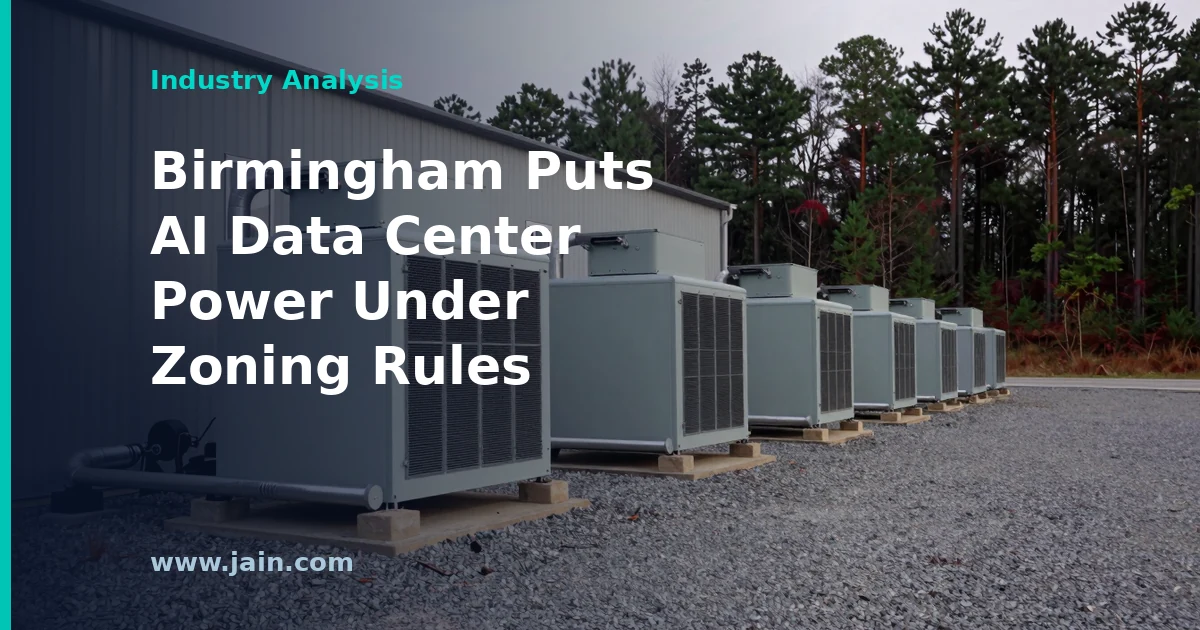
Birmingham, Alabama, has passed strict new rules for giant data centers, the warehouse-sized buildings full of computers that run cloud services and artificial intelligence.
They must sit at least 500 feet from homes, more than a football field and a half.
They cannot run their own gas-fired power plants on site.
Their cooling must use no more water than an ordinary office building.
Nearby neighbors must be told by certified letter before one is built.
The city, not the state, now decides these terms.
The City of Birmingham announced on June 9, 2026, that its City Council had approved a zoning ordinance setting 20 protective conditions for hyperscale data centers, the very large facilities built by cloud and AI operators. The city describes it as the toughest such ordinance in Alabama.
The rules include a 500-foot setback from residential districts, a 1,000-foot separation from high-capacity transit facilities, a 5-acre minimum lot size, mandatory closed-loop cooling, a ban on onsite gas turbines and round-the-clock diesel generation, noise studies before and after construction, disclosure of projected peak electricity demand, and certified-mail notice to property owners within 500 feet.
Executive Summary
Birmingham has written the most contested parts of AI data center development, power, water and noise, directly into its zoning code. A developer seeking a site in the city now has to show where its water comes from, how much electricity it expects to draw at peak and in what phases, which utility will supply it, and how it will keep noise at the property line in check, all before the project can proceed.
The most consequential provision is the prohibition on onsite gas turbines and diesel generators running 24/7. Onsite gas generation has become one of the ways large AI campuses bring capacity online faster than a utility connection allows. Birmingham has closed that route within city limits while leaving room for solar, fuel cells and battery storage under review.
The city pairs these limits with a pitch: it cites its strong electrical grid, industrial infrastructure and affordable land as reasons developers want to build there. The ordinance is an attempt to keep that demand while setting the conditions locally.
Power Moves From the Utility Contract to the Zoning File
Traditionally, how a data center gets its electricity is negotiated between the developer and the utility, and the city’s role is limited to land use. Birmingham’s ordinance changes that in two ways. First, it restricts the generation a site may build for itself: gas turbines and diesel generators running around the clock are prohibited, solar and fuel cells are allowed, and battery storage is permitted subject to emergency-response review. Second, it requires developers to disclose projected peak demand, planned development phases and the identity of the utility provider as part of the application.
For AI-focused developers, that matters because speed to power is often the binding constraint. When a utility cannot deliver a large new connection quickly, one workaround has been to install gas turbines on site and run them as primary or bridging power. Within Birmingham, that option is off the table. A hyperscale project there will depend on grid supply, supplemented only by solar, fuel cells or batteries, which puts the utility’s delivery timeline back at the center of the project schedule.
The disclosure requirement has a quieter effect. Peak demand projections and phasing plans give the city a public record of how much load each project intends to add and when. That turns electricity from a private commercial term into something neighbors and officials can see and question during permitting.
The Water Rule Is a Performance Standard With an Energy Cost
The ordinance does not just require closed-loop cooling; it sets a benchmark that water use be no greater than that of a similarly sized office building. That is a performance test, not simply a technology checkbox. Closed-loop systems recirculate the same coolant rather than evaporating water to shed heat, which sharply reduces consumption.
The trade-off is well understood in the industry: cooling without evaporation generally takes more electricity, particularly in hot, humid summers like Alabama’s. Birmingham has therefore chosen to protect local water supplies at the price of somewhat higher power draw per facility, which loops back to the peak demand figures developers must now disclose. Dense AI hardware, which runs hotter than conventional servers, makes that trade-off more pronounced.
Setbacks, Not Lot Size, Will Decide Where Campuses Fit
A 5-acre minimum lot is modest by hyperscale standards, so it is unlikely to be the constraint that matters. The 500-foot setback from residential and urban neighborhood districts is more demanding: a 5-acre parcel is only about 470 feet on a side if square, so a small site bordering a neighborhood could struggle to fit a building at all. In practice, the rules steer large projects toward bigger industrial tracts, which Birmingham, with its long manufacturing history, has in supply.
The 1,000-foot separation from high-capacity transit facilities is less common. It keeps land near major transit, which cities typically reserve for housing and employment-dense development, from being absorbed by facilities that employ relatively few people once built. Combined with pre- and post-construction noise studies, acoustical walls and certified-mail notice within 500 feet, the ordinance front-loads community disclosure rather than leaving disputes to surface after construction.
Weighing the City’s ‘Toughest’ Claim
The city’s description of the ordinance as Alabama’s toughest and as a mark of national leadership is its own characterization, and it has not published a side-by-side comparison with other jurisdictions to support it. What can be said is that combining an onsite gas ban, a water-use benchmark, noise studies and power disclosure in a single zoning instrument is more comprehensive than codes that address only setbacks or noise.
For developers, stricter rules are not purely a cost. Clear conditions published in advance reduce the risk of a project being stalled by opposition late in the process, and a site that meets them arrives with a documented answer to the questions neighbors most often raise. The larger point is structural: state-level tax incentives can make Alabama attractive, but in Birmingham it is the city code that now determines whether and how a specific site gets built.
Background
Birmingham grew as an iron and steel center, leaving it with industrial land, heavy electrical infrastructure and rail and utility corridors that suit large facilities. Alabama has courted data centers with state tax incentives and has already drawn large projects from companies such as Google and Meta elsewhere in the state.
Nationally, the surge in AI computing has driven demand for ever-larger data centers that consume significant electricity and, depending on cooling design, water. Many local zoning codes were written before facilities of this scale existed, and cities have begun adding specific rules on siting, noise, water and power as proposals arrive.
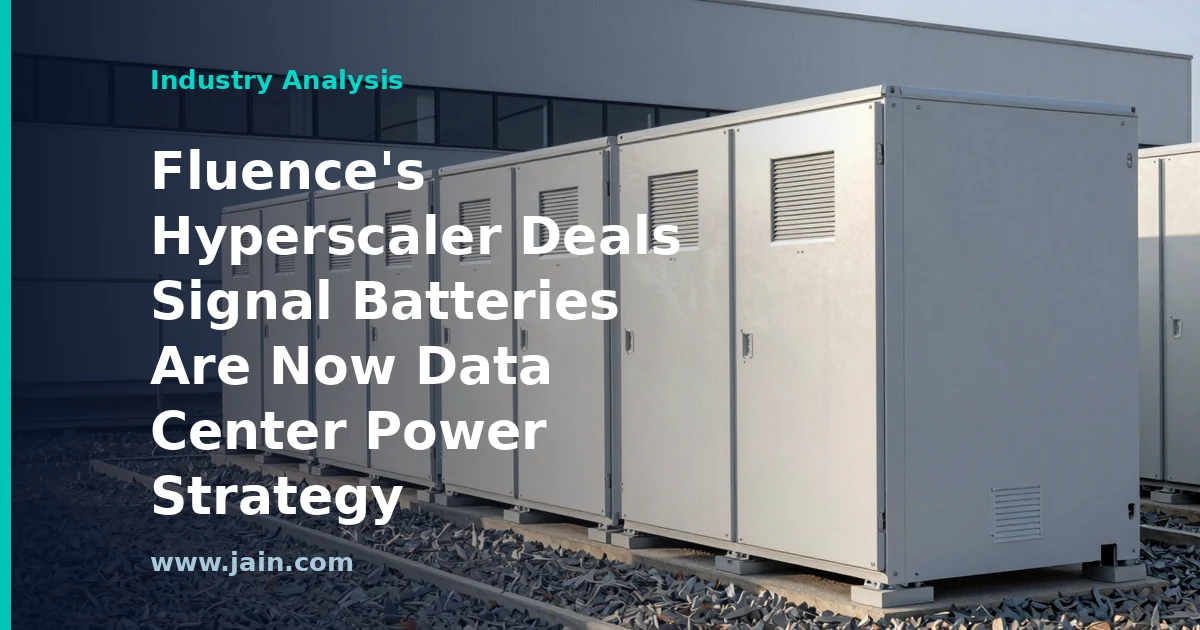
Energy storage company Fluence has signed agreements with two hyperscale data center operators, according to a report by Data Center Dynamics published May 18, 2026. The customers, deal values, and capacities were not disclosed in the source material, but the reported agreements mark a notable step: battery storage being procured directly in connection with hyperscale data center operations rather than solely by utilities and power producers.
Executive Summary
Fluence, one of the largest global suppliers of grid-scale battery energy storage systems, has reportedly landed two hyperscale data center customers — a category of buyer that historically purchased backup diesel generators and grid power, not utility-scale batteries. Hyperscale operators are the companies that run the world’s largest cloud and AI computing campuses, and their electricity demand has become one of the defining forces in power markets.
The significance is less about the (undisclosed) size of these specific deals and more about the buyer category. When hyperscalers begin contracting directly with storage integrators, batteries stop being purely a grid asset — something utilities install to balance supply and demand — and become part of the data center’s own power strategy: a tool for securing grid interconnection, riding through disturbances, and shaping when and how a facility draws power. If the pattern holds, it opens a substantial new demand channel for the storage industry and a new procurement lever for data center developers stuck in multi-year grid connection queues.
Why Hyperscalers Are Buying Batteries
The immediate driver is the collision between AI-era data center demand and a slow-moving grid. In many major markets, new large loads face interconnection waits measured in years, and utilities increasingly ask big customers to demonstrate they can soften their impact on the system. A battery energy storage system (BESS) — essentially a warehouse-scale bank of lithium-ion cells with power electronics — lets a data center reduce its peak draw, absorb power when it is cheap and plentiful, and present a more flexible, grid-friendly load. That flexibility can be the difference between an energization date in 2027 and one in 2030.
Batteries also address power quality. AI training clusters create fast, large swings in electricity demand that stress both on-site infrastructure and the surrounding grid; storage can buffer those swings. And for operators with public clean-energy commitments, batteries paired with wind and solar contracts help match consumption to carbon-free supply hour by hour, rather than only on an annual-average basis.
What Hyperscaler Customers Mean for Fluence
Fluence built its business selling storage systems and services to utilities, independent power producers, and renewable developers. Data centers represent diversification into a customer class with deep balance sheets, urgent timelines, and — critically — willingness to pay for speed and reliability rather than shopping purely on cost per megawatt-hour. For a storage integrator, that is an attractive shift in buyer mix, and landing two hyperscale names at once suggests deliberate strategy rather than a one-off win.
That said, the report gives no deal sizes, so the revenue significance cannot be assessed. Two agreements could range from pilot installations at single campuses to multi-site framework deals. The storage industry has seen announcements in both categories, and they carry very different weight. Until capacities and terms are disclosed, this is best read as a directional signal about the market, not a measurable change in Fluence’s book of business.
Batteries Versus Diesel — and Versus Gas Turbines
Data centers have long relied on diesel generators for backup: cheap to install, proven, but polluting, increasingly hard to permit, and useless for anything except emergencies. Batteries invert that profile. They are cleaner and can earn their keep daily — shaving peaks, providing grid services, arbitraging power prices — but standard four-hour lithium-ion systems cannot carry a facility through a multi-day outage. In practice, storage today complements rather than replaces backup generation, and the interesting design question is how large a battery a hyperscaler buys and what jobs it is asked to do.
The competitive backdrop matters too. Some data center developers are answering the power crunch with on-site gas turbines or fuel cells; others are betting on storage-plus-renewables or, further out, small modular reactors. Each path trades off speed, cost, carbon, and permitting risk differently. Hyperscalers signing with a storage integrator indicates that, at least for some sites, batteries have won a seat at that table — a meaningful endorsement in a market where Fluence competes with Tesla’s Megapack business, Sungrow, and a field of Chinese and Western integrators.
What Is Substantiated — and What Isn’t
It is worth being plain about the evidentiary base. The source is a single trade-press headline reporting that deals were signed; no capacities, locations, customer names, financial terms, or delivery dates accompany it. The trend it points to — storage converging with data center power strategy — is real and independently visible across the industry, but the specific commercial weight of these two agreements is unverified. Readers should treat the announcement as evidence of demand-side interest, not as proof of deployed megawatts.
Even so, thin announcements can be leading indicators. Hyperscalers rarely allow their names near a vendor’s deal news without internal conviction, and storage suppliers rarely publicize data center wins unless they expect the category to grow. The claims worth watching for next are concrete ones: megawatt-hours under contract, energization dates, and whether the systems sit behind the meter at the data center or in front of it on the grid.
Background
Fluence was created in 2018 as a joint venture between industrial group Siemens and global power company AES, combining their early battery storage businesses into a dedicated integrator. It listed on Nasdaq in 2021 and has since deployed grid-scale storage across the Americas, Europe, and Asia-Pacific, selling systems, services, and operational software primarily to utilities, independent power producers, and renewable developers.
The storage market it serves has grown rapidly as falling lithium-ion costs and rising renewable penetration made batteries a standard grid resource. What is newer is the demand side of this story: hyperscale data center operators, whose electricity needs have surged with AI computing, emerging as direct buyers of storage — a convergence of two of the fastest-growing segments in energy and digital infrastructure.