
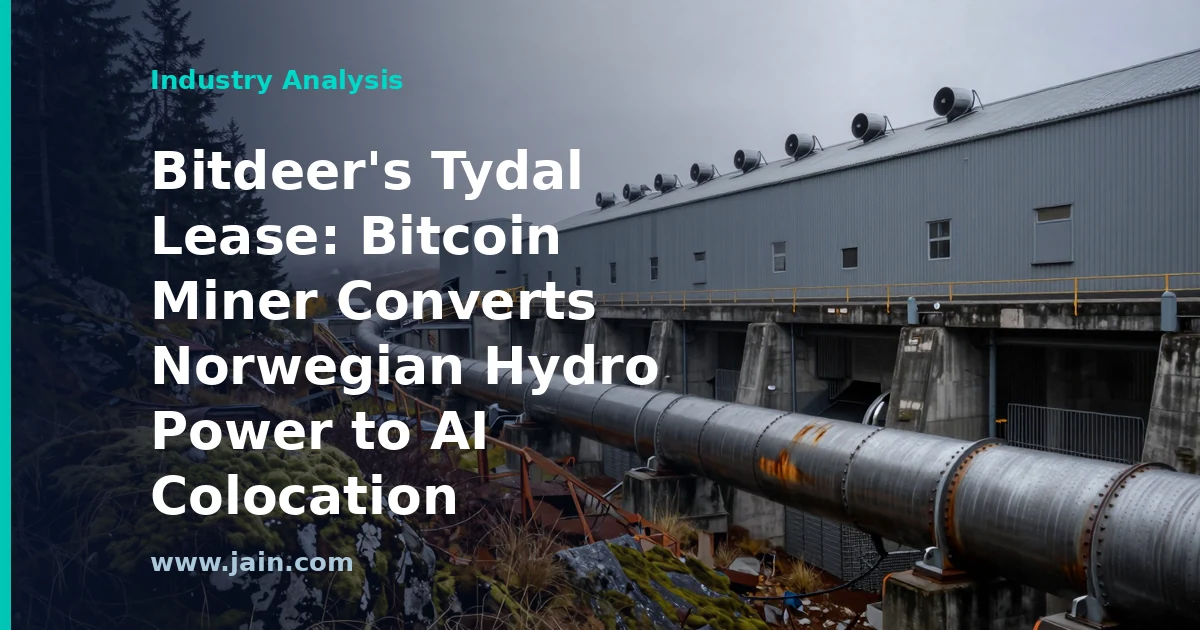
Bitdeer Technologies Group, the Nasdaq-listed bitcoin mining and data center company, has signed a colocation lease covering an AI data center at its site in Tydal, Norway, according to an April 24, 2026 report from Blockspace Media. Colocation means Bitdeer will act as landlord and facility operator, leasing powered, cooled data center space to a tenant that installs its own computing equipment.
The deal marks a concrete step in Bitdeer’s effort to convert part of its hydro-powered Norwegian footprint — originally built to mine bitcoin — into longer-duration AI infrastructure revenue.
Executive Summary
The announcement is notable less for its size — key commercial terms were not disclosed in the source report — than for what it represents: a signed lease, not a strategy slide. Over the past two years, most large bitcoin miners have announced intentions to pivot toward AI and high-performance computing (HPC), but the market has learned to distinguish between aspirational capacity announcements and executed contracts with tenants. A colocation lease at Tydal puts Bitdeer in the smaller group with a binding commercial agreement.
Tydal sits in central Norway, a region with abundant hydroelectric generation, a cool climate that reduces cooling costs, and historically low industrial power prices. Those attributes made it attractive for bitcoin mining; they are arguably more valuable for AI workloads, where customers pay a substantial premium per megawatt over what mining economics can support. For Bitdeer, swapping volatile, bitcoin-price-linked mining revenue for contracted lease income changes the character of the business — closer to a data center REIT than a commodity producer.
For the broader industry, the deal is another data point that the miner-to-AI conversion trend is producing real transactions, particularly at sites with cheap, clean, already-secured power.
Why Miners Are Becoming Landlords
The economic logic of the miner-to-AI pivot is straightforward: the scarcest input in AI infrastructure today is not chips but energized data center capacity — sites with grid connections, substations, and permits already in hand. Bitcoin miners spent a decade accumulating exactly that. Securing a new large-scale grid connection in most Western markets can take years; a miner with an operating site can, in principle, offer a tenant powered space far sooner.
The revenue math strengthens the case. Bitcoin mining revenue per megawatt is capped by network economics and falls with every halving of mining rewards, while AI tenants — cloud providers, GPU-cloud startups, and enterprises — have shown willingness to sign multi-year leases at rates mining cannot match. Converting a site from mining to AI colocation typically requires significant re-engineering, since AI servers demand far higher rack densities, more sophisticated cooling, and stricter reliability standards than mining rigs. But where the power and land are already in place, the conversion cost is generally lower than greenfield construction.
Norway’s Quiet Advantage in the AI Buildout
Norway rarely features in headlines dominated by Virginia, Texas, and the Gulf states, but it holds a strong hand: electricity that is overwhelmingly hydroelectric, among the lowest industrial power prices in Europe, a cold climate that allows free-air cooling for much of the year, and political stability. For AI customers facing sustainability reporting requirements — particularly European enterprises subject to EU disclosure rules — hydro-powered capacity carries genuine commercial value, not just marketing value.
The counterweights are real, too. Norway is far from the major European population centers, which adds network latency — a concern for user-facing AI inference, though far less so for model training, which tolerates distance well. Norwegian grid operators have also grown more selective about allocating power to data centers, and transmission constraints between Norway’s regions mean cheap power is not uniformly available. A site like Tydal, with an existing connection, is therefore more valuable than a map of Norwegian hydro resources might suggest.
Colocation Versus the GPU-Cloud Gamble
Bitdeer’s choice of a colocation lease — rather than buying GPUs and selling computing capacity itself — is a meaningful strategic signal. Miners pursuing the pivot face a fork: the asset-light path (lease space to a tenant who owns the chips) or the asset-heavy path (borrow to buy GPUs and operate a cloud). The colocation route earns lower headline revenue per megawatt but avoids the two biggest risks of the GPU-cloud model: rapid hardware depreciation as new chip generations arrive, and customer concentration in a market where a handful of AI labs dominate demand.
A lease also gives investors something mining never could: contracted, forecastable cash flow. How much credit Bitdeer earns for that depends on terms the report does not disclose — tenant identity and creditworthiness, lease duration, and who funds the conversion capital expenditure. Those details, more than the existence of the lease itself, will determine how the deal is ultimately judged.
What It Means for the Competitive Landscape
Each executed miner-to-AI deal tightens the market for the remaining players. Sites with cheap, clean power and existing interconnection are a finite inventory, and tenants signing leases today are effectively optioning that inventory ahead of rivals. For traditional data center operators, miners converting capacity represent new competition from an unexpected direction — though one that must still prove it can meet enterprise reliability expectations, which are far stricter than mining’s tolerance for downtime.
For other miners, the signal is double-edged. Successful conversions validate the strategy, but they also raise the bar: as more signed leases accumulate across the sector, companies still marketing unconverted ‘AI-ready’ capacity without tenants will face sharper investor questions about why their sites have not attracted commitments.
Background
Bitdeer Technologies Group went public on Nasdaq in 2023 and grew into one of the larger publicly traded bitcoin mining operators, building power-intensive computing facilities in markets with inexpensive electricity — including hydro-rich Norway. Bitcoin mining ties revenue directly to the cryptocurrency’s price and to network ‘halvings’ that cut mining rewards roughly every four years, pushing miners to seek steadier income from their energy assets.
Since the generative-AI boom began straining global data center supply, miners collectively controlling gigawatts of secured grid capacity have emerged as unexpected suppliers of AI infrastructure. Several have signed high-profile AI hosting and colocation agreements, and investors now reward executed contracts far more than announced ambitions — the context in which Bitdeer’s Tydal lease lands.
Source: Bitdeer signs colocation lease for Tydal, Norway AI data center — Blockspace Media report, April 24, 2026, on Bitdeer’s lease agreement converting hydro-powered Norwegian capacity to AI colocation.