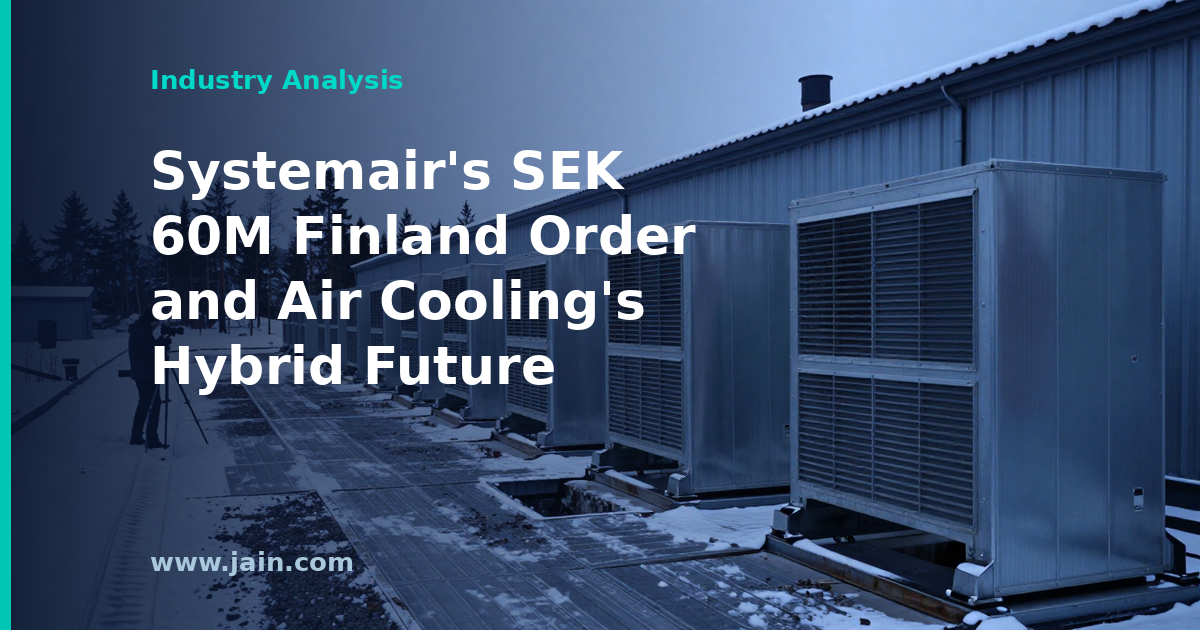
Swedish ventilation manufacturer Systemair AB (NASDAQ Stockholm: SYSR) said on 27 August 2026 that it has received an order for air-based data centre cooling solutions worth approximately SEK 60 million (EUR 5.4 million). The order is for a new data centre in Finland, and deliveries are scheduled to begin at the start of 2027.
The scope comprises Geniox Tera Fanwall units — modular air-handling assemblies with integrated controls and sensors — which will be produced at Systemair’s facility in Turkey. The Finnish site will recover waste heat from the cooling units and feed it into the local district heating network. Systemair announced the order the same day it published its Q1 2026/27 interim report.
Executive Summary
On its face this is a routine equipment win: a mid-cap European manufacturer books a single order equal to roughly half a percent of its SEK 12.5 billion in annual sales. What makes it worth reading closely is the technology choice and the geography. In a market narrative dominated by direct-to-chip liquid cooling for AI accelerators, a hyperscale-grade Finnish facility is still buying a substantial package of air handling capacity — and buying it a year or more before the building is expected to carry load.
Systemair’s CEO, Robert Larsson, framed the demand explicitly in AI terms: “Mission-critical hyperscale data centres require cooling solutions that combine high energy efficiency with exceptional reliability – and we are seeing a growing demand for energy-efficient data centre cooling as AI-related investments continue to expand.” That is a vendor’s characterisation of its own order book rather than an independently verified market statistic, but it is consistent with what the order itself shows: air-side equipment is being specified into the same buildings that host dense compute.
The second detail that matters is heat reuse. The Finnish site will export recovered heat into district heating. That turns a waste stream into a local utility input and, in Nordic markets, into part of the permitting and community-relations case for building at all. For buyers and investors, the practical takeaway is that thermal equipment orders — which are placed early, are hard to fake, and are denominated in real currency — are one of the cleaner leading indicators available for where AI-era capacity is genuinely being built.
Air Cooling Is Not Being Retired — It Is Being Reassigned
The dominant story of the past two years has been liquid: cold plates bolted directly to accelerators, rear-door heat exchangers, and immersion tanks, all pitched as the only way to handle rack densities that air physically cannot. That physics is real. What it does not mean is that air handling leaves the building. Liquid loops remove heat from the chips; they do not condition the room, they do not handle the substantial share of IT load that remains air-cooled, and they do not manage the electrical rooms, battery rooms, and support spaces that sit alongside the white space. A facility running direct-to-chip liquid on its densest halls still needs a competent air-side system — often a smaller one per megawatt of IT, but not a token one.
That is the reading this order supports. Fanwall units — arrays of multiple smaller fans working in parallel behind a common wall, rather than one large fan — are a design choice about redundancy and part-load efficiency as much as raw capacity. If one fan fails, the array degrades rather than stops, and at low load the array can run fewer fans closer to their efficient operating point. Systemair describes the Geniox Tera Fanwall line as flexible, compact and modular with integrated controls and sensors. Those are the attributes an operator specifies when it expects the load profile to change over the life of the building — which is precisely the situation of anyone commissioning a hall in 2027 without knowing what silicon will occupy it in 2030.
The honest framing, then, is hybrid rather than replacement. The competitive question for air-side vendors is not whether they get designed out, but what share of the thermal budget they retain per megawatt, and whether they can sell the controls and sensing layer alongside the boxes. Systemair’s release emphasises integrated controls; that is where differentiation and margin tend to migrate once the mechanical hardware itself becomes a commodity.
Why Finland, and Why the Heat Goes Back Out the Door
Finland has been an attractive Nordic data centre location for the same cluster of reasons that keep drawing operators north: a cold climate that extends the hours per year when outside air alone can do the cooling work, a grid with a substantial low-carbon component, political stability, and mature fibre routes into the rest of Europe. Cold ambient air is not a marketing point — it is an operating-cost line. Every hour a facility can cool with fans instead of compressors is an hour of materially lower energy draw.
The waste-heat detail is the more strategically interesting one. District heating — networks of insulated pipes that distribute hot water to buildings across a town or city district — is widespread across the Nordics in a way it is not in most of the United States. That existing pipe network is what makes data centre heat reuse economically viable rather than merely aspirational: the offtake infrastructure already exists and already has customers. Recovering heat from cooling units and pushing it into that network converts a disposal problem into a saleable or at least socially creditable output.
This matters commercially because heat reuse is increasingly part of how large facilities earn their social and regulatory licence. Data centres compete for grid connections, land, and public tolerance against other users of the same scarce power. An operator that can point to a heat offtake arrangement has a materially stronger position in that competition than one that vents everything to atmosphere. For equipment vendors, that creates a design requirement — cooling units specified with heat recovery in mind — that favours suppliers who already build for European efficiency standards.
Thermal Orders as a Leading Indicator of Where AI Capacity Lands
Announced AI capacity and delivered AI capacity are different quantities, and the gap between them is where a great deal of market confusion lives. Letters of intent, memoranda of understanding, and headline gigawatt figures are cheap to issue and frequently slip or quietly vanish. A signed equipment order with a delivery schedule is a harder object. Someone has committed capital, a manufacturing slot has been reserved, and a delivery date has been fixed — here, deliveries commencing at the beginning of 2027 for a facility that must therefore be structurally ready to receive them.
Long-lead mechanical and electrical equipment is ordered early precisely because it is long-lead. That timing property is what makes it useful as a signal: cooling and power orders surface roughly a build cycle ahead of the racks going in. Read across enough vendors, this order flow is arguably a better map of real capacity formation than announcement volume. The caveat is that a single order tells you almost nothing about aggregate demand — it is one data point from one supplier, and vendors publish the wins rather than the losses.
There is a related claim worth handling carefully. A separate forecast published the same day projects the generator cooling systems market reaching USD 5.03 billion by 2031, up from USD 3.76 billion in 2026, a 6.0% compound annual growth rate. That is a genuinely adjacent market but not the same one: generator cooling refers to the thermal management of electrical generating machinery, not the conditioning of data centre halls, and much of that market sits in power generation broadly rather than in data centres specifically. It is also a vendor-published research forecast, sold as a report, with methodology that is not open to inspection. It is reasonable to note the directional overlap — more compute means more backup and prime power, which means more machinery that needs cooling — and unreasonable to treat a 6.0% CAGR in that segment as validation of Systemair’s order or of AI-driven data centre cooling demand generally. The two releases share a date and a theme; they do not corroborate each other.
What SEK 60 Million Does and Does Not Prove
Scale discipline is worth applying. Systemair reported sales of SEK 12.5 billion in the 2025/26 financial year, with approximately 7,400 employees across 51 countries. A SEK 60 million order is therefore roughly half a percent of a single year’s revenue — around 1.8% of the SEK 3,281 million in net sales the company reported for Q1 2026/27 (May–July), which grew 6% organically. This is a meaningful, publishable win. It is not a company-transforming contract, and the release does not claim it to be.
What the order does demonstrate is qualification: a manufacturer whose core identity is building ventilation for offices, schools, and industry has been specified into what its own CEO characterises as mission-critical hyperscale infrastructure. That is a credential with option value. Data centre buyers are conservative and repeat-purchase heavily from vendors that have already performed; the first order into a programme is frequently worth more than its face value. Systemair’s own framing — “a diversified customer base” — suggests it views data centres as one growth vertical rather than a pivot.
What the release does not establish is equally worth stating plainly. It names no customer, no facility capacity, no contract margin, and no follow-on volume. It does not say whether the site also deploys liquid cooling, which would be the single most informative fact for the hybrid thesis. It does not disclose the terms of the district heating arrangement. And production in Turkey for delivery into Finland introduces a cross-border logistics and trade-policy exposure that the release does not address. None of that is unusual for an order announcement of this size — but it does mean this is a data point, not a proof.
Background
Systemair was founded in 1974 and has grown into one of Europe’s larger ventilation manufacturers, building air handling units, fans, air curtains and related climate equipment for buildings of every kind. Its historic market is ordinary commercial and industrial property — offices, schools, retail, factories — sold through the Systemair, Frico, Fantech and Menerga brands across 51 countries. The company is listed on Nasdaq Stockholm’s Large Cap list and reported SEK 12.5 billion of sales with roughly 7,400 employees in the 2025/26 financial year.
Data centres represent an adjacent but distinct opportunity for such manufacturers. The engineering is related, but the reliability expectations, controls sophistication, and procurement cycles are different, and qualification with hyperscale-grade buyers is slow to win and sticky once won. The Nordics have meanwhile become a favoured region for large facilities: cold ambient air reduces the hours per year that mechanical refrigeration must run, grids carry a significant low-carbon share, and established district heating networks give operators somewhere useful to send waste heat — a combination that shows up directly in the specification of this Finnish project.
Source: Systemair wins data centre cooling order worth SEK 60 million — the company’s 27 August 2026 announcement of an approximately SEK 60 million (EUR 5.4 million) order for air-based cooling at a new Finnish data centre, with deliveries starting in early 2027.