
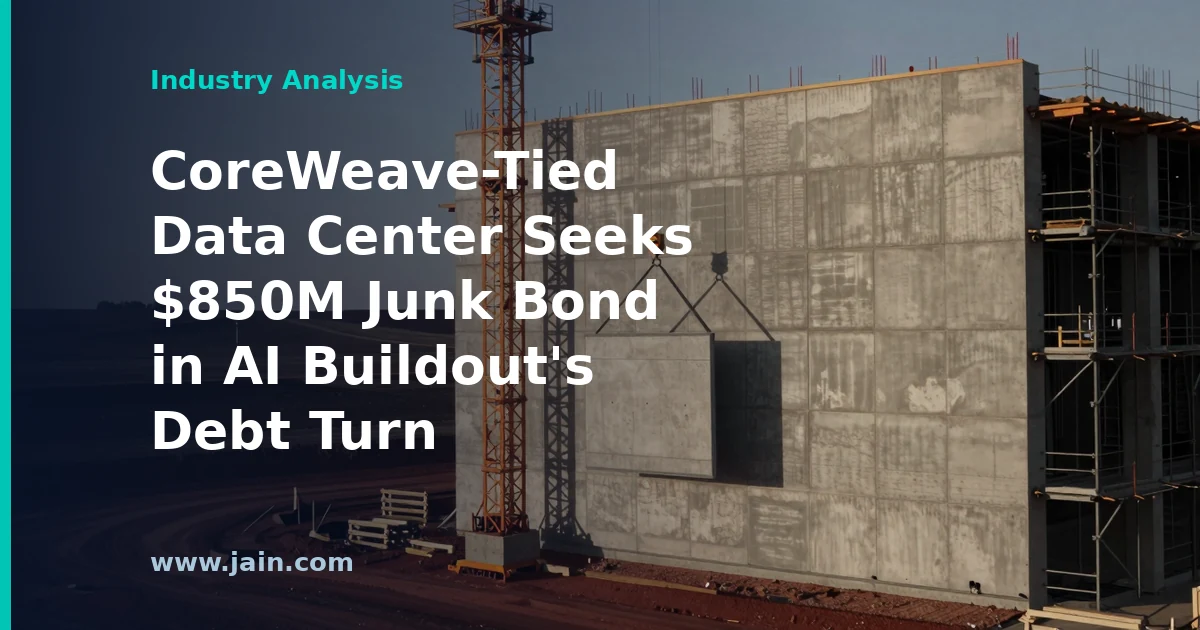
A data center company tied to AI cloud provider CoreWeave is seeking to raise $850 million through a junk bond sale, Bloomberg reported on May 31, 2026. The issuer was not identified in the report summary available at publication time, and terms of the offering — coupon, rating, and collateral — were not disclosed in the material we reviewed.
The deal adds to a growing pattern: companies whose business rests on leases or contracts with CoreWeave are turning to the high-yield bond market, rather than equity or traditional bank lending, to fund AI data center capacity.
Executive Summary
According to Bloomberg, a data center firm connected to CoreWeave — the GPU cloud provider that has become one of the largest buyers of AI computing capacity — is marketing an $850 million bond offering in the high-yield, or “junk,” market. Junk bonds are debt rated below investment grade, meaning rating agencies judge the borrower’s risk of default to be elevated and investors demand higher interest in return.
The announcement matters less for its size than for what it represents. The first phase of the AI infrastructure buildout was financed largely by venture capital, hyperscaler balance sheets, and private credit. An $850 million public high-yield deal from a CoreWeave-linked issuer shows the buildout has grown past the point where equity and private lenders can carry it alone: the broad, liquid corporate debt markets are now being asked to underwrite AI data centers directly.
That shift brings scale — and scrutiny. High-yield investors will price, in public view, exactly how much risk they see in a business model that often depends on a single fast-growing, heavily leveraged tenant.
Debt Markets Take the Baton in the AI Buildout
Building AI-grade data centers is extraordinarily capital-intensive: land, shells, power infrastructure, and liquid cooling can run into the billions per campus before a single GPU arrives. No single funding channel can absorb that alone. Venture equity funded the early movers, private credit funds stepped in next, and now — as this reported $850 million deal illustrates — the public high-yield bond market is opening to issuers whose story is essentially “we build capacity, and CoreWeave (or its customers) fills it.”
For the industry, that is a maturation signal. Public bond markets bring deeper pools of capital and lower cost than most private alternatives, but they also demand disclosure, ratings, and ongoing market pricing of risk. Once AI data center paper trades publicly, the sector gets a visible, daily referendum on whether investors believe the demand forecasts underpinning the buildout.
One Tenant, One Credit: The Concentration Question
The phrase “CoreWeave-tied” is doing significant work in this headline. A landlord or developer whose revenue depends substantially on one tenant effectively inherits that tenant’s credit profile. Bondholders in such a deal are not just underwriting concrete and cooling — they are underwriting CoreWeave’s ability to keep paying its leases for a decade or more. CoreWeave has grown at remarkable speed, but it has also financed that growth with substantial debt of its own and has disclosed meaningful customer concentration in its public filings. Risk, in other words, can stack: the bond investor is exposed to the issuer, the issuer to CoreWeave, and CoreWeave to a small set of very large AI customers.
This is not a novel structure — single-tenant credit lease financing is decades old in real estate — but the tenor mismatch is worth noting. Data center leases and bonds run for many years; AI demand forecasts are being revised quarter to quarter. Whether the release addresses lease length, renewal terms, or credit support is not visible in the source material, and those details will determine how risky this paper actually is.
What High-Yield Pricing Will Tell Us
A below-investment-grade rating is not a verdict of failure — much of the world’s infrastructure has been built on high-yield and leveraged debt. What matters is the price. If this deal and others like it clear at modest spreads, it signals that mainstream credit investors accept AI data center cash flows as durable. If issuers must pay up substantially, it signals skepticism that today’s AI compute contracts will hold their value over the life of the bonds.
Either outcome resets the cost of capital for the whole sector. Developers with signed hyperscaler or AI-cloud leases will watch this pricing closely, as will incumbents with investment-grade balance sheets, who may find their cheaper capital becoming a sharper competitive weapon if high-yield windows narrow. Banks and bond underwriters, meanwhile, gain a lucrative new issuance category either way.
Background
CoreWeave emerged as one of the defining companies of the AI infrastructure boom. Founded in 2017 as a cryptocurrency-mining operation, it repositioned itself as a specialized GPU cloud provider and rode surging demand for AI training capacity to a Nasdaq IPO in March 2025. Rather than building all of its own facilities, CoreWeave leases substantial capacity from third-party data center developers — creating a class of landlords and partners whose fortunes, and creditworthiness, are closely tied to its own.
Those partners have increasingly tapped debt markets to fund construction, part of a broader wave in which hundreds of billions of dollars in projected AI data center spending has outgrown venture equity and private credit alone. By mid-2026, high-yield bonds backed directly or indirectly by AI compute contracts had become a recognizable — and closely watched — corner of the corporate debt market.
Source: CoreWeave-Tied Data Center Seeks $850 Million Junk Bond Sale — Bloomberg report, May 31, 2026, on a planned $850 million high-yield bond offering by an unnamed data center company connected to CoreWeave.