Tag: High-Performance Computing

  • Argonne Launches First Large-Scale AI Inference Service for Open Science

    Argonne Launches First Large-Scale AI Inference Service for Open Science

    Argonne National Laboratory announced on May 26, 2026 that it has launched what it describes as the first large-scale artificial intelligence inference service for open science. In plain terms, the U.S. Department of Energy lab is now operating a shared service that lets researchers run trained AI models on demand — the way commercial AI platforms serve their users — rather than reserving supercomputer time for each job.

    The announcement, published by Argonne (anl.gov), positions the service as a resource for the open-science community, the network of publicly funded researchers whose methods and results are meant to be broadly shared.

    Executive Summary

    The significance here is less about any single piece of hardware and more about an operating model crossing an institutional boundary. Hyperscalers — the large cloud and AI companies — long ago mastered inference serving: keeping trained models resident and answering requests in real time, at scale, for many simultaneous users. National laboratories, by contrast, have historically run batch systems, where scientists queue jobs and wait their turn. Argonne is now claiming a first: bringing that always-on, request-driven serving model to open science at large scale.

    If the service works as described, it changes the day-to-day texture of AI-assisted research. Scientists could embed model calls directly into instruments, workflows, and analysis pipelines instead of scheduling supercomputer allocations for every experiment. It also signals that DOE laboratories intend to be operators of AI infrastructure in their own right, not just consumers of commercial APIs — a stance with real implications for data governance, cost, and scientific reproducibility.

    The public announcement is short on specifics, however. As of the release date, key details — the hardware behind the service, which models it serves, who qualifies for access, and how capacity is allocated — are not spelled out in the source available to us, and we flag those gaps below.

    From Batch Queues to On-Demand Serving

    Supercomputing centers were built around a simple economic logic: the machine is the scarce asset, so users line up for it. Jobs are submitted to a scheduler, wait in a queue, run to completion, and release the hardware. That model suits training runs and simulations that take hours or days. It suits inference badly. Inference — using an already-trained model to answer a question, label an image, or steer an experiment — is bursty, latency-sensitive, and interactive. A researcher who wants a model’s answer in two seconds cannot wait two hours in a queue.

    Standing up a dedicated inference service means Argonne is carving out capacity that stays warm and answers requests continuously, which is a genuine architectural and operational departure for a national lab. It requires the disciplines hyperscalers developed over a decade: request routing, autoscaling, multi-tenancy, uptime engineering. The claim of being ‘first at large scale’ in the open-science context is Argonne’s framing, but the underlying shift it describes — labs adopting service-oriented AI operations — is real and consequential.

    Why Labs Want Their Own Inference Layer

    Commercial AI APIs already exist, so it is fair to ask why a national lab should run its own. Three answers are visible in the structure of the announcement. First, data governance: much scientific data is subject to policies that make shipping it to a commercial endpoint complicated or impossible, and an in-house service keeps sensitive or export-controlled data inside the fence. Second, cost and predictability: at the volumes scientific workflows can generate, metered commercial pricing becomes a research-budget problem, while a shared national resource spreads cost across the community. Third, reproducibility: open science depends on knowing exactly which model, at which version, produced a result — control that is easier to guarantee on infrastructure the community operates itself.

    The counterweight is that operating inference infrastructure well is hard, and commercial providers iterate faster than public procurement cycles. Whether a lab-run service can keep pace with frontier commercial offerings — in model quality, tooling, and reliability — is the open competitive question, and the release, as available to us, does not yet provide the evidence to judge it.

    The Infrastructure Signal: Inference Is Becoming a Baseload Workload

    For the data-center industry, the notable thing is what this says about demand. Training gets the headlines, but inference is the workload that persists after the training run ends — continuous, growing with adoption, and increasingly treated as critical infrastructure. When a national laboratory stands up dedicated large-scale inference capacity, it confirms that inference is no longer an afterthought riding on spare cycles; it is a planned, provisioned workload with its own power, cooling, and availability requirements.

    That has knock-on effects for everyone who builds and operates facilities. Inference favors sustained utilization and low-latency proximity to users and instruments, which shapes site selection and network design differently than training campuses do. Public-sector entrants also add a new class of buyer for accelerators and serving software — one whose requirements (openness, auditability, long service lifetimes) differ from the hyperscalers’. Vendors who can meet those requirements gain a market; those optimized purely for commercial serving economics may find the fit imperfect.

    Background

    Argonne National Laboratory, founded in 1946 and located outside Chicago, is one of the U.S. Department of Energy’s largest science and engineering research centers. Its Argonne Leadership Computing Facility provides supercomputing to researchers nationwide through peer-reviewed allocations, and in recent years the lab has been a focal point of DOE’s push into exascale computing and AI for science, including early testbeds for emerging AI accelerator hardware.

    That history matters because national labs have traditionally delivered computing as scheduled batch time on flagship machines. The move to an always-on inference service represents the research-computing world adopting the service-oriented operating model that commercial AI platforms pioneered — a shift several labs have discussed, and which Argonne now claims to be first to deliver at large scale for open science.

    Source: Argonne launches first large-scale AI inference service for open science — Argonne National Laboratory announcement (anl.gov), published May 26, 2026.

  • Bitdeer’s $4.7B Long-Term Lease Deepens the Miner-to-AI Infrastructure Pivot

    Bitdeer’s $4.7B Long-Term Lease Deepens the Miner-to-AI Infrastructure Pivot

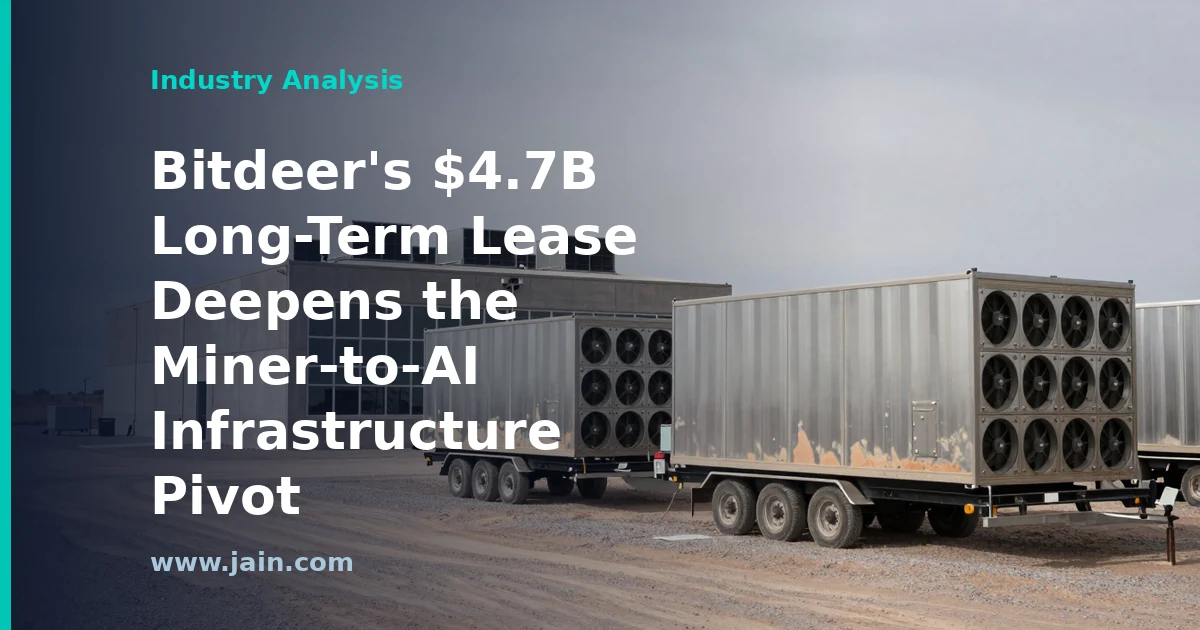
    Bitdeer Technologies, the Nasdaq-listed bitcoin mining and digital infrastructure company, has entered a long-term data center lease valued at $4.7 billion, according to a report published April 30, 2026. The company frames the agreement as an expansion of its artificial intelligence infrastructure business — one of the largest single capacity commitments yet disclosed in the ongoing migration of crypto-mining operators into the AI data center market.

    Executive Summary

    The announcement, carried via TradingView, is short on operational detail but large in headline value: $4.7 billion committed under a long-term lease structure tied to AI infrastructure. Long-term leases — multi-year contracts in which one party commits to pay for data center capacity over the life of the agreement — are the currency of the AI buildout, because they convert speculative capacity into bankable, contracted cash flows that lenders and investors can underwrite.

    For Bitdeer, a company built on bitcoin mining, a commitment of this scale matters because it shifts the company’s center of gravity. Mining revenue is volatile, tied to bitcoin’s price and network difficulty. AI infrastructure leases, by contrast, resemble traditional data center economics: contracted terms, identifiable counterparties, and revenue visibility measured in years rather than block rewards. A $4.7 billion figure, if executed as described, would place Bitdeer among the more consequential converts in the miner-to-AI transition.

    From Bitcoin Mines to AI Campuses

    Bitdeer’s move follows a pattern that has reshaped the crypto-mining sector: companies that spent years assembling large-scale power access and industrial sites for bitcoin mining are repurposing those assets for AI computing. The logic is straightforward. The scarcest input in AI infrastructure today is not chips but energized, grid-connected capacity — sites where hundreds of megawatts of power are already secured and permitted. Bitcoin miners happen to own exactly that.

    Several large miners have already signed multi-billion-dollar, multi-year agreements to host AI and high-performance computing workloads, and the market has generally rewarded those pivots with valuations closer to data center operators than to commodity miners. A $4.7 billion long-term lease would signal that Bitdeer intends to compete in that same lane, not merely experiment at the edges of it.

    Why Long-Term Leases Are the Deal Structure of the AI Buildout

    A long-term lease does two things at once. For the capacity provider, it converts an industrial asset into a stream of contracted revenue that can support debt financing — critical, because retrofitting mining sites into AI-grade facilities is capital intensive, requiring denser power delivery, liquid or advanced air cooling, and far more resilient electrical infrastructure than mining rigs need. For the capacity buyer, it locks up scarce power and space ahead of competitors in a market where lead times for new grid connections can run to years.

    The headline number deserves careful reading, however. In deals of this type, the quoted value typically represents total contract value across the full lease term, not annual revenue or an upfront payment. Without the term length disclosed, $4.7 billion could imply very different annual economics — a distinction that matters enormously for assessing the deal’s true weight.

    The Real Asset Is Power

    Whichever side of the lease Bitdeer occupies, the transaction underscores that access to electricity has become the defining constraint of the AI era. Utilities across major markets face multi-year interconnection queues, and hyperscalers and AI cloud providers have shown they will pay premium, long-duration commitments to secure energized capacity now rather than wait for new construction. Companies holding large existing power allocations — a category that prominently includes bitcoin miners — have found themselves holding strategic real estate.

    That dynamic cuts both ways. The premium on power access exists precisely because supply is constrained; as utilities and developers bring new capacity online over the coming years, the scarcity value embedded in today’s deals could compress. Long-term contracts signed at the peak of scarcity may look either prescient or expensive in hindsight, depending on which side of the lease one sits.

    Execution and Concentration Risks

    The risks in miner-to-AI conversions are well documented across the sector. Retrofitting facilities to AI specifications routinely runs over budget and behind schedule, because AI workloads demand redundancy, cooling density, and network architecture that mining sites were never designed for. Counterparty concentration is the second concern: many of these long-term leases depend on a single tenant or customer, so the credit quality and durability of that counterparty effectively determines the value of the contract.

    For a company in transition, there is also a strategic tension. Capital and management attention committed to AI infrastructure is capital not deployed in mining — and if the AI buildout slows or the counterparty falters, the company has repositioned itself around a contract rather than an operating business. None of this makes the deal unwise; it makes the undisclosed details decisive.

    Background

    Bitdeer Technologies emerged from the bitcoin mining industry’s consolidation around large-scale, professionally operated data centers. Spun off from mining-hardware giant Bitmain in 2021 and founded by Bitmain co-founder Jihan Wu, the company listed on Nasdaq in 2023 and built its business on three legs: mining bitcoin for its own account, hosting other miners’ machines, and selling cloud-based hash power. It operates industrial-scale facilities across multiple continents and has invested in developing its own mining chips.

    The broader market context is the collision of two trends: bitcoin mining’s thinning margins after successive halvings, and explosive demand for AI computing capacity that has outrun the electric grid’s ability to serve it. That collision has turned miners’ power portfolios into strategic assets and produced a wave of multi-billion-dollar agreements converting mining sites into AI infrastructure — the wave this lease places Bitdeer squarely within.

    Source: Bitdeer expands AI infrastructure with long-term $4.7B data center lease — report published via TradingView, April 30, 2026, announcing Bitdeer’s $4.7 billion long-term data center lease.

  • Riot Sells 4,300 BTC to Fund Its AI Data Center Pivot: Megawatts Over Coins

    Riot Sells 4,300 BTC to Fund Its AI Data Center Pivot: Megawatts Over Coins

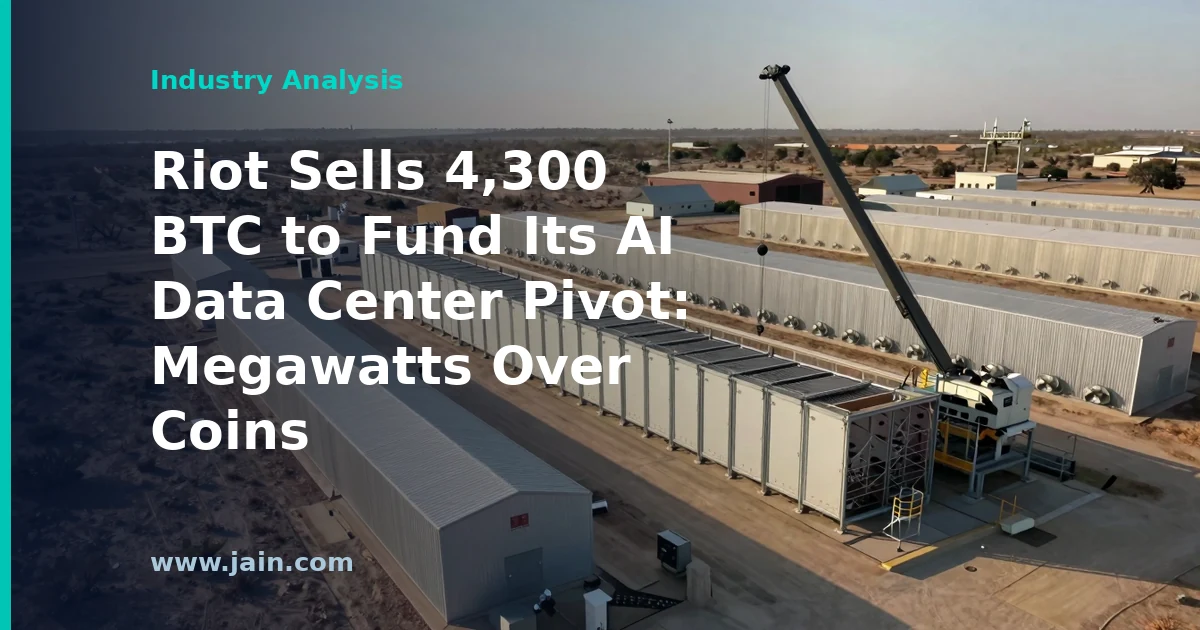
    Bitcoin miner Riot has sold 4,300 BTC from its treasury to help fund the buildout of AI data center capacity, according to an April 20, 2026 report carried by TradingView. The sale converts a large slice of the company’s signature asset — its Bitcoin hoard — into construction capital for high-performance computing infrastructure.

    Executive Summary

    The reported transaction is notable less for its mechanics than for what it says about priorities. For years, large public Bitcoin miners treated their mined coins as a strategic reserve — a balance-sheet bet that holding Bitcoin would outperform selling it. Liquidating 4,300 BTC to pour concrete and energize halls for AI workloads inverts that logic: the scarce, appreciating asset Riot is now accumulating is powered data center capacity, not cryptocurrency.

    If the report is accurate, Riot joins a growing cohort of miners redeploying their most valuable holdings — power contracts, land, substations, and now treasury coins — toward AI and high-performance computing (HPC) hosting, where demand from AI developers has made grid-connected megawatts one of the most sought-after assets in technology infrastructure.

    From Strategic Reserve to Construction Budget

    Bitcoin miners’ treasuries were long marketed to investors as a leveraged way to own Bitcoin: the company mines coins, holds them, and shareholders benefit if the price rises. Selling 4,300 BTC to fund a buildout is a deliberate break from that playbook. It says management believes a dollar invested in AI-ready data center capacity will return more than a dollar left sitting in Bitcoin — a striking assessment from a company whose core business is producing Bitcoin.

    It is also a pragmatic financing choice. Data center construction is brutally capital-intensive, and the alternatives — issuing new shares, which dilutes existing holders, or borrowing, which adds interest costs and covenants — both carry real drawbacks. A treasury sale is the one funding source that requires no one else’s permission and creates no ongoing obligation. The trade-off is equally real: coins sold today cannot participate in any future Bitcoin rally, and shareholders who bought the stock as a Bitcoin proxy are now holding something different.

    Megawatts Are the Scarce Asset Now

    The deeper story is why miners are so well positioned for this pivot. AI training and inference clusters need enormous amounts of reliable electricity, and utility interconnections — the formal grid hookups that let a site draw hundreds of megawatts — can take years to secure. Bitcoin miners spent the last decade quietly assembling exactly those assets: large power contracts, energized substations, and industrial sites with cooling and fiber already in place.

    That inheritance means a miner can offer AI tenants something hyperscale cloud builders often cannot: capacity that is available soon rather than after a multi-year interconnection queue. In that market, a company’s Bitcoin stack is incidental; its megawatts are the franchise. Riot converting coins into capacity is the cleanest expression yet of that repricing.

    The Economics Behind the Pivot

    Mining economics have tightened structurally. Bitcoin’s periodic “halvings” cut the block reward — the number of new coins miners earn — in half, which squeezes revenue per unit of computing power unless the Bitcoin price doubles to compensate. AI and HPC hosting offers a very different profile: multi-year contracts with creditworthy tenants, revenue in dollars rather than a volatile asset, and returns tied to utilization instead of a global hash-rate arms race.

    But the pivot is not free money. AI hosting is a different business — different cooling densities, different reliability guarantees, different customers with demanding technical requirements — and miners must execute a conversion while incumbents like established colocation providers and hyperscalers expand aggressively. A miner that sells its Bitcoin, builds capacity, and then struggles to sign anchor tenants would have traded a volatile asset for an idle one. Execution, not vision, will decide who wins this transition.

    Background

    Riot Platforms grew into one of North America’s largest public Bitcoin miners by building power-hungry facilities in Texas, where it locked in substantial electricity capacity — an asset originally acquired to run mining rigs. Beginning around 2024, surging demand for AI computing collided with a shortage of grid-connected data center sites, and miners across the sector began converting or leasing their facilities to AI and high-performance computing tenants. Several of Riot’s peers struck high-profile hosting deals or announced conversions, establishing a template in which a miner’s power portfolio, rather than its coin production, drives its valuation. Riot’s reported treasury sale extends that industry-wide repositioning to the balance sheet itself.

    Source: AI Over Bitcoin: Mining Giant Riot Cashes Out 4,300 BTC for Data Center Buildout — TradingView report, April 20, 2026, on Riot’s treasury sale to fund AI data center construction.