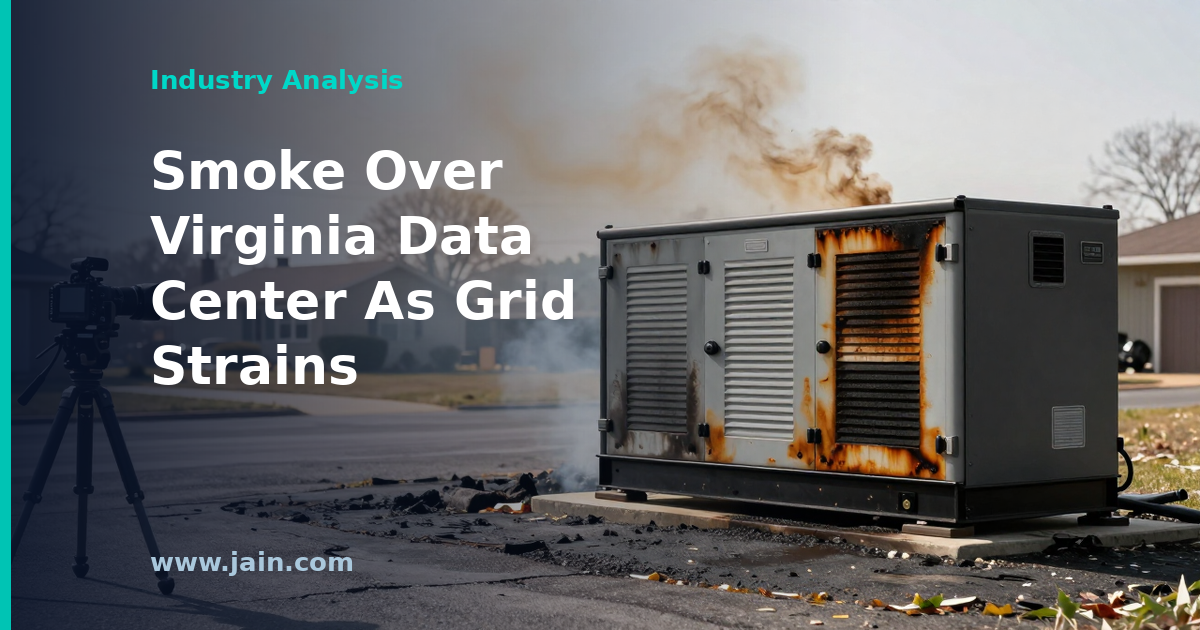
Business Insider reported that dark smoke was seen rising above a Virginia data center during a summer heat wave, at the same time PJM Interconnection — the grid operator serving the mid-Atlantic — was approaching the upper edge of its available supply. The incident occurred in the region that hosts the largest concentration of data center capacity in the world.
Executive Summary
A visible smoke event at a Virginia data center, coinciding with heat-driven stress on the PJM grid, has drawn attention to the fragility of the infrastructure that carries a large share of global internet traffic. The report does not detail the cause, the operator, or the scale of any outage, but the optics — smoke above a hyperscale campus during peak demand — are hard to ignore.
For an industry that has spent the last two years defending its power appetite in front of regulators and communities, the timing matters. Northern Virginia’s data center cluster is already the subject of intense debate over transmission buildout, ratepayer cost allocation, and permitting. A high-visibility incident during a grid emergency is the kind of event that shifts political conversations even when the technical facts turn out to be modest.
Why Loudoun County Is the Pressure Point
Northern Virginia, and Loudoun County in particular, hosts more data center capacity than any other region on Earth. That density exists because of a self-reinforcing cycle: fiber routes were built to serve early internet exchanges, cheap land and tax incentives attracted more operators, and each new campus made the next one more attractive by shortening latency between tenants. The result is a corridor where a single county’s electricity draw rivals that of a mid-sized country.
PJM Interconnection, the regional transmission organization that runs the grid across 13 states and D.C., has warned publicly for the past two years that generation retirements are outpacing new supply, and that data center growth is a major driver of load. A heat wave compresses the margin between demand and available capacity, and in that state any visible failure — smoke, sirens, a plume — reads as a system-level warning rather than a site-level problem.
The Anatomy of a Data Center Fire Risk
Smoke at a data center campus can originate from several places, and each carries different implications. Utility switchgear and transformers can fail under thermal stress, particularly when ambient temperatures push cooling systems past design points. Backup diesel generators, which typically start when grid voltage sags, can experience exhaust or lube-oil incidents when run for extended periods. Battery energy storage systems, increasingly used to bridge grid disturbances, carry their own thermal-runaway risks. Without more detail from the operator or the fire authority, the public cannot distinguish among these, and the release does not.
What is unambiguous is that data centers are designed to fail gracefully — that is the entire premise of N+1 redundancy, on-site generation, and multiple utility feeds. A visible smoke event does not, by itself, mean customer workloads went down. It does mean that at least one layer of the redundancy stack was exercised, and that the incident happened at the worst possible moment for the grid around it.
The Political Physics of a Bad Photograph
Data center operators have historically preferred to operate quietly. That posture is harder to maintain when smoke is visible from residential streets during a heat wave that has neighbors watching their thermostats. Virginia legislators have already been debating whether data center load growth should be paid for by the industry rather than socialized across residential ratepayers, and PJM’s capacity auctions have delivered sharp price increases that landed on household bills earlier this year.
None of that is caused by a single incident. But single incidents shape narratives. Operators, utilities, and regulators who want to sustain the current build-out will need to be more forthcoming — about what happened, what the redundancy actually did, and what the incident says (or does not say) about the wider grid — than the industry’s default communications posture typically allows.
What the Grid Data Actually Shows
The article’s framing — that PJM was near its limits — is worth taking seriously without overstating. Grid operators routinely run close to reserve margins during heat waves; that is what reserve margins are for. The relevant question is not whether PJM was stressed on a hot afternoon, but whether the trajectory of load growth, generator retirements, and transmission build is converging or diverging. Public filings from PJM suggest the latter, and the coincidence of a visible incident with a stressed grid gives that concern a face.
Background
Northern Virginia has been the center of gravity for the data center industry since the 1990s, when Equinix and others built exchange points that anchored transatlantic and domestic internet traffic. Loudoun County alone now hosts several gigawatts of operating capacity, with more under construction, and its tax revenue from the sector has reshaped county budgets.
PJM Interconnection, founded in 1927 as a pool among Pennsylvania and New Jersey utilities, today coordinates generation and transmission across a footprint stretching from Illinois to North Carolina. In recent capacity auctions, prices have risen sharply as generator retirements have outpaced new interconnections, a dynamic industry observers attribute in part to accelerating data center load growth.
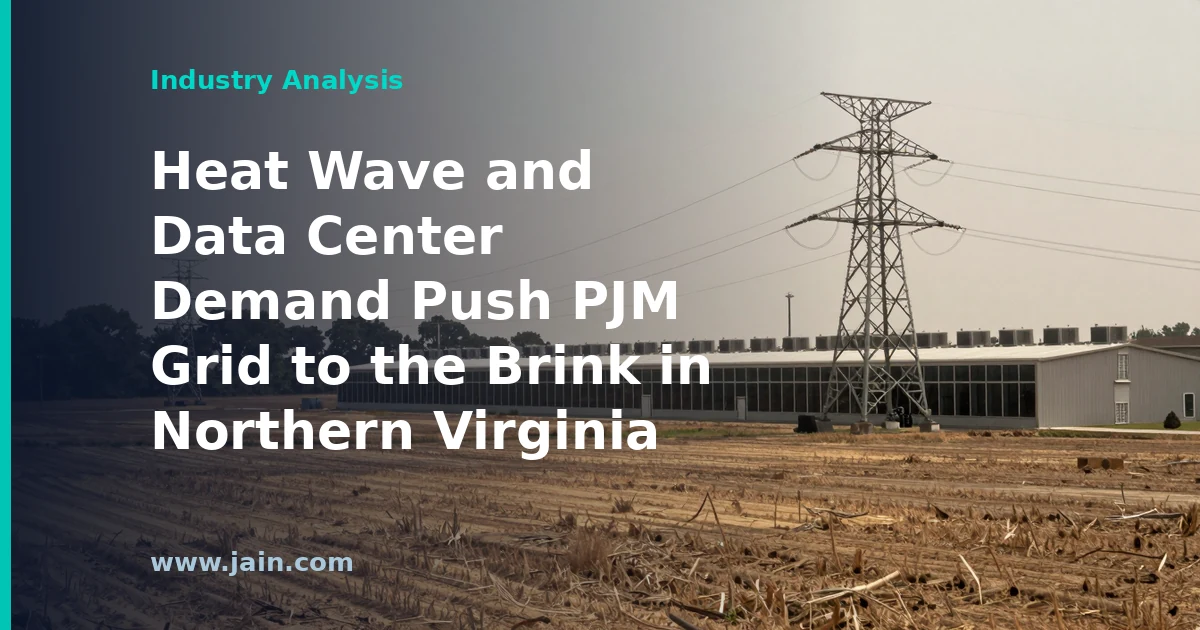
The Prince William Times reported on July 4, 2026 that a summer heat wave, layered on top of the enormous electricity appetite of the region’s data centers, pushed the regional power grid “to the brink.” The grid in question is operated by PJM Interconnection, the regional transmission organization that coordinates electricity across all or parts of 13 states and the District of Columbia — including Northern Virginia, home to the largest concentration of data centers in the world.
The report frames a collision that grid planners have warned about for years: weather-driven peak demand from air conditioning arriving at the same moment as a structural, around-the-clock load from data centers that has grown far faster than new generation and transmission have been built.
Executive Summary
According to the report, the stress event unfolded in Prince William County, Virginia and the surrounding region — the heart of “Data Center Alley,” where Prince William and neighboring Loudoun County host an unmatched density of hyperscale and colocation facilities. During a heat wave, residential and commercial air conditioning drives electricity demand to its annual peaks; data centers, unlike air conditioners, draw near-constant power day and night, so their load sits underneath the weather peak rather than replacing it.
Why it matters: grid operators plan for the single worst hour of the year. When a fast-growing baseload (data centers) raises the floor and a heat wave raises the ceiling, the margin between available supply and peak demand — the buffer that prevents emergency measures like conservation appeals or rolling outages — shrinks. A “to the brink” event is a concrete, dated data point in a debate that is often conducted in abstractions about future AI load forecasts.
A caveat on sourcing: this is a single local-newspaper account, and the headline-level material available does not specify which emergency procedures, if any, PJM invoked, what demand peaked at, or how close reserves actually came to exhaustion. Those specifics matter, and we flag them below.
The Peak Problem: Flat-Out Air Conditioning Meets Always-On Compute
Electric grids are sized for their worst hour, not their average one. In PJM territory that worst hour almost always occurs on a hot summer weekday afternoon, when tens of millions of air conditioners run simultaneously. Data centers change the arithmetic because they are effectively a new floor under demand: a large AI training or cloud facility draws a high, steady load 24 hours a day, in fair weather and foul. When a heat wave arrives, that steady draw does not politely step aside — it stacks. The result is that the same heat wave that a decade ago would have been routine can now push a region toward its limits, which is precisely the dynamic the Prince William Times describes.
For lay readers, “to the brink” typically means the grid operator is working through its escalation ladder — asking generators to defer maintenance, importing power from neighbors, calling on demand-response customers who are paid to curtail, and in the worst case shedding load (rolling blackouts). The available reporting does not tell us how far down that ladder PJM went in this event, and that distinction — between a tight day and a genuine emergency — is the difference between a warning sign and a crisis.
Northern Virginia Is the Stress Test the Rest of the Country Is Watching
Prince William County is not a random dateline. Northern Virginia is the world’s largest data center market, and the AI buildout has accelerated demand there just as it has become harder to site new transmission lines and generation. PJM’s own capacity auctions — the mechanism by which the operator procures commitments of future power supply — have cleared at sharply higher prices in recent cycles, a market signal that supply is not keeping pace with projected demand. A heat-wave near-miss in this region is therefore a preview: other fast-growing data center corridors in Texas, Georgia, Ohio, and Arizona face versions of the same squeeze.
The economics cut in several directions. Utilities and independent power producers benefit from higher capacity prices and large, creditworthy new customers. Data center operators face rising power costs and, increasingly, multi-year waits for grid connections — which is pushing some toward on-site generation, long-term nuclear and renewable contracts, and demand-flexibility commitments. Residential ratepayers, meanwhile, worry about absorbing the cost of grid upgrades driven by industrial customers, a tension that is now a live political issue in Virginia and across PJM’s footprint.
Who Bears the Risk — and Who Blinks First in the Next Heat Wave
Events like this sharpen a policy question that regulators have so far answered only partially: when supply gets tight, whose power is interruptible? Data centers have historically demanded — and paid for — extreme reliability, backed by on-site diesel or battery backup. That backup capacity is mostly idle during grid emergencies. Proposals to enroll data centers in demand-response programs, require flexible-load commitments as a condition of interconnection, or price peak consumption more aggressively all gain momentum every time a grid operator has a bad afternoon.
There is also a reputational dimension. The data center industry argues, with some justification, that it pays substantial sums into the grid and that load growth also comes from electrification of homes, vehicles, and factories. But headlines that pair “heat wave” with “data centers” and “brink” land hard with the public regardless of the precise load attribution. Operators that can document flexibility — shifting deferrable computing work away from peak hours, dispatching backup assets to support the grid — will have an easier time in siting battles than those that cannot.
Background
Northern Virginia became the world’s data center capital over two decades, thanks to early internet exchange points, cheap land, favorable tax treatment, and proximity to federal and enterprise customers. Loudoun County led the first wave; Prince William County became the frontier of the next one, with the AI boom driving proposals for ever-larger campuses. PJM Interconnection, formed from a power pool dating to 1927, operates the transmission grid across the Mid-Atlantic and parts of the Midwest and has repeatedly flagged accelerating load growth — led by data centers — as a central reliability challenge of the coming decade.
The tension surfaced well before this heat wave: PJM’s recent capacity auctions cleared at dramatically higher prices, utilities in Virginia have proposed new rate structures for large loads, and local land-use fights over data center siting in Prince William County have become some of the most contentious in the country. A dated, weather-driven stress event adds an operational exclamation point to what had largely been a forecasting debate.
The U.S. Department of Energy issued a directive on or around July 3, 2026 instructing data centers to switch to on-site backup generators during an active heat wave, so that grid electricity could be redirected to residential and commercial air conditioning demand.
The action, first reported by CNN, applies during the peak-load emergency window and treats hyperscale and colocation facilities as flexible load that can be temporarily islanded from the public grid.
Executive Summary
Federal regulators rarely intervene directly in how private data centers source their power. This order does exactly that, framing backup generators — normally reserved for outages — as a demand-response tool the government can call on during a grid emergency.
For an industry that has spent the past two years defending its rising share of national electricity consumption, the directive is a concrete signal that data-center load is now large enough to be actively managed by policymakers, not just utilities. It also raises immediate questions about emissions, fuel supply, wear on generator fleets, and who bears the incremental cost.
The CNN report is short on operational specifics. What is clear is the precedent: in a heat-driven grid crunch, the federal government has publicly told data centers to burn their own fuel so households can keep the AC on.
From Backup to Balancing Asset
Data-center backup generators — typically diesel, occasionally natural gas — are designed as insurance against utility failure. Running them proactively to relieve the grid reframes them as a demand-response resource, a category more commonly filled by industrial curtailment contracts and battery storage. The DOE’s move effectively conscripts private infrastructure into a public reliability role during an emergency window, without (based on the reporting available) a pre-existing market mechanism to compensate that role.
For operators, the economics are straightforward but uncomfortable: diesel fuel and generator hours are far more expensive per kilowatt-hour than grid power, and every runtime hour consumes maintenance life and emissions allowances. Whether those costs are reimbursed, absorbed, or passed to tenants under force-majeure or emergency-operations clauses in colocation contracts is not addressed in the source.
Policy Signal for a Power-Constrained Industry
The directive lands in the middle of an ongoing national debate over data-center power draw, particularly from AI training and inference workloads. Utility interconnection queues are years long in several regions, and multiple states are weighing tariffs and rate structures specific to large loads. An emergency order that pulls data centers off the grid on the hottest days does not solve those structural issues, but it does establish a template: when residential cooling and industrial compute compete for the same electrons, households come first.
That template has implications well beyond one heat wave. Operators planning new sites will read this as evidence that federal and state authorities are willing to treat their facilities as interruptible when the public interest demands it, which strengthens the case for on-site generation, long-duration storage, and firm behind-the-meter power. It also gives ammunition to utilities and community groups arguing that new hyperscale campuses should arrive with dedicated generation, not just a grid connection.
Environmental and Reliability Trade-offs
Shifting large facilities to diesel or gas backup during a heat wave trades one problem for another. Peak summer conditions already coincide with elevated ground-level ozone; concentrated diesel runtime in data-center clusters — northern Virginia, Dallas, Phoenix, Santa Clara — could measurably worsen local air quality on precisely the days when it is most fragile. The source does not indicate whether the order includes air-quality carve-outs, geographic targeting, or emissions monitoring.
Reliability is the other side of the ledger. Backup generators are tested regularly but not designed for sustained multi-hour or multi-day operation across an entire fleet. Fuel logistics, cooling of the generators themselves in extreme heat, and the risk of cascading failure if a facility loses backup mid-event are real engineering concerns. None of these are discussed in the reporting available, and they will determine whether the directive is remembered as a pragmatic success or a stress test that exposed hidden fragility.
Background
Data-center electricity demand has climbed sharply over the past several years as cloud computing and, more recently, AI training and inference workloads have expanded. Utilities in Virginia, Texas, Arizona, and the Pacific Northwest have publicly flagged multi-year interconnection queues for large loads, and several states have opened proceedings on tariffs and cost allocation specific to hyperscale facilities.
At the same time, summer heat waves have repeatedly pushed regional grids to the edge of their reserve margins, prompting conservation appeals and, in some cases, rolling outages. The DOE has authority to intervene in electricity emergencies but historically uses it sparingly and mostly to keep specific generators running. A directive aimed at reducing data-center load is a notable inversion of that pattern.