
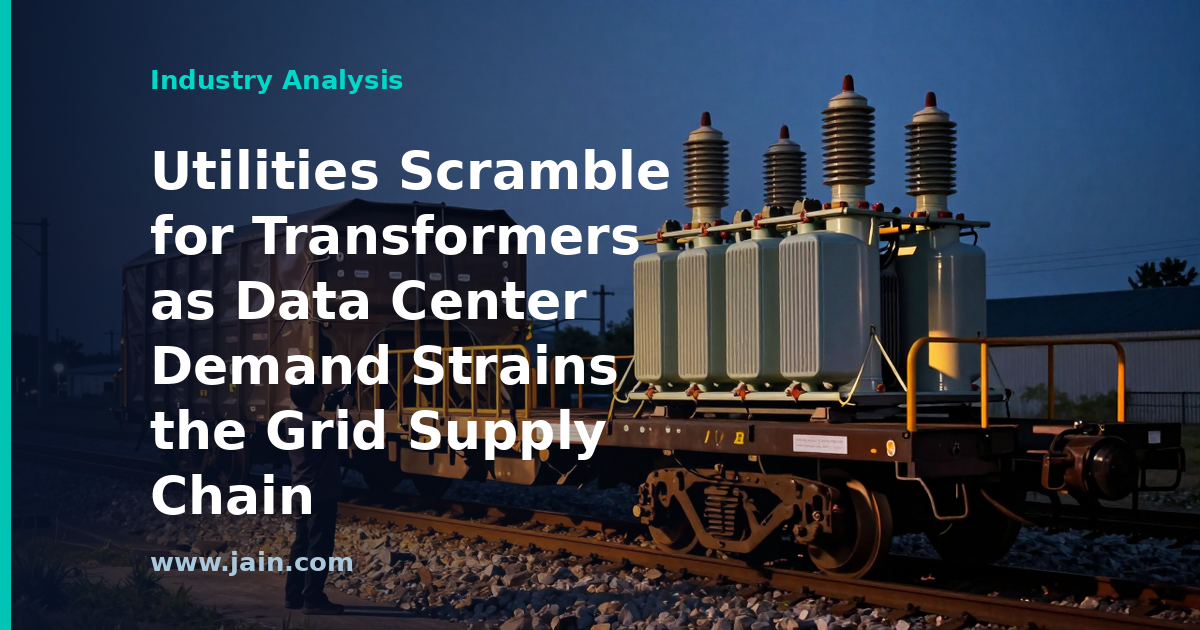
Reuters reported on July 8, 2026 that US power companies are scrambling to secure electrical equipment — the transformers, switchgear, and related grid hardware that move electricity from generators to customers — as surging demand from data centers strains available supplies. The report frames a nationwide procurement crunch: utilities that once ordered this equipment on routine replacement cycles are now competing for constrained manufacturing capacity against a wave of new large-load projects.
Executive Summary
The headline is not about a single deal or data center campus; it is about the industrial base underneath all of them. Transformers step electrical voltage up for long-distance transmission and back down for delivery, and switchgear is the apparatus that switches, protects, and isolates circuits. Neither is optional: every new data center interconnection, substation upgrade, and grid expansion needs both. Reuters’ reporting indicates that US utilities can no longer take timely delivery of this equipment for granted.
Why it matters: for the first time in decades, US electricity demand is growing meaningfully, and data centers — particularly AI-driven facilities — are a leading cause. When the equipment supply chain becomes the pacing item, it stops being a utility procurement problem and becomes a constraint on data center delivery schedules, grid reliability investment, and ultimately on how fast the AI buildout can proceed. Power availability has already emerged as the industry’s defining bottleneck; this report locates part of that bottleneck one layer deeper, in the factories that make grid components.
Why Transformers Became the Grid’s Chokepoint
Large power transformers are among the least glamorous and most consequential machines in the economy. They are heavy, highly engineered, often custom-built to a specific substation’s requirements, and produced by a relatively small number of manufacturers worldwide. Capacity to build them cannot be added quickly: it requires specialized factories, scarce materials such as grain-oriented electrical steel, and skilled workers who take years to train.
The US grid spent roughly two decades with flat electricity demand, and the supply chain sized itself accordingly — tuned for steady replacement of aging units, not for a demand shock. When data center load growth, electrification, and grid-hardening programs all began pulling on that thin manufacturing base at once, order backlogs stretched and utilities found themselves queuing for hardware. The scramble Reuters describes is the predictable result of a just-in-time supply chain meeting a step change in demand.
When Equipment Lead Times Set the Data Center Schedule
For data center developers, this crunch changes what “time to power” means. A site can have land, fiber, permits, and even a utility willing to serve it, and still wait on a transformer delivery slot. Interconnection — the process of physically and contractually tying a new load into the grid — increasingly depends less on paperwork and more on whether the required substation equipment physically exists.
That reality is reshaping behavior on both sides of the meter. Utilities are reported to be securing equipment earlier and more aggressively, which effectively shifts them from reactive procurement to strategic stockpiling. Large data center operators, for their part, have strong incentives to lock in capacity years ahead, pre-order long-lead equipment themselves, or favor sites where grid infrastructure already exists — one reason established carrier hotels and campuses with existing substation capacity have gained strategic value relative to greenfield sites.
The Economics of Scarcity: Who Absorbs the Cost
Scarcity moves pricing power toward manufacturers. Electrical-equipment makers with transformer and switchgear capacity are in an unusually strong position, and the open question is how much they will invest in expansion — factories are decade-scale bets, and executives remember the last long stretch of flat demand. Utilities, meanwhile, typically recover equipment costs through regulated rates, which means sustained price inflation in grid hardware eventually reaches ratepayers and invites regulatory scrutiny over how much of the buildout data center customers should fund directly.
Among data center players, scarcity favors scale and incumbency. Hyperscale operators can pre-purchase equipment, sign long-term supply agreements, and absorb schedule risk in ways smaller developers cannot. If the crunch persists, expect it to act as a filter: well-capitalized projects with early equipment commitments proceed, while speculative projects — announced capacity without secured power and hardware — quietly slip or die. That could rationalize an overheated development pipeline, but it also raises barriers to entry across the industry.
What Could Break the Bottleneck
Several paths out exist, none fast. Manufacturers can and do add capacity, but new production lines take years to reach output. Standardizing transformer designs — reducing the custom engineering in each order — could raise effective throughput. Utilities can extend the life of existing units, share spares, and prioritize deployments. On the demand side, data centers that bring their own generation or agree to flexible operation reduce the immediate grid equipment burden.
The honest assessment is that this is a multi-year imbalance. Equipment supply is a lagging system responding to a leading demand signal, and the gap between them is where project delays, price escalation, and strategic maneuvering will play out. For infrastructure operators, the practical takeaway is that secured power and in-hand electrical equipment are now assets in their own right, worth nearly as much as the buildings around them.
Background
For most of the 2000s and 2010s, US electricity demand barely grew, thanks to efficiency gains offsetting economic expansion. That era ended as data centers — driven most recently by AI training and inference workloads — joined manufacturing reshoring and electrification as major new sources of load. Utilities, regulators, and grid operators have spent the past several years revising demand forecasts upward and confronting the fact that generation, transmission, and the equipment supply chain were all sized for a slower world.
Concerns about transformer supply predate the AI boom — the aging of the US transformer fleet and the concentration of manufacturing capacity have been discussed in grid-security circles for years — but data center growth has converted a slow-burning replacement problem into an acute procurement race. The July 2026 Reuters report captures that shift from the utilities’ side of the table.
Source: US power companies scramble to secure equipment as surging data center demand strains supplies — Reuters reporting, July 8, 2026, on utilities competing for transformers and switchgear amid data-center-driven load growth.