Tag: Grid Security

  • Warner Pushes Cyber Overhaul for AI-Era Critical Infrastructure

    Warner Pushes Cyber Overhaul for AI-Era Critical Infrastructure

    Sen. Mark Warner, a senior voice on U.S. intelligence and technology policy, is proposing an overhaul of the federal government’s cybersecurity plans for critical infrastructure, arguing that existing frameworks were not designed for threats amplified by artificial intelligence. The proposal, reported by Nextgov/FCW on June 9, 2026, targets the policy scaffolding that governs how sectors such as energy, communications, water, and information technology defend against and report cyber incidents.

    Executive Summary

    The announcement lands at a moment when defenders and attackers are both integrating AI into their toolchains. Warner’s framing — that the current critical-infrastructure cyber posture is a product of a pre-AI era — implies a rethink of risk assessments, sector-specific plans, and coordination between the federal government and private operators who own most of the assets in scope.

    For infrastructure operators, the practical stakes are concrete even if the legislative text is not yet public: any overhaul is likely to touch incident-reporting timelines, minimum security baselines, supply-chain scrutiny, and the interface between operators and agencies such as CISA. Data-center, cloud, telecom, and power companies should expect the conversation about their obligations to intensify.

    Why an AI-Era Rewrite Is Being Argued For

    The core claim behind Warner’s proposal is that AI changes both sides of the cyber ledger. On offense, generative models lower the cost of writing convincing phishing lures, scaling reconnaissance, and probing for vulnerabilities in operational technology. On defense, AI can accelerate detection but also introduces new attack surfaces: model supply chains, training-data poisoning, and automated agents with credentials. Existing sector plans, many rooted in a 2013 presidential directive and refreshed only incrementally, were not written with those dynamics in mind. That is a defensible premise; whether Warner’s specific fix matches the diagnosis is a separate question the public materials do not yet answer.

    Who Feels This First: Grid, Telecom, and Data Centers

    Critical-infrastructure policy is not abstract for infrastructure companies. Electric utilities already live under NERC-CIP standards; pipeline operators absorbed emergency TSA directives after Colonial Pipeline; telecoms answer to the FCC and, increasingly, CISA. Data centers sit at the intersection of the communications and IT sectors and are becoming load-defining customers for the grid — which makes their security posture a shared concern with utilities. An overhaul that raises the floor for any of these sectors will ripple into procurement, insurance, and colocation contracts, particularly around incident notification and third-party risk.

    What the Release Substantiates — and What It Does Not

    Based on the reporting available, Warner is proposing an overhaul; the specifics of scope, statutory vehicle, funding, and enforcement are not yet visible in the excerpt. That distinction matters. A resolution urging the administration to update Presidential Policy Directive 21 is a very different intervention from a bill that expands CISA authorities or mandates AI-specific controls. Readers, and operators building budget cases, should treat the proposal as a policy signal rather than a settled compliance requirement until legislative text or an accompanying framework is published.

    The Political and Industry Cross-Currents

    Cyber policy for critical infrastructure has historically drawn bipartisan support in principle and friction in detail, particularly around reporting timelines, liability protections, and the balance between voluntary and mandatory measures. Industry groups tend to favor harmonization across regulators; civil-liberties groups scrutinize information-sharing provisions; and agencies compete for lead-sector authority. Warner’s proposal will be tested against all three currents. The fair questions to ask are the same on every side: what evidence supports the specific controls being proposed, what is the cost-benefit for smaller operators, and does the mechanism actually reduce risk rather than paperwork?

    Background

    The U.S. approach to critical-infrastructure cybersecurity has evolved through a patchwork of presidential directives, sector-specific regulations, and voluntary frameworks anchored by NIST and CISA. Presidential Policy Directive 21, issued in 2013, established the current sector model; subsequent measures such as the 2015 Cybersecurity Information Sharing Act, the 2018 creation of CISA, and the 2022 CIRCIA reporting law layered on new authorities without a comprehensive rewrite.

    The rapid mainstreaming of generative AI since 2023 has intensified debate over whether that scaffolding is still fit for purpose. Congressional interest, agency guidance, and executive orders have addressed AI safety broadly, but the specific intersection of AI and critical-infrastructure defense has remained a gap that proposals like Warner’s are now attempting to close.

    Source: Warner proposes overhaul of critical infrastructure cyber plans as AI threats rise – Nextgov/FCW — reporting on Sen. Mark Warner’s proposal to modernize U.S. critical-infrastructure cybersecurity policy for AI-era threats.

  • Grid Emergency Order Puts Data Center Power Procurement in Play

    Grid Emergency Order Puts Data Center Power Procurement in Play

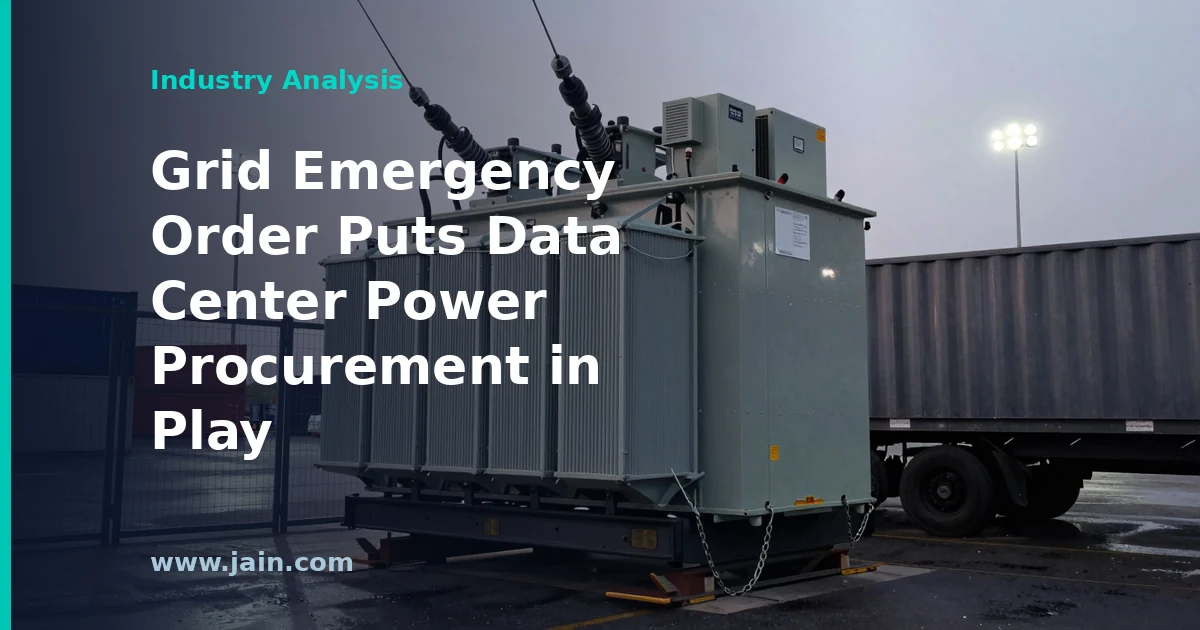
    President Trump has declared a national emergency covering the U.S. electric grid and moved to block certain foreign-made equipment from being installed on it, according to a report published by Utility Dive on May 2, 2026. The action is framed as a national-security measure aimed at hardware installed in the bulk power system — the high-voltage backbone that moves electricity from generators to local distribution networks.

    The report available to us is a headline-level summary rather than a full text of the declaration, so the operative details — which equipment classes are covered, which countries or vendors are implicated, when restrictions take effect, and whether orders already in transit are exempt — are not established by the source. What is established: an emergency has been declared, and a prohibition on some foreign-made grid equipment is being pursued.

    Executive Summary

    Emergency declarations matter in the power sector because they unlock authorities that ordinary rulemaking does not. Depending on the statute invoked, a declared emergency can let federal agencies restrict procurement, direct generation to stay online, or waive certain permitting and environmental review steps. The same declaration can therefore both accelerate some projects and constrain others — which is precisely the tension for anyone buying electrical infrastructure right now.

    For data-center developers, the constraint side is the one to watch. Large power transformers, medium-voltage switchgear, high-voltage breakers, and grid-tied inverters are long-lead items with a globally concentrated supply base. Any restriction that narrows the pool of qualified suppliers pushes demand toward domestic manufacturers whose order books are already committed to utilities. The binding constraint on a campus is rarely the servers; it is the substation.

    The measured read is that this is a supply-side policy event with delivery-schedule consequences, not a demand-side one. It does not change how much power AI and cloud buildouts need. It changes who is legally permitted to sell the hardware that delivers it, and how long the queue is to get it.

    What a Grid Equipment Lockdown Actually Touches

    “Grid equipment” is a broad phrase covering a narrow set of physically enormous objects. The category most exposed is the large power transformer — a custom-built unit, often weighing hundreds of tons, that steps voltage up or down between transmission and distribution. These are not catalog items. They are engineered to a utility’s specification, built to order, and shipped by specialized heavy haul. A second category is power electronics: grid-tied inverters that convert direct current from solar and battery systems into alternating current the grid can accept, along with the control and communications gear that supervises them.

    The security argument for scrutinizing this hardware is not exotic. Modern transformers and inverters contain embedded firmware, remote monitoring links, and control interfaces. A component installed on the bulk power system sits inside the trust boundary of critical infrastructure for decades. Whether the current declaration reflects a specific, documented threat or a precautionary posture is exactly what the underlying record would need to show — and the summary source available here does not show it either way. That is a gap in what has been published, not evidence for or against the policy.

    The counter-consideration deserves the same seriousness. Restricting suppliers on a compressed timeline can degrade reliability through a different mechanism: utilities that cannot source replacement units carry thinner spares inventories, and thin spares turn ordinary equipment failures into extended outages. A durable policy has to weigh the security risk of a compromised component against the reliability risk of a component that cannot be obtained at all. Neither risk is hypothetical, and the release as reported does not tell us how the administration balanced them.

    The Procurement Math for Data Center Developers

    Data-center power procurement is a queue problem before it is a price problem. A developer signs an interconnection agreement with a utility, and that agreement typically requires new or upgraded substation equipment. Some of that equipment the utility buys; increasingly, on large campuses, the customer buys it — sometimes ordering transformers years ahead and holding them as owner-furnished equipment. That practice exists precisely because lead times for heavy electrical gear have been the industry’s chronic bottleneck for several years, well before this declaration.

    Narrowing the approved supplier list reprices that queue in two ways. First, orders redirect toward domestic and allied manufacturers whose capacity is already substantially spoken for, extending waits for everyone in line. Second, buyers with the balance sheet to place speculative orders, pay expedite premiums, and absorb schedule slippage gain a relative advantage. That asymmetry favors hyperscalers and the largest developers over regional colocation operators and enterprise self-builds. The policy is neutral on its face; its practical incidence is not.

    The winners are more predictable than usual. Domestic transformer and switchgear manufacturers, and firms with U.S. or allied-country assembly footprints, gain pricing power and a stronger case for capacity expansion. Whether that translates into new domestic factories depends on whether they believe the restriction will outlast the administration that issued it — a genuinely open question given that grid-equipment restrictions have been issued, suspended, and revisited across previous administrations. Manufacturers finance multi-hundred-million-dollar plants on decade horizons, not on executive actions that can be reversed by the next signature.

    Interconnection Timelines and the Risk of Both Directions

    The most consequential detail, and the one the reported summary does not settle, is retroactivity. If restrictions apply only to future purchase orders, developers with equipment already ordered are largely insulated and the market effect is gradual. If they reach equipment already manufactured, in transit, or installed but not yet energized, the effect is immediate and disruptive: projects near completion could face requalification, re-sourcing, or replacement of units that cost millions and take years to rebuild. The gap between those two scenarios is the difference between a manageable procurement adjustment and a wave of schedule failures.

    Emergency authorities cut both ways here, which is why the declaration should not be read as purely restrictive. The same posture that constrains sourcing can also be used to expedite approvals, keep retiring generation available, or prioritize allocation of scarce equipment to critical loads. Whether data centers are treated as a critical load or as discretionary demand competing with residential and industrial customers is a policy choice that has not been publicly resolved — and it materially affects who gets a transformer first.

    The practical response for anyone with capital committed to a site is unglamorous: audit the country of origin and component provenance of every long-lead electrical item on order, confirm with suppliers whether their units and subassemblies would fall inside a plausible restriction, and revisit contractual force-majeure and schedule-relief language with counsel. Those steps are cheap relative to the exposure, and they are worth taking before the operative text is fully known rather than after.

    Reading a Thin Source Honestly

    One editorial note is warranted. The material available for this article is a headline and a trade-press attribution, not the text of the declaration or an accompanying order. That supports reporting the fact of the action and analyzing the mechanisms it plausibly engages. It does not support claims about scope, covered nations, dollar impacts, or effective dates, and readers should treat any coverage asserting those specifics without citing the operative document with corresponding caution.

    It also means the policy deserves evaluation on its published record once that record exists. Supporters will argue that supply-chain provenance in critical infrastructure is a legitimate and long-standing security concern that prior administrations of both parties have engaged with. Critics will argue that emergency authorities are a blunt instrument for a structural manufacturing problem, and that capacity is built by sustained industrial policy rather than by prohibition. Both arguments are testable against the actual order — its findings, its exemptions, and its waiver process. Neither is testable against a headline.

    Background

    Concern about foreign-manufactured equipment on the U.S. bulk power system predates this action. A 2020 executive order sought to restrict bulk-power-system equipment associated with foreign adversaries; it was suspended under the subsequent administration and the underlying policy question revisited, with the Energy Department separately addressing certain equipment serving critical defense facilities. The recurring theme across those efforts is that transmission-class hardware is long-lived, software-controlled, and sourced from a globally concentrated manufacturing base.

    That base has been strained independently of security policy. Sustained demand from grid modernization, renewable interconnection, electrification, and — most recently — AI and cloud data-center buildouts has pushed lead times for transformers and switchgear well beyond historical norms, making electrical equipment rather than land, capital, or chips the practical gating factor on many campuses. Any policy that changes who may supply that equipment therefore lands on a market that already had little slack.

    Source: Trump declares emergency, moves to block some foreign-made equipment from grid — Utility Dive, published May 2, 2026, reporting a national emergency declaration covering the U.S. electric grid alongside a move to prohibit certain foreign-made grid equipment.

  • Critical Infrastructure Supplier Discloses Cyberattack, Renewing Supply-Chain Fears

    Critical Infrastructure Supplier Discloses Cyberattack, Renewing Supply-Chain Fears

    A major supplier to the critical-infrastructure sector has reported a cyberattack, according to an April 28, 2026 report by trade publication Cybersecurity Dive. The syndicated report identifies the victim only as a “major critical infrastructure supplier” and, in the form available to us, provides no further detail on the company’s identity, the nature of the intrusion, or its operational impact.

    Executive Summary

    On April 28, 2026, Cybersecurity Dive reported that a major critical-infrastructure supplier had disclosed a cyberattack. Suppliers in this category — the vendors that build and service the switchgear, transformers, control systems, cooling plants, and software that power grids and data centers run on — occupy a uniquely sensitive position: a compromise at one vendor can create exposure across hundreds of downstream operators at once.

    The available report is thin on specifics, and that itself is worth noting. Early-stage incident disclosures from infrastructure vendors are often deliberately sparse while forensics are underway. But for grid operators, data-center owners, and their customers, even a bare-bones disclosure is actionable: it is the trigger to check vendor dependencies, review remote-access pathways, and press the supplier for indicators of compromise. This article lays out what the disclosure signals, why supplier breaches matter disproportionately in this sector, and the specific questions the announcement leaves open.

    Why a Supplier Breach Is Never Just the Supplier’s Problem

    Critical-infrastructure supply chains are highly concentrated. A relatively small set of vendors provides the industrial control systems (the computers that operate physical equipment like breakers, pumps, and chillers), the engineering software, and the field services that utilities and data-center operators depend on. When one of those vendors is breached, the blast radius is not one company — it is every customer whose networks the vendor can touch, whose equipment runs the vendor’s firmware, or whose engineering files sit in the vendor’s systems.

    Precedent explains why these disclosures draw immediate attention. The 2020 SolarWinds campaign turned one software vendor’s build system into a distribution channel for espionage across government and industry. The 2023 MOVEit file-transfer breach cascaded through thousands of organizations that had never heard of the underlying vendor. In the industrial world, attackers who obtain a supplier’s design documents, credentials, or remote-maintenance access gain exactly the foothold that is hardest for an operator to detect, because vendor traffic is expected and trusted.

    Reading a Thin Disclosure

    The report available to us confirms only that an attack occurred and was significant enough for a major supplier to report it. It does not — at least in the syndicated form we can verify — name the company, the attack type, or the impact. Readers should resist filling that vacuum with assumptions: “cyberattack” can span anything from a contained IT ransomware incident with no customer exposure to a compromise of systems that touch customer environments, and the difference matters enormously.

    Sparse initial disclosures are common and not inherently evasive. U.S. securities rules adopted in 2023 push public companies to disclose material cyber incidents within four business days of determining materiality — often before forensics are complete — and companies in the EU face tightened reporting duties under the NIS2 directive. The predictable result is a first announcement that confirms the incident and little else. The fair test of the supplier’s handling is not the first press release but the follow-through: whether customers receive timely indicators of compromise, whether the scope statement holds up, and whether subsequent filings expand or quietly walk back the initial account.

    What Grid and Data-Center Operators Should Do With This News

    For operators, a vendor-breach headline is a prompt to exercise the third-party-risk muscle regardless of whether this particular supplier is in their stack. The practical checklist is well established: inventory which vendors have remote access into operational networks, confirm that access is segmented and logged, verify the provenance of recent firmware and software updates, and ask key suppliers directly whether they are affected. Operators bound by NERC CIP — the mandatory cybersecurity standards for the North American bulk power system — already have supply-chain risk-management obligations that make this review an auditable expectation, not a nicety.

    Data-center operators sit in a similar position even where regulation is lighter. Modern facilities are dense with vendor-managed building-management, power-monitoring, and cooling-control systems, and the AI build-out has only deepened dependence on a fast-moving supplier ecosystem. The economic logic is straightforward: the cost of verifying vendor access paths is trivial next to the cost of an intrusion that arrives through a trusted maintenance channel.

    The Market Backdrop: Suppliers Are Now Front-Line Targets

    This disclosure lands in a market where infrastructure suppliers are under sustained pressure from both criminal and state-aligned actors, precisely because they aggregate access to many high-value environments. Governments have responded with overlapping reporting regimes — the SEC’s disclosure rule, the U.S. CIRCIA incident-reporting framework being implemented through CISA, and NIS2 in Europe — which means more of these announcements, not fewer, should be expected. That is arguably healthy: a steady stream of disclosures is evidence of reporting obligations working, not necessarily of a sector suddenly getting worse.

    For buyers, the durable takeaway is that supplier cybersecurity is now a procurement criterion with teeth. Operators increasingly demand software bills of materials (a machine-readable list of a product’s software components), contractual breach-notification windows, and evidence of secure development practices. Suppliers that can demonstrate mature incident response — including candid, detailed disclosure — are turning security into a competitive differentiator rather than a compliance cost.

    Background

    Critical infrastructure — power grids, data centers, water systems, telecommunications — runs on equipment and software from a concentrated set of specialist suppliers, and those suppliers have become prime cyber targets because one intrusion can yield access to many downstream operators. Landmark incidents shaped today’s defenses: the 2020 SolarWinds software-supply-chain campaign, the 2021 Colonial Pipeline ransomware shutdown, and the 2023 MOVEit breach that cascaded through thousands of organizations. In response, governments layered on reporting and supply-chain security mandates, including the SEC’s 2023 cyber-disclosure rule, NERC CIP standards for the North American grid, the U.S. CIRCIA reporting framework, and the EU’s NIS2 directive — making public disclosures like the one reported here an increasingly routine, and increasingly scrutinized, part of the infrastructure landscape.

    Source: Major critical infrastructure supplier reports cyberattack — Cybersecurity Dive, April 28, 2026, reporting a cyberattack disclosure by an unnamed major critical-infrastructure supplier.

  • US Warns of Active Cyber Threat to Critical Infrastructure: What to Check Now

    US Warns of Active Cyber Threat to Critical Infrastructure: What to Check Now

    The US government has warned of an active cyber threat targeting critical infrastructure, according to an April 20, 2026 report from Fox Business circulated via Google News. The warning puts operators across essential sectors — power, water, communications, transportation, and the data facilities that underpin them — on notice that a threat is currently in play, not merely theoretical.

    The public report is headline-level: it does not identify the issuing agency, the threat actor, the targeted sectors, or specific technical indicators. That thinness is itself the operative fact for operators deciding how to respond.

    Executive Summary

    According to the April 20, 2026 Fox Business report, US authorities issued a warning about an active cyber threat aimed at critical infrastructure. In federal parlance, “critical infrastructure” covers the systems whose disruption would harm national security, the economy, or public health — the electric grid, water treatment, pipelines, communications networks, and increasingly the data centers those sectors depend on.

    The word that matters is active. Federal agencies publish a steady stream of routine hygiene advisories; a warning framed around an active threat signals that adversary activity is believed to be underway now, which shifts the operator posture from “patch on your normal cycle” to “go look for this in your environment.”

    Because the public reporting carries no technical detail, the immediate task for infrastructure and data center operators is twofold: obtain the underlying federal advisory through official channels, and in parallel run the baseline checks that hold up regardless of which actor or technique the warning concerns — remote access, network segmentation, logging, and incident readiness.

    Why “Active Threat” Is the Operative Phrase

    Federal cyber communications come in tiers. At the low end are routine vulnerability notices and best-practice guides. At the high end are alerts that adversaries are actively exploiting systems in the wild. The Fox Business headline places this warning in the second tier, and that framing — if it accurately reflects the underlying government language — carries urgency: it implies intrusions or exploitation attempts are happening now, and that defenders should hunt for evidence of compromise rather than simply harden for the future.

    What the public report does not substantiate is equally important. There is no named agency, no named threat actor, no list of affected sectors, and no indicators of compromise in the material available. Operators should treat the headline as a prompt to retrieve the authoritative advisory — typically published through official government channels and sector information-sharing bodies — rather than as an actionable document in itself. Acting on a headline alone risks both over-reaction and misdirected effort.

    Critical Infrastructure’s Expanding Attack Surface

    The reason these warnings recur is structural. Operational technology (OT) — the industrial control systems that open breakers, run pumps, and manage chillers — was designed for reliability over decades, not for exposure to the internet. As utilities and facility operators connected those systems to corporate IT networks for monitoring and efficiency, they inherited IT’s threat landscape without IT’s patch cadence. Remote-access pathways added for vendors and after-hours staff are, year after year, among the most common ways attackers get in.

    Data centers sit on both sides of this equation. They are critical infrastructure in their own right — hosting the workloads of banks, hospitals, and government — and they are industrial facilities full of OT: building management systems, power distribution units, generators, and cooling plants. A federal warning about critical infrastructure is therefore a data center issue twice over: once for the tenants’ systems, and once for the physical plant that keeps them running.

    What Operators Should Check Now

    Absent specific indicators, the highest-value moves are the ones that blunt most intrusion campaigns regardless of actor. First, inventory every remote-access pathway — VPNs, vendor jump boxes, remote desktop exposure — and confirm multi-factor authentication is enforced on each, with unused accounts disabled. Second, verify that OT and building-management networks are genuinely segmented from corporate IT, so a compromised laptop cannot reach a chiller controller. Third, confirm internet-facing systems are patched and that logging is enabled, centralized, and retained long enough to support a look-back investigation.

    Beyond the technical checklist, operators should confirm their connection to official channels: sector-specific information sharing and analysis centers (ISACs) and government advisory feeds are where the technical detail behind a headline warning normally lands. Finally, this is a reasonable moment to dust off the incident-response plan — who gets called, how systems are isolated, and how the facility runs if IT systems must be taken offline. The cost of these checks is modest; the cost of discovering mid-incident that a vendor VPN had no MFA is not.

    Background

    Warnings about cyber threats to US critical infrastructure have become a recurring feature of the national security landscape. Over the past decade, federal agencies — chiefly the Cybersecurity and Infrastructure Security Agency (CISA), often jointly with the FBI and NSA — have repeatedly cautioned that both criminal ransomware groups and state-sponsored actors probe and, in some cases, pre-position inside the networks of utilities, pipelines, and other essential services. High-profile incidents, such as the 2021 ransomware attack that disrupted a major US fuel pipeline, demonstrated that cyber events can produce real-world physical and economic consequences.

    The persistent vulnerability stems from the convergence of information technology and operational technology: control systems designed decades ago for isolated operation are now reachable, directly or indirectly, from corporate networks and the internet. That is why federal warnings, whatever their specific trigger, tend to converge on the same defensive fundamentals — secured remote access, network segmentation, patching, logging, and rehearsed incident response.

    Source: US warns of active cyber threat targeting critical infrastructure — Fox Business report, April 20, 2026, on a federal warning of active cyber activity aimed at US critical infrastructure.