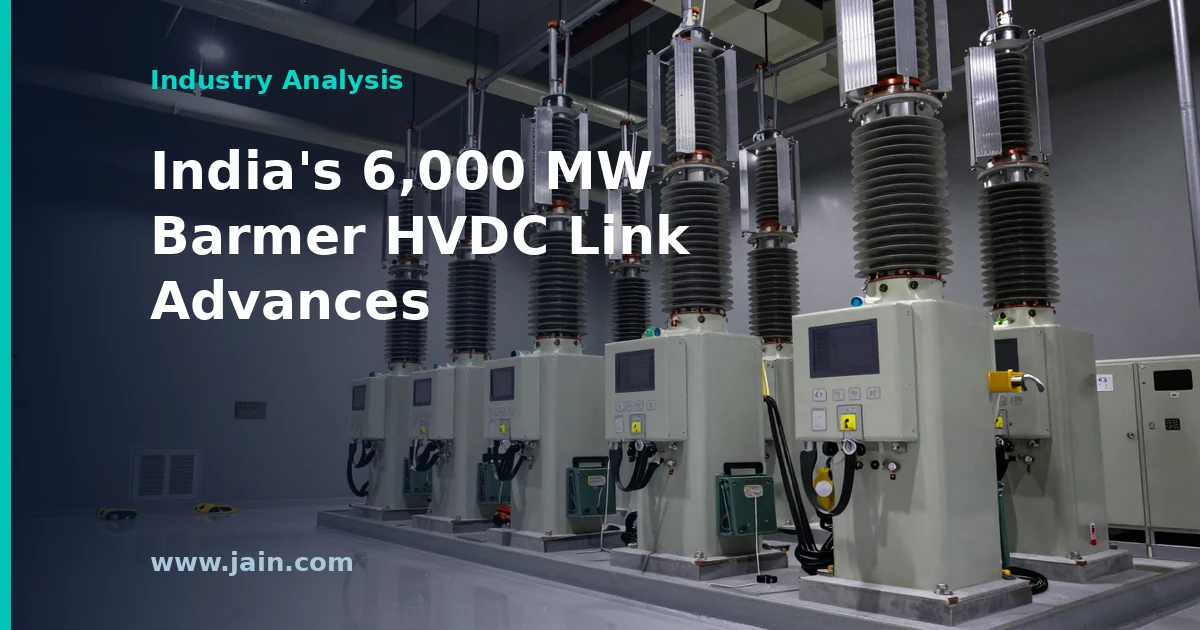
India’s state-controlled power-line company has won a project worth about 25,000 crore rupees, very roughly three billion US dollars, to build an electricity superhighway starting in Barmer, a desert district of Rajasthan crowded with solar and wind farms.
The line is designed to carry 6,000 megawatts, roughly the output of several large power stations. The Indian arm of the American company GE Vernova is reported to be the front-runner to supply the giant equipment at each end.
Why it matters: clean electricity is worthless if it cannot reach the cities, factories and data centers that need it.
Power Grid Corporation of India has secured the Barmer–South Kalamb high-voltage direct current (HVDC) transmission project, a 6,000 megawatt link valued at ₹25,000–₹26,000 crore (₹250–260 billion), Sahi Markets reported on September 7, 2026. The same report said GE Vernova T&D India emerged as the top bidder for the project’s terminal station equipment package, the converter stations that sit at either end of the line.
GE Vernova T&D India, the listed Indian subsidiary of GE Vernova, already carries an order backlog of ₹20,930 crore. Neither company has publicly confirmed the equipment award, its value or a construction schedule.
Executive Summary
The Barmer–South Kalamb award is one of the larger single transmission projects in India’s current build-out. At 6,000 megawatts, it is sized to move bulk renewable output from western Rajasthan, where land and sunshine are plentiful but local demand is modest, across long distances to consuming regions. HVDC is the technology of choice for that job because direct current loses less energy over long distances than conventional alternating current lines and lets grid operators control exactly how much power flows.
For the equipment supply chain, the significance is concentration. The terminal stations are the most technically demanding and valuable part of an HVDC system, and only a small number of manufacturers worldwide can deliver them. If GE Vernova T&D India’s reported position converts into a signed contract, it would add a substantial project to a backlog that is already more than four-fifths the size of the entire transmission scheme’s reported value.
For data center developers and other large power buyers, the story is a reminder that India’s clean-energy constraint is shifting from generation to delivery. Wind and solar capacity can be built in a few years; the transmission corridors that carry it to load centers take longer and depend on a thin supplier base.
Transmission Is Becoming the Scarce Asset
Renewable generation in India has clustered where resources are best, and Rajasthan’s Barmer region is a prime example. The problem is that the electricity is needed hundreds of kilometers away. Without enough transmission, solar and wind farms face curtailment, meaning they are ordered to cut output because the grid cannot absorb it. That makes long-distance corridors, rather than panels or turbines, the practical limit on how fast clean power reaches customers.
A 6,000 megawatt HVDC link is a direct response to that constraint. Unlike a conventional AC line, which spreads power across the network according to physics, an HVDC link behaves more like a pipeline with a valve: operators set the flow. That controllability is valuable for managing variable renewable output and for keeping regional grids stable as more intermittent supply is added.
A Narrow Supplier Base Holds Pricing Power
Converter stations, the equipment that turns alternating current into direct current and back again, are built by a small club of global manufacturers. That scarcity cuts two ways. Suppliers with local manufacturing and engineering capability, as GE Vernova T&D India has, are well placed to win work as India expands its HVDC pipeline. Buyers, meanwhile, face long lead times for transformers, valves and control systems, and limited competition on price.
A large existing backlog is both a strength and a question. The reported ₹20,930 crore order book signals demand visibility, but it also means new projects compete for the same factory slots, engineers and commissioning crews. Execution capacity, not order intake, is often what separates strong years from delayed ones in heavy electrical equipment.
What It Means for Data Center Power
India’s data center market is growing alongside rising demand for cloud and AI computing, and operators increasingly want renewable supply to meet customer sustainability targets. Most large campuses sit near major cities and connectivity hubs, not in the desert where renewable power is cheapest to generate. Corridors like Barmer–South Kalamb are what make long-distance renewable procurement, through open-access or power purchase arrangements, physically deliverable.
The project has not been tied to any specific data center or industrial customer, and it would be a stretch to read it as a data center announcement. The more measured takeaway is structural: large power buyers planning multi-year expansions in India should treat transmission timelines as a core site-selection and procurement risk, alongside land, water and fiber.
Background
India is building out large volumes of solar and wind capacity, much of it in resource-rich western states such as Rajasthan and Gujarat, far from major consumption centers. Moving that power requires new high-capacity transmission corridors, and HVDC links are increasingly used for the longest, highest-volume routes. Power Grid Corporation of India, the state-controlled central transmission utility, builds and operates much of this interstate network.
GE Vernova T&D India is the Indian-listed transmission and distribution subsidiary of GE Vernova, the energy equipment company spun off from General Electric. It manufactures and supplies grid equipment such as transformers, switchgear and HVDC systems, and it has benefited from utilities’ rising investment in grid expansion and modernization.
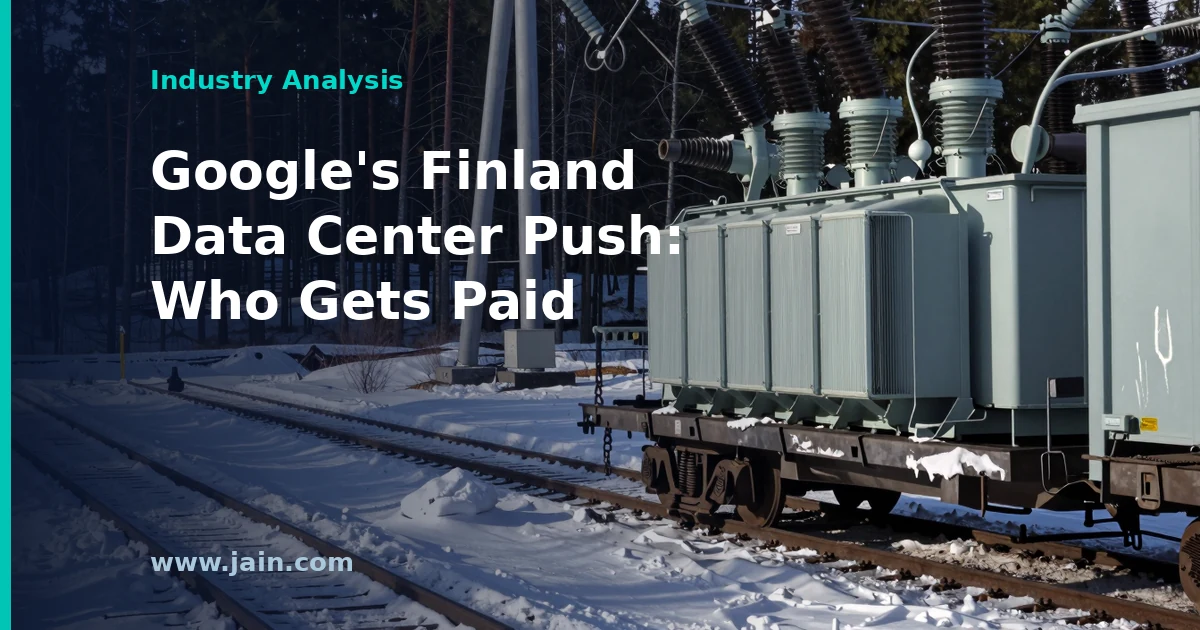
Google’s parent company is spending around 13 billion euros on data centers in Finland. These are warehouse-sized buildings packed with computers that run artificial intelligence.
Finland is cold, and that matters. For much of the year the outside air is enough to stop the machines overheating, so far less power goes to air conditioning. The country also has plenty of low-carbon electricity.
Investors are now guessing who gets paid. One small Finnish firm connects these sites to the power network. Two much larger American firms supply electricity and build hardware, but neither has said it does any work in Finland.
Simply Wall St reported on September 10, 2026 that an Alphabet-backed €13 billion push into Finnish AI data centers has turned a quiet corner of the Nordic market into a live test of how digital infrastructure and power providers absorb sudden, large-scale demand. The article named three stocks as the most directly exposed to the theme: US independent power producer Vistra, Finnish grid and connectivity contractor Enersense International Oyj, and contract manufacturer Flex. A screen behind the article surfaced 39 further companies tied to data center build-outs and grid upgrades.
The three names sit at very different points on the value chain and at very different sizes. Vistra carries a market capitalisation of about US$50.9 billion on roughly US$19.2 billion of revenue and supplies power and gas to around 5 million customers. Flex is valued at about US$42.2 billion and reports US$7.2 billion of revenue from Cloud and Power Infrastructure, US$11.6 billion from Integrated Technology Solutions and US$10.5 billion from Regulated Manufacturing Solutions. Enersense, the only one of the three actually operating in Finland, is worth about €71 million and books roughly €189 million of revenue there.
Executive Summary
The story is less about Google than about who converts a headline capital number into invoiced work. A €13 billion programme in Finland implies years of substations, transmission connections, transformers, switchgear, cooling plant and rack integration long before a single model is trained. The market’s instinct is to reach for liquid, well-known proxies. The names investors actually reach for are not always the ones standing next to the excavator.
Of the three stocks in focus, only Enersense has disclosed Finnish data center power work. It supplies power integration for atNorth’s 430 megawatt FIN04 site and works on projects for Finland’s national transmission operator. Vistra’s relevance is thematic and American: it signed 20-year power purchase agreements in January 2026 to supply Meta with more than 2,600 megawatts of nuclear electricity across three plants in the PJM grid region, described as the largest nuclear uprate ever underwritten by a single corporate customer. Flex’s relevance runs through hardware, and through its May 2026 plan to spin its Cloud and Power Infrastructure division into a separate listed company.
For infrastructure buyers, the signal worth taking is that the Nordic constraint has shifted. The scarce inputs are no longer cheap land and cold air, which Finland has always had. They are grid connection capacity, transformer lead times and the engineering firms qualified to do the interconnection work. That is where a small contractor with a €71 million market value becomes strategically interesting and financially fragile at the same time.
Why Finland Keeps Winning the Power-and-Cooling Argument
Finland’s advantage starts with physics. In a hot climate, a data center spends a large share of its electricity running mechanical chillers to remove the heat its servers produce. In a cold one, outside air does much of that work for free for most of the year, a technique the industry calls free cooling. The result shows up in power usage effectiveness, the ratio of total facility power to the power actually consumed by computing equipment. A lower ratio means less electricity wasted on overhead, and in the Nordics it is structurally lower than in Virginia, Texas or Singapore.
The second advantage is the grid itself. Finland’s electricity is heavily nuclear, hydro and wind, which suits hyperscalers with carbon-free energy commitments, and its industrial history left heavy transmission connections in places that once served paper mills and smelters. Fingrid, the national transmission system operator, is the gatekeeper for connecting large new loads, and interconnection work is exactly what Enersense sells. The atNorth FIN04 site, at 430 megawatts, is evidence that a genuine Finnish cluster is forming rather than a single anchor tenant.
There is a real limitation, and it is geographic. Finland is far from Europe’s population centres, which adds network latency, the delay between a user’s request and the response. That matters little for training large models, which is a batch process indifferent to a few extra milliseconds, and matters considerably more for latency-sensitive inference serving consumers. A Nordic strategy is therefore usually a training and heavy-compute strategy, with inference capacity placed closer to users. Investors reading a €13 billion figure as evenly distributed European capacity are reading it too generously.
One of These Three Actually Works in Finland
Enersense designs and builds grid connections, substations and storage, generating roughly €81 million from Connectivity and €63 million from Energy Transition. Set its €71 million market capitalisation against a €13 billion programme and the asymmetry is obvious: even a rounding error of that capital budget, landing as contract revenue, would be transformative. That asymmetry is precisely why such stocks move violently on thematic news, and why the move often runs ahead of any awarded work.
The harder question is capacity rather than opportunity. Large interconnection projects consume working capital before they generate cash, require performance bonding, and expose a contractor to fixed-price risk on materials with long and volatile lead times, transformers and high-voltage switchgear above all. A company of this size has limited balance sheet with which to absorb a cost overrun on a marquee project. The upside of being small in a big theme and the risk of being small in a big theme are the same fact viewed from two sides.
Vistra and Flex, by contrast, have no disclosed Finnish operations. The argument for including them is a demand argument rather than a geographic one: AI data center build-outs lift power producers and infrastructure manufacturers wherever they occur. That is a defensible thesis, but it is a different thesis from the headline. An investor buying Vistra on a Finland story is buying US merchant power exposure with a European narrative attached, and should price it accordingly.
The Power Trade Is Mostly a United States Trade
Vistra’s appeal to this theme rests on dispatchable generation, meaning plants that can be turned up or down on command rather than depending on wind or sun. Data centers need power that is available every hour, and the fleets capable of contracting that reliably for decades are few. The January 2026 agreements with Meta illustrate the model: more than 2,600 megawatts of nuclear output committed for 20 years across three plants in PJM, the market coordinating electricity across much of the US mid-Atlantic and Midwest. A nuclear uprate, in this context, means raising an existing reactor’s output rather than building a new one, which is faster and cheaper than greenfield construction.
The revenue mix repays a closer look. Retail contributes about US$14.9 billion and Texas roughly US$7.8 billion against US$19.2 billion of total revenue, which is normal segment reporting where internal sales are eliminated at the group level, but it is a reminder that Vistra is substantially a retail energy business with a generation fleet attached, not a pure merchant generator. The AI narrative attaches to one part of the enterprise, not all of it.
The central risk is duration. Twenty-year contracts convert a commodity business into something resembling an infrastructure annuity, and the market has increasingly valued it that way. That re-rating rests on assumptions about long-term data center load growth and contracted pricing holding. If load growth arrives slower than forecast, or if new supply and grid upgrades compress scarcity pricing, the earnings power implied by today’s valuation becomes harder to defend. Long contracts protect the volumes already signed. They do not protect the multiple applied to everything not yet signed.
Flex, the Spin-Off, and the Appetite for Pure Plays
Flex builds the unglamorous physical layer: power distribution, cooling systems and rack integration that sit behind hyperscale spending. Its Cloud and Power Infrastructure division generates US$7.2 billion, roughly a quarter of the approximately US$29.3 billion across its three reported segments. The May 2026 plan to separate that division into an independent public company is the clearest structural response yet to a valuation problem facing every diversified manufacturer with an AI-exposed unit.
The logic is straightforward. Investors will pay a higher multiple for a focused data center infrastructure supplier than for a conglomerate that also makes automotive and healthcare hardware, and separation surfaces that value rather than averaging it away. Public markets have limited direct ways to own the power and cooling hardware layer, so a listed pure play should find willing buyers.
The trade-off is that concentration removes the cushion. A standalone data center infrastructure business carries the full weight of hyperscaler capital expenditure cycles, customer concentration among a small number of very large buyers, and the working capital intensity of ramping production against lumpy orders. The remaining business loses its highest-growth story and must be valued on its own merits. Both halves face a market test that the combined company never had to sit.
Background
Finland has attracted large-scale computing for well over a decade. Google has run a data center campus at Hamina, on the southern coast, since converting a former paper mill site there, and the country has since drawn a wider cluster of operators including atNorth. The appeal has been consistent: a cold climate that reduces cooling load, a largely nuclear, hydro and wind electricity mix, and industrial sites already served by heavy transmission infrastructure. Fingrid operates the national transmission grid and controls the connection process for very large new loads, which makes interconnection engineering a bottleneck resource rather than a commodity service.
The companies now attached to the theme come from three different traditions. Enersense is a Finnish engineering and contracting business that grew out of energy and telecom infrastructure work and now sits at the junction of grid upgrades, storage and data center power connections. Vistra emerged from the restructuring of the Texas utility sector into one of the largest US independent power producers and retail energy suppliers, and has spent the past two years converting nuclear and gas capacity into long-dated corporate contracts. Flex is a decades-old contract manufacturer that built its business assembling hardware for others and has recently found its power and cooling systems unit growing faster than the rest of the group.
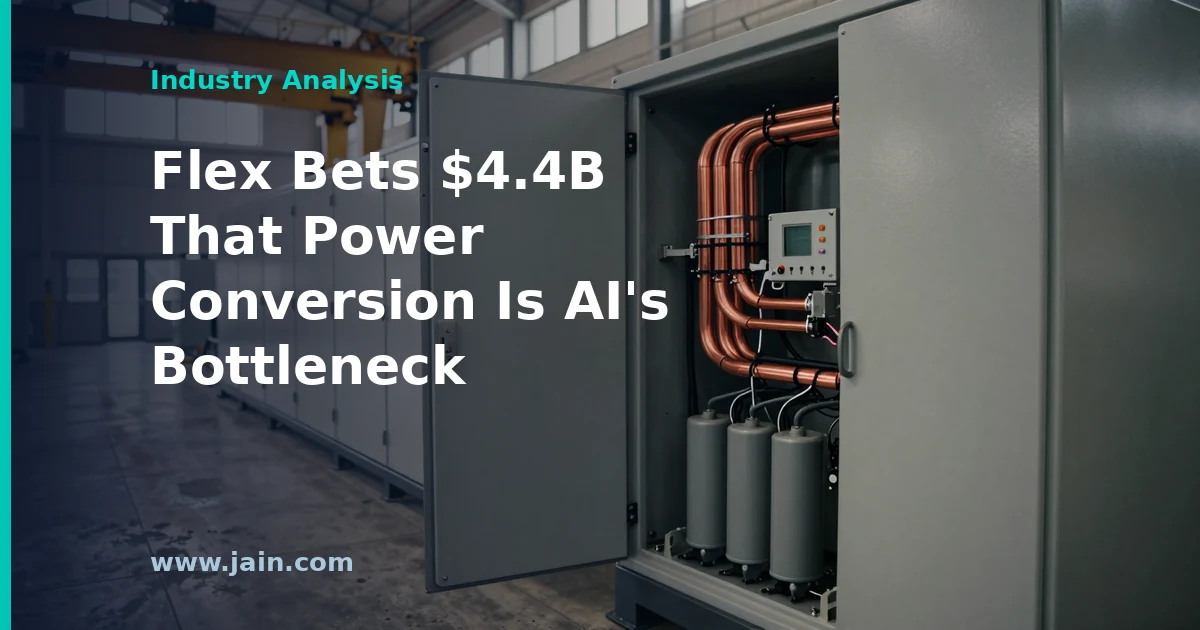
Flex, a company that builds and assembles products for other big brands, is paying $4.4 billion in cash for EPC Power, a California maker of equipment that converts electricity into the exact form computers can use.
Why care? The machines that run artificial intelligence swallow enormous amounts of electricity, and the unglamorous boxes that deliver it cleanly have become the hard part to get. Flex is betting the shortage is in the electrical plumbing, not the chips.
The deal is expected to be completed by the end of 2026.
Flex Ltd. (NASDAQ: FLEX) has agreed to acquire EPC Power Corp., a Poway, California designer and manufacturer of power conversion systems, for $4.4 billion in cash. The parties signed a Stock Purchase Agreement on September 3, 2026, under which Flex subsidiary ACS Acquisitions, Inc. buys all equity in EPC Power from Charge Parent, LLC, the holding vehicle for controlling shareholders Goldman Sachs Alternatives and Cleanhill Partners. Flex disclosed the agreement in an 8-K filed with the SEC on September 4, and is a party to the contract solely to guarantee its subsidiary’s obligations.
Flex’s announcement puts EPC Power’s calendar 2026 revenue at approximately $800 million, with roughly 40% organic growth expected in 2027 and EBITDA margin expanding by double-digit percentage points to approximately 30% that year. EPC Power says it has more than 15 GW deployed across 62 countries, and that annual U.S. manufacturing capacity will surpass 30 GW in 2027. The transaction is expected to close in the fourth quarter of 2026, subject to Hart-Scott-Rodino antitrust clearance and other customary conditions, after which EPC Power joins Flex’s Cloud and Power Infrastructure segment.
Executive Summary
This is a contract manufacturer paying a technology-company price. Flex has built its business designing and building hardware for other brands; EPC Power builds the equipment that sits between the grid and the server rack — rectifiers, DC-DC converters and grid-forming inverters, with solid-state transformers described in Flex’s announcement as planned development. Flex’s stated thesis, in CEO Revathi Advaithi’s words, is that “a generational shift in power architecture is underway,” and that owning the conversion layer lets Flex sell data center infrastructure as an integrated system rather than as parts.
The financial architecture matters as much as the strategic one. The 8-K describes a “locked box” structure in which EPC Power’s enterprise value was fixed as of June 30, 2026, with contractual protections against value leakage until closing — a mechanism common in private equity exits that gives the seller price certainty. Flex simultaneously signed a commitment letter with Citigroup Global Markets, Bank of America and BofA Securities for a senior unsecured 364-day bridge facility of up to $4.4 billion, a backstop it expects to replace with a permanent mix of debt and equity.
The timing is the sharpest detail. Flex states in both the 8-K and its announcement that EPC Power will land inside the Cloud and Power Infrastructure business, which Flex plans to separate into an independent public company in the first calendar quarter of 2027 — weeks after the acquisition is expected to close. Flex is, in effect, buying a $4.4 billion asset and then handing it to shareholders in a new vehicle.
The Bottleneck Moved Downstream of the Chip
For three years the constraint on AI buildouts was accelerators. The constraint discussed in this transaction is different: getting utility power into a building fast, and then converting it into something a rack of GPUs can drink without destabilizing the neighborhood grid. AI training and inference clusters draw power in large, fast swings — thousands of processors ramping together — which is closer to an industrial arc furnace than to the steady hum of a traditional colocation hall. EPC Power’s marketing centers on exactly this problem, and Flex is paying for the claim that solving it is a durable business rather than a moment.
The technical hook is the shift toward 800-volt DC distribution inside the data center. Conventional facilities step voltage down repeatedly and convert between alternating and direct current several times before power reaches a chip, losing a slice at each stage; higher-voltage DC architectures cut the number of conversions and the copper needed to carry the current. Flex’s announcement says EPC Power’s platform is engineered for these architectures with capabilities across rectifiers and DC-DC conversion. The grid-forming piece is complementary: most inverters follow the grid, matching a frequency someone else sets, while grid-forming units can establish voltage and frequency themselves, which is what lets a site run on batteries through a disturbance or energize before the utility interconnection is fully mature.
What $4.4 Billion Buys, Priced Against Flex’s Own Forecast
Work the disclosed numbers and the price becomes legible. Against approximately $800 million of calendar 2026 revenue, $4.4 billion is roughly 5.5 times sales. Apply the stated 40% organic growth and 2027 revenue lands near $1.1 billion; at the stated approximately 30% EBITDA margin, that implies something in the neighborhood of $330 million of 2027 EBITDA, or about 13 times forward earnings before interest, taxes, depreciation and amortization. Those multiples are derived arithmetic from Flex’s own projections, not company-stated figures, and they hold only if both projections land.
The margin guidance contains its own admission. If EBITDA margin expands by “double-digit percentage points” to reach approximately 30%, the 2026 margin is by definition 20% or below. Flex is paying today for a profitability structure that does not yet exist, on the expectation that mix shift toward data center product and scale in U.S. manufacturing delivers it. That is a defensible bet in a supply-constrained market — pricing power tends to follow scarcity — but it is a bet, and it is the single assumption most worth revisiting when the combined business reports actual results.
Buying an Asset You Plan to Give Away
Flex has told investors it will separate its Cloud and Power Infrastructure portfolio into an independent public company in the first quarter of 2027. EPC Power is being bought into that segment in the fourth quarter of 2026. The sequencing is deliberate: it makes the entity that goes public materially larger, faster-growing and more differentiated than it would otherwise be, and it moves the story of that company from “builds infrastructure hardware to order” toward “owns the power conversion layer.”
It also raises a capital-structure question that the filings flag rather than answer. Flex says it is evaluating financing alternatives and expects a combination of debt and equity, with committed financing from Citi and Bank of America standing behind it. Which balance sheet ultimately carries that debt — Flex’s or the new company’s — shapes both entities. Flex’s own forward-looking statement language lists the ability to achieve anticipated capital structures, credit ratings and financing in connection with the spin-off among its risks, which is an unusually direct acknowledgment that the two transactions are financially entangled. There is also a calendar risk: the purchase agreement’s outside date is December 31, 2026, subject to two automatic three-month extensions, meaning a slow antitrust review could push closing past the intended separation date.
Domestic Manufacturing as the Second Product
EPC Power’s pitch is not only technical. Flex describes U.S.-based engineering and manufacturing, and EPC Power’s own announcement says it expanded its domestic manufacturing footprint nearly tenfold under Goldman Sachs Alternatives and Cleanhill Partners, which first invested in 2021. In a market where electrical equipment lead times are a scheduling input and where tariff exposure and procurement rules increasingly favor domestic content, capacity located in the United States is a commercial asset in its own right, distinct from the merits of the hardware.
For buyers, the practical consequence is consolidation of the supply chain. A hyperscaler or colocation developer that previously bought conversion equipment, cooling and IT integration from separate vendors can, in principle, buy a larger integrated block from one supplier — faster to specify, but a heavier dependency. For other electronics manufacturing services firms, the transaction sets a marker: this asset was priced as differentiated intellectual property, not as assembly capacity, and the pool of independent power conversion specialists available to buy is not deep. For established power-equipment vendors, a well-capitalized new competitor now sits inside a manufacturing organization with a footprint spanning 30 countries.
Background
Flex Ltd. is one of the largest electronics manufacturing partners in the world, designing and building products for other brands across a footprint spanning 30 countries. In recent years it has pushed beyond assembly into data center power, cooling and IT infrastructure, organizing that work in a Cloud and Power Infrastructure segment that it has told investors it intends to separate into a standalone public company in the first quarter of 2027. Acquiring a power conversion specialist into that segment shortly before separation changes what the new company will look like on its first day of trading.
EPC Power was founded in 2010 in California and spent most of its life supplying inverters to the utility-scale battery storage market. Cleanhill Partners invested in 2021 on the thesis that power conversion would become critical as renewables, grid modernization and digital infrastructure converged; Goldman Sachs Alternatives later joined as a controlling shareholder. AI data centers then arrived as a second, larger market for the same core competence, because a building drawing power in large, rapid swings needs the same conversion and grid-stabilization hardware that a battery plant does — which is the convergence Flex is paying for.
Reuters reported on July 12, 2026, citing sources, that the White House intends to rally electric utilities and data center operators behind a pledge addressing the power costs associated with artificial intelligence. The report frames the effort as a response to growing concern that the AI build-out is putting upward pressure on electricity bills.
No official announcement accompanied the report, and the text, participants, and timing of any pledge had not been made public at the time of writing.
Executive Summary
According to the Reuters report, the administration is convening two industries whose interests increasingly collide on the electric grid: the utilities that must build generation and transmission to serve surging demand, and the hyperscale data center operators whose AI workloads are driving much of that demand. A “power cost pledge” — the report’s shorthand — suggests a voluntary commitment aimed at reassuring the public that households will not shoulder the cost of AI’s electricity appetite.
The move matters because it signals that data center power demand has fully crossed from an industry planning question into a national political one. When the White House feels compelled to broker a public commitment on electricity costs, it reflects pressure from ratepayers, state regulators, and elected officials who are hearing about rising bills from constituents.
It also matters for what it is not: a report based on unnamed sources, describing a voluntary pledge whose contents are unknown. Whether this becomes a substantive cost-allocation framework or a reputational exercise depends entirely on details that had not yet been disclosed.
Why Electricity Bills Became an AI Problem
The AI boom has made data centers one of the fastest-growing sources of new electricity demand in the United States, reversing roughly two decades in which overall power consumption was largely flat. Serving that growth requires new power plants, new transmission lines, and grid upgrades — and under traditional utility regulation, those costs are spread across all customers through rates approved by state commissions. That is the mechanism at the heart of the ratepayer backlash: households can end up helping pay for infrastructure built primarily to serve a handful of very large industrial customers.
Utilities and data center operators counter that large customers typically sign long-term contracts, often pay for dedicated interconnection upgrades, and can anchor investments that benefit the whole grid. Both framings contain truth, and which one dominates in a given state depends on tariff design — the specific rate structures regulators approve. A federal pledge would be entering a debate that is normally fought state by state, utility by utility.
What a Voluntary Pledge Can — and Cannot — Do
Voluntary pledges are a familiar Washington instrument: they move quickly, require no legislation, and give all parties a public commitment to point to. If the pledge commits data center operators to pay the full incremental cost of serving their load — through special tariff classes, minimum-take contracts, or funding their own generation — it could genuinely shift cost risk away from households. Several utilities and states have already been moving in this direction through large-load tariffs, so a pledge could standardize and accelerate an existing trend.
The limits are equally clear. A pledge cannot override state ratemaking authority; electricity rates are set by state public utility commissions, not the White House. It carries no enforcement mechanism unless one is built in. And “power cost” commitments are only as strong as their accounting: transmission, capacity, and reliability costs are notoriously difficult to attribute to a single customer class, which gives every party room to claim compliance. Analysts and consumer advocates will reasonably ask who verifies the math.
Winners, Losers, and the Politics of Grid Cost Allocation
For hyperscalers, a pledge is likely a price worth paying. Their binding constraint is speed of interconnection — how fast new facilities can get grid connections and power. A public commitment on costs could defuse local opposition and regulatory friction that currently slow projects. For utilities, the calculus is similar: demand growth is the best earnings story the sector has had in decades, and anything that keeps the political environment permissive protects that story.
The open question is what ratepayer advocates get. If the pledge produces binding tariff structures and transparent cost attribution, consumers benefit. If it produces language without accounting, the underlying dispute simply resurfaces in the next rate case. Smaller data center operators and AI startups also warrant attention: cost-allocation rules designed around hyperscalers can inadvertently raise barriers for firms without the balance sheet to fund their own substations or sign decade-long power contracts.
Background
Since the generative AI boom began in late 2022, hyperscale cloud providers and AI companies have raced to build data center capacity across the United States, turning electricity availability into the industry’s defining constraint. After decades of roughly flat national power demand, utilities now face sustained load growth, and the question of who pays for the required generation and transmission has become a flashpoint in state rate cases and local permitting fights.
Both federal and state policymakers have increasingly engaged with the issue — from grid interconnection reform to utility proposals for special large-load tariffs — as electricity affordability has risen on the political agenda. The reported White House pledge effort sits squarely in that context: an attempt to get ahead of ratepayer backlash without new legislation.
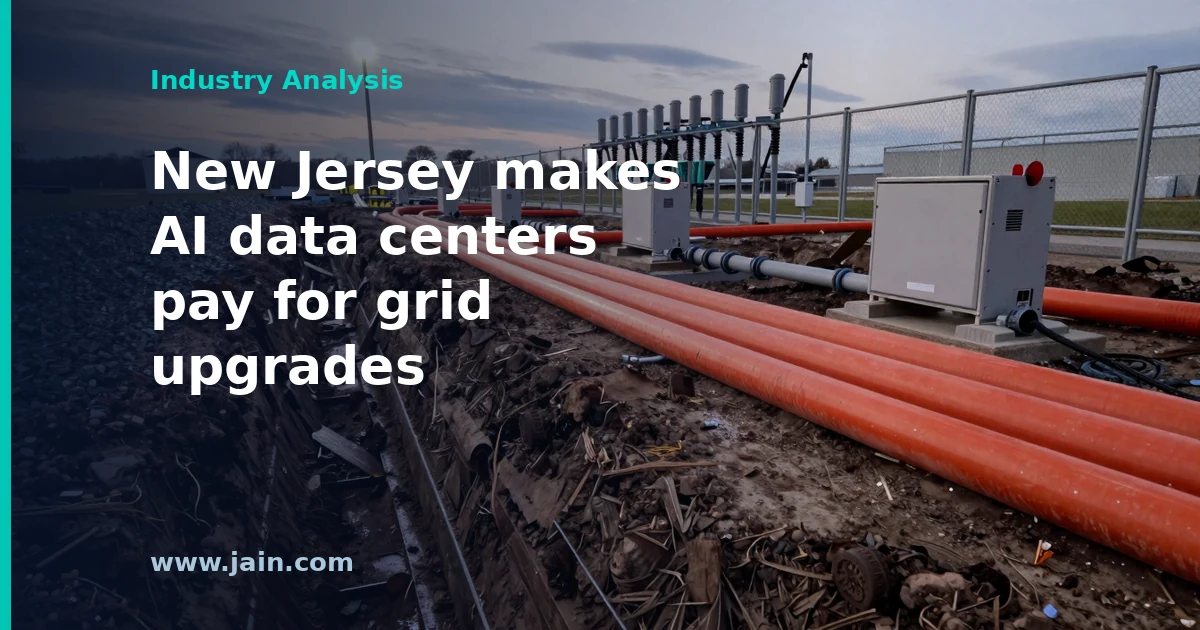
New Jersey’s governor has signed a law that makes large data centers, the warehouse-sized buildings full of computers that run artificial intelligence and online services, pay for the power lines and equipment they need.
Until now, families worried those costs would land on their own electric bills. Power prices in the state have already climbed more than 16 percent since 2024.
The catch for tech companies: plugging into the grid in New Jersey now costs them more directly, and that could shape where they choose to build.
New Jersey Gov. Mikie Sherrill signed a package of energy legislation in the week of July 6, 2026, WHYY reported. The centerpiece creates a separate electricity ratepayer class for data centers and requires them to pay for the electrical and clean energy infrastructure upgrades their projects create. The goal is to keep those costs from being passed on to households and small businesses.
The package also includes a “Repeal ROE Adder” bill, which requires electric utilities to join the regional grid and bars them from charging customers an extra “bonus” for doing so. It also includes the Advanced Grid Technologies Act, which directs state utility regulators to scrutinize “supplemental” grid projects and speeds approval of projects that use advanced transmission technologies.
Executive Summary
New Jersey has written into law a principle that is fast becoming the central fight of the AI buildout: who pays when a data center needs the grid to grow. By putting data centers in their own rate class and assigning them the cost of the upgrades they trigger, the state turns what could have been a cost spread across all customers into a line item on the developer’s budget.
The political backdrop is electricity prices. Rates in New Jersey have risen more than 16% since 2024, according to a U.S. Senate committee report, and the U.S. Energy Information Administration counted 128,828 electricity shutoffs in the state in 2024. PJM Interconnection, which runs the regional grid, has cited data center growth as one reason for higher bills.
The Data Center Coalition says its members are committed to paying the full cost of the energy they use. Its concern is that the law’s structure could make New Jersey less predictable and less competitive. The details regulators write next will largely decide which side’s expectations prove right.
Grid Upgrades Move From the Shared Bill to the Project Budget
The mechanism is simple to state. A “rate class” is a group of customers that a utility bills under the same set of prices; residential, commercial and industrial users typically sit in different classes. By creating a dedicated class for data centers, New Jersey can price their energy use separately, so costs driven by data center demand stay with data centers rather than flowing into everyone else’s rates. The second provision is more consequential for builders: data centers must pay for the electrical and clean energy infrastructure upgrades they create. New substations, feeder lines and transformer capacity needed to serve a large AI campus become a cost the developer carries.
That changes the economics of choosing a site. An AI data center developer choosing between locations weighs land, fiber, water, tax treatment and, above all, how quickly and cheaply it can get power. In New Jersey, the “cheaply” part now explicitly includes the upgrade bill. Colocation operators (companies that build facilities and lease space to tenants) and the large cloud and AI companies that lease or build capacity will price that obligation into their comparisons with other locations in the PJM region. How large the effect is depends on how regulators define the new class and calculate upgrade costs, which the law’s sponsors have not yet spelled out in public.
The legislators’ case rests on household affordability. Assemblyman Dave Bailey, a sponsor, framed the bill as “preventing households and small businesses from paying for data centers to connect to the grid.” With rates up more than 16% since 2024 and six-figure shutoff counts, the state has chosen to make the connecting customer, not the existing customer base, absorb the risk of the upgrades.
The Industry’s Objection Is About Design, Not Payment
The Data Center Coalition’s response is notable for what it concedes. The trade group did not argue that data centers should avoid these costs; it said members are committed to paying the full cost of the energy they use. Its argument is that any approach should “align costs with cost causation,” meaning each customer pays for the costs it actually causes. It also argued that protections should be “evidence-based” and “grounded in specific cost risks,” warning that anything else risks “market friction” and uncertainty.
That is a fair question to put to the law, and a fair one to put back to the industry. Supporters have pointed to PJM’s view that data centers are pushing up bills, but in their public statements they have not put a figure on how much of New Jersey’s rate increase is attributable to data centers. The coalition, for its part, cited unnamed “other markets” as a workable model without saying which rules it would accept in New Jersey. Both sides agree on the principle that data centers should pay their way. The dispute is over how precisely that is measured, and whether rules written broadly in advance will deter investment that tightly targeted rules would not.
The Utility Half of the Package
The package does not target only data centers. The “Repeal ROE Adder” bill addresses a feature of utility pricing. Return on equity (ROE) is the profit rate regulators allow a utility to earn on its investments, and an “adder” is a bonus on top of that rate, in this case one tied to joining the regional grid. The law requires utilities to join and removes the extra charge to customers for doing so.
The Advanced Grid Technologies Act points in two directions at once. It tightens oversight of “supplemental” projects, the wires, poles and substations utilities build outside the regional planning process, to screen out spending that raises bills without clear need. It also speeds approval for projects using advanced transmission technologies, a broad category of equipment and software that can move more power over existing lines. For data center developers, that second provision could eventually matter as much as the cost rules: faster approval of capacity upgrades can shorten the wait for power, which is often the binding constraint on an AI project’s timeline.
A State Law Inside a Regional Grid
New Jersey sits inside PJM, a wholesale market and grid that spans multiple states. A state law can decide how costs are allocated among a utility’s retail customers. It cannot on its own change wholesale power prices set regionally or the capacity pressures PJM has flagged. The law is therefore best read as an allocation tool: it decides who absorbs the local costs of growth, not whether that growth strains the regional system.
That distinction matters for residents and investors alike. Households may be shielded from the local upgrade costs a new data center triggers. They remain exposed to regional supply-and-demand pressures and weather-driven price spikes, which also drove last winter’s bills. Developers, meanwhile, now face a clearer but potentially higher cost of entry in New Jersey than in neighboring locations with different rules.
Background
Data centers house the servers that power online services, storage and, increasingly, artificial intelligence. They have existed since the mid-20th century, but the AI boom has driven demand for larger sites and far more electricity. In the mid-Atlantic, that demand lands on the grid run by PJM Interconnection, which has linked data center growth to higher power bills.
New Jersey has seen electricity prices climb sharply. Last winter’s freezing weather added to bills, but rate increases have also been driven by an imbalance between supply and demand and slow construction of new generation. Supporters of data centers point to tax revenue, while some residents have raised concerns about air quality, water use and electricity costs.
The Brookings Institution, a Washington-based public policy think tank, published an analysis on July 7, 2026 arguing that the wave of local opposition to data center construction across the United States is more than scattered NIMBY friction — it is an early signal of a broader political and economic fight over how much electricity artificial intelligence will consume, and who will pay for it.
Executive Summary
According to the piece’s framing, communities near proposed data center campuses are increasingly pushing back on projects through zoning hearings, moratoriums, and local elections. Brookings connects these disputes to the underlying driver: AI workloads require enormous amounts of electricity, and the infrastructure to deliver it — generation, transmission lines, and substations — lands in specific towns and counties whose residents did not sign up for it.
Why it matters: the data center industry has historically won siting battles on the strength of tax revenue and jobs arguments. If Brookings is right that opposition is hardening into an organized, durable political force, the industry’s expansion model — fast site acquisition, utility-negotiated power deals, and light-touch local engagement — may need to change. For an industry racing to build AI capacity, the constraint may prove to be not capital or chips, but community consent and grid access.
The Grid Is Where AI Meets Local Politics
Data centers are unusual among industrial facilities: they consume power on the scale of heavy manufacturing while employing relatively few permanent workers. That asymmetry is at the heart of the backlash Brookings describes. A large AI campus can draw as much electricity as a small city, which means new transmission lines, new substations, and in some regions new generation — all of which are visible, local, and subject to public process. AI is often discussed as an abstract technology; the grid is where it becomes a land-use question that a county board can vote on.
This gives local governments real leverage. Zoning approvals, special-use permits, and utility interconnection queues are choke points where a project can be delayed for years or killed outright. The industry has long treated these as procedural hurdles; the Brookings framing suggests they are becoming political contests.
Ratepayers, Tax Deals, and the Question of Who Pays
The economics beneath the backlash deserve attention. When a utility builds infrastructure to serve a massive new load, the cost recovery question — does the data center operator pay its full share, or do costs get socialized across all ratepayers — is decided in regulatory proceedings most residents never see. Where residents perceive that their electric bills are rising to serve a tech company’s servers, opposition tends to sharpen. Several state utility commissions have begun creating special large-load rate classes to address exactly this concern, an implicit acknowledgment that the old cost-allocation model strains under AI-scale demand.
Tax abatements cut the same way. Data centers are frequently recruited with incentive packages, and critics ask whether the revenue and job numbers justify them. Operators who can demonstrate full cost-of-service payment and transparent community benefit will be better positioned than those relying on confidentiality agreements and after-the-fact announcements.
What Hardening Opposition Means for the Buildout
If backlash becomes systematic, expect three shifts. First, siting migrates toward jurisdictions that actively want the load — regions with surplus generation, declining industrial demand, or explicit pro-data-center policy. Second, timelines lengthen and carry more political risk, which favors operators with existing land banks, secured power, and strong community track records over new entrants assembling projects from scratch. Third, self-supplied power — on-site generation, long-term clean energy contracts, and eventually small modular reactors — becomes more attractive precisely because it reduces the project’s visible draw on the shared grid.
None of this stops the AI buildout; demand is too strong. But it changes who can build, where, and how fast — and it rewards the operators who treat community engagement and grid stewardship as core competencies rather than public relations.
Background
Data centers — the warehouse-scale buildings full of servers that run websites, cloud services, and AI models — have expanded rapidly since generative AI took off in late 2022, with hyperscale operators and specialized developers announcing successive waves of multi-gigawatt campuses across the United States. Electricity availability has replaced land and fiber as the industry’s primary constraint, pulling utilities, state regulators, and local governments into what was once a quiet corner of commercial real estate. Northern Virginia, the world’s largest data center market, became an early flashpoint for community opposition, and similar disputes have since surfaced in markets across the country, making siting politics a national story that policy institutions like Brookings now track.
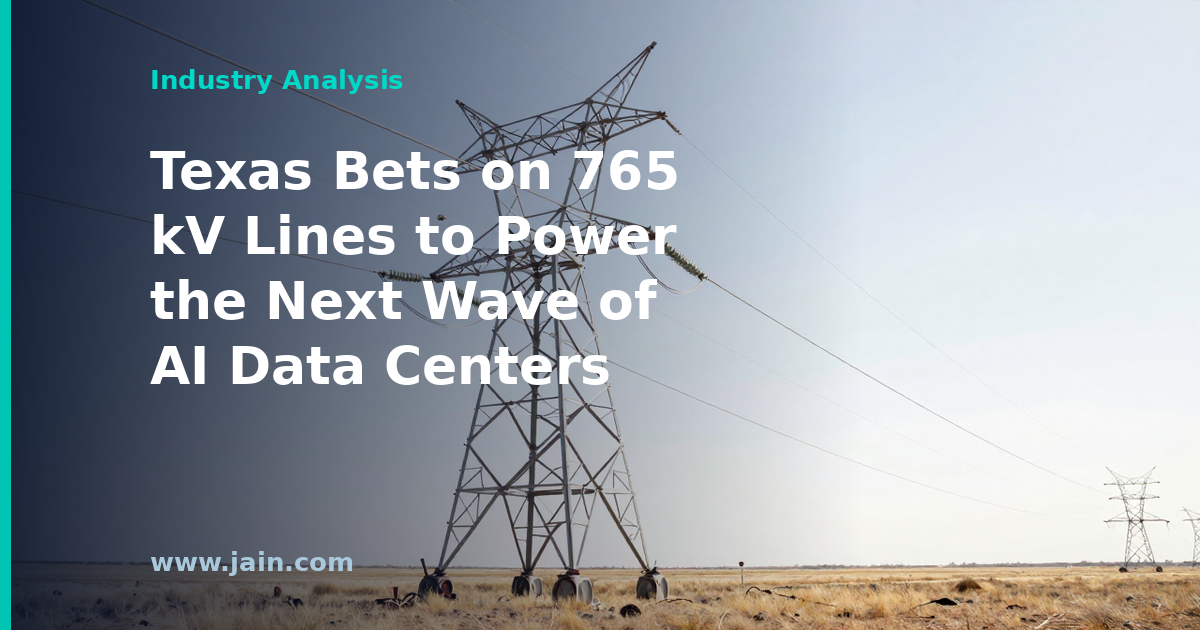
Texas has committed to building out its grid with 765 kilovolt (kV) transmission lines — the highest-capacity class of overhead power line used in North America — in a strategy Data Center Knowledge summarized on July 5, 2026 as “build the wires, the AI will follow.” Rather than waiting for AI data center projects to sign up first, the state’s approach is to construct extra-high-voltage backbone capacity in anticipation of that demand arriving on the ERCOT grid.
Executive Summary
The decision reported here is less about a single project than about a planning philosophy. Historically, most U.S. transmission has been built reactively: a large customer or generator commits, studies are run, and wires follow years later. Texas is inverting that sequence at the 765 kV level — the class of line capable of moving several times the power of the 345 kV circuits that have long formed the backbone of ERCOT, the grid operator serving most of Texas.
Why it matters: access to power has become the single biggest constraint on AI data center siting. A state that can credibly promise deliverable gigawatts on a known timeline gains a decisive edge in attracting capital-intensive AI campuses. But anticipatory building also shifts risk — if the forecast load arrives late, smaller than expected, or somewhere else, the cost of underused infrastructure lands on someone, and that someone is usually the ratepayer.
Why 765 kV Is a Statement, Not Just a Specification
Voltage class is the freeway-versus-farm-road question of the power grid. A 765 kV line can carry far more power than a 345 kV line over the same corridor, with proportionally lower electrical losses, which means fewer parallel lines, fewer towers, and less land consumed per delivered gigawatt. For a grid staring at data center campuses that each want hundreds of megawatts — sometimes a gigawatt or more — 765 kV is the only overhead technology that comfortably matches the scale of the ask.
Choosing it is also a signal. 765 kV projects take longer to permit and build, require specialized transformers with notoriously long lead times, and cost more up front than incremental 345 kV additions. A jurisdiction that standardizes on 765 kV is telling the market it expects load growth measured in tens of gigawatts, not incremental upticks — and that it intends to be structurally ready rather than perpetually catching up.
The Economics of Building Ahead of Demand
The core bet is that transmission, not land or fiber, is now the scarce input for AI infrastructure. Interconnection timelines — the queue a new large customer or generator waits in before it can plug into the grid — have stretched to years across much of the country. Every month of waiting is a month of idle capital for an AI developer whose chips depreciate quickly. If Texas can compress that wait by having backbone capacity already energized, it converts grid readiness directly into economic development.
The counterargument is forecast risk. AI load projections are among the most volatile numbers in the utility industry right now: they depend on chip supply, model efficiency gains, corporate capital cycles, and siting decisions that can pivot on a single tax incentive. Building wires for demand that hasn’t signed contracts means the state is, in effect, underwriting a demand forecast. If the forecast is right, the infrastructure looks prescient. If it’s wrong, Texas will have built expensive capacity whose carrying costs must still be recovered.
Winners, Losers, and Who Carries the Risk
The clearest winners are large-load customers — AI and cloud data center developers — who gain siting certainty, and the transmission utilities and equipment suppliers who get a multi-year construction pipeline. Landowners along new corridors face the familiar friction of routing and easement disputes, which 765 kV’s larger towers can intensify even as its higher capacity reduces the total number of corridors needed.
The pivotal question is cost allocation. In ERCOT, transmission costs have traditionally been spread across consumers, which works when new load broadly benefits everyone but becomes contentious when the driver is a handful of very large private customers. Whether Texas requires AI-scale loads to shoulder a larger, more direct share of the wires built substantially for them — through contribution requirements, minimum-take commitments, or special rate classes — will determine whether this build-out is remembered as smart industrial strategy or as a subsidy from households to hyperscalers. The source piece frames the bet; it does not settle who holds the downside.
What It Means Beyond Texas
Other states and grid operators are watching, because Texas is running the experiment they have avoided: proactive, speculative, extra-high-voltage expansion in a market famous for moving faster and regulating lighter than its peers. If the wires fill up with AI load on schedule, expect copycat programs and renewed pressure on slower-moving regional planning processes elsewhere. If they don’t, the episode will become the cautionary tale cited in every future transmission docket.
For the data center industry itself, the message is immediate: power-first siting is now official policy in at least one major market. Developers comparing regions will increasingly weigh not just today’s available megawatts but a grid’s demonstrated willingness to build ahead of them — and Texas has just bid aggressively on that dimension.
Background
Texas operates most of its grid through ERCOT, a system largely separate from the rest of the U.S., which allows the state to plan and permit infrastructure faster than regions governed by multi-state processes. That autonomy, combined with abundant land and energy resources, has already made Texas one of the country’s fastest-growing data center markets. The backbone of the ERCOT grid has long been built at 345 kV; standardizing new backbone corridors at 765 kV represents a step-change in the scale of power the state is preparing to move.
The backdrop is the AI infrastructure boom: since the early 2020s, demand from AI training and cloud computing has transformed electricity access from a routine utility matter into the decisive factor in where billions of dollars of data center capital lands. Grid operators nationwide have struggled with long interconnection queues — the waiting line for new large loads and generators — and Texas’s 765 kV program is a direct attempt to turn that bottleneck into a competitive advantage.
On June 20, 2026, U.S. Representative Kathy Castor (D-FL) introduced a bipartisan bill aimed at preventing American electricity ratepayers from being charged for the grid investments needed to serve new data center development. The announcement was made via her official congressional office.
The bill enters Congress amid a rapidly widening debate over how the cost of accommodating hyperscale and AI data centers on the U.S. power grid should be allocated between utilities, developers, and residential and small-business customers.
Executive Summary
Castor’s bill frames a question that state utility regulators have been grappling with for at least two years: when a utility must build new generation, transmission, or substations to serve a data center campus, who pays the bill? Historically, grid upgrades have been socialized across a utility’s customer base under cost-of-service ratemaking. As individual data center loads have grown from tens of megawatts to, in some proposed cases, more than a gigawatt, that default has become politically and economically untenable in a growing number of jurisdictions.
The measure matters because it moves the debate from state public service commissions — where rules vary widely — toward a federal floor. If enacted, it could reshape how hyperscalers negotiate site selection, how utilities file rate cases, and how quickly gigawatt-scale AI campuses can be energized. It also signals that the ratepayer-impact narrative has crossed party lines, which changes the political risk calculus for the data center industry.
The release itself is short on legislative text, cost estimates, and cosponsor detail, so the substantive analysis below is bounded by what the announcement establishes: the bill exists, it is bipartisan, and its stated aim is ratepayer protection.
Why The Cost-Shifting Debate Reached Washington
State-level friction over data center power costs has been building. Regulators in several large data center markets — including Virginia, Georgia, and Ohio — have opened dockets on whether large-load customers should be placed on their own rate class, post collateral, or pay directly for dedicated infrastructure. The core concern is that a residential customer pays, through their monthly bill, a share of transmission upgrades primarily driven by a single hyperscale campus down the road. Castor’s bill is the first high-profile federal attempt this cycle to answer that question with statute rather than tariff filings. Its bipartisan framing is notable: ratepayer bills are a pocketbook issue that tracks poorly along traditional partisan lines.
What A Federal Floor Would Change For Operators
Assuming the bill’s operative mechanism aligns with its stated purpose — the release itself does not publish text — the practical effect on operators would depend on how narrowly “data center development” is defined and how “paying” is measured. A strict interpretation could require that incremental generation and transmission tied to a specific large load be recovered from that load through dedicated tariffs or contracts. That would push more risk onto developers, favor sites with existing headroom, and reward operators who can bring their own generation (behind-the-meter gas, on-site solar plus storage, or eventually small modular reactors). It would disadvantage speculative site development that assumes utility-funded grid expansion.
Winners, Losers, And The Middle Ground
If the bill advances in something close to its announced spirit, the clearest beneficiaries are residential and small-commercial ratepayers in high-growth data center corridors, and utilities that have already moved toward large-load tariffs — those companies are ahead of a rule they may soon have to comply with. The clearest exposure sits with developers whose underwriting assumes socialized grid costs, and with utilities whose integrated resource plans lean heavily on load growth from a small number of very large customers to justify generation buildout. A likely middle path, and one Congress has taken before on infrastructure cost allocation, is a rule that permits recovery from general ratepayers only for costs demonstrably shared with the broader system — leaving significant interpretive work to FERC and state commissions.
The Political And Narrative Risk
The industry’s public messaging has emphasized economic development, tax base, and national competitiveness in AI. Those arguments remain intact, but they answer a different question than the one Castor is asking. A bipartisan bill signals that “data centers raise my power bill” has become a durable political frame, not a partisan talking point. Even if this specific bill does not pass, its introduction changes the baseline expectation for future state and federal action, and it gives regulators political cover to tighten large-load cost-allocation rules now. Operators and their trade groups will want to engage on the substance — cost causation, contribution to system reliability, willingness to pay for firm capacity — rather than dismiss the concern.
Background
U.S. data center power demand has grown sharply in the last several years, driven first by cloud consolidation and then, more intensely, by AI training and inference workloads. Individual hyperscale campuses now routinely request hundreds of megawatts of interconnection, and some proposed sites approach or exceed one gigawatt — comparable to the load of a mid-sized city. That growth has strained interconnection queues, generation adequacy, and, increasingly, the political consensus around who pays for the resulting grid buildout.
Rep. Kathy Castor represents Florida’s 14th congressional district and has been active on energy and consumer-protection issues. The bill announced on June 20, 2026 is her office’s entry into a debate that has, until now, been fought primarily in state public service commission dockets and utility rate cases.
On June 4, 2026, the Wall Street Journal published a feature describing metropolitan Phoenix as a data-center mecca — and, more pointedly, as a test case for how the enormous electricity demands of artificial intelligence will be paid for. The framing places one of America’s fastest-growing data-center markets at the center of a national debate over grid-buildout economics.
Only the article’s headline and framing are accessible through the syndicated feed; the underlying reporting sits behind the Journal’s paywall. This analysis therefore examines the question the piece raises rather than details it may contain.
Executive Summary
The Journal’s framing captures a real shift in the data-center industry’s center of gravity. For two decades, the binding constraints on data-center development were land, fiber, and tax treatment. In the AI era, the binding constraint is electricity — and with it comes a question that land and fiber never posed: when a utility spends billions on new generation, transmission lines, and substations to serve a handful of very large customers, who ultimately pays?
Phoenix is a natural place to ask. The metro area has courted data centers aggressively and now hosts one of the largest concentrations of them in the United States, served principally by Arizona Public Service and the Salt River Project. How Arizona’s utilities and regulators allocate the cost of serving AI-scale loads — to the data centers themselves through special tariffs and long-term contracts, or across all customers through general rates — will be watched closely by every other market facing the same surge.
For readers, the honest caveat is that the source material available here is a headline, not a data set. The analysis below addresses the question the headline poses; the specific figures, projects, and proceedings the Journal reported on remain behind its paywall and are flagged as open items in the gaps section.
Why Phoenix Became a Data-Center Magnet
Phoenix’s rise as a data-center hub was not accidental. The region offers large tracts of developable land, very low exposure to earthquakes, hurricanes, and flooding, and network proximity to Southern California — letting operators serve West Coast users while avoiding California’s costs and permitting friction. Arizona layered on tax incentives for data-center equipment, and its utilities historically welcomed large industrial loads as a way to spread fixed grid costs over more sales.
That welcome is what the AI era is now stress-testing. A market built on the premise that big customers make the grid cheaper for everyone works when load grows incrementally. AI training and inference campuses invert the premise: they arrive in blocks so large that the grid must be expanded specifically to serve them, which means new costs rather than better utilization of existing assets. The economic-development logic that attracted the industry does not automatically survive that inversion — it has to be re-underwritten, tariff by tariff.
The ‘Who Pays’ Question, Unpacked
Serving AI-scale load requires three layers of spending: new generation capacity (or contracts for it), high-voltage transmission to move the power, and local substations and distribution upgrades to deliver it. In the regulated-utility model that covers most of Arizona, those costs are recovered through rates approved by state regulators. The allocation question is whether they land on the customers who caused them or are socialized across households and small businesses.
Utilities and regulators across the country have been converging on a middle path: dedicated large-load rate classes that require long-term commitments, minimum-demand charges, or upfront contributions to construction, so that a data center pays for the infrastructure built on its behalf even if its plans change. The unresolved tension is forecasting risk. If a utility builds for announced demand that never materializes — projects are cancelled, chips get more efficient, workloads consolidate elsewhere — someone is left holding stranded assets. Contract structure, more than load-growth headlines, determines whether that someone is the developer, the utility’s shareholders, or the ratepaying public.
Winners, Losers, and What to Watch
If Phoenix gets the allocation right, the winners are numerous: operators gain a market where power, not litigation, sets the pace; utilities gain creditworthy anchor customers; and residents gain the tax base and jobs without underwriting the buildout. If it gets the allocation wrong in either direction, the losers are equally clear. Shift too much cost onto general rates and household bills rise to subsidize some of the world’s best-capitalized companies — a politically combustible outcome. Shift too much onto new entrants and the market’s growth advantage erodes in favor of Texas, Georgia, or other hubs competing for the same projects.
The practical signals to watch are unglamorous but decisive: rate-case filings and large-load tariff proposals before Arizona regulators, utility capital-expenditure plans and their financing, and the terms — especially minimum-take and exit provisions — attached to new interconnection agreements. It is also fair to note what the Journal’s framing implicitly concedes: calling Phoenix a test case means the answers are not yet in. Anyone claiming today to know who will pay for AI’s power, in Arizona or anywhere else, is ahead of the evidence.
Background
Metropolitan Phoenix grew into one of the largest data-center markets in the United States over the past decade, first on the strength of cloud computing and enterprise colocation, and more recently on AI infrastructure. Cheap land, low disaster risk, latency-friendly proximity to California, and Arizona’s tax incentives drew hyperscalers and colocation developers alike, while the region’s broader tech expansion — including major semiconductor investment — reinforced its industrial base.
Electric service in the metro comes mainly from Arizona Public Service, an investor-owned utility regulated by the state, and the Salt River Project, a public power provider. As in other data-center hubs, the AI boom has transformed these utilities’ planning outlook from slow, steady load growth to step-change demand — pushing questions of generation buildout, transmission, and cost allocation to the top of Arizona’s regulatory agenda.
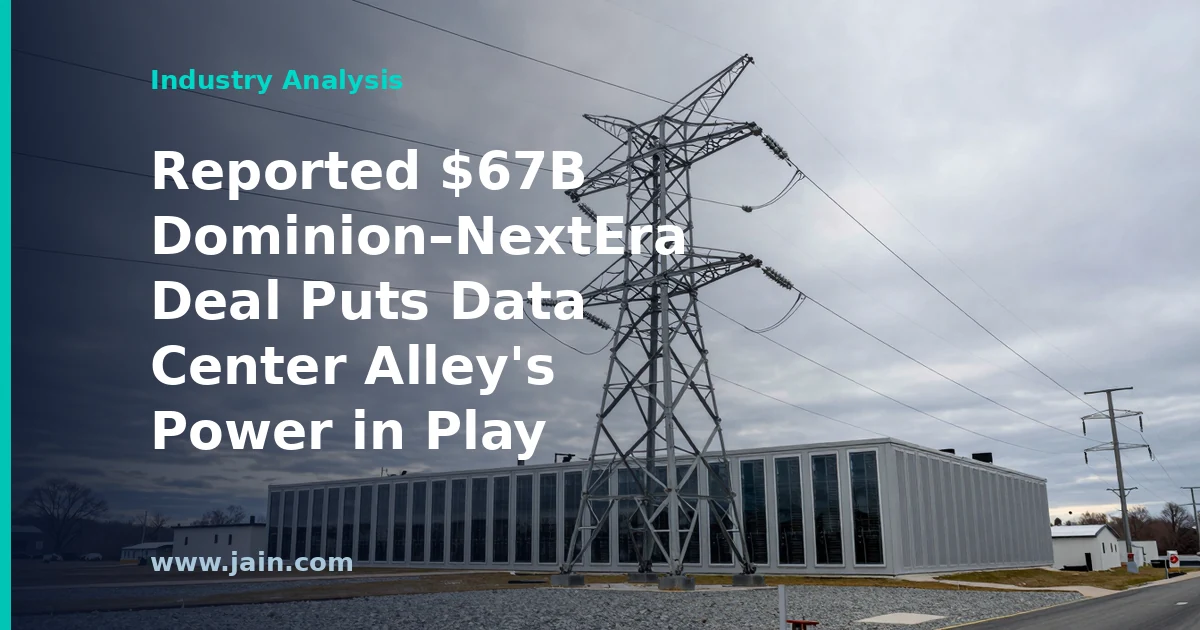
Technical.ly reported on May 17, 2026 that a $67 billion deal between Dominion Energy and NextEra Energy could reshape Northern Virginia’s data center economy — the largest concentration of data center capacity in the world. At that price, the transaction would rank among the biggest utility deals in U.S. history.
The report frames the deal around Northern Virginia’s “Data Center Alley,” the Loudoun County–centered corridor whose electricity is supplied largely by Dominion, and whose AI-driven load growth has become the defining challenge for the regional grid.
Executive Summary
According to the report, Dominion Energy — the regulated utility serving most of Virginia, including the Northern Virginia data center corridor — and NextEra Energy, the Florida-based utility holding company that is also the largest developer of wind and solar generation in the United States, are parties to a transaction valued at roughly $67 billion. The headline figure alone signals a bet that serving data center load is now the most valuable franchise in the American power sector.
Why it matters: whoever owns the wires and generation feeding Data Center Alley effectively controls the throttle on the region’s — and arguably the industry’s — AI buildout. Dominion has publicly described a contracted and requested data center pipeline measured in tens of gigawatts, an order of magnitude beyond historical utility growth rates. Pairing that captive demand with NextEra’s generation development machine is the strategic logic the market will read into a combination of this size, whatever the final structure proves to be.
A caution up front: the source available at publication is a single news headline. The deal’s structure — acquisition, merger, asset purchase, or joint venture — its financing, and its regulatory path are not described in the material we can verify, and we treat them accordingly below.
Why a Utility Deal Is Really a Data Center Deal
Northern Virginia is not just another service territory. Loudoun County and its neighbors host tens of millions of square feet of data center space, and Dominion has for years been the region’s essential supplier — its interconnection queue, transmission buildout, and rate design decisions directly set the pace at which hyperscalers and colocation providers can energize new capacity. A $67 billion transaction touching this territory is therefore less a conventional utility consolidation story than a claim on the single most concentrated pool of AI-era electricity demand on the planet.
For readers outside the power business: regulated utilities like Dominion earn a state-approved return on the infrastructure they build, which means guaranteed-growth demand — like contracted data center load — translates almost mechanically into earnings growth. That is why data center demand has turned sleepy utility stocks into growth assets, and why a buyer or partner would pay a historic premium to be attached to it.
The NextEra Logic: Generation Meets Load
NextEra brings the other half of the equation. Through NextEra Energy Resources it has built more wind, solar, and battery capacity than any other U.S. developer, and its regulated arm, Florida Power & Light, is among the country’s largest utilities. The structural problem in Northern Virginia has never been demand — it is that generation and transmission cannot be added fast enough. Marrying the nation’s most aggressive generation developer to the nation’s most demand-rich territory is a coherent industrial thesis, and it tracks the broader pattern of power and compute vertically converging: hyperscalers signing nuclear offtakes, developers co-locating generation with campuses, and utilities racing to finance multi-decade capital plans.
It also concentrates risk. AI demand forecasts are contested; utilities and grid operators have acknowledged that interconnection queues contain speculative and duplicate requests. A $67 billion valuation built on tens of gigawatts of projected load is exposed if even a fraction of that pipeline evaporates, gets self-supplied behind the meter, or migrates to cheaper-power regions.
Who Feels This: Ratepayers, Regulators, and Tenants
Any transaction involving Dominion’s Virginia franchise runs through the State Corporation Commission, and likely federal reviews as well, at a moment when data center cost allocation is already politically charged in Richmond. Virginia regulators have been actively weighing how to keep large-load infrastructure costs from spilling onto residential bills; a mega-deal gives them maximum leverage to extract commitments on rates, reliability, and clean energy timelines as conditions of approval. Expect the approval process, not the announcement, to determine what this deal actually does.
For data center operators and tenants, the practical questions are concrete: does consolidation speed up interconnection by unifying generation and delivery under deeper-pocketed ownership, or does it reduce competitive pressure and harden pricing power over a customer base with nowhere else to plug in at scale? Both outcomes are plausible, and the answer will likely be written into regulatory conditions rather than the merger agreement.
The Consolidation Signal
Step back and the deal — if consummated — marks a phase change: AI power demand is no longer being met by incremental utility capital plans but by restructuring the ownership of the grid itself. Other demand-heavy territories (Georgia, Texas, Ohio, Arizona) and the utilities that serve them become obvious candidates for similar combinations, and every hyperscaler’s site-selection calculus now has to price in who will own their utility in five years. The financing of the AI buildout is migrating from tech balance sheets and project finance into the regulated-utility capital model — with all the ratepayer politics that entails.
Background
Northern Virginia became the internet’s landlord over three decades, as early network exchange points around Ashburn attracted carriers, then cloud providers, then AI training campuses. Dominion Energy grew into the indispensable supplier of that boom, and by the mid-2020s was publicly describing data center demand — measured in tens of gigawatts of contracted and requested capacity — as the dominant driver of its capital plans, while Virginia lawmakers and regulators debated who should pay for the grid expansion it requires.
NextEra Energy took a different route to power-sector prominence: alongside its Florida utility franchise, it built the nation’s largest renewable generation fleet and has consistently argued that electricity demand from AI and electrification marks the sector’s biggest growth era in decades. A combination with Dominion, as reported, would fuse the industry’s largest generation developer with its most demand-rich territory.