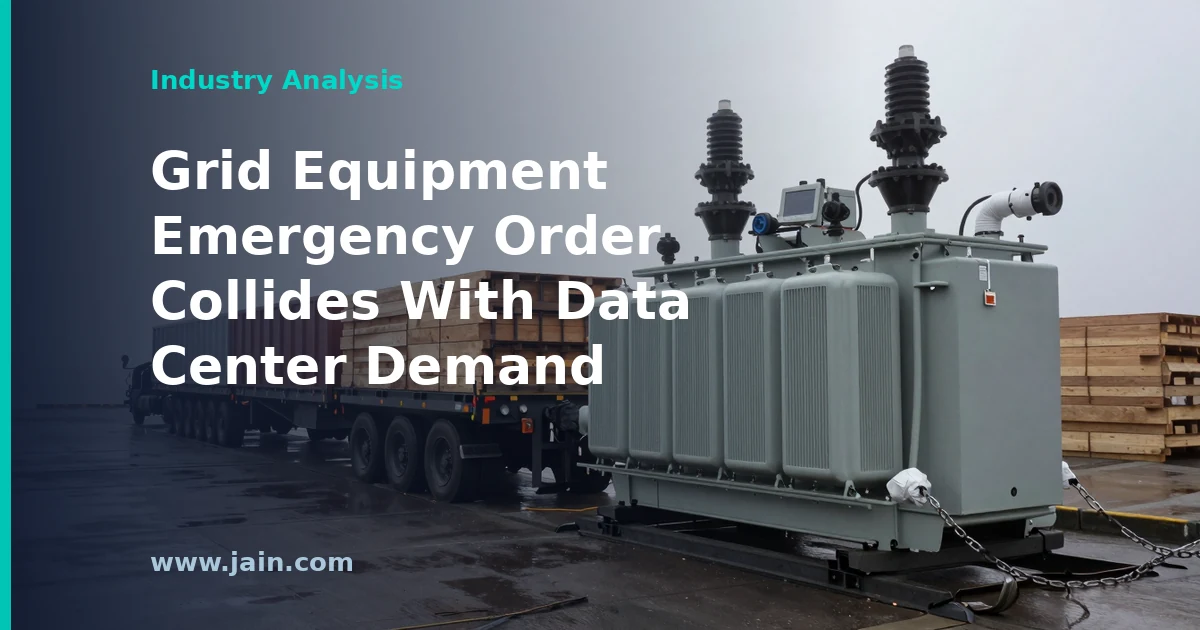
Eaton, a large electrical-equipment company, is buying COL Group, an Italian company that builds equipment for the power grid, for about 923 million dollars.
That equipment includes the heavy machinery that turns high-voltage electricity into power a building can use. It is often one of the slowest things to get when building the giant computer warehouses behind artificial intelligence.
Instead of spending years building new factories in Europe, Eaton is buying factories that already run. That could speed up supply there, but it also leaves buyers with one fewer independent supplier.
Eaton Corporation has agreed to acquire COL Group, an Italian manufacturer of electrical grid equipment, for €810 million, Reuters reported. Yahoo Finance put the price at about $923 million. Eaton describes the deal as a way to expand its footprint in Europe.
Executive Summary
Eaton, one of the largest suppliers of power-distribution equipment to data centers, utilities and commercial buildings, is paying €810 million (about $923 million) for COL Group, an Italian maker of grid equipment. The stated purpose is European expansion. Eaton has not disclosed financing, an expected closing date or COL’s revenue.
The transaction matters beyond Eaton’s own geography because of what it acquires: working production. Grid equipment such as transformers and switchgear is heavy, largely built to order and slow to scale, and the rising power demands of AI data centers, electrification and renewable connections all compete for it. Buying an operating manufacturer gives Eaton plants, trained workers and qualified products at once. Building from scratch would mean waiting years for all three.
For developers, utilities and operators in Europe, the practical question is whether this adds effective supply or mainly moves existing supply under a new owner. Eaton’s answer will show up in what it does with COL’s plants after closing.
Buying a Factory Is Buying Time
The core logic of this deal is sequencing. A new plant for electrical grid equipment has to move through site selection, permitting, construction, tooling, hiring and training. Its products then have to be tested and qualified before utilities and large customers will accept them. Each step mostly waits on the one before it. An acquired manufacturer arrives with every one of those steps already done: the buildings stand, the workforce knows the processes, and the products already carry the approvals customers require.
Seen that way, the €810 million is partly a payment for time. Eaton gets European production capacity immediately, not at the end of a multi-year greenfield program (‘greenfield’ meaning built new on an empty site). The deal does not say how much capacity that is, and Eaton has not published COL’s output or revenue. The direction of the trade-off is still clear. When customers are waiting on equipment, a supplier that already has capacity in hand can capture orders that a supplier still pouring concrete cannot.
The people most affected are European data-center developers and utilities. Their project schedules depend on when electrical equipment arrives. Eaton’s competitors in the region are affected too, because they now face a rival with more local production and a broader portfolio.
Why Grid Gear Sits Upstream of Every AI Data Hall
Before a single AI server can switch on, power has to travel from the high-voltage grid into the building. Transformers step that voltage down to usable levels. Switchgear (the assemblies of breakers and switches that route and protect electrical circuits) directs it safely to each part of the facility. AI data centers need far more power per site than conventional ones, so they need more of this equipment, and they often need larger units.
Eaton already sells much of the power-distribution chain inside data centers. Adding a grid-equipment maker extends its reach toward the utility side of the connection, where equipment is heavier, more customized and typically slower to deliver. That upstream position is attractive when the binding constraint on a project is the electrical connection, not the building or the chips.
A caution applies to that thesis. The companies have framed this as European expansion, not as an AI or data-center move. Eaton has not said what share of COL’s business serves data centers versus utilities, industry or renewable projects. The AI demand case explains why grid-equipment capacity is valuable right now. It does not by itself establish that COL’s output will go to data centers.
What European Equipment Buyers Should Watch
Consolidation cuts two ways for buyers. An integrated supplier that can deliver equipment from the grid connection through to the server rack may simplify procurement and coordination on large projects. The same deal also leaves one fewer independent supplier in the market. That can weaken buyers’ negotiating position and concentrate supply risk with a single vendor.
Allocation is the other open issue. If COL’s existing customers are mainly utilities and industrial firms, they will want to know whether their orders keep their place in the queue once the plants belong to a company with heavy data-center exposure. A clear statement from Eaton on capacity expansion at COL’s sites, as opposed to reprioritizing existing output, would settle much of that uncertainty.
The Price and the Proof
The €810 million figure is the only hard number in the announcement. Without COL’s revenue, earnings or production volumes, outside observers cannot judge whether Eaton paid a premium for scarcity or a conventional industrial multiple (the price expressed as a multiple of the target’s earnings). The European-expansion claim is supported by the act of buying a European manufacturer. The larger claim, that this adds meaningful grid-equipment supply where AI and electrification projects need it, remains to be shown.
The evidence will come in stages. First is regulatory clearance. Then comes any announced investment in expanding COL’s plants. Last is whether Eaton begins quoting shorter European delivery times for the product lines COL makes. Until then, the deal is best read as a bet that owning production capacity now is worth more than building it later.
Background
Eaton is a diversified power-management manufacturer whose electrical segment supplies utilities, buildings, industrial sites and data centers. Its data-center products include power-distribution units, uninterruptible power supplies (backup systems that keep servers running through outages) and switchgear. The company has long used acquisitions to add product lines and regional manufacturing.
Europe’s grid is under pressure from several directions at once. Renewable generation needs new connections. Electrification of heating and transport raises demand. AI data centers compete for scarce connection capacity and for the equipment that makes those connections possible. That combined demand has made established grid-equipment makers valuable acquisition targets for suppliers that want production capacity quickly.
President Trump has declared a national emergency in order to bar certain foreign-made electrical grid equipment from the United States, according to reporting by The Hill published on April 28, 2026. Grid equipment in this context means the heavy hardware that moves electricity from generators to customers: transformers that step voltage up and down, switchgear that isolates faults, protective relays, and the control systems that coordinate them.
The reporting available at the time of writing establishes the action and its instrument — an emergency declaration used to restrict a category of imported equipment — but does not, in the headline summary reaching us, itemize which product categories, which countries of origin, or which effective dates are covered. Those details determine almost everything about the order’s practical effect.
Executive Summary
A national emergency declaration is a legal mechanism, not a policy in itself. It unlocks executive authority to restrict transactions that would otherwise be ordinary commerce. Applied to grid equipment, it signals that the administration views some imported transformers, switchgear, or control hardware as a security exposure serious enough to justify blocking purchases rather than merely inspecting or certifying them.
The timing is what makes this consequential for the technology-infrastructure sector. Electrical equipment for utility interconnections has been a bottleneck for new construction for several years, and the arrival of large AI and cloud campuses has added a class of buyer that needs tens or hundreds of megawatts per site and needs it on a schedule. Any measure that narrows the pool of eligible suppliers acts on a market where the constraint is already delivery time rather than price.
None of that makes the security rationale wrong. Grid hardware sits at the base of every other system — including the data centers running the economy’s compute — and equipment with remotely accessible firmware is a genuine attack surface. The honest read is that this is a real trade-off between two legitimate goods, and that the size of the trade-off cannot be assessed until the scope of the ban is published.
A Supply Chain That Was Already the Bottleneck
Large power transformers are a category of equipment that behaves almost nothing like the rest of the technology stack. They are custom-engineered for a specific site and voltage, built from specialized steel and copper by a small number of factories worldwide, shipped by rail or heavy haul because of their weight, and ordered years rather than months ahead. There is no spot market and very little interchangeability: a unit built for one substation is generally not a drop-in for another.
That structure means supply responds slowly to demand. When a new class of buyer appears — and hyperscale and colocation data centers are exactly that, requesting utility interconnections at industrial scale — the queue lengthens rather than the price simply clearing the market. Utilities, which need the same equipment for ordinary replacement and storm hardening, are competing in that same queue, and they generally have regulatory obligations that make waiting expensive in a different way.
Into that market comes a restriction on a subset of foreign-made equipment. The mechanical effect is straightforward even without knowing the specifics: fewer eligible suppliers for the same volume of orders means longer waits, more competition for domestic and allied production slots, and a stronger bargaining position for whoever already holds capacity. Whether that effect is small or severe depends entirely on how much of current supply falls inside the restricted category — which the available reporting does not tell us.
Security Logic and Delivery Logic Are Both Real
The case for restricting foreign grid hardware rests on a straightforward premise: modern transformers, breakers, and substation controllers contain firmware and often communications interfaces, and equipment installed at the base of the power system is difficult to inspect, expensive to replace, and long-lived. A component compromised at manufacture could sit in place for decades. This is not a novel concern invented for this order — a 2020 executive order on securing the bulk-power system pursued the same theory, and successive administrations have kept the underlying question open rather than settling it.
The fair question to put to that case is evidentiary: what specifically has been found, and does the response match the finding? Emergency authority is a blunt instrument, and the difference between “we have identified compromised units in service” and “we judge this supply route to be an unacceptable theoretical risk” is the difference between two very different policies. Declarations of this kind are frequently issued without a public factual record; that is normal for classified material and also normal for weak cases, and from the outside the two look identical.
The same scrutiny belongs on the industry side. Utilities and equipment buyers will argue that restrictions raise costs and delay projects, and that argument is both true and self-interested — it is the response any purchaser gives to any supplier restriction. The useful question for readers is not who is complaining but what the measurable effect is: how many units, from which sources, on what delivery schedules, and whether qualified alternatives exist at comparable lead times.
Who Gains and Who Absorbs the Cost
The clearest beneficiaries of a narrowed supplier pool are manufacturers already inside it. Domestic and allied-country producers of transformers and switchgear gain pricing power and order-book visibility, which is precisely the condition under which firms are willing to finance new plant capacity. If the restriction is durable and clearly scoped, it can function as the demand signal that domestic manufacturing has historically lacked. If it is ambiguous or expected to be reversed, it produces the price effect without the capacity investment — the worst of both outcomes.
The cost lands first on projects that have not yet locked their electrical equipment orders. In practice that means later-stage entrants to the data center buildout rather than the incumbents: operators who placed equipment orders early, or who acquired sites with interconnection agreements and equipment already secured, are insulated. Those competing for slots now face a smaller field of eligible vendors. This tends to advantage large, well-capitalized buyers who can pre-purchase inventory and absorb carrying costs, and to disadvantage smaller developers.
For end customers of infrastructure — enterprises buying colocation, cloud capacity, or connectivity — the effect arrives indirectly and with a lag, as availability rather than as a line item. Capacity that cannot be energized on schedule shows up as longer waits for space and power in constrained metros, and as more pressure to consider secondary markets where interconnection queues are shorter.
What Careful Buyers Do Before the Rules Firm Up
The practical response to an announced-but-unspecified restriction is not to rewrite procurement strategy on a headline. It is to establish exposure: which equipment on order originates where, which suppliers are subcontracting to manufacturers that might fall within scope, and what the contractual position is if a delivery becomes non-compliant mid-order. Many buyers do not have that visibility past their immediate vendor, and building it is useful regardless of how this particular order is written.
The second move is to check where risk sits in existing contracts. Force majeure and regulatory-change clauses in equipment and construction agreements determine who eats a delay caused by a government restriction, and those clauses vary widely. This is a cheap thing to review now and an expensive thing to discover later.
The third is patience about the analysis itself. Emergency declarations are typically followed by implementing rules, definitions, exemption processes, and often litigation — and the scope can change materially at each step. Until the implementing detail is published, the responsible position is that the direction of the effect on grid-equipment lead times is upward and the magnitude is unknown.
Background
The electrical grid runs on a class of equipment that is unglamorous, extremely long-lived, and produced by a concentrated global supplier base. Large power transformers in particular are engineered to order, take years to procure, and cannot be swapped between sites. Because replacement cycles are measured in decades, a decision about what equipment is allowed into the system today shapes the physical grid well past the term of any administration that makes it.
Concern about foreign-supplied grid hardware has been a recurring feature of U.S. policy rather than a new development, including a 2020 executive order aimed at securing the bulk-power system. What has changed is the demand side. Data centers built for AI and cloud workloads have become a significant new source of load growth, requesting utility interconnections at a scale and pace that the equipment supply chain was not sized for. Restrictions on supply and a surge in demand are now arriving in the same market at the same time, which is why a policy question that once concerned mainly utilities and regulators is now a scheduling question for anyone building compute.