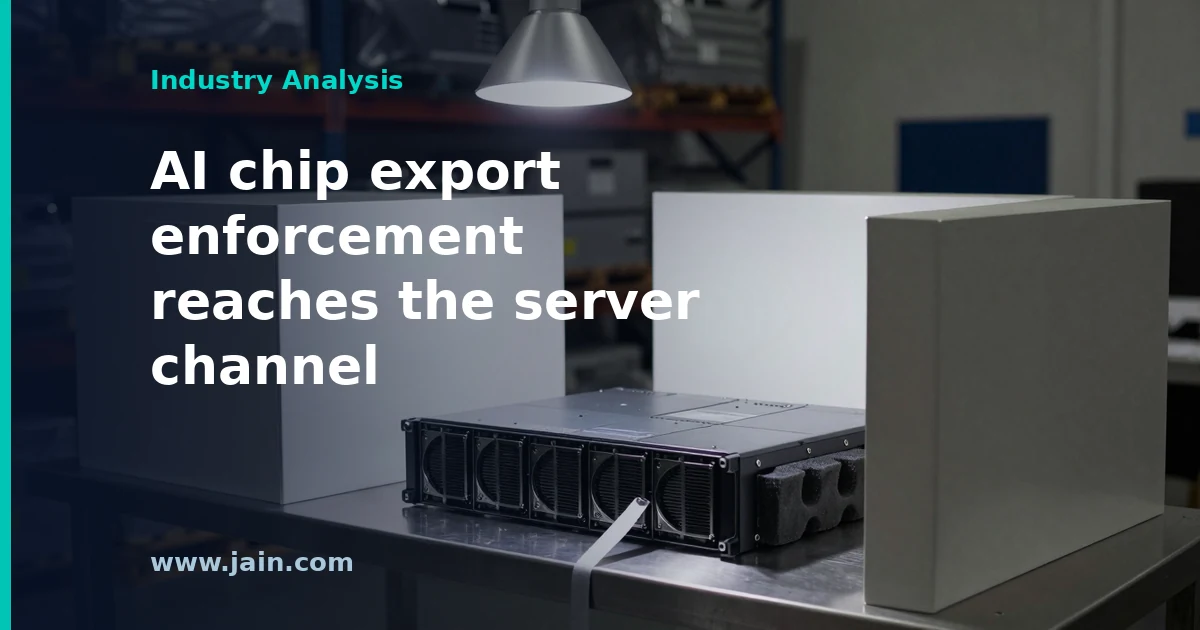
A contractor who worked with Super Micro, an American company that builds the powerful computers used to run artificial intelligence, has admitted in court to helping send those machines to China illegally. The scheme was valued at $2.5 billion.
The computers held chips from Nvidia, whose chips power much of today’s AI. US rules bar selling those advanced chips to China without government permission.
Why it matters: the case targets the people between the chipmaker and the final buyer, not the chipmaker itself. Enforcement is reaching further down the supply chain.
A contractor tied to Super Micro Computer has pleaded guilty in a scheme to divert AI servers containing Nvidia chips to China, Reuters reported. Coverage puts the scheme’s value at $2.5 billion and describes the contractor as a co-defendant of a Super Micro co-founder.
The plea comes in the same week Super Micro disclosed board changes in an 8-K filed October 8. That filing does not mention the export case.
Executive Summary
A guilty plea in a $2.5 billion AI server diversion scheme is among the clearest signals yet of where US export-control enforcement on AI hardware is landing. The equipment at issue was not loose chips but complete servers built around Nvidia GPUs (graphics processing units, the processors that do most AI computation). The person admitting guilt is a contractor, not an employee of the chipmaker.
That matters because it shifts the compliance burden. Export restrictions on advanced AI chips follow the chip into whatever system it is installed in. That makes everyone who builds, resells or ships those systems a potential point of failure, and of liability. For server makers, distributors and the data center operators who buy from them, the case is a reminder that end-user screening is part of the product, not paperwork around it.
The plea establishes guilt only for the person who entered it. Anything alleged against other defendants remains an allegation, and no charges against Super Micro as a company have been reported.
Where a GPU Becomes a Server, Control Gets Harder
Advanced AI chips leave Nvidia in large, traceable allocations to a relatively small set of server makers and cloud buyers. Once a GPU is installed in a server, it becomes one component inside a finished system. That system can then pass through distributors, contractors and resellers before reaching its final operator. US export rules still apply to the chip inside the box, but the chipmaker’s line of sight usually ends at its direct customer.
That gap is the mechanism this case exposes. The diverted goods were Super Micro AI servers with Nvidia chips inside, and the guilty party is a contractor in the server maker’s orbit. At a reported $2.5 billion, the scheme shows how much hardware value can move through the integration and resale layer, the stage after the chip is sold but before the system is plugged in. Controls written around the chip are only as strong as the checks at that downstream stage.
Those affected are the companies that sit between foundry and data hall: server builders, value-added resellers, logistics contractors, and the compliance teams that sign off on who the end user really is. Nvidia’s chips were in the boxes, but Nvidia is not reported to be a defendant and has made no material SEC filing on the matter. The enforcement weight in this case sits downstream.
What the Channel Now Has to Prove
For server makers and their partners, export compliance means knowing the end user and the end use, not just the immediate buyer. A diversion scheme works by putting a permissible-looking customer between the seller and a prohibited destination. A plea at the contractor level gives every company in that chain reason to scrutinize intermediaries, shipping patterns and resale terms more closely.
The economic effect is friction. Legitimate buyers of AI servers, from enterprise IT departments to colocation tenants, may face more documentation about where systems will be deployed and who will operate them. For integrators competing on speed of delivery during a GPU supply crunch, slower deal reviews carry a real cost. The case makes clear that the alternative cost is higher.
What Is and Isn’t Established About Super Micro
Super Micro is one of the largest builders of Nvidia-based AI servers, so any case involving its products draws attention to the company. The facts on the record are narrower than the headlines. A contractor has admitted guilt. A co-founder is described as a co-defendant, which is an allegation, not a finding. No charges against the company have been reported.
Super Micro’s most recent disclosure is an 8-K covering the appointment of former Intel IT chief technology officer Shesha Krishnapura as an independent director and the retirement of director Judy Lin. The filing states that Lin’s departure was not the result of any disagreement with the company, and it does not reference the case. Reading a connection into the timing would go beyond what either the plea or the filing supports.
Background
Since 2022 the United States has restricted exports of advanced AI chips and the systems built around them to China, through rules administered by the Commerce Department’s Bureau of Industry and Security and tightened in later rounds. Nvidia, the dominant supplier of AI accelerators, sells its GPUs largely through server makers and large cloud buyers, which turn them into finished systems.
Super Micro Computer, based in San Jose, California, is one of the biggest of those server makers and a major builder of Nvidia-based AI systems for data centers. Its fiscal year ended June 30, 2026. In early October it announced a board change, adding former Intel IT chief technology officer Shesha Krishnapura and accepting the retirement of director Judy Lin.
Nvidia, the company whose chips run most of today’s artificial intelligence systems, says it will sell twice as many chips next year as it does this year.
That sounds like it means twice as many data centers, twice the electricity and twice the cooling. It may not. Nvidia’s chips include the one inside the Nintendo Switch 2, plus chips for laptops and robots, and the company does not say how many of each it sells.
The businesses that must supply the power and cooling need that breakdown before they can plan.
Nvidia chief executive Jensen Huang said on Thursday, September 17, that the company will double the number of chips it sells next year, CNBC reported. “I expect Nvidia to sell twice as many chips as this next year as we do this year,” Huang said at a summit on AI safety with King Charles III in Scotland, attended also by representatives of Google DeepMind, OpenAI and Anthropic.
The remark follows Nvidia’s forecast of 70% growth for the fiscal year ending January 2028, a figure CNBC put at about $673 billion. Nvidia does not disclose how many chips it sells in total; last fall Huang said the company had shipped 6 million Blackwell GPUs in four quarters.
Executive Summary
Huang’s forecast is a headline-friendly number: twice as many chips in a single year. For the companies that build and supply AI data centers, it reads as a demand signal for everything a chip needs to run: electricity, cooling, high-bandwidth memory and the networking that links processors together.
The number is less precise than it sounds. Nvidia sells far more than data center graphics processing units (GPUs, the accelerators that train and run AI models). Its lineup includes central processors, network switch chips, optical networking chips, laptop chips, Jetson modules for robots and cars, and the processor in Nintendo’s Switch 2. A doubling of total units says nothing on its own about how many high-power data center accelerators are in the mix.
That matters because infrastructure is planned in megawatts and racks, not in chip counts. The direction of Huang’s forecast is clear; the load it places on grids and cooling plants is not yet specified.
A Unit Count Is Not a Load Forecast
A data center’s electricity and cooling needs are set by the accelerators and servers installed in it. A Blackwell or Rubin GPU sits in a liquid-cooled rack drawing power continuously; a Switch 2 processor sits in a handheld console on battery. Both count as one chip in a total unit figure. Doubling a blended count could therefore mean data center shipments doubled, or rose less while consumer and embedded lines rose more, or any combination in between.
The people who must translate Huang’s number into physical capacity — utilities fielding interconnection requests (applications to connect new load to the grid), developers securing sites, cooling-equipment makers, and memory suppliers allocating production — plan against deliveries of data center systems. Huang’s statement does not give them that figure. It confirms that demand is rising; it does not tell them by how much in the category that consumes the power.
That is the practical risk on both sides. Suppliers who read “twice the chips” as “twice the megawatts” could overbuild if the growth skews toward low-power parts. Suppliers who discount the statement could fall short if the growth is concentrated in data center accelerators. Either error is expensive in a business where transformers, cooling plants and memory lines take long lead times to add.
The Revenue Forecast Tells a Different Story Than the Unit Forecast
Nvidia’s own dollar guidance offers a cross-check. The company expects 70% growth in the fiscal year ending January 2028, which CNBC put at about $673 billion. That fiscal year broadly overlaps calendar 2027, the “next year” Huang appears to be describing.
If the two forecasts cover comparable periods, units growing 100% while revenue grows 70% implies average revenue per chip falls. One reading is a mix shift toward lower-priced parts; another is that the two figures simply measure different things over slightly different windows. Either way, the gap between them is a reason not to treat the unit figure as a proxy for data center buildout. The revenue figure, heavily weighted to data center products, is the better, though still indirect, gauge of the infrastructure load ahead.
What Power, Cooling and Networking Suppliers Can Still Take From It
The statement is not empty. Huang tied it to broad demand — “almost every single country that we’re in, people want to invest in AI” — and it extends a run of forecasts that, CNBC noted, pushed analyst expectations up and point to continued growth over the next six quarters. Nvidia’s list of product lines also includes switch chips and optical networking chips, so growth in AI clusters carries a networking and fiber component alongside compute.
For power equipment makers, cooling vendors, memory producers and data center landlords, the sensible reading is directional: demand for AI capacity continues to grow, and at a pace Nvidia expects to exceed this year’s. The sizing — how many megawatts, how many racks, how much memory — still depends on figures Nvidia has not broken out.
Background
Nvidia began as a graphics-chip company and became the dominant supplier of the accelerators used to train and run AI models. Its data center GPU families, Blackwell and now Rubin, are deployed in dense, often liquid-cooled racks whose power and cooling needs have reshaped how data centers are designed and where they are built.
The company also sells a wide range of other semiconductors, from networking and optical chips that link AI clusters together to processors for laptops, robots, cars and Nintendo’s Switch 2. That breadth is why a company-wide chip count and a data center buildout forecast are not the same thing.
NVIDIA and Amazon Web Services have announced an expanded partnership to deliver 2 million additional GPUs and next-generation infrastructure aimed at agentic AI (software that plans and executes multi-step tasks rather than just answering prompts) and physical AI (robotics, autonomous machines and industrial systems). Both companies published the news through their own newsrooms.
The announcement lands alongside two related data points: TechCrunch reports that Amazon has tripled its order of Nvidia chips, citing “surging demand,” and the Associated Press reports that Nvidia’s second-quarter results came in well beyond Wall Street’s expectations on the strength of AI chip demand. Together they describe one buyer, one supplier, and a step-change in contracted volume.
Executive Summary
The headline number — 2 million GPUs — matters less for what it says about Nvidia’s order book than for what it implies about the physical plant required to land it. A GPU is a graphics processing unit: a chip built for massively parallel math, and the workhorse of AI training and inference. Two million of them is not a purchase order; it is a multi-year industrial programme that has to be matched by buildings, substations, transformers, switchgear, water or refrigerant loops, and fibre.
Read together with Amazon’s tripled chip order and Nvidia’s Q2 beat, the pattern is a shift in how hyperscalers buy. Opportunistic, quarter-by-quarter allocation chasing has given way to committed, long-horizon supply agreements — the procurement posture of an airline ordering airframes, not a retailer restocking shelves. That change is rational when lead times on the surrounding infrastructure run longer than the lead time on the chips themselves.
For anyone who builds, powers or cools digital infrastructure, the strategic reading is straightforward: the scarce input is migrating downstream. When silicon supply is contracted years ahead, the question that determines whether capacity actually arrives on schedule is no longer “can you get the accelerators?” but “where will you land them, what feeds them, and what carries the heat away?”
Procurement Has Gone Industrial
A commitment expressed in millions of units, spanning generations of hardware, behaves differently from a spot purchase. It requires the supplier to reserve foundry capacity, advanced packaging and high-bandwidth memory allocation well in advance, and it requires the buyer to commit capital before the demand it serves is fully booked. Both sides are trading flexibility for certainty — the classic structure of industrial supply contracts in aerospace, energy and heavy manufacturing.
That framing explains why Amazon tripling its order and Nvidia beating expectations are the same story told from two ends of the same contract. The supplier’s revenue recognition and the buyer’s capital plan are now coupled over a multi-year horizon. The upside is predictability: fabs can plan, and data centre teams can sequence construction against known delivery windows. The downside is that a demand forecast, once converted into contracted volume, is expensive to be wrong about.
It also raises the entry price for everyone else. When a large share of leading-edge accelerator output is spoken for by a handful of buyers with balance sheets to match, smaller clouds, enterprises and national programmes are not competing on price so much as on queue position — and increasingly on whether they can offer the supplier something the hyperscalers cannot.
The Binding Constraint Moves From Silicon to the Envelope
AI accelerators concentrate far more power into a rack than the general-purpose servers most existing data centre halls were designed around. That concentration is what forces the shift from air cooling to liquid — direct-to-chip cold plates or immersion — and what turns electrical distribution, from the utility interconnect down through transformers, switchgear and busway, into the pacing item of a build. None of that is fast. Utility interconnection studies, transformer manufacturing and high-voltage equipment orders routinely take longer than a chip generation.
This is the practical significance of a 2-million-GPU commitment for infrastructure operators. The chips have a delivery schedule; the power envelope has a permitting, procurement and construction schedule; and the two only intersect if someone sequenced them together years earlier. Capacity that cannot be energised and cooled on time is not capacity — it is inventory.
The physical-AI element of the announcement adds a second dimension. Robotics and autonomous systems generate inference demand at the edge and in regional facilities, not only in a handful of mega-campuses. If that materialises at scale, it argues for distributed, latency-sensitive capacity in metros — a different real-estate and connectivity problem from the remote gigawatt campus, and one where existing colocation footprints and dense fibre routes have a genuine structural advantage.
Who Benefits, and Where the Risk Sits
The clearest beneficiaries beyond the two named parties are the suppliers of the envelope: power developers and independent producers, electrical equipment manufacturers, liquid-cooling vendors, mechanical and electrical contractors, and colocation operators with energised, high-density-ready shells. Scarcity in those categories is not a temporary shortage caused by one deal; it is a structural mismatch between how quickly chips can be fabricated and how slowly grid infrastructure can be built.
The risk is concentration and timing. A programme sized in millions of units assumes sustained demand for agentic and physical AI workloads that are, today, earlier in commercial adoption than large language model inference. If adoption arrives more slowly than the delivery schedule, the exposure is not primarily in the chips — which can be redeployed to other workloads — but in the long-lived, single-purpose assets built to host them, and in the power contracts signed to feed them.
For enterprise buyers, the near-term implication is capacity planning, not panic. More contracted supply should, over time, ease the availability constraints that have shaped GPU cloud pricing. But it will not ease them uniformly: availability will follow where power and cooling land first, which makes region selection, interconnection and committed-use terms more consequential in procurement than headline instance pricing.
What These Announcements Do and Do Not Substantiate
It is worth being precise about the evidentiary base. What is on the record is a stated intent to deliver 2 million additional GPUs and next-generation infrastructure, a reported tripling of Amazon’s chip order attributed to surging demand, and a quarterly result that exceeded analyst expectations. Those are meaningful, and the financial result in particular is an audited, externally verifiable data point rather than a marketing claim.
What is not established by these announcements is the delivery schedule, the capital commitment, the split between training and inference capacity, the regions involved, or the power procurement behind them. “Additional” is doing real work in the headline and is not defined against a stated baseline. A vendor-and-customer joint announcement is, by construction, the parties’ own account of their arrangement; it is a statement of direction, not a disclosure document.
None of this makes the announcement thin — the direction it signals is consistent with the independently reported financial results. But the useful posture for infrastructure planners is to treat the 2-million figure as a demand signal for power, cooling and land, and to wait for filings, permit applications, interconnection queue entries and utility disclosures for the details that determine when and where the capacity actually appears.
Background
NVIDIA designs the GPUs and accompanying networking and software that underpin most large-scale AI training and a growing share of inference. Amazon Web Services is the largest public cloud provider and has long combined third-party accelerators with silicon of its own design. The two have partnered on AI infrastructure for years; this announcement extends that relationship rather than establishing it.
The context is a multi-year build-out in which cloud providers have committed unprecedented capital to AI capacity. Early in that cycle, the scarce resource was the accelerators themselves, and access to allocation was a competitive differentiator. As supply agreements have lengthened and volumes have grown, attention across the infrastructure industry has moved to the constraints that cannot be solved by a purchase order: grid capacity, interconnection queues, long-lead electrical equipment, and the retrofit or replacement of facilities designed for a lower power density than AI hardware demands.
The Information reported on June 14, 2026 that Nvidia’s share of the AI inference chip market appears to be rising. The headline finding cuts against a widely held industry expectation: that the shift of AI workloads from model training toward day-to-day inference would open the door to cheaper, specialized alternatives and gradually dilute Nvidia’s dominance.
The report’s underlying data and figures sit behind The Information’s paywall, so the specific share numbers, timeframe, and methodology were not available in the syndicated headline. What is notable is the direction of the claim itself — share rising, not merely holding.
Executive Summary
For two years, the standard bear case on Nvidia has gone like this: training new AI models demands the most powerful, flexible chips — Nvidia’s home turf — but inference, the act of actually running a trained model to answer queries, is a more predictable, cost-sensitive workload where custom chips from cloud providers and startups could undercut GPUs. As inference grows to dominate total AI compute spend, the theory went, Nvidia’s grip would loosen.
The Information’s report suggests the opposite may be happening: even as inference becomes the larger workload, Nvidia appears to be gaining share within it. If accurate, that matters enormously, because inference is the recurring, revenue-generating side of AI — every chatbot reply, every AI-assisted search, every coding suggestion is an inference event. Winning inference means winning the long tail of AI economics, not just the up-front build-out.
The caveat is equally important: ‘appears to be rising’ is a hedged formulation, and without the report’s underlying figures, buyers and investors should treat this as a directional signal to test against their own deployment data rather than a settled fact.
Inference Was Supposed to Be the Open Flank
In AI infrastructure, ‘training’ means teaching a model from massive datasets — a bursty, brutally demanding job — while ‘inference’ means serving the finished model to users, millions of times a day. Because inference workloads are more repetitive and predictable, they are in principle easier to serve with purpose-built silicon: chips designed to do one thing cheaply rather than everything well. That logic is exactly why Google built its TPUs, Amazon built Inferentia and Trainium, Microsoft developed Maia, and a wave of startups raised billions to attack the inference market specifically.
A report that Nvidia’s inference share is rising, then, is not a routine data point — it challenges the core mechanism by which competitors expected to gain ground. It suggests that whatever advantages custom chips hold on paper, buyers deploying real inference fleets at scale are still, on the margin, choosing GPUs.
Why the Moat May Be Software, Not Silicon
The most plausible explanation for durable GPU share in inference is not raw chip performance but the surrounding ecosystem. Nvidia’s CUDA software platform, and the inference-serving stack built on top of it, lets teams deploy new model architectures quickly. In a period when leading models change every few months, flexibility has real economic value: a custom chip optimized for last year’s model architecture can become a stranded asset when the industry pivots to a new one.
There is also a fleet-management argument. Operators who own large GPU installations for training can redeploy the same hardware for inference as demand shifts, keeping utilization high. A mixed fleet of GPUs plus several custom accelerators, by contrast, fragments capacity and multiplies engineering overhead. None of this makes custom silicon unviable — hyperscalers continue to deploy their own chips internally at scale — but it helps explain why the merchant market, where chips are sold to third parties, may be consolidating around the incumbent.
What Rising Share Would Mean for the Rest of the Market
If Nvidia is gaining inference share, the squeezed parties are the merchant challengers — chip startups and rival semiconductor firms selling inference accelerators to enterprises and neoclouds — more than the hyperscalers, whose custom chips mostly serve their own internal workloads and are measured by different economics. For chip startups, inference was the beachhead market; a rising incumbent share shortens their runway and raises the bar for differentiation on price-performance.
For buyers of AI infrastructure — enterprises, cloud customers, and the data centers that house this equipment — the practical implication is continuity: power densities, cooling requirements, and networking architectures will keep following Nvidia’s roadmap, and supply allocation from a single dominant vendor remains a planning risk. A more competitive inference market would have given buyers pricing leverage; this report suggests that leverage is not materializing yet.
How Much Weight Can One Headline Carry?
It is worth being precise about what has and has not been established. The Information is a subscription outlet with a strong track record on AI-industry reporting, but the syndicated headline alone — ‘appears to be rising’ — carries visible hedging, and the definition of the market matters greatly. A share measured in revenue will favor Nvidia’s premium pricing; a share measured in deployed inference volume might tell a different story, especially if hyperscalers’ internal chips are excluded. Until the methodology is visible, the fair reading is that the custom-silicon disruption thesis is arriving more slowly than predicted — not that it has been refuted.
Background
Nvidia became the dominant supplier of AI computing hardware on the strength of its graphics processing units (GPUs), which proved ideally suited to the parallel math behind modern AI, and its CUDA software ecosystem, which made those chips the default target for AI developers. Its data center business grew into one of the largest revenue engines in the semiconductor industry during the generative-AI build-out that began in late 2022.
From early in that boom, cloud providers and startups invested heavily in custom AI accelerators — Google’s TPU line being the longest-running example — with inference widely identified as the segment where alternatives would gain traction first. The June 2026 report from The Information lands directly on that fault line, suggesting the incumbent is consolidating rather than ceding the inference market.
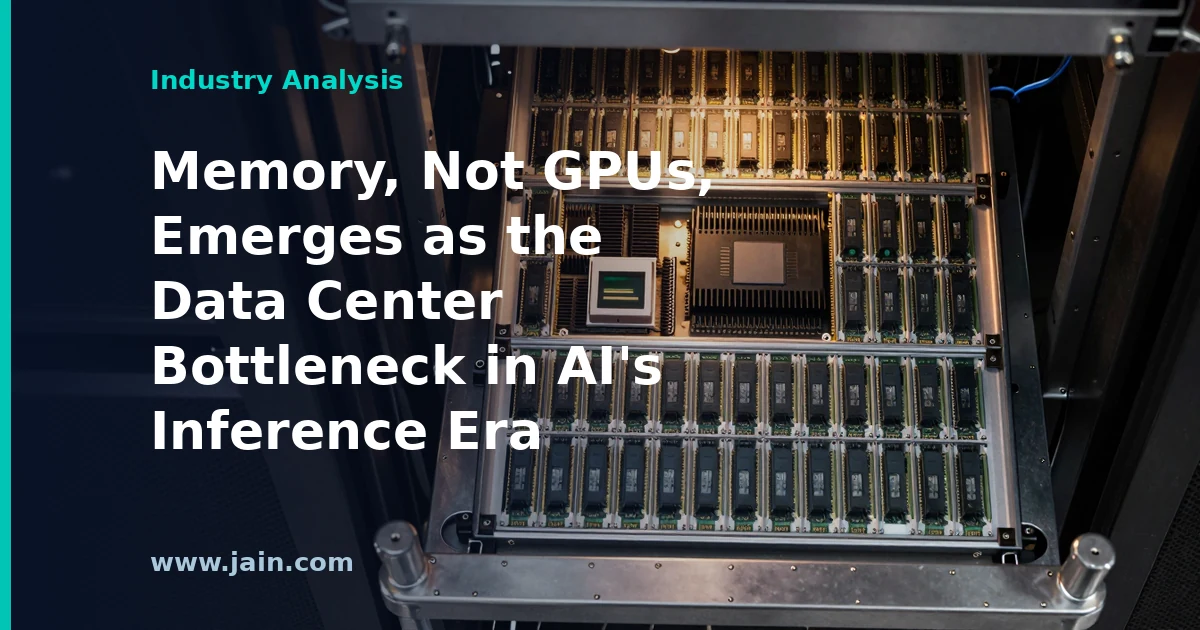
Data Center Knowledge reports that the AI industry’s next major data center challenge is scaling memory for the inference era. As of June 13, 2026, the trade publication frames memory — its capacity, bandwidth, and cost — rather than GPU supply alone as the constraint that will shape how AI infrastructure is built and operated as workloads shift from training models to serving them at scale.
Executive Summary
For the past several years, the AI infrastructure conversation has been dominated by one question: can you get enough GPUs? Data Center Knowledge’s report signals a maturing of that conversation. As deployed AI systems move from the training phase — where a model is built once on a massive cluster — to the inference phase — where that model answers millions of user requests every day — the binding constraint increasingly shifts toward memory: how much data an accelerator can hold close to its processors, and how fast it can move that data in and out.
This matters because inference is where AI meets its users and its revenue. Training is an episodic capital project; inference is a continuous operating workload whose economics are set by how efficiently each request can be served. If memory is the gating factor on that efficiency, then memory — not just compute — becomes a first-order design variable for chipmakers, server vendors, and the data center operators who house them. That has implications for procurement, facility design, and where the industry’s next supply-chain pressure points appear.
Why Inference Stresses Memory Differently Than Training
Training and inference are both AI workloads, but they stress hardware in different ways. Training is a throughput problem: enormous batches of data are pushed through a model in parallel, and the industry has optimized clusters, networks, and cooling around it. Inference is a latency and concurrency problem: a served model must hold its parameters — and, for modern conversational systems, the working context of many simultaneous user sessions — in fast memory, ready to respond in fractions of a second.
That is why the framing in this report resonates. A GPU with idle compute cycles but exhausted memory is, for inference purposes, a smaller GPU. The practical ceiling on how large a model you can serve, how long a context you can support, and how many users you can handle per accelerator is often set by memory capacity and bandwidth — the rate at which data moves between memory and processor — rather than by raw arithmetic performance. In industry shorthand, many inference workloads are ‘memory-bound’ rather than ‘compute-bound.’
From a GPU Supply Story to a Memory Supply Story
If the industry’s constraint migrates from processors to memory, the competitive map shifts with it. High-performance accelerators depend on specialized memory stacked directly alongside the processor — high-bandwidth memory, or HBM — which is produced by a small number of manufacturers and is among the most complex components in the server supply chain. A world in which inference demand keeps compounding is a world in which memory suppliers, packaging capacity, and memory-rich system designs command growing strategic attention.
It also opens the door to architectural alternatives. When fast on-package memory is scarce or expensive, system designers look for ways to tier it: pooling memory across servers, offloading less-frequently-accessed data to slower but larger stores, and caching repeated work so it need not be recomputed. Which of these approaches wins at scale is one of the genuinely open questions of the inference era, and the answer will influence everything from server bills of materials to network design inside the rack.
What It Means for Data Center Operators
For facility operators, the shift is subtler but real. Inference fleets are provisioned for sustained, user-facing demand, which favors availability, geographic distribution, and predictable power draw — a different profile from the concentrated, campus-scale training builds that have dominated recent headlines. Memory-heavy server configurations also change the calculus per rack: the balance of power, cooling, and floor space allocated to a given amount of useful serving capacity depends on how much memory ships alongside each accelerator.
The measured takeaway for buyers and operators is to treat memory as a first-class capacity-planning metric. Contracts, density assumptions, and refresh cycles built purely around GPU counts may misestimate what an inference-era fleet actually needs. That is not a crisis; it is the normal maturing of a young industry learning which of its inputs is truly scarce.
A Claim Worth Testing, Not Taking on Faith
It is worth being clear about the nature of this story: it is an analytical trend piece from a trade publication, not an announcement with commitments attached. The thesis — that memory becomes the bottleneck as inference scales — is directionally consistent with how served AI workloads behave, but its strength depends on variables the headline alone cannot settle: how fast inference demand actually grows, how quickly memory supply and packaging capacity expand, and whether software techniques blunt the constraint faster than hardware demand compounds. Readers should treat ‘memory is the next bottleneck’ as a well-founded hypothesis to plan against, not a settled fact.
Background
The AI infrastructure boom that accelerated from 2023 onward was defined first by a scramble for GPUs — the specialized processors used to train large AI models — and then by a scramble for the power and data center capacity to house them. As trained models moved into production across consumer and enterprise applications, the industry’s center of gravity began shifting from building models to serving them, a phase widely called the inference era.
That shift changes which hardware inputs are scarce. Modern accelerators pair their processors with high-bandwidth memory, a stacked, tightly integrated memory type made by only a few manufacturers worldwide. Because a served model’s size, context length, and concurrent user count are all bounded by available memory, industry attention has increasingly turned to memory supply, advanced packaging capacity, and architectures that stretch scarce fast memory further — the backdrop against which Data Center Knowledge’s June 2026 report was published.
The Semiconductor Industry Association (SIA) published a report finding that semiconductors account for roughly 95% of the value of an AI data server rack, announced May 31, 2026. The figure is not limited to headline AI accelerators: it encompasses the full stack of chip technologies inside a rack — processors, memory, networking, power management and supporting silicon.
Executive Summary
The SIA — the trade association representing the U.S. semiconductor industry — says that when you total up what an AI server rack is worth, about 95 cents of every dollar is silicon. A rack, the refrigerator-sized cabinet that holds stacked servers in a data center, has traditionally been valued as a mix of metal, boards, drives, cabling and chips. The report’s claim is that in the AI era, nearly everything else has become rounding error.
Why it matters: the finding reframes AI data centers as, economically speaking, chip-delivery vehicles. For operators, investors and policymakers, it concentrates attention — and risk — on the semiconductor supply chain. If 95% of rack value is silicon, then chip pricing, chip availability and chip export policy effectively set the cost curve for the entire AI buildout.
The Rack Is Now a Chassis for Silicon
The most useful part of the SIA’s framing is the phrase “full stack of chip technologies.” Public attention fixates on GPUs — the graphics-derived accelerators that do AI’s heavy math — but an AI rack is dense with other semiconductors: CPUs that orchestrate work, high-bandwidth memory stacked next to the accelerators, networking chips that lash thousands of processors into one machine, and power-management silicon that converts and conditions the enormous electrical loads involved. Counting all of that, a 95% share implies the sheet metal, boards, cabling and mechanical components that once defined “server hardware” now carry almost none of the value.
That inversion matters for anyone modeling AI infrastructure costs. In a conventional enterprise server, silicon was one line item among many. In an AI rack, the SIA’s figure suggests everything else — chassis, rails, fans, distribution — is a thin wrapper. The practical consequence: rack-level cost forecasting is essentially chip-price forecasting.
Concentration of Value Means Concentration of Risk
If nearly all rack value is semiconductors, then the risks that matter are semiconductor risks: fabrication capacity concentrated in a small number of foundries and regions, advanced-memory supply that has repeatedly run tight, and export-control regimes that can reprice or block hardware across borders. A data center operator can second-source steel and switchgear; it cannot easily second-source leading-edge accelerators or the memory bonded to them.
There is also a depreciation angle. Buildings depreciate over decades; chips depreciate on silicon product cycles, which in AI have been running fast. When 95% of a rack’s value sits in the component category with the shortest useful life, the refresh economics of an AI facility look less like real estate and more like a rolling fleet of rapidly aging assets. That affects how lenders, insurers and investors should think about collateral value in AI infrastructure deals.
Read the Messenger Along With the Message
The SIA is a trade association, and it is fair to note that this finding serves its members’ interests: a report showing semiconductors as the overwhelming source of AI value strengthens the industry’s case for policy support, incentives and favorable treatment in trade debates. That does not make the number wrong — the direction of the claim is consistent with what the market can observe, namely that AI systems are priced overwhelmingly by their compute and memory content. But readers should treat the precise 95% as an association-produced estimate until the methodology is examined: what rack configuration was assumed, whose prices were used, and whether “value” means bill-of-materials cost, market price, or something else.
The same scrutiny cuts the other way. Critics of AI-infrastructure spending sometimes describe the buildout as overpriced real estate; a full-stack accounting like this one, if its methodology holds up, is a substantive counterpoint — the money is going into the most technologically dense components, not the shell around them.
Background
The Semiconductor Industry Association has represented U.S. chipmakers since the industry’s early decades and regularly publishes data on semiconductor sales, manufacturing and policy. Its research gained a wider audience as governments moved to subsidize domestic chip manufacturing and as AI demand made semiconductor supply a mainstream economic concern.
The report lands amid a historic buildout of AI data centers, in which hyperscalers and specialized operators are deploying racks of accelerator-dense servers at unprecedented scale. Understanding where the money in that buildout actually goes — construction, power equipment, or chips — has become a live question for investors, utilities and policymakers alike.
Nvidia’s revenue grew 85% on the strength of AI infrastructure demand, according to a CIO Dive report published May 22, 2026. The figure — the only quantified data point in the report as surfaced — points to enterprises and cloud providers continuing to buy AI compute at a pace few hardware markets have ever sustained.
Executive Summary
An 85% revenue jump at a company already among the world’s largest chipmakers is not a startup doubling off a small base. At Nvidia’s scale, that percentage implies tens of billions of dollars in incremental sales, driven — per the report — by demand for AI infrastructure: the GPUs (graphics processing units repurposed as AI accelerators), networking gear, and integrated systems used to train and run artificial-intelligence models.
The number matters beyond Nvidia’s shareholders because Nvidia sits at the front of the AI build-out pipeline. Every accelerator it ships must eventually land in a rack, draw power, be cooled, and be connected. A growth rate like this is therefore a leading indicator for data center construction, electricity demand, and colocation absorption — the downstream industries that turn chips into working AI capacity.
That said, the source is a headline-level report with a single figure. It does not, as surfaced, disclose absolute revenue, the fiscal period covered, segment mix, margins, or guidance — all of which determine whether this print signals accelerating demand or the tail end of a catch-up cycle. Our analysis works within those limits.
Growth at This Scale Is a Demand Signal, Not a Rounding Error
The law of large numbers says percentage growth should fall as a company gets bigger. Nvidia posting 85% growth despite already dominating the AI accelerator market suggests the pull from AI infrastructure buyers remains intense: cloud providers, model developers, and increasingly mainstream enterprises are still racing to secure training capacity (the compute used to build AI models) and inference capacity (the compute used to run them for users).
What a single growth rate cannot tell you is trajectory. Without the absolute figures or prior-quarter comparisons, an 85% jump could represent acceleration, steady state, or deceleration from even hotter periods earlier in the AI cycle. It also cannot distinguish broad-based enterprise adoption from a handful of hyperscale customers placing enormous orders — a distinction that matters greatly for how durable the demand is. The honest reading of this report is directional: demand remains strong enough to move one of the world’s largest revenue bases by nearly half again.
The Squeeze Moves Downstream: Power, Cooling, and Floor Space
Chips are only the first link in the AI supply chain. Each generation of AI accelerators draws more power per rack than the last, pushing many deployments beyond what traditional air cooling handles and toward liquid cooling. When Nvidia’s revenue grows 85%, the practical consequence is a wave of hardware that needs megawatts of grid capacity, high-density data center space, and dense fiber connectivity — resources that take years, not quarters, to build.
For the infrastructure industry, that makes this print quietly bullish: data center operators, power-infrastructure providers, cooling vendors, and network carriers all sit downstream of Nvidia’s shipments. It also relocates the bottleneck. In the early AI boom the constraint was chip supply; increasingly, the constraint is where to plug the chips in. Buyers evaluating AI deployments should read Nvidia’s growth as a warning that competition for powered, cooled capacity is intensifying alongside competition for the silicon itself.
Concentration Cuts Both Ways
Nvidia’s position rests heavily on its CUDA software ecosystem — the programming platform that most AI frameworks target — which raises switching costs even when rival hardware is competitive on paper. But 85% growth is also the kind of number that motivates alternatives: rival merchant chipmakers, and the custom accelerators that large cloud providers design in-house to reduce dependence on a single supplier. The bigger the prize, the harder others will work to claim a share of it.
Concentration on the buyer side deserves equal scrutiny. Industry-wide, a large share of AI infrastructure spending flows from a small set of hyperscale companies, and order patterns from a few buyers can swing a supplier’s results sharply in either direction. The report offers no customer breakdown, so neither the bullish case (broadening enterprise demand) nor the cautious one (dependence on a few giant purchasers) can be confirmed from this source. Both remain fair questions to hold open.
Background
Nvidia, founded in 1993, spent its first decades known mainly for gaming graphics cards. Its parallel-processing GPUs proved ideal for the deep-learning techniques that took off in the 2010s, and its CUDA software platform became the default foundation for AI development. When generative AI demand exploded after 2022, Nvidia’s data center business became its dominant revenue driver and the company rose into the ranks of the world’s most valuable firms, with successive accelerator generations selling out to cloud providers and AI developers.
The broader market context is a global AI infrastructure build-out in which chip purchases, data center construction, and power procurement have become tightly linked: chip revenue at Nvidia today generally foreshadows demand for space, megawatts, and cooling across the data center industry tomorrow.