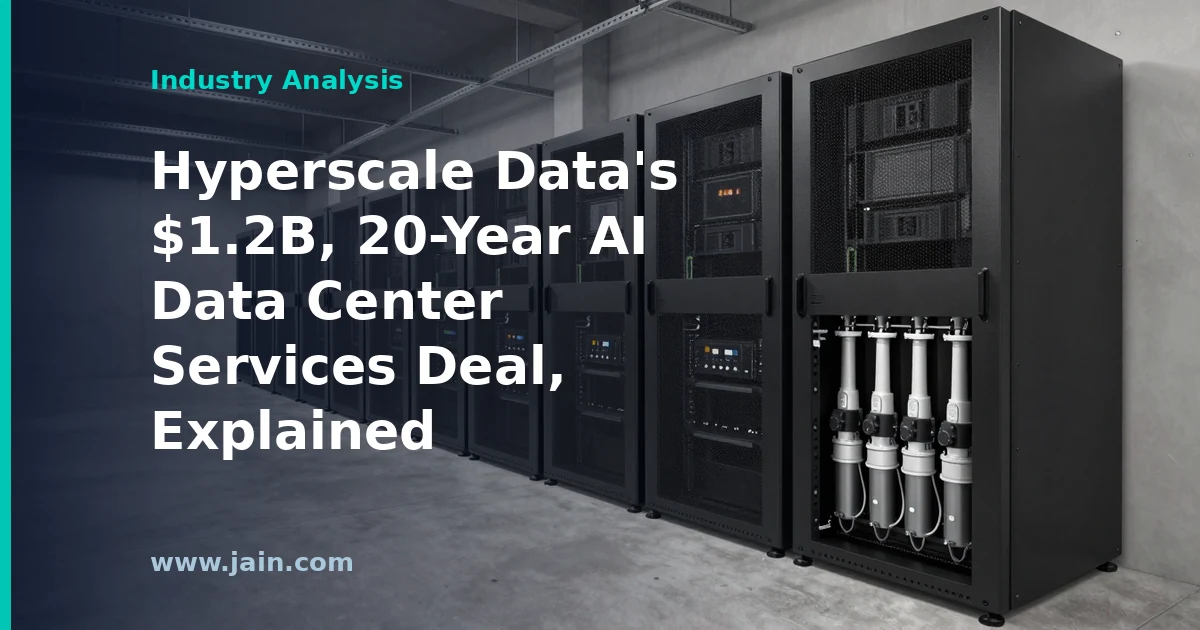
Hyperscale Data has signed a $1.2 billion AI data center services agreement, reported June 25, 2026 via Investing.com. The contract is structured over a 20-year term — an unusually long commitment in an industry where colocation and cloud deals typically run three to ten years.
The announcement positions the company as a beneficiary of surging demand for AI compute capacity, with a single long-dated services relationship underwriting future campus development.
Executive Summary
The headline facts are simple: a $1.2 billion total contract value, a 20-year duration, and AI data center services as the product. Averaged across the term, that works out to roughly $60 million per year — meaningful, recurring revenue for a company of Hyperscale Data’s size, if the contracted volumes materialize as projected.
Why it matters is the structure, not just the size. AI infrastructure operators increasingly need anchor tenants — customers who commit to capacity years before it is fully built — to justify the enormous capital costs of power, land, and cooling. A 20-year services agreement is a signal to lenders and investors that demand exists beyond the current AI investment cycle. The announcement, as reported, does not name the counterparty or detail the commercial terms, so the durability of that signal depends on specifics the headline does not provide.
Why Anchor Deals Now Run Decades, Not Years
Data center economics have always depended on matching long-lived assets to shorter-lived contracts. A campus takes years to permit, power, and build, and the shell and electrical infrastructure depreciate over decades — yet traditional colocation leases (renting space, power, and cooling to a customer’s own equipment) often ran only three to five years. The AI buildout has inverted that mismatch: operators now seek contracts as long as the assets themselves, and customers desperate for scarce GPU-ready capacity are willing to sign them. A 20-year term puts this deal at the far end of that trend, closer to a power purchase agreement or an infrastructure concession than a conventional hosting contract.
For the operator, the appeal is financing. Lenders and infrastructure investors price projects on contracted cash flow; two decades of committed revenue can unlock construction debt that a merchant (uncontracted) facility could never raise. For the customer, locking in capacity and pricing hedges against a market where AI-grade space and power remain supply-constrained.
The Neocloud Layer in the AI Stack
The demand behind deals like this increasingly comes from so-called neoclouds — specialized GPU cloud providers that rent AI compute to enterprises and model developers, sitting between the chip makers and end users. Unlike the hyperscale giants, neoclouds typically do not build their own campuses; they lease capacity from data center operators and fill it with accelerators. That makes them natural anchor tenants for second-tier and emerging operators that cannot land a hyperscaler directly.
The trade-off is counterparty quality. Hyperscalers carry investment-grade balance sheets; many neoclouds are young companies whose own revenue depends on continued AI demand. A 20-year commitment is only as strong as the customer’s ability to pay in year eight or year fifteen. Without the counterparty’s identity and credit profile — which the reported announcement does not supply — the $1.2 billion figure describes the contract’s ambition more than its guaranteed value.
Reading a Total Contract Value Honestly
Total contract value, or TCV, is the standard way these announcements are framed, and it deserves careful reading in every case, from any operator. $1.2 billion over 20 years averages about $60 million annually, but real contracts rarely pay evenly: they typically ramp as capacity is delivered, may include usage-based components, and can carry termination or renegotiation provisions. The material questions are how much of the value is a firm, take-or-pay minimum (payment owed whether or not capacity is used) versus a projection, and what milestones the operator must hit to earn it.
None of that skepticism is unique to Hyperscale Data — it applies to the entire wave of multibillion-dollar AI capacity announcements across the industry. The pattern to watch, here and elsewhere, is whether contracted revenue converts into financed construction, energized power, and recognized revenue on subsequent earnings reports.
Background
Hyperscale Data is a diversified, US-listed holding company that rebranded from Ault Alliance as it repositioned around data centers and AI infrastructure. Like several smaller operators, it is pursuing the AI buildout from outside the ranks of the established wholesale data center giants, which makes long-dated anchor contracts especially consequential for its growth story.
The market context is a historic capacity crunch: demand for GPU-ready power and space has outrun supply since the generative-AI investment wave began, pushing customers toward earlier and longer commitments and giving emerging operators a route to bankable projects that would have been unattainable in the pre-AI colocation market.
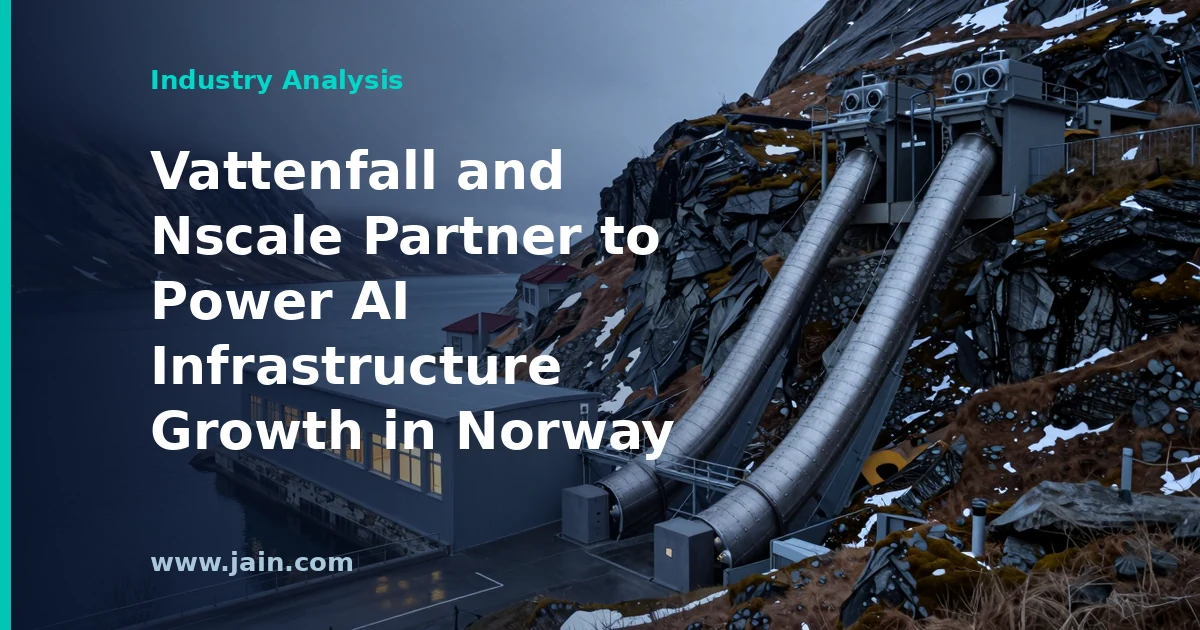
Vattenfall, the Swedish state-owned energy company and one of Europe’s largest power producers, announced on 27 May 2026 a partnership with Nscale, an AI infrastructure provider with operations in Norway, to support the growth of AI infrastructure in the country. The arrangement pairs Vattenfall’s position in the Nordic power market with Nscale’s GPU-based data center capacity.
The announcement, published through Vattenfall’s newsroom, frames the deal around enabling AI compute expansion in Norway with clean Nordic energy. Specific capacity figures, financial terms, and timelines were not detailed in the source material available to us.
Executive Summary
The partnership joins two sides of the equation that now defines AI infrastructure: electricity and compute. Vattenfall brings decades of experience generating and trading power in the Nordic region, where abundant hydropower keeps both electricity prices and carbon intensity among the lowest in Europe. Nscale brings the other half — data centers built to house GPUs (graphics processing units, the specialized chips that train and run AI models) — including an existing Norwegian footprint.
Why it matters: access to power has replaced access to chips as the binding constraint on AI buildout in much of the world. Grid connection queues in major markets stretch years, and hyperscalers increasingly sign deals directly with energy companies rather than waiting in line. A named partnership between a major European utility and a GPU infrastructure specialist is a signal of how the market is reorganizing — with power producers moving up the value chain toward compute, and compute providers moving upstream toward generation.
For Norway specifically, the deal reinforces the country’s bid to convert its renewable surplus into digital exports rather than only raw electricity — though it also lands amid an active Norwegian debate about which industries deserve scarce grid capacity.
Why AI Compute Keeps Moving North
The Nordics offer a combination few regions can match: hydropower-dominated grids with low, relatively stable wholesale prices; a cold climate that slashes cooling costs (cooling can be a significant share of a data center’s energy bill in warmer markets); political stability; and strong fiber connectivity to continental Europe. Norway in particular generates the overwhelming majority of its electricity from hydropower, which is both renewable and — unlike wind and solar — dispatchable, meaning it can run around the clock the way AI training clusters demand.
That is why Norway has attracted a steady stream of data center investment over the past decade, and why AI-focused operators like Nscale planted their flags there. Training large AI models is less latency-sensitive than serving consumer applications, so remote-but-cheap-and-green locations are a rational fit for training workloads even when end users are far away.
What a Utility Brings to the GPU Race
The scarce resource in AI infrastructure is no longer just GPUs — it is firm, sizable grid connections and the energy to feed them. Utilities control exactly that. A partnership with Vattenfall potentially gives an AI infrastructure operator earlier visibility into available capacity, structured long-term power purchase agreements (PPAs — contracts that lock in electricity supply and price for years), and credibility with grid operators and regulators. For Vattenfall, AI data centers represent something European utilities have lacked for years: large, creditworthy, growing demand in a region where industrial electricity consumption had been flat.
This mirrors a broader industry pattern of energy companies and compute companies converging — through PPAs, co-located campuses, and equity partnerships. The strategic logic is sound on both sides, but the value of any specific deal depends entirely on terms the parties disclose: how much power, at what price, for how long, and with what firmness. None of that is specified in the material available here.
A Thin Release, and the Questions Norway Is Already Asking
Based on the source available, this reads as a directional announcement rather than a detailed commercial agreement — no megawatts, sites, investment figures, or delivery dates are cited. That does not make it empty: named partnerships between a state-owned utility and an AI infrastructure firm typically precede concrete projects, and both parties accept reputational cost if nothing follows. But readers should distinguish between an announced intent to cooperate and a contracted buildout.
The deal also lands in a live Norwegian policy debate. Norway’s grid operators have faced more connection requests than the system can serve, and policymakers have discussed prioritizing which loads get capacity — weighing data centers against electrifying industry and transport. A fair reading is that partnerships like this one are partly designed to navigate that environment: aligning with an established utility is a way to demonstrate seriousness and secure standing in the queue. Whether Norwegian regulators and communities view AI data centers as valuable industry or as competition for their renewable advantage remains an open, legitimate question on all sides.
Background
Vattenfall, founded in 1909 and wholly owned by the Swedish state, is one of Europe’s largest electricity producers, with a generation fleet spanning Nordic hydropower, wind, and nuclear, and a stated strategy of enabling fossil-free energy across its markets. Nscale is a newer entrant that emerged in the mid-2020s wave of AI infrastructure specialists, building GPU data centers for AI training and inference and anchoring its early operations in Norway to take advantage of hydropower and a cool climate.
The partnership fits a broader industry realignment: as AI compute demand collided with constrained power grids across Europe and North America, energy companies and compute providers began pairing up through power purchase agreements, co-located campuses, and strategic alliances. The Nordics — with cheap renewable power and cold air — have been among the biggest beneficiaries of that shift, attracting hyperscalers and specialist operators alike over the past decade.
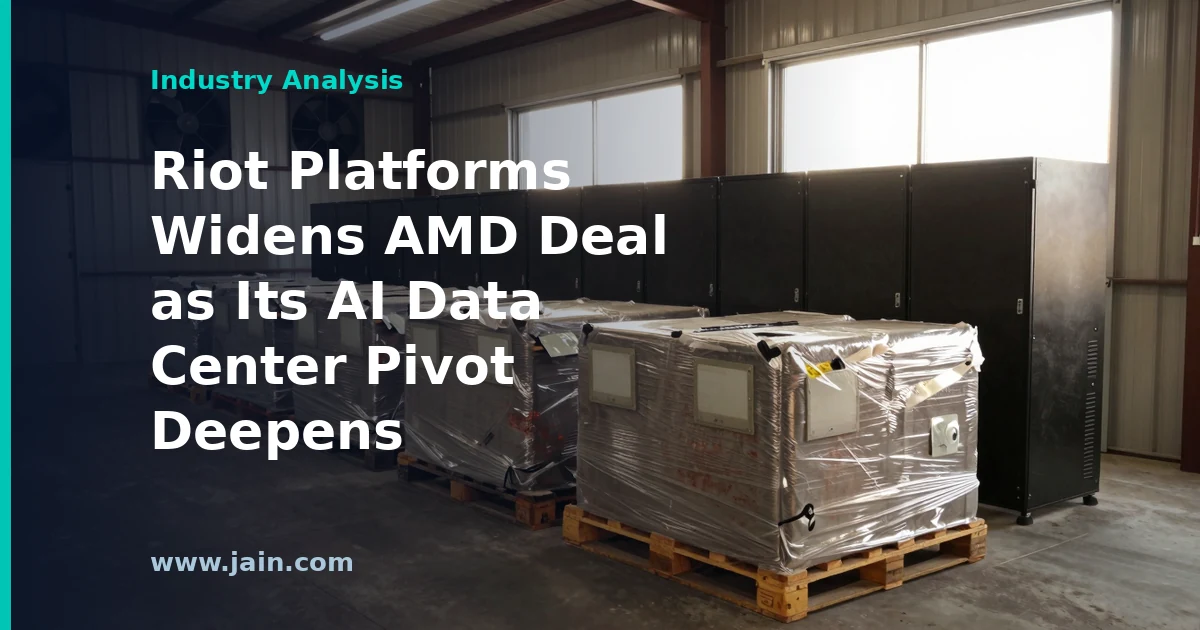
Yahoo Finance reported on May 3, 2026 that Riot Platforms (NASDAQ: RIOT), one of the largest publicly traded bitcoin miners in the United States, is deepening its strategic pivot toward artificial-intelligence data centers, anchored by a widened deal with chipmaker AMD. The coverage frames the expanded relationship as a potential reshaping event for RIOT investors.
The report reached us as an aggregated headline without the underlying deal terms, so the scale, structure, and timeline of the expanded AMD arrangement were not specified in the material we reviewed.
Executive Summary
According to the May 2026 Yahoo Finance report, Riot Platforms is widening an existing relationship with AMD as part of a broader repositioning from cryptocurrency mining toward AI and high-performance computing (HPC) infrastructure. For a company whose core asset has long been access to large amounts of cheap electricity in Texas, the move follows a well-worn path: bitcoin miners across the sector have been converting power capacity into AI-grade data center space, where long-term customer contracts can offer steadier revenue than mining’s boom-bust cycles.
Why it matters: the AI build-out is increasingly constrained not by chips but by powered, grid-connected sites — exactly what large miners already control. A deepened tie to AMD, the primary challenger to Nvidia in AI accelerators, would also signal that the second wave of AI capacity is diversifying its silicon. That said, the source material we reviewed is a headline-level report; the substance of the wider deal — its dollar value, capacity commitments, and delivery schedule — is not disclosed in it, and readers should weigh the strategic logic separately from the still-unverified specifics.
Why Bitcoin Miners Keep Becoming AI Landlords
Riot’s reported pivot is the latest instance of the defining infrastructure trade of this cycle: converting bitcoin-mining capacity into AI data centers. The two businesses share one scarce input — large, grid-connected power allocations — but little else. Mining revenue is tied to a volatile bitcoin price and a protocol that halves mining rewards roughly every four years, squeezing margins on a fixed schedule. AI compute, by contrast, is typically sold under multi-year contracts to creditworthy customers, which capital markets value far more richly per megawatt.
Riot is unusually well positioned for this trade on paper. Its Texas footprint, including the very large Corsicana development site, gives it the kind of secured power capacity that AI developers now wait years to obtain through utility interconnection queues. Precedents are instructive: other miners that repositioned toward AI and HPC hosting saw substantial re-ratings of their stock. But precedent also shows the conversion is neither fast nor cheap — AI halls demand denser power delivery, liquid or advanced cooling, and far higher reliability standards than mining sheds.
What a Wider AMD Deal Would Signal
The AMD element is the distinctive part of the headline. Most AI data center announcements orbit Nvidia, whose GPUs dominate AI training. AMD’s Instinct accelerator line is the leading alternative, and hyperscalers have been actively cultivating it to diversify supply and pressure pricing. A miner-turned-data-center operator aligning with AMD suggests the challenger ecosystem is reaching down from hyperscalers into the emerging tier of independent AI infrastructure providers.
For Riot, an AMD alignment could cut both ways. It may offer better chip availability and economics than fighting for Nvidia allocation, and a strategic partner with an incentive to see AMD-based capacity succeed. The risk is that customer demand today still skews heavily toward Nvidia’s software ecosystem, so AMD-based capacity must find tenants willing to run on that stack. Because the reporting we reviewed does not describe the deal’s structure — chip purchases, a hosting arrangement, or something more strategic — the strength of this signal remains an open question rather than an established fact.
The Investor Lens: Re-Rating Potential Versus Execution Risk
The Yahoo Finance framing — how the pivot “may reshape” RIOT investors — reflects the market’s central question for every converting miner: does the company get valued like a data center operator or like a bitcoin proxy? Data center REITs and AI-cloud providers trade on contracted, recurring revenue; miners trade largely on bitcoin sentiment. Successful conversions can shift a company from one valuation regime to the other.
Execution is the gap between those regimes. Converting sites requires billions in capital expenditure, and miners must fund it from mining cash flows, equity issuance, or debt — each with costs to existing shareholders. Landing anchor tenants is the true validation milestone; announced chip partnerships, however wide, are inputs rather than revenue. Until Riot discloses signed AI customers, contracted capacity, and financing, the pivot remains a credible strategy with material execution risk, not a completed transformation.
Background
Riot Platforms grew out of the 2017 crypto boom, when Riot Blockchain rebranded from a biotech company to pursue bitcoin mining, and it scaled into one of North America’s largest miners with major Texas operations. Bitcoin mining economics are structurally punishing: the network’s reward halves roughly every four years, most recently in April 2024, forcing miners to find new revenue per megawatt or consolidate. That pressure, colliding with the post-2022 explosion in AI compute demand, created the miner-to-AI-data-center conversion trend now reshaping the sector.
By the mid-2020s, powered land — sites with secured grid interconnection — had become the binding constraint on AI infrastructure, with new utility connections taking years. Miners holding hundreds of megawatts of capacity became natural acquisition targets and conversion candidates, and several signed landmark AI hosting deals. Riot’s reported widening of an AMD relationship in May 2026 places it squarely in that migration, on the less-traveled AMD side of a GPU market still dominated by Nvidia.
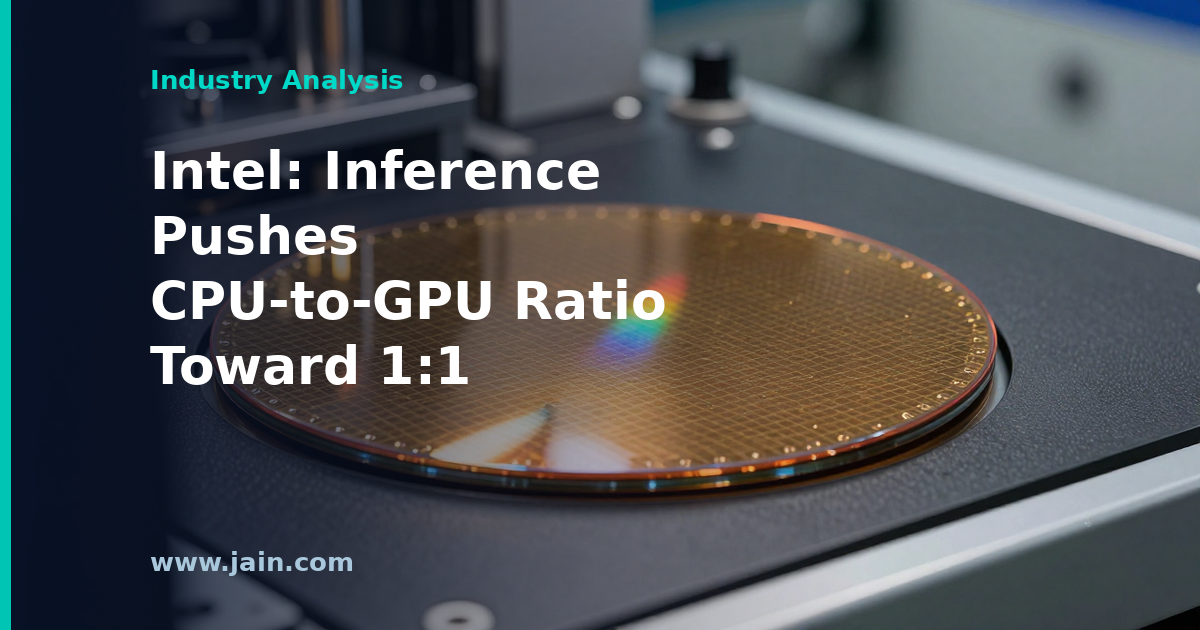
In remarks reported on 24 April 2026 by the Taiwan-based research firm TrendForce, Intel said the shift in AI data center workloads from training to inference is driving the ratio of general-purpose processors (CPUs) to accelerators (GPUs) up from roughly 1:8 toward 1:1. In the same set of comments, Intel said it has pulled forward the target date for reaching its yield goal on 18A — its most advanced manufacturing process — to the middle of the year.
The two statements are directional guidance from a supplier rather than an audited disclosure. The item circulated as an aggregated news headline and short summary; the underlying figures behind the ratio claim, and the definition of the 18A yield target, were not published with it.
Executive Summary
Two claims are bundled into one short item, and they pull on different parts of the AI infrastructure market. The first is a demand-mix claim: that inference — running trained AI models to answer queries — leans far more heavily on CPUs than training did, moving server designs from roughly one CPU per eight accelerators toward something closer to parity. The second is a manufacturing claim: that Intel’s 18A process is hitting its internal yield milestone earlier than previously signalled.
If the ratio claim holds at scale, it changes what an AI data center buys. CPUs, and the memory and I/O that travel with them, become a larger slice of the bill of materials rather than a rounding error next to the accelerator spend. That reshapes procurement negotiations, rack-level power budgeting, and the relative bargaining position of every vendor that sells server silicon — not only Intel.
The caveat matters as much as the claim. Intel sells CPUs and sells foundry capacity, so it has a commercial interest in both statements being believed. Neither is inherently implausible, and the CPU-heavy character of inference serving is a widely discussed engineering reality. But as presented, both are assertions without published supporting data, and buyers should treat them as a hypothesis to test against their own workloads rather than a planning input.
Why Inference Puts the CPU Back on the Critical Path
Training a large AI model is close to the ideal case for an accelerator: a long, predictable, mathematically dense job that keeps GPUs saturated for days or weeks. The CPU’s role is largely to feed and supervise. That is how the industry arrived at server designs with one or two CPUs shepherding eight accelerators — the accelerators do the work, and the host processor is overhead you minimise.
Inference — the production phase, where a trained model actually serves users — has a different shape. Requests arrive unpredictably and must be batched, scheduled and routed. Inputs get tokenised, retrieved documents get fetched and ranked, outputs get filtered and post-processed. Increasingly, a single user request triggers a chain of model calls with orchestration logic between them. Most of that work is branchy, latency-sensitive general-purpose computing, which is what CPUs are for. Serving systems also spend real effort managing the memory that holds a conversation’s intermediate state, and moving data in and out of it. As the accelerator gets faster, the surrounding coordination becomes a bigger share of end-to-end latency — a familiar pattern in which speeding up one component simply relocates the bottleneck.
So the direction of Intel’s claim is consistent with how inference serving is built. What is not established by a headline is the magnitude. A ratio of 1:1 across the industry is a strong statement, and real deployments vary enormously: a retrieval-heavy enterprise assistant and a batch image-generation farm sit at opposite ends of the same spectrum. Without knowing which workloads, which deployment sizes and which time horizon Intel is describing, “1:8 toward 1:1” is best read as a trend claim, not a design specification.
What Parity Would Change on the Purchase Order
Move from one CPU per eight accelerators to something near parity and the effect is not limited to the processor line item. Each additional CPU socket brings its own memory channels, DRAM, network interfaces, power delivery and cooling load. Server CPUs and their memory are meaningful contributors to rack power, and in facilities already constrained by the electricity available at the meter, a denser CPU complement competes for the same watts as the accelerators. Operators planning at fixed megawatts per hall would see fewer accelerators per rack, or higher power per rack, or both.
The commercial consequence is a rebalancing of leverage. In a market where accelerators are scarce and everything else is commodity, the accelerator vendor sets the terms. If CPU and memory content becomes a materially larger share of system cost, buyers gain a second axis to negotiate on, and the suppliers of that content gain relevance. Memory makers are plausible beneficiaries; so are the vendors of high-speed networking and the platform integrators who design around new socket counts.
It does not follow that Intel captures the upside. A structurally higher CPU attach rate is a market-wide tailwind that Intel’s competitors also ride — AMD in x86, and Arm-based host processors sold as part of integrated accelerator platforms, which are specifically designed to keep the host tightly coupled to the accelerator. Intel is describing a market it must still win share in. That is a fair thing for a vendor to point out, and an equally fair thing for a buyer to discount.
18A: A Yield Date Is a Supply Statement
18A is Intel’s most advanced manufacturing process, the one carrying its return to competitive leading-edge production after years of delay, and the one it intends to sell to outside chip designers through Intel Foundry. Yield — the fraction of chips on each silicon wafer that come out working — is the number that converts a process from a technical achievement into an economic one. Wafers cost roughly the same whether most of the chips on them work or few of them do, so yield sets cost per usable chip and, just as importantly, sets how much output a fab can actually ship.
Pulling a yield target forward to mid-year is therefore a supply signal, not a marketing one. Earlier confidence in yield supports earlier volume ramps, firmer commitments to customers, and a better cost position on every product built on the node. For a company that has spent heavily on capacity, the gap between a fab that is running and a fab that is running profitably is almost entirely a yield question.
The claim as reported is unfalsifiable in its current form, because the target itself is not disclosed. “The yield target” could mean defect density against an internal roadmap, functional yield on a specific test vehicle, or yield on a particular shipping product — and these are very different statements. Reaching an internal milestone early is genuine progress; it is not the same as demonstrating competitive yield on a complex, large-die product at volume, which is the bar that determines whether external customers commit. Intel has been explicit in the past that 18A is central to its foundry strategy, and the market will price the milestone accordingly only when it is corroborated by shipping products and named customers.
Reading a Vendor Claim Fairly
Both statements come from a supplier with a direct interest in the conclusion, delivered through an aggregated news item rather than a technical disclosure. That is not a reason to dismiss them. Suppliers frequently see demand-mix shifts before the rest of the market does, precisely because they sit at the order book, and process engineers know their yield curves better than anyone outside the fab. Intel’s ratio claim is also the kind of thing that would be quickly contradicted by customers if it were far off, which imposes some discipline.
The appropriate posture is symmetrical scrutiny. Ask of Intel: what workloads, what customers, what time frame, what definition of the target? Ask the same of the counter-narrative — the assumption that inference remains accelerator-dominated and that host CPU content stays marginal is also an assertion, one that suits vendors whose value is concentrated in the accelerator. Neither position has been demonstrated here with published data.
For anyone making procurement or capital decisions, the practical resolution is empirical and cheap: instrument your own inference serving stack and measure where time is actually spent. A single week of profiling on representative traffic will tell an operator more about its own correct CPU-to-accelerator ratio than any vendor’s industry-wide average, and that measurement is the only version of this claim that can safely be put into a budget.
Background
Intel spent much of the past decade losing manufacturing leadership to Asian foundries and share in server processors to AMD, while missing the accelerator wave that drove the AI buildout. Its response has been to rebuild leading-edge manufacturing and to open its fabs to outside chip designers as Intel Foundry — a capital-intensive strategy in which 18A, the company’s most advanced process, is the pivotal node. Progress on 18A is therefore read by the market as a proxy for whether the broader turnaround is working.
Separately, AI data center demand is passing through a mix shift. The first phase of the buildout was dominated by training runs that reward raw accelerator throughput. As models move into production and serve real users, spending shifts toward inference, where cost per query, latency and system-level efficiency matter more than peak compute. That transition reopens questions about server architecture — including how much general-purpose processing each accelerator needs beside it — that the training era had largely settled.