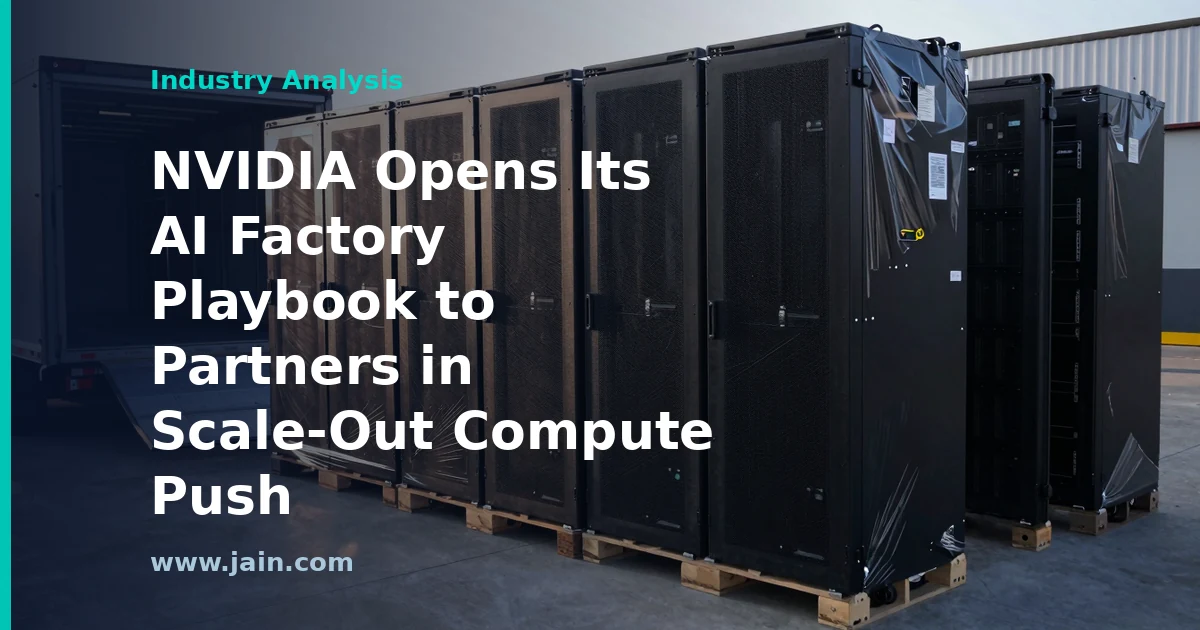
On July 2, 2026, NVIDIA published a blog post titled “NVIDIA Unlocks AI Compute at Scale, Inviting Partners to Power the AI Infrastructure Buildout.” The framing is direct: the world’s dominant supplier of AI accelerators is positioning its partner ecosystem — not just its own products — as the engine of the next phase of AI data center construction.
The syndicated release available to us carries the headline and framing but few operational specifics, so this article analyzes what that positioning signals and flags what the announcement, as distributed, does not substantiate.
Executive Summary
NVIDIA’s announcement extends a theme the company has been building for several years: that AI computing is no longer bought as individual chips or servers but as “AI factories” — entire data centers engineered end to end to turn electricity and data into AI model output. The July 2026 post signals that NVIDIA wants partners — cloud providers, data center operators, system builders and enterprises — to carry that model forward at a scale larger than any single company can build alone.
Why it matters: the constraint on AI growth has shifted from chip supply toward land, power, capital and construction capacity. An invitation to partners is an acknowledgment that the buildout’s next phase depends on the broader infrastructure industry — the operators who own sites, substations and customer relationships. For that industry, the strategic question is what “unlocking” means in practice: reference designs, software licensing, supply allocation, financing support, or something else. The headline alone does not say, and that distinction determines who benefits and how much.
From Chip Vendor to Infrastructure Architect
NVIDIA’s language — “AI compute at scale,” “AI infrastructure buildout” — reflects a deliberate repositioning that predates this announcement. The company popularized the term “AI factory” to describe a data center designed as a single integrated machine: accelerators, high-speed networking, system software and orchestration tools sold as a validated whole rather than as parts. In plain terms, NVIDIA increasingly behaves less like a component supplier and more like an architect that hands builders a full set of blueprints.
Opening that playbook to partners is the logical next step. NVIDIA does not own land, power contracts or construction crews at the scale the AI buildout demands. Its partners — hyperscale clouds, specialized GPU cloud providers, colocation operators and server makers — do. An ecosystem strategy lets NVIDIA’s designs propagate through other people’s capital and real estate, which multiplies its footprint without multiplying its balance sheet.
Why Partners, and Why Now
The timing tracks the industry’s binding constraints. By mid-2026, the practical bottlenecks in AI infrastructure were power availability, grid interconnection queues, cooling for ever-denser racks, and the sheer construction lead time of large facilities — problems that sit squarely in the domain of data center operators and utilities, not chipmakers. Inviting partners to “power the buildout” is, read plainly, a recognition that NVIDIA’s growth now depends on other companies’ ability to deliver megawatts and buildings on schedule.
There is also a demand-side logic. A broader partner base diversifies NVIDIA’s revenue beyond a handful of hyperscale buyers, reaches enterprises and governments that want AI capacity in their own regions or facilities, and seeds regional “sovereign AI” deployments. Each partner that standardizes on NVIDIA’s factory design also standardizes on its software stack — historically the stickiest part of the company’s franchise.
Winners, Risks and the Economics of the Buildout
If the program is substantive, the likely beneficiaries are infrastructure holders: colocation and wholesale data center operators with contracted power, GPU-cloud providers seeking supply and validation, and system integrators who assemble certified designs. For enterprise buyers, more qualified partners should mean more places to procure AI capacity without building it themselves.
The risks are equally concrete. Partners who build to one vendor’s blueprint concentrate their capital on that vendor’s product cycle; each new chip generation can compress the economics of the last. Utilization risk — building capacity ahead of proven demand — sits with the partner, not with NVIDIA. And a partner-led buildout raises the industry-wide question of whether capacity additions are pacing real workload growth or outrunning it. None of this makes the strategy unsound, but the release’s framing places the rewards up front and leaves the risk allocation to be inferred.
Background
Founded in 1993 and best known for inventing the modern graphics processing unit, NVIDIA transformed over two decades into the central supplier of AI computing. Its CUDA software platform, introduced in 2006, made GPUs programmable for general-purpose work, and the deep-learning boom of the 2010s and the generative-AI surge that followed made its data center business the company’s dominant segment — and NVIDIA, at points, the most valuable public company in the world. Along the way it acquired Mellanox for high-speed networking and expanded into full systems, positioning itself as a seller of complete “AI factories” rather than chips alone.
The July 2026 announcement lands in a market defined less by chip scarcity than by physical constraints: power availability, grid interconnection queues and multi-year construction timelines for the data centers that house AI hardware — the context in which an invitation to infrastructure partners carries its weight.
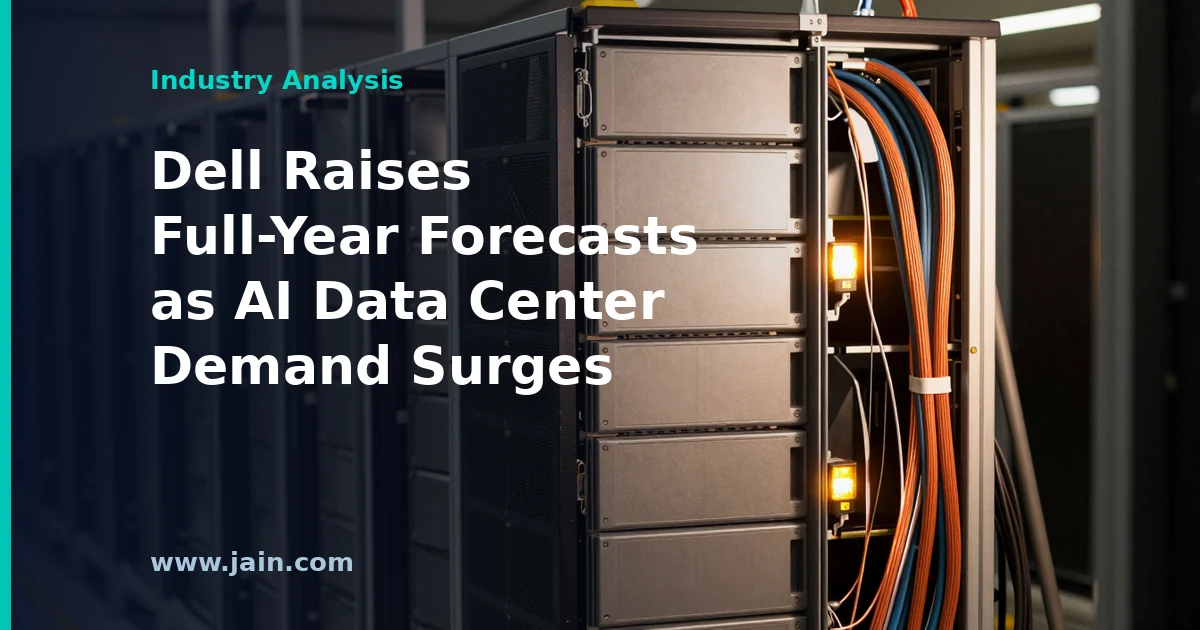
Dell Technologies raised its full-year financial forecasts, citing surging demand for servers driven by the ongoing AI data center buildout, according to a Reuters report published May 27, 2026. The company’s shares rose sharply on the news.
The report frames the guidance increase as a direct consequence of accelerating infrastructure spending by organizations racing to deploy AI computing capacity — making Dell’s outlook one of the clearest demand signals yet from the hardware layer of the AI supply chain.
Executive Summary
According to Reuters, Dell lifted its forecasts for the full fiscal year on the strength of AI-driven server demand, and the market responded with a significant share-price rally. A guidance raise — a company telling investors it now expects better results than it previously projected — is a stronger signal than a single good quarter, because it implies management sees the demand trend continuing rather than peaking.
Why it matters: Dell is one of the largest suppliers of the physical machines that AI runs on. When a vendor of its scale raises its outlook because of data center buildouts, it suggests that the capital spending wave from cloud providers, AI specialists, and large enterprises is still translating into real hardware orders — not just announcements. For everyone downstream of that spending — data center operators, power and cooling providers, connectivity firms — Dell’s forecast is a leading indicator of workloads and capacity demand still to come.
The headline-level report reviewed here does not include the specific revised revenue or profit figures, so the magnitude of the raise, and the margin picture behind it, remain to be read from Dell’s own investor disclosures.
Why Dell’s Guidance Is a Supply-Chain Bellwether
AI infrastructure spending is often measured in press releases — announced campuses, pledged gigawatts, multi-year commitments. Server revenue is different: it is recognized when physical machines ship, which makes it one of the more honest gauges of how much of the announced buildout is actually being executed. Dell sits at that conversion point. Its AI-optimized servers — dense systems built around GPUs, the graphics-derived accelerator chips that dominate AI training and inference — are what turn a chipmaker’s roadmap and a developer’s ambitions into installed capacity.
A raised full-year forecast therefore says something beyond Dell itself: purchase orders for AI hardware were strong enough, and visible enough, for management to commit to a higher number publicly. That is meaningful at a moment when parts of the market have debated whether AI capital spending is durable or a bubble. It does not settle that debate — guidance reflects the order book, not the eventual return on the buyers’ investments — but it indicates the spending had not slowed as of late May 2026.
The Economics Behind the Boom
The AI server business is famously a high-revenue, hard-margin trade. A large share of each system’s cost is the accelerator silicon, which the server maker buys from chip suppliers and passes through — so revenue can grow spectacularly while gross margin percentages compress. Industry analysts have repeatedly flagged this dynamic across the server sector. The headline report does not say how Dell’s raised forecast splits between revenue and profitability, and that distinction is exactly what sophisticated readers should look for in the underlying filings: a raise driven by profitable AI systems and attached storage, networking, and services is a different story than one driven by low-margin pass-through volume.
Dell’s structural advantages in this fight are its global supply chain, enterprise sales relationships, financing arm, and deployment services — capabilities that matter more as AI systems get denser, hotter, and harder to integrate. Liquid cooling, rack-scale delivery, and on-site services are where hardware vendors can defend margin against commodity pressure.
Winners and Losers Down the Stack
Strong AI server demand radiates outward. Chip suppliers benefit first and most directly. Data center operators benefit next: every GPU server Dell ships needs space, power, and cooling, and the newest generations demand far more of each per rack than traditional enterprise gear — sustaining demand for high-density colocation and purpose-built AI facilities. Power and cooling infrastructure vendors, and the connectivity providers linking these facilities, ride the same wave.
The competitive picture among server makers is less comfortable. Dell competes with Supermicro, HPE, Lenovo, and the original design manufacturers (ODMs) that build directly for hyperscale cloud companies. A demand environment strong enough to lift Dell’s full-year outlook likely lifts rivals too, but share shifts between them depend on allocation of scarce accelerator supply, cooling engineering, and delivery speed. For traditional enterprise IT budgets, there is also a quieter tension: dollars flowing to AI systems can crowd out spending on conventional servers and PCs, a mix shift worth watching in Dell’s segment detail.
The Durability Question
The risk case is concentration and cyclicality. AI server demand is driven by a relatively small set of very large buyers — hyperscale clouds, well-funded AI companies, and GPU-cloud specialists. If any of those buyers pause, digest capacity, or hit financing constraints, hardware orders can swing quickly, and guidance can be cut as fast as it was raised. Server makers also carry inventory and backlog timing risk across accelerator product transitions, when buyers may delay orders to wait for next-generation chips.
None of that is a prediction of trouble; it is the standard risk frame for reading any AI hardware guidance raise. The signal from this announcement is genuinely positive for the infrastructure economy. The discipline is remembering that a forecast is a forward-looking statement about a fast-moving market, not a contracted outcome.
Background
Dell Technologies, headquartered in Round Rock, Texas, is one of the world’s largest makers of servers, storage systems, and PCs. Its Infrastructure Solutions Group supplies the data center hardware at the center of this story, and over the past several years the company has become a leading integrator of GPU-dense AI systems, competing with Supermicro, HPE, Lenovo, and hyperscale-focused ODMs. Its scale in supply chain, enterprise sales, financing, and deployment services is central to its position in the AI server market.
The announcement lands amid a historic capital-spending wave: cloud providers, AI developers, and enterprises have been racing to build and equip AI data centers, straining supplies of accelerator chips, power, and cooling. Server-vendor guidance has become a closely watched proxy for whether that buildout is translating into real, shipped infrastructure — which is why a Dell forecast raise draws attention well beyond its own shareholders.
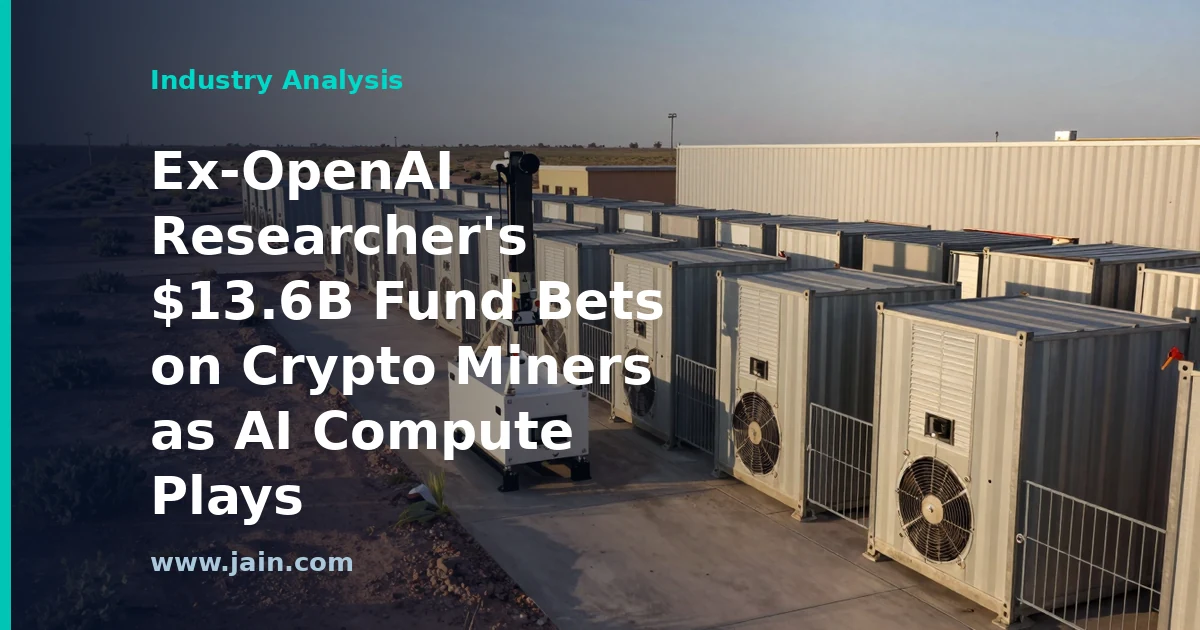
CoinDesk reported on April 25, 2026 that Leopold Aschenbrenner — a former OpenAI researcher who left the lab and became one of the most-watched voices on AI’s trajectory — is directing his roughly $13.6 billion investment vehicle toward crypto mining companies as a way to gain exposure to AI computing infrastructure. The report frames the miners not as bets on bitcoin, but as bets on the power-rich sites and industrial facilities miners control.
Executive Summary
According to CoinDesk, Aschenbrenner’s fund — an AI-focused vehicle now reported at $13.6 billion — is making sizable wagers on publicly traded crypto miners. The logic, as the framing suggests, is that mining companies hold exactly the assets the AI buildout is starved for: contracted electrical capacity, energized substations, industrial land, and operational teams accustomed to running dense computing at scale.
If accurate, this is one of the clearest third-party endorsements yet of the ‘miner-to-AI pivot’ — the industry-wide shift in which bitcoin miners convert or lease their facilities for GPU-based AI workloads. When a prominent AI-native investor allocates institutional capital to that thesis, it signals that the constraint on AI growth is increasingly seen as megawatts and real estate, not chips or models. That reading matters to anyone building, buying, or financing data center capacity.
Why an AI Fund Buys Bitcoin Miners
The trade only makes sense once you see what miners actually own. Training and serving large AI models requires enormous, uninterrupted electricity — and in most markets, new grid interconnections (the utility approvals and hardware needed to draw large power loads) now take years to secure. Crypto miners spent the last cycle locking up precisely those scarce inputs: power purchase agreements, high-capacity substations, cooling-ready industrial shells, and land near cheap generation.
That makes a miner’s equity a potential shortcut to AI capacity. Rather than waiting in an interconnection queue, an AI tenant or investor can access energized megawatts that already exist. Several miners have publicly repositioned themselves along these lines in recent years, converting sites to host GPU computing or signing long-term hosting deals with AI customers. An allocation of this reported size treats that conversion story as investable at institutional scale, not just as a narrative individual miners tell.
The Signal Value of $13.6 Billion
Aschenbrenner is not a generic fund manager; he is best known for his time at OpenAI and for widely circulated writing arguing that AI capabilities — and the industrial buildout behind them — will scale faster than most institutions expect. An investor whose public identity is built on taking AI scaling seriously choosing miners as an expression of that view tells the market where he believes the bottleneck sits: in physical infrastructure and power, the layer beneath the chips.
For data center operators and power developers, that is a meaningful validation. It implies continued appetite from capital markets to fund energized capacity wherever it can be found — including unconventional sources like mining fleets. It also raises the competitive temperature: if converted mining sites become a mainstream way to add AI capacity, they compete with traditional colocation and hyperscale development on speed-to-power, an axis where purpose-built facilities have historically been slow.
The Risks the Thesis Carries
The pivot is not free. Bitcoin mining facilities are engineered for cheap, interruptible, low-redundancy computing; AI training and inference customers typically demand higher reliability, denser networking, and far more sophisticated cooling. Converting a mining site to credible AI-grade infrastructure requires substantial new capital per megawatt, and not every site — or every management team — will make that leap successfully. Investors are, in effect, underwriting a construction and re-engineering project wrapped inside an equity.
There is also two-sided market risk. Miner share prices still move with bitcoin, so an AI thesis expressed through miners inherits crypto volatility it never wanted. And on the AI side, demand for compute is widely assumed but not contractually guaranteed at every site; a slowdown in AI capital spending would hit conversion-story miners harder than incumbents with signed long-term tenants. Concentrated bets by high-profile funds can also crowd a trade, bidding up the very assets whose scarcity made them attractive.
Winners, Losers, and the Rest of the Stack
The immediate beneficiaries of this kind of capital flow are miners with large contracted power positions and credible AI hosting plans — their cost of capital falls as investors reprice their real estate. Utilities and power developers near those sites gain a motivated, well-funded customer class. Traditional data center operators face a more crowded market for AI capacity, but also a rising tide: the same scarcity argument that justifies buying miners justifies premium pricing for any operator who already controls energized space.
The losers, if the thesis holds, are those betting that the power bottleneck resolves quickly — and, potentially, latecomer investors if conversion economics disappoint. The honest summary is that this reported allocation is a strong directional signal about where sophisticated AI capital sees scarcity, not proof that every miner-to-AI conversion will pay off.
Background
Aschenbrenner worked at OpenAI before departing and publishing an influential 2024 essay series on AI scaling, then launched an investment fund built around the thesis that AI’s growth would drive a historic industrial buildout. Over the same period, the crypto mining sector went through its own transformation: after bitcoin’s 2024 halving squeezed mining margins, a wave of miners began repurposing their power-rich facilities for AI computing, with several signing multi-year hosting deals or converting sites outright to GPU data centers.
By early 2026, the ‘miner as AI landlord’ story had moved from novelty to established strategy, with capacity-hungry AI firms competing for any site with large amounts of secured electricity. The reported allocation covered here sits at the intersection of those two arcs — an AI-native fund treating the mining sector’s converted infrastructure as a core way to own the physical layer of the AI economy.
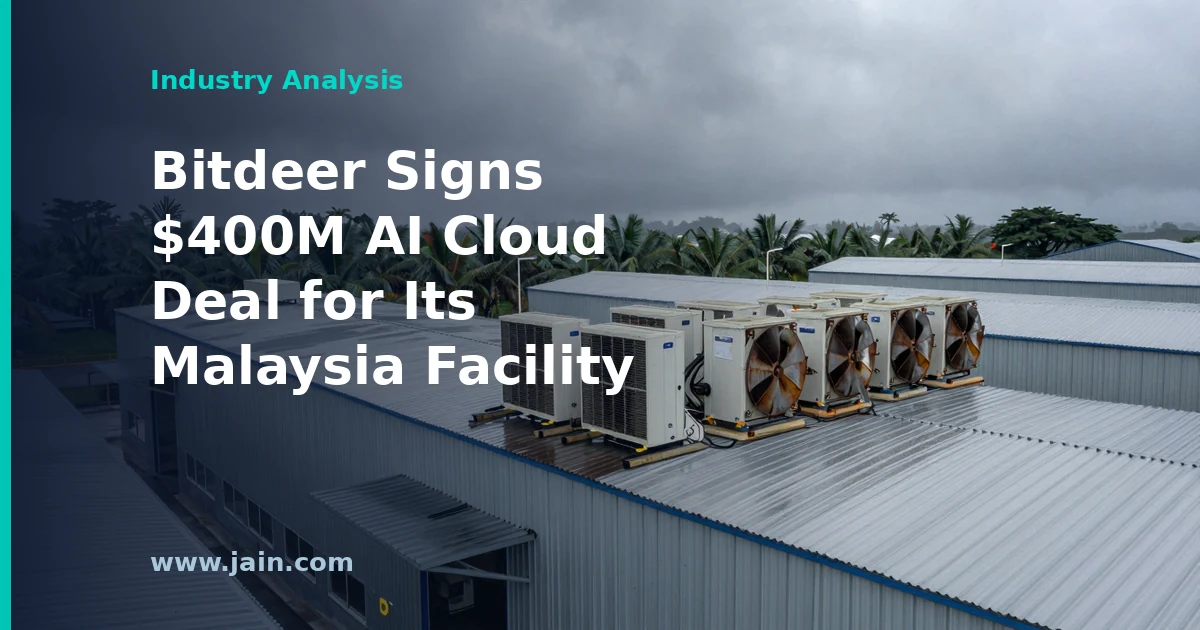
Bitdeer Technologies Group, the Nasdaq-listed bitcoin mining and computing-infrastructure company, has signed a $400 million AI cloud computing agreement tied to its facility in Malaysia, according to an April 22, 2026 report carried by TradingView. The report did not name the customer or disclose the contract’s duration.
The deal adds Bitdeer to the growing list of cryptocurrency miners converting power-rich sites originally built for hashrate — the raw computing throughput used to mine bitcoin — into contracted revenue from GPU-based AI services.
Executive Summary
The announcement, as reported, is straightforward: a $400 million AI cloud computing deal anchored to Bitdeer’s Malaysia facility. What makes it notable is less the single contract than the pattern it extends. Bitcoin miners control two assets the AI industry is starved for — secured grid power and industrial buildings engineered for dense computing — and one by one they are repurposing those assets to serve AI customers, whose workloads pay steadier and often better returns than mining volatile cryptocurrency.
For Bitdeer specifically, a contracted AI deal of this size would shift a meaningful slice of its business from merchant exposure — where revenue swings with bitcoin’s price and mining difficulty — toward committed customer revenue, the model investors reward in the data center sector. It also plants a flag in Southeast Asia, a region that has rapidly become a preferred destination for AI capacity serving Asia-Pacific demand.
The caveat is that the headline figure is nearly all we have. The report does not disclose the counterparty, contract length, GPU types or quantities, or delivery timeline — the variables that determine whether $400 million is transformative or merely respectable. We assess what can and cannot be concluded below.
The Miner-to-AI Conversion Playbook Keeps Compounding
Bitcoin mining and AI computing look similar from the parking lot — warehouses full of humming machines — but they are very different businesses. Mining revenue is merchant: it rises and falls with the price of bitcoin and with network difficulty, and every four years the protocol’s “halving” cuts the block reward miners earn. AI cloud revenue, by contrast, is typically contracted: a customer commits to pay for GPU capacity over a defined term, giving the operator predictable cash flow it can borrow against.
That difference explains why miners across the sector have been converting sites. The scarce inputs for AI infrastructure right now are grid interconnection, power capacity, and shells that can support dense racks — precisely what miners already own. A $400 million commitment, if it carries a multi-year term, is the kind of backlog that changes how the market values an operator: from a leveraged bet on bitcoin into an infrastructure company with visible revenue.
Why Malaysia Is on the AI Map
The location matters. Malaysia — particularly the Johor region adjacent to Singapore — has emerged in recent years as one of the fastest-growing data center markets in the world, absorbing demand that land- and power-constrained Singapore cannot host. Operators there benefit from comparatively available power, industrial land, and proximity to Singapore’s connectivity ecosystem, making it a natural landing zone for AI capacity serving Asia-Pacific customers.
An AI cloud contract anchored to a Malaysian site suggests customers are increasingly comfortable placing GPU workloads in the region rather than defaulting to the United States. For regional enterprises and AI developers, in-region capacity means lower latency and simpler data-residency compliance — the rules governing where data may legally be stored and processed. For operators like Bitdeer, it means competing in a market with structurally better power availability than many Western metros, though also with intensifying local competition.
What $400 Million Does — and Doesn’t — Tell Us
Headline contract values in AI cloud deals require careful reading. The economics depend on variables the report does not disclose: the term over which the $400 million is earned, whether payments are firm take-or-pay commitments or usage-based estimates, who supplies the GPUs and on whose balance sheet they sit, and when capacity actually comes online. A firm multi-year commitment from a creditworthy counterparty is bankable backlog; a usage-based projection is an aspiration.
There is also counterparty risk to weigh. The GPU cloud market has seen deals where the customer is itself a thinly capitalized AI startup whose ability to pay depends on its own future fundraising. Until the customer is identified, the quality of this revenue cannot be assessed — a caution that applies to this deal exactly as it applies to similar announcements across the sector, and one that says nothing negative about Bitdeer specifically. It is simply what the disclosure so far leaves open.
Winners, Losers, and What to Watch
If the conversion trend continues at this pace, the winners are miners holding large secured-power portfolios, the equipment vendors selling them GPUs and cooling, and Asia-Pacific AI customers gaining in-region capacity. The pressure lands on traditional data center developers, who now compete for AI tenants against converts that acquired their power years ago at mining-era prices, and on smaller miners without the balance sheets to fund GPU fleets, since AI conversion demands capital expenditure far beyond a mining retrofit.
For Bitdeer, the questions to watch are execution questions: how quickly the Malaysia capacity is energized and delivered, whether this contract is followed by others, and how the company funds the GPUs behind it. Contracted revenue is only as good as the operator’s ability to deliver the capacity on schedule.
Background
Bitdeer was founded by Jihan Wu, the co-founder of mining-hardware maker Bitmain, and spun off as an independent company before listing on Nasdaq in 2023. It operates large-scale computing facilities across several countries, historically devoted to bitcoin mining — a business whose revenue depends on cryptocurrency prices and on periodic ‘halvings’ that cut mining rewards. Like several peers, Bitdeer began building an AI and high-performance computing arm as GPU demand surged, offering cloud access to accelerated computing from its own data centers.
The backdrop is a structural shortage of AI-ready infrastructure. Power interconnection and dense-computing facilities take years to develop, so operators that already hold them — including former mining sites — have found eager AI customers. Malaysia, particularly the corridor near Singapore, has become one of the principal beneficiaries of that demand in Asia-Pacific.