Tag: GPU compute

  • Tesla’s ‘Megapod’ Reportedly Turns AI Data Centers Into a Turnkey Product

    Tesla’s ‘Megapod’ Reportedly Turns AI Data Centers Into a Turnkey Product

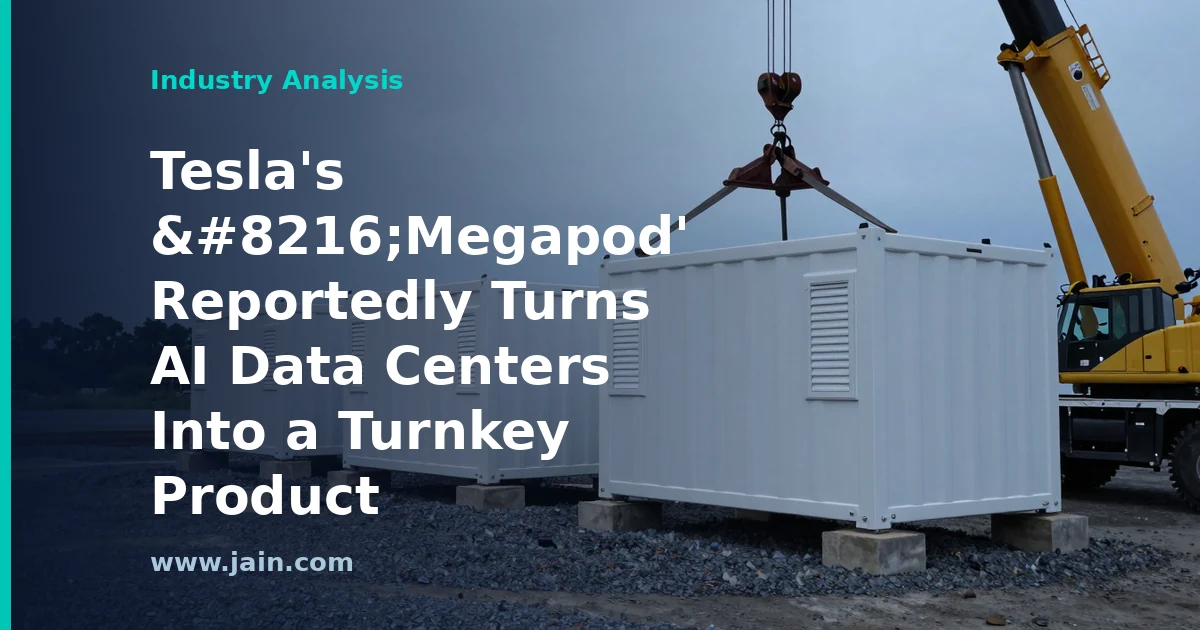
    According to a June 20, 2026 report from Electrek, Tesla plans to sell modular AI data center hardware under the name ‘Megapod’ — a productized, containerized package that would bundle power infrastructure and AI compute into a turnkey unit customers can buy, rather than a facility they must design and build. The report identifies the plan and the product name; specifications, pricing, capacity, and launch timing were not disclosed.

    Executive Summary

    The reported move would take Tesla from building AI infrastructure for itself to selling it as a product. Tesla already manufactures grid-scale battery systems (the Megapack, a factory-built container of batteries and power electronics that utilities buy by the unit) and has built large GPU clusters for its own self-driving and robotics programs. A ‘Megapod’ — the name deliberately echoes Megapack — would apply that same factory-built, buy-by-the-unit model to AI computing itself.

    Why it matters: the hardest part of deploying AI compute today is not buying chips, it is securing power and building the facility around them — a process that routinely takes years. A credible turnkey product that arrives with power conversion, cooling, and compute pre-integrated would compress that timeline and create a new class of competitor to traditional data center developers. That said, the report is thin: it establishes intent and a name, not a spec sheet, and the concept’s viability rests entirely on details Tesla has not yet made public.

    From Megapack to Megapod: Selling the Bottleneck

    Tesla’s energy business grew by productizing something that used to be a construction project. Before Megapack, grid-scale battery storage meant custom engineering on every site; Megapack turned it into a manufactured unit with a price, a lead time, and an order page. The reported Megapod applies the same logic to AI infrastructure, where the analogous pain is acute: demand for AI compute has outrun the industry’s ability to build the powered, cooled buildings that house it.

    If the product is what its name and the report’s framing suggest, the pitch writes itself — skip years of design-build and receive integrated capacity as freight. Tesla is plausibly positioned to attempt this because it already manufactures most of the non-chip ingredients at scale: battery storage, power electronics, thermal management, and high-volume factory assembly. It has also been its own first customer, having built large GPU clusters for training its driver-assistance and robotics models, which is where lessons about powering and cooling dense compute tend to be learned.

    The Market It Would Land In

    Modular and containerized data centers are not new — vendors have sold prefabricated modules for over a decade, and hyperscalers use prefabrication internally. What has changed is the customer base. AI demand has created buyers — enterprises, sovereign AI programs, GPU cloud startups — who need substantial compute quickly but lack the in-house expertise of a hyperscaler. That is the natural audience for a turnkey unit, and it is the same audience today served by colocation providers and data center developers.

    The competitive question is where such a product would sit relative to the existing stack. A Megapod would presumably still need land, grid interconnection or on-site generation, network connectivity, and operations — things a box does not include. That suggests the more likely outcome is complement rather than replacement: developers and colocation operators could themselves become customers, using prefabricated units to shorten construction. The disruptive scenario — buyers bypassing traditional facilities entirely — depends on how much of the surrounding problem Tesla actually packages, which the report does not say.

    What Would Have to Be True

    The economics of an integrated power-plus-compute product are unforgiving in one specific way: compute depreciates on a different clock than power infrastructure. GPUs turn over on a two-to-three-year cadence as new generations arrive, while switchgear, batteries, and cooling plant are fifteen-to-twenty-year assets. A well-designed modular product has to let the fast-aging part be swapped without stranding the slow-aging part; whether Megapod is architected that way is unknown.

    There is also a supply question the report leaves untouched: whose compute goes inside? Tesla has designed its own AI chips for in-house use, but a commercial product would more plausibly need to accommodate the accelerators customers actually want — which puts Tesla in the position of reselling scarce third-party silicon inside its own enclosure. And there is a focus question that applies to any company entering an adjacent market: manufacturing, selling, and supporting mission-critical infrastructure for enterprise customers is a service-heavy business with uptime obligations, a different muscle from selling vehicles or even utility batteries. None of this makes the product implausible — it defines the checklist the eventual announcement should be judged against.

    Background

    Tesla, founded in 2003 and best known for electric vehicles, has spent two decades building an energy division alongside its car business. Its Megapack — a shipping-container-scale battery system for utilities — became one of the company’s fastest-growing product lines, manufactured at dedicated ‘Megafactory’ plants. In parallel, Tesla became a major AI infrastructure operator in its own right, building large GPU training clusters and designing custom chips to train the neural networks behind its driver-assistance software and humanoid robot program.

    The reported Megapod arrives amid an industry-wide scramble: AI demand has made powered data center capacity one of the scarcest commodities in technology, with grid connections and construction — not chips alone — as the binding constraints. That scarcity has drawn manufacturers, utilities, and startups toward prefabricated and power-integrated designs, the space a Megapod would enter.

    Source: Tesla plans to sell modular AI data center hardware called ‘Megapod’ (Electrek) — June 20, 2026 report that Tesla intends to offer packaged power-plus-compute AI data center units as a product.
  • NVIDIA’s ‘AI Factory’ Framing: New Category or New Label?

    NVIDIA’s ‘AI Factory’ Framing: New Category or New Label?

    On May 28, 2026, NVIDIA published a blog post titled AI Factories: The New Infrastructure of Intelligence, arguing that facilities purpose-built to train and serve large AI models constitute a new class of infrastructure rather than an extension of the traditional data center.

    The post is a positioning piece, not an announcement of a specific project, customer, or product SKU. It reinforces a term NVIDIA executives have used with increasing frequency over the past two years as hyperscalers and neoclouds stand up gigawatt-scale GPU campuses.

    Executive Summary

    NVIDIA’s message is straightforward: buildings full of GPUs that ingest data and output tokens, weights, and inference responses look and behave differently enough from general-purpose data centers to deserve their own name. The company’s implicit argument is that treating these sites as ordinary colocation halls understates the electrical, thermal, network, and financial redesign they require.

    Why it matters: language shapes procurement. If buyers, financiers, and regulators accept ‘AI factory’ as a distinct category, it changes how sites are permitted, how power contracts are written, how depreciation is modeled, and which vendors are considered incumbents. NVIDIA benefits when the category is defined around dense GPU clusters, high-bandwidth fabrics, and liquid cooling — all areas where its stack is already assumed.

    For operators and enterprise buyers, the practical question is whether the label describes something genuinely new or repackages a trajectory the industry was already on: higher rack densities, direct-to-chip liquid cooling, campus-scale power procurement, and tighter compute-storage-network integration.

    Why NVIDIA Wants a New Category

    Categories are strategic. When cloud computing was rebranded from ‘hosted servers,’ it justified a decade of premium pricing and shifted procurement out of IT and into finance and operations. NVIDIA has commercial reasons to define AI infrastructure in terms that center accelerated compute — the more the industry treats an ‘AI factory’ as fundamentally GPU-shaped, the harder it is for CPU-first, ASIC-first, or non-NVIDIA-accelerator architectures to be considered the default. This is not dishonest; it is positioning, and buyers should read it as such.

    The framing also helps NVIDIA’s customers. Hyperscalers and specialized GPU cloud providers raising tens of billions in debt and equity benefit from a narrative that these are not commodity data centers competing on price per kilowatt, but capital assets producing a scarce good — intelligence — at industrial scale. Factories, unlike data centers, are supposed to have output curves, unit economics, and productive capacity that justifies their capex.

    What Is Actually Different — And What Is Not

    The technical case for a distinct category rests on real changes. Training clusters routinely exceed 100 kilowatts per rack, versus roughly 10-20 kW for a typical enterprise hall, forcing liquid cooling rather than air. Network topology is dominated by east-west traffic between GPUs on high-bandwidth fabrics, not north-south client traffic. Power draw is spiky and correlated across thousands of chips, which strains grid interconnections in ways general-purpose workloads do not. Site selection is increasingly driven by available generation capacity rather than proximity to users, since training is latency-tolerant.

    What is not obviously new is the underlying building. A well-run modern data center campus with high-density zones, on-site substations, and liquid loops can host these workloads, and many do. The ‘factory’ language risks obscuring a continuum: most operators are retrofitting and expanding existing sites rather than inventing a new asset class from scratch. Whether that continuum deserves a new noun is more a marketing question than an engineering one.

    Winners, Losers, and Who Is Watching

    Beneficiaries of the framing include NVIDIA and its close ecosystem — networking silicon, liquid cooling vendors, and reference-design integrators — plus GPU cloud specialists whose entire pitch is that they are purpose-built rather than repurposed. Incumbent colocation providers face a subtler pressure: they must show that their halls can be reconfigured to the same density and efficiency, or accept being characterized as legacy.

    Regulators, utilities, and communities are the audience that matters most for the label’s staying power. Calling a facility a factory invites questions about industrial siting, emissions accounting, job creation per megawatt, and grid impact that data centers have historically been able to sidestep. NVIDIA’s category may prove more consequential in permitting hearings than in procurement meetings.

    Background

    NVIDIA is the dominant supplier of GPUs and associated networking used to train and serve large AI models, and over the past three years its executives have repeatedly framed AI infrastructure as a new industrial category. The ‘AI factory’ language has appeared in keynotes, investor communications, and partner announcements, and this blog post consolidates that framing.

    The backdrop is a global build-out of purpose-built AI campuses by hyperscalers, sovereign AI initiatives, and specialized GPU cloud providers, funded by tens of billions in equity and debt. Site selection has increasingly shifted toward regions with available power generation, and the industry is in the middle of a transition from air to liquid cooling and from ethernet-centric to specialized high-bandwidth network fabrics.

    Source: AI Factories: The New Infrastructure of Intelligence – NVIDIA Blog — a positioning post arguing that purpose-built AI compute campuses constitute a distinct infrastructure category rather than a variant of the traditional data center.

  • IREN Closes $3 Billion Convertible Notes Offering to Fund AI Infrastructure Buildout

    IREN Closes $3 Billion Convertible Notes Offering to Fund AI Infrastructure Buildout

    IREN, the publicly traded bitcoin miner repositioning itself as an AI infrastructure company, has closed a $3 billion convertible notes offering, according to a report from The Block dated May 16, 2026. The raise ranks among the largest capital events yet for a company making the miner-to-AI transition.

    Convertible notes are debt instruments that can later be exchanged for shares, letting companies borrow at lower interest rates in exchange for potential future dilution. For IREN, the proceeds arrive as the company accelerates its push into AI compute and data center capacity.

    Executive Summary

    The headline fact is simple: $3 billion in fresh capital, closed, for a company that began life mining bitcoin and now markets itself as an AI infrastructure provider. Capital at that scale is not raised to sustain a mining operation — it is raised to build data centers, buy GPUs, and sign the power and construction commitments that AI compute demands. The offering’s closure, rather than mere announcement, means the money is in hand.

    Why it matters: the miner-to-AI pivot has been the dominant strategic story in the bitcoin mining sector for over two years, but most pivots have been announced in press releases rather than financed in capital markets. A closed $3 billion convertible offering is a market verdict of sorts — institutional buyers were willing to lend against IREN’s AI story at convertible terms. It suggests the pivot narrative, at least for the largest and most credible miners, has graduated from concept to bankable strategy.

    That said, the report is brief, and the substantive details that determine whether this is cheap or expensive capital — coupon, conversion premium, hedging arrangements, and specific use of proceeds — are not spelled out in the source. Readers should treat the raise as a strong signal of momentum while withholding judgment on its economics.

    From Mining Rigs to GPU Halls: Why the Pivot Attracts Capital

    Bitcoin miners and AI data center operators need the same scarce ingredients: large blocks of grid power, industrial land, cooling, and the operational muscle to run energy-dense facilities. Miners spent a decade securing exactly those assets, often in power-rich regions where capacity was cheap. When AI demand exploded and grid interconnection queues stretched to five years or more in many markets, energized megawatts became the bottleneck — and miners suddenly held an asset the AI industry desperately wants.

    The pivot is not automatic, however. A mining facility is engineered for cheap, interruptible, low-redundancy compute; an AI data center serving enterprise or hyperscale customers typically requires far higher reliability, denser networking, and liquid cooling. Converting one into the other is a genuine construction project, not a rebranding exercise. That is precisely why a raise of this magnitude is the tell: $3 billion is conversion-and-buildout money.

    The Economics of Convertible Debt in an AI Land Rush

    Convertible notes have become the financing instrument of choice for capital-hungry compute companies. The logic is straightforward: a company with a volatile, high-momentum stock can borrow at a much lower cash interest cost than straight debt would demand, because lenders are partly paid in the option to convert into equity if the stock rises. For shareholders, the trade-off is potential dilution down the road.

    For a company straddling bitcoin mining and AI — two of the most volatility-prone narratives in public markets — convertibles are arguably the only large-scale debt market reliably open. Traditional project finance lenders want long-term contracted revenue; a miner mid-pivot often cannot yet show it. The willingness of convertible buyers to absorb $3 billion of IREN paper says the market is pricing meaningful upside into the equity, but it also means the company is, in effect, pre-selling a slice of that upside to fund the buildout.

    Winners, Losers, and the Sorting of the Mining Sector

    The miner-to-AI transition is sorting the sector into tiers. Companies with large, well-located power portfolios and access to capital markets can finance real conversions; smaller miners without either are left competing in a bitcoin mining business whose economics tighten with every halving — the programmed event that cuts mining rewards roughly every four years. A raise like this one widens that gap: capital compounds, because funded buildouts attract customers, and customer contracts attract cheaper follow-on capital.

    For the broader data center industry, well-capitalized former miners are becoming genuine competitors for AI workloads, particularly in the cost-sensitive middle of the market. Incumbent operators retain advantages in reliability track record and enterprise relationships, but the energized-power advantage is real, and $3 billion buys a lot of construction.

    What a Closed Raise Does and Does Not Prove

    It is worth being precise about what this announcement substantiates. It proves investor appetite: sophisticated buyers committed $3 billion. It does not, by itself, prove customer demand for IREN’s AI capacity, the economics of its contracts, or the timeline on which the capital becomes revenue-generating infrastructure. The AI infrastructure boom has featured both genuinely contracted buildouts and speculative capacity built ahead of demand, and a financing headline cannot distinguish between them. The next meaningful data points will be customer agreements, deployment milestones, and disclosed note terms — not the raise itself.

    Background

    IREN began as Iris Energy, an Australian-founded bitcoin miner that listed publicly and built a portfolio of power-intensive data center sites, emphasizing access to low-cost and renewable energy. Like much of the mining sector, it faced the structural squeeze of bitcoin’s halving cycle, which periodically cuts mining revenue, just as the generative AI boom created enormous demand for exactly the kind of powered data center capacity miners control.

    Over the past two years, the miner-to-AI pivot has become the defining strategic story of the sector, with a handful of large operators securing AI and high-performance computing deals while smaller players remained pure miners. Capital markets have increasingly rewarded the pivot, and large convertible note offerings have become the sector’s signature financing tool for funding GPU purchases and data center conversion at scale.

    Source: IREN closes $3 billion convertible notes offering as Bitcoin miner’s AI infrastructure push accelerates — The Block’s May 16, 2026 report on IREN’s completed $3 billion capital raise.

  • Nscale’s $790M Norway Financing Signals Capital Shift to Nordic AI Infrastructure

    Nscale’s $790M Norway Financing Signals Capital Shift to Nordic AI Infrastructure

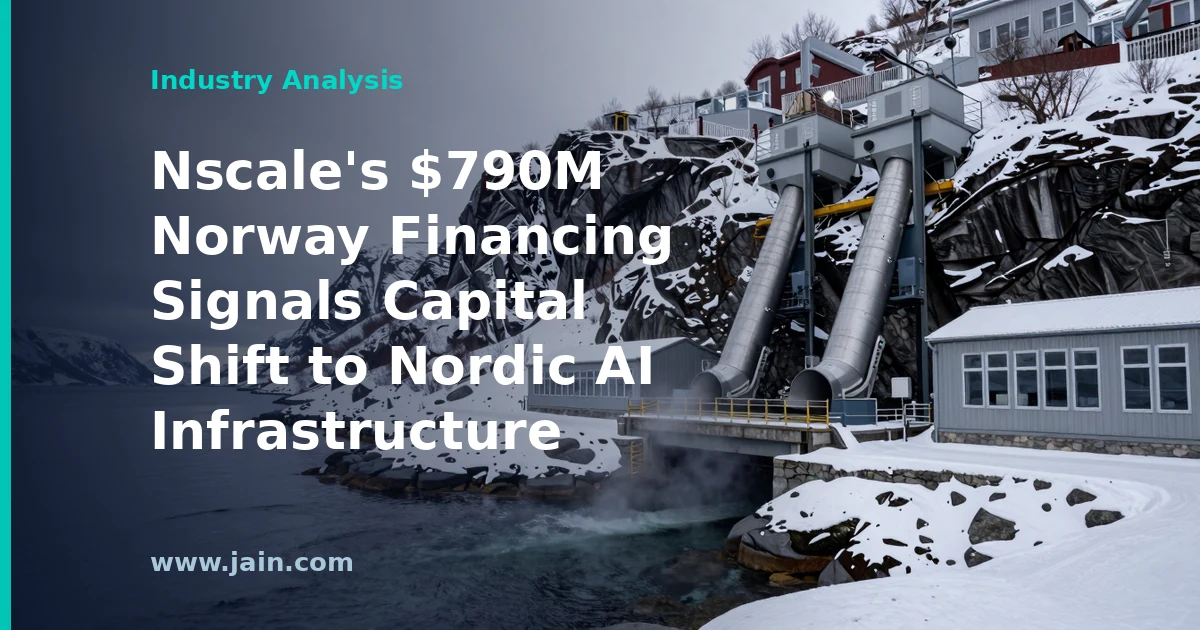
    Nscale, the London-headquartered AI infrastructure company, announced on May 10, 2026 that it has secured $790 million in financing to support its AI infrastructure buildout in Norway. The announcement, distributed via PR Newswire, did not publicly detail the structure of the financing or the specific facilities it will fund.

    The raise extends a rapid string of capital events for the two-year-old company, which operates hydropower-fed data center capacity in northern Norway and has positioned itself as a European alternative for large-scale AI compute.

    Executive Summary

    The headline fact is simple: $790 million in fresh financing, earmarked for AI infrastructure in Norway. What makes it worth analyzing is the pattern it confirms. Capital for AI data centers — both equity and, increasingly, project-style debt — is flowing toward locations selected for power and cooling economics rather than proximity to traditional internet hubs. Norway offers abundant hydroelectric power, some of Europe’s lowest industrial electricity costs, and a climate that allows servers to be cooled largely by outside air, a technique known as free cooling.

    For Nscale, the money supports a buildout strategy the company has pursued since its 2024 founding: convert stranded or under-used Nordic renewable power into GPU capacity (the graphics processors that train and run AI models) and sell that capacity to hyperscalers and AI labs. For the broader market, a financing of this size directed at a Norwegian buildout is another data point that lenders and investors now treat AI compute facilities as a financeable infrastructure asset class — provided the power story is strong.

    Why the Money Is Going North

    Traditional European data center markets — Frankfurt, London, Amsterdam, Paris, Dublin — are power-constrained. Grid connection queues stretch for years, and several jurisdictions have imposed moratoria or tight limits on new capacity. AI training workloads, which need enormous amounts of electricity but are far less sensitive to network latency than a website or trading system, break the old rule that data centers must sit near users. That decoupling is the entire Nordic thesis: build where power is cheap, renewable, and available now, and ship the model weights rather than fighting for megawatts in a congested metro.

    Norway sharpens that thesis further. Its grid is overwhelmingly hydroelectric, giving operators both low costs and a clean-energy claim that matters to hyperscale customers with public carbon commitments. Sub-Arctic ambient temperatures cut cooling energy dramatically — cooling can consume 30% or more of a conventional data center’s power budget, so free cooling flows straight to operating margin. A $790 million financing aimed specifically at Norway is capital underwriting exactly those advantages.

    From Venture Rounds to Infrastructure-Scale Finance

    Nscale’s earlier fundraising followed a venture pattern: a Series A in late 2024 and a Series B in late 2025 that ranked among Europe’s largest. The release does not specify whether the new $790 million is equity, debt, or a hybrid, but financings of this size in the sector have increasingly taken the form of asset-backed or project-level debt, where lenders advance capital against contracted future revenue and the hardware and facilities themselves. If that is the shape here, it would mark a maturation milestone — the point where a young company’s buildout is bankable on its contracts rather than purely on investor conviction in the AI boom.

    The economics explain why that distinction matters. GPU clusters are extraordinarily capital-intensive, and the chips depreciate quickly as new generations arrive. Equity alone cannot efficiently fund gigawatt-scale ambitions; the industry needs debt markets to participate, and debt markets need predictable cash flows. Every large financing that closes on a power-advantaged site lowers the perceived risk for the next one, which is how a regional buildout becomes a self-reinforcing capital cycle.

    Winners, Losers, and the Latency Trade

    The obvious beneficiaries are Nordic host communities and utilities, which convert surplus renewable generation into industrial investment and jobs, and the AI labs and cloud providers that gain a European supply of compute at competitive cost — a point with real weight as European institutions push for “sovereign AI” capacity on EU-adjacent soil. Suppliers of high-density and liquid-cooling equipment, long-haul fiber, and grid interconnection services also ride the wave.

    The trade-off is real but narrowing. Remote sites are poorly suited to latency-sensitive inference serving end users in central Europe, so Nordic capacity skews toward training and batch workloads. Competition is a second pressure: Sweden, Finland, and Iceland pitch similar advantages, and enormous buildouts in the United States and the Gulf compete for the same GPUs, transformers, and turbines. Cheap power is an advantage, not a moat — execution speed and customer contracts decide who wins.

    The Risks Behind the Momentum

    Three risks deserve sober attention. First, customer concentration: merchant AI compute providers typically depend on a small number of very large offtakers, so one renegotiated or lost contract can move the whole revenue model. Second, technology risk: financing hardware that may be economically obsolete in three to five years requires contract terms and depreciation assumptions that have not yet been tested through a full cycle. Third, local constraints: even in power-rich Norway, grid capacity in the far north is finite, and large industrial loads have drawn scrutiny over transmission upgrades and electricity-price effects for residents. None of these invalidate the buildout — but they are the variables that will determine whether today’s financings look prescient or aggressive in hindsight.

    Background

    Nscale was founded in 2024 as a spin-out of data center operator Arkon Energy, inheriting a hydropower-supplied site in Glomfjord in northern Norway. In roughly two years it moved from startup to one of Europe’s most heavily funded AI infrastructure players, raising a Series A in late 2024 and a Series B in late 2025 that ranked among the continent’s largest venture rounds, alongside major capacity agreements with hyperscale customers and a joint venture with Norwegian industrial group Aker to build AI capacity in Narvik with OpenAI as a customer.

    The company’s rise tracks a broader industry shift: as AI training demand collided with power shortages in established data center hubs, operators and their financiers turned to energy-rich regions — the Nordics chief among them — where renewable generation, cool climates, and available grid capacity make gigawatt-scale computing economically and politically feasible.

    Source: Nscale Secures $790 Million in Financing to Support AI Infrastructure Buildout in Norway — company announcement distributed via PR Newswire, May 10, 2026.