Tag: GPU clusters

  • Cisco and Supermicro Deepen Secure AI Factory Ties: What Holds Up

    Cisco and Supermicro Deepen Secure AI Factory Ties: What Holds Up

    Investment commentary site Simply Wall St reports that Cisco has expanded its Secure AI Factory partnership with Super Micro Computer (NASDAQ: SMCI), and argues the development could alter the bull case for the server maker’s stock. A “Secure AI Factory” is industry shorthand for a pre-validated bundle of GPU servers, networking, storage and security software sold as a single, tested design rather than as parts a customer must assemble.

    The item reaching our desk is a stock-watchlist analysis rather than a joint corporate announcement. It does not, in the material available to us, disclose contract value, product availability dates, named customers or revenue expectations. The substantiated fact is the direction of travel: two large infrastructure vendors are binding security more tightly into a packaged AI compute stack.

    Executive Summary

    The headline claim is narrow but strategically legible. Cisco supplies networking and security; Super Micro supplies dense, rapidly-configured GPU server systems. An expanded partnership around a “Secure AI Factory” means the two are shipping a joint reference design in which security controls are part of the validated architecture rather than a layer a customer bolts on after the racks are powered up.

    That matters because AI clusters have changed the security problem. A traditional enterprise application sits behind a perimeter. An AI training or inference cluster concentrates enormous value in one place — proprietary model weights, curated training data, high-bandwidth east-west traffic between GPUs that never touches a conventional firewall — and it is often stood up on aggressive timelines by teams under pressure to show results. Retrofitting controls onto that environment is slow and expensive; designing them in is the cheaper path if the design actually holds.

    For readers assessing the news, the important distinction is between a genuine architectural shift and a marketing package. The available source supports the former as a hypothesis and the latter as a risk. It does not yet supply the specifics — validated configurations, availability, pricing, support ownership — that would let a buyer or an investor tell the difference.

    Why Security Is Migrating Into the Rack

    The economics of retrofit are unforgiving. Adding segmentation, traffic inspection and identity controls to a live GPU cluster usually means change windows on hardware that a business has justified on utilization, plus integration labour that scales with every non-standard choice made during the build. A pre-validated design moves that cost to the vendor, who amortizes it across every customer who buys the same bundle. That is the same logic that produced converged and hyperconverged infrastructure a decade ago, applied to a workload with far higher value density.

    There is a technical driver too. Much of the traffic inside an AI cluster is east-west — GPU to GPU, node to node, across high-speed fabrics — and it is precisely the traffic that classic perimeter tooling was never designed to see. Controls have to live closer to the fabric and the host. That pushes security decisions into the reference architecture, where the networking vendor and the server vendor have to agree on them jointly, rather than into a procurement conversation that happens six months later.

    The unresolved question is depth. “Designed in” can mean security functions genuinely embedded in the data path and validated under load, or it can mean the same products tested together and sold on one quote. Both are useful; only the first changes the risk profile of the deployment. The source material does not distinguish between them.

    Asymmetric Stakes: What Each Side Gets

    The strategic value is not evenly split. Super Micro competes largely on speed and configurability — getting new GPU platforms into shipping systems quickly, at competitive cost. Its structural vulnerability is being seen as a box supplier in deals where enterprise buyers want a single accountable party for a full stack. Association with a validated security architecture from a large incumbent addresses that objection directly, and does so in enterprise and sovereign accounts where procurement rules and audit expectations favour recognized names.

    Cisco’s position is different. It has an installed base and a security portfolio, and its exposure in the AI build-out is the risk that compute-centric architectures route around it. Being embedded in the reference design of a fast-moving server vendor keeps its networking and security attached to workloads that might otherwise be specified by GPU vendors and cloud operators. For Cisco this is defense of attach rate; for Super Micro it is a credibility upgrade. That asymmetry is worth holding in mind when reading any claim that the partnership is transformative for either party.

    The plausible losers are pure-play security vendors selling into AI environments as an overlay, and system integrators whose margin comes from assembling and hardening clusters by hand. Neither is displaced by an announcement. Both are squeezed if validated bundles become the default way mid-sized enterprises buy AI capacity.

    Reading a Thin Source Fairly

    Editorial candour is warranted here. What we have is a headline and framing from an investment-commentary publisher, written to address whether a stock thesis changes. That is a legitimate genre, but it is not a primary disclosure. It carries no contract terms, no availability window, no customer reference and no financial quantification, and its intended reader is an investor rather than a buyer of infrastructure.

    The fair reading is neither dismissal nor amplification. Partnership expansions between established vendors are ordinary commercial activity and are usually incremental; they become material when they convert into named designs, shipping SKUs and disclosed revenue. Equally, the underlying trend — security folded into AI infrastructure architectures — is real and observable across the sector, and this report is consistent with it. The claim that deserves scepticism is not that the partnership exists, but that its existence alone should move a valuation.

    Buyers can apply a simple test. Ask for the validated design document, the specific security functions it covers, the performance overhead measured under representative load, and the name of the party who owns a support case when something in the integrated stack fails. Answers to those four questions separate an engineered product from a joint logo on a slide.

    What This Means for Enterprise AI Buyers

    For organizations building their first serious AI cluster, packaged secure designs lower the skill barrier. The scarcest resource in most enterprises is not GPUs but people who understand GPU networking, storage tiering and cluster security simultaneously. A validated architecture substitutes vendor engineering for in-house expertise, which is a real and quantifiable saving in time-to-first-workload.

    The trade is flexibility and negotiating position. Reference designs constrain component choice, and the deeper the security integration, the more expensive it becomes to swap a networking or server vendor at the next refresh. That is not automatically a bad deal — standardization has genuine operational value — but it should be priced. Buyers who intend to run mixed estates, or who expect to procure GPUs opportunistically across suppliers, should confirm how much of the security architecture survives when the compute underneath it changes.

    The practical recommendation is to treat this as a signal to ask better questions during the next AI infrastructure procurement, not as a reason to reopen a settled vendor decision. The market is moving toward integrated, security-inclusive stacks; which specific bundle wins remains an open commercial question.

    Background

    The AI build-out has reorganized how enterprises buy infrastructure. Rather than selecting servers, switches, storage and security tools separately, many organizations now purchase pre-validated “AI factory” designs — complete architectures tested by vendors and delivered as a unit — because the in-house expertise to integrate GPU clusters correctly is scarce and expensive. Server manufacturers, networking incumbents and GPU suppliers have responded with joint reference architectures aimed at shortening deployment from months to weeks.

    Super Micro Computer built its position by moving new silicon into shipping systems quickly and offering unusually wide configuration choice, which suited early GPU buyers optimizing for speed and cost. Cisco entered the same conversation from networking and security, where its interest is ensuring that AI infrastructure decisions do not bypass its portfolio. Partnerships between the two categories are a natural consequence: the server vendor gains stack credibility with conservative enterprise buyers, and the networking vendor stays attached to the fastest-growing workload in the data center.

    Source: The Bull Case For Super Micro Computer (SMCI) Could Change Following Cisco’s Secure AI Factory Partnership Expansion — investment commentary from Simply Wall St on the expanded Cisco and Super Micro Secure AI Factory partnership and its implications for the SMCI thesis.
  • AI Data Centers Need 36x More Fiber as Glass Shortage Stretches Lead Times

    AI Data Centers Need 36x More Fiber as Glass Shortage Stretches Lead Times

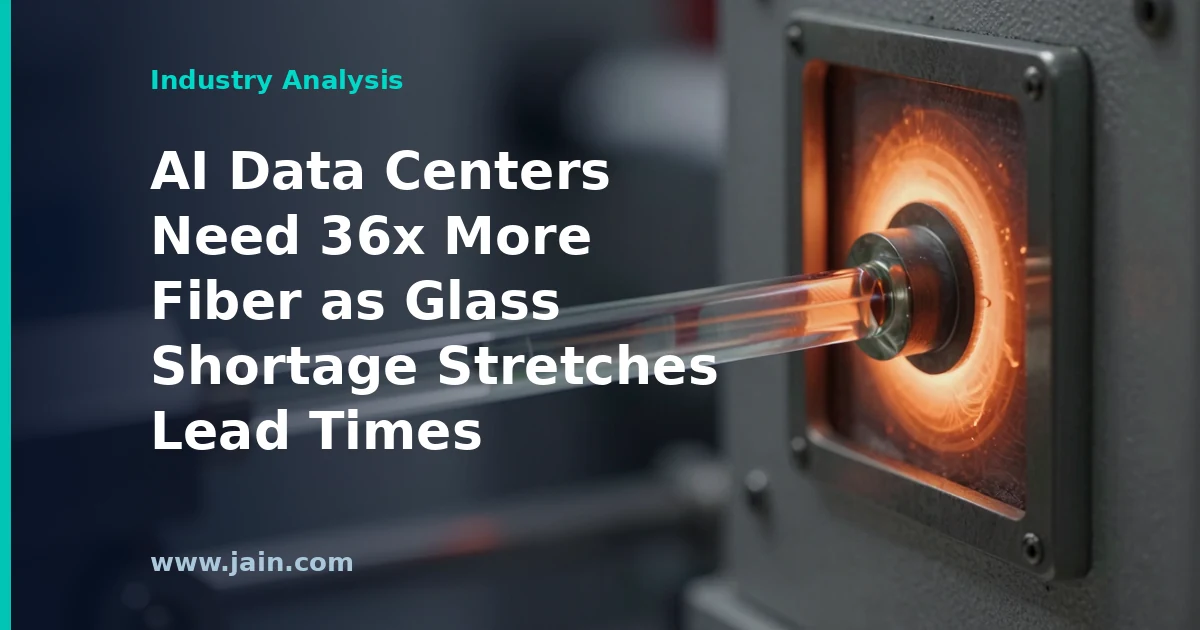
    Industry reporting published May 15, 2026 by Tom’s Hardware says AI data centers require roughly 36 times more optical fiber than facilities designed around standard servers, and that severe shortages of the specialty glass used to make fiber have pushed cable lead times out to as much as a full year.

    Executive Summary

    The headline claim is stark: an AI-optimized data center consumes on the order of 36 times the fiber optic cabling of a conventional server hall, according to the report. That multiplier reflects how modern GPU clusters are built — thousands of accelerators wired to each other through dense optical network fabrics, rather than rows of independent servers that mostly talk to the outside world.

    The second half of the story is the supply chain’s response. Optical fiber begins as ultra-pure glass, and the report says shortages of that glass are now severe enough that cable orders can take a year to fill. If accurate, that puts fiber alongside GPUs, power equipment, and cooling gear on the list of long-lead items that determine when an AI facility can actually come online — a bottleneck that gets far less attention than chips or megawatts, but can stall a build just as effectively.

    Why AI Clusters Devour Fiber

    In a traditional data center, most traffic is “north-south”: requests come in from the internet, a server answers, and the response goes back out. AI training clusters invert that pattern. Training a large model requires thousands of GPUs to exchange intermediate results with each other constantly — so-called “east-west” traffic — over network fabrics where every accelerator may need a high-bandwidth path to many others.

    Those paths run over optical transceivers and fiber because copper cabling cannot carry the required bandwidth beyond a few meters. Multiply high port counts per GPU by tens of thousands of GPUs, add multiple network planes (compute fabric, storage, management), and the cabling bill grows geometrically rather than linearly. A 36x multiplier versus a standard-server design is a dramatic figure, but the architectural logic behind heavy fiber consumption in AI facilities is well established, even though the report does not detail how that specific number was derived.

    A Supply Chain Built for a Different Era

    Optical fiber is drawn from glass preforms — cylinders of extremely pure silica manufactured in specialized, capital-intensive plants. That production base was scaled for telecom demand: long-haul networks, broadband buildouts, and steady data center growth. It was not sized for a scenario in which single campuses consume fiber volumes previously associated with regional networks.

    Capacity of this kind does not flex quickly. New preform and draw capacity takes significant time and investment to bring online, and manufacturers burned by past boom-bust cycles in fiber tend to expand cautiously. That is how demand shocks turn into year-long lead times: the report’s claim of severe glass shortages is consistent with a supply base that responds in years while demand is compounding in quarters, though the report itself does not identify which producers are constrained or how long the shortfall may last.

    Another Hidden Gate on the AI Buildout

    The AI infrastructure race has repeatedly been slowed less by capital than by unglamorous physical inputs: grid interconnections, transformers, generators, chillers — and now, potentially, cabling. A data center with power, cooling, and GPUs on the floor still cannot train models if the fabric connecting those GPUs is stuck in an order backlog. For builders, that makes fiber a schedule-critical procurement item to be locked in early, not a finishing detail ordered late in construction.

    If lead times hold at a year, the likely effects are familiar from other constrained components: large buyers with forecasting muscle and framework agreements absorb available supply, smaller operators and enterprises face longer waits or higher prices, and fiber and cable manufacturers gain pricing power and a rationale for capacity expansion. The caveat is that this is a single report; buyers should verify current lead times with their own suppliers rather than treating the year figure as universal.

    Background

    Optical fiber has been the workhorse of global connectivity since the 1980s, and the industry has weathered demand cycles before — most notably the telecom boom and bust of the early 2000s, which left manufacturers wary of overbuilding capacity. Inside data centers, fiber’s role grew steadily as network speeds passed the limits of copper, but conventional facilities still used it relatively sparingly.

    The generative AI buildout that accelerated from 2023 onward changed the equation. Training clusters grew from hundreds to tens of thousands of GPUs, each demanding multiple high-bandwidth optical connections, while hyperscalers and specialist operators announced multi-gigawatt campuses worldwide. That put unprecedented demand on every physical input to a data center — power equipment, cooling, chips, and, as this report highlights, the glass and cable that tie the machines together.

    Source: AI data centers require 36 times more fiber than designs with standard servers — severe glass shortages push cable lead times out to a full year, Tom’s Hardware, May 15, 2026 — a report on AI-driven fiber demand and optical glass supply constraints.

  • CoreWeave Makes the Case for Liquid Cooling as the AI Data Center Default

    CoreWeave Makes the Case for Liquid Cooling as the AI Data Center Default

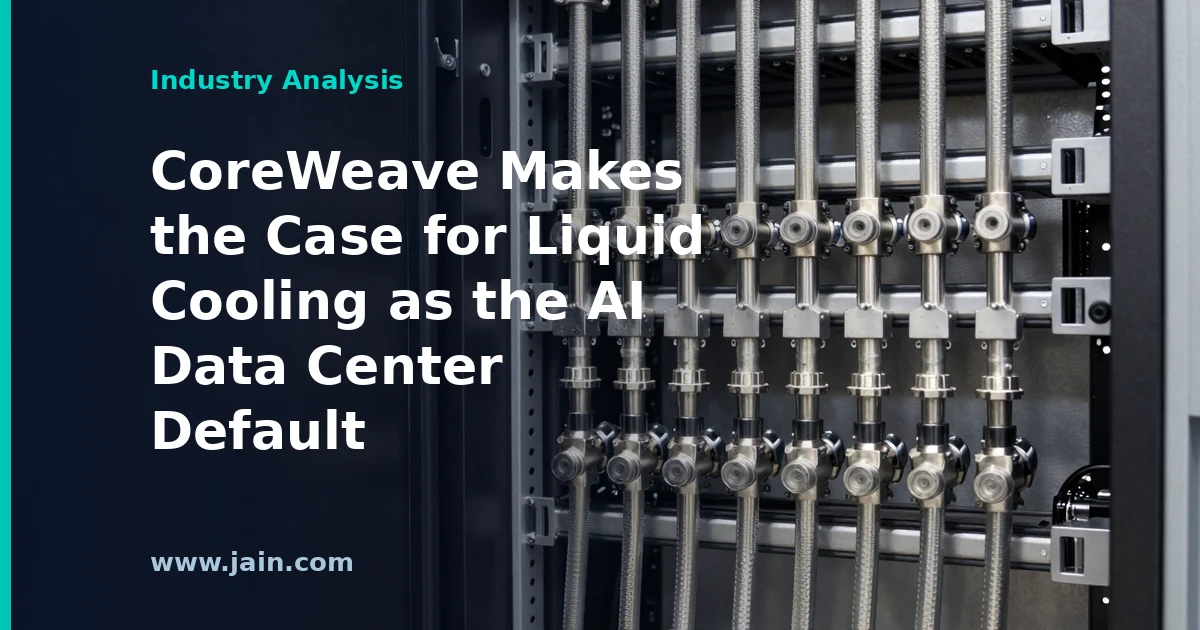
    CoreWeave, the AI-focused cloud provider, published a piece titled “Liquid Cooling for AI Data Centers: Run Cold, Act Bold,” making the argument that liquid cooling — circulating fluid directly to or near the chips rather than relying on chilled air — should be treated as the default engineering choice for dense AI training and inference clusters, not a specialty option.

    The post, surfaced in early May 2026, is a vendor thought-leadership piece rather than a product or facility announcement: no new sites, capacity figures, or customer commitments accompany it. Its significance lies in who is saying it — one of the largest dedicated AI cloud operators publicly framing liquid cooling as table stakes.

    Executive Summary

    The core claim is architectural: modern AI accelerators are being packed into racks at power densities that air cooling struggles to serve economically, so operators who standardize on liquid cooling now will deploy the newest hardware faster and run it more efficiently than those who retrofit later. That position aligns with the direction of the hardware itself — flagship AI rack systems from the leading accelerator vendors are increasingly designed around liquid cooling from the outset.

    Why it matters: cooling has quietly become one of the binding constraints on AI buildout, alongside power availability and chip supply. A data center designed for traditional air-cooled racks often cannot accept the densest AI systems without significant rework of its mechanical plant, piping, and floor layout. When a major AI cloud provider says liquid cooling is the default, it is effectively telling the colocation and construction ecosystem what the demand side now expects.

    For buyers and investors, the practical takeaway is less about CoreWeave specifically and more about the signal: the market for AI capacity is bifurcating between facilities that can support liquid-cooled density and those that cannot, and the gap affects deployment speed, efficiency, and ultimately the cost of delivered compute.

    Why Cooling Became the Bottleneck

    For most of the data center industry’s history, air cooling was sufficient: racks drew a few kilowatts, and moving enough cold air through the room was a solved problem. AI changed the arithmetic. Training clusters concentrate power-hungry accelerators as tightly as possible to shorten the distances data travels between chips, because interconnect latency and bandwidth directly affect training performance. That pushes rack densities far beyond what conventional air handling was designed for, and at some point the physics favors liquid — water and engineered fluids carry heat far more effectively than air.

    CoreWeave’s framing of liquid cooling as a default rather than an exception reflects where the hardware roadmap already points. The densest current-generation AI rack systems are engineered for direct liquid cooling, meaning operators who want the newest silicon at full density have limited choice. In that sense the post is less a prediction than a description of a constraint the industry is already living with — but stating it as doctrine matters, because much of the world’s existing data center stock was not built for it.

    The Economics: Efficiency Versus Retrofit Cost

    The business case for liquid cooling rests on two ledgers. On the operating side, liquid systems can reduce the energy spent on cooling itself — a meaningful lever, since cooling is typically one of the largest non-IT loads in a facility, and every watt saved on cooling is a watt available for revenue-generating compute in power-constrained markets. On the capital side, however, liquid cooling requires piping, coolant distribution units, leak management, and often structural changes, which is straightforward in a new build and expensive in a retrofit.

    That asymmetry is the strategic subtext of a piece like this. Operators that standardized early on liquid-ready designs can absorb each new accelerator generation with incremental changes; operators with large air-cooled footprints face a harder choice between costly conversion and ceding the densest workloads. CoreWeave, which built its business specifically around GPU infrastructure for AI, has an obvious interest in emphasizing a criterion where purpose-built AI clouds hold an advantage over general-purpose incumbents — which does not make the underlying engineering argument wrong, but readers should recognize the alignment between the message and the messenger.

    Winners, Losers, and the Supply Chain Ripple

    If liquid cooling is the default, the beneficiaries extend well beyond AI clouds. Suppliers of coolant distribution units, cold plates, piping, and heat-rejection equipment see their addressable market expand from a niche to a standard line item in every AI facility. Colocation providers with liquid-ready halls gain pricing power for AI tenants; those without face pressure to invest. Engineering and construction firms with liquid-cooling experience become scarcer resources in an already stretched buildout.

    The risk side deserves equal attention. Liquid cooling adds mechanical complexity — leaks, coolant chemistry, maintenance procedures — into environments that prize uptime above almost everything. Standardization across vendors is still maturing, which raises the possibility of stranded investment if designs shift between hardware generations. And efficiency gains at the rack level do not eliminate the larger constraint: many AI projects today are gated by grid power availability, a problem no cooling technology solves on its own.

    Background

    CoreWeave began as a cryptocurrency mining operation before pivoting to GPU cloud computing, and rode the generative AI boom to become one of the largest providers of dedicated AI infrastructure, going public in 2025. Its business model — building or leasing data centers purpose-designed for dense GPU clusters and renting that capacity to AI developers — makes facility engineering choices like cooling central to its competitive position.

    The broader industry context: for decades, air cooling dominated data centers because rack power draws were modest. The AI era reversed that, with accelerator racks reaching power densities that favor liquid-based heat removal, and the latest flagship AI rack systems are designed for liquid cooling from the factory. That has turned cooling from a back-of-house mechanical detail into a strategic differentiator in the race to deploy AI capacity.

    Source: Liquid Cooling for AI Data Centers: Run Cold, Act Bold — CoreWeave, a vendor blog post arguing for liquid cooling as the default architecture for dense AI clusters.

  • Cooling Struggles to Keep Pace With AI Power Density in Data Centers

    Cooling Struggles to Keep Pace With AI Power Density in Data Centers

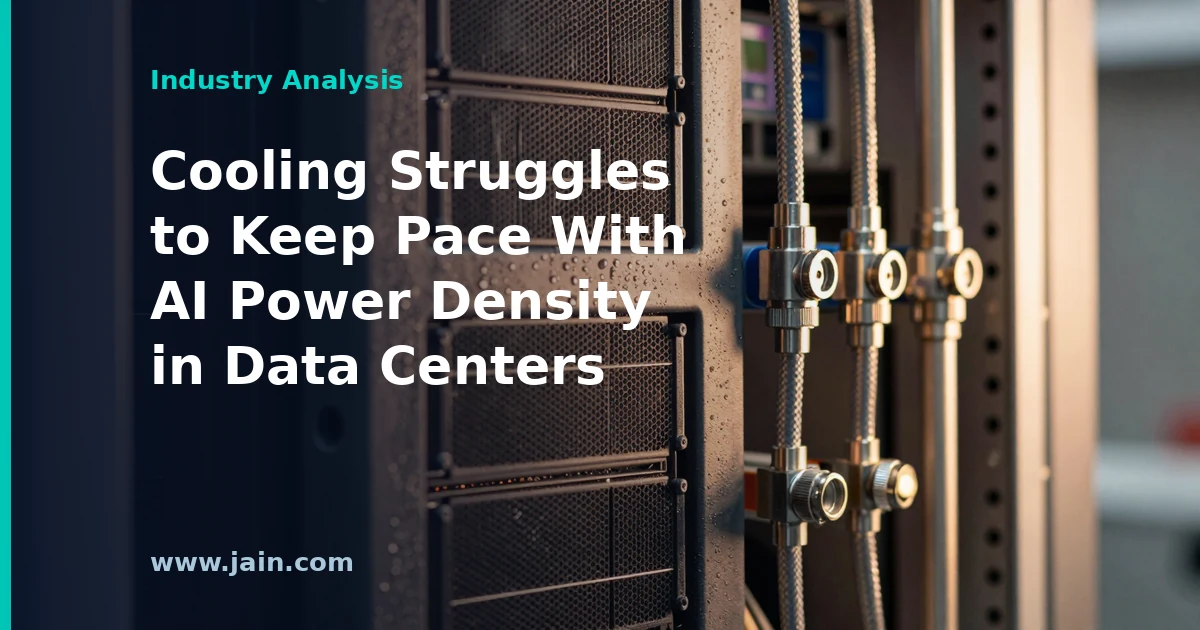
    Trade publication Data Center Knowledge reported on May 1, 2026 that cooling capability is failing to keep pace with the power density of AI computing hardware in data centers. The report frames a problem now visible across the industry: racks packed with AI accelerators draw far more power — and therefore shed far more heat — than the air-cooled infrastructure most facilities were built around, turning thermal management into a gating factor for AI capacity.

    Executive Summary

    The core claim is simple but consequential: the heat produced by AI hardware is rising faster than the industry’s ability to remove it. Every watt a server consumes becomes heat that must be carried away, and conventional data centers were engineered for racks drawing modest single-digit to low-double-digit kilowatts. Dense AI training clusters concentrate an order of magnitude more power in the same floor space, pushing air-based cooling — fans, raised floors, and computer-room air handlers — toward its physical limits.

    Why it matters: if cooling cannot keep up, it does not matter how many GPUs a company can buy or how much grid power a site can secure. Thermal capacity becomes the binding constraint on AI deployment schedules. That reality is forcing a generational transition toward liquid cooling — circulating coolant directly to chips or immersing hardware in fluid — and it is reshaping how facilities are designed, financed, and leased.

    Heat Is the Hard Ceiling, Not Power or Chips

    The AI buildout has been narrated mostly as a race for GPUs and grid connections, but this report points at the quieter bottleneck between them: getting heat out of the building. Air cooling works by moving enormous volumes of chilled air past hot components, and its effectiveness falls off sharply as power concentrates. Past a certain rack density, no arrangement of fans and airflow containment can remove heat as fast as modern accelerators generate it. Liquid, which carries heat far more efficiently than air, becomes a physical necessity rather than an optimization.

    That distinction matters for planning. Power shortages can sometimes be solved with money and patience — new substations, on-site generation. Thermal limits are baked into a building’s design: pipe runs, floor loading, chilled-water plant capacity, and the space between racks. A facility designed for air cooling cannot simply be told to run hotter.

    The Retrofit Problem: Old Buildings, New Physics

    The industry’s installed base is the crux of the struggle the report describes. Most operating data centers were designed years before dense AI clusters existed. Retrofitting them for direct-to-chip liquid cooling means adding coolant distribution units, leak detection, new piping, and often structural work — all while existing tenants keep running. That is slow, expensive, and disruptive, which is why much of the highest-density AI capacity is going into purpose-built greenfield facilities instead.

    The economic consequence is a widening split in the market. Modern, liquid-ready capacity commands premium pricing and pre-leases quickly, while older air-cooled facilities risk sliding toward commodity workloads. For operators, the question is no longer whether to invest in liquid cooling but how much of the existing portfolio is worth converting versus running out its useful life on conventional enterprise and cloud workloads.

    Winners, Losers, and the Supply Chain in Between

    A constraint this fundamental redistributes value. Suppliers of liquid-cooling hardware — cold plates, coolant distribution units, immersion systems, heat exchangers — and the engineering firms that integrate them stand to benefit from a multi-year upgrade cycle. Chipmakers are increasingly designing accelerators that assume liquid cooling, which pulls the whole ecosystem along. Operators with liquid-ready designs and available power gain leverage in lease negotiations with AI tenants who have few alternatives.

    The losers are less obvious but real: enterprises and smaller cloud providers holding long leases in facilities that cannot economically support high-density deployments, and AI projects whose timelines quietly slip because the cooling plant — not the chips — is the long-lead item. For buyers of AI capacity, thermal specifications are becoming as important a diligence item as price per kilowatt.

    Background

    For most of the industry’s history, data centers were cooled by air: chilled air pushed through raised floors and aisles past servers drawing a few kilowatts per rack. That model scaled comfortably through the enterprise and cloud eras. The AI boom broke the pattern — training clusters built on power-hungry accelerators concentrate an order of magnitude more power per rack, and the industry has responded with a generational shift toward liquid cooling, a technique long used in supercomputing but new at commercial scale.

    By early 2026, the constraint conversation around AI infrastructure had expanded from chip supply to grid power and, increasingly, to thermal capacity — the subject of this report. Cooling now sits alongside power procurement as a first-order determinant of where and how fast AI capacity gets built.

    Source: Cooling Struggles to Keep Pace With AI Power Density — Data Center Knowledge trade-press report, published May 1, 2026, on thermal management lagging AI hardware density in data centers.