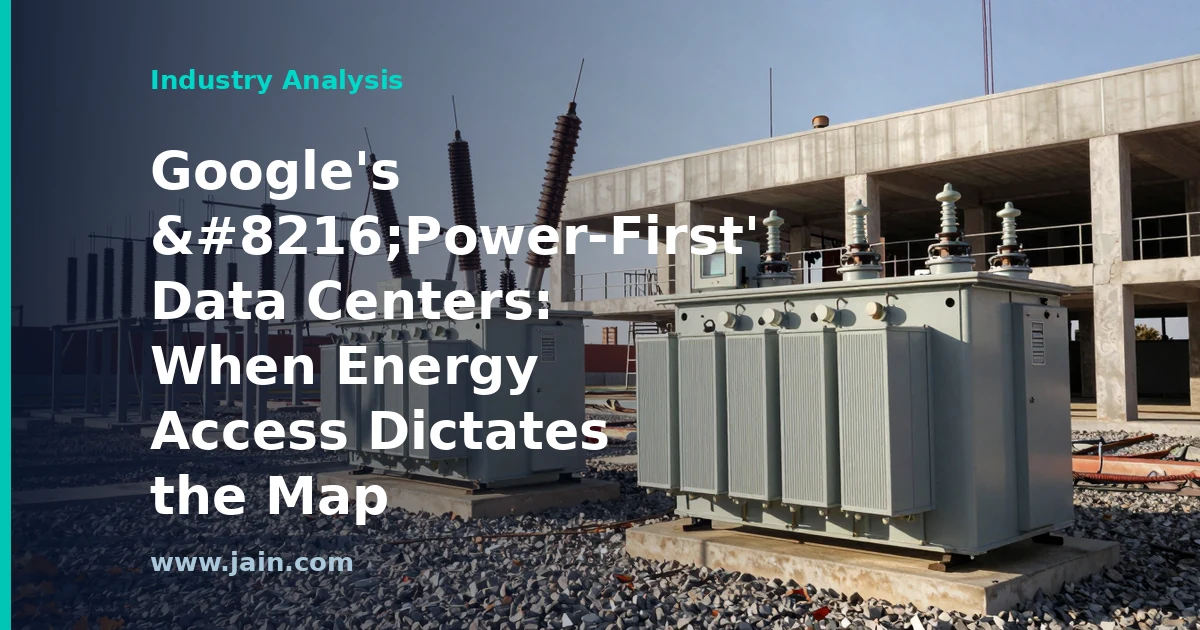
Data Center Knowledge reported on June 5, 2026, that Google is pursuing what it frames as a ‘power-first’ data center model — an approach in which access to electricity, rather than proximity to fiber routes, land, or customers, becomes the primary factor deciding where and how new facilities get built. The framing positions the model as a potential template for an industry now defined by energy scarcity.
Executive Summary
The report’s headline poses power-first siting as ‘a new model for energy scarcity’ — and that question mark matters. What is being described is less a single project announcement than a strategic posture: when grid interconnection queues stretch for years and utilities cannot promise large blocks of firm capacity, the rational response for a hyperscaler (a company operating cloud infrastructure at global scale, such as Google) is to start the site-selection process with the question ‘where can we actually get megawatts?’ and let everything else follow.
If that is genuinely how Google is now sequencing its development decisions, it inverts decades of data center orthodoxy. Historically, operators picked locations for network latency, tax incentives, land cost, and workforce, then asked the local utility to deliver power — which utilities, until recently, could almost always do. The reported shift is a public acknowledgment that electricity has become the scarce input around which everything else in digital infrastructure must now be designed.
From Location, Location, Location to Megawatts, Megawatts, Megawatts
Site selection used to treat power as a utility in the literal sense: always there when you flipped the switch. The AI buildout broke that assumption. Training clusters demand campus-scale power draws that rival heavy industry, and in many popular data center markets the local grid simply cannot add that load quickly. A power-first model responds by making energy availability the first filter — screening geographies by generation capacity, transmission headroom, and interconnection timelines before considering the traditional criteria at all.
For laypeople, the analogy is a factory town: the plant goes where the resource is, and the rest of the operation organizes itself around that fact. The strategic consequence is a likely redrawing of the data center map away from saturated hubs toward regions with surplus generation or the ability to build it — a shift with real winners (energy-rich regions, utilities with spare capacity, landowners near transmission) and real losers (constrained legacy markets that can no longer trade on their connectivity advantages alone).
What Power-First Implies for Design, Not Just Siting
The editorial angle here is worth taking seriously: if energy is the binding constraint, it shapes design as much as geography. A facility conceived power-first tends to be engineered around its energy reality — sized to the block of capacity actually secured, potentially paired with on-site or contracted generation, and optimized to extract maximum compute per watt because every watt was hard-won. Efficiency stops being a sustainability talking point and becomes the core economic lever.
That logic also favors operators with the balance sheet to participate in energy development itself — funding new generation, signing long-duration power purchase agreements (contracts to buy a plant’s output for years in advance), or co-developing sites with utilities. Hyperscalers can play that game. Smaller operators and enterprises largely cannot, which suggests power scarcity could further concentrate AI-scale infrastructure among a handful of companies with the ability to originate their own electricity supply.
A Question Mark Doing Honest Work
It is equally important to note what this coverage is and is not. The available material is a report framing a strategic concept, with a headline that explicitly asks whether this constitutes a new model rather than declaring it one. From the source available to us, there are no disclosed site lists, capacity figures, investment commitments, or timelines to evaluate. ‘Power-first’ is a compelling frame, and it is consistent with pressures the whole industry acknowledges — but as presented, it remains a thesis about Google’s approach rather than a verifiable program with published specifics. Readers should hold both things at once: the underlying constraint is real and well-documented across the sector, while the specific contours of Google’s response are, on this evidence, still thinly detailed.
Background
Google was among the earliest builders of hyperscale data centers and has long treated energy procurement as a strategic discipline, including years of large-scale renewable purchasing and a stated goal of running on carbon-free energy around the clock. That history makes it a bellwether: when Google changes how it sequences power and siting decisions, the rest of the industry pays attention.
The broader context is the AI infrastructure boom that accelerated from 2023 onward, which pushed data center power demand up sharply and collided with a grid whose generation and transmission additions move on multi-year regulatory timelines. By 2026, power availability — not land, capital, or chips alone — had become the most commonly cited bottleneck for new capacity across the sector, setting the stage for strategies like the one described here.
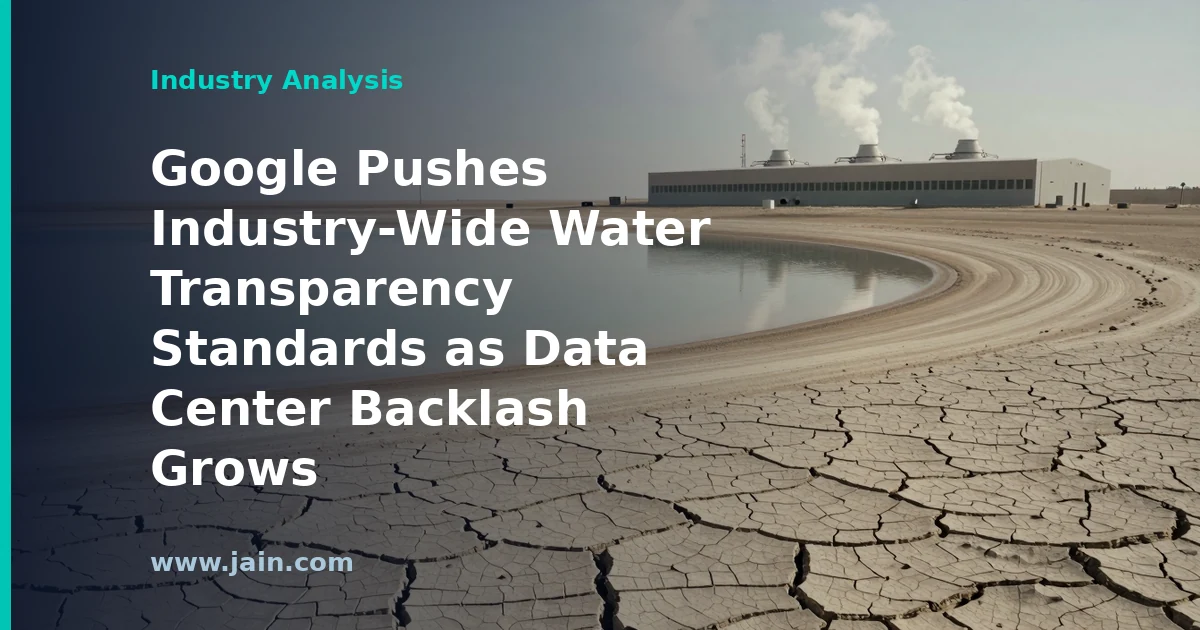
Google is advocating for industry-wide standards on how data centers measure and disclose their water use, according to a June 4, 2026 report from Axios. The move comes as public and political backlash over data-center water consumption intensifies, driven by the rapid buildout of AI computing capacity in communities that are increasingly asking what these facilities take from local water supplies.
Executive Summary
According to the Axios report, Google — operator of one of the world’s largest data-center fleets — is pushing for water-use standards across the data-center industry at a moment when the sector’s social license to build is under real strain. Water has joined electricity as the most contested resource in data-center siting fights, and operators have historically disclosed water consumption inconsistently, if at all, often citing competitive sensitivity.
The significance is less about any single company’s practices than about the reporting baseline. Today there is no universally applied, apples-to-apples standard for how a data center reports water withdrawal, consumption, and offsetting. If a major hyperscaler — one of the handful of companies operating cloud infrastructure at global scale — succeeds in normalizing common metrics and disclosure, it changes the conversation for every operator, utility, and permitting authority in the market. The available reporting is brief, so the details of what Google is proposing, and to whom, remain to be seen.
Why Water Became the AI Buildout’s Flashpoint
Data centers consume water primarily for cooling: many facilities use evaporative systems, which lower temperatures by evaporating water and are energy-efficient but consumptive — much of that water leaves as vapor rather than returning to the local system. As AI training and inference drive a historic wave of data-center construction, the aggregate water question has moved from sustainability reports to city-council meetings, especially in drought-prone regions where residents and farmers compete for the same supply.
The backlash dynamic is straightforward: communities are asked to approve large industrial facilities, often under non-disclosure agreements during site selection, and then struggle to learn how much water those facilities actually use. That information vacuum breeds distrust regardless of the underlying numbers. In several well-publicized siting disputes, the absence of clear water data has itself become the story.
Transparency as a Strategic Play, Not Just a Virtue
A push for common standards from a company of Google’s scale is best read as both principled and pragmatic. Voluntary, industry-defined standards frequently emerge when an industry senses that mandatory, jurisdiction-by-jurisdiction regulation is the alternative. A single common disclosure framework is far cheaper for a global operator to comply with than fifty different state or municipal reporting regimes — and it lets efficient operators demonstrate that efficiency in a comparable way.
Standardized metrics also reframe the competitive field. Water-use effectiveness (WUE) — a ratio of water consumed to computing energy delivered, analogous to the industry’s PUE metric for energy — only becomes meaningful if everyone measures it the same way. Operators that have invested in air cooling, recycled or non-potable water sources, or closed-loop liquid cooling would benefit from a regime that makes those investments visible. Operators that have relied on cheap potable water in stressed basins would face uncomfortable comparisons. That is how standards shift markets: not by mandate, but by making differences legible.
What It Could Mean for Communities, Utilities, and the Rest of the Industry
For host communities and water utilities, credible standardized disclosure would change permitting conversations from adversarial guesswork into negotiations over real numbers — how much withdrawal, how much consumption, from what source, with what offsets. For colocation providers and smaller operators, an emerging standard cuts both ways: it adds reporting burden, but it also offers a ready-made framework to answer the water question before it derails a project.
The open risk is that voluntary standards become a ceiling rather than a floor — disclosure calibrated to what the largest operators are already comfortable reporting. Fair questions apply in both directions here: critics should ask whether an industry-authored standard will require site-level data in water-stressed basins, and operators can fairly ask whether blanket opposition to data centers engages with actual consumption figures or with worst-case anecdotes. Standards only defuse a backlash if both sides accept the numbers they produce.
Background
Google operates one of the world’s largest fleets of data centers and, alongside the other major cloud providers, is in the midst of an unprecedented expansion to serve AI workloads. The company has positioned itself as a sustainability leader among hyperscalers, publishing water usage data for its operations and pledging in 2021 to replenish more freshwater than it consumes by 2030. The industry as a whole, however, has no universally applied standard for water reporting: metrics, boundaries, and disclosure practices vary widely between operators, and some have historically treated water data as competitively sensitive. That inconsistency has collided with a wave of community opposition to data-center construction — particularly in water-stressed regions of the United States — making water disclosure one of the sector’s most consequential unresolved questions.
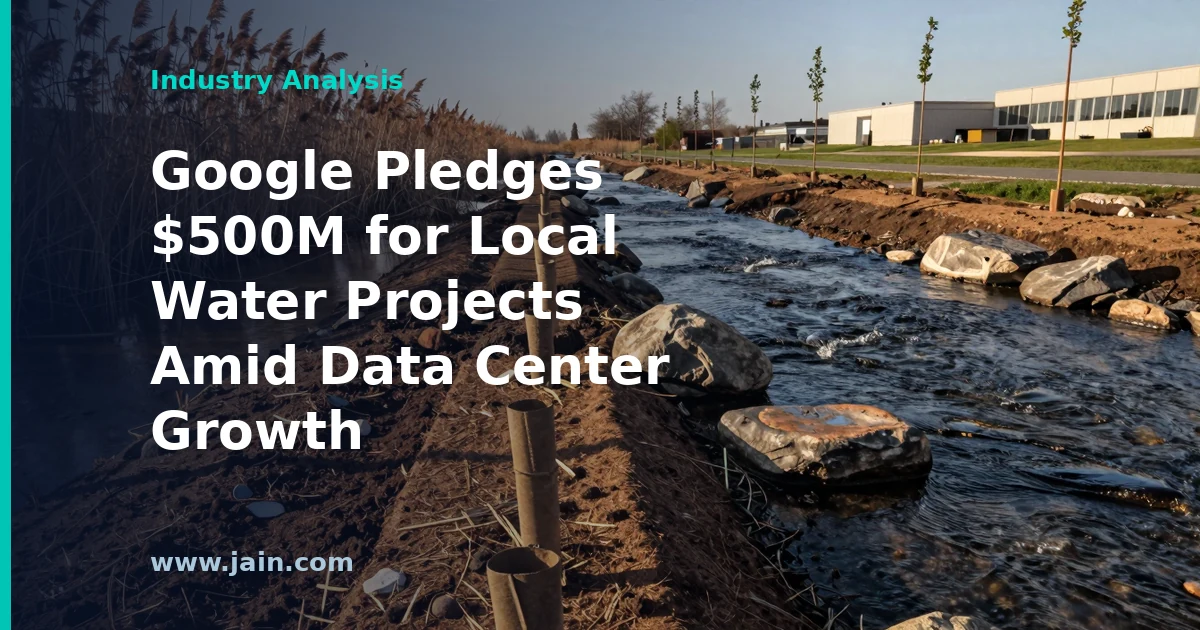
Google has pledged $500 million toward local water projects, a commitment reported June 2, 2026 by E&E News (POLITICO) as the company continues an aggressive data center buildout. The pledge lands amid growing scrutiny of how much freshwater hyperscale computing facilities consume, particularly in water-stressed regions where new sites are planned.
Executive Summary
The announcement, as reported, ties a nine-figure dollar commitment to water infrastructure and stewardship in communities affected by Google’s data center push. Data centers use water primarily for evaporative cooling — a process that consumes water to reject the heat generated by servers — and the AI era has sharply increased both the number of facilities and the density of the computing inside them.
Why it matters: water has become the second front, after electricity, in the contest over where and how fast AI infrastructure gets built. Local opposition over water has delayed or reshaped projects in several U.S. markets, and hyperscalers have learned that a permit fight is more expensive than a partnership. A commitment of this size signals that community water benefits are moving from voluntary sustainability programs toward the cost of doing business for large-scale data center development — though the reported announcement leaves the mechanics of the spending largely undefined.
Water Is Now a Siting Currency
For most of the cloud era, electricity determined where data centers went. Water has now joined it. Evaporative cooling remains the most energy-efficient way to cool dense server halls, but it can draw millions of gallons per facility per year — a visible, local impact in a way that grid electrons are not. Communities from the American Southwest to the Pacific Northwest have pushed back on data center water use, and those disputes have made water access a genuine gating factor for new capacity.
Against that backdrop, a $500 million pledge functions as more than philanthropy: it is a de-risking tool. Funding aquifer recharge, leak repair, or watershed restoration in host communities builds the local goodwill and regulatory credibility that expedite the next permit. That does not make the money less real or less useful — it means the incentive structure has aligned so that community water investment and business strategy point the same direction.
From Pledges to Proof
Google has previously set a goal of replenishing more freshwater than it consumes across its operations — a “water positive” ambition targeting 120% replenishment by 2030. The challenge with replenishment accounting, as with carbon accounting before it, is locality: replenishing water in one basin does not help a community whose own aquifer supplies the cooling towers. The strongest version of this new commitment would direct money into the specific watersheds that host Google facilities, with independently verifiable volumes.
The reported announcement, based on the available source material, does not yet detail which projects, which basins, or over what period the $500 million will be deployed. That distinction — local, measured, and verified versus aggregate and self-reported — is exactly where community groups, utilities, and state regulators will focus. Hyperscalers that get ahead of it with transparent, basin-level disclosure will find siting easier; those that do not will keep meeting organized opposition.
What It Means for the Rest of the Industry
When the largest operators attach dollar figures to community water benefits, they reset expectations for everyone else. Colocation providers, GPU-cloud startups, and enterprise builders negotiating with the same counties will increasingly face water-benefit asks modeled on hyperscaler precedents. That favors operators with strong balance sheets and disadvantages smaller developers — a dynamic already visible in power procurement, where hyperscalers’ ability to fund grid upgrades and long-term energy contracts has become a competitive moat.
It also accelerates the engineering alternatives. Closed-loop liquid cooling, air-side economization, and treated wastewater (reclaimed water) supply all reduce potable water draw, each with cost and energy trade-offs. As community water commitments become priced into projects, designs that minimize freshwater consumption get relatively cheaper — a quiet but consequential shift in how the next generation of AI facilities will be engineered.
Background
Google operates one of the world’s largest data center fleets, and the generative-AI boom has pushed it — alongside Microsoft, Amazon, and Meta — into a historic expansion of computing capacity. Because many facilities rely on evaporative cooling, that growth has drawn increasing attention to freshwater consumption, especially in drought-prone regions of the U.S. where several communities have challenged or scrutinized data center water permits.
Google announced a company-wide water stewardship strategy in 2021, including the goal of replenishing 120% of the freshwater it consumes by 2030. The June 2026 pledge of $500 million for local water projects, reported by E&E News, extends that posture with a concrete dollar figure at a moment when water transparency has become a live permitting and political issue for the entire data center industry.
Google and Telstra, Australia’s leading phone and internet company, have agreed to use each other’s cables.
Google gets strands of fiber on Telstra’s new cross-country network, already more than 8,000 kilometers long, or roughly twice the drive from Sydney to Perth. Telstra gets space on three undersea cables that are part of Google’s Pacific programs, linking Australia to Japan, the Pacific Islands and the United States.
Why it matters: if one cable is cut, internet and artificial intelligence services can reroute instead of going dark. Neither company said what the deal is worth.
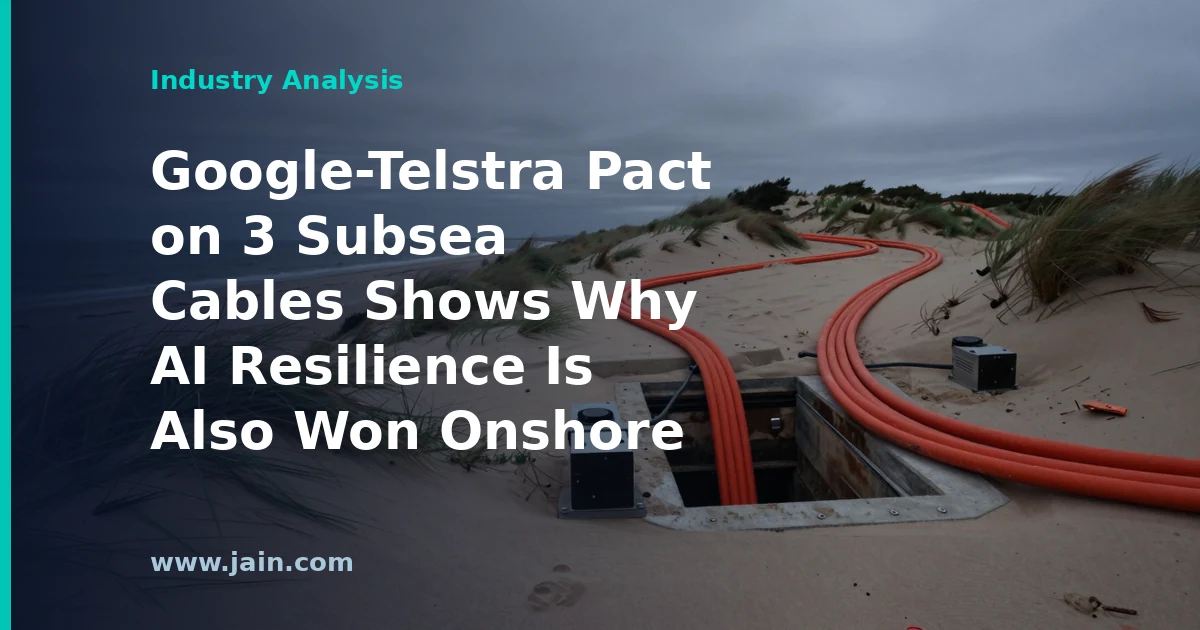
Google and Telstra announced a partnership on June 1, 2026, that connects the two companies’ networks on land and at sea. Google will secure inter-city dark fiber, which is unlit fiber that the buyer switches on with its own equipment, on Telstra’s new Aura Network backbone. In return, Telstra will use subsea fiber pairs on the Tabua, Proa and Bulikula cable systems through Google’s Pacific Connect and Australia Connect initiatives. Those cables link Australia with Japan, the Pacific Islands and the United States.
The deal was announced jointly by Bikash Koley, Google’s Vice President of Global Infrastructure, and Steven Worrall, CEO of Telstra Digital Infrastructure. Worrall said Aura has more than 8,000 kilometers of fiber already laid, and that its Melbourne-Canberra-Sydney coastal routes launched late last year. The companies did not disclose financial terms, capacity volumes or in-service dates.
Executive Summary
This is a reciprocal infrastructure arrangement, and it is not a conventional supply contract. Each company takes access to the half of the network the other one is building. Google is a major builder of subsea cable, and it gains terrestrial backbone across Australia’s key inter-city corridors. Telstra owns the country’s most extensive domestic network, and it gains fiber on three international systems that reach Japan, the Pacific Islands and the United States.
The stated goal is resilience. The companies say that joining their land and sea routes will let each of them ‘remove single points of network failure.’ The underlying argument is an operational one that often gets lost in AI-infrastructure coverage. Diverse ocean cables do not add much resilience if the traffic they carry funnels into the same stretch of fiber once it reaches shore.
For Australian enterprises, government agencies and cloud customers, the practical promise is more redundant paths in and out of the country and between its major cities. The companies have not yet said how much capacity is involved or when it becomes usable.
The Shoreline Is Where Diversity Is Won or Lost
A subsea cable comes ashore at a landing station, and from there its traffic still has to travel overland, over terrestrial fiber, to data centers, exchanges and cities. Network engineers call the full path end-to-end diversity. If two separate ocean cables land in different places but their inland backhaul runs through the same conduit or corridor, a single construction accident can cut both. The ocean diversity bought at great cost is lost a few kilometers from the beach.
The Google-Telstra deal is built around that problem. Google already has subsea reach into the region through Tabua, Proa and Bulikula. What it lacked was inter-city capacity on land that it controls. It chose dark fiber, which means it lights the strands with its own optical equipment and sets capacity and upgrade timing itself, and it chose it on a new backbone that is physically separate from older routes. Telstra had the domestic network but wanted more international exits. The release states that integrating the two lets ‘Telstra and Google each remove single points of network failure.’ That is the substance behind the AI framing. As AI services depend more on moving data between Australian cities and overseas compute, a cable cut costs more, and the fix involves the land side as much as the sea side.
Several groups are affected. Google’s Australian users and cloud customers get more alternative routes if a path fails. Telstra’s enterprise and government customers get more options for international traffic. Other carriers and cloud providers face a competitor pair that now controls diversity at both ends of the path. This is one deal, so it is not proof of an industry trend. It is a clear example of how a hyperscaler, meaning one of the largest cloud operators, and a national carrier can split the build instead of each duplicating the other’s half.
A Two-Way Exchange of Scarce Assets
The structure is notable because each company offers something that is slow and expensive to replicate. Laying new inter-city fiber across Australia takes years of trenching, permits and landholder negotiations. Building a trans-Pacific cable takes consortium financing, marine surveys and cable-ship time. By exchanging access, each company avoids building the other’s specialty. Long-haul fiber and subsea capacity commonly change hands through long-term rights of use. The companies have not said whether cash, capacity or both are involved in this deal.
For Telstra’s Aura build, a hyperscaler taking dark fiber serves as an anchor tenant, a large customer whose commitment helps justify the network. Worrall tied the deal to Aura’s momentum and to ‘sustainable, disciplined growth.’ That suggests the company sees Google as validation for the backbone’s economics. How much of Aura’s capacity Google has taken, and on which routes, has not been said.
What Is Substantiated and What Is Aspiration
Some claims are concrete. These include the named cable systems and their destinations, the dark-fiber arrangement on Aura, Aura’s more than 8,000 kilometers laid, and the launch of the Melbourne-Canberra-Sydney coastal routes. The resilience mechanism is also sound network engineering.
Other claims are broader and harder to test. These include the partnership being ‘a significant step forward in securing Australia’s digital and AI future,’ Australia’s role as a ‘regional connectivity hub,’ and the link to ‘the next industrial revolution.’ The release does not quantify AI traffic growth, capacity added, or any change in latency or availability. These are reasonable ambitions for a well-connected market. Readers should weigh them as direction rather than as measured outcomes.
Background
Australia’s geography makes it heavily dependent on subsea cables for international traffic. Its population is concentrated in a few coastal cities linked by long terrestrial fiber routes. That combination makes route diversity, both at sea and on land, a recurring concern for carriers, cloud providers and government. Telstra is Australia’s largest telecommunications company. Its Telstra Digital Infrastructure unit is building Aura, a new inter-city fiber backbone.
Google, a subsidiary of Alphabet, has become one of the most active investors in subsea cables worldwide. It uses them to connect its data centers and to serve cloud and consumer products. Through its Pacific Connect and Australia Connect initiatives, it has backed new systems linking Australia with Japan, the Pacific Islands and the United States, including Tabua, Proa and Bulikula.
A farm county in southeast Nebraska has put new data centers on hold for up to a year. Data centers are the huge warehouse-like buildings full of computers that run artificial intelligence.
Residents were alarmed by reports of a Google plan for a Nebraska facility that could use more than three times the electricity of the entire city of Lincoln on a hot summer day. They asked about water, power bills and heat.
A new state law now gives counties a deadline to rule on some projects. Counties without rules may pause first and write rules later.
The Otoe County Board of Commissioners in southeast Nebraska voted on Tuesday, May 19, to suspend the permits needed for a new data center for up to a year, Nebraska Public Media reported, carrying reporting by the Flatwater Free Press. Commissioner Chuck Cole said the pause is meant to give county officials time to study the issue and update county regulations.
The vote followed local concern about a Google proposal for a large Nebraska data center. According to documents shared at a private utility meeting in January, that facility could require more than triple the electricity the city of Lincoln uses during its hottest months. The proposal did not name a site. The Omaha-based energy developer Tenaska, described as a potential partner, has optioned large tracts of land in southeast Nebraska, including in Otoe and Gage counties. Gage County’s planning and zoning commission is scheduled to hold a hearing on its own moratorium in June.
Executive Summary
Otoe County has not rejected data centers. It has stopped issuing the permits for one while it writes rules it does not yet have. That distinction matters to anyone planning large AI facilities in rural America. The practical obstacle in Otoe is not a lack of electricity or land. It is the absence of a local rulebook that can answer residents’ questions about water, power costs and heat before a project arrives.
Two new Nebraska laws raise the stakes. One allows private power plants built to serve a single large industrial customer to connect to the grid. That law is widely seen as aimed at data centers and was backed by Tenaska’s CEO at a legislative hearing. The other law requires counties to rule on some projects within a fixed period. Jon Cannon of the Nebraska Association of County Officials said that deadline may prompt counties to adopt moratoriums first so they are not forced to rule without regulations in place.
Otoe is one of several signals. Madison County now requires a special permit for data centers, Gage County is weighing a pause, and, according to the report, at least 14 states have considered statewide moratoriums this year.
A Pause to Write Rules, Not a Permanent No
A moratorium is a temporary halt on a category of approvals. Otoe’s suspends data center permits for up to a year. The board framed it as time to study the issue and update its regulations, not as a verdict on the industry. Wynee Benedict, one of the residents who pushed for it, described the goal in regulatory terms: “We needed regulations on the books prior to a data center coming to this county. We don’t want to have to play catch up and regulate something that’s already here.”
Residents did not all agree. Jim Nemec supported time to study the issue but warned about the signal it sends: “Are we sending out the impression that business is closed here?” That is a fair concern. A county that pauses without a clear end date, or that uses the year to write rules nobody can meet, risks becoming a place developers skip. A county that uses the year to publish clear standards on water, noise, setbacks and power costs may become an easier place to build than one with no rules at all. Setbacks are required distances from homes or roads. The ordinance the county drafts will matter more than the vote itself.
Why AI Siting Now Runs Through the County Board
This is the core of the story. The scale being discussed in southeast Nebraska is large. The Google proposal could require more than triple Lincoln’s summer electricity use, and the organizers in Gage County said they understood it would include a private natural gas plant. At that size, a project needs the grid connection, the generation, the land and the local land-use permit. The state has now eased the power question by allowing private generation dedicated to a large customer. Tenaska has reportedly secured land options, which are contracts giving it the right to buy or lease land later. The piece still in doubt is the county permit, and in Otoe that piece is now frozen for up to a year.
The state’s new decision-deadline law pushes counties in the same direction. It was intended to stop counties from stalling projects indefinitely. But a county with no data center rules that faces a firm deadline to decide on an application has two choices: rule without standards, or pause until it has them. Cannon expects many to pause, and not only for data centers. For developers this matters a great deal. A law designed to shorten approvals could lengthen them in counties that are not ready, and in the short term the counties that are not ready are most of the rural counties where land and gas access make these projects attractive.
This should not be overstated. One county’s vote is not a statewide trend, and Cannon himself said attitudes will vary from county to county, as they have for wind and solar. But Otoe, Madison and Gage have all acted or scheduled action within weeks of each other, and all three are responding to the same prospect. That points to county zoning as the next checkpoint for rural AI campuses, alongside power and fiber.
Power Was Handled in Lincoln; Water Was Left to the Counties
Nebraska’s legislature and Gov. Jim Pillen addressed the energy question directly. The private-generation law is meant to keep large new loads from burdening existing ratepayers. Virginia shows what happens when this goes unaddressed. Joe Lerch of the Virginia Association of Counties said the state’s main utility has had to postpone connecting some new data centers for lack of power and transmission capacity.
Water got no equivalent state-level answer, and in Otoe and Gage it is the concern residents raise first. Gage County organizer Anna Wolken said the top issue would be water, because both a gas plant and a data center can draw on it. Gas plants use water for cooling, and many data centers use water to carry heat away from their servers. How much depends heavily on the cooling design. Air-based and closed-loop systems use far less than evaporative ones. Nobody involved has said publicly which approach the proposed facility would use.
A separate transparency law will require data centers to report their owners, size, location, annual electricity demand, water use and tax incentives each year. That gives county officials comparable data for future decisions. It does not help a county decide on a first project before any such reports exist, which is exactly Otoe’s situation.
What Developers Can Take From Otoe
Cannon’s advice to developers was practical: tell residents early. He described what happens when neighbors learn about a project from each other, through someone who “just signed this big contract for a right of way.” In Otoe and Gage, residents appear to have learned of the potential project through press reporting on a private utility meeting and through land options. It was not an announcement from the companies. A community that pieces a project together from secondhand reports tends to fill the gaps with worst-case assumptions.
The lesson for anyone siting AI capacity in rural areas is that the time-consuming work may be local rather than technical. That means disclosing water and cooling plans, explaining who pays for power, and engaging before the zoning agenda is set. Developers who bring those answers to a county writing its first ordinance have a chance to help set the terms. Developers who arrive afterward will be working within rules written without their input.
Background
Otoe County sits in southeast Nebraska. Its county seat is Nebraska City, south of Omaha and east of Lincoln. Like many rural counties, it has previously dealt with controversial large developments such as wind and solar farms. Its land-use rules were not written with hyperscale data centers in mind. Hyperscale refers to the very large facilities built by major cloud and AI companies.
Demand for AI computing has driven a nationwide search for sites with available land, power and water. Established hubs such as Northern Virginia have run into grid limits. Nebraska responded in 2026 with a law allowing dedicated private power generation for large customers and a separate law requiring annual public reporting on data center energy and water use.
Google has announced a $15 billion data center expansion in Missouri, and — notably — the company is pairing the buildout with explicit power commitments and protections for utility ratepayers, according to a May 22, 2026 report by POWER Magazine. The pledge positions one of the world’s largest cloud and AI operators as a partner in managing the grid impact of its own growth, rather than simply a very large new electricity customer.
Executive Summary
The headline number is striking on its own: $15 billion is a top-tier hyperscale commitment, the kind of figure that historically flowed to established data center markets like Northern Virginia or central Ohio. Directing it to Missouri continues a broader migration of AI-era infrastructure toward interior states with available land, power, and political goodwill.
But the more consequential part of the announcement may be the framing. By foregrounding power commitments and ratepayer protections, Google is acknowledging the central tension of the AI infrastructure boom: data centers are now large enough to move electricity prices and strain grid planning, and communities have noticed. Structuring a megaproject so that existing utility customers are shielded from its costs — at least as pledged — is emerging as the price of admission for hyperscale development, and this deal reads as a template for that era.
Ratepayer Protection Is Becoming the Price of Admission
For most of the data center industry’s history, electricity was a procurement detail. That changed as AI training and inference pushed individual campuses toward the power draw of small cities. Utilities must build generation and transmission to serve that load, and under traditional regulated-utility economics, those costs can be spread across all customers — meaning households could subsidize infrastructure built primarily for a trillion-dollar technology company. Regulators, consumer advocates, and legislatures in several states have pushed back, demanding special tariff classes, minimum-payment contracts, and cost-allocation guarantees for large loads.
Google publicly committing to ratepayer protections up front, rather than having them imposed in a contested rate case, is therefore strategically significant. It shortens the approval path, lowers political risk, and sets a benchmark competitors will likely be measured against. The caveat: a headline pledge is not a tariff. What ‘ratepayer protection’ means in practice depends on binding terms filed with regulators, and the report available to us does not detail those terms.
Why Missouri, and Why Now
Missouri is not a legacy data center hub, and that is increasingly the point. The traditional markets are constrained — grid interconnection queues stretch for years, land prices have soared, and local opposition has hardened. Interior states offer buildable land, room on the transmission system, fiber routes crossing the middle of the country, and governments eager for capital investment and construction activity. A $15 billion commitment would instantly place Missouri among the more significant AI infrastructure destinations in the region.
For the state, the bargain is jobs, tax base, and relevance in the AI economy, weighed against long-lived demands on power and, typically, water for cooling. The durability of that bargain depends heavily on the details this announcement previews but does not fully disclose: how much generation gets built, who owns it, and how firmly the cost shield for existing customers is written.
The Economics of Pledging Power, Not Just Buying It
An explicit ‘power commitment’ from a hyperscaler can take several forms: funding or contracting for new generation, paying for transmission upgrades, guaranteeing minimum offtake so utilities can finance construction without stranding costs on other customers, or bringing dedicated supply behind the meter. Each shifts risk from the public to the developer in a different way, and each has different implications for how fast capacity actually arrives. Hyperscalers have learned that power availability — not chips, not concrete — is now the binding constraint on AI growth, so paying to expand supply is self-interested as much as civic-minded.
For the wider industry, deals like this raise the bar. Smaller operators and colocation providers cannot underwrite generation the way an Alphabet can, which could bifurcate the market: hyperscalers who bring their own power solutions, and everyone else competing for whatever grid headroom remains. Utilities, meanwhile, gain a rare growth story — if regulators can verify that growth genuinely pays its own way.
Background
Google has spent more than two decades building one of the world’s largest data center footprints, and the generative-AI boom that began in late 2022 pushed its infrastructure spending — like that of Microsoft, Amazon, and Meta — to unprecedented levels. As easy grid capacity in traditional hubs ran short, hyperscalers fanned out across interior states, turning electricity availability into the industry’s defining constraint.
That expansion has collided with utility economics. In multiple states, regulators and consumer groups have questioned whether households end up subsidizing grid buildouts made for tech giants, prompting special large-load tariffs and contract protections. Google’s Missouri announcement lands squarely in that debate, presenting itself as the cooperative model: hyperscale growth that pledges to pay its own way.
Blackstone, the world’s largest alternative asset manager, will invest $5 billion in an AI infrastructure venture with Google, with the resulting capacity powered by Google’s Tensor Processing Units (TPUs) rather than the Nvidia graphics processing units (GPUs) that have dominated AI build-outs to date, according to a CNBC report published May 18, 2026.
Executive Summary
The announcement pairs one of the deepest pools of private capital with the only hyperscaler that designs and deploys its own AI accelerator at scale. Blackstone’s $5 billion commitment funds infrastructure — the data center capacity, power, and systems needed to run AI workloads — while Google contributes its TPU silicon, custom chips it has refined over roughly a decade to train and serve machine-learning models.
Why it matters: nearly every headline AI infrastructure deal of the past three years has been, implicitly or explicitly, an Nvidia GPU deal. A marquee private-equity firm underwriting billions against TPU-based capacity is a meaningful vote of confidence that alternative accelerators can anchor institutional-grade infrastructure investment — and a signal that the financing market for AI compute is beginning to diversify beyond a single chip vendor.
The First Big Check Written Against Non-Nvidia Silicon
AI infrastructure finance has grown enormously, but it has grown narrowly: lenders and equity investors have overwhelmingly underwritten deals where the collateral and the revenue engine are Nvidia GPUs. That concentration has been rational — Nvidia’s CUDA software ecosystem and resale liquidity made its chips the safest asset to finance — but it has also made the entire capital stack a leveraged bet on one supplier. Blackstone committing $5 billion against TPU-powered capacity is the clearest sign yet that sophisticated capital now sees a second underwritable accelerator. TPUs are application-specific chips Google designed for the mathematics of neural networks; they lack the open resale market of GPUs, which is precisely why a partnership with Google — the designer, operator, and most likely demand backstop — is the structure that makes the risk financeable.
For the broader market, the precedent may matter more than the dollars. If TPU capacity can attract institutional capital on infrastructure terms, similar structures become imaginable around other custom silicon. That would gradually loosen the financing chokepoint that has funneled most AI investment through a single vendor’s order book.
Blackstone’s Compounding Digital Infrastructure Thesis
This deal extends a strategy Blackstone has pursued aggressively since taking data center operator QTS private in 2021 in a transaction valued around $10 billion — then one of the largest data center acquisitions ever. Under Blackstone’s ownership, QTS became a vehicle for hyperscale expansion, and the firm has repeatedly identified AI infrastructure — data centers and the power to run them — as one of its highest-conviction themes. A venture with Google fits the pattern: Blackstone supplies capital at a scale few can match, and captures returns from the physical layer of AI regardless of which models or applications ultimately win.
The economics of such ventures typically hinge on tenancy: infrastructure returns are attractive when long-term, creditworthy commitments stand behind the capacity. Google’s involvement suggests — though the report does not confirm — that Google itself or its cloud customers would utilize the TPU capacity, which would make this closer to a pre-leased infrastructure play than a speculative build. The announcement does not disclose the venture’s structure, so that remains an inference rather than a fact.
Winners, Losers, and the Accelerator Question
Google is an obvious beneficiary: external capital lets it scale TPU deployment faster than its own capital-expenditure budget alone would allow, and every TPU-anchored venture strengthens the case that its silicon is a genuine alternative for AI workloads, not just an internal cost-saver. For Nvidia, one $5 billion venture is immaterial to near-term demand — its chips remain heavily supply-constrained — but the directional message is unwelcome: the largest infrastructure investors are actively building expertise in financing non-Nvidia compute. Data center developers, power providers, and cooling vendors win either way; TPUs, like GPUs, are power-dense accelerators that need substantial electricity and advanced thermal management.
The risks are real, too. TPU capacity is only as valuable as demand for TPU workloads, and that demand is concentrated in Google’s own ecosystem and a handful of large AI developers. If the software world remains standardized on Nvidia’s tooling, TPU infrastructure could face a narrower tenant pool than comparable GPU builds — a concentration risk any underwriter of this deal will have had to price.
Background
Google introduced TPUs in the mid-2010s to run its own machine-learning workloads more efficiently than off-the-shelf chips allowed, and has since iterated through multiple generations while making them available to outside customers through Google Cloud. TPUs are the most mature in-house AI accelerator program among the hyperscalers, all of whom have pursued custom silicon to reduce dependence on Nvidia. Blackstone, for its part, has spent the past half-decade positioning itself as a dominant financier of digital infrastructure — anchored by its roughly $10 billion take-private of QTS in 2021 — on the thesis that AI’s appetite for compute and power represents a generational infrastructure build-out.
Google announced, via a company blog post published May 4, 2026, that it has achieved roughly 3X speedups in large language model (LLM) inference on its Tensor Processing Units (TPUs) using a technique it describes as diffusion-style speculative decoding. The claim addresses inference — the everyday work of generating responses from an already-trained model — rather than training.
The announcement arrives as the AI industry’s cost center shifts from training frontier models to serving them at scale, making per-token efficiency one of the most closely watched metrics in AI infrastructure.
Executive Summary
The core claim is that combining two research threads — speculative decoding and diffusion-based text generation — lets Google’s TPUs produce LLM output up to three times faster. In conventional LLM serving, tokens are generated autoregressively: one at a time, each requiring a full pass through the model. Speculative decoding accelerates this by having a fast ‘drafter’ propose several tokens ahead, which the large model then verifies in a single parallel pass. The ‘diffusion-style’ twist suggests the drafter generates its candidate tokens in parallel through iterative refinement, rather than sequentially, potentially drafting longer spans more cheaply.
If the 3X figure holds across real production workloads, the implications are material: the same TPU fleet could serve roughly three times the traffic, or the same traffic at roughly one-third the compute cost, with corresponding effects on power draw and data-center capacity planning. It would also sharpen Google’s efficiency argument for TPUs against Nvidia’s GPU ecosystem.
A caveat up front: the source available to us is the announcement headline itself, and headline speedup multipliers in AI are notoriously sensitive to benchmark choice, batch size, and workload. The claim is plausible — it sits within the range published speculative-decoding research has demonstrated — but the conditions behind ‘3X’ are the entire story, and they are not visible from the announcement alone.
Why Inference, Not Training, Is Now the Battleground
For years, AI headlines focused on the enormous cost of training frontier models. But training is a one-time (if repeated) capital expense; inference is a perpetual operating expense that scales with every user and every query. As LLMs are embedded into search, office software, coding tools, and customer service, the cumulative compute spent answering queries dwarfs what was spent teaching the model. A 3X inference speedup is therefore not an academic result — it is, in effect, a claim of a 60-70% reduction in the marginal cost of serving AI, which flows directly into cloud pricing, margins, and how much data-center capacity the industry must build.
This is also why hyperscalers keep announcing inference optimizations at every layer: better chips, better compilers, quantization (using lower-precision numbers), batching strategies, and now decoding algorithms. The decoding layer is attractive because it is pure software — gains stack on top of whatever the silicon already delivers, without waiting for the next chip generation.
How Diffusion-Style Speculative Decoding Works
Standard LLMs are autoregressive: to write a 500-token answer, the model runs 500 sequential passes, and each pass leaves much of the chip’s parallel horsepower idle while memory shuttles weights around. Speculative decoding attacks this by pairing the big model with a small, fast drafter that guesses the next several tokens; the big model then checks all the guesses at once in a single pass. Correct guesses are kept, the first wrong one is discarded, and generation resumes. The output is provably identical in distribution to what the big model would have produced alone — the speedup comes from accepting cheap guesses in bulk.
The ‘diffusion-style’ element points to a newer research direction: diffusion language models, which generate text the way image generators like Imagen create pictures — starting from noise and refining all positions in parallel over a few steps, rather than left to right. Used as a drafter, a diffusion-style model can propose an entire multi-token block in a handful of parallel steps, which maps well onto TPUs, hardware explicitly built for large parallel matrix operations. In principle, this means longer accepted drafts per verification pass than a conventional small autoregressive drafter can offer, which is where a multiplier like 3X becomes arithmetically credible.
The TPU Angle: Efficiency as Competitive Positioning
Google is the only hyperscaler that both designs its own AI accelerator at scale and operates frontier models on it, and announcements like this serve a dual purpose: engineering disclosure and marketing for Google Cloud’s TPU business against the Nvidia-dominated GPU market. A software technique that triples effective throughput on existing TPU fleets improves the total-cost-of-ownership story Google tells prospective cloud customers without any new silicon.
It is worth noting that speculative decoding itself is not proprietary — variants run on Nvidia hardware throughout the industry, and Nvidia, AMD, and inference-focused startups publish their own multipliers regularly. The durable question is not whether Google found a 3X speedup on some benchmark, but whether the technique generalizes across workloads and whether TPU customers can actually invoke it, neither of which the announcement, as available to us, establishes.
What 3X Would Mean for Power and Data Centers
Inference efficiency gains cut both ways for infrastructure demand. In the short run, tripling throughput per chip relieves pressure on strained power grids and data-center supply — the same megawatt serves three times the queries. But the industry’s consistent experience is a rebound effect (often called Jevons paradox): cheaper inference enables new applications — longer contexts, agentic workloads that chain many model calls, always-on assistants — and total demand rises rather than falls. For data-center operators and utilities, efficiency breakthroughs like this one tend to change the composition of demand growth, not its direction.
Background
Google has designed its own TPU accelerators since 2015, making it the most vertically integrated of the hyperscalers: it builds the chips, operates the data centers, trains frontier models, and sells the same silicon through Google Cloud. That integration lets hardware and serving-software teams co-design optimizations like this one. Speculative decoding entered the mainstream through research published around 2022-2023 and is now used across the industry, while diffusion-based language models emerged more recently as a parallel-generation alternative to token-by-token output.
The announcement lands amid an industry-wide pivot from training-dominated to inference-dominated AI spending, with hyperscalers committing hundreds of billions of dollars to AI data centers. In that context, per-token efficiency claims have become a recurring front in the competition among Google’s TPUs, Nvidia’s GPUs, and rival custom silicon from Amazon, Microsoft, and others.
Data Center Knowledge reports that Google’s compute agreement with AI developer Anthropic has effectively pre-sold AI data-center capacity at gigawatt scale — capacity committed to a single customer before much of it is even energized. The framing builds on the expanded partnership the two companies announced in late 2025, under which Anthropic gained access to as many as one million of Google’s custom TPU chips, with more than a gigawatt of capacity expected to come online during 2026 in a deal reported to be worth tens of billions of dollars.
Executive Summary
The story here is less a new announcement than a milestone in how AI infrastructure gets bought. A gigawatt of data-center capacity — roughly the output of a large nuclear reactor — has historically been the sum of many facilities serving many customers. In this arrangement, that scale of capacity is committed to one AI company, Anthropic, largely in advance of construction and energization. That is what “pre-sold” means: the customer is contracted before the concrete cures.
For the data-center industry, pre-sold capacity at this scale changes the risk equation that governs financing, siting, and power procurement. Developers and hyperscalers no longer build speculatively and lease later; they build against signed demand from a handful of AI labs. That accelerates construction — and concentrates the industry’s fortunes on whether those few customers’ demand forecasts hold.
From Speculative Build to Pre-Sold Order Book
Traditional data-center development resembled commercial real estate: build a shell, energize it, then lease space to tenants over years. Pre-sold capacity inverts that model. When a customer the size of Anthropic commits to a gigawatt before delivery, the developer’s leasing risk largely disappears, and the project starts to look more like contracted infrastructure — closer to a power-purchase agreement or a pipeline than to an office tower.
That shift matters because it unlocks capital. Lenders and infrastructure investors price contracted cash flows far more cheaply than speculative ones, so a pre-sold gigawatt can be financed at scale and speed that merchant builds cannot match. It is a large part of why AI data-center construction has outpaced every prior cycle: the demand is signed before the ground is broken.
The trade-off is concentration. A pre-sold facility is only as sound as its anchor tenant’s commitment. The industry is exchanging many small, diversified tenants for a few very large counterparties whose own revenues depend on continued growth in AI demand.
A Gigawatt Is a Power Deal, Not Just a Chip Deal
For readers outside the industry: a gigawatt is a unit of electrical power, and using it to describe a compute deal is itself telling. AI capacity is now constrained less by chips than by electricity — grid interconnections, substations, transformers, and generation. Committing more than a gigawatt to one customer means Google must line up utility-scale power across multiple sites, a process that routinely takes years and is the industry’s most common source of delay.
This is where pre-selling cuts both ways. Signed demand strengthens the case utilities need to approve large interconnection requests and build transmission. But it also means delivery risk migrates from “will anyone rent this?” to “will the power arrive on schedule?” A pre-sold gigawatt that cannot be energized on time is a contractual problem, not just an opportunity cost.
The Multi-Cloud Chessboard
Anthropic’s position is distinctive: it is one of the few AI labs deliberately spreading frontier-scale compute across providers. Amazon remains a major investor and cloud partner, while the Google agreement gives Anthropic access to TPUs — Google’s in-house AI accelerator chips and the principal large-scale alternative to Nvidia’s GPUs. For Anthropic, diversification is leverage on price and a hedge against any single supplier’s constraints.
For Google, landing a gigawatt-scale anchor customer for TPUs is strategic validation. Every large workload that runs well on TPUs strengthens Google’s case that the AI compute market will not remain a single-vendor story. One caveat deserves even-handed treatment: Google is also an investor in Anthropic, so supplier, customer, and shareholder relationships are intertwined. That structure is common across the AI ecosystem and is not improper, but it does mean headline deal values reflect a mix of commercial demand and strategic positioning, and observers are right to read them with that in mind.
Who Bears the Risk When Capacity Is Sold Before It Exists
Pre-sold capacity redistributes risk rather than eliminating it. The developer sheds leasing risk but takes on delivery risk. The customer secures scarce capacity but commits capital — or long-term obligations — against demand forecasts for products that are evolving quarter to quarter. Utilities and communities commit grid upgrades against load that arrives in step functions.
The systemic question is what happens if AI demand growth moderates. Contracted capacity does not vanish, but the appetite to pre-sell the next gigawatt would cool quickly, and merchant capacity built in the slipstream of these mega-deals would feel it first. For now, the fact that hyperscalers can pre-sell at this scale is the market’s clearest signal that the buyers themselves expect demand to keep compounding — a forecast worth tracking, not taking on faith.
Background
Google was an early investor in Anthropic and has supplied it with cloud infrastructure since the company’s founding era, alongside Anthropic’s deep partnership with Amazon Web Services. The relationship expanded sharply in late 2025 with the TPU agreement referenced here. The broader backdrop is a data-center construction boom driven by AI training and inference demand, in which electricity availability has displaced chip supply as the binding constraint, and in which hyperscalers increasingly sign a small number of very large AI labs as anchor tenants before facilities are built.
Google has begun construction on a data center in Kronstorf, a municipality in the Linz-Land district of Upper Austria, according to a groundbreaking announcement posted to the Google Cloud Press Corner and distributed on 23 April 2026. The item marks the start of physical work on the site.
The release as circulated is a headline announcement. It does not, in the version distributed through news syndication, state the campus size, planned power capacity, capital commitment, construction timeline, staffing, or whether the facility will underpin a new Google Cloud region for Austria.
Executive Summary
Groundbreaking is the point at which a data center stops being a land holding and becomes a construction project. For a hyperscaler — an operator running compute at global scale, such as Google, Amazon Web Services, Microsoft or Meta — it normally implies that land control, planning permission and, critically, a grid connection agreement are already settled. Those are the hard parts. Steel and concrete are comparatively easy.
The significance of Kronstorf is geographic more than technical. Europe’s data center industry has historically concentrated in five markets known as FLAP-D: Frankfurt, London, Amsterdam, Paris and Dublin. Those markets are now constrained less by demand than by electricity — grid connection queues, local moratoria and planning resistance have pushed new capacity outward into secondary markets with available power. Upper Austria, sitting on a hydro-heavy generation mix and on fiber routes between Munich, Vienna and northern Italy, fits that pattern.
What the announcement does not do is tell buyers anything actionable. Google has not, as far as the distributed release states, committed to a launch date or to an Austrian cloud region. Enterprises with Austrian data residency requirements should treat this as an encouraging signal about Google’s intentions, not as a procurement input.
Why Austria, and Why Now
The proximate driver of hyperscale expansion into new European markets is power availability, not proximity to customers. Latency between Kronstorf and Frankfurt is a rounding error for most workloads; the difference that matters is whether a transmission operator can deliver tens of megawatts on a schedule the builder can plan around. In several established hubs it cannot. Dublin’s grid operator has restricted new data center connections in the Greater Dublin area for years, and Amsterdam imposed a construction pause that reshaped Dutch development. Frankfurt and London face their own queue and land pressures.
Austria offers a different profile. Its electricity generation is unusually hydro-weighted by European standards, which is attractive both for carbon accounting and for price stability relative to gas-linked markets. Upper Austria is an industrial region with existing heavy-load infrastructure — the kind of grid that was built for manufacturing and can, in principle, be repurposed for compute. Kronstorf sits between Linz and Steyr, close to that industrial corridor.
None of this is stated in the release. It is the standard site-selection logic of the sector, and it is the most plausible reading of the decision. Readers should hold it as inference, not as a company claim.
What a Groundbreaking Actually Signals
Announcements of this kind are frequently over-read in both directions. A groundbreaking is a stronger signal than a land purchase or a memorandum of understanding: capital has been committed, contractors are mobilised, and the permitting and interconnection work that typically consumes years has largely concluded. Hyperscalers do not break ground on sites they intend to abandon, and the sunk cost from this point forward rises steeply.
It is a weaker signal than a service commitment. Large data center builds commonly run two to four years from groundbreaking to first customer traffic, and campuses are usually delivered in phases, with later buildings contingent on demand and on the operator’s capital plan at the time. A groundbreaking therefore says a facility is being built; it does not say when it will serve traffic, at what capacity, or which Google products will run on it.
The distinction matters most for the question of a Google Cloud region in Austria. A physical data center and a published cloud region are related but separate things — regions require multiple availability zones, a defined service catalogue and a launch commitment. The release, as distributed, does not make that commitment, and the absence should not be filled in by assumption.
Winners, Losers, and the Local Ledger
The clearest beneficiaries are Austrian enterprises and public-sector bodies with data residency obligations, who gain a credible prospect of in-country hyperscale capacity, and the regional construction and electrical trades, who capture the build phase — the largest and shortest-lived share of employment any data center generates. Local landowners and the municipal tax base typically benefit as well.
The competitive read is that Google is buying optionality in the DACH region rather than responding to a single anchor customer. Microsoft and AWS both hold established positions in German-language markets, and Vienna already hosts commercial colocation from international operators. Entering Austria with owned capacity changes Google’s cost structure and its sovereignty story simultaneously — owned facilities are cheaper at scale than leased ones and easier to make claims about.
The costs land locally and are worth stating plainly rather than defensively. Large sites consume grid capacity, land and, depending on the cooling design, water; operational employment is modest relative to capital deployed. Communities that raise these points are asking legitimate questions, and the honest answer is that this release provides no basis to evaluate them in either direction. When Google publishes capacity, cooling method and water sourcing, those figures should be tested — and so should any counter-claims made about them.
Reading a Thin Announcement Fairly
It would be unfair to characterise this release as evasive. Groundbreaking announcements are ceremonial by convention across the industry, and operators routinely withhold capacity figures for competitive and security reasons. Google’s more detailed European disclosures have historically followed at launch rather than at first excavation.
It would be equally unfair to present the announcement as more than it is. What is substantiated: construction has started at Kronstorf, and Google is the party announcing it. What is not substantiated by the release text: megawatts, euros, jobs, dates, cooling design, power procurement, and any regional service commitment. Coverage that supplies those numbers should be checked against a primary source.
For infrastructure buyers, the practical posture is patience. Treat Kronstorf as evidence of Google’s medium-term intent in Central Europe, factor it into three-to-five-year architecture planning, and revisit when the operator publishes a launch date or a region announcement.
Background
Google operates a global network of owned data centers supporting Search, YouTube, Workspace and Google Cloud, with a substantial European footprint including sites in Ireland, the Netherlands, Belgium, Finland and Denmark. Its cloud business competes with Amazon Web Services and Microsoft Azure, where physical proximity and in-country capacity increasingly matter for regulated customers subject to data residency rules.
Austria has hosted commercial colocation and enterprise data centers for years, largely concentrated around Vienna, but has not been a primary hyperscale construction market. The wider shift of European capacity toward secondary markets has been driven principally by electricity: as grid connections in Dublin, Amsterdam and Frankfurt became constrained, operators moved toward regions with spare transmission capacity and favourable generation mixes. Upper Austria, with its hydro-heavy power supply and existing industrial grid, sits squarely in that category.