Google signed a long-term deal to buy electricity from Constellation Energy, the biggest owner of nuclear power plants in the United States. The total is roughly what three large nuclear reactors produce.
The surprise: only about a quarter of it is described as new power that does not exist today. The companies have not said whether the rest is new.
That matters because the giant computer buildings that run artificial intelligence are straining the power grid across a large part of the eastern United States. New plants add electricity for everyone. Buying power that already exists mostly changes who gets it.
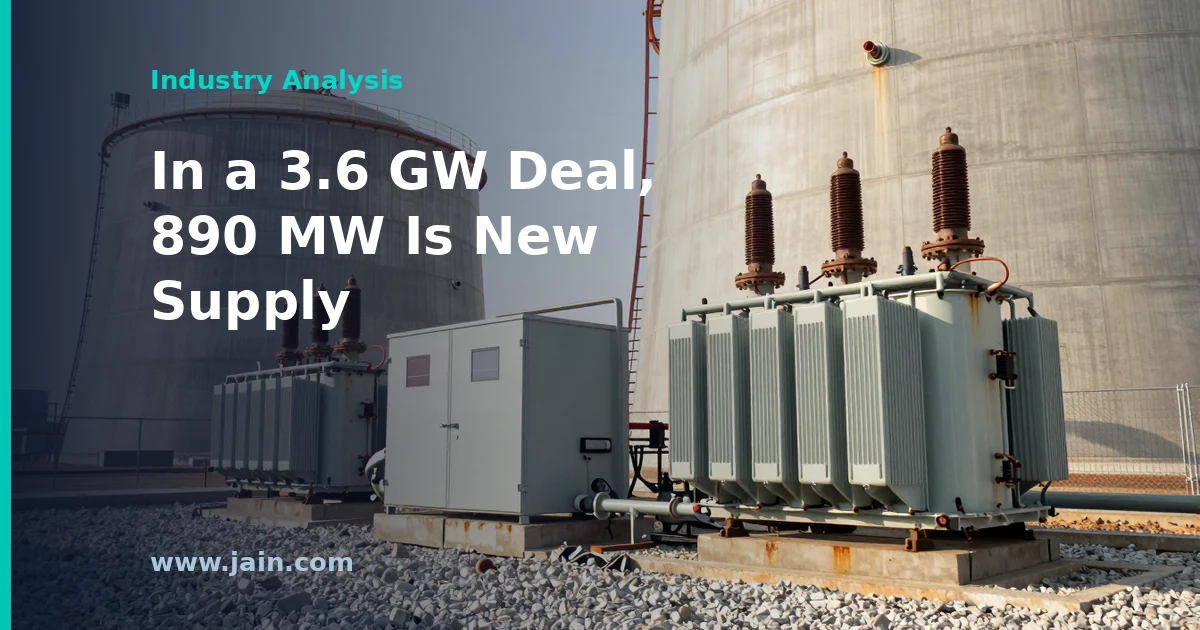
Google has entered a long-term power agreement with Constellation Energy that Reuters reported totals 3.6 gigawatts (GW), a gigawatt being a thousand megawatts, or roughly the output of one large nuclear reactor. Google’s announcement says the agreement will bring 890 megawatts (MW) of new nuclear capacity to the PJM grid, the regional power system covering the Mid-Atlantic and parts of the Midwest. Bloomberg, which reported the talks before the announcement, put the deal’s value at roughly $1 billion or more.
Executive Summary
The headline number is 3.6 GW, which makes this one of the larger power agreements a technology company has signed for its data centers. But Google’s own framing singles out a smaller figure: 890 MW of new nuclear capacity on PJM. That is about a quarter of the total. The companies have not described the remaining roughly 2.7 GW as new supply.
The distinction matters because data centers built for artificial intelligence (AI) are adding electricity demand faster than grid operators are adding generation, and PJM is where that pressure is most visible. New capacity increases the amount of power the grid can deliver to everyone. A contract for output from plants that already run changes who is credited with that power, but does not, on its own, add megawatts to the system.
So the useful question about this deal is not how large it is, but how much of it is additive. On current disclosures, the answer is 890 MW, with the composition of the rest still unexplained.
The 890 MW Is the Only Slice Labeled as New Supply
Subtract the new nuclear capacity from the total and roughly 2.7 GW of the 3.6 GW agreement remains without a public description. If that remainder is drawn from reactors already running and already selling into the grid, it is a reassignment: the same electrons are produced, but a contract now ties their output, or the clean-energy credit attached to it, to Google rather than to the open market. Energy analysts call the difference ‘additionality’, meaning whether a purchase causes new generation to exist that would not otherwise have been built.
The 890 MW is different in kind. Whether it comes from upgrading existing reactors to produce more power (known as ‘uprates’), restarting idle capacity, or something else, the companies describe it as new, which means it should expand what PJM can actually supply once it comes online. For the utilities, data center developers and households that share that grid, the 890 MW is the part of this deal that eases supply. The rest primarily determines who holds a claim on supply that was already there.
That is why the 890 MW, not the 3.6 GW, is the operationally meaningful number. It is the portion that shows up as added capacity in grid planning, and it is the portion other large power buyers on PJM will feel.
Why PJM Is Where Additionality Matters Most
PJM Interconnection coordinates wholesale electricity for 13 states and Washington, D.C., and its territory includes Northern Virginia, the densest concentration of data centers in the world. PJM runs an auction that pays power plants to commit capacity years in advance, and prices in recent auctions rose sharply as forecasts of data center demand climbed. Meanwhile, new generators wait in an ‘interconnection queue’, the line of projects seeking permission to connect to the grid, which has been slow to clear.
In that setting, contracts that lock up existing output for one large buyer can tighten the market for everyone else, because the total available supply does not change while one claimant’s share does. Co-location arrangements involving existing nuclear plants in PJM have already drawn regulatory scrutiny over who pays for grid services. A deal anchored in new capacity sidesteps much of that argument, which may be one reason Google’s announcement leads with the 890 MW figure.
The Case for Contracting Existing Nuclear Output
Reassignment is not worthless, and it is fair to say so. Long-term contracts give a plant owner price certainty, which can justify the spending needed to extend a reactor’s licensed life or fund the very uprates that create new capacity. A reactor kept online through a contract is supply the grid does not lose. For Google, which has set a goal of running on carbon-free energy around the clock by 2030, contracted nuclear output also supports that target in a way intermittent wind and solar cannot fully match.
Constellation has used this model before, with Microsoft for the restart of a reactor at the former Three Mile Island site, now called the Crane Clean Energy Center, and with Meta for output from its Clinton plant in Illinois. The pattern suggests technology companies are willing to pay a premium for firm, carbon-free power, and that Constellation can convert that willingness into investment in its fleet. The open question is how much of each contract funds new megawatts versus securing existing ones, and this deal is the clearest case yet where the split is visible in the headline numbers.
What the $1 Billion Figure Cannot Yet Explain
Bloomberg’s figure of roughly $1 billion or more has not been broken down publicly. It is unclear whether it represents total contract value, annual spending, or capital tied specifically to the new capacity. Without a contract length or price per megawatt-hour, readers cannot judge whether Google is paying a premium for new supply, a market rate for existing output, or a blend.
That matters to investors comparing Constellation’s tech-sector contracts, and to other buyers trying to benchmark what firm, carbon-free power now costs on PJM. Until the companies disclose more, the dollar figure is best read as a signal of scale rather than a basis for valuation.
Background
Technology companies have become some of the largest buyers of electricity in the United States as they build data centers to train and run AI models. Nuclear power is attractive to them because it runs around the clock without carbon emissions, unlike wind and solar, which vary with the weather. Google has set a goal of matching its electricity use with carbon-free energy every hour of every day by 2030, and has previously signed a deal for future small modular reactors with Kairos Power.
Constellation Energy, spun off from Exelon in 2022, owns the largest fleet of nuclear plants in the country, much of it inside PJM. It has signed long-term agreements with Microsoft and Meta, making it a central player as AI-driven demand collides with a grid that is slow to add new generation.
Google has been ordered to pay $463 million for breaking a European Union rule covering location data — the record of where a phone has been.
The sum is large in absolute terms, but small next to what a company of Alphabet’s size earns in a single three-month period. Its real weight is as a public price tag on handling personal data badly.
It matters beyond maps. The same European rules cover the data that artificial intelligence services quietly collect while they run. Any business using those services in Europe carries part of that risk.
AP News reported that Google has been fined $463 million for breaching a European Union rule governing location data — the positional records generated by phones and the apps running on them. The penalty lands on Alphabet’s core consumer business, where location signals underpin mapping, local search and ad targeting.
The amount places the decision among the more consequential European data-protection actions taken against a single company, and it arrives at a moment when every large cloud and artificial-intelligence provider is expanding the volume of behavioural data it collects, moves and stores inside the bloc.
Executive Summary
A $463 million penalty against Google for mishandling location data is, on its face, a consumer-privacy story. Read as an infrastructure story, it is something more useful: a published, enforceable price for a category of failure that until now most organisations have carried on their risk registers as an unquantified exposure.
Location data is a well-understood regulatory target. It is personal, it is continuous, it is generated as a by-product of a service the user came for, and it is retained by default. Those four properties describe location history. They also describe the telemetry produced by modern artificial-intelligence systems: prompt logs, retrieval traces, session identifiers, device signals, model-feedback records. None of that was at issue in this case. All of it sits under the same European legal regime.
For buyers of cloud and AI capacity in Europe, the practical consequence is that data-handling design — where logs land, how long they persist, who can read them, whether they can be deleted on request — moves from a compliance checkbox to a line item with a comparable number attached to it.
A Half-Billion-Dollar Number Is a Benchmark, Not Just a Bill
Regulatory fines do two jobs. The first is punitive and specific to the company. The second, and the more durable one, is that they establish a reference price. Before an enforcement action of this size, a compliance team arguing for budget to rebuild a retention pipeline is making an abstract case about tail risk. Afterwards, there is a figure in the room.
$463 million is not existential for Alphabet — it is a modest fraction of what the company earns in a quarter, and markets generally treat penalties of this scale as an operating cost rather than a structural event. But that is precisely why the number travels. It is small enough that Google can absorb it and large enough that a mid-sized enterprise, a cloud reseller or a data-centre operator offering managed services cannot. European data-protection law does not scale its rules down for smaller defendants; it scales the fine down, while leaving the obligation identical. The deterrent lands hardest on organisations with the least capacity to engineer around it.
Location Data Was the Test Case. Machine Telemetry Is the Larger Surface.
Nothing in this case concerns artificial intelligence, and it would be wrong to read it as an AI ruling. The mechanism it enforces, however, is agnostic about which product generated the data. European data-protection rules attach to personal data by its nature and its processing, not by the business line that produced it. What made location history legally fragile was that it was collected continuously as a by-product of another service, retained by default, and hard for a user to see, correct or erase.
Every one of those characteristics is present in the exhaust of a production AI system. Inference endpoints log prompts and completions for quality monitoring and abuse detection. Retrieval-augmented systems log which internal documents were fetched for which user. Agentic tooling logs actions taken on a user’s behalf, often against third-party systems. Fine-tuning and evaluation pipelines retain samples specifically because they are useful later — the retention is the point. When those records identify a person, directly or by combination, they are personal data under the same regime that produced this fine, and the same questions apply: what was the lawful basis, how long is it kept, can it be deleted on request, and where physically does it sit.
Who this affects is concrete. It affects enterprises signing AI contracts in Europe, who now have a sized precedent to point at when negotiating logging and retention terms. It affects model and cloud providers, whose default telemetry settings — often designed for debugging convenience and for model improvement — become contractual battlegrounds rather than footnotes. And it affects operators selling European capacity, because the market’s willingness to pay a premium for in-region processing is a function of how expensive the alternative looks. A published $463 million figure makes the alternative look more expensive than it did the week before.
The Infrastructure Response Is Boring, Expensive and Already Underway
The engineering answer to this class of risk is unglamorous: keep less, keep it in fewer places, and be able to prove both. In practice that means in-region inference so prompts never leave the jurisdiction, log pipelines with enforced time-to-live rather than indefinite retention, tokenisation or pseudonymisation of identifiers before they reach an analytics store, key management held by the customer rather than the provider, and deletion tooling that can actually reach into backups and derived datasets. Each of those adds cost — more regional footprint, more duplicated storage tiers, more egress between zones, more engineering time spent on data lineage rather than features.
That cost is the opportunity. Sovereign and in-region cloud offerings, European colocation with clear jurisdictional boundaries, confidential-computing hardware, and the data-governance tooling layer all sell against precisely this risk, and they have historically struggled to price it because the counterfactual was invisible. Enforcement makes the counterfactual visible. The likely near-term effect is not a dramatic reallocation of AI workloads but a steady, contract-by-contract tightening of data-residency and retention clauses — the kind of shift that shows up first in procurement documents and only later in where capacity gets built.
The honest caveat is that fines of this size have repeatedly failed to change platform behaviour on their own, because the revenue attached to the underlying data practice can exceed the penalty. The more consequential outcome is usually the remediation order that accompanies the money — what a company must stop doing, and by when. Until Google details what changes, the $463 million is a price, not yet a redesign.
Background
The European Union operates the world’s most consequential data-protection regime, built on the principle that personal data may only be collected for a specified purpose, with a lawful basis, and kept no longer than necessary. Enforcement is carried out by national authorities and courts, and penalties are calculated against a company’s global turnover rather than its local revenue — which is why actions against the largest technology firms produce figures in the hundreds of millions or billions. Location data has been a recurring focus because it is collected continuously, is rarely the service a user actually asked for, and is unusually revealing when aggregated.
Alphabet’s Google has been the subject of repeated European regulatory action across competition, advertising and data protection over the past decade. It is simultaneously one of the largest operators of data-centre and cloud infrastructure in Europe, and one of the most aggressive builders of artificial-intelligence capacity — which places the same corporate entity on both sides of this story: the regulated handler of consumer data, and the supplier of the infrastructure that enterprises use to process their own.
Google has promised to cover $3.2 billion of rent payments on a data center it will not own and will not occupy. The site is a retired coal plant near Buffalo, New York, run by a company that used to mine bitcoin.
Without that promise, lenders would not fund the buildings. With it, construction can proceed. In return, Google holds rights to roughly 14 percent of the company.
The borrowing stays off Google’s own books. So, largely, would the loss if the project failed.
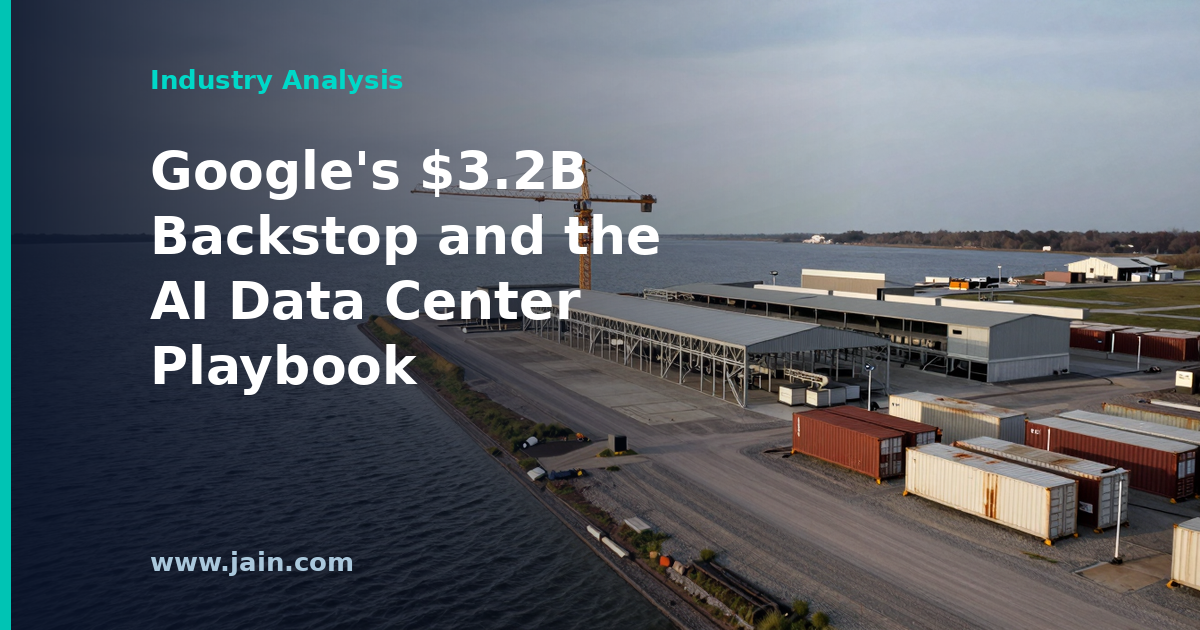
Startup Fortune reported that Google has backstopped $3.2 billion in lease obligations tied to TeraWulf’s AI data center campus at Lake Mariner in western New York, adding $1.4 billion in new support on top of earlier commitments. In exchange, warrants held by Google now represent roughly 14% of TeraWulf, up from about 8% months earlier.
Google is not the tenant. Fluidstack, an AI cloud provider, holds two 10-year leases at the site covering more than 200 megawatts of critical IT load — the power available to servers themselves, excluding cooling and building overhead — expanded by a 160-megawatt building known as CB-5 to a contracted total of 360 megawatts. Those leases have been valued at $3.7 billion over the initial term and up to $8.7 billion if Fluidstack exercises its extension options. TeraWulf, a Maryland-based bitcoin miner, has spent roughly two years converting the former coal plant site outside Buffalo into an AI campus.
Executive Summary
The headline number is a guarantee, not a purchase. Google is not buying a data center, not leasing one, and not putting one on its books. It is standing behind someone else’s rent so that a third party’s lenders will fund construction. That single move is the reason CB-5 and the buildings behind it become financeable at all.
The economics are straightforward once you strip out the jargon. TeraWulf cannot borrow billions against its own credit history; a former crypto miner’s balance sheet does not support project debt at that scale. Fluidstack’s ten-year lease payments can support it — but only if a lender believes those payments will arrive for a decade. Google’s backstop supplies that belief. TeraWulf gets a construction loan, Fluidstack gets capacity, and Google gets warrants, an expanding equity position, and access to compute without a capital expenditure line.
This matters beyond one campus in New York. It is the same logic operating at far larger scale elsewhere in the sector, and it means the binding constraint on AI infrastructure is increasingly not land, turbines or chips. It is whose credit sits behind the lease.
Credit Is the Scarce Input, Not Land
The industry talks about AI capacity in megawatts, but megawatts are a downstream output. A developer with a permitted site, an interconnection position and a signed tenant still cannot pour concrete without several billion dollars of debt, and debt is priced against the weakest promise in the chain. TeraWulf’s site work at Lake Mariner is real; its balance sheet history is a bitcoin miner’s. Those two facts pull in opposite directions when a credit committee sits down.
A backstop resolves the contradiction. In plain terms, Google has agreed to make the lease payments if the arrangement falls apart, which allows lenders to underwrite the loan against Google’s ability to pay rather than TeraWulf’s. The developer keeps the project, the operating risk and the upside. The hyperscaler takes on a contingent obligation — one that shows up as a commitment rather than as borrowed money — plus warrants, which are contracts giving the right to buy shares later at a fixed price. Those warrants moving Google from roughly 8% to roughly 14% of TeraWulf is the price of the credit enhancement, paid in equity instead of cash.
For anyone tracking who builds AI capacity over the next three years, this reframes the competitive question. The winners are not necessarily the developers with the best sites. They are the developers who can attach an investment-grade counterparty to their lease stack.
The Lease Is the Collateral
Fluidstack’s 360 megawatts of contracted capacity at Lake Mariner is what the debt is actually secured against. A ten-year lease valued at $3.7 billion over its initial term, rising toward $8.7 billion with extensions, is a cash flow stream — and project finance exists to turn predictable cash flow streams into buildings. The tenant’s obligations, not the landlord’s assets, do the heavy lifting.
That structure has an obvious sensitivity. The loan is sized to a tenant. If the tenant disappears, the campus is worth whatever the next tenant will pay, which in a softer market is not the same number. Google’s guarantee is the shock absorber, and its existence is a fair signal of how lenders assess a decade-long AI cloud commitment on its own: not sufficient without support. That is an observation about credit markets, not a judgment on Fluidstack’s business.
It also explains why converted industrial sites keep winning. A retired coal plant near Buffalo already has transmission, substation land, water and a grid position that a greenfield site would spend years acquiring. Crypto miners bought many of those sites cheaply in a different cycle, which is why several of them are now landlords to AI tenants rather than operators of hash rate.
Off the Balance Sheet, Not Out of the System
TeraWulf’s structure is modest against the largest comparable. Meta’s Hyperion campus in Richland Parish, Louisiana — around 4 million square feet, expected to draw up to 5 gigawatts on completion in 2029 — was financed through a joint venture with funds managed by Blue Owl Capital, with Blue Owl holding 80% and Meta 20%. Morgan Stanley arranged $27 billion of debt and $2.5 billion of equity through a special purpose vehicle, a standalone company created to hold a single project’s assets and borrowings, with Pimco anchoring a bond sale rated A+ by S&P and maturing in 2049. Because Meta does not control the entity holding the debt, the debt does not appear on Meta’s balance sheet; the long lease is recorded as an operating cost instead.
The aggregate is no longer marginal. A study cited by Forbes found the five largest US hyperscalers have moved more than $1.6 trillion in AI infrastructure debt into footnotes rather than balance sheets, and Moody’s separately estimates roughly $662 billion of hyperscaler lease commitments now sit outside reported debt — with more than $120 billion of that shift occurring in under two years. None of this is improper; lease and consolidation accounting is well-established, and the commitments are disclosed. But an investor reading only reported debt is reading a partial picture of sector leverage.
Where the First Loss Actually Lands
The structure relocates risk rather than eliminating it. At Lake Mariner, if the tenant walked, TeraWulf would hold a partially built campus with debt sized to a lease that no longer exists, and Google’s backstop would be the barrier between that debt and default. In the Louisiana model, private credit investors and bondholders hold the majority position and would absorb first losses, while the hyperscaler’s exposure is capped by a minority equity stake and its continuing rent obligation.
That asymmetry is a feature, not an accident, and both sides enter it knowingly. Private credit funds are paid a spread precisely to hold decade-length demand risk that public equity investors would punish on a hyperscaler’s own books. The judgment being made across the sector is that AI compute demand holds up long enough to service twenty-plus-year paper. If it does, every party in the stack is paid as modeled. If it does not, the losses surface first in private credit vehicles and among warrant-holding partners, where they are less visible and slower to be marked than a write-down at a listed technology company would be.
For enterprise buyers of AI capacity, there is a practical takeaway. When you sign with a neocloud or a converted-site operator, it is worth understanding who stands behind the building — because the entity on your contract may not be the entity whose credit made the building possible.
Background
TeraWulf is a Maryland-based company that built its business mining bitcoin — running warehouses of specialized computers that consume large amounts of electricity. When mining economics tightened, several operators discovered that their most valuable asset was not the hardware but the sites: power-rich industrial land with grid connections already in place. Over roughly two years, TeraWulf has been converting its Lake Mariner property, a retired coal plant site in western New York, into an AI data center campus leased to third parties.
The financing model around it is newer than the buildout itself. AI campuses now routinely cost more than a mid-sized developer can borrow, so the industry has converged on project finance structures: a long lease from a creditworthy tenant, debt raised against that lease, and a special purpose vehicle or credit guarantee that keeps the borrowing separate from the hyperscaler’s own balance sheet. Meta’s Hyperion campus in Louisiana, financed through a joint venture majority-owned by Blue Owl Capital funds with bonds anchored by Pimco and rated A+ by S&P, is the largest example to date. Google’s TeraWulf backstop is a smaller variant of the same idea.
Google has expanded its custom AI chip partnership with Marvell Technology in a deal reported at $12.2 billion, according to multiple Yahoo Finance reports published this week. Broadcom — long regarded as Google’s incumbent partner for custom AI accelerators — saw its shares fall 6.2% on the news, while analyst fair-value estimates for Marvell edged higher.
Executive Summary
The reported agreement deepens Google’s relationship with Marvell for custom silicon — chips designed to a single customer’s specification rather than sold off the shelf. In AI infrastructure, these custom accelerators (often called XPUs or ASICs) are the hyperscalers’ primary lever for reducing dependence on Nvidia’s general-purpose GPUs, and the design partner that wins the engagement captures years of high-visibility revenue.
The market reaction tells the story in one frame: Broadcom, which has been widely credited as the co-design partner behind Google’s Tensor Processing Units (TPUs), dropped 6.2%, while Marvell’s bull case strengthened. A $12.2 billion figure, if it represents committed or expected purchases, would be one of the larger custom-silicon engagements publicly reported — though the source articles leave the deal’s structure, duration, and scope largely undefined.
For the broader AI infrastructure market, the significance is less about one stock move and more about confirmation of a trend: hyperscalers are dual-sourcing their chip design partners the same way they dual-source power, fiber, and data center capacity — to control cost, schedule risk, and negotiating leverage.
Why Hyperscalers Refuse to Depend on One Chip Partner
Custom AI accelerators are multi-year commitments. A hyperscaler like Google picks a design partner, co-develops a chip over 18–36 months, then ramps production across successive generations. That timeline creates lock-in — and lock-in creates pricing power for the partner. Broadcom’s custom-silicon business has been a major beneficiary of exactly that dynamic. By expanding work with Marvell, Google gains a credible second source, which pressures pricing on every future generation and insulates its TPU roadmap from any single vendor’s execution stumbles.
This mirrors how large infrastructure buyers behave everywhere in the stack. No serious operator single-sources grid power, network transit, or construction contractors for a multi-gigawatt buildout. As custom silicon becomes as strategically important as the data centers that house it, the same procurement discipline is arriving in chip design.
Broadcom’s 6.2% Drop: Signal Versus Substance
A one-day 6.2% decline reflects what investors fear, not necessarily what Google has decided. The reports do not state that Google is reducing its Broadcom engagement — only that it is expanding Marvell’s. Those are different things: Google’s total accelerator demand is growing fast enough that two partners could both see rising volumes. The bearish reading is about share and leverage, not necessarily absolute revenue.
That said, the concern is not irrational. In custom silicon, the design win for generation N strongly influences who builds generation N+1. If Marvell’s expanded role includes compute (the accelerator itself) rather than adjacent components such as networking or interconnect silicon, the competitive implications for the incumbent are materially larger. The source reporting does not settle that question — and it is the single most important unknown in this story.
What $12.2 Billion Does — and Doesn’t — Tell Us
Headline deal values in semiconductors deserve careful reading. A $12.2 billion figure could represent firm purchase commitments, a cumulative multi-year revenue expectation, or an analyst’s sizing of the opportunity — each with very different levels of certainty. The reports cited here frame it as changing Marvell’s bull case, which suggests investors are treating it as durable pipeline, but the articles do not disclose contract structure, timeline, or margin profile.
Custom silicon also carries structurally lower gross margins than merchant chips, because the customer funds the design and captures much of the value. Marvell’s win is real in revenue-visibility terms; whether it is equally attractive in profitability terms depends on details not yet public.
Downstream Effects on AI Infrastructure Buyers
For enterprises and operators who buy cloud AI capacity rather than chips, this competition is quietly good news. Every credible alternative to Nvidia GPUs — and every second source within the custom-silicon supply chain — adds capacity to a market that has been supply-constrained for years. More TPU supply at better economics ultimately shows up as more available accelerated compute, and potentially better pricing, for Google Cloud customers. It also intensifies demand on the physical layer: more accelerator volume means more high-density data center space, more power procurement, and more advanced cooling — the parts of the stack where constraints now bind hardest.
Background
Google has designed its own AI accelerators — the TPU line — for roughly a decade, working with external semiconductor partners on design and production. Broadcom has long been identified in industry reporting as the principal partner behind that program, and custom accelerators for hyperscalers have become one of the fastest-growing segments in semiconductors as cloud providers seek alternatives to merchant GPUs. Marvell, meanwhile, has built its own custom-compute franchise serving hyperscale customers, making it the most frequently cited challenger to Broadcom in this market.
The reported $12.2 billion expansion lands in that context: a two-horse race for hyperscaler design partnerships, where each win shapes multiple future chip generations and, downstream, the data center, power, and cooling infrastructure required to deploy them.
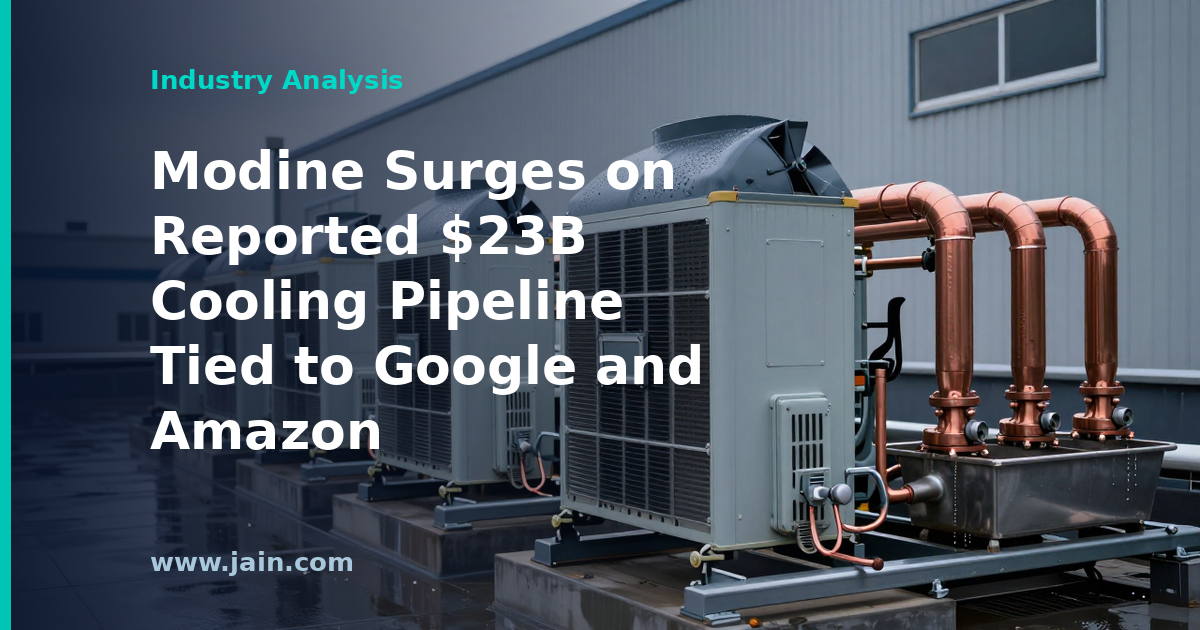
Shares of Modine Manufacturing (NYSE: MOD) jumped after Hunterbrook published a report, based on what it describes as leaked files, claiming the thermal-management company has a roughly $4 billion deal tied to Google and a data center cooling demand pipeline of about $23 billion that also links Amazon as a customer. Multiple financial outlets, including Benzinga, Proactive, and Pluang, relayed the report on August 22, 2026.
Neither Modine, Google, nor Amazon has publicly confirmed the figures, which originate from the report rather than from any company disclosure.
Executive Summary
The claim at the center of the move is simple but large: a report by Hunterbrook, citing leaked documents, names Google and Amazon as customers behind a data center cooling pipeline it sizes at $23 billion, including a reported $4 billion arrangement connected to Google. For a company of Modine’s size — a century-old industrial thermal specialist rather than a hyperscale household name — numbers of that magnitude, if borne out, would represent a step-change in the scale of its data center business.
The market’s reaction is as informative as the claim itself. Investors bid the stock up on an unverified, third-party report — a signal of how hungry the market is for pure-play exposure to data center cooling. As artificial intelligence workloads push server racks toward power densities that air cooling alone cannot handle, the companies that move heat — through chillers, coolant distribution units, and liquid cooling systems — are being repriced as strategic AI infrastructure suppliers rather than cyclical industrial vendors.
What matters now is verification: whether the companies involved confirm, deny, or stay silent, and whether the reported pipeline reflects contracted backlog or aspirational opportunity. Those are very different things for a stock that just moved on the distinction being blurred.
Cooling Is Becoming the Buildout’s Next Bottleneck
For most of the data center industry’s history, cooling was a solved problem: blow enough cold air across the servers and manage the electric bill. AI has broken that model. Modern accelerator racks can draw many times the power of traditional server racks, concentrating heat beyond what air-based systems efficiently remove. The industry’s answer — liquid cooling, where coolant is piped directly to chips or to heat exchangers at the rack — requires specialized equipment, and the supplier base for that equipment is far smaller than the demand now chasing it.
That is the structural story that makes a report like this land so hard. Investors have already repriced power equipment makers, transformer suppliers, and generator manufacturers as AI bottleneck trades. Thermal management is the logical next link in that chain: every megawatt of new AI compute is also a megawatt of heat that must go somewhere. A report naming the two largest cloud builders as anchor customers of a mid-cap cooling specialist fits a narrative the market was already primed to believe.
What the Report Claims Versus What Is Confirmed
It is worth being precise about the evidentiary chain here. The $4 billion and $23 billion figures come from a media report citing leaked files — not from a Modine securities filing, an earnings call, or a customer announcement. Hyperscalers rarely confirm their suppliers, and suppliers are often contractually barred from naming hyperscaler customers, so silence from Google and Amazon would be unremarkable either way. As of the coverage cited, none of the three companies had substantiated the numbers.
The word “pipeline” also deserves scrutiny. In industrial sales, a pipeline is typically the total value of opportunities being pursued — not signed contracts, not backlog, and not revenue. If the $23 billion figure describes potential demand Modine is quoting against, the economic reality could differ substantially from what a headline reader might assume. The reports available do not make that distinction clear, and the distinction is worth billions.
The Messenger Matters: Reading a Hunterbrook Report
The source of the claim adds its own analytical wrinkle. Hunterbrook operates an unusual model in financial media: a newsroom paired with an affiliated investment fund that can trade on its reporting before publication. In this case the report is bullish — a departure from the short-seller-style exposés such outlets are better known for — but the incentive question cuts the same way in both directions. Readers and investors should ask of any market-moving report: who benefits from the move, and was the evidence strong enough to justify it?
None of that makes the reporting wrong. Leaked documents can be accurate, and Hunterbrook’s work has moved markets before precisely because it is often substantive. But the fair standard is symmetrical: the same skepticism this publication would apply to an unverified vendor press release applies to an unverified media report, however sophisticated the outlet. Until Modine addresses the figures directly — in a filing, an earnings call, or a formal statement — the $23 billion number is a claim, not a fact.
Concentration Risk Hides Inside the Opportunity
Suppose the report is directionally right. Even then, the economics carry a caveat familiar to anyone who supplies hyperscalers: customer concentration. A supplier whose growth story rests on two buyers — however creditworthy — inherits their capital-expenditure cycles, their pricing leverage, and their willingness to dual-source or bring capabilities in-house. Hyperscalers have a long record of commoditizing their supply chains once a technology matures, from servers to networking gear.
The competitive field is also crowding fast. Established HVAC and infrastructure giants, specialist liquid cooling firms, and well-funded startups are all racing into the same thermal market. A large pipeline today says little about margins three years from now if the bidding field triples. For buyers of cooling equipment, that competition is good news — more capacity and better pricing. For any single supplier’s shareholders, it is the risk that tempers the headline number.
Background
Modine Manufacturing, founded in 1916 and headquartered in Racine, Wisconsin, spent most of its history as a heat-transfer specialist serving automotive and industrial markets. In recent years it has pivoted deliberately toward higher-growth thermal businesses, with data center cooling — including chillers and precision cooling systems — becoming a centerpiece of its climate solutions segment. That repositioning has coincided with the AI-driven data center boom, which has turned formerly unglamorous supply categories like power distribution and heat rejection into some of the market’s most closely watched bottleneck trades.
Hunterbrook, the report’s source, represents a newer breed of financial media: an investigative newsroom paired with an affiliated fund that can trade on its findings. Its reports have moved stocks in both directions before, which is why a bullish claim about Modine’s customer pipeline traveled so quickly through financial media despite lacking company confirmation.
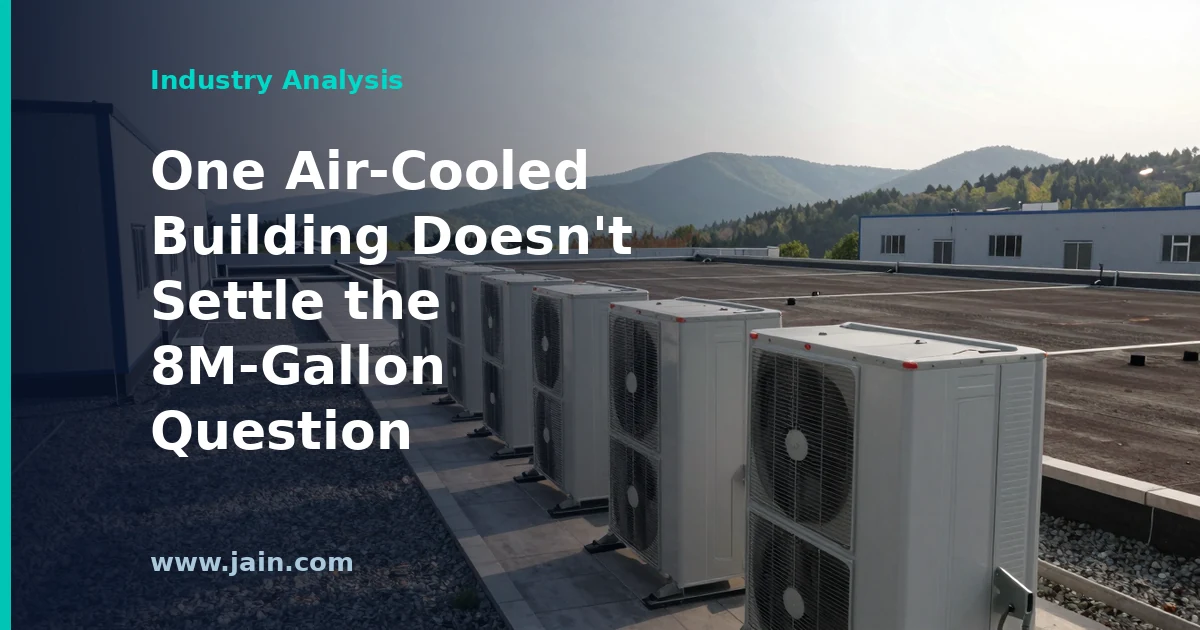
Google is planning a $3 billion computer-server complex in rural southwest Virginia. A water deal signed last year allowed it to eventually draw up to 8 million gallons a day, roughly a dozen Olympic swimming pools, while the region faces drought.
After local pushback, Google says its first building will be cooled with air instead of water. But that covers only one of three buildings, and air cooling usually burns more electricity. Residents now want to know how much, and where that power comes from.
Google confirmed on Friday, July 24, 2026, that the first building of its proposed $3 billion data center campus at the Botetourt Center at Greenfield in Botetourt County, Virginia, will use air cooling rather than water to keep its equipment cool, Virginia Business reported. Cooling for the campus’s two other planned buildings “remains under active evaluation,” according to an update on botetourtcountydatacenter.com.
The decision follows community concern over Google’s October 2025 utility services funding agreement with the Western Virginia Water Authority, which anticipated up to 8 million gallons of water per day at full buildout and no more than 2 million gallons per day initially.
Executive Summary
Google has chosen air cooling for the first of three buildings on its Botetourt County campus. A Google spokesperson said the company “determined that air cooling was the appropriate solution based on the facility’s needs and our focus on operating efficiently and responsibly,” and the project website described the choice as “driven by business demand and infrastructure requirements.”
The announcement is a meaningful concession to local water concerns, arriving as the neighboring Roanoke drought region sits at emergency status. But it is scoped narrowly. It settles one building, not the campus, and Google has not published a revised water estimate or said whether the 8-million-gallon full-buildout figure in its water agreement still reflects its plans.
It also shifts the debate rather than ending it. Cooling a data center without water generally means spending more electricity, and a local group, the Southwest Virginia Data Center Transparency Alliance, is now asking how much power the facility will need and where it will come from.
One Building of Three Doesn’t Move the Ceiling
The number that alarmed residents was 8 million gallons a day, the full-buildout figure in Google’s October 2025 agreement with the Western Virginia Water Authority. That figure describes the whole campus. The July 24 decision covers only the first building, and the project website says the other two remain under evaluation. Nothing in Google’s statement revises the agreement’s terms or offers a new campus-wide estimate.
That matters because of how utility planning works. A water authority sizing pipes, treatment and supply commitments plans against the maximum a customer is entitled to draw, not the amount the first phase happens to use. As long as the agreement anticipates up to 8 million gallons at buildout, the authority, local officials and neighboring communities are still planning around that ceiling. The first building likely draws well under the agreement’s 2-million-gallon initial limit, but Google has not said by how much.
So the practical effect is a deferral. The first phase gets lighter on water; the larger question of what the finished campus will consume moves to the decision on buildings two and three, which has no announced timeline.
Water Saved Is Power Spent
Data centers turn nearly all the electricity they use into heat, and that heat has to go somewhere. Evaporative, or water-based, cooling removes it efficiently by evaporating water, much as sweat cools skin. Air-based systems avoid that water loss but generally rely more heavily on fans and mechanical chillers, which consume electricity. Operators track the two sides with separate yardsticks: water usage effectiveness (litres per unit of computing energy) and power usage effectiveness (total facility energy divided by what the servers use). Improving one often worsens the other.
That is the trade-off the Transparency Alliance flagged. Co-founder Julie Bivins asked how much power the facility will now use and whether it will come from fossil fuels, natural gas or nuclear. Those are fair questions, and they apply symmetrically: Google has not quantified the added energy draw, and the alliance has not quantified it either. Whether the swap is a net environmental gain depends on the local grid’s generation mix and on how water-stressed the region is, and neither side has put those numbers on the table.
The density of the hardware inside also shapes the choice. Air cooling suits lower-density server halls; the most power-hungry equipment, including the accelerators used for AI workloads, increasingly pushes operators toward liquid cooling. Google has not said what the Botetourt buildings will host, but the website’s reference to “business demand and infrastructure requirements” suggests the cooling decision for later buildings will turn on what they are built to run, not only on water.
A Cooling Decision Made in a Drought
The timing is hard to separate from the local climate. On July 15, Gov. Abigail Spanberger announced that the Roanoke Drought Evaluation Region, which includes Roanoke city and Roanoke County next to Botetourt, had reached emergency status, while most of Virginia sat under drought warnings or watches.
Local governance has been strained as well. Botetourt County said on July 3 that its planning commission lacks legal authority to independently convene public hearings, and The Roanoke Times described tense proceedings at the commission’s July 13 meeting, where members voted to recommend that the Board of Supervisors direct them to organize a meeting on water supply.
For developers elsewhere, the lesson is that cooling architecture is no longer purely an engineering decision made late in design. Water commitments negotiated early, and disclosed later through public-records requests, can become the defining public fact about a project. Publishing water and power estimates together, per building and at buildout, is the clearest way to show what a cooling trade-off actually saves.
Background
Google’s planned campus sits at the Botetourt Center at Greenfield, an industrial park in Botetourt County, just north of Roanoke in southwest Virginia. The company has proposed a $3 billion investment across three buildings, part of a broader push of large data center projects beyond Virginia’s established hub in the northern part of the state.
Data centers house the servers behind cloud services, search and AI, and they need continuous cooling. Many large facilities use evaporative systems that consume significant water; others use air-based or closed-loop designs that use less water but more electricity. That choice has become a central point of negotiation between developers and host communities, particularly in areas facing drought.
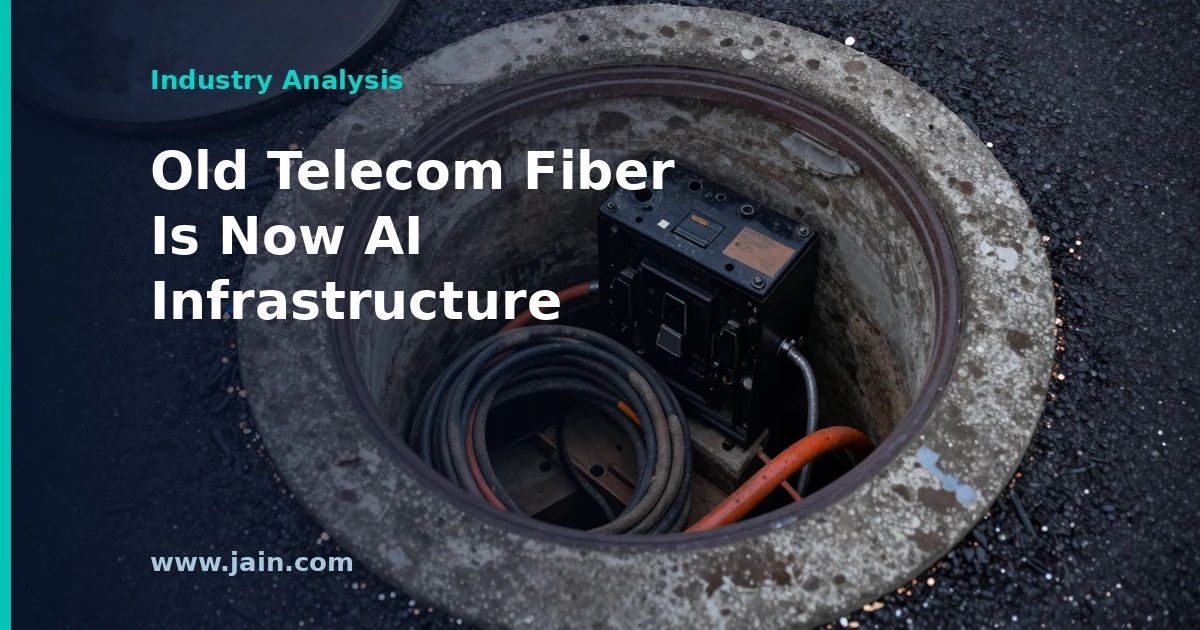
Verizon, best known for phone service, will supply Google with unused fiber-optic cable in a deal worth more than $1 billion. Fiber-optic cables are glass lines that carry internet traffic as pulses of light.
Google needs the cable to link its data centers, the warehouse-sized buildings full of computers that run artificial intelligence. Those buildings must constantly swap huge amounts of data.
The surprise is that much of this cable was laid for an older internet. Artificial intelligence has turned it into something worth a fortune, and Verizon says more deals worth billions are coming this year.
Verizon Communications has signed a dark fiber agreement with Alphabet’s Google worth more than $1 billion, Quartz reported. CEO Dan Schulman disclosed the deal on Verizon’s second-quarter earnings call on Friday, July 24, 2026. Under the agreement, Verizon will provide dark fiber to connect Google’s data centers.
Schulman said Verizon expects to announce additional AI infrastructure agreements by year-end that would generate multiple billions of dollars in revenue over the next several years. Verizon shares rose more than 3% in Friday’s opening trade, and Alphabet’s Class A shares gained about 1%.
Executive Summary
Verizon is selling Google access to dark fiber, meaning optical cable with no transmission equipment attached, which Google will light with its own gear to link its data centers. The disclosed value is more than $1 billion. Schulman called the announcement “consequential” and a preview of where Verizon’s revenue trajectory is headed.
The deal matters beyond one contract. Schulman argued that Verizon’s long-haul and metro fiber, originally built for a different technological era, now fits precisely what is needed to connect AI data centers, compute clusters and geographic regions. If he is right, fiber routes already in the ground are becoming a strategic input to AI buildouts, alongside power and chips, and carriers holding those routes gain a new class of long-term customer.
What remains unproven is scale. One deal is disclosed; the “multiple billions” are a forecast. The year-end pipeline is what will show whether this is a durable revenue line or a single large transaction.
Why Fiber Built for Another Era Now Sells as AI Infrastructure
Dark fiber is the rawest form of network capacity a carrier can sell: strands of glass with no lasers or routers attached. The buyer installs its own optical equipment at each end, decides how much data to push through, and upgrades on its own schedule. For a company like Google, that means the capacity between its sites is set by its own engineering choices rather than by a carrier’s service tiers, which is why large cloud operators favor it for their most important links.
AI changes how much those links matter. Large AI workloads increasingly span multiple buildings and regions, so data centers must move enormous volumes of data between one another. Schulman’s claim is that Verizon’s network, though built for an earlier era, fits “precisely” what is needed to link AI data centers, compute clusters and geographic regions. The operational point is that the glass itself is rarely the scarce part. The scarce parts are the installed routes, rights-of-way and permits, which take years to assemble and which an incumbent carrier already holds. A more-than-$1 billion commitment from Google is a concrete price signal that those existing routes now carry AI-era value.
That reprices assets across the industry. Other owners of long-haul fiber now have a public comparable for what a hyperscaler will commit. Data center developers have another reason to weigh proximity to established fiber corridors alongside power availability. And for hyperscalers, leasing proven routes is one way to connect new campuses without waiting on new construction.
A Billion-Dollar Headline Without the Fine Print
Markets took the news seriously. Verizon stock rose more than 3% at Friday’s open, a notable move for a large, mature telecom carrier, and Alphabet’s Class A shares gained about 1%. Investors appear to be reading the deal as evidence that Verizon can earn growth revenue from assets it already owns, rather than only from its consumer wireless business.
The economics are harder to judge than the headline. “More than $1 billion” does not say over how many years that value is earned, how many route miles or strands are involved, or whether payment is largely upfront or spread across the term. Dark fiber deals can carry attractive margins when the cable is already in the ground, but Verizon has not said how much new construction, such as short connecting routes to Google’s sites, the agreement requires. Those details determine whether this is a high-margin monetization of sunk investment or a capital project with a customer attached.
The Year-End Test for Verizon’s AI Pitch
Schulman framed Google as the beginning, not the peak. He said additional agreements expected by year-end would generate multiple billions of dollars in revenue over the next several years, describing them as stable, extended-term arrangements with some of the most technically rigorous customers in infrastructure. That is a specific, checkable commitment, and it will define how the Google deal is judged.
There are structural limits to watch. Dark fiber inventory is finite: a strand provided to one customer is not available to another, so sustained growth eventually depends on how much spare capacity Verizon holds on the routes AI customers want, or on building more. Hyperscalers also have alternatives, including other fiber owners and their own construction, which will shape pricing. None of this undercuts the Google deal; it frames the question of whether a network built for an earlier era can supply AI demand at the scale Schulman describes.
Background
Verizon Communications is one of the largest US telecom carriers, known mainly for wireless and broadband service. It also owns long-haul fiber connecting cities and regions and metro fiber within urban areas. Schulman, now CEO, argues that this network, originally built for a different technological era, suits the connectivity needs of AI data centers.
Google, owned by Alphabet, is one of the hyperscalers building large-scale AI infrastructure. As AI computing spreads across multiple campuses and regions, the network links between data centers have become a strategic requirement. Large cloud operators commonly buy dark fiber on long-term agreements and light it with their own equipment, keeping control of capacity and upgrades.
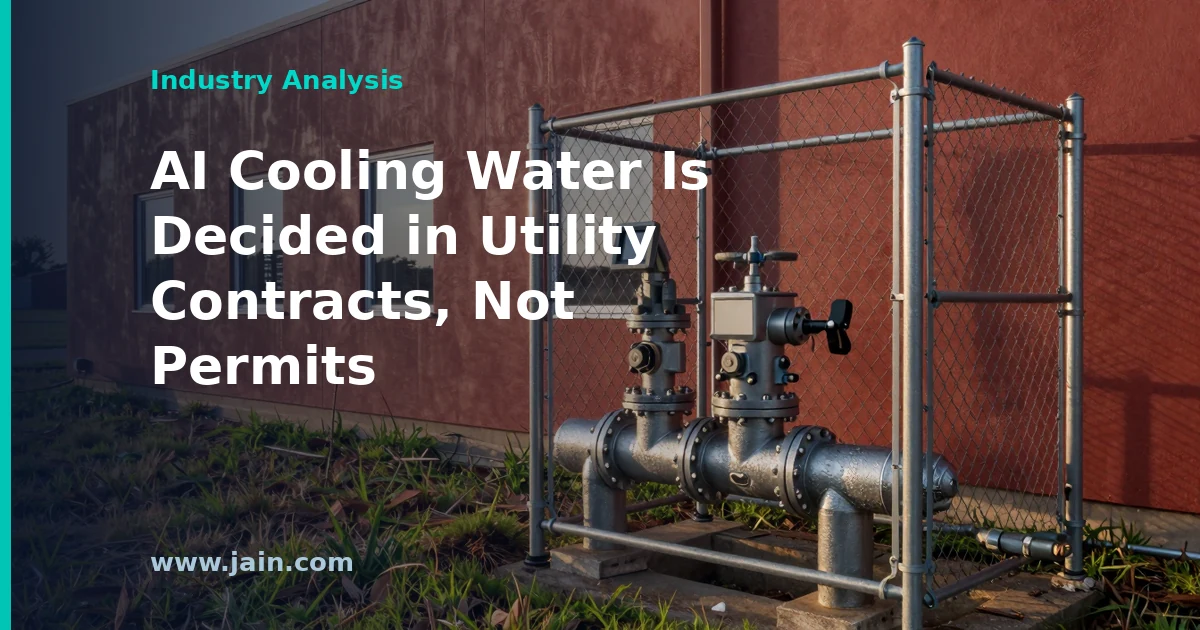
Oklahoma has about 55 data centers, the giant warehouses of computers behind apps, websites and artificial intelligence. Not one has applied for a state permit to draw water.
They buy water from local utilities like any other customer, so the state does not track how much they use. One Google site uses as much water each year as 10,000 homes, and most of it evaporates.
With a $15 billion campus proposed near Yukon in a state hit by years of drought, neighbors are asking questions developers are not yet required to answer.
None of the 55 data centers that advisory firm Baxtel lists in Oklahoma has applied for a state water permit, according to reporting by Investigate Midwest published in The Oklahoman. They buy water as customers of municipal utilities, rural water districts or industrial parks that already hold water rights, so their consumption sits largely outside state oversight. Senate Bill 259, signed by Gov. Kevin Stitt in May, allows groundwater permits for data centers only if they use water-conserving, recycling cooling systems, but it does not reach facilities that buy water instead of seeking permits.
The gap is drawing attention as Atlanta-based Beltline Energy proposes a $15 billion, 1,000-megawatt campus of 15 buildings on 480 acres straddling Oklahoma City and Yukon. Yukon is considering selling the project up to 2.5 million gallons of wastewater per day, while Beltline has requested extensions on the water agreement and has not said which cooling system it would use.
Executive Summary
Oklahoma’s newest data center water rule targets the one route data centers do not use. State permits govern taking water directly from aquifers and rivers; data centers instead contract with local suppliers. “So far, we have not had any permits issued specifically to data centers,” said Julie Cunningham, director of the Oklahoma Water Resources Board.
The practical consequence is that the decisions that determine how much water an AI campus consumes, including its volume, its source and whether it evaporates or recycles cooling water, are being made in municipal supply agreements rather than state permits. Yukon’s pending contract with Beltline is a live example.
Closing the permitting gap would not by itself produce usage data. The state relies on self-reported figures, metering requirements have failed twice, and the water board reported fewer than 20 staff in 2025. Rep. Carl Newton, the author of SB 259, says a new bill next year will address data centers drawing groundwater through a secondary source.
Why the Permit Rule Misses the Meter
SB 259 attaches a sensible condition to groundwater permits: data centers can get one only if their cooling systems are designed to conserve and recycle water. But a permit is only required when a user withdraws water itself. A data center that buys from a city, a rural water district or an industrial park holding industrial water rights is treated as an ordinary customer of that system, and the state never sees an application. That is why a statewide count of zero permits sits alongside 55 listed facilities.
The real regulatory instrument is therefore the supply contract. Google’s Pryor data center, the state’s largest, buys water from the state-owned MidAmerica Industrial Park, which draws and treats it from the Neosho River. Beltline’s Yukon purchase agreement hinges on a separate water agreement with the city. Whoever negotiates those contracts, usually a municipal utility or city council, effectively decides volume, source and whether the water is potable or treated wastewater. The state’s conservation standard never enters the room.
This matters for everyone on the supply side. City water utilities are becoming the de facto gatekeepers for AI cooling, often with small staffs and without statewide guidance. Developers face a patchwork of local terms rather than one state rulebook. And residents who want answers, like Yukon-area neighbor Pencia Truhan, who said developers “don’t have to tell us what they’re going to do about water,” find no state filing to consult.
The Cooling Choice Is Also a Power Choice
Cooling design is where water and electricity trade off. Open-loop, or evaporative, systems like Pryor’s lose water to the atmosphere: Google reports the site consumes 1.1 billion gallons a year, about the annual use of 10,000 American households, and returns roughly 275 million gallons to the Neosho River. That leaves about 825 million gallons evaporating each year. Closed-loop systems recirculate water, and air-cooled systems use little water but significantly more electricity.
For Beltline’s proposal, that trade-off lands on an unusually large base. A 1,000-megawatt campus would, at full capacity, draw roughly as much electricity as Oklahoma City’s average use and more than double the demand of Google’s Pryor facility. Choosing air cooling to spare local water would push that electricity figure higher; choosing evaporative cooling would do the reverse. Because the cooling system has not been disclosed, neither the water nor the full power burden can yet be estimated.
Yukon’s Math: Wastewater, Wells and a 2035 Deadline
Yukon’s planning memo describes selling Beltline up to 2.5 million gallons of wastewater a day, and officials have promised the project will not rely on drinking water. At full volume that is about 900 million gallons a year, comparable in scale to what Pryor evaporates annually. Using treated wastewater is a common way to spare potable supply, but the sale still commits a resource the city may want for other purposes.
The city’s supply position is already tight. Yukon relies on 15 leased wells in the Garber-Wellington Aquifer plus purchases from Oklahoma City, and those leases expire in 2035. A city-commissioned study projects its 27,300 residents will grow by about 23% over 25 years, in Canadian County, the state’s fastest-growing county. Against that, Beltline-commissioned studies project 450 permanent jobs and $543.12 million in tax revenue over 25 years, figures that potential tax abatements would significantly reduce.
Measurement Is the Harder Fix
Even a closed loophole would leave a data gap. The Oklahoma Water Resources Board relies on self-reported water use. Newton’s original bill would have required commercial groundwater users to install meters; that provision was removed after opposition from Panhandle irrigation groups, and Stitt vetoed similar legislation in 2023 after the Oklahoma Farm Bureau and others argued it infringed on private property rights.
Capacity is the other constraint. In 2025 the board reported fewer than 20 staff handling an average of 250 permit applications and amendments a year, plus investigations and fieldwork, and its 140-page Water Demand Forecast from last October does not mention data centers. Cunningham said the agency is working to build expertise. Until measured data exists, planners in a drought-stressed state are forecasting water demand without one of its fastest-growing users in the model.
Background
Data centers house the servers behind everyday online services, and the newest hyperscale facilities built for artificial intelligence concentrate enough computing to generate heat on an industrial scale. Removing that heat often uses large volumes of water, which is why cooling design has become a siting issue alongside land and power. Oklahoma already hosts one of Google’s largest facilities in Pryor, where the company outlined plans addressing power and water for new sites, and the state is drawing further proposals.
Beltline Energy, based in Atlanta, began as a renewable energy developer that secured land and developed solar projects before selling them to investors, and it is applying a similar model to data centers. It has developed more than a dozen solar farms but lists no completed data center projects. Its Oklahoma proposals, in Yukon and Oklahoma City, Piedmont and Luther, arrive as the state’s water regulator, which relies on self-reported usage data, works to develop expertise in the sector.
Google has unveiled an open-source liquid-to-air cooling sidecar designed for air-cooled data center environments, as reported by Data Center Dynamics on June 17, 2026. The design targets one of the most pressing constraints in the industry: modern AI accelerators increasingly require direct liquid cooling, while the vast majority of existing data center floor space was built to move heat with air alone.
A sidecar of this type is a heat-exchanger cabinet that sits beside a rack of liquid-cooled servers, circulating coolant through the chips in a closed loop and then rejecting that heat into the room’s existing airflow — no facility water piping required. By publishing the design openly, Google is inviting vendors and operators to build and adapt it rather than keeping it proprietary.
Executive Summary
The announcement matters less for what the hardware is than for where it lets liquid cooling go. Direct-to-chip liquid cooling has become effectively mandatory for the densest AI training hardware, but deploying it normally requires facility-level infrastructure — coolant distribution units, piping loops, and water connections that most operating data centers simply do not have. A liquid-to-air sidecar sidesteps that requirement: the liquid loop stays local to the rack, and the building’s existing air-handling systems carry the heat away as they always have.
That makes this a retrofit play. Enterprises, colocation tenants, and smaller operators sitting on air-cooled capacity gain a path to host at least some liquid-cooled equipment without construction projects. It is also a continuation of Google’s recent posture of contributing cooling designs to the open hardware ecosystem rather than treating them as competitive secrets — a bet that standardizing the plumbing layer accelerates the whole market Google’s cloud and AI businesses depend on.
The report available at the time of writing is brief, and the announcement as covered leaves key engineering and availability details unstated — including the design’s cooling capacity, its publication venue and license, and whether it reflects hardware Google runs in production. Those specifics will determine whether this is a broadly useful reference design or a niche one.
The Retrofit Gap Is the Industry’s Quiet Bottleneck
Headlines about AI data centers focus on new gigawatt-scale campuses, but most of the world’s installed data center capacity is older, air-cooled space designed for racks drawing 5 to 15 kilowatts. Current AI server racks can draw many times that, and the chips inside them ship with cold plates that expect liquid, not airflow. Operators of existing facilities face an unattractive menu: leave AI workloads to someone else, undertake disruptive plumbing retrofits in live buildings, or find a bridge technology.
Liquid-to-air sidecars are that bridge. Because the liquid never leaves the immediate vicinity of the rack, the facility itself does not need water loops, external coolant distribution plants, or new mechanical rooms. The trade-off is physics: the room’s air systems still have to absorb every watt the sidecar rejects, so total rack density remains bounded by the building’s air-handling and power envelope. A sidecar extends the life of air-cooled space; it does not turn a legacy building into a frontier AI facility.
Why Give the Design Away?
Google has form here. The company has run liquid-cooled custom TPU accelerators internally since roughly 2018, and in 2025 it announced it would contribute a production coolant distribution unit design to the Open Compute Project, the industry body through which hyperscalers share hardware specifications. Open-sourcing a sidecar fits the same logic: cooling hardware is not where Google differentiates, but an immature, fragmented cooling supply chain slows everyone — including Google and the customers of its cloud business.
Open designs give equipment manufacturers a common reference to build against, which tends to lower prices, improve interoperability, and widen the vendor pool. For Google there is also a soft-power dividend: hyperscaler-authored designs shape industry standards, and the ecosystem that grows up around them tends to stay compatible with the author’s infrastructure choices. None of that makes the contribution less useful — but it is worth understanding open-source hardware as strategy, not charity.
Winners, Losers, and the Honest Limits
The clearest beneficiaries are operators of existing air-cooled facilities — enterprise server rooms, regional colocation providers, and edge sites — who gain an on-ramp to liquid-cooled hardware without capital construction. Cooling-equipment manufacturers get a design they can productize; some may welcome the demand signal, while vendors selling proprietary sidecar and rear-door heat exchanger products now face an open alternative that could compress margins.
The honest caveat is that the announcement, as reported, is a design release, not a product with published performance data. Until the specification’s capacity, tested configurations, and licensing terms are public and third parties have built against it, the practical impact is prospective. Open hardware contributions have a mixed track record: some become de facto standards, others languish without a manufacturing ecosystem. Which path this design takes depends on details the initial coverage does not yet supply.
Background
Google is one of the world’s largest data center operators and has cooled its custom TPU AI accelerators with liquid since roughly 2018 — years before liquid cooling became an industry-wide necessity. In 2025 it began contributing pieces of that cooling stack to the open hardware ecosystem, announcing a production coolant distribution unit design for the Open Compute Project, the body through which hyperscalers share server and infrastructure specifications.
The backdrop is a market-wide squeeze: AI hardware demand is rising far faster than new liquid-ready facilities can be built, leaving a large installed base of air-cooled data centers unable to host the densest equipment. Bridge technologies that bring liquid cooling into air-cooled buildings — sidecars and rear-door heat exchangers among them — have become one of the fastest-moving segments of data center engineering.
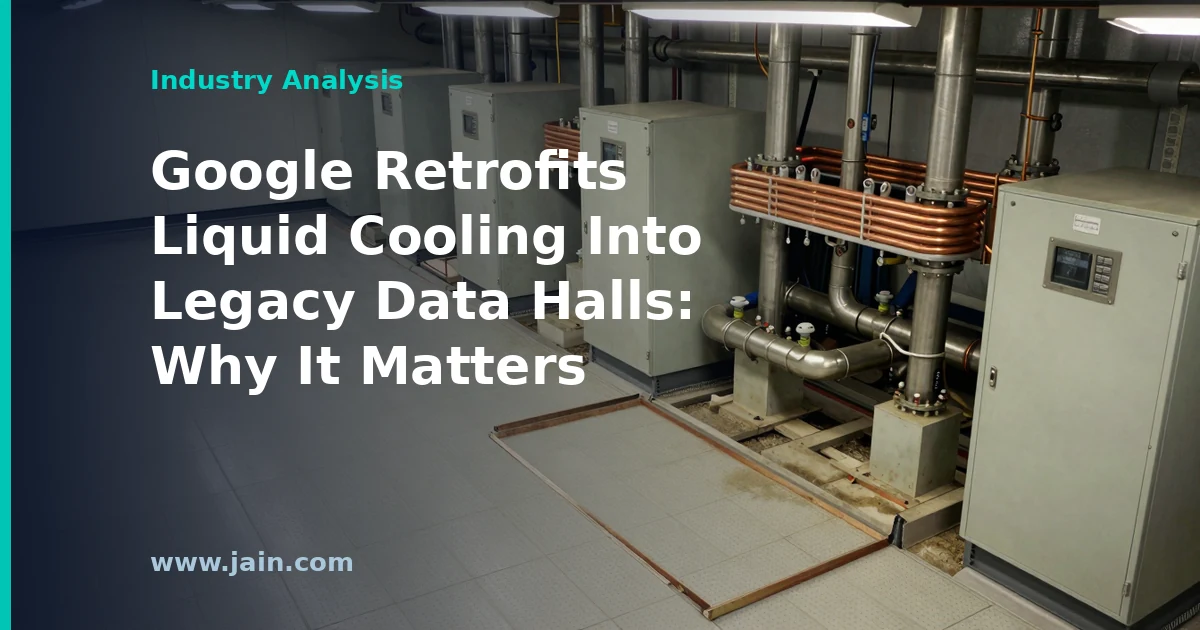
A June 16, 2026 report from the Data Center Richness newsletter on Substack says Google is bringing liquid cooling into its legacy data halls — retrofitting existing, originally air-cooled facilities rather than confining liquid cooling to newly built AI campuses. The report positions the move as a marker that liquid cooling is graduating from a specialty technology for new AI construction into something operators must engineer into buildings that already exist.
Executive Summary
According to the report, Google — one of the world’s largest data center operators — is extending liquid cooling beyond greenfield construction and into older data halls in its existing fleet. Liquid cooling circulates fluid close to (or directly across) hot silicon instead of relying on chilled air, and it has become the default answer for the extreme heat produced by modern AI accelerators.
The significance is less about any single facility and more about direction of travel. Until recently, the industry’s working assumption was that liquid cooling arrives with new buildings designed around it, while legacy halls carry on with air. If a hyperscaler of Google’s scale is instead threading liquid into buildings that were never designed for it, that suggests demand for accelerator capacity is outrunning the pace of new construction — and that existing real estate, with its already-secured power and grid connections, is too valuable to leave running at air-cooled densities.
One caveat up front: this is a single analyst-newsletter report, not a detailed Google engineering disclosure. The headline claim is clear; the scope, sites, methods, and timeline behind it are not spelled out in the source material available.
From Greenfield Exception to Fleet-Wide Expectation
For most of the past two decades, data center cooling meant moving air: chilled air pushed through raised floors or hot-aisle containment, absorbing heat from servers and carrying it away. Liquid cooling — whether direct-to-chip cold plates that sit on processors or full immersion of hardware in dielectric fluid — was a niche reserved for supercomputers. AI changed the math. Modern accelerator racks concentrate far more heat in far less space than air can economically remove, so new AI facilities are now routinely designed liquid-first.
The retrofit story flips the remaining assumption. If liquid cooling only lived in new builds, older halls would gradually become second-class assets, suitable only for lighter workloads. Retrofitting says the opposite: the industry’s installed base is being upgraded in place. For an operator with Google’s fleet size, even partial retrofits could unlock meaningful accelerator capacity without waiting years for new construction.
Why Retrofit When You Can Build New? Power and Time
The economics here are straightforward even without disclosed figures. The scarcest resources in data center development today are grid power and time — utility interconnections and permits for new campuses can take years in major markets. A legacy data hall already has land, a building, a grid connection, and delivered megawatts. Converting some of that hall to liquid cooling lets an operator redeploy existing power toward denser, higher-value AI capacity on a much shorter clock than greenfield construction allows.
Retrofits are not free or trivial, though. Liquid cooling in an air-designed building typically means adding coolant distribution units (the pumping and heat-exchange gear that moves fluid between facility water systems and server cold plates), new piping runs, leak detection, and floor-loading and maintenance procedures the original design never contemplated — often while neighboring racks keep serving live traffic. The engineering challenge of doing this in production facilities is precisely why a credible report of Google doing it at fleet scale is notable.
What It Signals for the Rest of the Market
Hyperscaler practice tends to become industry expectation. If Google normalizes liquid retrofits, colocation providers and enterprise operators will face the same question from their customers: can your existing halls take liquid-cooled racks, or only your new ones? Operators who can answer yes gain a way to monetize older buildings at AI-era densities; those who cannot may see legacy space reprice downward relative to liquid-ready capacity.
The supplier picture shifts too. A retrofit wave would expand the addressable market for cooling-distribution hardware, piping, quick-disconnect fittings, and specialized integration services well beyond the new-construction pipeline — because the installed base of air-cooled data halls worldwide is vastly larger than any single year’s new builds. At the same time, air cooling is not disappearing: the bulk of general-purpose computing still runs comfortably on air, and most retrofits produce hybrid halls where liquid and air coexist. The realistic near-term future is mixed-mode facilities, not a wholesale replacement.
Background
Google operates one of the world’s largest data center fleets and has long treated infrastructure engineering as a competitive advantage, publishing influential work on efficiency and custom hardware. It was an early hyperscale adopter of liquid cooling, deploying it at scale with its TPU v3 AI chips in 2018 — years before the generative-AI boom made the technology an industry-wide priority.
Across the wider market, the surge in AI computing since 2023 has pushed rack power densities far beyond what conventional air cooling handles economically, making liquid cooling standard in new AI construction. The unresolved question has been what happens to the enormous installed base of air-cooled facilities — which is exactly the question a credible hyperscaler retrofit program begins to answer.