TL;DR · 30-second read
The Short Version
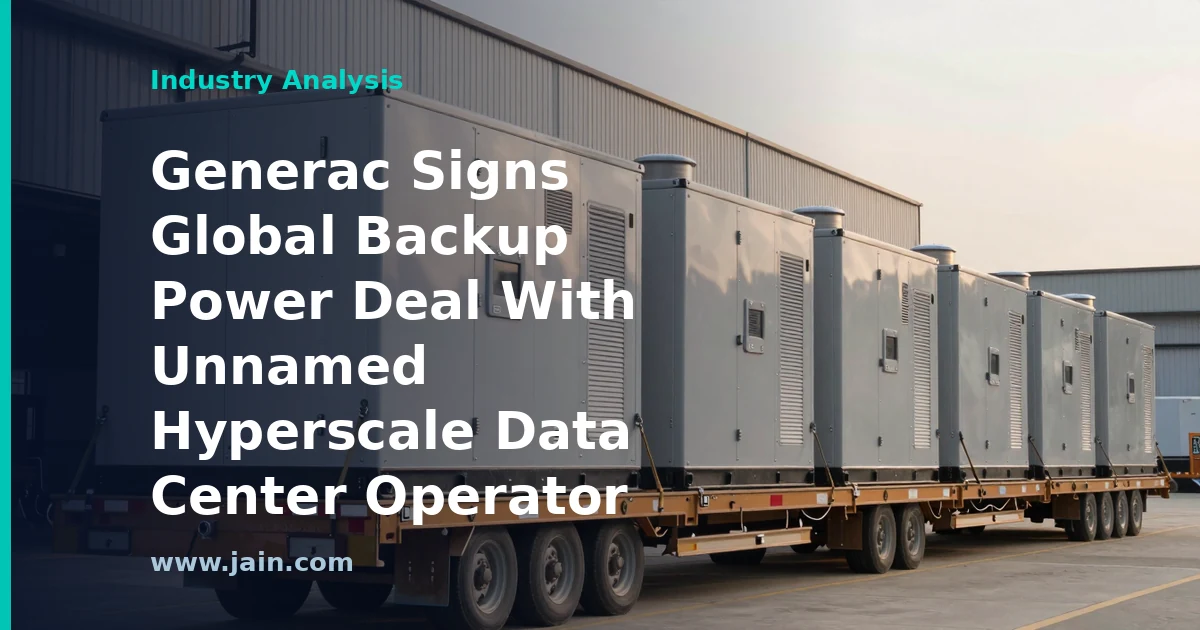
Amazon agreed to buy backup generators from Generac, the company best known for the generators that keep homes running during blackouts. These machines do the same job for the giant computer buildings behind online services, starting up when the regular power fails.
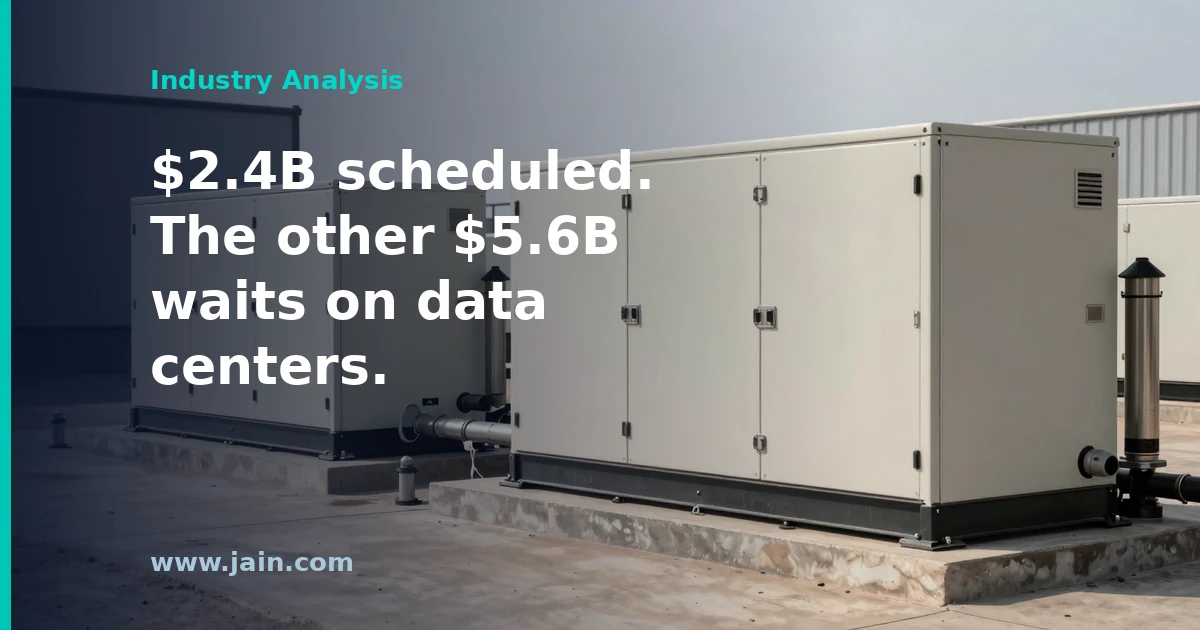
About $2.4 billion worth is expected to be delivered in 2027 and 2028. Amazon also gets the right to buy Generac stock at a fixed price, and that right grows the more generators Amazon buys, up to $8 billion.
The first $2.4 billion has a date on it. The rest only happens if Amazon keeps building.
On September 16, 2026, Generac Holdings (NYSE: GNRC) and Amazon.com signed a long-term supply agreement for backup power generators for Amazon data centers, according to an 8-K Generac filed the same day. Initial deliveries are expected to total $2.4 billion across 2027 and 2028. Alongside the supply deal, Generac issued an Amazon subsidiary a warrant to buy up to 1,693,745 Generac shares at $200.9266 each. Some of those shares vested immediately, and the rest vest as Amazon’s generator payments accumulate, up to a total of $8 billion.
Yahoo Finance reported that Generac shares rallied on the news.
Executive Summary
Generac’s filing makes Amazon a named buyer of data-center backup power, the generators that carry a facility through a grid outage once its batteries run down. It puts two numbers on the relationship. The first is $2.4 billion in expected deliveries over two years. The second is an $8 billion ceiling on the purchases that can unlock Amazon’s equity stake.
Those two figures measure different things. The $2.4 billion is a delivery expectation with dates attached. The $8 billion is the spending level at which Amazon’s warrant fully vests, and the warrant runs until September 2033. Most of the headline figure is therefore contingent: it turns into revenue only if Amazon keeps building data centers that need Generac equipment.
The structure also shows who is paying for what. Generac is giving its customer equity upside in return for volume. For Generac shareholders, that is a trade of some future dilution for a large anchor buyer. For the wider data-center supply chain, it signals that backup generation is now valuable enough to be locked in years ahead with financial ties that go beyond a purchase order.
The $8 Billion Is a Ceiling, Not an Order
The 8-K describes two separate instruments. The long-term supply agreement governs what Amazon buys, and the only scheduled volume it discloses is the $2.4 billion in initial deliveries expected in 2027 and 2028. The warrant governs what Amazon earns, and it vests in tranches “contingent upon aggregate gross payments, net of certain offsets” from Amazon for data-center backup generators, “up to a total of $8 billion.” The $8 billion is the point where the incentive stops growing. It is not a commitment to spend that much.
Scheduled deliveries cover 30% of that ceiling. The remaining $5.6 billion has no timetable in the filing, only an outer boundary: the warrant can be exercised on or before September 16, 2033. Every new hyperscale data center needs its own backup generation, sized to its electrical load. Whether Generac’s revenue approaches the $8 billion mark therefore depends on how many facilities Amazon builds over the next seven years, how large they are, and how much of that generator demand Generac wins against other suppliers.
This matters to three groups. Investors should model $2.4 billion as the disclosed baseline and treat anything above it as dependent on Amazon’s construction pace. Generac’s factory planning has to support a two-year delivery ramp without knowing what comes after 2028. Other generator suppliers now face a buyer that has a financial incentive to direct its volume toward one vendor.
Generac Is Paying for Volume in Equity
A warrant is the right to buy shares later at a fixed price. Here the supplier grants it to the customer. That makes it a volume incentive paid in stock rather than cash. Of the 1,693,745 warrant shares, 307,954 (about 18%) vested at signing, which works as an upfront signing incentive. The other 1,385,791 unlock only as Amazon’s payments grow. Spread evenly across $8 billion, that would be roughly one share for every $5,770 of generator purchases. The filing says only that vesting occurs in “multiple tranches” and does not give the actual schedule.
The economics favor Amazon when Generac’s stock trades above the $200.9266 strike price. Buying all 1,693,745 shares would cost about $340 million at that price. However, Amazon can choose a cashless exercise, receiving the net value in shares without paying cash. Generac has also granted registration rights, which make it easier for Amazon to sell those shares later. The result ties part of Amazon’s return to Generac’s share price, and that price should rise as Amazon buys more generators. Existing Generac shareholders bear the cost through potential dilution. The warrant’s strike price and share count are also subject to anti-dilution adjustments.
A Home-Standby Brand Takes a Hyperscale Test
Generac built its name on home standby generators. Data-center backup is a different business. The units are larger, reliability requirements are strict, and a hyperscaler’s construction schedule does not move because a supplier fell behind. Having Amazon as a named, contracted buyer is the clearest external validation of Generac’s data-center push so far. It also exposes Generac to a direct test: delivering $2.4 billion of equipment within two calendar years, to a customer that can measure its performance precisely.
Amazon’s broader funding shows how much money is flowing into these projects. Two days before the Generac agreement, Amazon’s own 8-K reported that it closed a £4.25 billion sterling bond sale, with coupons ranging from 5.200% on notes due 2029 to 6.650% on notes due 2045. Nothing in that filing links the proceeds to Generac or to data centers in particular. What it does show is a buyer raising capital at a scale where multi-year equipment commitments are routine. For Amazon, a warrant that pays off only if Generac performs is an inexpensive way to secure a supply chain it will need regardless.
Background
Generac Holdings, which trades as GNRC, is best known for home standby generators, the units that switch on automatically when a house loses power. Data-center backup power is a larger, more demanding version of the same product. Each facility needs enough on-site generation to carry its full electrical load through a grid outage, and hyperscale operators such as Amazon buy these systems in volume as they build new campuses.
Warrants tied to a customer’s purchases are an established way for suppliers to secure large buyers. The supplier grants equity upside that grows as the customer spends. Generac’s agreement follows that model, pairing a long-term supply contract with a warrant that vests against Amazon’s generator payments. Source: Generac Rallies on Power Deal With Amazon. How to Play GNRC Stock Now. (Yahoo Finance): coverage of Generac’s share move after the Amazon supply agreement. Primary sources: Generac Holdings Inc., Form 8-K filed September 16, 2026 (Transaction Agreement, warrant and long-term supply agreement with Amazon); Amazon.com, Inc., Form 8-K filed September 14, 2026 (closing of £4.25 billion sterling notes offering).Sources