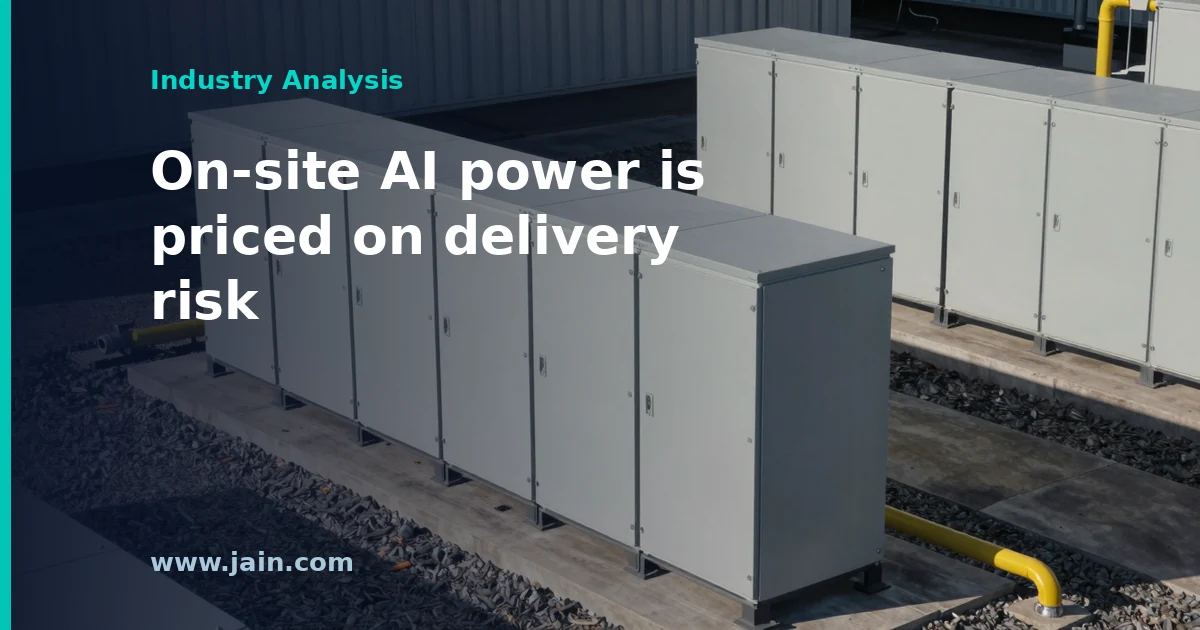
Oracle, one of the giant companies that rents out computing power over the internet, has confirmed it still plans to buy a huge amount of power equipment from a company called Bloom Energy.
The equipment is fuel cells: machines that turn natural gas into electricity on site without burning it. Together they would produce roughly as much power as two large nuclear reactors, to run artificial intelligence computer centers.
A formal warning had said deliveries might be disrupted. When Oracle said the deal was still on, Bloom’s stock jumped about 8 percent. The deal didn’t get bigger. Investors were simply relieved it would happen.
Bloom Energy shares climbed after Oracle reaffirmed its commitment to a 2.4 gigawatt (GW) fuel cell contract that had been put in question by a force majeure notice. A force majeure notice is a formal warning that events outside a party’s control may delay or prevent it from meeting its obligations. Yahoo Finance put Bloom’s gain at 8.7%, and 24/7 Wall St. reported a jump of about 8%.
The contract covers on-site fuel cell generation intended to power AI data center capacity. Oracle’s reaffirmation left the headline size of the commitment unchanged at 2.4 GW.
Executive Summary
Oracle has publicly stood by a 2.4 GW fuel cell agreement with Bloom Energy after a force majeure notice raised the possibility that deliveries under the contract could be disrupted. Investors responded by bidding Bloom’s shares up roughly 8% to 8.7%.
The notable part is what did not change. The contract was 2.4 GW before the notice and 2.4 GW after it. The share move therefore reflects restored confidence that the equipment will actually be delivered and used, not any new demand. That is a useful read on how the market values on-site power for AI. The megawatts on paper matter less than whether the delivery chain behind them holds.
The episode also highlights concentration. A single customer’s statement about a single contract moved Bloom’s valuation this much, which suggests investors see this relationship as central to the company’s outlook. Bloom has not publicly quantified that dependence.
A Reaffirmation, Not a New Order, Moved the Stock
Bloom’s rally did not come from new business. The contracted capacity stayed at 2.4 GW, and no expanded scope was announced. What changed was the perceived probability that the contract would be performed as planned. A move of roughly 8% to 8.7% on that alone is effectively a market price on delivery risk. Before the reaffirmation, investors were discounting the chance that the notice would lead to delays, renegotiation or a smaller commitment. Oracle’s statement removed much of that discount.
The mechanism runs through the force majeure clause. That clause lets a party suspend or delay its obligations when an event beyond its control intervenes. For on-site generation, performance depends on a long chain: fuel cell modules have to be manufactured, shipped, installed, connected to a gas supply, permitted and commissioned. A notice under that clause signals that at least one link is under strain. For the buyer, the stakes are high, because on-site fuel cells are the power plant for the data center. If the modules arrive late, the computing capacity switches on late.
Three groups feel that directly. Bloom’s shareholders are exposed because revenue timing depends on delivery. Oracle’s capacity plans assume the power arrives on schedule. Contractors and lenders have built plans around the same timeline. For on-site AI power, the variable that moves value is delivery certainty, and this episode puts a number on how much.
Why AI Builders Are Taking Power Into Their Own Hands
Large AI data centers need enormous, steady amounts of electricity. Connecting that much new demand to the utility grid often means joining an interconnection queue, the line of projects waiting for grid operators to study and approve new connections, and that wait can stretch for years. On-site generation offers a way around it. Fuel cells can be installed next to the data center and added in modules as capacity grows.
That speed comes with a trade-off. An operator that generates its own power exchanges dependence on a regulated utility for dependence on a vendor contract. That means exposure to the manufacturer’s factory output, to natural gas pipeline availability and to local air permits. Fuel cells avoid combustion, but they still emit carbon dioxide when running on natural gas, so permitting and emissions questions do not disappear.
Scale sharpens the risk. A gigawatt is 1,000 megawatts, and 2.4 GW is roughly the output of two to three large nuclear reactors. At that size, on-site generation is no longer backup power. It is the primary supply for the campus, so any disruption to it matters.
One Buyer, Outsized Weight
The size of the market’s reaction suggests investors treat the Oracle contract as central to Bloom’s outlook. Bloom has not said what share of its backlog or expected revenue the contract represents. Concentration of this kind cuts both ways. An anchor customer from the hyperscale tier (the handful of companies running cloud platforms at global scale) validates the technology at a scale few buyers could offer, and it can justify factory expansion. The same concentration means one counterparty’s decisions on site priorities, schedules or procurement flow directly into Bloom’s revenue timing.
In fairness to both companies, Oracle’s reaffirmation is a meaningful signal. A buyer looking to exit or reprice a deal could have used a force majeure notice as leverage, and Oracle chose to stand by the commitment publicly. Still, a public reaffirmation is not the same as disclosed terms. It is not known whether delivery schedules, pricing or remedies were adjusted along the way.
What Buyers and Financiers Should Take From It
For data center developers, the practical lesson is in the contract drafting. That includes how force majeure is defined, what remedies apply if delivery slips, whether deliveries are staged against milestones, and what backup supply exists if a vendor cannot perform. These terms carry weight well beyond boilerplate when on-site generation is the campus’s main power source.
Lenders and equity investors underwriting AI campuses powered on site will likely want more visibility into the vendor’s manufacturing throughput and the fuel supply behind each project. This episode shows the market is already pricing that risk. Better disclosure is how the discount narrows.
Background
Bloom Energy builds solid oxide fuel cells, modular systems that convert natural gas or other fuels into electricity through an electrochemical reaction rather than combustion. The company has positioned its systems as a fast way for data center operators to secure large blocks of power without waiting for grid upgrades, a pitch that has gained traction as AI workloads push electricity demand well beyond what many local grids can supply quickly.
Oracle runs Oracle Cloud Infrastructure and has become one of the most aggressive builders of AI computing capacity. Its proxy statement filed with the SEC on September 25 lists Clayton M. Magouyrk and Michael D. Sicilia, alongside Safra A. Catz, as principal executive officers for the fiscal year ended May 31, 2026. That is the leadership team now responsible for Oracle’s large power commitments, including the 2.4 GW Bloom contract.
Bloom Energy (NYSE: BE) has launched Power Connect, an offering the company positions as a way to accelerate data center deployments by delivering on-site electricity without waiting for a utility grid connection. Shares in the company rose 7.6% in the session following the launch, according to the Yahoo Finance report that carried the news.
The coverage available at the time of writing establishes the product name, its stated purpose and the market’s same-day reaction. It does not disclose contracted capacity, pricing, named launch customers, fuel arrangements or delivery timelines — so the scale of the initiative remains unquantified in the public record.
Executive Summary
The announcement is best read as a packaging decision rather than a technology one. Bloom Energy already sells solid oxide fuel cells — refrigerator-sized units that convert natural gas or hydrogen into electricity through an electrochemical reaction instead of combustion. Power Connect reframes that hardware as an answer to a procurement problem: the multi-year queue data center developers face when they ask a utility for hundreds of megawatts.
That reframing matters because the scarce commodity in the AI build-out is no longer chips or land. It is energized capacity on a defensible schedule. Selling “speed to power” as the product, with the generating equipment as an implementation detail, targets the buyer who has already concluded that the grid cannot serve their timeline and is comparing on-site options on delivery date first and cost second.
The market response — a 7.6% move — reflects enthusiasm for that positioning, not evidence of demand. No revenue, backlog or customer commitment has been attached to Power Connect in the reporting reviewed here. The commercial test is whether the offering converts into signed, deliverable capacity, and that evidence does not yet exist publicly.
The Product Is the Wait, Not the Watt
Every megawatt sold into a data center competes on three axes: cost per megawatt-hour, reliability, and time to first power. For most of the past decade, the first axis dominated, and on that axis fuel cells have historically been a premium product — they cost more per unit of electricity than grid power in most US markets. Power Connect implicitly concedes that contest and moves the argument to the third axis, where the value of arriving eighteen or twenty-four months earlier can dwarf a per-kilowatt-hour premium.
The arithmetic behind that is straightforward for anyone building AI capacity. A hall of accelerators that sits dark is depreciating hardware and idle contracted demand. If on-site generation lets a facility monetize that hardware materially sooner, the developer is effectively buying calendar time, and the fuel cell is the delivery mechanism. Framing the offering around the interconnection queue — the line of projects waiting on utility studies, upgrades and approvals — is a recognition that the buyer’s pain is administrative and physical, not thermodynamic.
What the naming does not change is the underlying engineering and permitting reality. On-site generation still requires gas supply, air permits in many jurisdictions, local approvals and interconnection of a different kind. A product name can compress the sales cycle; it cannot by itself compress a permitting authority’s review. Whether Power Connect bundles any of that regulatory and logistical work into a single contractual commitment is precisely the detail the available coverage does not settle.
Why the Interconnection Queue Became a Product Category
Bloom is not inventing this market, it is naming its position in one that has formed rapidly. Reciprocating-engine generator fleets, aeroderivative and industrial gas turbines, linear generators and utility bridge-power arrangements are all being sold into the same gap. Large-frame turbine manufacturers have order books stretching years out, which pushes developers toward whatever can be built and commissioned faster, and pushes suppliers to compete on schedule certainty rather than efficiency curves.
Fuel cells bring genuine advantages into that comparison. Because they generate electricity electrochemically rather than by burning fuel, they emit negligible nitrogen oxides and particulates, which is often the binding constraint for siting thermal generation near populated areas or in regions with strained air quality permitting. They are modular, so capacity can be added in increments that track a phased data center build rather than requiring a single large commitment up front. They are also quiet, which matters for community acceptance.
The offsetting realities are equally concrete. Fuel cells generally carry higher capital cost per kilowatt than reciprocating engines, they consume natural gas and therefore expose the buyer to commodity and pipeline-capacity risk, and stack replacement over the life of the asset is an operating cost that must be underwritten. None of that disqualifies the approach — it does mean that any comparison should be made on a full lifecycle basis, and that a launch announcement is not the place to find those numbers.
Winners, Losers and the Utility Question
The clearest beneficiary of a productized speed-to-power offer is the developer with a signed tenant and no energization date. The clearest loser is not the utility, at least not immediately. Behind-the-meter generation in this cycle is more often a bridge than a divorce: developers energize early on site, then transition to grid supply when the interconnection completes, sometimes retaining the on-site plant for resilience or peak-shaving. Utilities lose near-term load but frequently retain the customer, and in some cases gain a dispatchable resource on their system.
The more exposed parties are competing on-site generation vendors and, over a longer horizon, developers who bet on grid timelines they cannot control. There is also a policy dimension worth watching without overstating it: as more large loads self-supply, the cost of shared transmission infrastructure is spread across a smaller base, and regulators in several markets are actively examining how large-load tariffs should handle that. This is a live question, not a settled criticism, and it applies to every on-site generation vendor rather than to Bloom specifically.
Reading the 7.6% Move Honestly
A same-session gain of 7.6% is a real data point about sentiment and a weak one about fundamentals. Bloom trades as a high-expectation name tied to AI power demand, and in that regime announcements that connect a company to the scarcest input in the sector tend to move the stock regardless of disclosed economics. The move tells us investors found the positioning credible. It does not tell us that anyone has bought anything.
The disciplined way to track this is to look for the follow-through that a genuine product launch produces: named customers, contracted megawatts, revenue recognized under the offering, or backlog disclosed in subsequent quarterly reporting. Those are falsifiable. Until at least one of them appears, Power Connect is a well-aimed go-to-market motion addressed to a real and demonstrable market constraint — which is a reasonable thing to be, and less than a booked order.
For buyers, the practical read is simpler. A vendor competing explicitly on schedule invites schedule-based diligence: what is contractually guaranteed, what remedies attach to a missed energization date, and which dependencies — gas service, permits, grid backup — remain the buyer’s risk. Those questions are answerable in a term sheet even when they are absent from a press release.
Background
Bloom Energy manufactures solid oxide fuel cell systems that generate electricity on site from natural gas, biogas or hydrogen without combustion. The company sells to commercial, industrial and data center customers who want power that is independent of, or supplementary to, the local grid, and it has traded publicly on the New York Stock Exchange under the ticker BE since its 2018 listing.
The market context has shifted sharply in its favor. AI computing has driven data center power requirements to a scale that utilities in many regions cannot serve on developers’ timelines, with interconnection studies and transmission upgrades stretching over years and large turbine manufacturers carrying multi-year order backlogs. That bottleneck has created a distinct commercial category — generation that can be sited and commissioned quickly next to the load — and Power Connect is Bloom’s explicit entry into it.
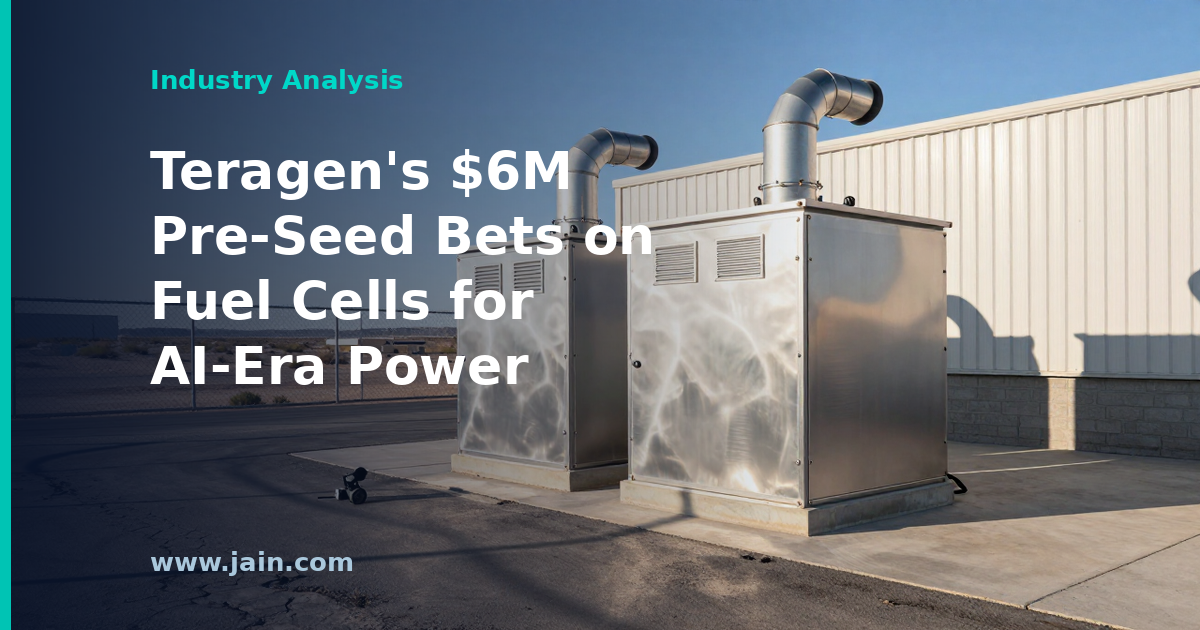
Teragen Energy, a Boston-based advanced fuel cell company, announced on August 26, 2026 that it has closed an oversubscribed $6 million pre-seed funding round. The round was co-led by BEVC and Energy Capital Ventures, with participation from AP Ventures, AIC Ventures, the Massachusetts Clean Energy Center (MassCEC) and UntroD Capital Asia.
The company builds modular onsite power systems for data centers, industrial sites and utilities using a solid oxide fuel cell architecture co-invented by chief executive Dr. Ruofan Wang at Berkeley Lab. The capital is earmarked to expand testing and manufacturing infrastructure, grow the engineering team, scale the core technology, and carry it from prototypes to first commercial pilot projects.
Executive Summary
A fuel cell is a device that converts fuel directly into electricity through an electrochemical reaction rather than by burning it to spin a turbine, which is why fuel cells can be quieter, cleaner at the point of use, and more efficient than combustion for the same fuel. A solid oxide fuel cell — the class Teragen is working in — runs hot and can accept several different fuels, which is the property the company describes as “fuel-flexible.” Teragen says its architecture also produces near-zero local pollutants and can optionally be configured for energy storage or carbon capture.
The reason a $6 million pre-seed round in this category is worth an industry reader’s attention has little to do with the dollar figure, which is small by infrastructure standards and normal by venture standards. It matters because of what the buyer side now looks like. Utility interconnection — the permission and physical connection required to draw large loads from the public grid — has become the binding constraint on new data center capacity in many markets. Operators that cannot secure an interconnect on a schedule that matches their AI deployment plans are increasingly willing to fund generation on their own site.
That shift turns behind-the-meter power from a facilities line item into a venture-backed product category. The investor syndicate here reflects it: a clean-energy state agency, a natural-gas-oriented fund, a materials-and-hydrogen specialist, and an Asia-based investor all underwriting the same early-stage hardware bet. What the release does not provide is the evidence layer — no efficiency figures, no module ratings, no named pilot customer and no pilot date.
The Interconnect Queue Is the Real Product Market
For most of the past two decades, an onsite generator at a data center was insurance. It existed to bridge the seconds and hours between a utility outage and its restoration, and its economics were judged as an insurance premium: what does it cost to never lose the load? The grid was the primary source, and nobody wrote a venture check against backup diesel.
AI training and inference capacity has inverted that logic in specific markets. When the constraint is not the price of power but the availability of a connection on a workable schedule, onsite generation stops being insurance and becomes the primary supply for some portion of the facility. That is a materially different purchase. It has to run continuously rather than a few dozen hours a year, it has to clear local air-permitting for continuous operation rather than emergency operation, and its fuel cost becomes a line in the operating model rather than a rounding error.
Teragen’s framing points directly at that market. The release argues that existing onsite options carry “high costs, high emissions, large footprints, and limited flexibility” — a fair description of why continuous-duty reciprocating engines and turbines are an awkward fit for a dense urban or suburban data center campus. Whether Teragen’s architecture actually clears those four hurdles simultaneously is exactly what a pilot is supposed to demonstrate, and the pilots have not happened yet.
What $6 Million Buys, and What It Does Not
Pre-seed is the earliest institutional stage of venture funding, typically covering the work required to prove that a technology can leave the lab. Teragen’s stated use of proceeds is consistent with that: testing and manufacturing infrastructure, engineering headcount, scale-up of the core technology, and commercialization work with partners. Those are the right things to spend early money on.
The gap between that and a data center power contract is wide, and it is worth being explicit about it rather than letting the AI-demand narrative paper over it. Power hardware sold into critical facilities is bought on demonstrated reliability over years, not on architecture claims. Buyers ask for run-hour data, degradation curves, service networks, spare-parts logistics and a balance sheet that will still exist when a warranty is called. Solid oxide systems in particular have historically had to prove out stack lifetime and thermal cycling behavior — the wear that comes from running very hot and from starting and stopping. None of that is a criticism of Teragen; it is the standard gauntlet, and $6 million is the ticket to enter it, not to finish it.
The practical read for a data center buyer is therefore patience. A pre-seed announcement is a signal about where capital and talent are moving, not a procurement option. The nearer-term relevance is to developers and investors mapping which onsite-power approaches might be commercially available in the second half of this decade.
The Syndicate Tells You What the Bet Actually Is
Investor composition in a hardware round is usually more informative than the headline number. Energy Capital Ventures’ managing general partner, Victor Pascucci III, framed the investment squarely around natural gas, describing that industry as “the backbone of the energy expansion” and calling for “more modular and scalable technology.” AP Ventures is known in the industry for hydrogen and platinum-group-metals-adjacent investing. MassCEC is a Massachusetts state clean-energy agency, which ties some of the value here to in-state development. UntroD Capital Asia brings a non-U.S. vantage point.
Read together, that syndicate is underwriting fuel flexibility itself as the asset — a machine that can run on today’s abundant gas infrastructure and, in principle, on cleaner fuels later, without replacing the installed base. That is a coherent thesis, and it is also where the environmental claims need careful parsing. The release says the technology produces “near-zero local pollutants,” which refers to things like nitrogen oxides and particulates that affect air quality around the site. That is a genuine and meaningful advantage over combustion. It is not the same as being carbon-free: burning or electrochemically converting natural gas still yields carbon dioxide, and the release describes carbon capture as an optional configuration rather than a standard one.
An even-handed summary, then: Teragen is credibly positioned as a cleaner and more flexible alternative to onsite combustion, and the release does not claim otherwise. Readers should simply avoid collapsing “near-zero local pollutants” into “zero emissions,” because those are different measurements answering different questions.
Claims Made Versus Claims Substantiated
The release asserts a “path to best-in-class cost, efficiency, power density, and responsiveness.” The word doing the work in that sentence is “path.” No efficiency percentage, module power rating, capital cost per kilowatt, or ramp-rate figure appears anywhere in the announcement. That is normal for a pre-seed company protecting its position, and it is also the reason the claim cannot yet be evaluated on its merits by anyone outside the company.
The credential that carries the most independent weight is the Berkeley Lab origin. National-laboratory co-invention means the underlying architecture went through a research environment with peer review and technology-transfer processes attached — a meaningfully higher bar than a claim asserted in a press release alone. It does not, by itself, establish manufacturability or cost at scale, which is the failure mode that has claimed a long list of promising energy hardware over the years.
For competitors, the strategic signal is straightforward. Solid oxide fuel cells already have a commercial incumbent presence in the data center market, most visibly through Bloom Energy, and gas turbine manufacturers are actively selling into the same shortage. A well-funded newcomer with a laboratory pedigree does not disturb that in the near term, but it does confirm that investors see room for a next architecture rather than treating the category as settled.
Background
Fuel cells have been commercially deployed at data centers and industrial sites for years, most visibly through solid oxide systems sold as primary or supplemental onsite power. Their appeal has always been the same: converting fuel to electricity electrochemically avoids the noise, local air pollution and efficiency losses of combustion, and modular units can be added incrementally as load grows. The persistent obstacles have been capital cost per kilowatt, the operating lifetime of the cell stacks, and the service infrastructure needed to support machines running continuously in mission-critical facilities.
What changed recently is demand. The buildout of AI compute has pushed electricity requirements for new data center campuses well beyond what many local grids can connect quickly, making the interconnection queue — the waiting line for permission and physical connection to the public grid — a gating factor on project schedules. That has reopened onsite generation as a primary supply strategy rather than a backup one, and pulled venture capital, state clean-energy agencies and gas-industry investors into the same early-stage deals. Teragen Energy, founded on Berkeley Lab research and based in Boston, is one of the companies formed against that backdrop.
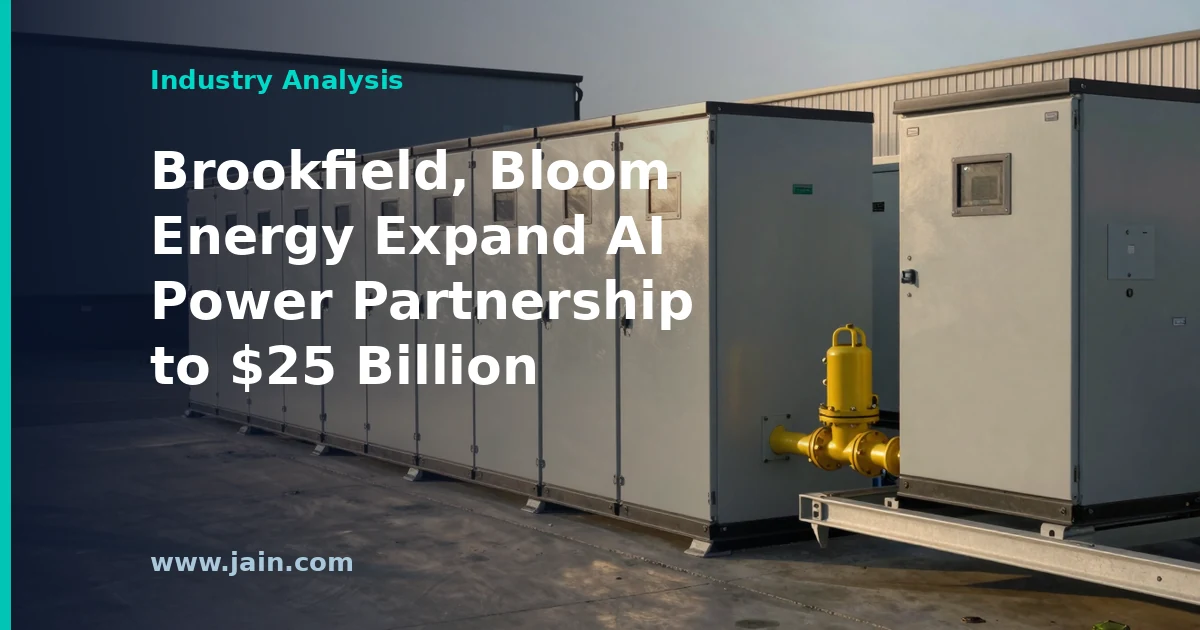
Brookfield and Bloom Energy announced on June 29, 2026 that they are expanding their AI infrastructure partnership to $25 billion — a fivefold increase over the original framework — to build and finance rapid power deployment for AI data centers. The expanded arrangement pairs Bloom’s solid oxide fuel-cell technology with Brookfield’s infrastructure capital.
Executive Summary
Bloom Energy, the fuel-cell manufacturer, and Brookfield, one of the world’s largest infrastructure investors, have scaled their partnership from an original framework — implied by the announcement’s “fivefold” language to have been on the order of $5 billion — to $25 billion. The stated purpose is to build and finance “rapid power” for AI infrastructure: on-site electricity generation that can be deployed faster than utility grid connections.
The announcement matters because electricity availability, not chips or land, has become the binding constraint on AI data-center construction. A $25 billion commitment of this shape signals that major infrastructure capital now treats on-site fuel-cell generation as a bankable asset class rather than a niche backup option. That said, the release as reported gives a headline dollar figure without megawatt targets, named customers, or deployment timelines — so the scale of actual near-term power delivery remains to be demonstrated.
Why Fuel Cells Are Jumping the Grid Queue
The core problem this partnership targets is speed. In many major data-center markets, a new facility requesting a large grid connection can wait years for utilities to build the transmission and generation needed to serve it — a delay measured in lost AI product cycles. On-site generation sidesteps that queue. Bloom’s solid oxide fuel cells convert fuel, typically natural gas, into electricity through an electrochemical reaction rather than combustion, and they arrive as factory-built modules that can be installed in months rather than the multi-year timelines of large power plants or grid upgrades.
That “speed-to-power” pitch has become the dominant selling point across the AI power market — gas turbines, batteries, and behind-the-meter deals all compete on the same axis. Fuel cells’ specific claim is modularity and siting flexibility: they are quiet, produce no combustion emissions like NOx at the point of generation, and can be permitted in places where a turbine plant could not. The trade-off is cost per megawatt-hour and dependence on fuel supply, which is why financing structure matters as much as technology.
The Capital Stack Behind the Megawatts
The division of labor is the interesting part. Bloom manufactures and services the equipment; Brookfield brings the balance sheet. In a typical arrangement of this kind, the infrastructure investor owns the generating assets and sells power or capacity to data-center operators under long-term contracts, so the data-center customer avoids a large upfront capital outlay. For Bloom, a deep-pocketed financing partner converts its technology into an offering that can compete for hyperscale-sized deals it could never finance from its own balance sheet.
For Brookfield, fuel-cell fleets serving AI campuses look like classic infrastructure: long-lived assets, contracted revenue, and a customer base — AI compute operators — currently willing to pay a premium for firm power delivered quickly. Growing the framework fivefold within roughly a year of the original announcement suggests the partners believe demand from AI builders exceeds what the initial commitment could serve. It is a strong demand signal, though announced frameworks and deployed megawatts are different things.
What a Fivefold Scale-Up Signals — and What It Doesn’t
A $25 billion figure invites careful reading. Partnership frameworks of this kind typically describe a ceiling — capital the partners intend to deploy if projects materialize — rather than contracted orders. The announcement as reported does not specify how much is committed versus targeted, how much power it represents, or over what period. Until customer contracts and megawatt figures are disclosed, the number is best understood as a statement of ambition backed by a credible financier, not a backlog.
Competitively, the deal sharpens the contest to power AI. Utilities and grid operators risk losing their largest new customers to behind-the-meter generation; gas-turbine suppliers, battery vendors, and small modular reactor developers are chasing the same load. For data-center operators, more credible power options mean more negotiating leverage — and for the industry’s critics, more scrutiny of what fuels that power. Fuel cells running on natural gas still emit carbon dioxide, so the climate profile of this buildout will depend on fuel sourcing choices the announcement does not detail.
Background
Bloom Energy, founded in 2001 and headquartered in California, went public in 2018 and built its business selling solid oxide fuel-cell “Energy Servers” to commercial, industrial, and utility customers seeking reliable on-site power. Brookfield is a global asset manager with hundreds of billions of dollars across infrastructure, renewable power, and real estate, and has been among the most aggressive institutional investors in AI-related infrastructure. The two first announced an AI-focused partnership in late 2025, part of a wider industry wave in which data-center developers turned to behind-the-meter generation — fuel cells, gas turbines, and eventually nuclear — as utility interconnection queues stretched to multiple years in key markets.
Research firm Rystad Energy projects that investment in fuel cells by data-center operators will grow roughly tenfold, reaching $30 billion by 2030, according to a report published June 26, 2026. The forecast points to on-site power generation moving from a niche backup strategy to a mainstream way of energizing new data-center capacity as connections to the electric grid grow slower and harder to secure.
Executive Summary
Rystad Energy, a Norway-based energy research and intelligence firm, has put a headline number on a trend the data-center industry has been living with for several years: when the grid cannot deliver power on the timeline a project needs, operators increasingly buy their own generation. Its new forecast calls for data-center fuel cell investment to grow tenfold by 2030, reaching $30 billion — a figure that implies today’s spending is on the order of a few billion dollars a year.
Fuel cells convert a fuel — most commonly natural gas today, potentially hydrogen in the future — directly into electricity through an electrochemical reaction rather than combustion. That gives them attractive properties for data centers: they can be deployed in modular blocks at the site, run continuously as primary power rather than just backup, and generally face lighter air-permitting burdens than combustion turbines or diesel generators. A tenfold growth call, if it materializes, would make fuel cells one of the fastest-growing categories of behind-the-meter power — generation installed on the customer’s side of the utility connection — in the broader AI-infrastructure buildout.
The Grid Queue Is the Real Story
The most important context for this forecast is not the fuel cell itself but the waiting line in front of it. In many major data-center markets, utilities and grid operators have quoted multi-year waits for large new interconnections — the formal process of hooking a big load up to the transmission system. For an AI data center whose revenue depends on being energized quickly, a delay of several years is often more costly than paying a premium for on-site generation. That inversion of economics — time-to-power mattering more than cost-per-megawatt-hour — is what turns a niche technology into a $30 billion market forecast.
Fuel cells are one of several answers to that problem, alongside gas turbines, reciprocating engines, and eventually small modular nuclear reactors. Their particular appeal is speed and siting flexibility: modular units can be added in increments as a campus grows, they operate quietly with no combustion exhaust plume, and in many jurisdictions they clear environmental permitting faster than combustion alternatives. For operators, that can compress the gap between breaking ground and serving customers.
What Tenfold Growth Would Actually Require
Growing an equipment market tenfold in roughly four years is not just a demand question — it is a manufacturing and supply-chain question. Fuel cell systems depend on specialized components and materials, and stepping up output by an order of magnitude means new factory capacity, expanded supplier networks, and trained installation and service workforces. The release headline does not indicate whether Rystad’s forecast is constrained by manufacturing capacity or is a pure demand-side projection, and that distinction matters a great deal for whether the number is achievable.
The fuel supply side deserves equal scrutiny. Most commercially deployed data-center fuel cells today run on natural gas, which means large deployments need pipeline capacity and gas contracts — their own version of an interconnection queue. Operators are effectively trading one infrastructure dependency for another. That trade often still makes sense, because gas infrastructure can frequently be expanded faster than high-voltage transmission, but it is not a free pass around the physical world.
Winners, Losers, and the Emissions Question
If the forecast is directionally right, the clearest beneficiaries are fuel cell manufacturers and the developers who package on-site generation into ready-to-run power solutions for data centers, along with gas utilities that supply the fuel. Traditional electric utilities face a more nuanced picture: behind-the-meter generation can relieve pressure on constrained grids, but it also diverts what would have been decades of steady load growth — and the revenue that comes with it — away from the regulated system.
The environmental ledger is genuinely mixed and worth stating plainly. Natural gas fuel cells emit carbon dioxide, though generally with higher electrical efficiency and far lower local air pollutants than combustion generation. Advocates point to a future switch to hydrogen as a path to low-carbon operation; skeptics note that low-carbon hydrogen remains scarce and expensive. Buyers and communities evaluating these projects should ask which fuel is actually contracted today, not which fuel is possible in principle.
A Forecast Is a Scenario, Not a Commitment
It is worth being clear about what a research-firm projection is: a modeled scenario built on assumptions about data-center demand, grid-connection timelines, technology costs, and competing options. Rystad is a well-established energy intelligence firm, but the headline figure arrives without published methodology in the source at hand. If AI capacity growth slows, if utilities accelerate interconnections, or if gas turbine supply loosens, the fuel cell number could land well short of $30 billion. Conversely, if grid queues lengthen further, it could prove conservative. The forecast is best read as a signal about the direction and seriousness of the on-site power trend, not as a precise measurement of the future.
Background
Data-center electricity demand has surged with the AI buildout, and in several major markets the ability to get grid power — not land or capital — has become the binding constraint on new capacity. That has pushed operators toward on-site generation of many kinds, from gas turbines to fuel cells, and made “time to power” a core competitive metric. Fuel cells entered the data-center world primarily as clean backup and supplemental power, with a small number of vendors building a commercial track record over the past decade; the shift Rystad describes is their promotion to primary, at-scale power for new facilities.
Rystad Energy, founded in Oslo in 2004, built its reputation on oil and gas market intelligence and has since expanded into power, renewables, and energy-transition research, making it one of the more frequently cited independent forecasters in the energy sector.
Bloom Energy has published a report arguing that continued expansion of AI data centers depends on operators addressing two intertwined constraints in parallel: electricity supply and local community acceptance. The report, released in June 2026, frames the two issues as inseparable rather than sequential.
Executive Summary
The fuel-cell maker’s central thesis is that the AI buildout cannot be solved by megawatts alone. Even where generation, transmission, or on-site power can be procured, projects increasingly stall on zoning, noise, water, and land-use objections from neighbors and municipalities. Conversely, community outreach without a credible power plan is equally insufficient.
For an industry accustomed to treating power and permitting as separate workstreams, the framing is a nudge toward integrated planning. It also, unsurprisingly, positions Bloom’s distributed on-site generation product as a natural fit for that integrated approach — a commercial interest readers should weigh alongside the analysis.
Why ‘Power And Community’ Is The Real Bottleneck
For most of the cloud era, data center siting followed a familiar recipe: cheap land, fiber, tax incentives, and a utility willing to sign an interconnect. AI workloads have broken that recipe. A single hyperscale AI campus can now request hundreds of megawatts — comparable to a small city — on timelines that outpace utility planning cycles measured in years. Bloom’s report reframes this as a two-variable problem: neither raw generation nor social license alone is sufficient, and progress on one without the other tends to collapse the project.
That framing matters because the industry has historically optimized for the technical variable and treated community relations as public affairs. When a substation upgrade takes five years and a rezoning fight can add two more, the bottleneck is whichever constraint binds first — and increasingly, both bind simultaneously.
Winners, Losers, And The Distributed-Generation Pitch
The report’s logic favors technologies that can be sited close to load, deployed quickly, and configured to reduce visible community impact — a description that fits Bloom’s solid-oxide fuel cells, but also natural-gas peakers, on-site solar-plus-storage, and eventually small modular reactors. Utilities that can offer flexible, phased interconnection may win share from those that cannot. Operators willing to co-locate generation with compute gain optionality against constrained grids.
The losers, if the thesis holds, are projects that assume grid capacity will materialize on hyperscaler timelines, and jurisdictions that treat every large load as a windfall without offering a permitting path. It is worth noting that the report comes from a vendor whose products directly address the problem it describes; that does not make the diagnosis wrong, but readers should treat the prescription as one option among several.
Community Concerns Are Not A Communications Problem
The more substantive point in the report — to the extent the summary conveys it — is that community opposition is being driven by material impacts: water use for cooling, diesel backup emissions, noise from chillers and generators, truck traffic during construction, and property-value anxieties. These are engineering and siting questions, not messaging questions. Treating them as PR problems has, in several high-profile cases, hardened opposition rather than defused it.
For buyers and investors, the implication is that due diligence on new capacity should include the permitting posture and neighbor relations of a site, not just its power and fiber. A campus with signed interconnects but an organized opposition can be as delayed as one with willing neighbors and no transformer.
Background
Bloom Energy, founded in 2001 and headquartered in San Jose, makes solid-oxide fuel cells that generate electricity on-site from natural gas, biogas, or hydrogen. Its customers include large enterprises and, increasingly, data center operators seeking alternatives to constrained grid interconnection.
The wider context is a global surge in AI training and inference demand that has pushed data center power requests to levels utilities did not plan for. In the United States in particular, several regions have seen multi-year queues for large interconnects, prompting operators to explore on-site and behind-the-meter generation, direct utility partnerships, and, in some cases, relocation to more permissive jurisdictions.
Nebius, the AI infrastructure company spun out of the former Yandex, has agreed to deploy up to 328 megawatts of Bloom Energy solid-oxide fuel cells to power its U.S. AI data center expansion, according to a report published May 24, 2026.
The arrangement positions on-site fuel cells as a bridge power source while Nebius scales GPU capacity in a market where utility interconnection timelines routinely stretch to five years or more.
Executive Summary
The 328 MW figure is significant. It is roughly the electrical draw of a mid-sized hyperscale campus, and it lands at a moment when AI-driven compute demand is outrunning the pace at which U.S. utilities can deliver new substations and transmission upgrades. By procuring behind-the-meter generation, Nebius is buying schedule certainty — trading potentially higher lifetime energy costs for the ability to energize racks on its own timetable.
For Bloom Energy, a Nebius commitment at this scale reinforces a thesis the company has pitched to Wall Street for two years: that fuel cells, historically a niche resiliency product, have found a mainstream buyer in AI. The deal also plants a flag for gas-fueled distributed generation in a segment often assumed to be dominated by renewables and long-duration storage.
Nebius is a watchlist name for infrastructure investors precisely because it is trying to establish itself as a Western pure-play AI cloud without the balance sheet of a hyperscaler. Power procurement is one of the clearest tests of whether that plan can scale.
Why Fuel Cells, Why Now
Solid-oxide fuel cells convert natural gas — or, in principle, hydrogen or biogas — into electricity through an electrochemical reaction rather than combustion. That makes them quieter than reciprocating engines, cleaner than diesel generators on criteria pollutants, and, crucially, deployable in modular blocks over months rather than the years it takes to build a substation. For an AI operator racing to install GPUs before the next model generation renders current capacity uncompetitive, that speed premium can justify a higher levelized cost of energy.
The economics still depend on assumptions the release does not spell out: gas prices at the delivery site, capacity factor, whether the fuel cells serve as primary power or bridge to a future grid tie, and how carbon is accounted for. Fuel cells emit CO2 when fed pipeline gas, even if they avoid the NOx penalties of engines. That matters for customers with science-based targets and for regulators in states tightening data center emissions rules.
The Nebius Growth Story Gets Its Power Test
Nebius has positioned itself as a neocloud — a category of GPU-first infrastructure providers, including CoreWeave and Crusoe, competing to rent Nvidia capacity to model developers and enterprises. The market rewards these names for signed capacity and rewards them further for capacity that is actually energized and generating revenue. Announcements of GPU orders without a credible power path have grown less impressive to investors over the past year.
A 328 MW behind-the-meter arrangement addresses that skepticism directly. It does not, however, resolve questions about financing structure, siting, or whether the megawatts are contracted, optioned, or contingent on further milestones. Investors will want to see how the commitment is reflected in Nebius’s capex guidance and whether Bloom is a supplier, a project partner, or both.
Winners, Losers, And The Grid Question
The clearest short-term winner is Bloom Energy, which converts a marquee AI reference into a validation point for future data center pursuits. Gas producers and midstream operators benefit indirectly if the pattern spreads. Utilities are more ambiguous: they lose a large potential load in the near term, but they also lose the political burden of finding transmission capacity for it.
The loser, if any, is the tidy narrative that AI infrastructure will be powered predominantly by new renewables plus storage. On-site gas generation is expedient, and expedient often wins when demand is measured in quarters. The counter-argument — that fuel cells can eventually run on hydrogen or biogas — is technically valid but depends on fuel supply chains that do not yet exist at scale.
Background
Nebius is one of a handful of pure-play AI infrastructure companies competing with hyperscalers to lease Nvidia GPU capacity to model developers. Its scale ambitions in the United States hinge on securing power quickly in a market where utility interconnection timelines have become the binding constraint on data center growth.
Bloom Energy has sold solid-oxide fuel cells for more than a decade, initially as resiliency and prime-power equipment for enterprises and utilities. Over the past two years the company has repositioned as a data center power supplier, arguing that its modular systems can be deployed years faster than new grid capacity.