
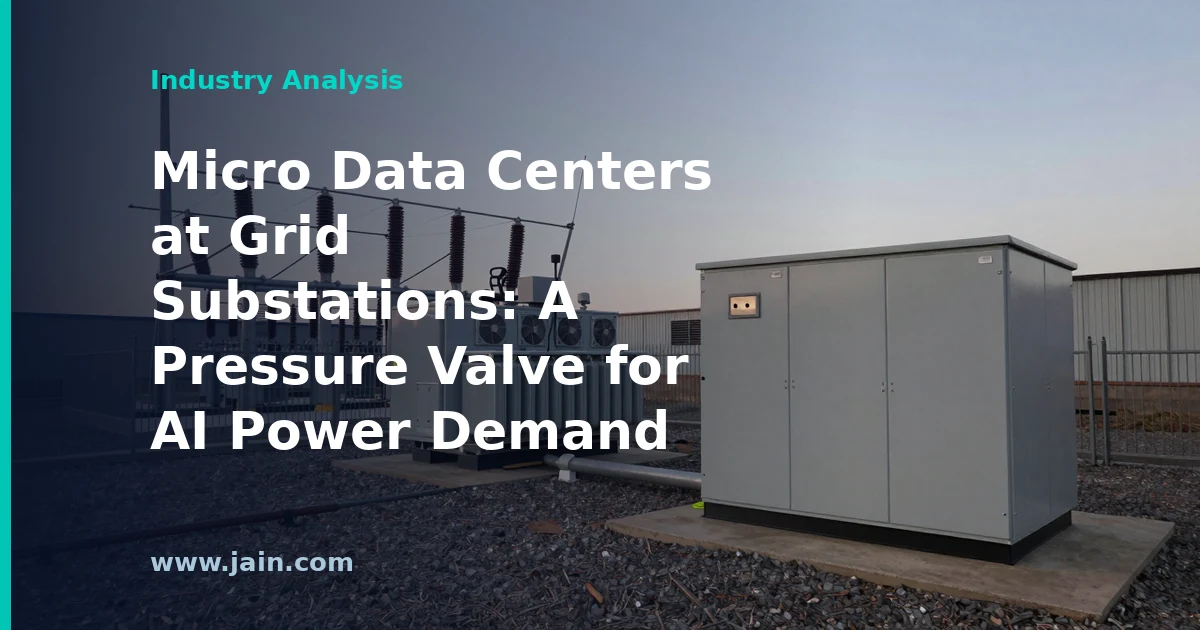
IEEE Spectrum reported on May 13, 2026 on an emerging infrastructure concept: placing small, modular data centers directly at electric-grid substations as a way to keep surging AI power usage in check. Rather than concentrating hundreds of megawatts of computing at a single campus and forcing utilities to build new transmission to serve it, the approach distributes compute in small increments at points where the grid already has capacity, interconnection equipment, and land.
Executive Summary
The idea IEEE Spectrum describes inverts the dominant pattern of the AI buildout. Instead of asking the grid to come to the data center — often a multi-year, multi-billion-dollar transmission and generation exercise — micro data centers go to the grid, occupying the underused margins of existing substations. A substation is the node where high-voltage transmission is stepped down for local distribution; many have spare transformer capacity for part of the day or year, plus fenced land and existing utility interconnection.
Why it matters: interconnection queues and transmission constraints, not chips, have become the binding constraint on AI capacity growth in many U.S. markets. Any credible mechanism that adds compute without triggering new large-load interconnection studies deserves attention from utilities, hyperscalers, and colocation operators alike. The open question — which the source coverage frames but cannot yet settle — is whether compute measured in hundreds of kilowatts to a few megawatts per site can meaningfully offset demand measured in gigawatts.
Why the Substation Is Suddenly Prime Real Estate
The scarce resource in the AI era is not land or servers — it is grid interconnection. Large data center campuses in major markets face waits that can stretch for years while utilities study whether the transmission system can absorb a new load of 100 MW or more. A substation-sited micro facility sidesteps much of that: the interconnection already exists, the utility already owns and monitors the site, and the incremental load can be sized to fit whatever headroom the local transformer bank actually has.
There is also a load-shaping logic. Substation loading varies by hour and season; a data center that can throttle or shift its work — as some AI training and batch-inference workloads can — could soak up capacity when the neighborhood demand is low and back off at peak. In that framing, the micro data center is less a tenant than a grid instrument: a flexible load that improves utilization of assets ratepayers have already paid for.
The Economics Cut Both Ways
Distributing compute forfeits the economies of scale that made the hyperscale model dominant. A 200 MW campus amortizes security, staffing, cooling plant, and network backbone across a vast footprint; a 1 MW pod at a substation must be nearly autonomous — remotely operated, prefabricated, and cheap to service — or its cost per kilowatt will not compete. The viability of the model rests heavily on modular manufacturing driving unit costs down, something the industry has promised for a decade with mixed results.
On the revenue side, however, distributed sites have an asset central campuses lack: proximity. Inference — the serving of trained AI models to users — benefits from being near population centers, and substations are by definition embedded where people and businesses are. If AI demand shifts from training-dominated to inference-dominated, as most industry roadmaps assume, the value of many small, close-in sites rises relative to a few remote giants.
Utilities as Gatekeepers — and Potential Partners
Nothing in this model works without the utility, which controls the substation, the interconnection, and the tariff. That is both the model’s strength and its fragility. Utilities gain a new class of revenue-generating, potentially flexible load and a better story for regulators worried about data centers driving up residential rates. But utilities are conservative by design and by regulation: hosting third-party commercial equipment inside the substation fence raises questions of liability, security, union work rules, and whether ratepayer-funded assets can be leveraged for private gain.
Expect the regulatory treatment to vary sharply by state and by whether the market is vertically integrated or restructured. Pilots with a single cooperative or municipal utility are one thing; scaling across investor-owned utilities under public-utility-commission oversight is a much longer road, and the source coverage does not indicate that road has been mapped.
A Complement, Not a Substitute
It is worth being precise about scale. AI’s incremental power demand is commonly discussed in gigawatts per year in the U.S. alone; substation-sited pods of a megawatt or less would need to be deployed by the thousands to absorb even a modest share. That does not make the idea a gimmick — grid-edge flexibility has outsized value precisely at the margins where systems break — but it does mean micro data centers are best understood as a pressure valve, as the framing suggests, rather than a replacement for large campuses, new generation, and transmission expansion. The realistic outcome is a layered market: hyperscale for training, regional colocation for enterprise, and grid-embedded micro sites for latency-sensitive inference and load balancing.
Background
The idea of the micro or edge data center predates the AI boom — telecoms and content networks have long placed small compute nodes near users — but it struggled commercially because most cloud workloads tolerated centralization. Two forces revived it: the AI buildout’s collision with grid interconnection queues, and the rise of latency-sensitive inference. By 2026, utilities, regulators, and hyperscalers were all publicly wrestling with how to add gigawatts of data center load without destabilizing rates or reliability, making grid-aware siting concepts — flexible loads, curtailable contracts, and now substation-sited compute — a mainstream topic of industry discussion rather than a fringe experiment.
Source: Tiny Data Centers at Substations Aim to Keep AI Power Usage In Check — IEEE Spectrum’s May 13, 2026 report on siting micro data centers at grid substations to ease AI-driven electricity demand.