Applied Digital, a Dallas company that builds the huge computer warehouses used to run artificial intelligence, has signed a deal for access to a large supply of electricity in Finland. It is the company’s first project outside the United States.
At full size, the site could use about as much power as one large nuclear reactor produces. But the first electricity is not expected until 2028, and no customer has signed yet.
The lesson is that in this business, the electricity gets locked up first. The buildings and the paying tenants come later, if they come at all.
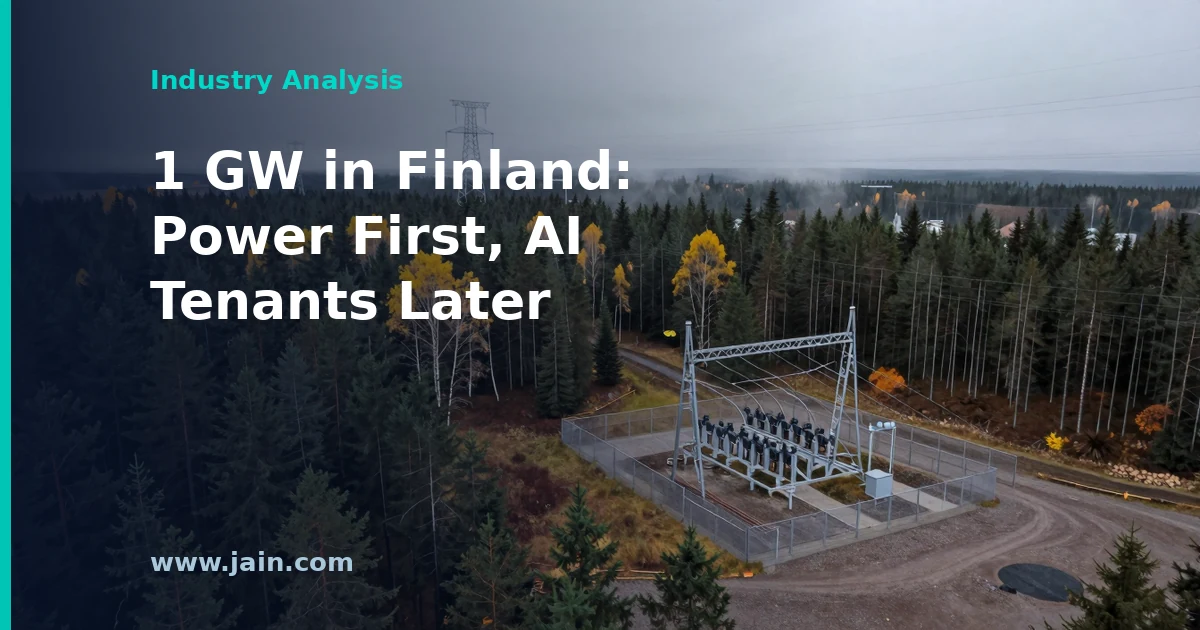
Applied Digital (Nasdaq: APLD) announced on October 6, 2026 that it has entered into an agreement providing access to up to 1 gigawatt (GW) of potential power capacity in Finland, its first development opportunity outside the United States. The company plans a large-scale “AI Factory” campus that could scale to as much as 1 GW, with initial power availability anticipated beginning in 2028.
Applied Digital said it has begun marketing the site and is in discussions with leading global hyperscale customers, the largest cloud and AI platform operators. It did not name the site’s location, the counterparty to the agreement, its financial terms or any prospective tenant.
Executive Summary
The Finland agreement gives Applied Digital a claim on a very large block of future electricity in a cool-climate market, the input that most constrains how fast AI data centers can be built. The company framed the deal as a measured first step abroad, structured to limit its initial exposure, with further investment contingent on customer demand, commercial milestones and regulatory approvals.
That framing matters as much as the headline number. “Up to 1 GW of potential” capacity, power from 2028 and an unsigned customer base describe an option rather than a project under construction. The announcement establishes where Applied Digital wants to grow next and how it intends to manage the risk; it does not yet establish how much capacity will actually be built, when, or for whom.
For industry readers, the deal is a test of whether a US developer’s site-selection model, built around abundant power and cold weather in North Dakota, transfers to the Nordics. For investors, it adds long-dated growth optionality while the company’s own guidance keeps near-term attention on its US pipeline.
What “Up to 1 GW of Potential” Actually Buys
Read closely, the release qualifies its headline figure at every step. The agreement provides access to “up to” 1 GW of “potential” power capacity; the campus is one “capable of scaling to as much as” 1 GW; and only “initial” power is anticipated, beginning in 2028. The company says future investment and development decisions will be tied to customer demand, commercial milestones and regulatory and development requirements, and that the deal was structured to limit initial exposure. Each of those statements points the same way: Applied Digital has secured the right to pursue a campus, not a commitment to build one at full scale.
That is a rational way to buy the scarcest input in AI infrastructure. A gigawatt is roughly the output of one large nuclear reactor, and AI campuses of this size are gated less by land or buildings than by how quickly a large, reliable grid connection can be delivered. Securing power years before a tenant signs lets a developer offer hyperscalers a dated path to capacity, which is the thing those customers are shopping for. The trade-off is that the value of the option depends on terms the company has not disclosed, including what it pays to hold the capacity and what happens if no tenant materialises.
The people most affected are prospective tenants, who gain another large-scale European option with a stated 2028 start, and shareholders, who should treat the 1 GW as a ceiling on what could be built rather than a measure of what has been contracted.
Why Finland Fits the North Dakota Playbook
Chief executive Wes Cummins tied the choice directly to the company’s US model: Finland “stood out because many of the characteristics that have supported our success in North Dakota are also present in the Nordics — a favorable climate, an attractive energy ecosystem, strong connectivity and the ability to develop at meaningful scale.” Each of those factors has an operational meaning. Cold ambient air reduces the energy spent removing heat from dense AI servers; a strong energy ecosystem determines whether large power blocks can be delivered; and fibre connectivity determines whether the site can serve customers beyond its immediate region.
The release presents this as continuity, not reinvention: securing scalable power and land where AI capacity can be developed “efficiently, responsibly and repeatedly.” That is a reasonable thesis, but it is a claim to be proven. Cummins said as much, describing Finland as the chance “to begin proving that platform can travel.” The company’s own risk disclosures in the release flag what could differ abroad, including sourcing materials and labour internationally and complying with regulations outside the US.
The 2028 Clock and the Hyperscaler Question
With initial power not expected until 2028, the commercial work happens now. Applied Digital says it has begun marketing the site and is in discussions with leading global hyperscale customers. Large AI campuses are typically financed around long-term leases with creditworthy tenants, so the timing and size of any signed lease will largely determine whether the Finland project moves from option to construction, and how quickly it scales beyond its first phase.
The release does not indicate how much of the 1 GW becomes available in 2028 versus later years. That phasing matters: a hyperscaler weighing the site will compare not just the headline ceiling but the megawatts deliverable in each year against competing sites. Until a tenant and a phasing schedule are disclosed, the near-term financial contribution of the Finland site should be treated as zero, consistent with the company’s own emphasis on its US projects.
Discipline as the Message
The release spends notable space reassuring investors. Cummins called the deal “a deliberate first step, not a change in our strategy,” and said scale “is not about planting flags in as many markets as possible.” That emphasis is consistent with the risk factors the company lists, which include its ability to raise additional capital for data center construction and to obtain financing for leases. Framing Finland as low-exposure optionality signals that the company does not intend to divert capital from US execution to fund it.
Whether that framing holds will depend on disclosures still to come: the cost of holding the capacity, any deposits or milestone payments, and how a Finnish build would be financed if a tenant signs.
Background
Applied Digital, founded in 2021 and headquartered in Dallas, designs, builds and operates large data centers for high-performance computing, including artificial intelligence, cloud, networking and blockchain workloads. The company markets closed-loop cooling, a system that recirculates coolant rather than continuously consuming water, along with rapid deployment, and describes its build model as an “AI Factory” franchise. Its US development has centred on North Dakota, which the company credits for traits it now seeks in Finland: cold weather, available energy and room to scale. Datacloud named it Best Data Center in the Americas for 2025.
Across the AI infrastructure market, developers increasingly compete to secure large blocks of electricity years ahead of construction, because access to reliable power at scale has become a principal constraint on how fast AI computing capacity can be added. The Nordics, which the company describes as an emerging European AI market, have drawn growing investment from global technology firms on the strength of their climate, energy and digital networks.
Google’s parent company is spending around 13 billion euros on data centers in Finland. These are warehouse-sized buildings packed with computers that run artificial intelligence.
Finland is cold, and that matters. For much of the year the outside air is enough to stop the machines overheating, so far less power goes to air conditioning. The country also has plenty of low-carbon electricity.
Investors are now guessing who gets paid. One small Finnish firm connects these sites to the power network. Two much larger American firms supply electricity and build hardware, but neither has said it does any work in Finland.
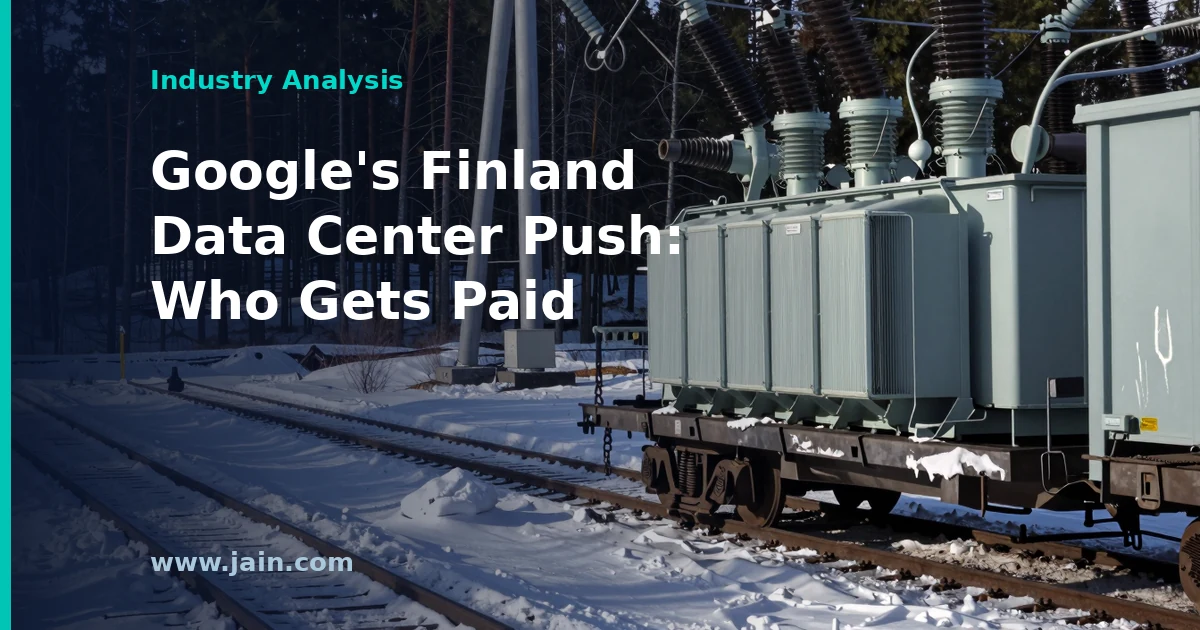
Simply Wall St reported on September 10, 2026 that an Alphabet-backed €13 billion push into Finnish AI data centers has turned a quiet corner of the Nordic market into a live test of how digital infrastructure and power providers absorb sudden, large-scale demand. The article named three stocks as the most directly exposed to the theme: US independent power producer Vistra, Finnish grid and connectivity contractor Enersense International Oyj, and contract manufacturer Flex. A screen behind the article surfaced 39 further companies tied to data center build-outs and grid upgrades.
The three names sit at very different points on the value chain and at very different sizes. Vistra carries a market capitalisation of about US$50.9 billion on roughly US$19.2 billion of revenue and supplies power and gas to around 5 million customers. Flex is valued at about US$42.2 billion and reports US$7.2 billion of revenue from Cloud and Power Infrastructure, US$11.6 billion from Integrated Technology Solutions and US$10.5 billion from Regulated Manufacturing Solutions. Enersense, the only one of the three actually operating in Finland, is worth about €71 million and books roughly €189 million of revenue there.
Executive Summary
The story is less about Google than about who converts a headline capital number into invoiced work. A €13 billion programme in Finland implies years of substations, transmission connections, transformers, switchgear, cooling plant and rack integration long before a single model is trained. The market’s instinct is to reach for liquid, well-known proxies. The names investors actually reach for are not always the ones standing next to the excavator.
Of the three stocks in focus, only Enersense has disclosed Finnish data center power work. It supplies power integration for atNorth’s 430 megawatt FIN04 site and works on projects for Finland’s national transmission operator. Vistra’s relevance is thematic and American: it signed 20-year power purchase agreements in January 2026 to supply Meta with more than 2,600 megawatts of nuclear electricity across three plants in the PJM grid region, described as the largest nuclear uprate ever underwritten by a single corporate customer. Flex’s relevance runs through hardware, and through its May 2026 plan to spin its Cloud and Power Infrastructure division into a separate listed company.
For infrastructure buyers, the signal worth taking is that the Nordic constraint has shifted. The scarce inputs are no longer cheap land and cold air, which Finland has always had. They are grid connection capacity, transformer lead times and the engineering firms qualified to do the interconnection work. That is where a small contractor with a €71 million market value becomes strategically interesting and financially fragile at the same time.
Why Finland Keeps Winning the Power-and-Cooling Argument
Finland’s advantage starts with physics. In a hot climate, a data center spends a large share of its electricity running mechanical chillers to remove the heat its servers produce. In a cold one, outside air does much of that work for free for most of the year, a technique the industry calls free cooling. The result shows up in power usage effectiveness, the ratio of total facility power to the power actually consumed by computing equipment. A lower ratio means less electricity wasted on overhead, and in the Nordics it is structurally lower than in Virginia, Texas or Singapore.
The second advantage is the grid itself. Finland’s electricity is heavily nuclear, hydro and wind, which suits hyperscalers with carbon-free energy commitments, and its industrial history left heavy transmission connections in places that once served paper mills and smelters. Fingrid, the national transmission system operator, is the gatekeeper for connecting large new loads, and interconnection work is exactly what Enersense sells. The atNorth FIN04 site, at 430 megawatts, is evidence that a genuine Finnish cluster is forming rather than a single anchor tenant.
There is a real limitation, and it is geographic. Finland is far from Europe’s population centres, which adds network latency, the delay between a user’s request and the response. That matters little for training large models, which is a batch process indifferent to a few extra milliseconds, and matters considerably more for latency-sensitive inference serving consumers. A Nordic strategy is therefore usually a training and heavy-compute strategy, with inference capacity placed closer to users. Investors reading a €13 billion figure as evenly distributed European capacity are reading it too generously.
One of These Three Actually Works in Finland
Enersense designs and builds grid connections, substations and storage, generating roughly €81 million from Connectivity and €63 million from Energy Transition. Set its €71 million market capitalisation against a €13 billion programme and the asymmetry is obvious: even a rounding error of that capital budget, landing as contract revenue, would be transformative. That asymmetry is precisely why such stocks move violently on thematic news, and why the move often runs ahead of any awarded work.
The harder question is capacity rather than opportunity. Large interconnection projects consume working capital before they generate cash, require performance bonding, and expose a contractor to fixed-price risk on materials with long and volatile lead times, transformers and high-voltage switchgear above all. A company of this size has limited balance sheet with which to absorb a cost overrun on a marquee project. The upside of being small in a big theme and the risk of being small in a big theme are the same fact viewed from two sides.
Vistra and Flex, by contrast, have no disclosed Finnish operations. The argument for including them is a demand argument rather than a geographic one: AI data center build-outs lift power producers and infrastructure manufacturers wherever they occur. That is a defensible thesis, but it is a different thesis from the headline. An investor buying Vistra on a Finland story is buying US merchant power exposure with a European narrative attached, and should price it accordingly.
The Power Trade Is Mostly a United States Trade
Vistra’s appeal to this theme rests on dispatchable generation, meaning plants that can be turned up or down on command rather than depending on wind or sun. Data centers need power that is available every hour, and the fleets capable of contracting that reliably for decades are few. The January 2026 agreements with Meta illustrate the model: more than 2,600 megawatts of nuclear output committed for 20 years across three plants in PJM, the market coordinating electricity across much of the US mid-Atlantic and Midwest. A nuclear uprate, in this context, means raising an existing reactor’s output rather than building a new one, which is faster and cheaper than greenfield construction.
The revenue mix repays a closer look. Retail contributes about US$14.9 billion and Texas roughly US$7.8 billion against US$19.2 billion of total revenue, which is normal segment reporting where internal sales are eliminated at the group level, but it is a reminder that Vistra is substantially a retail energy business with a generation fleet attached, not a pure merchant generator. The AI narrative attaches to one part of the enterprise, not all of it.
The central risk is duration. Twenty-year contracts convert a commodity business into something resembling an infrastructure annuity, and the market has increasingly valued it that way. That re-rating rests on assumptions about long-term data center load growth and contracted pricing holding. If load growth arrives slower than forecast, or if new supply and grid upgrades compress scarcity pricing, the earnings power implied by today’s valuation becomes harder to defend. Long contracts protect the volumes already signed. They do not protect the multiple applied to everything not yet signed.
Flex, the Spin-Off, and the Appetite for Pure Plays
Flex builds the unglamorous physical layer: power distribution, cooling systems and rack integration that sit behind hyperscale spending. Its Cloud and Power Infrastructure division generates US$7.2 billion, roughly a quarter of the approximately US$29.3 billion across its three reported segments. The May 2026 plan to separate that division into an independent public company is the clearest structural response yet to a valuation problem facing every diversified manufacturer with an AI-exposed unit.
The logic is straightforward. Investors will pay a higher multiple for a focused data center infrastructure supplier than for a conglomerate that also makes automotive and healthcare hardware, and separation surfaces that value rather than averaging it away. Public markets have limited direct ways to own the power and cooling hardware layer, so a listed pure play should find willing buyers.
The trade-off is that concentration removes the cushion. A standalone data center infrastructure business carries the full weight of hyperscaler capital expenditure cycles, customer concentration among a small number of very large buyers, and the working capital intensity of ramping production against lumpy orders. The remaining business loses its highest-growth story and must be valued on its own merits. Both halves face a market test that the combined company never had to sit.
Background
Finland has attracted large-scale computing for well over a decade. Google has run a data center campus at Hamina, on the southern coast, since converting a former paper mill site there, and the country has since drawn a wider cluster of operators including atNorth. The appeal has been consistent: a cold climate that reduces cooling load, a largely nuclear, hydro and wind electricity mix, and industrial sites already served by heavy transmission infrastructure. Fingrid operates the national transmission grid and controls the connection process for very large new loads, which makes interconnection engineering a bottleneck resource rather than a commodity service.
The companies now attached to the theme come from three different traditions. Enersense is a Finnish engineering and contracting business that grew out of energy and telecom infrastructure work and now sits at the junction of grid upgrades, storage and data center power connections. Vistra emerged from the restructuring of the Texas utility sector into one of the largest US independent power producers and retail energy suppliers, and has spent the past two years converting nuclear and gas capacity into long-dated corporate contracts. Flex is a decades-old contract manufacturer that built its business assembling hardware for others and has recently found its power and cooling systems unit growing faster than the rest of the group.
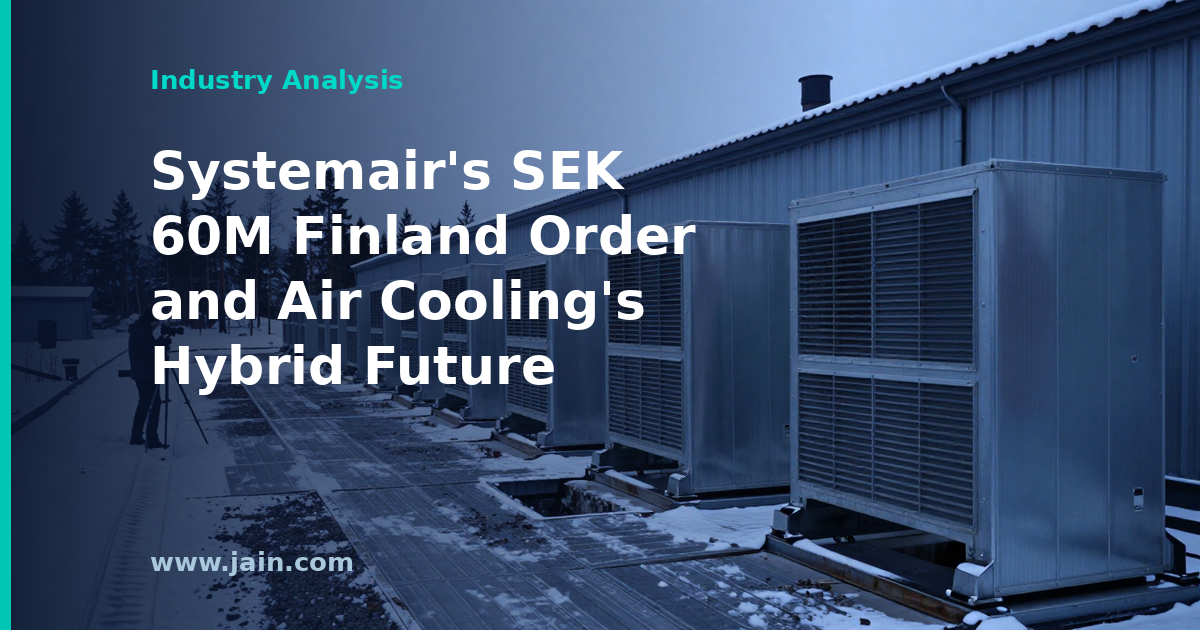
Swedish ventilation manufacturer Systemair AB (NASDAQ Stockholm: SYSR) said on 27 August 2026 that it has received an order for air-based data centre cooling solutions worth approximately SEK 60 million (EUR 5.4 million). The order is for a new data centre in Finland, and deliveries are scheduled to begin at the start of 2027.
The scope comprises Geniox Tera Fanwall units — modular air-handling assemblies with integrated controls and sensors — which will be produced at Systemair’s facility in Turkey. The Finnish site will recover waste heat from the cooling units and feed it into the local district heating network. Systemair announced the order the same day it published its Q1 2026/27 interim report.
Executive Summary
On its face this is a routine equipment win: a mid-cap European manufacturer books a single order equal to roughly half a percent of its SEK 12.5 billion in annual sales. What makes it worth reading closely is the technology choice and the geography. In a market narrative dominated by direct-to-chip liquid cooling for AI accelerators, a hyperscale-grade Finnish facility is still buying a substantial package of air handling capacity — and buying it a year or more before the building is expected to carry load.
Systemair’s CEO, Robert Larsson, framed the demand explicitly in AI terms: “Mission-critical hyperscale data centres require cooling solutions that combine high energy efficiency with exceptional reliability – and we are seeing a growing demand for energy-efficient data centre cooling as AI-related investments continue to expand.” That is a vendor’s characterisation of its own order book rather than an independently verified market statistic, but it is consistent with what the order itself shows: air-side equipment is being specified into the same buildings that host dense compute.
The second detail that matters is heat reuse. The Finnish site will export recovered heat into district heating. That turns a waste stream into a local utility input and, in Nordic markets, into part of the permitting and community-relations case for building at all. For buyers and investors, the practical takeaway is that thermal equipment orders — which are placed early, are hard to fake, and are denominated in real currency — are one of the cleaner leading indicators available for where AI-era capacity is genuinely being built.
Air Cooling Is Not Being Retired — It Is Being Reassigned
The dominant story of the past two years has been liquid: cold plates bolted directly to accelerators, rear-door heat exchangers, and immersion tanks, all pitched as the only way to handle rack densities that air physically cannot. That physics is real. What it does not mean is that air handling leaves the building. Liquid loops remove heat from the chips; they do not condition the room, they do not handle the substantial share of IT load that remains air-cooled, and they do not manage the electrical rooms, battery rooms, and support spaces that sit alongside the white space. A facility running direct-to-chip liquid on its densest halls still needs a competent air-side system — often a smaller one per megawatt of IT, but not a token one.
That is the reading this order supports. Fanwall units — arrays of multiple smaller fans working in parallel behind a common wall, rather than one large fan — are a design choice about redundancy and part-load efficiency as much as raw capacity. If one fan fails, the array degrades rather than stops, and at low load the array can run fewer fans closer to their efficient operating point. Systemair describes the Geniox Tera Fanwall line as flexible, compact and modular with integrated controls and sensors. Those are the attributes an operator specifies when it expects the load profile to change over the life of the building — which is precisely the situation of anyone commissioning a hall in 2027 without knowing what silicon will occupy it in 2030.
The honest framing, then, is hybrid rather than replacement. The competitive question for air-side vendors is not whether they get designed out, but what share of the thermal budget they retain per megawatt, and whether they can sell the controls and sensing layer alongside the boxes. Systemair’s release emphasises integrated controls; that is where differentiation and margin tend to migrate once the mechanical hardware itself becomes a commodity.
Why Finland, and Why the Heat Goes Back Out the Door
Finland has been an attractive Nordic data centre location for the same cluster of reasons that keep drawing operators north: a cold climate that extends the hours per year when outside air alone can do the cooling work, a grid with a substantial low-carbon component, political stability, and mature fibre routes into the rest of Europe. Cold ambient air is not a marketing point — it is an operating-cost line. Every hour a facility can cool with fans instead of compressors is an hour of materially lower energy draw.
The waste-heat detail is the more strategically interesting one. District heating — networks of insulated pipes that distribute hot water to buildings across a town or city district — is widespread across the Nordics in a way it is not in most of the United States. That existing pipe network is what makes data centre heat reuse economically viable rather than merely aspirational: the offtake infrastructure already exists and already has customers. Recovering heat from cooling units and pushing it into that network converts a disposal problem into a saleable or at least socially creditable output.
This matters commercially because heat reuse is increasingly part of how large facilities earn their social and regulatory licence. Data centres compete for grid connections, land, and public tolerance against other users of the same scarce power. An operator that can point to a heat offtake arrangement has a materially stronger position in that competition than one that vents everything to atmosphere. For equipment vendors, that creates a design requirement — cooling units specified with heat recovery in mind — that favours suppliers who already build for European efficiency standards.
Thermal Orders as a Leading Indicator of Where AI Capacity Lands
Announced AI capacity and delivered AI capacity are different quantities, and the gap between them is where a great deal of market confusion lives. Letters of intent, memoranda of understanding, and headline gigawatt figures are cheap to issue and frequently slip or quietly vanish. A signed equipment order with a delivery schedule is a harder object. Someone has committed capital, a manufacturing slot has been reserved, and a delivery date has been fixed — here, deliveries commencing at the beginning of 2027 for a facility that must therefore be structurally ready to receive them.
Long-lead mechanical and electrical equipment is ordered early precisely because it is long-lead. That timing property is what makes it useful as a signal: cooling and power orders surface roughly a build cycle ahead of the racks going in. Read across enough vendors, this order flow is arguably a better map of real capacity formation than announcement volume. The caveat is that a single order tells you almost nothing about aggregate demand — it is one data point from one supplier, and vendors publish the wins rather than the losses.
There is a related claim worth handling carefully. A separate forecast published the same day projects the generator cooling systems market reaching USD 5.03 billion by 2031, up from USD 3.76 billion in 2026, a 6.0% compound annual growth rate. That is a genuinely adjacent market but not the same one: generator cooling refers to the thermal management of electrical generating machinery, not the conditioning of data centre halls, and much of that market sits in power generation broadly rather than in data centres specifically. It is also a vendor-published research forecast, sold as a report, with methodology that is not open to inspection. It is reasonable to note the directional overlap — more compute means more backup and prime power, which means more machinery that needs cooling — and unreasonable to treat a 6.0% CAGR in that segment as validation of Systemair’s order or of AI-driven data centre cooling demand generally. The two releases share a date and a theme; they do not corroborate each other.
What SEK 60 Million Does and Does Not Prove
Scale discipline is worth applying. Systemair reported sales of SEK 12.5 billion in the 2025/26 financial year, with approximately 7,400 employees across 51 countries. A SEK 60 million order is therefore roughly half a percent of a single year’s revenue — around 1.8% of the SEK 3,281 million in net sales the company reported for Q1 2026/27 (May–July), which grew 6% organically. This is a meaningful, publishable win. It is not a company-transforming contract, and the release does not claim it to be.
What the order does demonstrate is qualification: a manufacturer whose core identity is building ventilation for offices, schools, and industry has been specified into what its own CEO characterises as mission-critical hyperscale infrastructure. That is a credential with option value. Data centre buyers are conservative and repeat-purchase heavily from vendors that have already performed; the first order into a programme is frequently worth more than its face value. Systemair’s own framing — “a diversified customer base” — suggests it views data centres as one growth vertical rather than a pivot.
What the release does not establish is equally worth stating plainly. It names no customer, no facility capacity, no contract margin, and no follow-on volume. It does not say whether the site also deploys liquid cooling, which would be the single most informative fact for the hybrid thesis. It does not disclose the terms of the district heating arrangement. And production in Turkey for delivery into Finland introduces a cross-border logistics and trade-policy exposure that the release does not address. None of that is unusual for an order announcement of this size — but it does mean this is a data point, not a proof.
Background
Systemair was founded in 1974 and has grown into one of Europe’s larger ventilation manufacturers, building air handling units, fans, air curtains and related climate equipment for buildings of every kind. Its historic market is ordinary commercial and industrial property — offices, schools, retail, factories — sold through the Systemair, Frico, Fantech and Menerga brands across 51 countries. The company is listed on Nasdaq Stockholm’s Large Cap list and reported SEK 12.5 billion of sales with roughly 7,400 employees in the 2025/26 financial year.
Data centres represent an adjacent but distinct opportunity for such manufacturers. The engineering is related, but the reliability expectations, controls sophistication, and procurement cycles are different, and qualification with hyperscale-grade buyers is slow to win and sticky once won. The Nordics have meanwhile become a favoured region for large facilities: cold ambient air reduces the hours per year that mechanical refrigeration must run, grids carry a significant low-carbon share, and established district heating networks give operators somewhere useful to send waste heat — a combination that shows up directly in the specification of this Finnish project.
Source: Systemair wins data centre cooling order worth SEK 60 million — the company’s 27 August 2026 announcement of an approximately SEK 60 million (EUR 5.4 million) order for air-based cooling at a new Finnish data centre, with deliveries starting in early 2027.
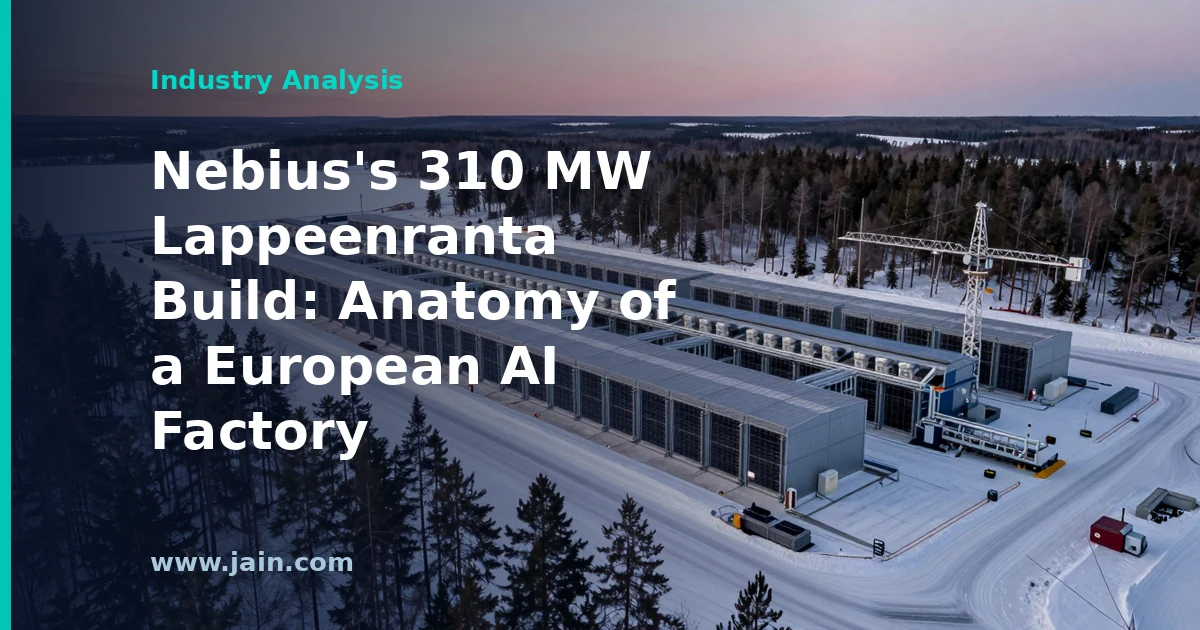
A project profile published April 25, 2026 by Northwise Project details a 310 megawatt (MW) data center in Lappeenranta, Finland attributed to Nebius Group, the Amsterdam-headquartered AI infrastructure company that trades on Nasdaq under the ticker NBIS. The report frames the facility as an “AI factory” — a data center purpose-built for training and running artificial-intelligence models rather than for general-purpose computing.
At 310 MW, the Lappeenranta site would sit firmly in the top tier of European data center projects by power capacity, and would extend Nebius’s existing Finnish footprint, anchored by its long-running campus in Mäntsälä.
Executive Summary
The headline fact is the number: 310 MW of power capacity dedicated to AI computing in a single Finnish location. Power capacity — the electricity a facility can draw and convert into computation — has become the standard yardstick for AI infrastructure because modern graphics processing units (GPUs) are constrained less by floor space than by the megawatts available to feed and cool them. A conventional enterprise data center might draw a few megawatts; 310 MW is the scale at which a facility can host tens of thousands of accelerators and compete for the largest AI training workloads.
The location is just as telling as the size. Finland offers a cool climate that slashes cooling costs, a grid that is among Europe’s most carbon-free, political stability inside the EU, and — in Nebius’s case — years of accumulated operating experience in the country. Lappeenranta, a university city in southeastern Finland, adds a local energy-engineering talent base.
What the profile does not settle is equally important: it is a single third-party report, and details on timeline, phasing, investment, power contracts, and customers are not substantiated in the source material. The scale claim is specific, but readers should treat the project’s parameters as reported rather than independently confirmed.
Why Finland Keeps Winning AI Capacity
Finland has quietly become one of Europe’s most competitive destinations for compute-intensive infrastructure, and the reasons are structural rather than promotional. Cooling is one of the largest operating costs in a data center, and Finland’s climate allows “free cooling” — using outside air or nearby water — for much of the year. The Finnish grid is also unusually clean, drawing heavily on nuclear, hydro, and wind, which matters both for operating economics and for AI customers facing sustainability reporting obligations in the EU.
Nebius knows this terrain better than most entrants. Its Mäntsälä campus, inherited from the company’s pre-2024 corporate history, is well known in the industry for piping waste heat from servers into the local district heating network — turning a cost center into community energy. A second, far larger Finnish site would suggest the company is doubling down on a playbook it has already proven, rather than experimenting in an unfamiliar market.
What 310 MW Actually Buys
For readers outside the industry: data centers are sized by power, not square footage, because electricity is the true scarce input. A 310 MW facility operates on a different plane from traditional colocation sites. Individual AI server racks now draw 100 kilowatts or more — ten times the density of conventional racks — so hundreds of megawatts translate into the tens of thousands of GPUs needed to train frontier-scale models.
The “AI factory” framing is more than marketing shorthand. Purpose-built AI facilities differ from general-purpose data centers in their electrical distribution, liquid-cooling infrastructure, and network fabric, which must move enormous volumes of data between GPUs at very low latency. Retrofitting a legacy facility to these specifications is often harder than building new — which is why the current AI cycle is producing greenfield gigascale campuses rather than expansions of existing colocation stock.
Nebius and the Neocloud Race
Nebius belongs to a category investors have taken to calling “neoclouds”: companies that rent GPU capacity for AI workloads, competing with the hyperscale clouds on price, availability, and specialization. The strategic logic of a 310 MW owned site is vertical integration — controlling land, power, and buildings rather than leasing from wholesale data center providers should yield structurally lower cost per GPU-hour, which is the metric on which this market ultimately competes.
The risk side of that logic is capital intensity. Facilities at this scale require investment in the billions of dollars before revenue arrives, and the GPU rental market is young, with demand concentrated among a relatively small set of AI labs and enterprises. A purpose-built AI factory is a leveraged bet that today’s extraordinary demand for training and inference capacity persists through the multi-year window it takes to permit, build, and fill such a site. That bet may well pay off — but it is a bet, and the source material offers no visibility into how this one is financed or contracted.
Europe’s Sovereignty Subtext
A gigascale AI facility on EU soil lands in the middle of Europe’s “sovereign AI” debate — the push to ensure European companies and governments can access frontier compute under European jurisdiction rather than depending entirely on U.S.-based capacity. An Amsterdam-headquartered operator building hundreds of megawatts in Finland fits that narrative neatly, and European AI startups and public-sector buyers are an obvious customer constituency.
Whether the project actually serves that market, or is absorbed by one or two large anchor tenants, is not something the source addresses. The distinction matters: a facility serving broad European demand changes the region’s compute landscape; a facility pre-committed to a single large customer changes one company’s supply chain. Both are legitimate businesses, but they have different implications for European AI buyers watching capacity announcements with interest.
Background
Nebius Group took its current form in 2024, when Yandex N.V. — the Dutch holding company of the Russian internet group — sold its Russia-based businesses and rebuilt itself around international assets, including a data center in Mäntsälä, Finland. Rebranded as Nebius and relisted on Nasdaq under the ticker NBIS in October 2024, the company positioned itself as a European-rooted provider of AI cloud infrastructure, backed by partnerships in the Nvidia ecosystem and an aggressive data center expansion program across Europe and beyond.
The broader backdrop is a global scramble for AI compute. Training and serving large AI models requires unprecedented concentrations of GPUs and electricity, and power availability has replaced land or fiber as the industry’s gating resource. The Nordics — with cool climates, clean grids, and supportive municipalities — have become one of the main theaters for this build-out, and Finland in particular has converted those advantages into a steady pipeline of hyperscale and AI-specialized projects.