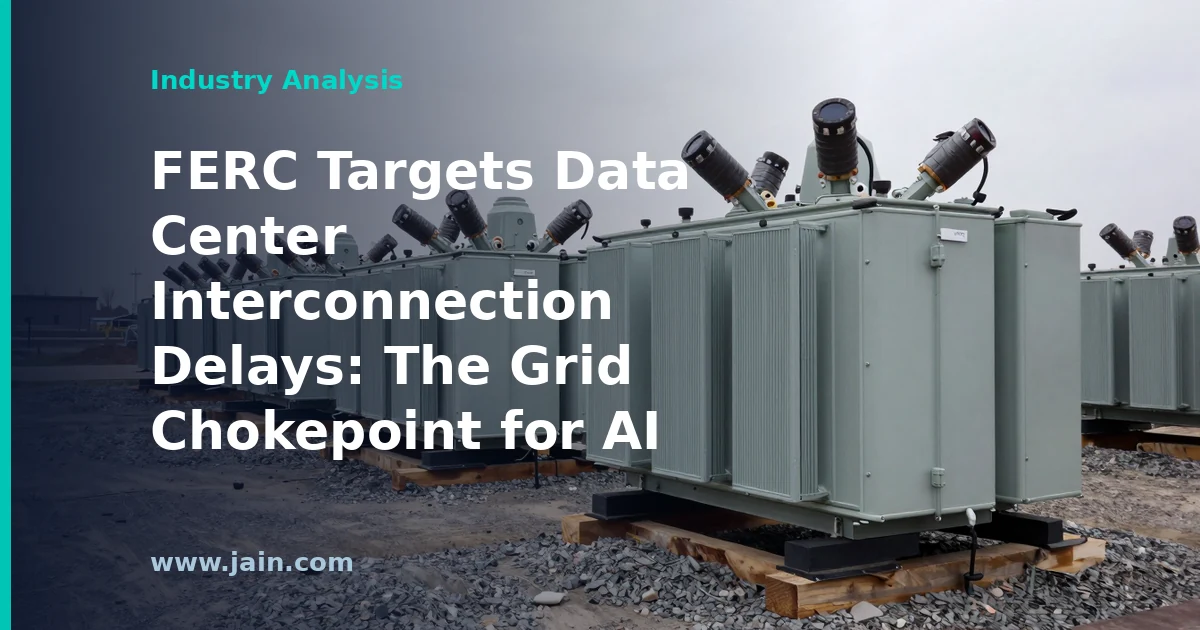
The Federal Energy Regulatory Commission (FERC), the top US energy regulator, is pressing the nation’s grid operators to overhaul the rules governing how large data centers connect to and draw power from the electric grid, according to a Reuters report dated June 17, 2026. The push targets the regional transmission organizations that manage most of the US high-voltage grid, and lands in the middle of an unprecedented wave of AI-driven electricity demand.
Executive Summary
According to Reuters, FERC is urging grid operators to rewrite their rules for connecting large data center loads — the procedures, studies, and cost arrangements that determine how quickly a gigawatt-scale computing facility can plug into the transmission system and on what terms. The report frames this as a directive from the regulator to the regional grid operators rather than a finished rule, which means the substance will be worked out in filings, stakeholder processes, and likely litigation over the months ahead.
Why it matters: interconnection has become the single biggest bottleneck in the AI infrastructure buildout. Chips can be bought and buildings can be raised in quarters; grid connections for very large loads are quoted in years. Whoever writes the rules for large-load interconnection — how costs are allocated, whether data centers can co-locate with power plants, and what reliability obligations big loads must accept — will effectively set the pace and geography of AI data center construction in the United States. A FERC push to standardize those rules is therefore one of the most consequential regulatory developments the industry has seen this cycle, even before its details are settled.
Interconnection Is Now the Gating Factor for AI Capacity
For most of the grid’s history, the hard problem was connecting new generators; large customer loads arrived gradually and were absorbed through routine utility planning. AI has inverted that. Individual data center campuses now request hundreds of megawatts — in some cases more than a gigawatt, roughly the draw of a mid-sized city — and they request it on construction timelines the traditional load-forecasting process was never designed to handle. Grid operators have responded with a patchwork: some regions created special large-load study tracks, others applied generator-style queue rules to loads, and others negotiated case by case. A federal push to overhaul and presumably harmonize these rules is a recognition that the patchwork itself has become a source of delay and dispute.
For data center developers and their tenants, the near-term effect of any rule rewrite is uncertainty, but the medium-term prize is predictability. A standardized process — with defined study timelines, transparent cost estimates, and clear rules on what a large load must commit to — would let operators of digital infrastructure make siting decisions on engineering and economics rather than on which utility territory offers the friendliest ad hoc deal.
The Fights Underneath: Co-Location, Cost Allocation, and Curtailment
Three unresolved disputes sit beneath any large-load rule overhaul. First, co-location — siting a data center directly beside a power plant and buying its output behind the meter. The arrangement can bypass years of transmission upgrades, but regulators and utilities have questioned whether such configurations pay their fair share for the grid that still backs them up; FERC itself has been wrestling publicly with co-location frameworks since high-profile disputes over data centers sited at nuclear plants in the PJM region. Second, cost allocation: when a multi-hundred-megawatt load triggers new transmission lines or substations, someone pays — the developer, the utility’s general ratepayer base, or some blend. Consumer advocates in several states have argued that ordinary households risk subsidizing AI growth; developers counter that they routinely fund dedicated upgrades. Third, flexibility and curtailment: grid operators increasingly want large loads to accept interruption or demand-response obligations during system stress in exchange for faster connection. Each of these is a genuine economic contest between reasonable positions, and the Reuters report does not indicate which way FERC is leaning on any of them.
Winners, Losers, and the Federal–State Seam
If the overhaul produces faster, standardized large-load interconnection, the clearest winners are hyperscale cloud and AI companies with capital ready to deploy, and the transmission-rich regions able to absorb them. Utilities gain too, if the rules convert speculative or duplicative connection requests — a real problem, since developers often file in multiple territories for the same project — into firm, financially committed ones. The pressure lands on grid operators, which must rewrite tariffs under regulatory deadline while managing record demand growth, and potentially on smaller data center operators, if new rules impose financial-commitment thresholds sized for hyperscalers.
There is also a jurisdictional seam worth watching. FERC governs wholesale markets and the interstate transmission system, but retail electric service and most siting decisions belong to the states, and Texas’s ERCOT grid sits largely outside FERC’s reach altogether. A federal overhaul can standardize how regional operators study and connect big loads, but it cannot by itself resolve state-level fights over who pays or where facilities are built. Buyers should expect a more legible federal process layered over a still-fragmented state landscape, not a single national rulebook.
Background
FERC, created in its modern form in 1977, oversees the interstate transmission system and the wholesale power markets run by regional grid operators. Its interconnection rules historically focused on generators — culminating in a 2023 queue-reform order aimed at the enormous backlog of power plants awaiting connection. Large customer loads, by contrast, were left mostly to individual utilities and states, an arrangement that held until AI demand broke it.
From roughly 2024 onward, gigawatt-scale data center requests, contested co-location deals at nuclear plants in the PJM region, and warnings from grid operators about record demand growth pushed large-load interconnection onto FERC’s docket. The June 2026 push reported by Reuters is the continuation of that arc: the federal regulator moving from case-by-case dispute resolution toward pressing for systematic rules on how the grid absorbs the AI buildout.
PJM Interconnection, the regional grid operator serving 13 states and the District of Columbia, announced on June 16, 2026 via its Inside Lines publication that its overhauled generator interconnection process is delivering results. The announcement, titled “New Interconnection Process Delivers,” signals that the reformed study framework — approved by federal regulators in 2022 to replace PJM’s clogged first-come, first-served queue — is now moving projects through review at a pace the old system could not match.
Executive Summary
Interconnection is the process by which a new power plant, battery, or other resource gets studied and approved to plug into the transmission grid. For years it has been one of the most stubborn bottlenecks in American energy: PJM’s legacy queue accumulated thousands of speculative and serious projects alike, with study timelines stretching years and many projects withdrawing before ever being built. In 2022, PJM won federal approval to replace that serial queue with a cluster-based, “first-ready, first-served” model that studies projects in batches and requires financial commitments up front to weed out placeholders.
PJM’s declaration that the new process “delivers” matters because the region is simultaneously facing surging electricity demand — driven prominently by data center growth in markets like Northern Virginia, the largest data center concentration in the world — alongside the retirement of older generation. Whether new supply can be connected fast enough is now a first-order question for grid reliability, electricity prices, and the pace of digital infrastructure buildout.
The announcement is a progress marker rather than a finish line: clearing studies is a necessary step, but megawatts only matter once projects secure equipment, financing, and construction — stages the interconnection process does not control.
Why the Queue Became the Grid’s Chokepoint
Under the old regime, PJM studied interconnection requests one at a time in the order received. That design worked when a handful of large plants applied each year, but it collapsed under the modern development model, in which developers file many speculative requests — often for renewables and storage — and decide later which to build. Each withdrawal forced restudies of everyone behind it, compounding delays. The result was a backlog measured in years, and a paradox: enormous volumes of proposed generation on paper, with comparatively little of it reaching commercial operation.
The reformed process attacks this structurally. Projects are studied together in clusters, network upgrade costs are shared across the cluster rather than assigned by queue position, and developers must post deposits and demonstrate site control to stay in. “First-ready, first-served” replaces “first-in-line,” which changes developer incentives from claiming a place early to being genuinely prepared. This is a governance fix as much as an engineering one — and PJM’s announcement suggests the incentive redesign is doing its job.
The Collision With Data Center Demand
PJM’s territory includes the densest data center market on the planet, and the region’s load forecasts have swung from decades of flat demand to sustained growth. That reversal makes interconnection speed a commercial issue for the digital infrastructure industry, not just a utility concern: a data center campus is only as viable as the power that can reach it, and new generation stuck in study limbo tightens capacity markets and pushes up costs for every large power buyer.
For data center operators, colocation providers, and their customers, a functioning interconnection pipeline is upstream of everything — site selection, lease pricing, and expansion timelines. If PJM can convert its backlog into energized projects, it relieves pressure on the supply side of an equation that has recently been dominated by demand headlines. If it cannot, the alternatives — demand curtailment, delayed retirements of aging plants, or higher capacity prices — all carry costs that eventually land on tenants and end users.
From Cleared Studies to Steel in the Ground
A cleared study is not a power plant. Projects that emerge from PJM’s process with signed interconnection agreements still face equipment lead times — transformers and high-voltage gear remain constrained industry-wide — plus financing, permitting, and supply chain realities. Historically, a large share of queued projects never get built, so the headline metric that matters over time is commercial operation dates, not study completions.
It is also worth noting the source here: this is PJM’s own publication reporting on PJM’s own reform. That does not make the claim wrong — grid operators publish detailed queue statistics that independent analysts scrutinize closely — but a self-assessment titled “Delivers” should be read as a progress report from the institution being measured. The durable test is whether independent queue data shows sustained throughput across successive study cycles, and whether new entrants, not just legacy backlog projects, move through on predictable timelines.
Background
PJM Interconnection, headquartered in Pennsylvania, is the largest regional transmission organization in the United States, coordinating the grid and wholesale power markets from the Mid-Atlantic into the Midwest. Like other U.S. grid operators, PJM saw its interconnection queue swell dramatically through the early 2020s as renewable, storage, and gas projects applied faster than its serial study process could handle, prompting a FERC-approved overhaul in 2022 that shifted to clustered, readiness-based studies and a phased transition to work off the backlog.
The reform arrived just as PJM’s demand outlook inverted. After years of flat load, forecasts turned sharply upward on data center growth and electrification, while older coal and gas plants moved toward retirement — making the speed at which new resources can connect a central reliability and cost question for the region, and a closely watched variable for the digital infrastructure industry that depends on PJM power.
A Republican U.S. senator has introduced a bill that would give the federal government authority over data centers’ access to the electric power grid, NBC News reported on June 15, 2026. The measure targets the fast-growing AI and cloud data center sector, whose interconnection requests have become a flashpoint in state utility proceedings across the country.
Executive Summary
The proposal, as summarized by NBC News, would insert a federal role into what has historically been a state- and regional-utility matter: deciding when, where, and on what terms large data centers can plug into the grid. The senator’s office has framed the bill as a response to concerns that hyperscale AI campuses are absorbing scarce generation and transmission capacity ahead of residential and industrial customers.
For the data center industry, the stakes are meaningful even if the bill never becomes law. A federal review layer — depending on scope — could add time, cost, and uncertainty to interconnection, the process by which a new load or generator is approved to connect to the grid. It would also reopen a long-settled jurisdictional question about who governs retail electric service.
Why Washington Is Suddenly Interested In Interconnection Queues
Interconnection — the technical and contractual process of hooking a large customer up to the transmission system — used to be a sleepy engineering topic. AI has changed that. Single hyperscale campuses now request hundreds of megawatts, and in some regions gigawatts, of firm capacity. That has produced multi-year queues, contested rate cases, and political pressure on governors and public utility commissions. A federal bill directed specifically at data center grid access is a signal that the issue has migrated from utility filings to national politics.
The measure appears to target a genuine coordination problem: individual state regulators approve individual interconnections, but the cumulative effect ripples across multi-state grid operators such as PJM, MISO, and ERCOT. Whether a federal gatekeeper is the right fix, or would simply add a layer on top of existing FERC and regional transmission organization processes, is the substantive question the bill will have to answer.
Who Wins And Who Loses If A Federal Role Is Added
Incumbents with signed interconnection agreements and energized sites are the clearest short-term winners of any friction added to new connections: their capacity becomes scarcer and more valuable. Developers still in queue — particularly speculative sites without anchor tenants — face the most exposure, because a federal review could reshuffle priority or impose siting criteria unrelated to a project’s engineering readiness.
Utilities are harder to place. Some have complained that speculative data center requests inflate their planning forecasts; a federal filter could relieve that pressure. Others rely on large-load growth to spread fixed costs across more kilowatt-hours and would resist anything that slows revenue. Residential ratepayer advocates, who have argued that AI loads are effectively cross-subsidized by households, may find themselves unusual allies of a bill from across the aisle.
What The Bill Would Have To Overcome
Retail electric service — the sale of power to end customers, including data centers — has traditionally been a state matter under the Federal Power Act, with FERC’s jurisdiction limited to wholesale sales and interstate transmission. A federal veto over data center grid access would test that boundary and likely draw legal challenge from states that have aggressively courted the industry, as well as from operators with existing contracts.
The politics are also non-obvious. A Republican-led bill imposing federal oversight on a private industry cuts against the party’s usual deregulatory posture, suggesting the sponsor sees data center power consumption as a constituent-facing affordability and reliability issue rather than a market question. Whether that framing attracts bipartisan support or stalls in committee will determine if this is a serious legislative vehicle or a marker bill.
Background
Data centers house the servers that run cloud computing, streaming, and AI workloads. Historically they consumed a manageable share of U.S. electricity, but the training and deployment of large AI models since 2023 has driven exceptional growth in individual site sizes and total sector demand. That has collided with a slower-moving power system, where new generation and transmission routinely take five to ten years to build.
Grid access for large customers has traditionally been a state matter, with utility regulators approving special contracts and rates. Federal involvement has been limited to wholesale markets and interstate transmission, primarily through the Federal Energy Regulatory Commission. Proposals to expand that federal role, from either party, mark a departure from decades of practice.
The Federal Energy Regulatory Commission (FERC) has approved a temporary process that allows PJM Interconnection — the operator of the largest wholesale electricity market in the United States, serving 13 states and the District of Columbia — to fast-track large capacity projects, according to a June 10, 2026 report from PJM’s Inside Lines publication. The measure is expressly temporary, aimed at accelerating the arrival of sizable new power resources at a moment when the region’s demand outlook is being reshaped by electrification and data center growth.
Executive Summary
FERC’s approval gives PJM a sanctioned shortcut: a temporary pathway to move large capacity projects — power resources big enough to matter for regional reliability — through its processes faster than the standard sequence would allow. In a system where a generation project can spend years in the interconnection queue before delivering a single megawatt, the ability to pull select large projects forward is one of the most consequential levers a grid operator can hold.
The details published in the brief report are limited, but the direction is unmistakable and consistent with PJM’s recent trajectory: regulators and the grid operator are prioritizing speed-to-power for large resources. For data center developers, utilities, and generation investors across the mid-Atlantic and Midwest, the practical question is no longer whether PJM will triage its pipeline, but which projects benefit, on what criteria, and for how long the temporary window stays open.
Why the Queue Became the Bottleneck
To connect a new power plant to the high-voltage grid, a developer must pass through the grid operator’s interconnection queue — the engineering and cost-allocation study process that determines what network upgrades a project needs before it can safely deliver power. Across the U.S., and acutely in PJM, that process became a multi-year bottleneck as applications surged past the pace of study work. Projects that are financed, sited, and ready to build can still sit waiting for paperwork and grid studies.
Meanwhile, PJM’s supply-demand picture has tightened from both directions: older fossil plants are retiring while forecast demand climbs, driven in significant part by data center construction in places like Northern Virginia, the densest data center market in the world. When ready supply can’t get connected but demand keeps arriving, prices and reliability risk both rise. A fast-track for large capacity projects attacks that mismatch at its procedural source.
A Temporary Lever, Not Structural Reform
The word “temporary” is doing real work here. FERC has not rewritten PJM’s standard interconnection or capacity rules; it has approved a time-bounded exception that pulls certain large projects ahead. That framing matters for two reasons. First, it signals that regulators see the current situation as an emergency-adjacent gap — a bridge measure until broader queue reforms and new supply catch up. Second, it leaves the durable rules of the road intact, which limits how much long-term investment behavior the order alone can change.
Bridge measures carry their own risk: if the underlying study backlog and construction constraints (transformers, turbines, skilled labor, transmission upgrades) don’t ease, a temporary fast-track can become a recurring one. Market participants will reasonably ask whether this is a one-time triage or the first installment of a standing priority lane for large resources.
Winners, Losers, and the Fairness Question
Any fast-track creates a queue-jumping question. Projects selected for expedited treatment gain a material commercial advantage — earlier revenue, earlier capacity market participation, and first claim on scarce grid headroom. Projects that remain in the standard process, including many smaller renewable and storage developments, effectively wait longer in relative terms even if their absolute timelines don’t change. FERC approvals of this kind typically turn on whether the selection criteria are transparent and non-discriminatory, and that is exactly where scrutiny from developers and consumer advocates will concentrate.
There is also a resource-mix dimension. “Large capacity projects” tends, in practice, to favor big dispatchable plants — the kind that can be counted on during peak demand — over distributed or intermittent resources. That is defensible on reliability grounds, but it shapes the competitive landscape, and the release gives no detail on how technology-neutral the criteria are.
What It Means for the Data Center Buildout
For the digital infrastructure industry, this is a supply-side answer to a demand-side surge. Data center campuses now routinely request hundreds of megawatts — utility-scale loads — and the pace at which PJM can connect new generation directly governs how fast those campuses can energize. A credible fast-track for large supply projects modestly improves the odds that new load and new generation arrive in the same timeframe rather than years apart.
It is not, however, a cure. Interconnecting a power plant faster does not by itself build the transmission lines, substations, and transformers that both generators and large loads need. Operators and their customers should read this as one favorable policy data point in a long chain — permitting, equipment lead times, and local siting fights still set the real clock.
Background
PJM Interconnection dispatches power and runs wholesale electricity markets for roughly 65 million people across a footprint stretching from the mid-Atlantic into the Midwest. Over the past several years, the region has become the epicenter of the U.S. power-demand story: an enormous backlog of projects in the interconnection queue, accelerating retirements of older generation, and surging load forecasts driven heavily by data center construction — most visibly in Northern Virginia’s “Data Center Alley.” Those pressures have pushed PJM’s capacity market prices sharply higher and made speed-to-power a central policy concern.
Against that backdrop, PJM and FERC have pursued a series of reforms to modernize the interconnection process and, where necessary, create expedited pathways for resources deemed critical to reliability. The temporary fast-track approved here is the latest step in that sequence, extending the theme of triaging a congested pipeline so the largest, most reliability-relevant projects reach the grid sooner.
According to a May 12, 2026 report from Engineering News-Record, the Federal Energy Regulatory Commission (FERC) is weighing federal oversight of how AI data centers connect to the electric grid. The report signals that the commission — the U.S. regulator of interstate transmission and wholesale power markets — is considering a more direct role in the interconnection of the very large loads that hyperscale AI facilities represent.
Executive Summary
The headline development is straightforward but consequential: FERC is reportedly considering whether the federal government should assert oversight over AI data center grid connections — the physical and contractual arrangements that let a large computing facility draw power from the bulk electric system. Historically, connecting a new load (a consumer of power, as opposed to a generator) has been governed largely by state regulators and local utilities. A federal framework would be a meaningful shift in who sets the rules for the fastest-growing category of electricity demand in decades.
Why it matters: power availability has become the binding constraint on AI infrastructure buildout. Data center developers routinely cite interconnection timelines and grid capacity — not chips or capital — as the limiting factor on new capacity. Whoever writes the rules for large-load interconnection will influence where hyperscale campuses get built, how fast they energize, and who pays for the grid upgrades they require. Based on the available report, FERC is weighing action, not announcing a final rule; the scope, mechanism, and timeline remain to be seen.
Why the Grid Connection Became the Bottleneck
AI training and inference clusters concentrate enormous electrical demand in single facilities — individual campuses now request capacity measured in the hundreds of megawatts, and some multi-site plans reach into the gigawatts. That is utility-scale demand appearing at a pace the interconnection process was never designed for. Utilities and grid operators must study whether the local transmission network can serve a new load without degrading reliability for existing customers, and those studies, plus any required upgrades, can take years.
For the AI infrastructure sector, the interconnection queue is now a competitive battleground. Access to a firm, timely grid connection has become as strategically valuable as access to GPUs. Any change in who governs that process — and under what standards — goes directly to the economics of the buildout.
The Jurisdictional Line FERC Would Be Redrawing
FERC’s authority under the Federal Power Act covers interstate transmission and wholesale electricity sales; states and their utility commissions traditionally govern retail service, distribution, and the siting of both power plants and large customers. Load interconnection has mostly lived on the state side of that line. But recent disputes have pulled FERC in — most visibly the fights over co-located load, where a data center connects directly to a power plant (such as a nuclear station) and questions arise about whether it is fairly using, or bypassing, the shared transmission system. FERC’s 2024 rejection of an expanded co-location arrangement at a Pennsylvania nuclear plant, and its subsequent review of co-location rules in the PJM region, established the commission as an active referee in this space.
Weighing broader oversight of AI data center connections would extend that trajectory. The legal theory matters: rules framed around transmission access and wholesale-market effects sit comfortably within FERC’s mandate, while anything resembling federal siting authority over customer facilities would be contested territory. Expect states, utilities, and hyperscalers to litigate exactly where that line falls.
Winners, Losers, and the Price of Certainty
A single federal framework could benefit large developers by replacing a patchwork of state-by-state and utility-by-utility processes with predictable national rules — much as FERC’s generator interconnection reforms sought to standardize the queue for power plants. Uniformity lowers diligence costs and could speed projects in regions where local processes are slow or opaque.
The countervailing risk is that new federal process layers add time before they save it, and that cost-allocation rules — who pays for the transmission upgrades a gigawatt-scale campus triggers — shift in ways developers cannot yet price. Utilities in high-growth regions may welcome clearer rules for protecting existing ratepayers; states courting data center investment may resist anything that dilutes their leverage. Ratepayer advocates, who have pressed regulators to ensure ordinary customers do not subsidize hyperscale growth, would likely see federal engagement as validation of their concerns — though the substance of any rule will determine whether they view it as protection or preemption.
What Is — and Is Not — Substantiated Here
It is worth being direct about the sourcing: this is a single trade-press report that FERC is weighing oversight. The available material does not establish whether the commission has opened a formal proceeding, issued a proposed rule, or merely discussed the topic at a conference or in commissioner statements. “Weighing” can describe anything from staff inquiry to an imminent order. Readers should treat the direction of travel — growing federal attention to large-load interconnection — as well supported by the past two years of docket activity, while treating any specific regulatory outcome as unconfirmed until FERC itself acts.
Background
FERC was created to regulate the interstate wholesale electricity system, leaving retail service and facility siting to states — a division written long before any single electricity customer could demand a gigawatt. That division has come under strain as AI-driven data center growth produced the fastest load expansion the U.S. grid has seen in decades, with grid operators across the country reporting unprecedented volumes of large-load interconnection requests.
The pressure surfaced first in co-location disputes: FERC’s 2024 rejection of an expanded data-center arrangement at a Pennsylvania nuclear station, followed by a broader review of co-located load rules in the PJM region, made the commission a central player in data center power policy. The reported deliberations over direct oversight of AI data center grid connections are the logical next chapter in that story.
The Federal Energy Regulatory Commission (FERC) — the U.S. agency that oversees interstate electricity transmission and wholesale power markets — is taking aim at the delays data centers face when connecting to the power grid, according to a May 11, 2026 report from Broadband Breakfast. Interconnection, the formal process by which a large new electricity load or generator gets studied and physically wired into the transmission system, has become one of the tightest bottlenecks in the AI infrastructure buildout.
Executive Summary
According to the report, FERC is targeting the interconnection delays that have left large data center projects waiting — often years — for grid connections. The report available to us is brief and does not detail the specific mechanism, so it is not yet clear whether the action takes the form of a rulemaking, an order directed at grid operators, or a preliminary inquiry. What is clear is the direction: the federal regulator most responsible for transmission access is treating data center connection timelines as a problem worth its attention.
Why it matters: capital, chips, and land have largely stopped being the binding constraints on AI data center construction — power is. A hyperscale campus can be financed and built in two to three years, but securing a firm grid connection can take longer than that in constrained regions. Any FERC move that compresses those timelines, or that standardizes how utilities and regional grid operators study large new loads, goes directly to the pace at which announced AI capacity actually energizes.
The Queue Is the Chokepoint
For most of the grid’s history, interconnection processes were designed around new power plants, not new consumers. A data center drawing hundreds of megawatts — comparable to a small city — inverts that model: it is a load so large that utilities must run detailed studies to confirm the transmission system can serve it without destabilizing service to everyone else. Those large-load studies are handled inconsistently across the country, often utility by utility, with no uniform federal timeline. The result is a patchwork in which functionally identical projects can face wait times that differ by years depending on jurisdiction.
FERC has already spent years reforming the generator side of this problem — its Order 2023 overhauled generator interconnection queues with clustered, first-ready-first-served studies after backlogs stretched to multi-year waits. The load side, where data centers sit, has had no equivalent national framework. FERC has also been drawn into adjacent fights, most visibly over co-location arrangements that would place data centers directly at existing power plants, a structure that raised contested questions in the PJM region about who pays for the grid and who gets access to scarce capacity. An action targeting data center interconnection delays fits a pattern of the Commission being pulled, docket by docket, into the collision between AI demand growth and grid process.
What Federal Action Can and Cannot Fix
FERC’s leverage is real but bounded. It regulates interstate transmission and the regional grid operators (RTOs and ISOs) that administer most of the U.S. bulk power system, so it can standardize study timelines, impose deadlines, and clarify cost responsibility for network upgrades. That could meaningfully shrink the procedural portion of interconnection delays — the months lost to sequential studies, restudies, and ambiguity about process.
What FERC cannot conjure is physical capacity. Where delays reflect genuinely constrained transmission — lines and transformers that do not yet exist — faster paperwork simply delivers a faster “no” or a large upgrade bill. Transformers and high-voltage equipment carry their own multi-year supply lead times, and retail-level service decisions remain with states and local utilities. The honest framing is that federal reform can remove artificial delay, not engineering reality; both matter, and the report available does not indicate which FERC believes is dominant.
Winners, Losers, and the Cost Question
Faster, more predictable interconnection most benefits large, well-capitalized developers — hyperscalers and major colocation operators — who can meet readiness requirements and post financial commitments quickly. It also benefits regions competing for data center investment, where interconnection uncertainty has begun steering projects toward states or utilities perceived as faster. Utilities face a more mixed picture: standardized deadlines add pressure and potential liability, but a clearer process also protects them from accusations of arbitrary treatment.
The hardest question any reform must answer is cost allocation: when a multi-hundred-megawatt load triggers transmission upgrades, does the data center pay, or do those costs spread across all ratepayers? Consumer advocates have pressed this issue sharply as residential bills rise in data-center-heavy regions, and it was central to the co-location disputes FERC has already handled. A reform that accelerates connections without settling who pays would relocate the fight rather than resolve it — and that question deserves scrutiny regardless of which side raises it.
Background
FERC’s involvement in the data center power crunch has been building for several years. U.S. electricity demand, flat for roughly two decades, began rising sharply in the mid-2020s as AI training and cloud workloads drove a wave of hyperscale construction, and grid operators repeatedly raised their load forecasts in response. The Commission modernized generator interconnection with Order 2023, but large consuming loads had no comparable national framework, leaving data centers subject to a patchwork of utility-specific processes. FERC was also pulled into high-profile disputes over co-locating data centers at power plants, which crystallized the cost-allocation and market-access questions that any broader interconnection reform will have to answer. Action targeting data center connection delays is the logical next step in that progression.
American Electric Power is publicly weighing withdrawal from two of the country’s largest wholesale power markets — PJM Interconnection and the Southwest Power Pool — citing the slow pace at which new generation gets studied, approved and connected to the grid, according to a report published by Utility Dive on 6 May 2026.
AEP is among the largest transmission owners in PJM and a long-standing SPP member through its Oklahoma, Arkansas, Louisiana and Texas operating companies. The available source material is headline-level: it indicates AEP is examining an exit, not that the company has filed a withdrawal notice with federal regulators or set a date.
Executive Summary
Regional transmission organizations, or RTOs, are the independent bodies that run the high-voltage grid and wholesale power markets across most of the eastern United States. Utilities join them voluntarily, and once inside, they hand over control of transmission planning and the queue that determines when new power plants can plug in. AEP saying out loud that it may leave two of them is unusual. Utilities have migrated between RTOs before, but a large incumbent threatening to step outside organized markets entirely is a governance event, not a routine filing.
The stated grievance is generation interconnection: the multi-year engineering and cost-allocation process every new power plant must clear before it can energize. Queues across the country have lengthened as developers filed far more projects than the grid can absorb, and as demand forecasts — driven heavily by data centers and industrial electrification — moved faster than the studies designed to serve them. For a utility trying to build or contract generation to match load growth in Ohio, Indiana, Virginia, West Virginia and Oklahoma, the queue is the bottleneck between a signed customer and a served customer.
What matters for buyers of digital infrastructure is not whether AEP ultimately leaves. It is that a utility of this size considers the market structure itself a liability worth reopening. Data centers are sited on ten- to twenty-year horizons; the assumption that the rules governing power supply are stable for that period is now a live question in a meaningful part of the eastern grid.
Two Markets, One Complaint — and What That Implies
The most analytically interesting feature of the report is that AEP names both PJM and SPP. These are very different institutions. PJM coordinates a largely restructured, competitive footprint across the Mid-Atlantic and parts of the Midwest, where merchant generators compete and a capacity market pays for future reliability. SPP spans mostly vertically integrated territory in the Plains and South, where utilities still own their generation and recover costs through state rate cases. If the same utility finds the interconnection process unworkable in both, the diagnosis pointing only at PJM’s design is incomplete.
That cuts in two directions, and both deserve equal scrutiny. It strengthens the argument that queue processing is a systemic failure of the current model rather than one operator’s mismanagement — a fair reading. It also weakens the implicit premise that leaving would solve the problem, because a utility outside an RTO still runs an interconnection process under federal rules, still needs system impact and facilities studies, and still faces the same constrained supply of turbines, transformers, high-voltage breakers and skilled labor that is throttling projects industry-wide. Neither AEP nor the RTOs have, in the material available, shown how much of the delay is queue administration versus physical supply chain. That distinction is the whole argument, and it is unresolved.
What Leaving an RTO Actually Requires
Exit is not a decision a utility makes alone. Withdrawal from an RTO typically requires approval from the Federal Energy Regulatory Commission, compliance with notice provisions in the RTO’s governing agreements, and in practice the acquiescence of state regulators in every state where the utility operates — states that have their own views on reliability, rates and whether their consumers benefit from a larger market. FERC has historically been attentive to whether a departure strands costs on the members left behind, and obligations for transmission projects already approved under regional plans generally do not evaporate on the way out.
Then there is the operational bill. An RTO provides centralized dispatch, reserve sharing across a wide area, and a resource adequacy framework. A departing utility must replicate those functions or buy them, either by running its own balancing authority or joining another market. It also inherits seams — the friction at the borders between neighboring grids, where power that used to flow on a single set of rules now needs contracts, scheduling and duplicated reserves. Seams cost real money and, historically, are the argument that built RTOs in the first place. Precedent from past migrations, such as the moves of several Midwestern utilities from MISO into PJM last decade, suggests a timeline measured in years, not quarters.
None of that makes the threat empty. A large transmission owner signalling that the exit math is being run changes the bargaining table inside RTO stakeholder processes, where votes are weighted and reform packages are negotiated among generators, load-serving entities, states and consumer advocates. Observers are entitled to ask whether this is leverage, intent, or both — and to note that leverage is a legitimate governance tool, not a scandal. The honest answer is that the available reporting does not distinguish between them.
The Data Center Angle Is Real but Frequently Misstated
Two clarifications matter here. First, the process AEP is reportedly complaining about is generation interconnection — plugging power plants in — which is a separate queue from large load interconnection, the process a hyperscale campus goes through to plug demand in. Developers care about both, because a load request is only as good as the supply behind it, but they are governed by different rules and different disputes.
Second, the geography deserves precision. Northern Virginia’s Data Center Alley sits in Dominion Energy’s service territory, not AEP’s, so an AEP withdrawal would not remove Loudoun County from PJM. What it would do is shrink the footprint across which PJM plans transmission, shares reserves and allocates costs — and a smaller pool changes the arithmetic for everyone still inside, including the utilities serving the Alley. AEP’s own data center exposure is concentrated elsewhere: central Ohio, which has attracted substantial hyperscale and semiconductor investment, plus growing interest across Appalachian Power’s Virginia and West Virginia footprint and Indiana Michigan Power’s territory.
For site selection, the practical effect is a new diligence line item. A campus reaching commercial operation in 2030 or later, in AEP territory, may be energized under a market structure, capacity obligation and cost-allocation regime different from the one modelled at underwriting. That is not a reason to avoid the region; central Ohio’s fundamentals — land, fiber, water, workforce, existing anchor tenants — are unchanged. It is a reason to price structural risk explicitly rather than assume it away.
Winners, Losers and the Claims That Remain Unproven
If AEP stayed and secured faster queue treatment, the winners would be its own generation plans and the customers waiting on them, and the loser would be the principle that all developers queue on equal terms — a principle merchant generators and independent power producers defend precisely because it protects them from incumbent preference. If AEP left, it would gain control over the sequencing of its own build-out and lose the reserve-sharing and market-depth benefits of a wide area. Consumers could plausibly land on either side depending on whether seams costs exceed the value of faster capacity additions. Anyone claiming certainty about that outcome, in either direction, is ahead of the evidence.
The RTOs have a defensible record to point to. Both operate under FERC Order 2023, which replaced serial, project-by-project studies with cluster analysis and first-ready, first-served rules, and PJM has stood up expedited pathways for shovel-ready projects. It is reasonable for PJM and SPP to argue that reforms adopted only recently have not had time to show results. It is equally reasonable for a utility facing near-term load commitments to say that a reform which pays off in 2029 does not help a customer energizing in 2027. Both claims can be true; neither is proven by assertion.
The fair-minded conclusion is narrow. This is a credible signal of strain in RTO governance from a participant with standing to know, reported at a level of detail too thin to adjudicate. It should raise the priority of queue reform on every regulator’s docket. It should not, on this evidence, be read as a verdict that PJM or SPP have failed, nor as a commitment by AEP to go anywhere.
Background
American Electric Power is one of the largest electric utility holding companies in the United States, headquartered in Columbus, Ohio, operating regulated utilities across a footprint that stretches from Michigan and Ohio through Appalachia into Oklahoma, Arkansas, Louisiana and Texas. That geography is unusual: it straddles three separate wholesale market structures — PJM in the east, SPP in the west, and ERCOT in Texas — which gives the company direct comparative experience of how different market designs handle new generation.
PJM and SPP both emerged from the federal push in the late 1990s and 2000s to separate grid operation from utility ownership and create competitive wholesale markets. The bargain was that utilities would cede control of transmission planning and dispatch in exchange for a larger, more efficient pool. That bargain has come under strain since 2023 as electricity demand began growing again after two decades of flat consumption, driven substantially by data centers, and as interconnection queues filled with more projects than could be studied or built. The result is a widening gap between how quickly load can be signed and how quickly supply can be connected — the gap at the centre of AEP’s reported complaint.