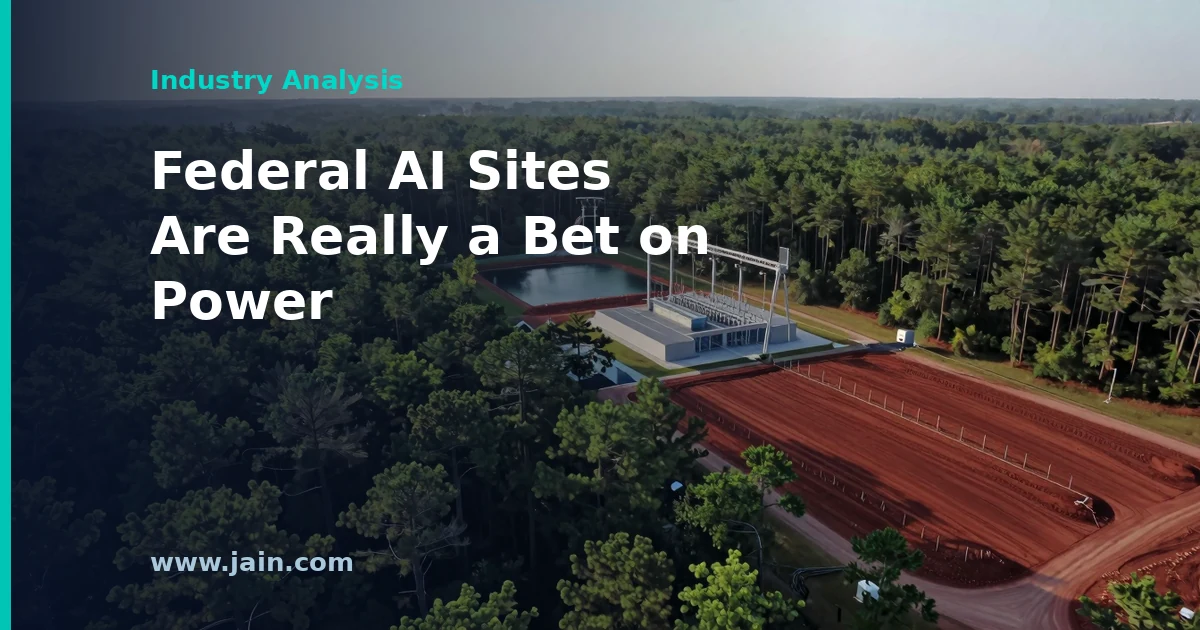
The United States government is opening some of its own land to companies that want to build the huge computer warehouses that run artificial intelligence. One of the first chosen sites is in South Carolina, at a lab that supports the nation’s nuclear weapons work.
The twist: these projects are meant to come with their own power plants. The biggest artificial intelligence facilities can need as much electricity as a large power plant produces, and building power on-site is meant to keep that cost off ordinary households’ bills.
Engineering firm Amentum was picked to build it. No price, size or start date has been announced.
Microgrid Knowledge reported on July 20, 2026 that the National Nuclear Security Administration (NNSA), part of the U.S. Department of Energy (DOE), has selected Virginia-based engineering firm Amentum to develop a co-located artificial intelligence data center and on-site power generation project at the Savannah River National Laboratory site in South Carolina. The selection followed a competitive request for proposals that DOE began last year, after identifying 16 federal sites it judged could host AI data centers paired with their own energy infrastructure.
The effort, formally the Savannah River Site Artificial Intelligence Infrastructure and Energy Generation Project, has no announced timeline, generating technology, capacity or cost. DOE says the project could meet its own electricity needs without shifting large costs to utility customers and could also increase the power available to the grid.
Executive Summary
NNSA has named Amentum to lead construction of both an AI data center and the power plant that would feed it, on federal land at one of the country’s principal nuclear security sites. It is a concrete step in DOE’s program to put AI computing on government property, and the first selection at Savannah River under that program.
The significance lies less in the land than in the pairing. DOE did not simply offer acreage; it screened its sites for their ability to host data centers together with co-located generation, and it justified the Savannah River project on the grounds that it would not push large grid-upgrade costs onto utility customers. That makes federal sites a potential route around the slowest and most politically sensitive part of AI buildout: getting enough electricity to the building.
What has been announced is a selection and a scope, not a financed, sized project. The generating technology, megawatt capacity, tenant, financing and schedule are all still undisclosed, so the model’s claims about cost and grid benefits remain untested.
Sixteen Sites, One Condition: Bring the Power
DOE’s list of 16 federal sites was not a catalogue of empty lots. According to the department, it identified sites that could support AI data centers paired with co-located energy infrastructure. The Savannah River award makes that pairing explicit: generation is in the project’s official name, and Amentum is contracted to build the power supply alongside the data center rather than to plug into whatever the local utility can provide.
The reason is the grid connection itself. A large new electricity user normally joins the grid through an interconnection process, in which the utility studies whether its lines and power plants can serve the new load and what must be built if they cannot. At AI scale, those upgrades are substantial: industry projections cited in the coverage put future AI server racks at up to 1 megawatt each and the largest AI campuses at around 1 gigawatt, roughly the output of a large power plant. When a utility builds for a customer that size, the question of who pays tends to fall on its other customers. DOE’s stated case for Savannah River answers that directly, saying the project could generate its own needs “without shifting huge costs to utility customers.”
That is where federal land earns its place. A large, secured, government-controlled site offers space, a single landowner and an existing security perimeter for putting generation right next to the load, which many sites closer to population centers struggle to offer. The trade-off is engineering: AI training creates wide, fast swings in power demand, and a self-supplied site has less grid backing to absorb them. Whatever generation Amentum ultimately builds will need to be designed around that volatility, which makes the power system as central to the project as the data center it serves.
Why a Nuclear Security Site, and Why Amentum
NNSA Administrator Brandon Williams framed the award as a way to “move faster, apply innovative technologies, and make productive use of federal land while maintaining our commitment to mission delivery.” That last clause matters. Savannah River hosts sensitive defense work, and any private-sector partner operating there has to coexist with it. Amentum already does; it was selected earlier this year to provide design and engineering services for the site’s Tritium Finishing Facility, which supports the nuclear weapons program.
That existing footprint is a competitive advantage that is hard to replicate. Contractors that already understand federal security, procurement and site operations are positioned to win the first wave of these awards, while conventional data center developers may find their route onto federal land runs through partnerships with such firms. Amentum and NNSA say they will collaborate on expanding private-sector partnerships in the project, which leaves room for tenants, financiers or generation owners still to be named.
What Is Settled, and What Still Rests on “Could”
The announcement establishes a selection made through a competitive process, a defined scope covering both compute and generation, and a named site. Those are real commitments of intent from a federal agency. The headline benefits are conditional, however: the project could meet its own electricity needs, and it could increase power available to the grid. Williams himself called it a “proposed partnership.”
Until the parties disclose the generation type, capacity and commercial structure, the ratepayer-protection claim cannot be measured. Its value depends on details not yet public: whether the site stays connected to the grid for backup, who pays for that connection, and on what terms any surplus power is sold. The first projects under DOE’s program will set the template for the remaining sites, so those terms will matter well beyond South Carolina.
Background
The Savannah River Site in South Carolina is a Department of Energy complex overseen by the National Nuclear Security Administration, the DOE agency responsible for nuclear weapons and nuclear security. Its national laboratory supports defense programs including tritium production. Amentum, a Virginia-based firm spun out of AECOM about six years ago, ranks as the second-largest U.S. government services contractor behind Leidos and was already working at the site on the Tritium Finishing Facility.
The award sits within a wider federal push to use government land for AI infrastructure. DOE identified 16 of its sites as candidates for data centers paired with their own power, and Energy Secretary Chris Wright has described the AI race as “the next Manhattan project.” The pressure behind that push is electricity: an analysis by the Penn State Institute of Energy and the Environment projects AI’s share of global electricity use could rise from 4% to 20% by 2035.
El Paso Matters reported on May 1, 2026 that a proposed data center at Fort Bliss, the U.S. Army installation adjoining El Paso, Texas, could consume more electricity than the entire city of El Paso. The project is at the proposal stage.
The comparison is the story’s core claim: a single campus on federal land whose electrical demand would rival or exceed that of the roughly 680-square-mile metropolitan area next door. Beyond that framing, the source material available to us does not carry a stated capacity figure, developer name, timeline, or power-supply arrangement.
Executive Summary
The news is a siting proposal, not a groundbreaking. What makes it notable is the combination of two ingredients that rarely appear together: a very large computing load and a U.S. Army installation as the host site. Federal land sidesteps some of the frictions that slow data center development — land assembly, municipal zoning fights, fragmented ownership — because a single federal landlord controls tens of thousands of contiguous acres behind an existing security perimeter.
What federal land does not do is generate electricity. A load described as larger than a city of roughly 680,000 people has to be served by wires, generation, and firm capacity that either already exist or must be built. El Paso sits in an unusual position for a Texas city: its incumbent utility, El Paso Electric, operates within the Western Interconnection rather than ERCOT, the grid that covers most of the state. That means the fast, deregulated Texas interconnection dynamics that have absorbed much of the state’s data center boom are not directly available here.
For infrastructure buyers, utilities, and investors, the useful question is not whether the headline comparison is dramatic — it is. The question is which of the four hard constraints (power, water, transmission, and mission compatibility with an active training installation) has an identified answer, and which are still open. On the evidence in this report, most remain open.
Why Federal Land Is Suddenly Attractive to Data Center Developers
Large computing campuses have become difficult to site in ordinary jurisdictions. Assembling several hundred acres from multiple private owners takes years; local zoning hearings have become genuine contests in Virginia, Georgia, and parts of Texas; and utility interconnection queues in popular markets stretch well past the point where a developer can promise a delivery date. Federal installations short-circuit several of those problems at once. One landlord controls the land, the parcels are already contiguous and large, physical security is a built-in feature rather than a capital line item, and the leasing path runs through federal real-property authorities rather than a city council.
Fort Bliss is an especially plausible candidate for that logic. It is among the largest Army posts in the country by land area, extending from El Paso north into New Mexico, with vast stretches of desert range. Where a private developer would need to buy out dozens of owners, a federal lease covers the same footprint in a single instrument.
The trade is that federal siting solves the land problem and leaves the harder problems untouched. Electricity, water, fiber routes, and construction labor all still have to come from the surrounding region. A campus on an Army post is not an island; it draws on the same regional grid and the same desert water system as the city beside it. The siting advantage is real, but it is narrower than the headline suggests.
El Paso Is in Texas, But It Is Not on the Texas Grid
This is the detail that most casual readers of the story will miss, and it matters more than any other technical point. The United States is divided into three major grids: ERCOT, which covers most of Texas and operates largely independently; the Eastern Interconnection; and the Western Interconnection, which runs from the Rockies to the Pacific. El Paso Electric, the incumbent utility serving El Paso and the surrounding area, sits in the Western Interconnection, not ERCOT. A very large load at Fort Bliss would therefore be interconnecting into a different market structure than a comparable load outside Dallas or Abilene.
The practical consequences are substantial. ERCOT’s combination of a large generation fleet, a fast-moving queue, and light-touch retail structure is a significant part of why so much data center demand has landed in Texas over the past several years. El Paso Electric is a considerably smaller, vertically integrated utility operating under Western planning and reliability processes, with regulatory oversight in both Texas and New Mexico. Adding generation and transmission at the scale implied by “more power than all of El Paso” is a multi-year capital program under any framework, and it is not one a single utility of that size undertakes casually.
None of this makes the proposal implausible. Behind-the-meter generation, phased buildout, on-site gas turbines, large-scale solar paired with storage, or a bespoke transmission arrangement are all mechanisms developers have used elsewhere. But each carries its own permitting path, its own capital requirement, and its own timeline — and the report as summarized does not identify which, if any, is on the table.
What a “More Power Than the Whole City” Comparison Does and Doesn’t Prove
City-scale comparisons are a legitimate way to convey magnitude to a general audience, and the figure deserves to be taken seriously rather than dismissed as alarmism. But readers evaluating it should know that such comparisons are sensitive to how both sides are measured. Peak demand in megawatts and annual energy consumption in megawatt-hours tell different stories, because a data center runs at a high, flat load factor around the clock while a city’s demand swings with weather and time of day. A campus that trails El Paso on peak summer demand could still exceed it on annual energy. “El Paso” itself can mean the municipality, the metropolitan area, or El Paso Electric’s full service territory, which reaches into southern New Mexico.
Two further caveats apply to nearly every announcement in this category. Stated capacity is almost always the fully built figure, reached over many years and many phases, not day-one load. And proposed capacity is not contracted capacity: the distance between a developer’s stated ambition and a signed interconnection agreement with firm delivery dates is where a large share of announced projects quietly stall.
The even-handed read, then: the comparison is a fair signal that the proposal is genuinely large and that the local grid implications warrant public scrutiny. It is not, on its own, evidence about what will be built, when, or on whose electrical system. Both the developer’s ambitions and the alarm the number generates should be measured against the same standard — a stated capacity figure, a defined phasing schedule, and an identified power supply.
Who Carries the Cost, and Who Carries the Risk
When a load of this size arrives in a mid-sized utility territory, the central regulatory question is cost allocation. Transmission upgrades, substation work, and any new generation built primarily to serve one customer represent capital that has to be recovered from someone. If those costs flow into general rates, every household and small business in the territory helps pay for them. If they are assigned to the customer through a large-load tariff, minimum-take commitments, or exit fees, the developer carries the risk that its own demand forecast proves optimistic. Utility commissions in several states have spent the past two years writing exactly these rules, and how Texas and New Mexico regulators would treat a Fort Bliss load is a live and unanswered question.
Water is the second cost that tends to surface late. El Paso sits in the Chihuahuan Desert and has built a national reputation for water management precisely because supply is constrained. Cooling technology choice — evaporative cooling, which consumes water to save electricity, versus closed-loop or air-cooled designs, which use more power to save water — is therefore not a technical footnote here. It is a direct trade against the grid constraint discussed above, and the two cannot be optimized independently.
There are plausible winners. Construction employment, a long-term property or lease revenue stream to the federal government, improved fiber routes, and potential grid investment that outlasts any single tenant are all genuine. But data centers are capital-dense and labor-light once operating, so permanent job counts are typically modest relative to investment, and on federal land the local property-tax treatment that usually anchors community benefit arguments works differently than it does for a private site. Those are the terms on which the community-benefit case should be argued, in either direction.
Background
El Paso is a metropolitan area of roughly 680,000 people in the city proper on the Texas–New Mexico–Mexico border, served electrically by El Paso Electric, a vertically integrated utility regulated in both Texas and New Mexico. Unlike most of the state, the region sits in the Western Interconnection rather than ERCOT, giving it a different set of grid neighbors, market rules, and planning processes than Dallas, Houston, or the Permian Basin. Fort Bliss, the adjoining Army installation, is among the largest in the country by land area and has long been a defining economic presence in the region.
The broader context is a multi-year surge in demand for computing capacity, driven substantially by AI training and inference workloads, that has run into the physical limits of land, electricity, and water in established data center markets. That pressure has pushed developers toward less conventional sites — including federal property, where land is abundant and controlled by a single owner. The Fort Bliss proposal reflects that search, and it puts the resulting trade-offs in unusually sharp relief: abundant land next to a mid-sized utility, in a desert, on a working military installation.