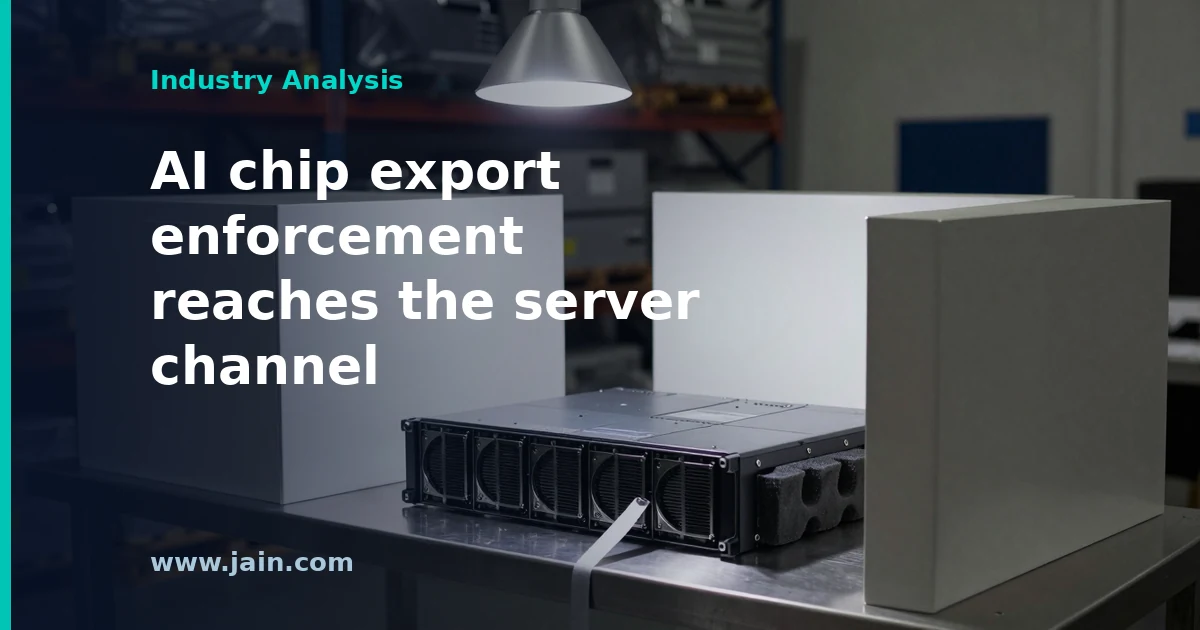
A contractor who worked with Super Micro, an American company that builds the powerful computers used to run artificial intelligence, has admitted in court to helping send those machines to China illegally. The scheme was valued at $2.5 billion.
The computers held chips from Nvidia, whose chips power much of today’s AI. US rules bar selling those advanced chips to China without government permission.
Why it matters: the case targets the people between the chipmaker and the final buyer, not the chipmaker itself. Enforcement is reaching further down the supply chain.
A contractor tied to Super Micro Computer has pleaded guilty in a scheme to divert AI servers containing Nvidia chips to China, Reuters reported. Coverage puts the scheme’s value at $2.5 billion and describes the contractor as a co-defendant of a Super Micro co-founder.
The plea comes in the same week Super Micro disclosed board changes in an 8-K filed October 8. That filing does not mention the export case.
Executive Summary
A guilty plea in a $2.5 billion AI server diversion scheme is among the clearest signals yet of where US export-control enforcement on AI hardware is landing. The equipment at issue was not loose chips but complete servers built around Nvidia GPUs (graphics processing units, the processors that do most AI computation). The person admitting guilt is a contractor, not an employee of the chipmaker.
That matters because it shifts the compliance burden. Export restrictions on advanced AI chips follow the chip into whatever system it is installed in. That makes everyone who builds, resells or ships those systems a potential point of failure, and of liability. For server makers, distributors and the data center operators who buy from them, the case is a reminder that end-user screening is part of the product, not paperwork around it.
The plea establishes guilt only for the person who entered it. Anything alleged against other defendants remains an allegation, and no charges against Super Micro as a company have been reported.
Where a GPU Becomes a Server, Control Gets Harder
Advanced AI chips leave Nvidia in large, traceable allocations to a relatively small set of server makers and cloud buyers. Once a GPU is installed in a server, it becomes one component inside a finished system. That system can then pass through distributors, contractors and resellers before reaching its final operator. US export rules still apply to the chip inside the box, but the chipmaker’s line of sight usually ends at its direct customer.
That gap is the mechanism this case exposes. The diverted goods were Super Micro AI servers with Nvidia chips inside, and the guilty party is a contractor in the server maker’s orbit. At a reported $2.5 billion, the scheme shows how much hardware value can move through the integration and resale layer, the stage after the chip is sold but before the system is plugged in. Controls written around the chip are only as strong as the checks at that downstream stage.
Those affected are the companies that sit between foundry and data hall: server builders, value-added resellers, logistics contractors, and the compliance teams that sign off on who the end user really is. Nvidia’s chips were in the boxes, but Nvidia is not reported to be a defendant and has made no material SEC filing on the matter. The enforcement weight in this case sits downstream.
What the Channel Now Has to Prove
For server makers and their partners, export compliance means knowing the end user and the end use, not just the immediate buyer. A diversion scheme works by putting a permissible-looking customer between the seller and a prohibited destination. A plea at the contractor level gives every company in that chain reason to scrutinize intermediaries, shipping patterns and resale terms more closely.
The economic effect is friction. Legitimate buyers of AI servers, from enterprise IT departments to colocation tenants, may face more documentation about where systems will be deployed and who will operate them. For integrators competing on speed of delivery during a GPU supply crunch, slower deal reviews carry a real cost. The case makes clear that the alternative cost is higher.
What Is and Isn’t Established About Super Micro
Super Micro is one of the largest builders of Nvidia-based AI servers, so any case involving its products draws attention to the company. The facts on the record are narrower than the headlines. A contractor has admitted guilt. A co-founder is described as a co-defendant, which is an allegation, not a finding. No charges against the company have been reported.
Super Micro’s most recent disclosure is an 8-K covering the appointment of former Intel IT chief technology officer Shesha Krishnapura as an independent director and the retirement of director Judy Lin. The filing states that Lin’s departure was not the result of any disagreement with the company, and it does not reference the case. Reading a connection into the timing would go beyond what either the plea or the filing supports.
Background
Since 2022 the United States has restricted exports of advanced AI chips and the systems built around them to China, through rules administered by the Commerce Department’s Bureau of Industry and Security and tightened in later rounds. Nvidia, the dominant supplier of AI accelerators, sells its GPUs largely through server makers and large cloud buyers, which turn them into finished systems.
Super Micro Computer, based in San Jose, California, is one of the biggest of those server makers and a major builder of Nvidia-based AI systems for data centers. Its fiscal year ended June 30, 2026. In early October it announced a board change, adding former Intel IT chief technology officer Shesha Krishnapura and accepting the retirement of director Judy Lin.
Nations are usually offered weapons, aid or trade deals to settle a conflict. The Wall Street Journal reports the United States offered something new: access to Nvidia’s artificial-intelligence chips, as part of the peace agreement it brokered between Armenia and Azerbaijan.
Those chips are the engines behind modern artificial intelligence. Nearly every government wants them, only one company makes the most sought-after ones, and Washington decides who is allowed to buy.
So computing power now sits on the negotiating table next to tanks and tariffs, and the rules about who gets it can change for reasons that have nothing to do with technology.
The Wall Street Journal reported that the United States used the promise of access to Nvidia chips as an inducement in brokering a peace deal between Armenia and Azerbaijan. The report places advanced AI accelerators — the graphics processing units, or GPUs, that train and run large AI models — alongside security guarantees and market access as instruments of American diplomacy.
Nvidia’s own disclosures do not address the matter. The company’s 8-K and second-quarter results filed August 26, 2026, its Form 10-Q of the same date, and the 8-K filed September 3 announcing a definitive agreement to acquire Hugging Face make no reference to either country. What those filings do establish is the scale of what is being offered and withheld: data center revenue of $89.0 billion in the quarter ended July 26, 2026, up 117% from a year earlier, and third-quarter guidance of $108.0 billion that assumes, in Nvidia’s words, no data center compute revenue from China.
Executive Summary
Export controls on AI accelerators began as a defensive measure — a way to slow a rival’s military and intelligence capabilities. The Armenia-Azerbaijan report describes something different in kind: chip access used affirmatively, as a reward offered to close a negotiation. If accurate, it marks the point at which compute stopped being merely a thing governments restrict and became a thing they spend.
That shift matters because the underlying asset is unusually well suited to the role. Advanced accelerators are scarce, concentrated in a handful of suppliers, already governed by a licensing regime, and legible to any head of state as a symbol of technological arrival. Nvidia’s second-quarter release documents how strong that appetite is: gigawatt-scale sovereign AI programs in Korea with SK Telecom, NAVER and Brookfield, a national AI infrastructure partnership with the Japanese government and industrial leaders, and a record 35 new AI supercomputers in development across Europe.
For infrastructure operators, the practical consequence is that policy risk now runs in both directions. The same filings that show demand also show a company guiding to $108.0 billion in quarterly revenue while assuming a major market contributes nothing, and committing to physical assets — data center leases of up to twenty years, guarantees capped at $105 billion — on timelines far longer than any political cycle.
Why Compute Works as Leverage
Diplomatic inducements need three properties: the recipient must want them badly, the giver must control them tightly, and they must be withdrawable. Advanced AI chips satisfy all three. Manufacturing is concentrated, the most capable parts are already subject to United States export licensing, and a license is a permission rather than a property right — it can be conditioned, narrowed or allowed to lapse as circumstances change.
The demand side is not speculative. Nvidia’s second-quarter release describes sovereign AI as a distinct customer class and lists national-scale programs: expanding Korea’s AI factory ecosystem at gigawatt scale, partnering with the Japanese government to launch what the company calls the world’s first national AI infrastructure, and 35 new AI high-performance-computing supercomputers under development across Europe. A country that cannot buy accelerators cannot host frontier training, cannot pitch itself as a regional cloud hub, and watches neighbors do both.
The analytical caution is that a promise of access is not the same as delivered hardware. Between an inducement and an installed cluster sit license applications, end-user screening, transformer capacity, grid interconnection, buildings and staff. Announcements of intent have historically outrun physical deployment by years, and nothing in the public record establishes where on that path this arrangement sits.
The China Line Already Priced Into Guidance
Nvidia’s own numbers show what happens when compute policy moves against a market. Shipments of data center Hopper products to China were less than 1% of data center revenue in the quarter, and the company’s third-quarter outlook of $108.0 billion plus or minus 2% explicitly assumes no data center compute revenue from China at all. That is a disclosed planning assumption, not a forecast of policy — but it is a remarkable one: a company can now guide to record revenue while zeroing out one of the world’s largest computing markets.
Read against the Armenia-Azerbaijan report, the symmetry is the point. If access can be granted to seal an agreement, it can be revoked when an agreement frays. Markets that open by diplomacy close the same way, and neither direction is underwritten by a contract that a supplier or an operator can enforce.
The evenhanded reading is that Nvidia’s exposure here is manageable at the corporate level and sharper further down the stack. With revenue of $96.2 billion in the quarter, up 106% year over year, and gross margins of 75.0%, the company has absorbed the loss of a large market without visible damage. A colocation provider that built to serve one geography does not have that cushion.
Long Leases, Short Policy Cycles
The infrastructure commitments in Nvidia’s disclosures are measured in decades. Supply commitments rose from $119 billion in the prior quarter to $279 billion, primarily for memory procurement. Data center leases run terms of up to twenty years, commencing between the third quarter of fiscal 2027 and fiscal 2033. In August 2026, Nvidia entered guarantees supporting the land, power and shell buildout for approximately 4.25 gigawatts at SB Energy’s PORTS-Pike Technology Campus in Ohio — a scale comparable to the output of several large power plants — which will exclusively host Nvidia infrastructure under twenty-year leases to OpenAI, with guarantee obligations capped at $105 billion and effective in phases as conditions such as readiness for service are met.
Set a twenty-year lease against an export-control regime that can be rewritten by a single administrative action, and the duration mismatch becomes the central financing question of this cycle. Concrete, substations and memory contracts do not reprice when a licensing posture changes. Nvidia has also disclosed that it signed roughly fifteen-year leases commencing in fiscal 2028 and 2029 that it expects to reassign to third parties, and that its maximum gross exposure under other land, power and shell guarantees is $3.5 billion — useful markers of how much balance-sheet risk is being intermediated between chipmaker, cloud and landlord.
None of this is evidence of trouble. It is evidence that the industry’s capital structure now assumes political stability in export policy over horizons that no government has ever guaranteed. Anyone underwriting a fifteen- or twenty-year asset should be able to say what the residual value is if the intended end market becomes unlicensable.
Compliance Migrates Downstream
When chip access travels as part of a diplomatic package, conditions travel with it: approved end users, permitted applications, restrictions on re-export and on remote access from third countries. Those conditions are enforced not in Washington but at the rack — by the colocation operator that knows who is in the cage, and by the cloud provider that knows whose workload is running. Operators serving newly permitted jurisdictions should expect know-your-customer obligations, end-use attestations and audit rights to become standard contract terms rather than legal boilerplate.
The model layer carries a parallel exposure, and Nvidia said so itself. In the September 3 8-K announcing the $11.9 billion agreement to acquire Hugging Face, the company added a risk factor warning that governments may impose new requirements governing the development, training, release, distribution, access, transfer, deployment or use of AI models, including open-source models. It goes further, noting that many of the world’s most popular open models originated in China and are then downloaded and fine-tuned by developers worldwide, and that restrictions on supporting models derived from any region could have a material impact.
That is an unusually direct statement of the theme this story illustrates. The same company that benefits when compute is used to open a door is telling investors, in a filed document, that policy can close doors around hardware and software alike. For buyers, the practical takeaway is to treat regulatory contingency as a procurement question — portability of workloads, jurisdictional diversity of capacity, and contractual remedies if a supply route is closed by rule rather than by failure.
Background
Nvidia designs the graphics processing units that became the default hardware for training and running large AI models, together with the CUDA software layer that keeps developers on its platform. Since 2022, successive United States rules have restricted sales of the most capable accelerators to China, turning a commercial product line into an instrument of national technology policy. The company has since built a second demand base among governments buying so-called sovereign AI capacity, so that the same hardware is simultaneously withheld from some states and courted by others.
The scale of the current buildout is what makes policy decisions consequential. Nvidia’s latest quarter shows $96.2 billion of revenue and $89.0 billion from data centers, supply commitments of $279 billion, data center leases running up to twenty years, and guarantee structures that place the chipmaker between AI clouds, model developers and the landlords financing gigawatt-scale campuses. Compute is no longer a component purchase; it is long-lived infrastructure whose value depends on rules that can change without notice.
A market-news report from Stocktwits says four Taiwan-based staff have been detained in connection with an alleged illegal export of Nvidia artificial-intelligence chips, and that shares of Super Micro Computer (SMCI) — the San Jose-based maker of GPU servers — rose in premarket trading on the news. Super Micro operates significant manufacturing and engineering capacity in Taiwan, which places its regional workforce and supplier network within the geography where the alleged conduct is said to have occurred.
The item circulated as a headline and summary through a news aggregator; the underlying report was not accompanied by charging documents, an official statement from any prosecuting authority, or a company response in the material available to us. No individuals are named, no chip volumes or destinations are specified, and the four detained people have not been convicted of anything. Detention in many jurisdictions, including Taiwan, is an investigative step rather than a finding of guilt.
Executive Summary
What was announced is narrower than the headline implies. The substantiated content is that a financial-news outlet reported detentions connected to an alleged illegal Nvidia chip export, and that SMCI traded higher before the opening bell. The reporting does not, in the material available, establish that the detained individuals are Super Micro employees, that Super Micro is a subject or target of the investigation, or that any of the company’s products were diverted. Readers should hold those as open questions rather than assumptions.
It matters anyway, and for a reason that has little to do with guilt or innocence. Advanced AI accelerators — the high-end graphics processors that train and run large AI models — are now among the most tightly controlled commercial goods in the world. Washington restricts their sale to China and several other destinations, and Taiwan has tightened its own strategic high-tech export rules. Any server vendor that builds GPU systems at scale sits inside that control perimeter, and enforcement actions anywhere along the chain create legal, operational, and reputational exposure.
For buyers and investors, the practical question is not whether this particular case is proven. It is whether the vendors they depend on can demonstrate know-your-customer discipline, end-use verification, and channel controls strong enough that a single rogue transaction — by an employee, a distributor, or a reseller three steps removed — does not interrupt supply or trigger regulatory action. That capability is becoming a genuine differentiator in AI infrastructure procurement.
What the Report Establishes, and What It Does Not
Careful readers should separate three claims that the headline blends together. First: that four people based in Taiwan were detained. Second: that the detentions relate to an alleged illegal export of Nvidia chips. Third: that this is a Super Micro story. The first two are what the report asserts. The third is an inference — reasonable, given the company’s Taiwanese footprint and the fact that the item ran on an SMCI watchlist, but an inference nonetheless. The source material available to us does not name an employer, an authority, a destination country, or a product line.
This is not a reason to dismiss the story. Export-control enforcement is real, ongoing, and has repeatedly touched intermediaries in Asia. It is a reason to be precise about exposure. A company whose employee is accused of wrongdoing faces a different problem from a company whose products were diverted by an unrelated broker, which in turn is different from a company that is itself under investigation. Those three scenarios carry very different consequences for penalties, licence privileges, and customer contracts, and nothing in the available reporting distinguishes among them.
The fair standard to apply is the one any responsible outlet would apply to an activist claim or a short-seller thesis: what evidence is on the table, who produced it, and what would change the conclusion? Here, the evidence is a single aggregated news item. That is enough to warrant attention and enough to justify questions. It is not enough to support a verdict about any company or person.
Export Controls Have Become a Supply Chain Design Problem
For most of the past three decades, server manufacturing optimised for cost, speed, and thermal engineering. Compliance was a back-office function. The AI buildout changed that. High-end accelerators command scarcity pricing, and scarcity pricing creates arbitrage: a chip that cannot legally reach a restricted buyer is worth far more there than at list price. Wherever that gap exists, so does an incentive for diversion — routing goods through a permitted destination and onward to a prohibited one, often via a chain of small trading firms.
That economic pressure lands hardest on the assembly and integration layer, where Super Micro and its peers operate. Server builders touch enormous volumes of controlled silicon, ship to a global reseller channel, and often configure systems for customers they never meet directly. Every one of those handoffs is a place where end-use assurances can fail. Controlling it requires customer screening, shipment tracking, contractual flow-down obligations on resellers, and internal separation of duties — the same discipline banks apply to anti-money-laundering, applied to hardware.
The commercial consequence is a compliance premium. Vendors that can evidence robust controls become safer counterparties for hyperscalers, sovereign AI programmes, and regulated enterprises, all of which face their own supply chain diligence obligations. Vendors that cannot may find themselves priced out of exactly the large, long-horizon contracts that justify capacity investment. Compliance capability is migrating from cost centre to sales asset.
Why the Stock Rose, and What That Signals
SMCI shares moving higher on a story about detentions in an export case looks counterintuitive, but it is a familiar pattern. Equity markets price incremental information against expectations. If investors already assign meaningful probability to regulatory and compliance friction around a name, a report that contains no charges against the company, no quantified financial impact, and no disclosed licence action can resolve as less bad than feared. Premarket trading is also thin, and a single session’s move is weak evidence about anything.
The more durable read is about what the market is actually watching. Demand for GPU server capacity has been the dominant driver for this category of stock, and headlines that do not change the demand picture or the ability to ship tend to fade quickly. That calculus reverses sharply if an enforcement action ever restricts a vendor’s access to controlled components or its right to export — which is the tail risk worth monitoring, not the headline itself.
For institutional buyers, the signal to track is disclosure behaviour. Companies with mature compliance functions typically respond to enforcement reporting with a clear statement of scope: whether they are a subject, whether they are cooperating, whether operations are affected. Silence is not evidence of wrongdoing, but a prompt, specific response is genuine evidence of governance quality, and it is reasonable for customers to weigh it.
Background
Super Micro Computer builds server and storage systems and became one of the most visible beneficiaries of the AI infrastructure boom, supplying dense GPU platforms and liquid-cooled rack systems to data centre operators. Its model depends on rapid configuration and a broad global reseller channel, alongside manufacturing operations in the United States, Taiwan, and elsewhere. The company drew significant investor scrutiny during 2024 and 2025 over delayed financial filings and its auditor’s resignation, and subsequently completed its filings and regained compliance with Nasdaq listing requirements — history that helps explain why governance-adjacent headlines attract outsized attention on this name.
The broader context is a decade-long tightening of technology export policy. Successive US rules have restricted the sale of advanced AI accelerators and semiconductor manufacturing equipment to China and other destinations, and allied jurisdictions including Taiwan have expanded their own strategic high-tech control lists. Because scarce, high-value chips create strong arbitrage incentives, enforcement has increasingly focused on intermediaries — trading firms, resellers, and logistics providers — rather than only on primary manufacturers.
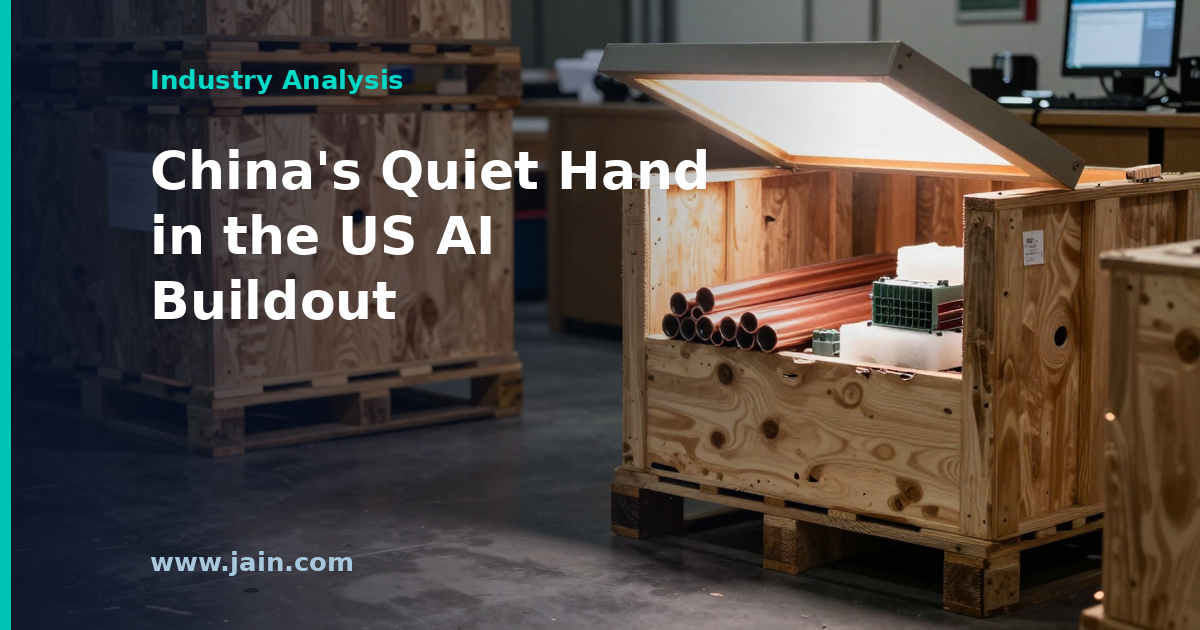
Axios reported on May 21, 2026 that Chinese-made components and materials are quietly flowing into the United States data-center construction boom, even as Washington tightens export controls on advanced chips headed the other direction. The piece frames the dependency as a geopolitical risk for the AI infrastructure now being stood up at record pace.
Executive Summary
The Axios story argues that America’s data-center surge — the physical backbone of the current AI wave — leans on a supply chain in which Chinese firms still play a meaningful, if under-discussed, role. That includes hardware, electrical gear, and construction inputs sourced directly or through intermediaries.
The reason it matters is straightforward: policymakers have spent two years hardening the outbound side of the US–China technology relationship, restricting what advanced silicon and tools American companies can sell to Chinese buyers. The inbound side of the same relationship — what the US buys to build the facilities that host AI — has drawn far less scrutiny, and the article suggests that gap is now visible in the numbers.
The Buildout Nobody Fully Sourced
Hyperscale data-center construction is a bill of materials problem as much as a real-estate problem. A single campus consumes transformers, switchgear, busways, generators, cabling, cooling coils, racks, and structural steel in volumes that already exceed what Western manufacturers can supply on the timelines operators want. When Tier-1 vendors are booked out, buyers turn to whoever can ship — and Chinese factories remain the marginal supplier for a long list of electrical and mechanical components. The Axios framing is that this quiet substitution is bigger than the industry publicly acknowledges.
None of that is inherently a scandal; global sourcing is how infrastructure gets built. It becomes a policy question when the same components sit inside facilities that host frontier AI training runs, defense workloads, or critical services, and when the exporting country is also the strategic competitor the export-control regime is designed around.
Asymmetric Controls, Symmetric Exposure
US policy since 2022 has focused almost entirely on the outbound flow: chips, chip-making equipment, and increasingly the model weights and cloud capacity that could be used to train frontier AI abroad. The inbound flow — grid-scale transformers, power distribution units, network gear, cooling hardware — has been governed by a patchwork of tariffs, Section 232 reviews, and Buy American rules that were not designed with AI infrastructure in mind.
If the Axios reporting holds, the practical implication is that America’s ability to build AI capacity is partly gated by a country it is simultaneously trying to slow down in AI. That is a fragile equilibrium: a future round of tariffs or export restrictions from either side could stretch already long lead times for the exact components operators need most.
Who Gains, Who Gets Squeezed
Western manufacturers of transformers, switchgear, and cooling equipment stand to benefit if buyers and regulators push harder on country-of-origin — but only if they can add capacity, which takes years and skilled labor that is itself in short supply. Hyperscalers with the balance sheets to pre-buy multi-year allocations from domestic and allied suppliers are best positioned; smaller colocation operators and enterprise builders, who buy in smaller lots and later in the cycle, would feel any supply squeeze first.
For AI customers, the second-order effect is schedule risk. A data-center delivery pushed from Q2 to Q4 because a Chinese-sourced transformer was reclassified or a substitute part is on allocation translates directly into delayed GPU deployments and delayed model training. In an environment where compute is the binding constraint on product roadmaps, that is a real cost.
Reading the Claim Carefully
The Axios piece is a framing article, not a forensic supply-chain audit, and the responsible read is to hold both possibilities open. It is plausible that Chinese content in US data-center construction is material and under-reported, given how opaque multi-tier supply chains are. It is also fair to ask how much of the reported exposure is finished Chinese-branded equipment versus subcomponents inside Western-branded gear, and how much is displaceable at reasonable cost versus genuinely single-sourced. Those distinctions determine whether this is a policy problem, a procurement problem, or a headline.
Background
The US data-center industry is in the middle of the largest capacity expansion in its history, driven by generative AI training and inference demand from hyperscalers and a new tier of AI-native operators. That expansion has already collided with constraints on grid interconnection, transformer supply, water, and permitting.
In parallel, the US and China have spent the past several years decoupling on advanced semiconductors, with successive rounds of US export controls on chips and chip-making tools and Chinese retaliation on critical minerals. The Axios story sits at the intersection of those two trends, arguing that the physical layer of the AI economy is still more entangled with China than the policy conversation has acknowledged.