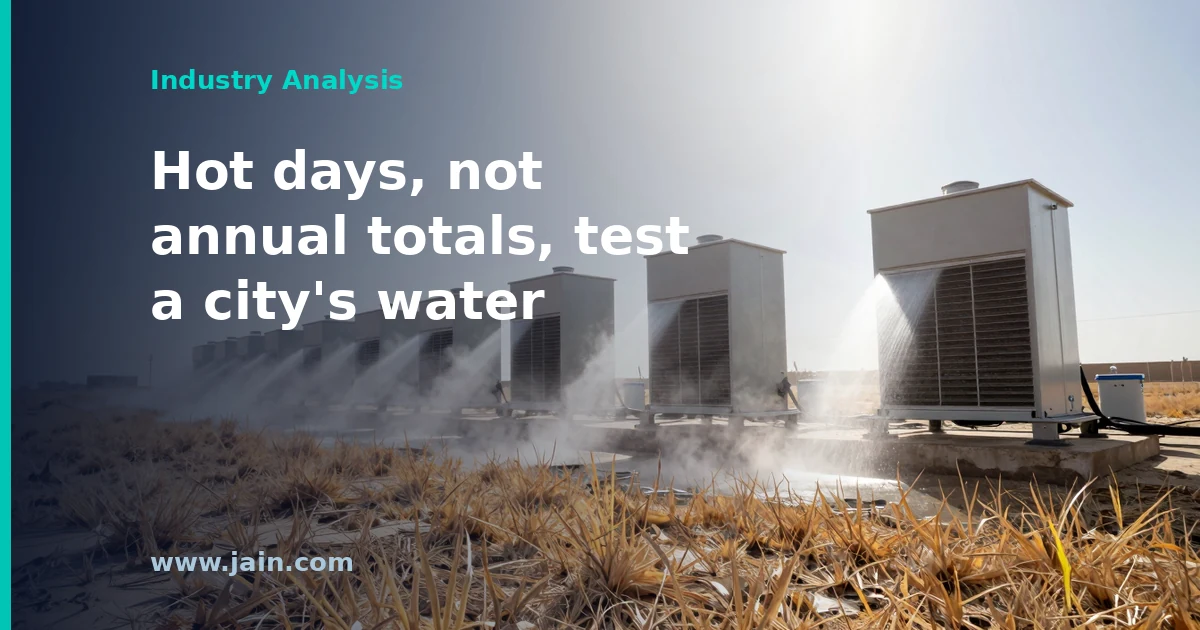
A company wants to build a data center, a large building full of computers, in Salem, Oregon. On the hottest days, its design lets it use up to 3 million gallons of water, about four and a half Olympic swimming pools, mostly to keep those computers cool.
Over a full year it expects to use far less, about 39 million gallons. The catch is timing: its thirstiest days are the same hot days when everyone else in town is also using the most water.
Salem’s city council is now discussing whether to pause projects like this.
A data center proposed for Salem, Oregon, is designed to use up to 3 million gallons of water a day on the city’s hottest days and roughly 39 million gallons over a full year, the Salem Reporter reported on August 5, 2026. The figures describe the first phase of a proposed multi-phase project from developer Verrus.
The numbers arrive as local opposition grows. Residents holding signs against the project attended a Salem City Council meeting this summer, where the council heard public comment and discussed the process for a possible moratorium on the project.
Executive Summary
The two water figures attached to Salem’s proposed data center describe very different things. Roughly 39 million gallons a year works out to an average of about 107,000 gallons a day. The design peak of 3 million gallons on the hottest days is roughly 28 times that average. The annual number describes volume; the peak number describes how much capacity the city’s water system must be able to deliver on a single day.
That distinction matters because water systems are sized, and water is rationed, around the highest-demand days of the year. A facility whose use spikes during heat waves asks for the most water precisely when residential and irrigation demand is also at its maximum and western Oregon is in its dry season.
For the wider data center industry, Salem is a preview of the question operators will increasingly face: not how much water a campus uses in a year, but how much it needs on the worst day, and who gets priority when the two collide.
The Number That Matters Is the Peak Day
An annual figure of 39 million gallons sounds modest next to a city’s total water use, and that is the figure most likely to appear in a sustainability report. But the arithmetic behind the two disclosed numbers tells a different story. Spread evenly, 39 million gallons is about 107,000 gallons a day. The 3-million-gallon design peak is roughly 28 times that. Put another way, just 13 days at full peak would consume the entire annual total. The facility’s water demand is not a steady trickle; it is a low baseline with sharp spikes tied to temperature.
Water utilities plan around those spikes. Treatment plants, pumps, pipes and storage reservoirs are built to meet the maximum-day demand, not the yearly average, because running short on one hot afternoon is the failure that matters. A large user whose demand concentrates in heat waves therefore consumes a disproportionate share of the system’s capacity, even if its annual share looks small. That is why the annual figure understates the strain, and why the peak figure is the one city engineers and councils need to evaluate.
The people most affected are the ones already competing for water on those days: households watering lawns and gardens, farms irrigating crops, and the rivers that carry less water in late summer. A data center’s peak does not create that summer squeeze, but it lands directly on top of it.
Why Cooling Demand Tracks the Thermometer
Data centers turn nearly all the electricity they use into heat, and that heat has to go somewhere. One of the most energy-efficient ways to move it out is evaporation: warm water passes through cooling towers, some of it evaporates, and the evaporation carries heat away, much as sweat cools a person. The hotter and drier the outside air, the more water that approach consumes. A design that uses little water most of the year but spikes on hot days is the typical signature of cooling that leans on evaporation when outside air alone is not enough.
The alternative, often described as closed-loop or dry cooling, recirculates the same water and rejects heat through fans and chillers, much like a car radiator. It uses far less water but more electricity, and its electricity demand also rises on hot days, when the regional power grid is under its own peak load. Neither choice is free. The design decision determines whether a facility leans on the water system or the power system during a heat wave, and on the hottest days both are stretched.
A First Phase, and a Council Weighing a Pause
The disclosed figures cover only the first phase of a multi-phase project. Whether later phases would add proportionally to peak water demand, use a different cooling design, or rely on another water source has a direct bearing on how the city should read the first-phase numbers. A peak figure that is manageable for one building could look different across a full campus.
The council’s discussion of a possible moratorium reflects how quickly the conversation shifts once peak-day figures are public. Communities elsewhere have used tools short of an outright pause: caps on peak-day withdrawals, contracts requiring a facility to curtail water use during declared shortages, requirements to use recycled rather than drinking water, and on-site storage that fills during cool periods. Which of these, if any, are on the table in Salem is not yet clear, but they show that the peak problem has engineering and contractual answers, not only yes-or-no ones.
Background
Salem is Oregon’s capital, and Oregon has long been a data center destination, with large campuses in Hillsboro west of Portland and along the Columbia River in The Dalles and in Central Oregon at Prineville. Cool climates, available land and access to power have drawn operators, and water has become a recurring point of friction: in The Dalles, the scale of Google’s water use became public only after a public-records dispute.
Across the industry, water disclosure has lagged behind energy disclosure. Operators often report annual totals or efficiency ratios in sustainability reports, but peak-day demand, the figure that determines how much capacity a municipal system must provide, is rarely published. As data center demand grows, local governments are increasingly asking for that number before approving new campuses.
Forbes reported on July 10, 2026 that a Meta AI data center has been linked to rare bacteria detected in a city’s water system — a striking escalation of the long-running debate over how much water AI data centers consume, into a question about what they may put back. The headline alone frames the story; the publicly circulated material does not name the city, identify the bacteria, or explain the mechanism of the alleged link.
The report lands as Meta and its hyperscale peers are in the middle of the largest data center construction wave in history, much of it cooled — directly or indirectly — with municipal water.
Executive Summary
According to Forbes, a Meta data center built to serve the company’s artificial-intelligence workloads has been connected to the presence of a rare bacteria in the water system of a nearby city. If substantiated, this would mark a significant shift in the data center water debate: for years the argument has centered on quantity — how many millions of gallons evaporative cooling draws from local supplies — while this story raises a quality and public-health dimension.
Why it matters: water is the quiet dependency of the AI buildout. Many large data centers use evaporative cooling, in which water absorbs server heat and is partially evaporated away, because it is dramatically more energy-efficient than pure air-based cooling. That efficiency comes with entanglement — data centers become major customers of, and in some configurations discharge back into, the same municipal systems that serve residents.
Important caveat up front: ‘linked’ is doing heavy lifting in this headline. The available material does not establish causation, name a health authority’s finding, or describe Meta’s response. This article analyzes the stakes while flagging exactly what remains unverified.
When the Water Debate Becomes a Public-Health Story
Data center water use has been a community flashpoint for several years, but the framing has been almost entirely volumetric: how many gallons per day, whether aquifers or reservoirs can sustain it, and whether households pay more as a result. A bacteria-in-the-water-system story changes the emotional and regulatory register entirely. Volume disputes are negotiated in rate cases and zoning hearings; contamination questions summon health departments, environmental regulators, and — fairly or not — a much deeper reservoir of public anxiety.
Mechanically, there are plausible pathways for a large industrial water user to interact with a municipal system’s water quality: heavy draws can change pressure and flow patterns in distribution pipes, warm discharge or blowdown water (the mineral-concentrated water periodically flushed from cooling systems) must be treated and returned somewhere, and large open-loop cooling towers are themselves known habitats for waterborne bacteria such as Legionella. To be clear, none of these mechanisms is confirmed in this case — the source material does not say which, if any, applies. But they explain why a ‘link’ claim is at least technically conceivable rather than absurd on its face.
What ‘Linked’ Does and Does Not Establish
The scrutiny has to run in every direction. For the reporting: what evidence supports the link — sampling data, a utility investigation, a health-department finding, or expert inference? Correlation between a new industrial water customer and a new detection is not causation; municipal systems detect unusual organisms for many reasons, including aging pipes, source-water changes, and improved testing. For Meta: what water does the facility draw, what does it discharge, under what permit, and what monitoring does it publish? For the utility and local officials: what does the testing history show before and after the facility came online, and has anyone actually been harmed?
The honest answer, based on what has circulated publicly, is that we cannot yet distinguish between three very different stories: a genuine contamination pathway traced to the facility, a coincidental detection amplified by the data center’s high profile, or something in between — for example, system stress that made an existing problem visible. Each has radically different implications, and readers should hold all three open until primary documents surface.
The Economics of Water in the AI Buildout
Hyperscalers use water because physics and economics reward it. Evaporative cooling can cut a facility’s cooling energy dramatically compared with mechanical chillers, lowering both operating cost and the grid capacity a site must secure — often the binding constraint on AI campuses measured in hundreds of megawatts. The industry’s own metric, water usage effectiveness (WUE), exists precisely because operators know the trade-off is real: save electrons, spend water.
That calculus is shifting. Direct-to-chip liquid cooling and closed-loop systems — which recirculate a fixed volume of water or coolant rather than continuously evaporating fresh supply — are increasingly standard for dense AI hardware, and several operators have announced designs that consume little or no water for cooling. A public-health controversy, even an ultimately unproven one, accelerates that shift by adding reputational and permitting risk to the cost side of the evaporative-cooling ledger. Communities negotiating with data center developers now have one more reason to demand closed-loop designs, discharge transparency, and independent water-quality monitoring as conditions of approval.
Winners, Losers, and the Precedent That Matters
If the link is substantiated, the losers are obvious: the affected community first, then Meta’s siting pipeline, and then every operator whose pending permits get re-examined through a public-health lens. The beneficiaries would be vendors of waterless and closed-loop cooling, water-treatment and monitoring firms, and jurisdictions that wrote strong discharge and reporting requirements into their agreements and can now point to them.
If the link is not substantiated, the story still matters, because permitting battles run on narrative as much as data. The industry has often been slow to publish site-level water data, treating it as competitively sensitive; that opacity leaves a vacuum that headlines fill. The durable lesson either way is that transparency is cheaper than suspicion: operators who publish withdrawal, discharge, and monitoring data before a controversy get to argue from their own numbers rather than someone else’s framing.
Background
Meta operates one of the world’s largest data center fleets and has been expanding it aggressively to support its artificial-intelligence ambitions, with new campuses whose power demands are measured in the hundreds of megawatts and beyond. Like its hyperscale peers, the company has faced recurring community scrutiny over local resource impacts — power, land, and especially water — and, like those peers, has publicized water-restoration commitments intended to offset consumption.
Until now, the water controversy around AI infrastructure has been overwhelmingly about scarcity: whether local systems can supply large evaporative-cooling loads without straining households and agriculture. A report tying a facility to bacteria in a municipal system — whatever its ultimate substantiation — moves the debate from resource competition to public health, a categorically more sensitive terrain for operators, regulators, and residents alike.
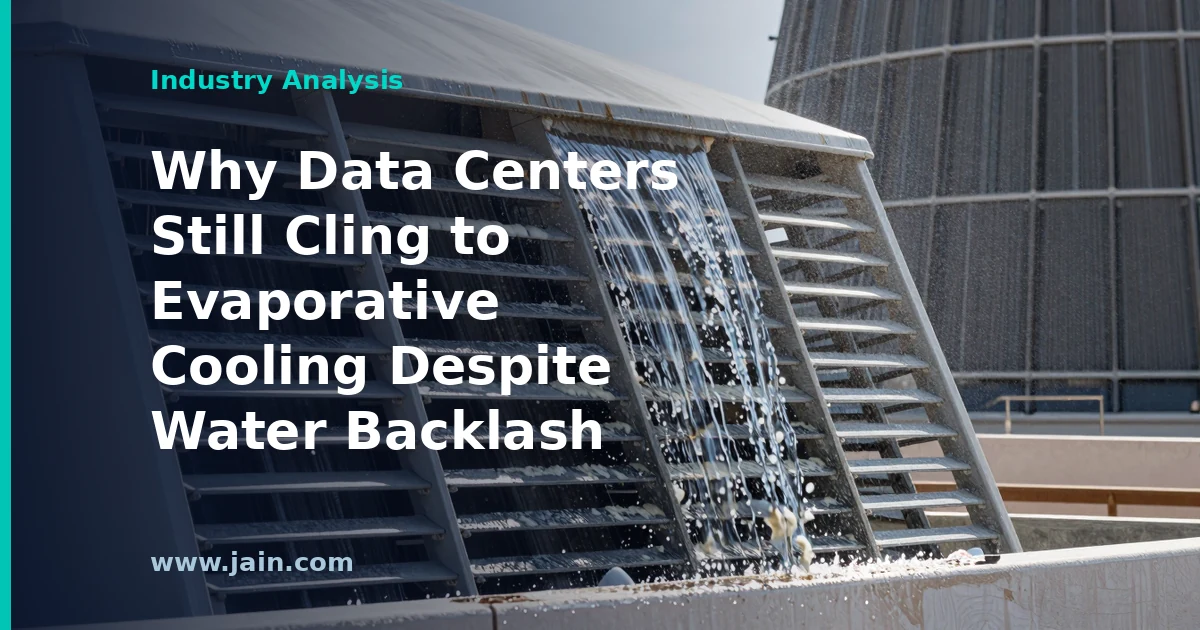
Data Center Knowledge published a report on June 18, 2026 examining why the data center industry continues to rely on evaporative cooling — a heat-rejection method that consumes large volumes of water — even as public and regulatory backlash over water use intensifies. The piece frames the industry’s position as hesitation rather than refusal: operators broadly acknowledge the water problem but have been slow to abandon a technology that remains cheaper and more energy-efficient than the alternatives.
Executive Summary
The report’s core subject is a tension the industry has lived with for years and that the AI build-out has sharpened: evaporative cooling rejects heat by evaporating water, which makes it highly energy-efficient but water-hungry, while the main alternatives — dry (air-cooled) systems and refrigerant-based chillers — save water at the cost of higher electricity consumption, larger equipment footprints, or both. In markets where power is the scarcest commodity a data center can buy, trading water savings for a bigger electrical load is not a simple upgrade; it is a genuine engineering and economic trade-off.
That trade-off is why the headline speaks of hesitation. Operators face mounting pressure from drought-affected communities, local governments, and sustainability commitments to cut water use, and technologies such as closed-loop liquid cooling and hybrid systems are maturing. But retrofitting existing facilities is expensive, and for new builds the calculus depends heavily on local climate, water price, and power availability — variables that differ from one metro to the next. The result is an industry moving unevenly rather than uniformly, which is precisely the dynamic worth understanding for anyone siting capacity or evaluating operators’ sustainability claims.
The Water-for-Energy Trade at the Heart of Cooling
Every data center must move heat from chips to the outside world, and the physics offers no free option. Evaporative systems — cooling towers and their variants — exploit the fact that evaporating water absorbs enormous amounts of heat, which lets a facility reject heat with comparatively little electricity. Dry coolers and air-cooled chillers avoid consuming water but must push heat into the air mechanically, which takes more fan and compressor power, especially on hot days when the temperature difference working in the operator’s favor shrinks. In plain terms: saving water usually means burning more electricity, and in an era when grid connections are the binding constraint on data center growth, extra megawatts spent on cooling are megawatts not available for revenue-generating compute.
This is the economic logic the Data Center Knowledge piece points at with its framing of industry hesitation. An operator that switches a large campus from evaporative to dry cooling is not just paying for new equipment; it is accepting a permanently higher power draw — degrading power usage effectiveness, the industry’s standard efficiency metric — and potentially reducing the sellable IT capacity of a power-constrained site. Where water is cheap and power is scarce, the incumbent technology keeps winning on spreadsheets even as it loses in public opinion.
Why the Backlash Is Getting Harder to Price at Zero
For most of the industry’s history, water was effectively an afterthought in site selection — abundant, inexpensive, and invisible to the public. That has changed. Data center water consumption has become a recurring flashpoint in drought-prone regions, a subject of local permitting fights, and a standard line of questioning for journalists and community groups evaluating new projects. Operators now routinely publish water usage effectiveness figures and, in some cases, commit to becoming “water positive” — replenishing more water than they consume.
The practical consequence is that water carries a growing shadow price beyond the utility bill: longer permitting timelines, conditions attached to approvals, reputational exposure, and in the worst case the loss of a site altogether. The report’s premise — that the industry hesitates rather than transitions — suggests that many operators still judge those risks manageable relative to the hard costs of switching. Whether that judgment holds depends largely on how regulators and communities act next, which varies enormously by jurisdiction.
The Alternatives Are Real, but Not Drop-In
The transition options are well understood in engineering terms. Dry cooling eliminates onsite water evaporation at the cost of energy and space. Hybrid systems run dry most of the year and evaporate water only during peak heat, cutting consumption substantially without the full energy penalty. Direct-to-chip liquid cooling and immersion cooling — increasingly common in AI deployments because high-density chips demand them — move heat in closed loops that consume little or no water onsite, though the heat still has to be rejected somewhere, and that final stage can itself be wet or dry. None of these is a simple swap for an operating facility: cooling infrastructure is capital-intensive, deeply integrated with a building’s design, and typically replaced on decade-plus cycles.
That replacement cycle is the quiet variable in the whole debate. The realistic path for the industry is less about retrofitting the installed base and more about what gets designed into the enormous wave of new construction now underway. If new AI-era facilities standardize on low-water designs where climate and economics allow, the fleet’s water profile shifts over years, not quarters. If they default to evaporative cooling because power constraints dominate, the backlash the report describes is likely to intensify.
Winners, Losers, and the Siting Chessboard
The cooling transition redistributes advantage. Cooler, water-rich regions gain appeal because they make both wet and dry cooling cheaper; hot, arid markets that boomed on cheap land and power face the sharpest version of the water-versus-energy dilemma. Vendors of hybrid and liquid cooling systems benefit from every tightening of water rules. Utilities and municipalities gain leverage, since water service is becoming a negotiated element of large deals rather than a formality. And operators that invested early in low-water designs acquire a permitting and public-relations asset that is difficult for laggards to replicate quickly. Buyers of colocation and cloud capacity should read cooling architecture as a proxy for siting risk: a facility’s water dependence is now part of its long-term cost and continuity profile.
Background
Cooling is one of the two great resource demands of data centers, alongside electricity: every watt a server consumes becomes heat that must be removed. For decades, evaporative cooling towers have been a workhorse of large-scale heat rejection across many industries because evaporating water is thermodynamically cheap. Data centers adopted the approach widely as the industry scaled through the cloud era, and it helped drive the sector’s headline efficiency gains. The AI construction boom that accelerated through the mid-2020s raised the stakes on both sides of the equation — far denser computing produces far more heat, while the communities hosting these facilities have grown increasingly vocal about local water and power impacts. Trade publication Data Center Knowledge, which published the report discussed here, has tracked this cooling debate as one of the defining infrastructure questions of the AI build-out.
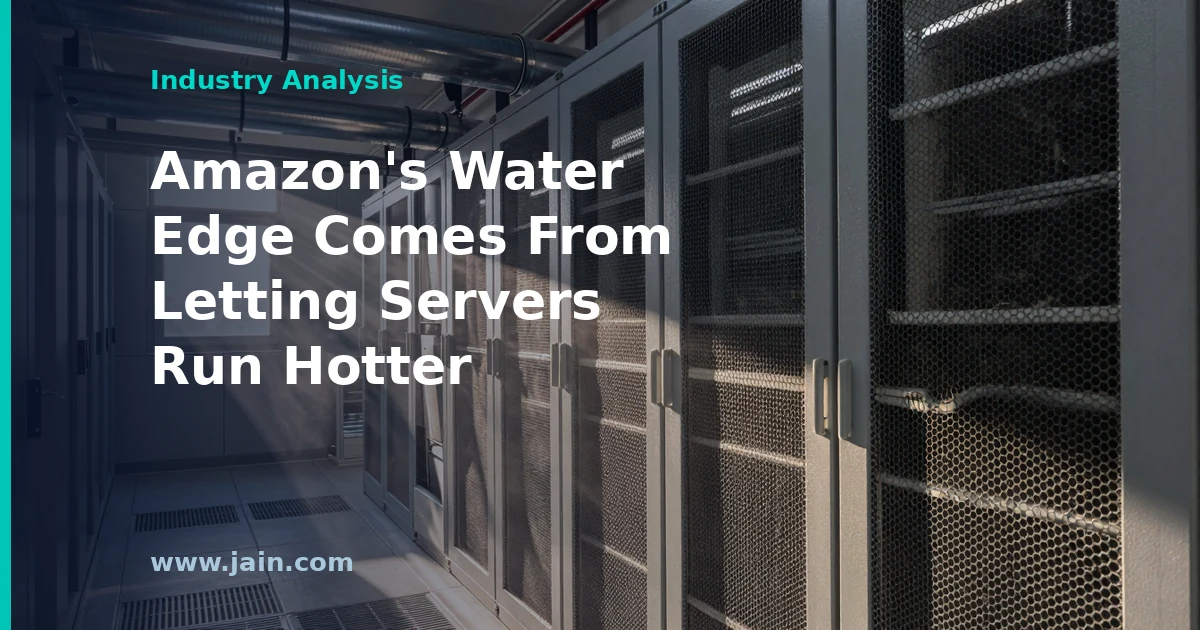
Amazon says the buildings that run its websites, apps and artificial intelligence services use about one-seventh the water of a typical facility of their kind.
The main trick is letting the computers run warmer. Outside air cools the buildings about 90% of the time. Water is used only when it is hotter than about 85 degrees Fahrenheit outside.
This matters because these buildings are multiplying, and their neighbors want to know how much local water they take. The open question is whether the newest artificial intelligence chips, which Amazon says needed a new kind of liquid cooling, will let that approach last.
Amazon said in a June 11, 2026 post on its About Amazon site that its global data center operations used 0.12 liters of water per kilowatt-hour (L/kWh) in 2025. The company puts that at more than seven times better than an industry average of 0.84 L/kWh and says it is a 52% improvement since 2021. It withdrew about 2.5 billion gallons of water across its global data center footprint in 2025.
Amazon credits two things for the result. The first is free-air cooling, which it uses about 90% of the time. The second is higher server temperature limits, so that evaporative cooling runs only when outside air is above roughly 85°F. The company also said it is 75% of the way to its 2030 water-positive goal and that it runs 26 facilities on 100% reclaimed water, with 130 more contracted.
Executive Summary
Amazon has published a headline water-efficiency figure for its data centers: 0.12 liters of water for every kilowatt-hour of energy in 2025. It set that against an industry average of 0.84. The company explains how it got there. It relies on outside air for most cooling, uses evaporative cooling only in the hottest hours, and has spent several years raising the temperatures its servers are allowed to run at. It says this cut water use without raising hardware failure rates.
The figure matters because water has become one of the main local questions asked of new data center campuses. Amazon’s explanation also shows that water efficiency is a set of engineering trade-offs, not a fixed property of a building. The company chose to use some water on hot days rather than run chillers, which it says need 25% to 35% more electricity at the moments the grid is most stressed.
Two things are harder to assess. One is the comparison itself: Amazon did not publish how the 0.84 average was built or on what basis each peer’s figure is measured. The other is the future. Amazon says denser AI chips already required a custom liquid cooling system, so the air-first approach behind the 7x figure now has to hold up as AI capacity grows.
The Water Number Is Really a Temperature Number
Amazon’s 0.12 liters per kilowatt-hour did not come from a new water technology. It came from deciding how rarely to use water at all. About 90% of the time, Amazon says, its data centers use free-air cooling. Outside air is drawn past the servers and pushed back out, with no water involved. Water comes into play only through evaporative cooling. In that process, hot air passes through a water-soaked medium and cools by five to 10 degrees as the water evaporates. Amazon now switches that on only when outside air exceeds roughly 85°F.
That threshold is the lever. Every degree of heat the servers can tolerate removes hours from the evaporative season, so raising operating temperatures cuts water use directly. Amazon’s own evidence is specific:
Two identical data centers on the same campus, one running hotter, differed by about 50% in water use.
Northern Virginia, its largest region by IT load (the power drawn by the computing equipment itself), cut water use 42% year over year while demand grew.
Thousands of hours of campus data showed no increase in failure rates at the higher temperatures.
Those results fit the 52% efficiency improvement Amazon reports since 2021.
The same logic is why this is a test for AI-era cooling. The approach depends on air being able to carry heat away from the servers. Amazon itself says denser, more powerful AI chips required a completely custom liquid cooling system. It has not said how much of its fleet now runs that way, whether those systems rely on evaporative water on hot days, or how a growing share of AI capacity will move the 0.12 figure. The air-first playbook behind the 7x gap was proven on the fleet Amazon has run since 2021. Whether it carries over to high-density AI halls is the next data point to watch.
Water or Watts: The Trade Behind the Ratio
Amazon is explicit that a low water number is partly a choice about electricity. The alternative it names is chillers, which work like giant air conditioners and, by Amazon’s figures, typically need 25% to 35% more electricity. The timing of that extra load is the problem. It arrives in the hottest hours, when household air conditioning is already straining the grid. Amazon concluded it is better to spend some water on those days than to add power demand at the peak.
That is a defensible engineering position, and it cuts against a simple reading of water metrics. An operator could report a lower water ratio by running chillers, which shifts the burden onto the grid and, depending on how that electricity is generated, onto water used off site. Conversely, a site that uses more water may be sparing a stressed grid. For utilities and local planners, the useful question is how much water and how much power a campus uses together at the peak hour, not either one in isolation.
Amazon did not quantify the grid side of its trade. It has not said how much peak demand evaporative cooling avoids across its fleet, or how many hours a year its sites in hot regions exceed 85°F. Without those figures, the argument rests on the chiller penalty range alone.
Why 0.12 and 0.84 Are Hard to Line Up
Liters per kilowatt-hour is the industry’s standard water-efficiency ratio, often called water usage effectiveness. It divides the water used for cooling by the energy consumed by the IT equipment. Amazon describes it as water per unit of compute, but the denominator is energy, not work done. A fleet running more efficient chips gets more computing out of each kilowatt-hour, and the metric does not capture that in either direction.
The 7x claim depends entirely on the 0.84 industry average. Amazon’s chart cites sustainability reports and blogs from Microsoft, Google and Meta alongside its own report. The company did not publish how 0.84 was derived: which operators it covers, how they were weighted, or whether each figure measures water withdrawn (taken from a source) or water consumed (evaporated and not returned). Large operators do not all report water the same way, so a like-for-like reading requires knowing which basis each number uses.
Scope matters too. Amazon’s absolute figure, about 2.5 billion gallons in 2025, is a withdrawal number for its global data center footprint. The 2% year-over-year decline it cites applies only to sites it owns and operates directly. The company did not say whether the 0.12 ratio is based on withdrawal or consumption, or whether leased facilities are included. None of that makes the claim wrong. It does mean the 7x multiple is Amazon’s own calculation rather than a figure a reader can reproduce from peers’ reports.
Replenishment and Reclaimed Water Carry the Local Story
Efficiency is only half of Amazon’s water case. The company has committed to being water positive by 2030, meaning it returns more water to communities than its data center operations use. It says it is 75% of the way there, returning 3 gallons for every 4 used in 2025. It has announced more than 50 projects that are expected to return over 5.8 billion gallons a year once fully implemented, which is more than twice its 2025 withdrawals. Examples include:
storing Columbia River winter flows in an aquifer in Hermiston, Oregon;
a runoff pipeline in Pina del Ebro, Spain;
watershed restoration near Guadalajara, Mexico.
Replenishment is an accounting balance. Its value to a given town depends on whether the returned water lands in the same basin the data center draws from. Reclaimed water addresses the local question more directly, because it replaces drinking water with treated wastewater at the site itself. Amazon says 26 facilities already run on 100% reclaimed water, more than any other cloud provider, and 130 more are contracted. It has also funded infrastructure and helped with permitting for programs in Mississippi, Hong Kong and Indonesia. If those 130 facilities come online, reclaimed supply may matter as much to neighbors as the headline efficiency ratio.
Background
Amazon operates one of the world’s largest data center fleets, mostly to run Amazon Web Services (AWS), its cloud computing business. Data centers convert nearly all the electricity they use into heat, and removing that heat is where most of their water goes. The industry commonly measures water efficiency as liters of water per kilowatt-hour of IT energy, a ratio known as water usage effectiveness, or WUE.
Amazon has committed to being water positive by 2030 and has expanded its use of reclaimed water from wastewater treatment plants. Amazon says data centers account for less than 0.5% of global industrial water use. Still, where a campus draws its water matters to the surrounding community, and Amazon says its water team is particularly focused on water-scarce areas.
Ars Technica reported on May 10, 2026 that a data center drew roughly 30 million gallons of water — and that the consumption went undetected for months. The headline alone frames the story: the issue is not only the volume, which is significant but not unheard of for a large facility, but the fact that no one — apparently neither the operator’s oversight processes nor the local water authority — flagged it while it was happening.
Executive Summary
The report describes a data center that “guzzled” about 30 million gallons of water while the draw went unnoticed for months. For scale, 30 million gallons is roughly 45 Olympic-size swimming pools, or about a year’s supply for several hundred typical U.S. households. Data centers commonly use water for evaporative cooling — spraying or trickling water so that its evaporation carries away server heat — which is energy-efficient but consumptive: much of the water leaves as vapor rather than returning to the system.
Why it matters: the industry is under growing scrutiny over water in drought-prone regions, and the standard defense is that usage is metered, permitted, and disclosed to the relevant utility. An episode in which tens of millions of gallons flow without timely detection undercuts that assurance and strengthens the case — made by regulators and communities alike — for real-time submetering, faster reconciliation between withdrawals and billing, and public reporting of facility-level water use.
How Tens of Millions of Gallons Go Missing From View
Water is easy to lose track of in a way electricity is not. Power draw is metered continuously because it is billed continuously, and grid operators watch load in real time. Water billing, by contrast, often runs on monthly or quarterly meter reads, estimated bills, and manual reconciliation — and large industrial users sometimes draw from wells or dedicated lines that sit outside a municipality’s ordinary consumption dashboards. A facility running evaporative cooling around the clock can therefore accumulate an enormous draw between the moments anyone actually looks at the numbers.
The headline’s claim that “nobody noticed for months” is consistent with that structural lag rather than requiring any bad intent. But intent is not the point: a monitoring regime that only surfaces a 30-million-gallon draw after the fact is not a monitoring regime in any meaningful sense. The same volume flowing through a leak, a stuck valve, or an unauthorized connection would have gone equally unnoticed.
The Volume Is Ordinary; the Blindness Is the Story
Thirty million gallons over several months is within the range that large evaporatively cooled data centers can plausibly consume — big hyperscale campuses can use hundreds of thousands of gallons on a hot day. So the fair reading is not that this facility was uniquely thirsty, but that a routine level of industrial water use ran without effective oversight. That distinction matters for how the industry should respond: the fix is measurement and disclosure, not necessarily a smaller pipe.
It also matters for the public debate. Data center water use is frequently discussed in aggregate estimates precisely because facility-level figures are scarce — operators often treat water contracts as confidential, and utilities have historically honored that. Every incident like this one shifts the burden of proof: if the numbers are unremarkable, operators strengthen their own position by publishing them; if the numbers only emerge when something goes wrong, skepticism is the rational default.
What Good Looks Like: Metering, WUE, and Utility Practice
The remedies are unglamorous and well understood. Continuous submetering at the facility intake, with telemetry to both the operator and the water utility, turns months of invisibility into hours. Publishing water usage effectiveness (WUE — liters of water consumed per kilowatt-hour of IT load, the water analogue of the PUE efficiency metric) lets outsiders compare facilities on a common basis. Utilities, for their part, can set anomaly thresholds on large industrial accounts the way credit-card issuers flag unusual spending — an established technique that simply has not been standard practice for water.
There are trade-offs worth being honest about. Cutting water use usually means air-cooled or closed-loop systems, which consume more electricity — shifting the environmental burden from watershed to grid. Communities and operators may reasonably choose evaporative cooling in water-rich regions. But that choice is only defensible when the water is measured, permitted, and disclosed. Transparency is the precondition for the trade-off being legitimate, and this episode is a case study in what happens when it is absent.
Background
Data center water use has become one of the industry’s most contested environmental questions, alongside electricity demand. As AI and cloud growth drive construction of ever-larger campuses, communities from the American Southwest to Europe have pushed back on facilities sited in water-stressed regions, and operators have responded with a mix of efficiency pledges, “water positive” commitments, and — less often — actual facility-level disclosure. Unlike power, which is continuously metered and increasingly reported, water has historically been governed by opaque utility contracts and infrequent meter reads, leaving both regulators and the public reliant on aggregate estimates rather than measured data. Incidents in which large draws surface only after the fact have repeatedly reset that debate.