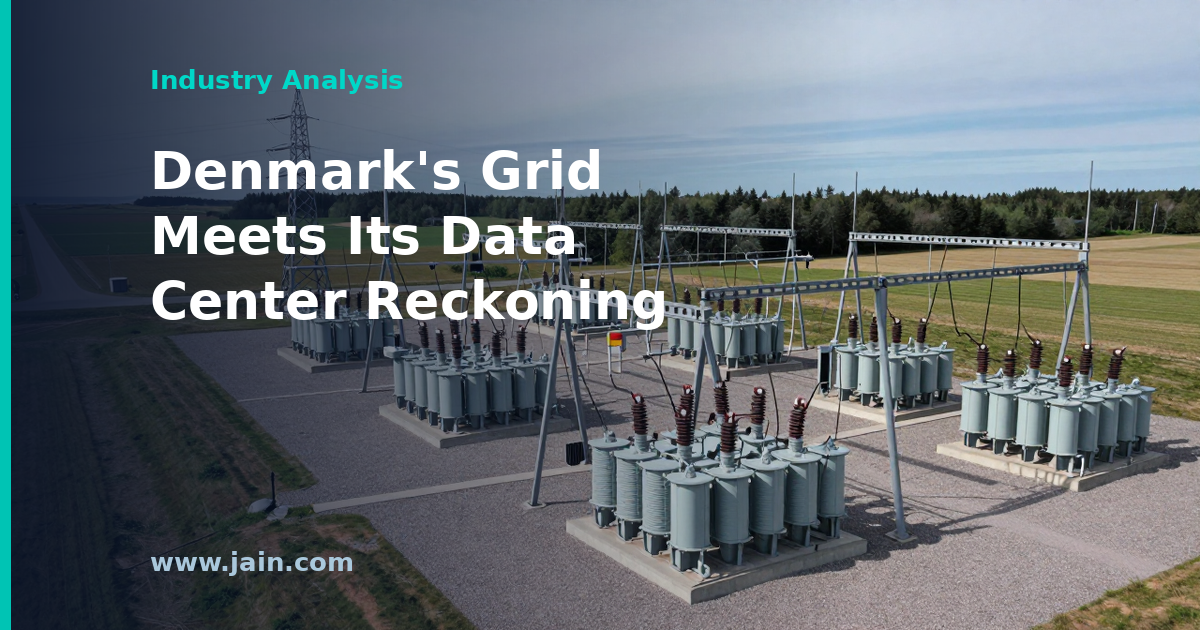
CNBC reports that Denmark is confronting a data center reckoning as its electricity grid struggles to keep pace with demand from new and planned compute campuses. The story frames Denmark — long marketed as a cool-climate, renewable-rich destination for hyperscale sites — as an early warning for the wider European market.
Executive Summary
Denmark built its data center pitch on wind power, fiber connectivity, and a stable regulatory climate. According to CNBC’s May 5, 2026 reporting, that pitch has now collided with a physical limit: the grid itself. Surging load from AI training clusters and cloud expansion is arriving faster than transmission and generation can be built to serve it.
The significance is less about one country and more about a pattern. When a small, wealthy, wind-heavy grid begins turning away or slow-walking data center load, it signals that Europe’s compute buildout is entering a capacity-constrained phase where power availability — not land, tax breaks, or fiber — decides who gets to build and when.
From Marketing Advantage to Physical Constraint
For roughly a decade, Nordic countries sold themselves as the natural home for hyperscale compute: cold air for free cooling, abundant wind and hydro, and grids with historically high renewable penetration. Denmark in particular attracted anchor tenants on that narrative. The CNBC framing suggests the narrative has aged faster than the infrastructure. Interconnection — the physical and contractual act of tying a new large load into the transmission system — is now a multi-year exercise in many European jurisdictions, and Denmark appears to be joining that queue-bound club.
The economics shift accordingly. When power is the binding constraint, the value of a permitted, energized site rises sharply relative to a greenfield parcel with only a land option. Developers holding older, already-connected sites gain leverage; newcomers face longer development cycles and more expensive grid upgrades passed through in connection fees.
The AI Load Curve Is Not the Cloud Load Curve
Traditional cloud regions grew in relatively predictable megawatt increments. AI training campuses do not. A single modern training hall can request tens to hundreds of megawatts at a single point of interconnection, with utilization profiles that are peakier and less flexible than a general-purpose cloud zone. Grids planned around gradual electrification of transport and heat were not sized for step-change industrial loads landing in single postcodes.
That mismatch is what turns a growth story into a reckoning. It is not that Denmark lacks renewable generation in aggregate; it is that moving power from where wind blows to where a proposed campus wants to plug in requires transmission that takes years to permit and build. In the interim, either the load waits, the grid operator constrains it, or fossil balancing quietly rises to keep the system stable.
Winners, Losers, and the New Site-Selection Playbook
Operators with existing energized capacity in Denmark and neighboring markets benefit from scarcity pricing on colocation and wholesale power capacity. Hyperscalers with the balance sheet to co-invest in transmission or to sign long-tenor renewable PPAs (power purchase agreements — long-term contracts to buy electricity from a specific generator) can still move forward, but on the utility’s timeline. Smaller enterprises and AI startups without that leverage are pushed toward secondary markets or toward renting capacity rather than building it.
Regulators and policymakers face their own trade-off. Restricting new data center load protects households and existing industry from grid stress and price spikes, but risks ceding a strategically important slice of the AI economy to jurisdictions willing to build faster. The Danish debate, as CNBC frames it, is a preview of choices Ireland, the Netherlands, and parts of Germany have already had to make explicitly.
What Substantiated, What Is Not
The reporting substantiates the direction — grid stress from data center demand in Denmark — more than any specific quantified ceiling. Readers should treat headline claims of “overwhelmed” grids as a description of pipeline pressure and interconnection backlog rather than active blackouts. The useful takeaway is directional: European compute siting is repricing around power, and Denmark is a visible early data point rather than a singular crisis.
Background
Denmark, along with Sweden, Norway, and Finland, spent the 2010s courting hyperscale data center investment on the strength of cool weather, renewable generation, and connectivity to mainland Europe. Anchor projects from major U.S. cloud providers helped establish the region as a credible alternative to the FLAP-D markets (Frankfurt, London, Amsterdam, Paris, Dublin).
By the mid-2020s, that same set of European markets began hitting grid constraints as electrification of transport, heating, and industry collided with a step-change in compute demand from AI. Ireland’s moratorium in the Dublin area and the Netherlands’ national siting restrictions were the first public signals; Denmark’s current situation extends that pattern into the Nordics themselves.
Security Affairs reported on May 2, 2026 that Salt Typhoon — the threat actor Western governments have linked to Chinese state espionage — breached an IBM subsidiary in Italy. The report frames the intrusion as a warning for Europe’s digital defenses, signaling that a campaign best known for compromising U.S. telecommunications carriers is now reaching into the European enterprise technology sector.
Executive Summary
According to the Security Affairs report, an Italian subsidiary of IBM — one of the world’s largest enterprise IT and consulting companies — was compromised by Salt Typhoon, a hacking group that U.S. agencies have attributed to China’s state security apparatus. The report positions the incident less as an isolated breach and more as evidence that Chinese state-aligned intrusion campaigns are expanding beyond American telecom networks into Europe’s corporate and IT-services core.
Why it matters: IT-services and consulting firms sit inside the trust boundary of hundreds or thousands of client organizations. A foothold in one such firm can become a staging point for espionage against banks, governments, telecoms, and critical infrastructure downstream. If the attribution holds, this is the kind of supply-chain-adjacent intrusion that European regulators designed the NIS2 directive — the EU’s updated cybersecurity law for essential and important entities — to surface and contain. The public reporting, however, is thin on specifics, and the material questions remain open.
From Phone Networks to the Enterprise Back Office
Salt Typhoon earned its notoriety through a sweeping campaign against U.S. telecommunications carriers, disclosed beginning in late 2024, in which intruders reportedly reached systems used for lawful intercept — the infrastructure carriers maintain to comply with court-ordered wiretaps. That campaign established the group’s signature: patient, infrastructure-level espionage aimed at the systems that other systems depend on. A breach of an IBM subsidiary in Italy, if confirmed in the terms reported, would fit that pattern while marking a geographic and sectoral expansion — from American carriers to a European arm of a global IT-services giant.
The logic is straightforward. An IT-services firm holds privileged credentials, remote-access pathways, and architectural knowledge for its clients. Compromising one is economically efficient espionage: a single intrusion can yield visibility into many organizations at once. Security practitioners call this a trusted-relationship or supply-chain attack, and it has been a recurring theme in state-linked campaigns for a decade.
What the Report Establishes — and What It Doesn’t
It is worth being precise about the evidentiary picture. The public reporting names the actor (Salt Typhoon), the victim category (an IBM subsidiary), and the location (Italy). It does not, in the material available, name the specific subsidiary, describe the intrusion method, quantify what was accessed, or state whether client environments were touched. Attribution to a specific state-linked group is a technical judgment that typically rests on tooling, infrastructure overlaps, and tradecraft — evidence the public report does not lay out. None of that means the report is wrong; it means readers should treat scope and impact as unestablished until the company or a government agency speaks on the record.
That caution cuts both ways. Vendors and victims have incentives to minimize; incident reporting sometimes outruns confirmed facts. The responsible reading on May 2, 2026 is that a credible security outlet has flagged a serious claim that warrants verification, notification, and follow-up — not that the full blast radius is known.
Europe’s Regulatory Moment Meets Its Threat Moment
The timing lands squarely in Europe’s post-NIS2 era. The directive, which EU member states were required to transpose into national law by late 2024, obliges essential and important entities — a category that captures much of the IT-services sector — to report significant incidents on tight timelines and imposes management-level accountability. Italy’s national cybersecurity agency, ACN, is among the bodies that would ordinarily be in the notification chain for an incident of this description, alongside GDPR obligations if personal data were involved.
For buyers of IT services, the practical takeaway is not to churn vendors on the strength of a single report. It is to exercise the rights modern contracts and regulations already provide: ask providers directly about exposure, review the privileged access those providers hold, and verify that monitoring covers the vendor-facing pathways into your own environment. State-aligned espionage campaigns target the seams between organizations; that is where defensive attention should concentrate.
Background
IBM is one of the world’s largest enterprise technology companies, operating consulting, software, and infrastructure businesses through subsidiaries in most major markets, including Italy. Salt Typhoon entered public awareness in late 2024, when U.S. officials disclosed that the China-linked group had penetrated major American telecommunications carriers in what some officials described as among the most serious telecom intrusions on record. Western governments have attributed the group’s activity to Chinese state intelligence interests, a characterization Beijing has consistently denied.
The reported Italian incident arrives as Europe implements NIS2, its toughened cybersecurity regime for critical and important sectors, and as governments on both sides of the Atlantic warn that state-aligned actors are pre-positioning inside infrastructure and service-provider networks. IT-services firms occupy a particularly sensitive position in that landscape because their access spans so many client organizations at once.
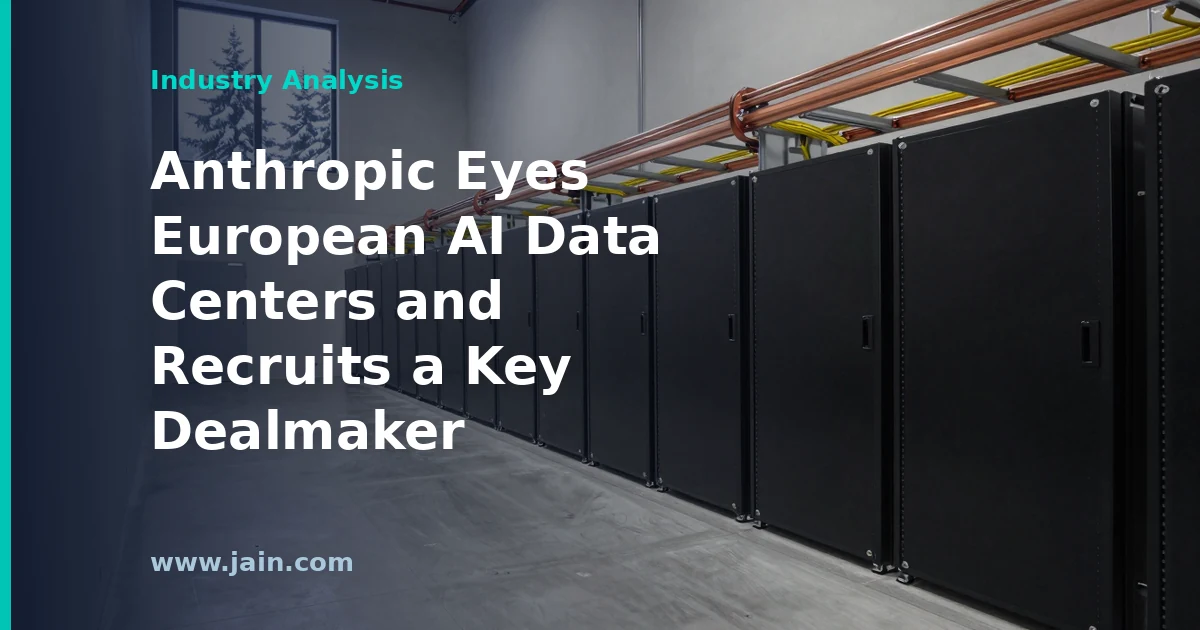
Anthropic, the AI lab behind the Claude family of models, is pursuing a push into European AI data centers and is recruiting for a key dealmaking role to drive it, according to a CNBC report published April 26, 2026. The report signals that Anthropic intends to secure compute capacity in Europe directly, rather than relying solely on its cloud partners — though no sites, capacity figures, or financial commitments have been disclosed.
Executive Summary
According to CNBC, Anthropic is working to expand its AI data center footprint in Europe and is hiring for a senior dealmaker position to lead infrastructure negotiations. A “dealmaker” hire in this context typically means someone who structures large, complex transactions — capacity leases, joint ventures, land and power agreements — rather than a conventional corporate development role.
The move matters because it marks a broader industry shift: frontier AI labs, which historically consumed compute through hyperscale cloud providers, are increasingly acting like infrastructure buyers in their own right. If Anthropic contracts European capacity directly, it becomes a new class of anchor tenant — or even developer — in a market already straining under power and land constraints. For data center operators, utilities, and governments courting AI investment, that changes who sits across the negotiating table.
From Tenant to Buyer: Frontier Labs Are Changing Seats at the Table
Until recently, the division of labor in AI infrastructure was clean: labs trained models, cloud providers built and operated the data centers. Anthropic has historically run its workloads on partner infrastructure, backed by deep compute relationships with Amazon and Google. Recruiting a dedicated dealmaker for a European push suggests the company wants direct agency over where its capacity sits and on what terms — the same trajectory other frontier labs have followed as training and inference demand outgrew what standard cloud contracts comfortably deliver.
The economics explain the shift. AI compute is now the dominant cost line for a frontier lab, and multi-year capacity commitments are effectively infrastructure finance decisions. Negotiating directly with data center developers, power providers, and governments can secure capacity earlier and potentially on better terms than consuming it through an intermediary — but it also requires skills labs did not traditionally employ: site selection, power procurement, and structured real-estate-style dealmaking. A dealmaker hire is the organizational tell that this capability is being built in-house.
Why Europe: Sovereignty Demand Meets a Supply-Constrained Market
Europe is a logical but difficult target. On the demand side, European enterprises and public-sector buyers increasingly want AI workloads processed in-region — a mix of data-protection law, the EU AI Act’s compliance regime, and a broader political push for “sovereign AI” capability. A lab that can offer European customers inference served from European soil holds a genuine commercial and regulatory advantage over one that cannot.
On the supply side, however, Europe’s prime data center markets — Frankfurt, London, Amsterdam, Paris, Dublin — are among the most power-constrained in the world, with grid-connection queues stretching years and some jurisdictions having imposed moratoria on new builds. That scarcity is precisely why a dealmaker matters: available large-scale capacity in Europe is won through early, creative transactions — secondary markets, powered-land deals, partnerships with utilities — not by placing an order. Anthropic entering that hunt adds a well-capitalized bidder to an already competitive field.
Ripple Effects: Operators, Hyperscalers, and Governments
For European data center operators and developers, a frontier lab shopping directly is attractive: AI labs sign large, long-duration commitments that can anchor entire campuses and underwrite new construction. Utilities and grid operators face the harder version of the same news — more gigawatt-scale demand arriving in systems already juggling electrification and renewable-integration timelines.
For the hyperscalers, the picture is nuanced rather than adversarial. Anthropic’s cloud partnerships remain central to its compute story, and a European buildout could well be executed with or through those partners. But every direct deal a lab signs shifts some negotiating leverage and some margin away from the cloud intermediary. Governments, meanwhile, gain a new courtship target: expect member states competing for AI investment to treat frontier labs, not just hyperscalers, as strategic accounts.
Background
Anthropic was founded in 2021 by former OpenAI researchers and has grown into one of the leading frontier AI labs, best known for its Claude models. Its compute has historically come through deep partnerships with Amazon — which has committed roughly $8 billion in investment — and Google, both of which also serve as cloud infrastructure providers for its training and inference workloads.
The European data center market it is now reportedly entering is large but supply-constrained: the established FLAP-D hubs (Frankfurt, London, Amsterdam, Paris, Dublin) face power scarcity and permitting friction, pushing new AI capacity toward secondary markets such as the Nordics, Iberia, and Southern Europe. European policymakers, for their part, have been actively courting AI infrastructure investment as part of a broader push for regional AI capability.
Google has begun construction on a data center in Kronstorf, a municipality in the Linz-Land district of Upper Austria, according to a groundbreaking announcement posted to the Google Cloud Press Corner and distributed on 23 April 2026. The item marks the start of physical work on the site.
The release as circulated is a headline announcement. It does not, in the version distributed through news syndication, state the campus size, planned power capacity, capital commitment, construction timeline, staffing, or whether the facility will underpin a new Google Cloud region for Austria.
Executive Summary
Groundbreaking is the point at which a data center stops being a land holding and becomes a construction project. For a hyperscaler — an operator running compute at global scale, such as Google, Amazon Web Services, Microsoft or Meta — it normally implies that land control, planning permission and, critically, a grid connection agreement are already settled. Those are the hard parts. Steel and concrete are comparatively easy.
The significance of Kronstorf is geographic more than technical. Europe’s data center industry has historically concentrated in five markets known as FLAP-D: Frankfurt, London, Amsterdam, Paris and Dublin. Those markets are now constrained less by demand than by electricity — grid connection queues, local moratoria and planning resistance have pushed new capacity outward into secondary markets with available power. Upper Austria, sitting on a hydro-heavy generation mix and on fiber routes between Munich, Vienna and northern Italy, fits that pattern.
What the announcement does not do is tell buyers anything actionable. Google has not, as far as the distributed release states, committed to a launch date or to an Austrian cloud region. Enterprises with Austrian data residency requirements should treat this as an encouraging signal about Google’s intentions, not as a procurement input.
Why Austria, and Why Now
The proximate driver of hyperscale expansion into new European markets is power availability, not proximity to customers. Latency between Kronstorf and Frankfurt is a rounding error for most workloads; the difference that matters is whether a transmission operator can deliver tens of megawatts on a schedule the builder can plan around. In several established hubs it cannot. Dublin’s grid operator has restricted new data center connections in the Greater Dublin area for years, and Amsterdam imposed a construction pause that reshaped Dutch development. Frankfurt and London face their own queue and land pressures.
Austria offers a different profile. Its electricity generation is unusually hydro-weighted by European standards, which is attractive both for carbon accounting and for price stability relative to gas-linked markets. Upper Austria is an industrial region with existing heavy-load infrastructure — the kind of grid that was built for manufacturing and can, in principle, be repurposed for compute. Kronstorf sits between Linz and Steyr, close to that industrial corridor.
None of this is stated in the release. It is the standard site-selection logic of the sector, and it is the most plausible reading of the decision. Readers should hold it as inference, not as a company claim.
What a Groundbreaking Actually Signals
Announcements of this kind are frequently over-read in both directions. A groundbreaking is a stronger signal than a land purchase or a memorandum of understanding: capital has been committed, contractors are mobilised, and the permitting and interconnection work that typically consumes years has largely concluded. Hyperscalers do not break ground on sites they intend to abandon, and the sunk cost from this point forward rises steeply.
It is a weaker signal than a service commitment. Large data center builds commonly run two to four years from groundbreaking to first customer traffic, and campuses are usually delivered in phases, with later buildings contingent on demand and on the operator’s capital plan at the time. A groundbreaking therefore says a facility is being built; it does not say when it will serve traffic, at what capacity, or which Google products will run on it.
The distinction matters most for the question of a Google Cloud region in Austria. A physical data center and a published cloud region are related but separate things — regions require multiple availability zones, a defined service catalogue and a launch commitment. The release, as distributed, does not make that commitment, and the absence should not be filled in by assumption.
Winners, Losers, and the Local Ledger
The clearest beneficiaries are Austrian enterprises and public-sector bodies with data residency obligations, who gain a credible prospect of in-country hyperscale capacity, and the regional construction and electrical trades, who capture the build phase — the largest and shortest-lived share of employment any data center generates. Local landowners and the municipal tax base typically benefit as well.
The competitive read is that Google is buying optionality in the DACH region rather than responding to a single anchor customer. Microsoft and AWS both hold established positions in German-language markets, and Vienna already hosts commercial colocation from international operators. Entering Austria with owned capacity changes Google’s cost structure and its sovereignty story simultaneously — owned facilities are cheaper at scale than leased ones and easier to make claims about.
The costs land locally and are worth stating plainly rather than defensively. Large sites consume grid capacity, land and, depending on the cooling design, water; operational employment is modest relative to capital deployed. Communities that raise these points are asking legitimate questions, and the honest answer is that this release provides no basis to evaluate them in either direction. When Google publishes capacity, cooling method and water sourcing, those figures should be tested — and so should any counter-claims made about them.
Reading a Thin Announcement Fairly
It would be unfair to characterise this release as evasive. Groundbreaking announcements are ceremonial by convention across the industry, and operators routinely withhold capacity figures for competitive and security reasons. Google’s more detailed European disclosures have historically followed at launch rather than at first excavation.
It would be equally unfair to present the announcement as more than it is. What is substantiated: construction has started at Kronstorf, and Google is the party announcing it. What is not substantiated by the release text: megawatts, euros, jobs, dates, cooling design, power procurement, and any regional service commitment. Coverage that supplies those numbers should be checked against a primary source.
For infrastructure buyers, the practical posture is patience. Treat Kronstorf as evidence of Google’s medium-term intent in Central Europe, factor it into three-to-five-year architecture planning, and revisit when the operator publishes a launch date or a region announcement.
Background
Google operates a global network of owned data centers supporting Search, YouTube, Workspace and Google Cloud, with a substantial European footprint including sites in Ireland, the Netherlands, Belgium, Finland and Denmark. Its cloud business competes with Amazon Web Services and Microsoft Azure, where physical proximity and in-country capacity increasingly matter for regulated customers subject to data residency rules.
Austria has hosted commercial colocation and enterprise data centers for years, largely concentrated around Vienna, but has not been a primary hyperscale construction market. The wider shift of European capacity toward secondary markets has been driven principally by electricity: as grid connections in Dublin, Amsterdam and Frankfurt became constrained, operators moved toward regions with spare transmission capacity and favourable generation mixes. Upper Austria, with its hydro-heavy power supply and existing industrial grid, sits squarely in that category.