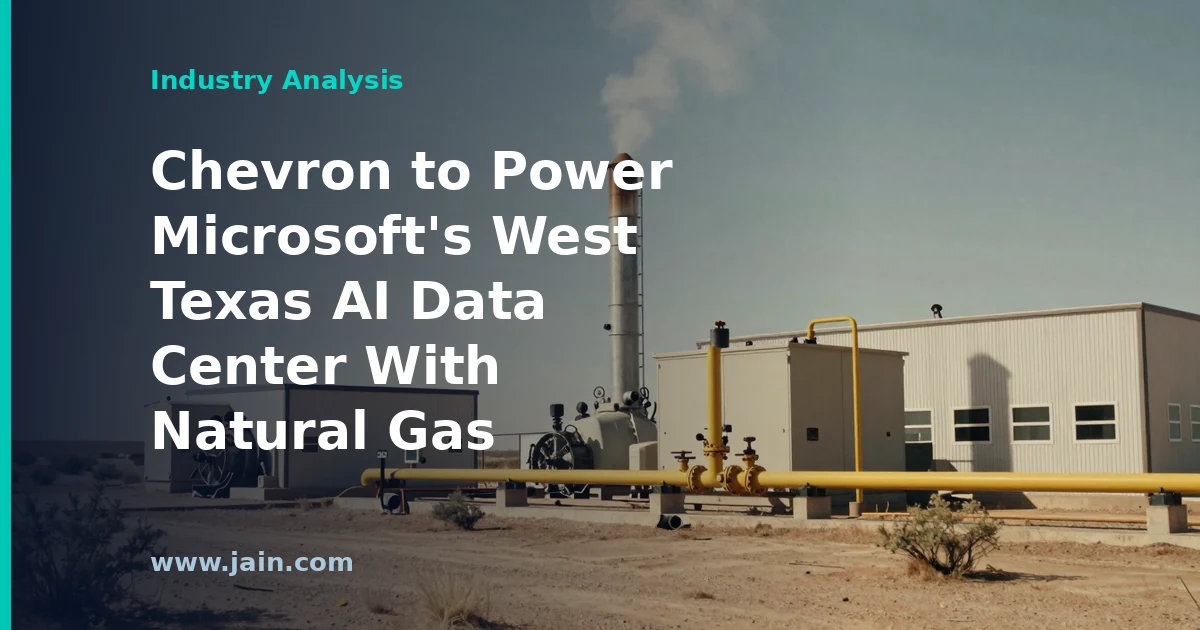
Chevron has struck a deal to supply electricity generated from natural gas to a Microsoft artificial-intelligence data center in West Texas, according to a Wall Street Journal report dated June 21, 2026. Deal terms — including capacity, pricing, and start date — were not disclosed in the source material available to us.
The agreement pairs one of America’s largest oil and gas producers with one of its largest data-center builders, and it lands in the Permian Basin region, where Chevron produces enormous volumes of natural gas close to where Microsoft needs power.
Executive Summary
The reported arrangement makes Chevron a power supplier — not just a fuel supplier — to a hyperscaler, the industry term for the handful of companies (Microsoft, Google, Amazon, Meta) that operate cloud computing at global scale. That distinction matters: selling gas molecules is Chevron’s traditional business, while selling electrons under long-term contract to a single anchor customer is a new one, and it captures more of the value chain.
For Microsoft, the deal addresses the single biggest constraint on AI expansion: getting large amounts of reliable power quickly. Utility interconnection queues — the waiting lists to plug big new loads or generators into the transmission grid — now stretch years in much of the country. Dedicated generation built by an energy company with its own fuel supply is one way to shortcut that wait.
Chevron had previously signaled this ambition: in early 2025 the company announced plans to develop gas-fired power plants co-located with data centers, in partnership with investment firm Engine No. 1 and turbine maker GE Vernova, with West Texas among the first targeted regions. The Microsoft deal, as reported, would be visible evidence that the strategy has landed a marquee customer.
Oil Majors Are Becoming Power Companies
For decades, the boundary was clean: oil and gas companies produced fuel, utilities and independent power producers turned it into electricity. AI is dissolving that boundary. Data-center operators need gigawatt-scale power on timelines utilities struggle to meet, and they are willing to sign long-dated contracts to get it. That contract structure — a creditworthy counterparty committing to buy power for many years — is exactly what makes a power plant financeable, and it is an asset profile oil majors understand from their LNG businesses.
Chevron’s advantage is vertical integration. In the Permian Basin, gas is so abundant relative to pipeline takeaway capacity that regional prices at the Waha hub have repeatedly traded near zero or even negative in recent years. Burning that gas on-site to serve a data center converts a stranded, low-value commodity into contracted electricity revenue. Few competitors can match that feedstock economics story.
Why Gas, and Why West Texas
Natural-gas turbines remain the fastest way to deliver large blocks of firm, around-the-clock power — the kind AI training clusters demand. Solar and wind are cheaper per unit of energy but intermittent; nuclear is firm but slow to build; batteries shift power in hours, not weeks. Texas adds a structural advantage: ERCOT, the state’s independent grid, has lighter interconnection processes than other U.S. regions, and state law accommodates large co-located or behind-the-meter loads — facilities that take power directly from a dedicated plant rather than through the public grid.
The tradeoff is emissions. Microsoft has a publicly stated goal of being carbon negative by 2030, and a new gas-fired power arrangement runs against that grain unless it is paired with carbon capture, offsets, or a credible transition plan. The source material does not say whether any such mitigation is part of this deal — a material omission, since how hyperscalers reconcile gas-fired AI power with climate commitments is one of the industry’s live controversies. The fair reading cuts both ways: gas power for data centers is neither the betrayal critics sometimes claim nor the bridge its promoters assert until the specifics — capture rates, contract duration, retirement plans — are on the table.
Winners, Losers, and the Competitive Map
If deals like this proliferate, the winners are gas producers with stranded Permian volumes, turbine manufacturers whose order books are already stretched to the end of the decade, and Texas jurisdictions collecting tax base. Traditional utilities lose a growth story if the largest new loads in a generation bypass them; conversely, they shed the risk of building for a demand boom that may not fully materialize.
The strategic question is whether hyperscaler-oil-major partnerships become a template. ExxonMobil has announced similar ambitions in gas-plus-carbon-capture power for data centers, and other producers are circling. If the model works, the AI buildout will have quietly created a new class of independent power producer — one with its own wells.
Background
Chevron is one of the world’s largest integrated energy companies and a top producer in the Permian Basin, the West Texas oil field whose wells also produce vast quantities of natural gas. Historically Chevron sold that gas into pipelines and export markets; in 2025 it announced a venture to build gas-fired power plants serving data centers directly, reserving turbine capacity with GE Vernova alongside investment firm Engine No. 1.
Microsoft, through its Azure cloud division and its partnership with OpenAI, has been spending tens of billions of dollars a year building AI data centers, and has pursued a wide portfolio of power deals — from renewables to the planned restart of a reactor at Three Mile Island — as electricity has replaced land and chips as the scarcest input in the AI buildout.
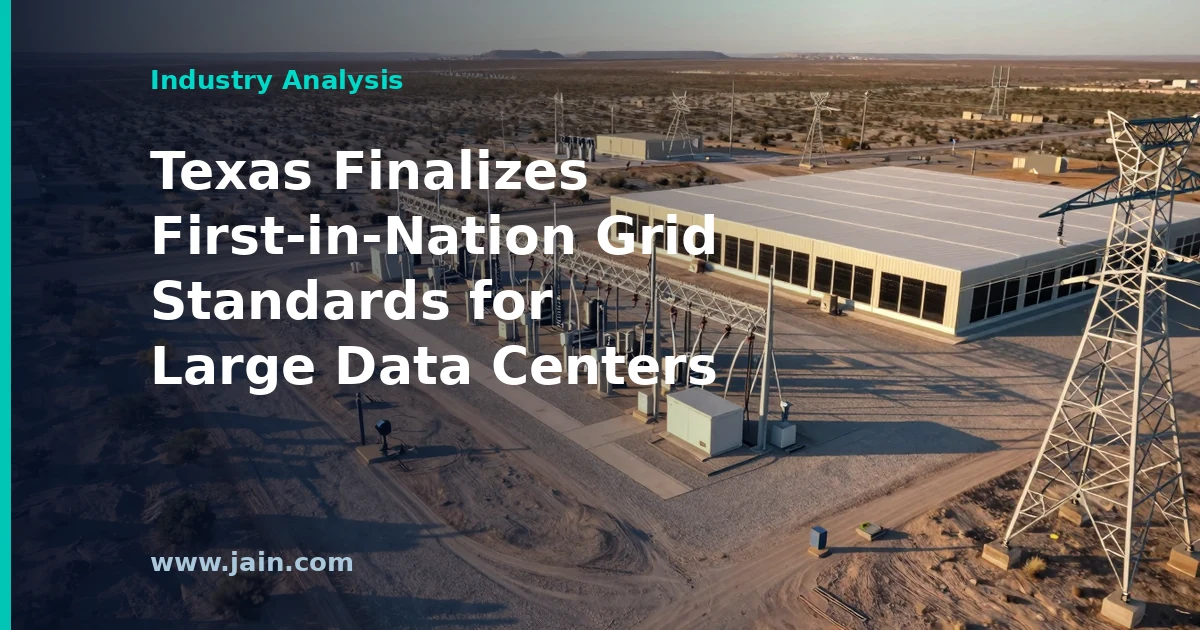
The Public Utility Commission of Texas (PUCT) has finalized new standards governing how large data centers connect to, and operate on, the state’s power grid, Houston Public Media reported on June 17, 2026. The rules implement Senate Bill 6, the 2025 Texas law that created a distinct regulatory category for very large electricity users — including data centers — seeking to plug into the ERCOT grid.
The action makes Texas the first U.S. state to complete a comprehensive rulebook for large-load interconnection and emergency curtailment at a moment when AI-driven data center demand is reshaping utility planning nationwide.
Executive Summary
Texas regulators have closed the loop on a process that began with Senate Bill 6, signed into law in June 2025. That statute directed the PUCT and ERCOT — the Electric Reliability Council of Texas, which operates the grid serving roughly 90 percent of the state’s electric load — to build new rules for “large loads,” generally facilities demanding 75 megawatts or more. The law’s core provisions required large customers to share better information during interconnection studies, bear more of the study costs, and accept that the grid operator can curtail (temporarily reduce or disconnect) their power during genuine grid emergencies.
Why it matters: Texas hosts one of the largest and fastest-growing data center pipelines in the world, and ERCOT’s interconnection queue has swelled with speculative large-load requests that make demand forecasting difficult. Finalized standards convert a statutory framework into operational reality — telling developers what they must disclose, what they will pay, and under what conditions their megawatts can be interrupted.
Because Texas is both the most active battleground for AI infrastructure siting and an energy-only market that other regions watch closely, these standards are widely expected to serve as a template. Utilities and regulators in other high-growth markets face the same problem Texas confronted first: how to welcome enormous new loads without socializing their costs or risking reliability for everyone else.
Why Texas Moved First
ERCOT operates an electrically isolated grid with limited connections to neighboring systems, which means Texas cannot import its way out of a supply crunch. When data center developers began filing interconnection requests at unprecedented scale, the gap between requested capacity and capacity that will actually be built became a planning hazard: transmission gets sized, and costs get allocated, against demand that may never materialize. Senate Bill 6 was the legislature’s answer, and the PUCT’s finalized standards are the machinery that makes it enforceable.
The economics are straightforward. Interconnection studies, transmission upgrades, and reserve capacity all cost money. Without rules assigning those costs to the large loads that trigger them, they flow to ordinary ratepayers. Texas has effectively decided that hyperscale demand should arrive with obligations attached — better data, upfront fees, and flexibility during emergencies — rather than as an unconditional guest.
Curtailment Changes Data Center Math
Curtailment — the grid operator’s ability to reduce or interrupt a customer’s power draw during scarcity events — is the provision with the sharpest commercial edge. Data centers sell uptime; their customer contracts are built on availability guarantees measured in fractions of a percent. A regulatory regime in which ERCOT can order large loads offline during firm load shed events forces operators to invest in the mitigations SB 6 contemplated: on-site backup generation, batteries, and workload orchestration that can shift compute out of state during grid stress.
That is not necessarily bad news for the industry. Facilities that can flex have something to sell — demand response is compensated in ERCOT — and AI training workloads, unlike real-time transaction processing, can often tolerate interruption. The standards effectively reward operators who engineer for flexibility and penalize those who assumed firm power was an entitlement. Expect the gap between those two designs to show up in siting decisions and financing terms.
A Template Other Grids Will Copy
Regulators in other high-growth markets — Virginia, Georgia, Arizona, and the multi-state PJM region — are wrestling with the same questions Texas has now answered on paper: who pays for network upgrades, how to filter speculative interconnection requests, and whether the largest loads should be interruptible. A finalized Texas rulebook gives them working language and, in time, empirical results to point to.
The competitive question is whether the standards make Texas more or less attractive. Developers may bristle at curtailment exposure, but regulatory certainty has value: a known process with known costs can beat a friendlier jurisdiction where interconnection timelines are unbounded. If Texas continues to land marquee AI projects under these rules, the argument that clear obligations deter investment will weaken, and the template will spread faster.
Background
Texas has become one of the world’s most important data center markets, drawn by cheap land, fast permitting, abundant natural gas and renewable generation, and an energy-only electricity market. That growth accelerated dramatically with the AI buildout, pushing ERCOT’s long-term demand forecasts sharply upward and filling its interconnection queue with large-load requests whose eventual construction was far from certain.
Senate Bill 6, passed by the Texas Legislature and signed in June 2025, was the state’s structural response: it required large electricity users to disclose more information, shoulder interconnection study costs, and accept curtailment authority during grid emergencies, then directed the PUCT to write implementing rules. The standards finalized in June 2026 are the culmination of that rulemaking.
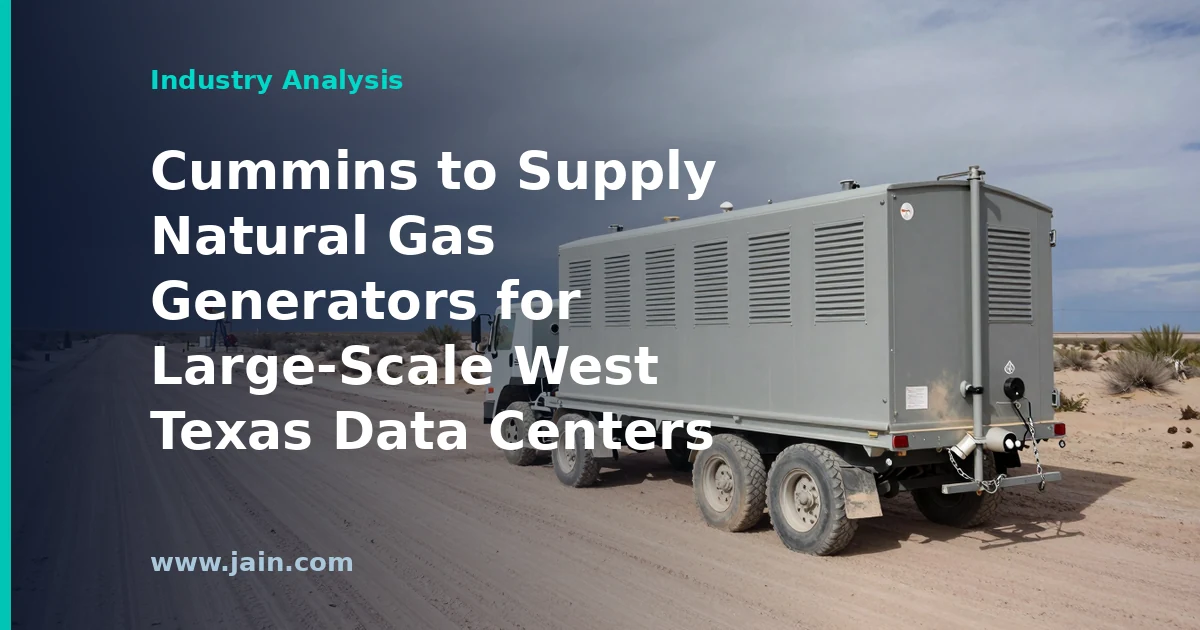
Cummins announced on June 15, 2026 that its natural gas generators will power large-scale data centers in West Texas. The announcement, issued by the engine and power-systems maker itself, confirms a supply arrangement for on-site power generation but does not disclose the customer, the number of units, the total generating capacity, or the delivery schedule.
Executive Summary
Cummins, the Indiana-based manufacturer best known for diesel engines and generator sets, says its natural gas generators have been selected to power large-scale data center development in West Texas. Stripped to its substantiated core, the announcement establishes three facts: the vendor (Cummins), the fuel (natural gas), and the setting (large-scale data centers in West Texas). Everything else — megawatts, dollars, dates, and the developer’s name — is left unstated.
Even so, the deal is worth attention because of what it represents. Data center developers are increasingly buying their own power plants rather than waiting years for utility interconnections, and West Texas — with abundant natural gas, cheap land, and a congested grid — has become the proving ground for that model. A generator manufacturer announcing data-center-scale natural gas orders is a data point in one of the most consequential shifts in how digital infrastructure gets energized.
Why Data Centers Are Buying Their Own Power Plants
The traditional model — build a data center, plug it into the utility grid — is breaking down under AI-era demand. Requests for new grid connections in fast-growing markets can take several years to fulfill, because utilities must study, permit, and build transmission lines and substations before energizing a large new load. For developers racing to deliver capacity to cloud and AI tenants, that queue is often the single longest item on the schedule.
On-site generation — sometimes called behind-the-meter power, because it sits on the customer’s side of the utility meter — collapses that timeline. Reciprocating natural gas generators of the kind Cummins builds can be manufactured, shipped, and commissioned far faster than a transmission project, and they can be added in increments as a campus grows. What was once purely backup equipment, sized to ride through rare outages, is increasingly being specified as primary or bridge power that runs for thousands of hours a year.
West Texas: Abundant Gas, Strained Wires
West Texas is a logical setting for this model. The region sits atop the Permian Basin, one of the most productive oil and gas regions in the world, where natural gas is plentiful and pipeline infrastructure is dense. Land is inexpensive, and the area already hosts substantial wind and solar development. What the region lacks is transmission: moving power across the Texas grid, operated by ERCOT (the Electric Reliability Council of Texas), is constrained by long distances and congested lines.
For a data center developer, that combination — fuel at the wellhead, but a bottlenecked grid — makes on-site gas generation attractive. Rather than exporting the region’s energy as electrons over strained wires, the data center effectively moves the demand to the fuel. The announcement does not say whether these facilities will also seek grid connections later, a common strategy in which on-site generation serves as a bridge until utility service arrives.
What It Means for Cummins and the Genset Market
For Cummins, data-center demand is reshaping a business that historically sold generators as insurance. Backup generators run perhaps a few dozen hours a year; prime-power installations run continuously, which means more units, larger service contracts, and steadier parts revenue. Major engine and turbine makers across the industry have reported stretched lead times for large power equipment as data-center orders stack up, so a manufacturer publicizing a West Texas win is competing for position in a genuinely supply-constrained market.
The competitive backdrop matters too. Data center developers weighing on-site power can choose among reciprocating gas engines, gas turbines, and, eventually, small modular nuclear or fuel-cell options. Reciprocating engines like Cummins’ occupy a middle ground: faster to deploy and more modular than turbines, though generally better suited to incremental capacity than to single gigawatt-scale blocks. Which architecture wins at a given site depends on scale, gas supply, and air-permitting headroom — none of which this announcement details.
The Trade-Offs the Headline Skips
Natural gas generation is cleaner than the diesel that has long dominated data-center backup — it burns with lower particulate and sulfur emissions — but it is still a fossil-fuel source with carbon dioxide and nitrogen oxide emissions, and large installations require air-quality permits from Texas regulators. Hyperscale tenants with public net-zero commitments will want to know whether gas-powered campuses fit their carbon accounting, whether the plants are bridge or permanent solutions, and whether the equipment can later run on lower-carbon fuels.
Reliability cuts the other way: a well-designed fleet of gas generators with firm fuel supply can rival or exceed grid reliability, and it insulates the tenant from ERCOT’s scarcity-priced energy market during extreme weather. The honest framing is that on-site gas is a pragmatic trade — speed and control in exchange for emissions and fuel-price exposure — and this release, as circulated, makes the case for the first half without quantifying the second.
Background
Founded in 1919 in Columbus, Indiana, Cummins built its reputation on diesel engines for trucks and heavy equipment, and its power systems division has long been a leading supplier of standby generator sets for data centers, hospitals, and industry. In recent years the company has expanded its natural gas engine lineup as customers seek lower-emission alternatives to diesel.
The backdrop is a historic surge in electricity demand from AI and cloud computing that has outpaced utilities’ ability to connect new loads. Texas has emerged as a leading destination for this buildout, and West Texas in particular — sitting atop the Permian Basin’s gas supply but far from major transmission corridors — has become a testbed for data centers that generate their own power on-site rather than waiting for the grid.
Texas Governor Greg Abbott has publicly called for regulators to clamp down on data centers, according to a June 11, 2026 report from E&E News by POLITICO headlined “Texas governor talks tough on data centers, calls for clampdown.” The remarks signal a potential policy shift in the state that has become one of the largest and fastest-growing data center markets in the United States.
The syndicated report available to us carries only the headline, so the specific mechanisms the governor proposed — and which regulators he addressed — are not detailed in the source material.
Executive Summary
The significance here is less about any single proposal and more about who is speaking. Texas has spent years courting data centers with cheap power, fast permitting, abundant land, and a light-touch regulatory reputation. When the governor of that state “talks tough” and calls for a clampdown, it suggests the political calculus around hyperscale computing growth is changing even in the market most identified with welcoming it.
The pressure has been building. Texas’ independent grid, operated by the Electric Reliability Council of Texas (ERCOT — the body that manages electricity flow for most of the state), has projected enormous demand growth driven heavily by large loads such as data centers. In 2025 the state enacted Senate Bill 6, a law giving regulators new tools to manage very large electricity users, including requirements that they be able to reduce consumption during grid emergencies. Gubernatorial rhetoric about a clampdown, if it translates into rulemaking or legislation, would extend that trajectory.
For the industry, the message is straightforward: even in the most development-friendly major market, social license is not unconditional. Grid reliability, cost allocation, and community impact are now live political issues that developers must plan for rather than assume away.
When the Friendliest Market Turns Cautious
Texas — anchored by the Dallas–Fort Worth metro, one of the largest data center hubs in the world, plus fast-growing clusters in San Antonio, Austin, and West Texas — has been a primary beneficiary of the AI-driven construction boom. Developers chose Texas precisely because its political environment favored speed: deregulated retail electricity, no state income tax, and officials who actively recruited large projects. A governor from that same political tradition calling for a clampdown is therefore a meaningful signal, whatever the eventual policy details turn out to be.
It is worth being precise about what a headline can and cannot tell us. “Talks tough” and “clampdown” are the reporter’s characterizations; the underlying remarks could range from a demand for strict new siting rules to a narrower push for large loads to pay their own way on the grid. Political rhetoric about data centers also does not always convert into binding regulation. But the direction of travel matches a broader national pattern in 2025–2026: statehouses in both parties’ hands have moved from recruiting data centers to scrutinizing them.
The Grid Is the Battleground
The most likely driver is electricity. ERCOT has repeatedly flagged that large flexible loads — data centers, crypto miners, industrial electrification — are the dominant source of projected demand growth, on a grid that already suffered a catastrophic failure during Winter Storm Uri in 2021. Every gigawatt of new computing load raises two politically sensitive questions: can the grid stay reliable, and who pays for the transmission and generation needed to serve it?
Texas’ 2025 Senate Bill 6 was the first major answer, imposing interconnection requirements on very large loads and enabling their curtailment (mandatory reduction of power use) in emergencies. A gubernatorial call for further clampdown suggests officials may view those tools as insufficient — or at least politically insufficient — as residential ratepayer concerns about rising bills and water use gain traction. For an industry whose product is uptime, curtailment obligations and slower interconnection are direct commercial threats, which is why many operators are already investing in on-site generation and storage to reduce their grid dependence.
Winners, Losers, and the Cost of Uncertainty
If Texas tightens meaningfully, the near-term losers are speculative developers whose pipeline value depends on fast, cheap grid connections. Established operators with secured power and existing interconnection agreements arguably benefit, since barriers to entry protect incumbents. Utilities and grid operators gain leverage to demand stronger financial commitments from data center customers, reducing the risk that infrastructure is built for projects that never materialize — a growing concern given inflated interconnection queues nationwide.
Competing markets should temper their enthusiasm, though. Rival states may market themselves as alternatives, but most face their own power constraints, and Texas’ fundamental advantages — land, energy resources, and scale — do not disappear because of tougher rules. The more realistic outcome is not an exodus but a repricing: longer timelines, more self-supplied power, and heavier upfront commitments becoming the standard cost of building in Texas. For buyers of data center capacity, that ultimately flows into pricing and delivery schedules.
Background
Texas rose to the top tier of global data center markets over the past decade on the strength of cheap and abundant energy, available land, fast permitting, and active state recruitment. The AI construction boom that accelerated from 2023 onward magnified that growth, with hyperscale campuses proposed across the Dallas–Fort Worth area, Central Texas, and West Texas — and with them, unprecedented projected demand on the ERCOT grid, which operates independently of the two large interconnections serving the rest of the continental U.S.
The politics shifted as the load forecasts grew. After the deadly 2021 winter blackout exposed the grid’s fragility, Texas lawmakers grew warier of unmanaged demand growth, culminating in 2025’s Senate Bill 6, which created a regulatory framework for very large electricity users. The governor’s June 2026 call for a clampdown, as reported by E&E News, suggests that framework may have been a starting point rather than a settlement.
Bitcoin mining operator Bitdeer will deploy 28 megawatts (MW) of mining capacity at a Soluna Holdings wind-powered site in Texas, according to a June 4, 2026 report by ForkLog. The arrangement pairs Bitdeer’s application-specific mining hardware with electricity generated at Soluna’s co-located Texas wind facility.
Executive Summary
The announcement is modest in scale — 28 MW is a fraction of a typical hyperscale data-center campus — but it is a clean illustration of a business model that has become a fixture of the U.S. power market: bitcoin miners acting as flexible offtakers for renewable generation that the grid cannot always absorb.
For Soluna, whose stated strategy is to co-locate compute loads with wind and solar assets in transmission-constrained regions, the deployment adds a paying tenant to existing infrastructure. For Bitdeer, it is incremental hashrate at a site whose marginal power cost should be low precisely because the underlying wind energy is often curtailed. Neither company disclosed contract length, pricing, or revenue-share terms in the source material.
Stranded Wind, Willing Buyer
West and South Texas produce more wind power than local transmission lines can always evacuate to demand centers. When the grid operator, ERCOT, cannot move the electrons, wind farms either curtail output or accept negative prices to keep turbines spinning. Bitcoin miners — which can start, stop, and modulate consumption in seconds — are among the few loads willing to sit next to that generation and buy the surplus. The Bitdeer–Soluna deployment is a textbook example of that pairing at 28 MW, roughly the draw of a mid-sized industrial park.
The economic logic is straightforward: mining revenue is set by the global bitcoin price and network difficulty, but the cost side is dominated by electricity. A site that can source curtailed wind at a deep discount to grid retail rates has a structural margin advantage, provided the operator can tolerate the intermittency.
What This Says About the Post-Halving Miner Playbook
Following bitcoin’s April 2024 halving, block rewards dropped to 3.125 BTC, compressing miner gross margins and forcing operators to hunt for the cheapest available power. Publicly traded miners have responded by signing behind-the-meter deals with independent power producers, buying distressed sites, and — as here — plugging into renewables developers that need a compute anchor tenant. Bitdeer, which is Nasdaq-listed and was spun out of Bitmain, has been methodically expanding its self-mining fleet alongside its hosting and cloud-hashrate businesses.
Soluna, for its part, is a small-cap public company whose thesis is that co-located data compute makes marginal renewable projects financeable. Every incremental megawatt under contract validates that thesis to its own investors, even if the absolute numbers remain small relative to utility-scale peers.
Winners, Losers, and the AI Overhang
The immediate winners are the two counterparties and, arguably, the wind farm’s original developer, which gains a more predictable revenue floor. Ratepayers in ERCOT are largely indifferent at this scale, though critics of behind-the-meter mining argue that adding flexible load anywhere on the grid changes wholesale price formation in ways that deserve scrutiny.
The looming variable is AI. Hyperscalers and neocloud operators are now competing with miners for the same combination of cheap power, fast interconnect, and permissive siting. AI training clusters generally pay more per megawatt-hour than mining and demand higher uptime, which could crowd miners off the best sites over time. A 28 MW mining build today is defensible; whether the same footprint gets renewed at 2029 pricing, when a GPU tenant might be willing to pay a premium for the same substation capacity, is an open question.
Background
Texas has become the center of gravity for U.S. bitcoin mining, driven by abundant wind and solar generation, a deregulated ERCOT market, and permissive local siting. Curtailment of West Texas wind — power that the grid physically cannot deliver to load centers — created an opening for flexible industrial consumers, and bitcoin miners, whose loads can ramp in seconds, filled it.
Soluna Holdings has built its strategy around this dynamic, developing modular compute sites next to renewable projects. Bitdeer, spun out of mining-hardware giant Bitmain and listed on Nasdaq in 2023, has grown by combining its own mining fleet with hosting and cloud-hashrate products, and by seeking low-cost power in the U.S., Norway, Bhutan, and elsewhere.
Texas is moving forward with major grid rules governing how large data centers connect to the ERCOT power system, E&E News by POLITICO reported on June 2, 2026. The rulemaking advances the state’s effort — set in motion by 2025 legislation — to manage an unprecedented wave of data center load requests while deciding who pays for the grid capacity those facilities require.
Executive Summary
According to the report, Texas regulators are advancing significant new rules for data centers seeking power from ERCOT, the grid operator serving most of the state. The rules sit at the center of the most consequential question in American power markets today: how to absorb enormous new computing loads without destabilizing the grid or shifting costs onto ordinary consumers.
The stakes are hard to overstate. Texas has become a leading destination for hyperscale data center development thanks to available land, relatively fast interconnection, and an energy-only market design. But that same openness produced a flood of speculative load requests that ERCOT and the Public Utility Commission of Texas (PUCT) must now sort into real projects and phantom ones. The rules being advanced will effectively define the terms of entry — what large loads must disclose, what curtailment they must accept during grid emergencies, and how the costs of new transmission are allocated.
For the data center industry, the outcome will shape siting decisions for years. Rules that provide clarity and predictable timelines could reinforce Texas’s lead; rules perceived as onerous could redirect capital to other states — though every major market is now wrestling with the same tradeoffs.
Why Texas Is Writing the National Playbook
ERCOT (the Electric Reliability Council of Texas) operates the only major U.S. grid largely isolated from its neighbors, which means Texas must solve its load-growth problem internally — it cannot import its way out. That isolation, combined with the state’s outsized share of announced AI data center capacity, makes this rulemaking a de facto national template. Other states and grid operators, from PJM in the mid-Atlantic to utilities in Georgia and Virginia, are watching how Texas balances economic development against reliability.
The legislative foundation was laid in 2025, when Texas enacted Senate Bill 6, a law directing regulators to create a distinct framework for very large electricity users — generally facilities demanding 75 megawatts or more, a scale at which a single campus can rival a small city’s consumption. The rules now advancing at the PUCT are the implementation phase, where abstract legislative intent becomes binding detail: interconnection study procedures, financial commitments, and emergency curtailment mechanics.
The Core Bargain: Faster Connection for Flexible Load
The emerging framework embodies a bargain. Data centers get a defined pathway to interconnect in a state with real available capacity. In exchange, they accept obligations that traditional industrial customers rarely faced — most notably, the expectation that large loads can be curtailed (temporarily powered down or reduced) during grid emergencies, before regulators resort to rolling outages for homes and businesses.
For operators, curtailability is a genuine cost. Training runs for AI models can tolerate interruption better than latency-sensitive cloud services, but any curtailment obligation forces investment in on-site generation, batteries, or workload flexibility. The counterargument is that flexible large loads are precisely what makes rapid interconnection defensible: a grid can safely add enormous demand much faster if that demand can step back during the handful of hours per year when supply is tight. Facilities engineered for flexibility may find Texas rewards them; those requiring uninterruptible utility power around the clock face a harder economic equation.
Who Pays Is the Real Fight
Beneath the technical detail lies a distributional question: when a multi-gigawatt cluster of data centers requires new transmission lines and grid upgrades, should those costs be socialized across all ERCOT ratepayers — as transmission historically has been — or assigned to the loads that caused them? Consumer advocates argue that households should not underwrite infrastructure built for the world’s best-capitalized companies. Developers counter that data centers bring tax base, jobs, and — by spreading fixed grid costs over more kilowatt-hours — can put downward pressure on everyone’s rates if allocation is done well.
How the PUCT resolves cost allocation will influence project economics more than any siting incentive. It will also test a broader principle now surfacing in every U.S. power market: whether the era of socialized grid expansion survives contact with load growth of this magnitude.
Separating Real Demand From Phantom Load
A less visible but equally important function of the rules is filtering ERCOT’s interconnection queue. Developers routinely file requests in multiple utility territories for the same project, shopping for the fastest connection — leaving grid planners unsure how much of the forecast demand is real. Requirements for financial commitments and disclosure of duplicate requests aim to shrink speculative load from planning forecasts. That matters because overbuilding for phantom demand wastes ratepayer money, while underbuilding for real demand costs Texas the very investment it is competing for. A credible queue is the unglamorous prerequisite for everything else.
Background
Texas became a magnet for data center development over the past decade thanks to cheap land, abundant energy, an energy-only wholesale market, and interconnection timelines faster than saturated markets like Northern Virginia. The AI boom super-charged that trend, producing interconnection requests far exceeding what ERCOT can quickly serve — and reviving memories of the February 2021 winter storm blackouts that made grid reliability a first-order political issue in the state.
Lawmakers responded in 2025 with Senate Bill 6, establishing that very large new loads would face distinct rules: firmer financial commitments to connect, transparency about duplicate requests, and the expectation of curtailability during emergencies. The Public Utility Commission of Texas, which oversees ERCOT, is now translating that mandate into binding regulations — the process the June 2026 report describes as advancing.
Data Center Knowledge reported on 9 May 2026 that a Texas data center has stopped waiting for a grid connection and will instead be served by generation sited behind the meter — industry shorthand for power that reaches the load without passing through the utility’s revenue meter, typically from plant on or adjacent to the customer’s own property. The stated trigger is delay in the interconnection queue: the study-and-approval process through which a large new load or generator is modelled, cleared and physically tied into the transmission network.
The report as circulated to us is headline-level. It does not name the operator, the site, the megawatt capacity, the generating technology, the counterparties or the energisation date, so the size of the commitment cannot be established from this source alone.
Executive Summary
The substantiated claim is narrow but consequential: at least one Texas data center project has concluded that private generation is a faster route to electrons than the queue for public grid capacity. That is a decision about time, not ideology. A shell with tenants and no power earns nothing, and self-supply converts a regulatory wait into a construction schedule the operator controls.
It matters because it inverts a fifty-year assumption in this industry. Data centers were historically sited where large, reliable, cheap grid power already existed; the operator’s job was to buy it well. When queue times stretch past the useful life of an AI hardware generation, the operator’s job becomes building a power plant as a precondition of building a data center — a different balance sheet, a different risk register and a different set of counterparties.
Read with appropriate caution. A single trade report of a single project establishes a direction of travel, not its magnitude. What follows treats the behind-the-meter decision as reported and examines the economics and risks that any such decision entails, while marking clearly where the source is silent.
What Behind the Meter Actually Buys — and What It Costs
Grid power is, in ordinary conditions, the cheapest and least troublesome electricity a data center can buy. Someone else finances the plant, maintains it, holds the fuel contracts, carries the outage risk and spreads the cost across many customers. Going behind the meter means taking all of that onto your own books: capital for generating equipment, firm fuel supply, air permits, spare parts, operators on shift, and redundancy engineered to the availability level your tenants’ contracts require.
What the operator gets in exchange is a schedule. Interconnection is an administrative queue in which the customer’s position is set by process, not by willingness to pay; on-site generation is a procurement and construction problem, and construction problems respond to money. The arithmetic that makes the swap rational is straightforward: if a leased or pre-let facility is earning nothing while it waits, the carrying cost of idle capital plus foregone revenue can exceed the premium on self-generated power for a long time. That premium is real, and it recurs every year the plant runs.
The corollary is that this decision is much easier with contracted demand behind it. Speculative capacity rarely justifies a private power plant. Where an operator has firm hyperscale or AI tenancy, the revenue is certain enough to underwrite generation assets; where it does not, behind-the-meter economics look considerably thinner. The report does not tell us which situation applies here, and that distinction changes how much the case should be generalised.
The Queue Became the Scarce Asset
For most of the past decade the constraints on data center siting were land, fibre routes, water, tax treatment and labour. Power was a line item. The last few years have promoted grid access to the binding constraint almost everywhere large campuses are proposed, and the practical effect is that a credible, near-dated path to megawatts is now the asset being competed for — more than the acreage it sits on.
That reordering creates identifiable winners. Suppliers of on-site generating equipment and the engineering firms that install it gain pricing power, because their delivery slots are what a stranded project is actually buying. Landowners with gas pipeline adjacency, existing industrial permits or brownfield interconnects become disproportionately valuable. Developers who can present a financed, permitted power solution can charge for certainty in a market where certainty is scarce.
The losers are less visible. Developers whose principal advantage was an early queue position lose that advantage when rivals stop queuing. Utilities forgo the load growth that would have supported their own investment cases, and lose the revenue base across which fixed network costs are spread. System planners face a harder forecasting problem when significant demand exists but does not appear as grid load. None of these effects is catastrophic at the scale of one project; all of them compound if the pattern holds.
Texas Rules, Texas Risks
Texas is a plausible place for this to surface first. ERCOT, the grid operator covering most of the state, runs an energy-only market and sits largely apart from the two big interconnections that cover the rest of the country, which has historically made it quick to build in and attractive to load. Rapid demand growth has strained that reputation, and Texas has abundant gas infrastructure and a permitting culture that makes private generation a more available answer than it would be in many jurisdictions.
It also lands in an unresolved policy argument that deserves scrutiny in both directions. Consumer advocates argue that very large loads which self-supply but retain grid ties for backup or standby service should still contribute to the network costs they rely on; operators argue that adding generation alongside new demand relieves rather than burdens the system. Both positions are testable and neither should be accepted on assertion: the fair questions are what the load’s actual grid interaction looks like under stress, whether the on-site plant is dispatchable to the system or purely captive, and what the standby tariff genuinely recovers. Nothing in this report answers those questions for this project.
The risk ledger is equally concrete. Generating equipment has its own multi-year lead times, so the swap is not automatically fast. Firm fuel transport must be contracted, and fuel price exposure moves onto the operator. Air permitting can consume the schedule the queue exit was meant to save. And behind-the-meter is often a bridge rather than a destination — many operators intend to connect eventually and run private generation as an interim or hybrid arrangement. Whether that is the plan here is precisely the sort of thing the available reporting does not say.
Background
Data centers were traditionally sited where large, reliable grid power already existed, alongside fibre routes, water and favourable tax treatment. The rise of AI training and inference workloads has pushed campus power requirements to a scale that many transmission systems cannot absorb quickly, and the interconnection queue — the sequential study process that clears new loads and generators for connection — has become the binding constraint on when a facility can open rather than a routine administrative step.
Texas is a focal point for that pressure. Most of the state is served by ERCOT, an energy-only market operating largely independently of the wider US interconnections, which long gave it a reputation for speed and low cost and attracted heavy data center investment. As demand growth has outpaced network build-out, operators there have increasingly explored on-site generation, co-location with power plants and other private-supply arrangements. Data Center Knowledge, which reported this case, is a long-established trade publication covering the sector.
The Electric Reliability Council of Texas (ERCOT), the operator of the grid serving most of the state, said it plans to complete an audit of data centers ordered by the governor by December, according to a May 8 report from Houston Public Media. The commitment puts a public deadline on one of the most closely watched regulatory reviews of AI-era electricity demand in the United States.
Executive Summary
ERCOT has attached a timeline to a politically charged assignment: auditing the data centers connecting to, or seeking to connect to, the Texas grid. The review was directed by the governor’s office, and ERCOT now says it expects to finish the work by December. While the report offers few details on the audit’s scope or methodology, the deadline itself is meaningful — it tells developers, utilities, and investors that the current period of ambiguity around large-load treatment in Texas has an end date.
The stakes are hard to overstate. Texas has become one of the world’s most active data center markets, drawn by comparatively fast interconnection, abundant land, and a deregulated power market. But that same openness has produced an interconnection queue crowded with speculative large-load requests, and state officials have grown increasingly focused on separating real projects from phantom ones — and on understanding what AI-scale demand means for a grid that must also keep the lights on for 27 million Texans.
Why a Grid Operator Is Auditing Its Own Customers
Grid operators do not normally audit the businesses that buy power across their wires. That ERCOT is doing so — at a governor’s direction — reflects how much data centers have changed the load-planning problem. A traditional factory or subdivision adds demand in predictable, modest increments. A single AI data center campus can request as much power as a mid-sized city, and developers routinely file interconnection requests at multiple sites while intending to build at only one. The result is a planning fog: the grid operator cannot easily tell how much of the demand in its queue is real, which makes every downstream decision — transmission buildout, generation adequacy, reliability modeling — harder.
An audit, in this context, is essentially a truth-finding exercise. If ERCOT can establish which projects are financed, contracted, and actually advancing, it can plan against genuine demand rather than paper demand. For serious developers, that is arguably good news: credible projects benefit when speculative ones stop distorting the queue and inflating the apparent scarcity of grid capacity.
The December Deadline Sets a Clock for the Market
Deadlines discipline both regulators and markets. By committing to finish by December, ERCOT is signaling that developers and capital allocators should expect findings — and potentially policy consequences — on a knowable schedule rather than an open-ended one. Regulatory uncertainty is itself a cost: projects in the ERCOT queue must decide whether to commit capital now or wait to see whether the audit reshapes interconnection rules, cost allocation, or curtailment expectations for large flexible loads.
The likelier near-term effect is informational. Audit findings could give Texas policymakers their first authoritative picture of AI-driven load growth in the state, which in turn feeds legislative and regulatory processes already underway. Texas lawmakers have in recent sessions moved to give regulators more visibility into and authority over very large loads, and an audit completed in December would land squarely in the window when such policies are being refined and implemented.
Texas as the Test Case for AI Load Governance
ERCOT’s situation is distinctive: its grid is largely isolated from the rest of the country, meaning it cannot lean on neighboring regions when supply runs short. That isolation, which contributed to the severity of the February 2021 winter storm blackouts, makes Texas unusually sensitive to demand growth that outpaces generation and transmission. It also makes Texas the natural test case for a question every U.S. grid region now faces: how should the power system verify, prioritize, and integrate enormous new computing loads?
Other states and regional grid operators are watching. If the Texas audit produces a workable framework — for instance, distinguishing committed projects from speculative ones, or clarifying expectations for load flexibility during grid stress — versions of it will likely be replicated elsewhere. If it becomes a bottleneck that slows legitimate development, that too will be instructive, and competing markets will use it in their pitches to site-selection teams.
Winners, Losers, and the Cost of Scrutiny
For well-capitalized operators with signed customers and real construction schedules, tighter scrutiny is mostly upside: it thins out queue competition and firms up the planning environment. For speculative land-and-power plays that bank megawatt allocations to flip later, an audit is an existential threat. Utilities and transmission developers gain a clearer demand signal to build against. Ratepayer advocates get a lever for a question they have pressed nationally: who pays for the grid upgrades that giant loads require? The audit will not settle that question, but the data it produces will shape how Texas answers it.
Background
Texas has become one of the most active data center markets in the world, propelled by the AI boom’s demand for computing capacity and by the state’s comparative advantages: land, energy resources, a competitive wholesale power market, and interconnection timelines faster than many other U.S. regions. ERCOT, which operates the grid serving most of the state, has watched its large-load interconnection queue swell with data center requests — a mix of committed projects and speculative filings that is difficult to disentangle.
Grid reliability carries particular political weight in Texas. The February 2021 winter storm caused days-long blackouts and made the ERCOT grid a permanent subject of legislative attention. Since then, state officials have pursued greater oversight of both supply and demand, including measures targeting very large electricity users. The governor’s data center audit, which ERCOT now says it will complete by December, is the latest expression of that scrutiny as AI-driven load growth accelerates.
An AI data center megaproject carrying the Trump brand has stalled, and its chief executive has left the company, according to an Axios report published on April 20, 2026. The report is the first public signal that the venture, promoted as a large-scale AI computing campus, is not proceeding on its announced path.
The available source is a headline-level wire item. It establishes two things: the project has stalled, and the CEO has departed. It does not, in the material available to us, set out the project’s contracted capacity, financing status, customer commitments, or the reason for the leadership change.
Executive Summary
The announcement of a large AI campus and the delivery of one are separated by a chain of dependencies that rarely appears in a press release: firm power, an interconnection agreement with the grid operator, long-lead electrical and generation equipment, an anchor customer willing to sign a decade-long lease, and a capital stack willing to fund construction before that customer moves in. A stall at this stage usually means one link in that chain did not close.
Why it matters beyond one project: since 2024, the AI buildout has been announced in gigawatts rather than megawatts, and much of that pipeline is speculative. A gigawatt is roughly the output of a large power plant, enough for a mid-sized city. Projects at that scale are not real estate transactions; they are power transactions with buildings attached. Each publicly stalled project gives lenders, utilities and enterprise buyers a data point on how much of the announced pipeline converts to poured concrete.
The political branding adds a distinct variable. A licensed name raises a project’s visibility and can widen its investor pool, but it does not shorten an interconnection queue, secure a turbine order, or substitute for a creditworthy tenant. This case tests whether that distinction is priced correctly.
Announcements Are Cheap; Interconnection Is Not
The binding constraint on large AI campuses today is electricity, not land or capital appetite. To draw hundreds of megawatts from a grid, a developer must enter the operator’s large-load interconnection process, fund system-impact studies, and often pay for transmission upgrades that take years to build. In Texas, the ERCOT market is attractive precisely because it is fast and deregulated by U.S. standards, but the surge of large-load requests has made a queue position an asset in itself, and grid operators have grown more demanding about which requests are financially backed rather than exploratory.
Behind-the-meter generation, the common workaround, has its own timetable. Large gas turbines and grid-scale transformers are ordered years in advance from a small number of manufacturers, and a developer without a slot in that order book cannot buy one at any price on short notice. A project that announced first and secured equipment later is exposed to exactly this gap.
The practical lesson for readers evaluating any megaproject: treat an announced capacity figure as an aspiration until it is paired with a signed interconnection agreement, an energy supply contract, or a filed transmission study. Those documents are frequently public. Rendering images are not evidence.
Who Signs the Lease Decides Whether the Steel Goes Up
The economics of a hyperscale campus rest on offtake — a long-term commitment from a creditworthy tenant to pay for capacity whether or not it uses it. That contract is what construction lenders underwrite. Without it, a developer is asking capital markets to fund a multi-billion-dollar facility on the assumption that demand will arrive, which is a materially more expensive proposition and, in tighter credit conditions, sometimes an impossible one.
This is where independent developers face a structural disadvantage against the largest cloud and AI operators. A hyperscaler building for itself is its own anchor tenant, funds construction from operating cash flow, and can absorb a delay. A newly formed venture must persuade someone else’s balance sheet first. When a project of this type stalls, the most common explanation is not that AI demand evaporated, but that the demand went to counterparties who could deliver capacity on a credible schedule.
Both readings deserve scrutiny. If the venture’s backers argue this is a temporary financing pause, the fair question is which specific milestone slipped and what the revised date is. If critics argue the project was never viable, the fair question is what evidence beyond the stall itself supports that — announced projects are routinely restructured, resited or resumed under new sponsors, and a stall is not a liquidation.
A Brand Is Not a Balance Sheet
Name licensing is a conventional real estate structure: a developer pays for the right to use a recognizable brand, which can lift marketing reach and investor attention. What it does not transfer is operational capability or credit. In digital infrastructure, buyers procure on uptime history, power availability, network density and financial durability over a fifteen-year lease. Brand recognition ranks low on that list, and a politically salient brand can cut both ways with multinational customers who prefer their infrastructure vendors to be uncontroversial.
The CEO departure compounds this. In early-stage infrastructure ventures, the executive team is often the substance of the enterprise — the relationships with utilities, equipment vendors, and prospective tenants sit with named individuals rather than with institutional processes. Losing a chief executive before financial close therefore carries more weight than the same event at an operating company. Nothing in the available source explains the circumstances of the departure, and it would be unfair to the individual to assume any.
For the wider market, the healthiest outcome of episodes like this is better disclosure discipline. Operators, utilities and municipalities all benefit when announcements distinguish between land under option, capacity under study, and capacity under contract. Those are three very different things that are currently reported in the same units.
Background
Since 2024, the buildout of computing capacity for artificial intelligence has become the largest wave of industrial construction in the technology sector, with announced projects routinely measured in gigawatts of electrical load rather than square feet. The scale changed the nature of the business: developers now compete primarily for grid capacity, generation equipment and construction credit, and only secondarily for land. Texas became a focal point because of its independent power market, generation mix and speed of permitting relative to other U.S. states.
That environment produced a wide gap between announced and delivered capacity, and a corresponding pattern of ventures formed to capture attention and capital ahead of securing the underlying power and customers. Independent developers without a captive tenant face the hardest version of this problem, because they must persuade an external counterparty to commit before lenders will fund construction. Reports of stalled projects and leadership changes in that cohort are a recurring feature of the cycle rather than an anomaly, and each one offers a measurable test of which announcements were backed by contracts.