Denton, a Texas city north of Dallas, is weighing a 90-day pause on new data centers. These are giant buildings full of computers that run online services and artificial intelligence.
The surprise: the pause may not reach the biggest one already there. Core Scientific’s site is built to handle 391 megawatts, about as much electricity as a sizable city uses. Its growth depends more on the city-owned power company, which sells it electricity and owns the land it wants to rent.
Residents are split between worries about the power grid and a $3 billion rise in the value of local taxable property.
Denton City Council held the first of two required public hearings on a proposed moratorium on new data center development during its Sept. 22 meeting, Community Impact reported. The moratorium would halt all new data center development and permitting in city limits for 90 days, with an option to extend for another 90. A second hearing is set for Oct. 27, and the council could vote as early as Dec. 2.
At the same meeting, city officials said Core Scientific, which operates a 391-megawatt (MW) data center in Denton, had asked Denton Municipal Electric (DME), the city-owned utility, to lease additional public land south of its facility. A second project, Qumulus AI’s 20 MW data center, is planned to start operating in 2028 but has not begun construction.
Executive Summary
Denton is moving through the legal steps to pause new data center development, a process the council started with a unanimous vote on Aug. 18. The city attorney, Mack Reinwand, told the council that “a moratorium being passed does not necessarily stop an existing project from being built out.” Whether the pause would apply to an operator expanding or needing more land to meet its agreement with the city will depend on what that project’s original submission included.
That distinction matters because Denton is not only a zoning authority. Through DME, it sells electricity to its largest data center under a power purchase agreement (PPA, a long-term contract for electricity) and owns the land that operator wants to lease. The hearing also landed days after Texas Gov. Greg Abbott ordered state environmental regulators to stop issuing new data center permits while ERCOT, the state grid operator, audits proposed projects.
For data center operators, including bitcoin miners repositioning as hosts for AI and high-performance computing, Denton shows how local, state and grid-level controls now stack on the same site. For an existing operator, the most precise controls sit with the utility, not the moratorium.
What a Moratorium Can and Cannot Reach
A moratorium is a temporary pause on accepting or processing new development applications. Denton’s version would stop new data center development and permitting in city limits as soon as it passed. That is a blunt tool aimed at what has not been built yet. The city attorney’s caution that it “does not necessarily stop an existing project from being built out” means the pause bites hardest on projects that have not yet secured approvals.
That puts the two projects in different positions. Core Scientific’s 391 MW facility is operating. Qumulus AI’s 20 MW data center has a 2028 target, according to Charlie Rosendahl, Denton’s director of development services, but has not started construction. Whether Qumulus falls under the pause depends on the same question Mayor Chris Watts raised: what was submitted, and what the city already approved. Until the council answers that, the moratorium’s practical reach is unclear at both ends.
The Utility Is Also the Landlord
The headline point rests on what DME officials said about Core Scientific. DME Assistant General Manager Chris Lutrick said Core Scientific’s PPA limits how many megawatts it can consume. Those limits are controlled by ERCOT. He also said the company “ha[s] not got there” and has not asked for more power than the contract allows. So the operator’s electrical ceiling is already set by a contract with the city’s utility and by the state grid operator, whatever the council decides on the moratorium.
Land is the second lever. Lutrick said Core Scientific asked three to four months earlier to lease public land just south of its facility. He said the company did not say how it would use that land, and that it had been renting space at a private residence to park contractor vehicles. He added that the company “never mentioned another data center.” Rosendahl said the city is not discussing future data center development while the moratorium process continues. Interim City Manager Cassey Ogden said Core Scientific had not contacted the city about leasing more land, which does not match the utility’s account.
Taken together, the city’s decisions on whether to lease that parcel and how to administer the PPA will shape the 391 MW site more precisely than a pause on new applications. For operators on municipal utilities, the city can be regulator, power supplier and landlord at once. Each role gives it a separate point of leverage.
State and Grid Controls Stack on Top
Denton’s process does not run alone. According to the same reporting, Gov. Abbott said on Sept. 21 that state environmental regulators must stop issuing new data center permits. His order expands an existing state pause while ERCOT audits proposed data center projects. Rosendahl told the council that any interconnection, meaning the physical and contractual hookup to the grid, requires a study. Loads over 75 MW also need ERCOT approval, and that category is now under closer review at the governor’s direction.
The grid itself is the backdrop. Rosendahl said recent studies show Denton’s transmission system was already running near its limits before the large data center developments came online. That gives the moratorium’s supporters a concrete argument. It also suggests that any large new load would face capacity questions even without a local pause. For developers, the practical result is three layers of review: city permitting, state permits and ERCOT interconnection approval. Any one of them can set the schedule.
A $3 Billion Tax Base Against Unanswered Questions
The trade-off residents described is real on both sides. Denton saw a $3 billion increase in property tax value from data center development, according to earlier reporting. That is a direct fiscal benefit to the city and other local taxing bodies. Opponents cited long-term community effects and grid strain. Council Member George Ferrie said the city lacks long-term data on questions such as air quality because data centers “haven’t been this dense, this present for two decades.”
Neither side’s case is settled by what was presented at the hearing. The tax figure is a documented gain, but the grid concerns are backed by the city’s own transmission findings. A 90-day pause, extendable once, is a way to buy time for those studies rather than a final verdict. For AI infrastructure investors, the signal is that Texas sites near constrained municipal grids now carry local political review as a scheduling risk alongside power and equipment lead times.
Background
Denton, a fast-growing city in the Dallas-Fort Worth area, runs its own public power utility, Denton Municipal Electric. It currently has two data center operators: Core Scientific, with a 391 MW facility already operating, and Qumulus AI, with a 20 MW project planned for 2028. The moratorium effort began with a two-minute pitch from Mayor Pro Tem Nick Stevens on May 14. The council approved the pitch June 2 and voted unanimously on Aug. 18 to start the legal process.
Core Scientific built its business on bitcoin mining and has been repositioning toward hosting AI and high-performance computing workloads, part of a wider shift among miners with large power allocations. Most of Texas is served by the ERCOT grid, which has become a central gatekeeper for large new electricity loads such as data centers.
Hut 8, a company that mines bitcoin and builds computer centers, won a bankruptcy auction for two Texas computer sites with a $140 million offer. A judge still has to approve the sale on September 29.
The prize is the electricity. Power-ready space at crypto miners has been valued at less than one-ninth of what similar space fetches once an artificial intelligence company rents it. Buying sites that already exist can mean skipping a crowded line to connect to the Texas grid.
The catch: Hut 8 has not said how much power the sites have, and the Texas governor just ordered a pause on permits for these facilities.
Hut 8 has won the bankruptcy auction for Poolin’s two Texas data centers, the Pyote and Tarbush sites, with a $140 million bid, Bitbo reported on September 24, 2026, citing court records. The sale still requires approval from the U.S. Bankruptcy Court for the District of New Jersey, which has scheduled a hearing for September 29.
The sites would add to the roughly 1.5 gigawatts of power capacity Hut 8 already controls in Texas across operating and development-stage sites. The result arrives days after Texas Governor Greg Abbott directed the Texas Commission on Environmental Quality to halt data-center permits until ERCOT, the state’s main grid operator, completes an audit.
Executive Summary
Hut 8 placed the winning $140 million bid for two Texas data centers being sold out of Poolin’s bankruptcy. If the court approves the sale on September 29, the Pyote and Tarbush sites join a Texas portfolio of about 1.5 gigawatts that Hut 8 already has operating or in development.
The deal matters because grid access has become one of the scarcest inputs for both AI data centers and bitcoin mining in Texas. Data centers now account for 87% of ERCOT’s large-load queue, which totals 410 gigawatts, according to CoinShares. An existing site whose power arrangements come with it is a way to acquire capacity without starting at the back of that line.
Whether $140 million is cheap or expensive cannot yet be judged. Data-center capacity is priced per megawatt, and the megawatt capacity of Pyote and Tarbush has not been disclosed. The purchase also lands just as Texas has paused data-center permitting, which could either raise the value of sites that already hold permits or slow any plan to convert them.
The $3M-to-$27M Megawatt Gap Behind the Bid
Data-center capacity is priced per megawatt, meaning the amount of electrical power a site can deliver to the computers inside it. Two recent market marks bracket what sites like Pyote and Tarbush could be worth. At the low end, the energized but unleased capacity of some listed bitcoin miners is valued at less than $3 million per megawatt. At the high end, three fully leased AI facilities in Northern Virginia recently sold for about $27 million per megawatt. Between those two marks sits the cost of moving from one to the other: converting a mining site to AI-grade infrastructure runs roughly $8 million to $15 million per megawatt.
Stacking those figures shows where the value is. Power at the miner mark plus conversion comes to about $11 million to $18 million per megawatt, against a $27 million mark for leased AI capacity. The residual, roughly $9 million to $16 million per megawatt on these numbers, is what a buyer captures only if it converts the site and signs a tenant. The comparison is directional rather than precise. Northern Virginia is a more mature data-center market, the Virginia sales were of finished and leased buildings, and Texas sites differ in power, land and permitting.
Where the $140 million lands on that ladder depends on a figure that has not been published: the sites’ capacity. The arithmetic is simple. If Pyote and Tarbush together carry more than about 47 megawatts, Hut 8 bid less per megawatt than the sub-$3 million mark for miner capacity. If they carry less, the bid priced in a premium to that mark, effectively paying in advance for part of the conversion upside. In either case, the auction tests how much buyers will pay for a position on the gap before any tenant exists.
Buying Around a 410-Gigawatt Queue
ERCOT’s large-load queue is the line of big electricity customers asking to connect to the Texas grid. CoinShares puts its total at 410 gigawatts, with data centers making up 87% of it. A gigawatt is 1,000 megawatts. A new project joins that line and waits for grid studies and upgrades before it can draw power. An existing data center lets a buyer start further up the line, provided its grid connection and power agreements survive the change of ownership. That is the core case for buying distressed sites: the asset is the interconnection as much as the buildings.
Governor Abbott’s September 21 directive to halt data-center permits until ERCOT completes an audit, alongside reviews of grid and water impacts, cuts both ways for this deal. If the pause applies only to new applications, sites that already hold their permits become scarcer relative to demand, which strengthens the case for buying over building. If expanding or converting an existing facility requires new or amended permits, the pause could reach Pyote and Tarbush too and delay any AI conversion until the audit concludes.
On August 10, Hut 8 said it welcomed state scrutiny focused on grid reliability, local resources and community impacts. That statement predates the permit pause. How the company paces its Texas expansion against the audit is now an operational question as well as a policy one.
A Small Check Against a Large Book
For Hut 8, $140 million is modest. In the second quarter the company reported 949 megawatts of contracted IT capacity, worth an estimated $26.6 billion in base-term contracts, and said it had secured $7.5 billion in investment-grade financing so far. The bid equals less than 2% of that financing. For a developer at this scale, the binding constraint looks less like capital and more like power that can be connected and permitted, which is what a bankruptcy auction can offer.
CoinShares estimates AI work can earn about $1.5 million in annual profit per megawatt, compared with $0.5 million for bitcoin mining. That tripling explains the pull toward conversion. On the same figures, though, the extra $1 million per megawatt a year takes roughly 8 to 15 years to repay an $8 million to $15 million conversion, before financing costs. The economics therefore rest on long, contracted leases, which is why a leased Virginia megawatt trades at many times an unleased one and why Hut 8 reports contracted capacity and contract value rather than raw megawatts alone.
Mining Distress Is Supplying the Sites
The second quarter was hard on miners. Bitcoin ended June at $58,400, while listed miners faced a weighted-average cash cost of about $75,500 per coin, which left the sector below breakeven overall. Conditions improved by mid-August as bitcoin recovered and a stronger hash price, the expected revenue per unit of computing power, pushed most operators back above cash breakeven. Stretches like that test weaker balance sheets, and assets that change hands through court processes are one result.
The likely beneficiaries are creditors and estates selling energized sites, because the pool of bidders now includes developers who value power for AI, not only for mining. Listed miners whose capacity carries sub-$3 million marks could see those marks revisited if more auctions clear at higher per-megawatt prices. One auction is a single data point, though. The September 29 hearing, and any disclosure of the sites’ capacity, will say more about the market than the headline price does.
Background
Hut 8 is a publicly traded company (Nasdaq: HUT) that began in bitcoin mining and has built a large data-center business alongside it, reporting 949 megawatts of contracted IT capacity in the second quarter and about 1.5 gigawatts of operating or development-stage power capacity in Texas. Poolin is best known in bitcoin mining as a mining-pool operator. Its two Texas data centers, Pyote and Tarbush, are being sold through a bankruptcy proceeding in the U.S. Bankruptcy Court for the District of New Jersey.
Texas has become a center of both bitcoin mining and AI data-center development because of its large, largely self-contained grid run by ERCOT. Demand to connect has surged, with data centers making up most of ERCOT’s large-load queue. That has made sites with existing power connections valuable and drawn closer scrutiny from state officials over grid reliability and water use.
Texas’s power grid has reportedly promised away all the room it set aside for new giant electricity users. That is roughly the output of eight large nuclear power plants.
An existing hookup to the grid is now one of the most valuable things a company can own.
Wall Street research firm Bernstein expects companies that once ran computers to earn bitcoin, such as IREN, to rent those powered sites to artificial intelligence companies.
The bigger point: electricity, not computer chips, is becoming the main limit on how fast artificial intelligence can grow.
Moomoo reported that the Electric Reliability Council of Texas (ERCOT), which runs most of the Texas power grid, has fully allocated 8 gigawatts (GW) of connection capacity for large electricity users. That means no uncommitted headroom remains in that pool for new projects such as data centers.
Against that backdrop, research firm Bernstein argues that bitcoin miners like IREN (Nasdaq: IREN) will pivot to becoming AI infrastructure landlords. On this view, miners would collect rent from AI tenants for access to power-connected sites instead of relying mainly on mining revenue.
Executive Summary
The reported full allocation of ERCOT’s 8 GW large-load capacity is a signal about where the bottleneck in AI infrastructure now sits. Securing chips and capital matters, but the hardest thing to obtain in a fast-growing market like Texas is increasingly a grid connection, the approved right to draw large amounts of power at a specific site.
Bernstein’s thesis follows from that scarcity. Bitcoin miners spent years building energized, high-capacity sites in Texas and elsewhere. If new connections are effectively closed off, those existing sites become scarce real estate. Owners could lease them to AI and cloud customers under longer-term contracts, which may produce steadier income than bitcoin mining.
The thesis is plausible and consistent with how the sector has been moving, but it remains an analyst’s forecast rather than a company commitment. Whether any individual miner earns landlord-style returns depends on conversion costs, tenant contracts and the terms of its grid access, and those details have not been set out alongside the claim.
Grid Access Is the New Scarce Asset
For a large data center, the power hookup is the part of the project that is hardest to speed up. Before a facility can draw tens or hundreds of megawatts, the grid operator and local utilities must study whether the transmission system can handle it. This review is often called the interconnection process, and projects wait in a queue while it runs. When a pool of approved capacity is fully spoken for, a new entrant faces a longer wait, a costlier upgrade, or a move to another market.
Texas has been a magnet for power-hungry computing because of its large, fast-moving market and relatively quick build times. If the 8 GW pool is fully allocated, the advantage moves to whoever already holds approved or energized capacity. For comparison, 8 GW is in the range of the output of about eight large nuclear reactors. That scale shows how much demand has already lined up, and it suggests Texas’s reputation as the easy place to plug in is being tested.
Allocation is not the same as consumption, though. Capacity promised to projects on paper may never be built if financing, tenants or equipment fall through. How much of the 8 GW turns into operating load will shape whether the scarcity is lasting or partly an artifact of speculative requests.
From Hashrate to Rent: The Landlord Thesis
Bitcoin mining revenue swings with the bitcoin price, network competition and the periodic halving of mining rewards. A miner that instead leases powered space to an AI company trades that volatility for contracted payments. That model looks more like a data center operator or real estate investment trust than a commodity producer. Bernstein’s framing of miners collecting rent captures this shift: the valuable asset is the site and its power, not the mining machines.
The economics are attractive in principle. Investors typically value long-term, contracted infrastructure income more highly than volatile mining cash flow. A miner with existing grid access can also offer something a newcomer cannot: a faster path to energized capacity at a time when waiting years for a connection is a real cost.
Conversion is not free. Mining facilities are often built for cheap, interruptible power with minimal backup, simple air cooling and limited fiber connectivity. AI tenants, especially those running dense GPU clusters, generally need liquid or advanced cooling, redundant power, strong network links and uptime commitments. Closing that gap takes significant capital and time, and the returns depend on lease terms that are rarely disclosed in full.
Winners, Losers and the Risks Beneath the Rent
The likely winners are operators already holding energized, well-located capacity, including miners that move early to sign creditworthy tenants. Hyperscalers, the largest cloud providers, and AI labs gain a quicker route to power, though scarcity may push up what they pay. Late-arriving developers without approved connections are the most exposed, as are smaller miners whose sites lack the scale or location AI customers want.
The landlord model also brings new risks. Tenant concentration is one: a miner leasing much of its capacity to a single AI customer swaps bitcoin price risk for counterparty risk. Policy is another. Texas has already moved to put more obligations on large loads, including sharing grid costs and accepting curtailment during emergencies. Further rule changes could alter what an allocated connection is worth. Finally, if AI demand cools or new transmission eases the bottleneck, today’s scarcity premium could narrow.
The claim that grid access is now a strategic asset is well supported by the broader shift toward power as AI’s limiting factor. The narrower forecast, that miners specifically will capture durable landlord economics, remains a projection that each company will have to prove through signed contracts and completed conversions.
Background
Texas operates a largely separate power grid managed by ERCOT, with limited connections to neighboring grids. Its competitive electricity market, large renewable buildout and relatively fast permitting drew bitcoin miners over the past several years. Many miners took part in programs that pay large users to reduce consumption when the grid is under strain. More recently, AI data center developers have been competing for the same power, and Texas lawmakers have moved to put more cost-sharing and reliability obligations on large loads.
IREN, which renamed itself from Iris Energy, is one of several publicly listed miners repositioning toward AI and high-performance computing. The industry-wide logic is that the power infrastructure miners built, including substations, grid connections and large land parcels, is increasingly worth more to AI customers than to bitcoin mining itself.
Texas cannot connect every giant computer warehouse that wants to plug into its power grid. So the agency running the grid has started rationing, deciding who gets electricity first by paperwork and start dates rather than by who asks loudest.
One company, Cipher, cleared an early hurdle for enough power to run a large city. Its shares jumped about nine percent.
A filing from rival Core Scientific shows the catch. Sites switched on before March 2022 skip the line. Everything newer waits, even after the concrete is poured.
Yahoo Finance reported that shares of Cipher Digital rose roughly 9% after the company received conditional status from the Electric Reliability Council of Texas (ERCOT), the operator of the Texas power grid, for 3.2 gigawatts of capacity in the state, with Core Scientific up about 4% and IREN slightly higher on the same read-across.
The move landed days after Core Scientific furnished an 8-K to the Securities and Exchange Commission on September 10, 2026, disclosing the ERCOT power status of each of its existing and proposed Texas data centers site by site: 371 megawatts at Denton, 600 megawatts at Pecos and 431 megawatts planned at Hunt. That filing is the clearest public description yet of how ERCOT is now sorting large data center loads — and of how much of a miner’s announced capacity is conditional rather than secured.
Executive Summary
The news event is a share price move, but the substance underneath it is regulatory. ERCOT is running an allocation exercise it calls Batch Zero, which assigns large new electrical loads to defined pathways and only releases a final allocation and load ramp when the process concludes. Conditional status inside that process is now the gating item between a developer’s announced gigawatts and energized, billable capacity.
Core Scientific’s 8-K sets out how the sorting works in practice. Denton’s existing 297 megawatts was conditionally approved as “Base Load, Pathway (a)” — longstanding existing load — purely because it energized before March 25, 2022, and is exempt from Batch Zero altogether. A further 74 megawatts at Denton is also exempt, because ERCOT had already incorporated it into the 2025 Regional Transmission Plan study cases. Pecos, by contrast, sits inside Batch Zero: 300 megawatts as “Base Load, Pathway (b)” for load energized after March 25, 2022, and another 300 megawatts as “Studied Load.” Hunt’s planned 431 megawatts qualified under Pathway (e) for demonstrated maturity, which the company earned by completing interconnection studies, clearing a 431-megawatt stability study, posting collateral, ordering long-lead equipment and starting construction.
For anyone buying, financing or underwriting Texas compute capacity, that hierarchy is the story. Two identical 300-megawatt blocks at the same site carry different regulatory certainty because of when they switched on. Cipher’s 3.2 gigawatts of conditional status is a real milestone; it is not the same thing as a final allocation, and the market repriced three companies on the distinction in a single session.
The Scarce Asset in Texas Isn’t a Megawatt. It’s a Date.
Core Scientific’s filing is unusually legible about a mechanism the industry usually discusses in the abstract. At Denton, 297 megawatts of existing power was conditionally approved as “Base Load, Pathway (a)” on one qualification: it was energized prior to March 25, 2022. That single fact takes it outside the Batch Zero allocation process entirely. At Pecos, 300 megawatts of existing power — physically comparable capacity, already operating — was conditionally approved as “Base Load, Pathway (b)” because it energized after that cutoff and before July 10, 2026. It sits inside Batch Zero, and the company states plainly that it will not receive its final allocation and load ramp until the process concludes.
The same asymmetry shows up in a quieter form on Denton’s additional 74 megawatts, which is exempt not because of an energization date but because ERCOT had already validated it inside the 2025 Regional Transmission Plan study cases. Presence in the grid operator’s own planning model functions as an entitlement. This is what makes interconnection paperwork the scarce input: it cannot be bought with capital on a short timeline, it cannot be manufactured, and it is not fungible with megawatts sourced elsewhere.
Run the arithmetic across the three Texas sites and the exposure becomes concrete. Of 1,402 megawatts described in the filing, 371 megawatts — just over a quarter — is outside Batch Zero and effectively settled in status terms. The remaining 1,031 megawatts is conditional and awaiting final allocation. Anyone underwriting Texas capacity, whether a lender sizing a facility, a GPU cloud tenant signing a multi-year lease or an investor modelling ramp, now has to ask which bucket a given block sits in, because the headline gigawatt figure no longer distinguishes them.
Pathway (e) Turns the Queue Into a Capital Test
Hunt is the instructive case, because it shows the alternative route for capacity that has no date advantage. Its planned 431 megawatts was conditionally approved as “Base Load, Advancing Large Load, Pathway (e)” — demonstrated maturity and advancement through the interconnection process. Core Scientific earned that by doing five specific things: completing interconnection studies with its utility partner, obtaining ERCOT approval of a 431-megawatt stability study, posting financial collateral, ordering long-lead equipment, and commencing construction.
That is a queue that rewards irreversible spend. Long-lead equipment orders — transformers, switchgear, generation and cooling plant — are placed years ahead and are difficult to cancel cleanly. Posting collateral ties up cash. Starting construction commits site capital before final allocation is known. The effect is to sort applicants by balance sheet and by willingness to accept sequencing risk, which advantages incumbent operators with existing land, utility relationships and financing access, and disadvantages speculative filings that exist mainly to hold a position.
The policy logic is defensible: a queue clogged with phantom load helps nobody, and requiring proof of advancement filters it. The commercial consequence is that developers must now fund a substantial portion of a project before they know what load ramp they will be granted. That is a materially different risk profile from the pattern of the past several years, and it is a cost that eventually shows up in the price of Texas capacity.
Why Three Companies Repriced on One Company’s Filing
Cipher’s 9% move, Core Scientific’s 4% and IREN’s smaller gain describe a market re-rating regulatory position rather than operating performance. Nothing about hash rate, bitcoin price or a new customer contract changed that day. What changed was information about who is likely to be allowed to energize large load in ERCOT, and the read-across was applied to peers with Texas portfolios.
The spread between those moves is worth reading carefully rather than dramatically. A one-day share price reaction is not a valuation, and conditional approval is several steps short of revenue. The chain runs: conditional status, then final allocation and load ramp, then energization, then a signed tenant, then billable capacity. Core Scientific’s own history illustrates the far end of that chain — its February 2025 expansion with CoreWeave added 70 megawatts of contracted power at Denton, took the site to 260 megawatts of critical IT load, brought CoreWeave’s contracted total across six locations to 590 megawatts, and carried an expected $10.2 billion of revenue over 12-year contract terms against $104 million of company capital expenditure. Note that critical IT load and electrical power are different measures, the former excluding cooling and electrical overhead, so the 260-megawatt figure and the filing’s 297 megawatts are not directly comparable.
There is a neat coincidence in that pairing: Denton, the site carrying the deepest contractual commitment, is also the site with the cleanest queue position. That is the combination the market is now hunting for, and it is rarer than announced gigawatt totals suggest. Capacity that is both contracted and exempt from allocation risk is the genuinely scarce product; capacity that is conditional and uncontracted is an option on a process whose conclusion has not been dated publicly.
Background
Bitcoin miners built large, power-hungry sites in Texas over the past decade because the state combines abundant generation, an independent grid and a market that rewards flexible load. After the 2024 halving cut mining rewards, several of those operators pivoted their footprints toward hosting artificial intelligence and high-performance computing, where tenants pay long-term contracted rates rather than exposing the operator to commodity price swings. Core Scientific’s February 2025 Denton expansion with CoreWeave was an early template: $1.2 billion of investment, 70 additional megawatts of contracted power, and a stated intent to run 900 megawatts of its contracted capacity as HPC hosting against 400 megawatts of mining.
The constraint on that pivot has shifted from capital to connection. As requests for hundreds of megawatts per site multiplied, ERCOT moved to formalise how large loads are approved and sequenced, creating the pathway definitions and the Batch Zero allocation process that Core Scientific’s September 10 filing describes. The practical effect is that a developer’s position in that process — its energization dates, its completed studies, its posted collateral, its presence in the grid operator’s transmission planning model — now determines how much of its announced capacity it can actually energize, and when.
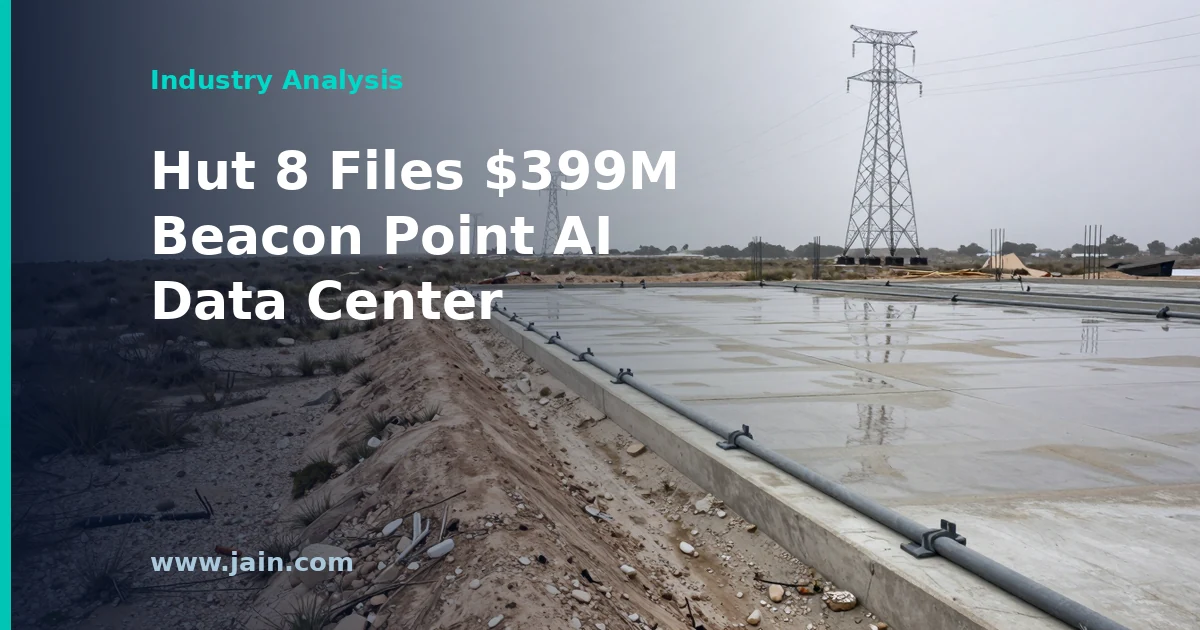
Hut 8, a company that started out mining bitcoin, has filed plans with Texas for a $399 million computer building near Corpus Christi. It would cover about as much floor space as 11 football fields.
The building is part of a much larger site built to run artificial intelligence systems, tied to about $20 billion in long-term deals involving chipmaker Nvidia and the artificial intelligence companies Lambda and Anthropic.
Why it matters: sites like this use as much electricity as a city, and Texas is now asking whether its power grid and water supply can keep up.
Construction Review reported on September 15, 2026 that Hut 8 Corp. has submitted state filings for a $399 million, 657,130-square-foot data center at its Beacon Point campus in Nueces County near Corpus Christi, Texas. The facility is designed for artificial intelligence training and inference workloads and is linked to 704 megawatts of contracted capacity that the report values at nearly $20 billion in long-term contracts. Nvidia leases the facility, according to the report, in an arrangement under which Lambda supplies AI computing power to Anthropic.
The filing lands while Texas Governor Greg Abbott has ordered a full audit of the state grid and a temporary halt to new large-load connections until developers confirm land rights, permits, water use and financial backing. The project is under regulatory review.
Executive Summary
Hut 8 has moved Beacon Point from a capacity figure to a building. The $399 million state filing describes a single large facility, purpose-built for AI rather than general-purpose colocation (renting space, power and cooling to many tenants), inside a campus whose contracted value is put at roughly $20 billion. For a company with roots in bitcoin mining, the filing is a tangible step in turning secured power into long-term, contracted AI infrastructure revenue.
The announcement matters for two reasons. First, it shows how AI capacity is now being assembled: a site developer controls land and power, a chipmaker leases the building, a cloud provider sells computing time, and an AI lab consumes it. Second, it collides directly with Texas’s new scrutiny of data centers. Contracted megawatts are only valuable if the grid can deliver them, and the state’s verification demands on land, permits, water and financing now sit squarely in Beacon Point’s path.
What $399 Million Buys, and What It Does Not
The $399 million figure is a construction value for one facility, not the price of the campus. Divided across 657,130 square feet, it works out to roughly $607 per square foot. Divided across 704 megawatts, it is under $600,000 per megawatt, which is unlikely to represent the full cost of delivering that much AI-ready power once electrical systems, cooling, grid upgrades and computing hardware are counted. Readers should treat the filing as a marker of physical progress on one building rather than a measure of total capital at stake.
The $20 billion number is a different kind of metric again: the value of long-term contracts attached to the capacity, not a construction budget. Spread across 704 megawatts, that is roughly $28 million of contracted value per megawatt, a figure that implies multi-year commitments. The distinction matters, because contract value speaks to revenue potential while construction value speaks to what must be built and financed first.
A Layered Deal That Spreads Roles and Concentrates Exposure
As described, Beacon Point runs through a chain of parties. Hut 8 develops the campus, Nvidia holds the lease and provides chips, Lambda sells computing capacity, and Anthropic is the end consumer of that capacity. This kind of structure is increasingly common in AI infrastructure: each party takes the slice of risk it is best placed to carry, and the developer gains a creditworthy tenant rather than betting on speculative demand.
The same structure also concentrates exposure. Each link depends on the next. If AI demand from a single end user shifts, or contract terms are renegotiated anywhere along the chain, the effects flow back to the landlord. For Hut 8, the strength of the arrangement ultimately rests on the specific lease terms with its direct counterparty, which have not been published. The reported figures also describe both a 704-megawatt contracted capacity and a 700-megawatt campus, and the relationship between this one building and the campus-wide total is not spelled out.
Texas Is Changing the Rules for Big Power Users
Texas has been a magnet for data centers because of available land and a grid, run by ERCOT (the Electric Reliability Council of Texas), that historically connected large customers comparatively quickly. That advantage is now under pressure. ERCOT’s interconnection queue, the waiting list of projects seeking a grid connection, holds hundreds of gigawatts of data center requests, more than the state’s entire peak demand. Many of those requests will never be built, but regulators cannot easily tell which.
The governor’s audit and connection pause is effectively a filter: prove you have the land, permits, water and money, or wait. For well-capitalized projects with real tenants, that filter could help by clearing speculative requests from the queue. For every project, it adds time and uncertainty. A 704-megawatt load needs substantial grid upgrades and firm power supply commitments, and water consumption for cooling is explicitly on the evaluation list. Beacon Point’s contracts give it a stronger story than a speculative filing, but contracts do not substitute for delivered electricity.
Who Gains, and What Could Slow It
If Beacon Point clears review, Hut 8 gains a flagship example of the developer model it has been pursuing, and the Corpus Christi area gains a major construction project and a long-lived industrial facility. Nvidia and Lambda gain dedicated capacity at a time when power-ready sites are scarce. The broader signal for the industry is that land and power alone are no longer enough in Texas; verifiable financing, permits and resource plans are becoming the price of admission.
The main risks are timing and resources. A prolonged pause, costly grid upgrades, or water constraints could push back energization, the point at which a site receives power and starts earning. Local stakeholders will reasonably want clarity on water use and grid impact, while the companies will want certainty that contracted revenue materializes on schedule. Both sets of questions deserve answers backed by specifics rather than headline figures.
Background
Hut 8 Corp. built its business on bitcoin mining, an activity that requires large amounts of cheap, reliable electricity. That experience in securing power and sites has become valuable as artificial intelligence drives demand for data centers that can draw hundreds of megawatts. Like several former miners, Hut 8 has been repositioning toward developing and leasing power-ready infrastructure for AI and high-performance computing customers.
AI data center deals increasingly involve several layers of participants: site developers, chipmakers, specialist AI cloud providers and AI labs. Texas has been a leading destination for these projects, but the scale of demand has strained the ERCOT grid’s planning process, prompting state leaders to demand proof of land, permits, water and financing before connecting new large loads.
Galaxy Digital, a company that builds warehouses of computers for artificial intelligence, has cleared an important hurdle in Texas.
The state’s electricity grid operator conditionally agreed to let five of its sites plug in and draw an enormous amount of power, roughly what a large city consumes. Two sites got the firmer approval. Three still need more study.
Why it matters: in Texas, the grid now decides who gets that much electricity and who waits. That makes the power company, not the builder, the one setting the pace.
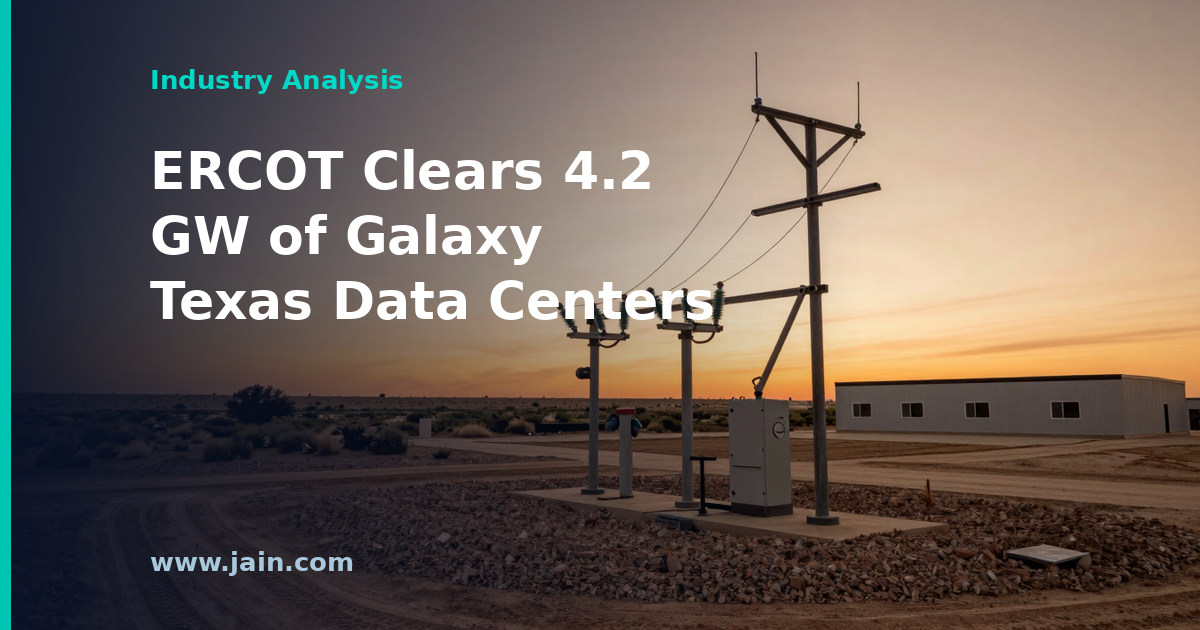
Galaxy Digital has secured conditional Batch Zero large load classifications from the Electric Reliability Council of Texas, the grid operator that runs most of the state’s power system, for five Texas data center projects covering roughly 4.2 gigawatts of gross power capacity. TipRanks reported that the decisions advance the company’s Helios I and Helios II campuses as Base Load, while three expansion sites were designated Studied Load, and that they lift Galaxy’s development pipeline to more than 5.7 gigawatts across four Texas sites.
The classifications are conditional rather than final. Some projects remain subject to further capacity allocation and audit, and the decisions were granted amid heightened regulatory scrutiny of very large electricity users by Texas authorities. Galaxy also has a planned campus called Merlin in McGregor, Texas, in the pipeline.
Executive Summary
What Galaxy Digital announced is not a customer, a construction start or a financing. It is a place in line. Batch Zero is the first tranche of requests processed under the interconnection regime Texas built for outsized electricity users, and a classification determines whether a proposed campus is treated as a load the grid is prepared to serve or as one that still has to be studied before capacity is set aside for it.
That distinction is the whole story. Galaxy’s two Helios campuses were classified as Base Load, the firmer designation. The three expansion sites were classified as Studied Load, which by the company’s own description leaves them exposed to further capacity allocation and audit. Roughly 4.2 gigawatts sits inside those five classifications; the pipeline figure Galaxy is promoting, more than 5.7 gigawatts, sits outside them.
For the wider market, the announcement is a useful demonstration of how power procurement has replaced land, capital and even chip supply as the gating item for artificial intelligence infrastructure in Texas. A developer can own the site, fund the shell and sign a tenant, and still be unable to energize anything until the grid operator says how many megawatts it will actually deliver and when.
The Interconnection Queue Is Now the Real Permit
For most of the past decade, a data center developer’s hardest document was a zoning approval or a fiber agreement. In Texas today it is a grid classification. A gigawatt is a thousand megawatts, and a megawatt is roughly the continuous draw of several hundred homes; campuses of this size arrive on the system as the equivalent of new cities appearing overnight, which is precisely why Texas legislators moved in 2025 to give the grid operator explicit authority over how the largest new loads are studied, sequenced and, in emergencies, curtailed.
Batch Zero is the first cohort run through that machinery, and Galaxy’s result shows what the process actually produces: not a yes or a no, but a tier. Base Load and Studied Load are not synonyms with a paperwork difference between them. One reflects capacity the operator is prepared to plan around. The other reflects a request that has been acknowledged and is still being evaluated. Galaxy’s announcement puts Helios I and II in the first category and its three expansion sites in the second, and states plainly that further capacity allocation and audit remain ahead.
The competitive implication is that queue position is becoming a genuine asset. Developers who filed early, on sites with existing electrical infrastructure, hold something that latecomers cannot buy with capital alone. Whether that advantage is durable depends on how fast the operator works through subsequent batches, which nobody outside the process can currently forecast.
Gross Gigawatts Are Not Leased Megawatts
Two numbers dominate the headlines, 4.2 gigawatts and 5.7 gigawatts, and neither describes computing capacity that exists or revenue that has been contracted. The 4.2 figure is gross power capacity, measured at the point where the campus meets the grid. Real facilities spend a meaningful share of that on cooling, power conversion and losses before any of it reaches a server, so the critical load available to tenants is always lower than the gross figure, and how much lower depends on design choices the announcement does not describe.
The 5.7 gigawatt pipeline number is broader still. It spans four Texas sites and includes projects that have not received Batch Zero classifications at all. Pipeline figures are legitimate planning disclosures, and every developer in this market publishes one, but they aggregate wildly different degrees of certainty into a single headline. A reader comparing developers on pipeline size is comparing intentions, not assets.
The arithmetic itself invites a question: five projects received classifications, the pipeline is described as spanning four sites, and one campus, Merlin in McGregor, appears in the announcement without a stated classification or capacity. That is not necessarily inconsistent, since a single site can host multiple projects, but it means the relationship between the two headline numbers is not self-explaining.
A Crypto Balance Sheet Funding a Utility-Scale Buildout
Galaxy is a digital asset firm that also develops data centers, and the two businesses have very different capital rhythms. Trading, asset management and custody generate returns on a cyclical, mark-to-market basis. Gigawatt-scale campuses consume billions of dollars over multi-year horizons before producing a dollar of lease revenue, and they are typically financed with project debt underwritten against signed, investment-grade tenant contracts.
The market has not fully resolved how to price that combination. The company carries a market capitalization of about ten billion dollars, and the most recent analyst rating cited in the announcement is a Hold with a twenty-six dollar price target, a stance that reads as neither endorsement nor rejection of the buildout thesis. That is a reasonable posture given what has and has not been established: the regulatory milestone is real and verifiable, while the conversion of classified megawatts into contracted, cash-generating capacity is not yet demonstrated by this announcement.
The strategic logic is nonetheless coherent. Sites originally developed for bitcoin mining tend to come with substantial interconnection already in place, which is exactly the scarce ingredient artificial intelligence tenants need and cannot manufacture. Galaxy’s ambition, as it describes it, is to fold power costs into hosting and lease arrangements, which would make it a seller of energy-inclusive capacity rather than a landlord of empty shells. That is a defensible model. It is also one that depends entirely on securing power at prices that stay below what tenants will pay for it, over lease terms measured in years.
Background
Texas has become the center of gravity for power-hungry computing in the United States, first for bitcoin mining and more recently for artificial intelligence. Its grid, operated independently of the two large interconnections that cover most of the country, offers abundant wind and solar generation, comparatively fast interconnection historically, and a market structure that rewards flexible consumers. That combination drew mining operators to remote West Texas sites, many of which were later positioned for conversion to artificial intelligence workloads because they already held the scarce asset: a completed connection to high-voltage transmission.
Galaxy Digital followed that path. Its Helios campus began as a mining facility and has been redeveloped as a multi-tenant site for artificial intelligence and high-performance computing, with Galaxy having previously announced long-term lease agreements with an artificial intelligence cloud provider there. The volume of such requests eventually forced a policy response: in 2025 Texas legislators gave the grid operator new authority to study, sequence and, in grid emergencies, curtail the largest new loads. Batch Zero is the first application of that framework, and it is why an interconnection classification now carries the weight a construction permit once did.
Artificial intelligence needs enormous amounts of electricity, and there is not enough to go around. That is making the companies that actually generate power unusually valuable.
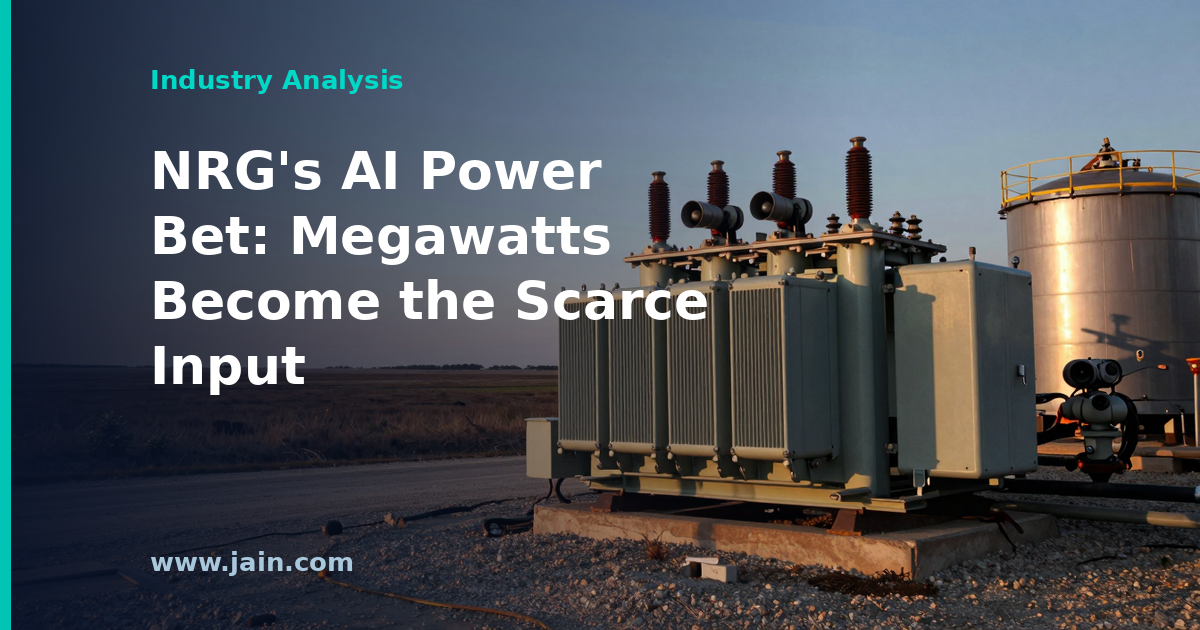
Shares of NRG Energy, a large American electricity producer and retailer, climbed sharply after investors focused on its plan to build about 4 gigawatts of new supply for data centers — roughly what four big nuclear reactors put out. One Texas project, sized at 1.2 gigawatts, is earmarked for a major cloud computing company that has not been named.
The stock is still down about 29 percent this year, so this is a bet, not a victory lap.
NRG Energy shares rose sharply in trading after bouncing off a fresh 52-week low, with TipRanks reporting that the move was driven by renewed investor attention to a perceived valuation disconnect and to NRG’s 4-gigawatt pipeline of power projects aimed at data centers — including a 1.2 GW build in Texas serving a major cloud operator. A gigawatt is a billion watts; 1.2 GW is the scale of a large conventional power station.
The rally coincided with broad strength across power and data-center infrastructure names as markets reassessed the long-term revenue potential of supplying electricity to AI-heavy cloud workloads. No specific analyst price-target changes accompanied the move. NRG’s market capitalisation stood at $23.35 billion, with year-to-date price performance of -29.08% and average trading volume of roughly 2.77 million shares.
Executive Summary
What moved was not an operating result but a valuation frame. NRG is an independent power producer and competitive retailer — a company that sells electricity at market prices rather than at rates set by a regulator. For most of the past decade, that business was valued like a mature commodity: cash-generative, cyclical, and structurally exposed to flat demand. The AI data-center buildout has broken that assumption, and the market is now testing whether generation capacity should be priced as a scarce asset instead.
The specific hook is NRG’s 4 GW development pipeline directed at data centers, anchored by a 1.2 GW Texas project tied to a large cloud customer. That combination — a named market, a named scale, and a described contracted anchor — is what separates a generator with an AI story from a generator with an AI slide. It gives investors something closer to a line of sight on high-margin, long-duration revenue than a general appeal to rising load growth.
The counterweight is the balance sheet. NRG carries a heavy debt load alongside recent revenue pressure and uneven cash flows, and it has committed to returning capital through buybacks and dividends. Those three claims on cash — deleveraging, development capital expenditure, and shareholder returns — compete directly. A stock still down more than 29% year-to-date reflects that unresolved tension as much as it reflects any AI optimism.
The Scarce Input Is No Longer the Chip
The bottleneck in AI infrastructure has migrated. Two years ago it was accelerators; today it is increasingly firm, deliverable electricity at a specific location on a specific date. Servers can be shipped. Interconnection — the physical and contractual process of attaching a large load to the grid — cannot be expedited by writing a bigger cheque. Where a hyperscaler (one of the giant cloud operators that build data centres at national scale) can secure power, it can build; where it cannot, capital sits idle.
That inversion is what re-rates a merchant generator. A company whose fleet was previously valued on forward power curves and capacity payments now holds an option on the fastest-growing industrial load in a generation. NRG’s move off a 52-week low on pipeline news rather than earnings news is the market pricing that optionality, not the underlying quarter. The distinction matters: optionality is real value, but it is value contingent on execution, and it can be repriced downward just as quickly.
Texas Is the Point, Not an Incidental Detail
The 1.2 GW project sits in Texas, and geography is doing analytical work here. Texas operates its own grid under ERCOT, largely outside federal interconnection jurisdiction, with an energy-only market design and a historically faster path from project conception to energisation than the multi-year queues that characterise other US regions. For a cloud operator with a delivery deadline, speed to power is worth a premium over marginal price.
NRG’s incumbency in that market is the differentiator. It already has generation assets, retail customer relationships, and operating experience in the region — which means the data-centre opportunity is an extension of an existing footprint rather than a greenfield bet. That lowers execution risk relative to a pure-play developer, though it does not eliminate the shared industry constraints: turbine manufacturing lead times, gas supply and pipeline capacity, transmission upgrades, and local permitting all sit outside any single company’s control.
A Pipeline Is a Menu, Not a Contract
The most important discipline for readers is distinguishing between the two numbers in this story. The 4 GW figure is a development pipeline — projects at varying stages of maturity, some of which will be built, some deferred, some abandoned. The 1.2 GW Texas build is described as anchored by a major cloud customer, which places it in a different category. Conflating the two produces a valuation that assumes 4 GW of contracted, revenue-generating capacity, which is not what a pipeline means.
This is where the balance sheet re-enters. Multi-gigawatt generation development is capital-intensive, front-loaded, and slow to convert to cash. A company with elevated leverage and uneven cash flows faces a genuine allocation problem: money spent on turbines is money not spent on debt reduction or buybacks. Investors rewarding NRG for growth and rewarding it for capital returns are, at some point, asking for two different companies. How management sequences those priorities — and whether it funds development on-balance-sheet, through project finance, or through partnership structures — will matter more to the outcome than the headline gigawatt count.
Who Wins, Who Pays
The clear beneficiaries of this repricing are owners of dispatchable generation — plants that can produce on demand rather than when the wind blows or the sun shines — in markets with load growth and workable interconnection timelines. Their bargaining position with data-centre developers has improved materially, and the contract structures now being negotiated increasingly resemble long-dated industrial offtake agreements rather than spot commodity sales.
The less-discussed side is who bears the cost. Large new loads on a constrained system put upward pressure on prices for everyone else, and the allocation of transmission and generation build costs between data-centre customers and general ratepayers is an unresolved regulatory question in several states. For enterprise buyers of colocation and cloud capacity, the practical implication is more immediate: power availability is becoming a primary site-selection constraint and a growing share of total cost, and contracts that were once priced casually on a per-kilowatt basis now deserve close reading on escalation, curtailment, and term.
Background
NRG Energy is a Houston-headquartered independent power producer and competitive retail electricity provider, operating generation assets and selling power to residential and commercial customers in deregulated US markets, with a substantial presence in Texas. Unlike a regulated utility, which earns a set return on approved investment, a merchant generator’s economics turn on wholesale power prices, plant availability, and the terms it can negotiate with large customers — a model that rewards scarcity and punishes oversupply.
For much of the past decade, US electricity demand was broadly flat, and the sector was valued accordingly: as a source of cash returns rather than growth. The data-center buildout has reversed that assumption within roughly two years. Grid operators across several regions are now processing interconnection requests measured in gigawatts from single customers, and the constraint on AI capacity expansion has shifted from computing hardware toward power delivery. That shift is what puts companies like NRG — which already own dispatchable generation in load-growth markets — at the centre of an investment story they were not previously part of.
Sources
Source: NRG Energy Surges As AI Power Deal Ignites Rally — TipRanks report on NRG Energy’s share move off a 52-week low, its 4 GW data-center power pipeline, and the 1.2 GW Texas project serving a major cloud operator.
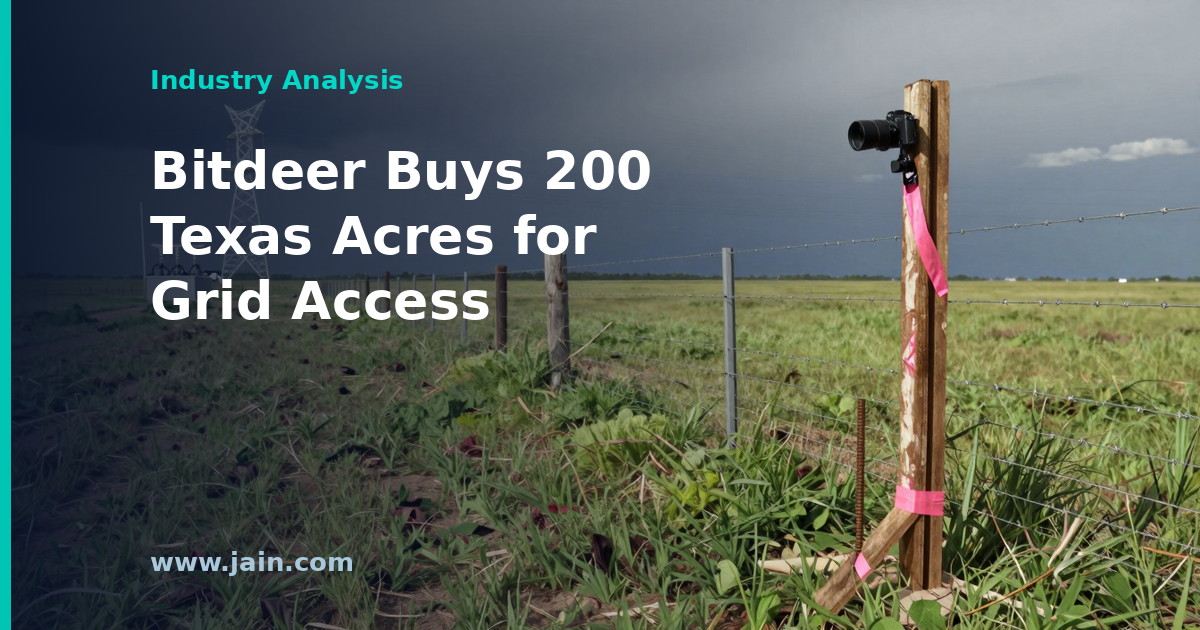
Bitdeer paid about $100 million for 200 acres of empty land in rural Texas — roughly half a million dollars an acre. The land itself is not really what it bought.
What it bought is a spot on the electricity grid. The site sits next to a plant the company already runs near Rockdale, about 70 miles from Austin, where the utility has already agreed to deliver enough power to run a small city.
Getting that kind of power hookup can take years of waiting. Land next to one that already exists is worth paying up for.
Bitdeer Technologies Group (NASDAQ: BTDR) said on September 1 that it has completed the fee simple purchase of approximately 200 acres of greenfield land in Milam County, Texas, for total consideration of approximately $100 million, paid in cash. The parcel sits near the company’s existing Rockdale facility, roughly 70 miles from Austin, and is intended to support development of AI and high-performance computing (HPC) infrastructure. The announcement was furnished to the U.S. Securities and Exchange Commission as an exhibit to a Form 6-K filed September 2.
In the release, Bitdeer says the Milam County sites, including the new parcel, currently feature approximately 563 megawatts (MW) of interconnected grid capacity with existing plans expected to scale to 742 MW, plus a dedicated water supply. After the deal, the company says it owns and/or operates roughly 255 acres and 742 MW of existing and pipeline power capacity in the county, against approximately 3.0 gigawatts of total power capacity across a global portfolio spanning the United States, Norway, Bhutan, Canada, Malaysia and Ethiopia.
Executive Summary
The headline number is land, but the substance is electricity. Bitdeer disclosed a cash purchase of about 200 acres next to a campus that already holds a large-load grid connection — the utility-approved right to draw power at scale, which in Texas and most other markets is now the slowest and scarcest input in data center development. Land can be bought in weeks. An interconnection typically cannot.
Chief Financial Officer Michael G. Potter framed the deal as a control decision rather than a capacity decision, saying outright ownership “eliminates the renewal risk associated with a lease” and gives the company flexibility to keep running Bitcoin mining while it develops the new property. That matters commercially: hyperscale and AI tenants signing decade-plus leases underwrite the landlord’s title as well as its power, and a developer building on leased dirt carries a financing discount its owned-land peers do not.
The wider context is a Bitcoin miner converting itself into a data center landlord. In its July operations update, filed August 26, Bitdeer pointed to a $4.7 billion, 16-year AI/HPC lease announced in early August as “a key milestone in converting our power portfolio into contracted, long-term revenue,” alongside approximately 76.7 exahashes per second of self-mining hash rate and a 9.5 MW facility in Malaysia fully committed under long-term offtake agreements. The Texas purchase extends that conversion strategy to the company’s best-connected North American site — without, so far, a disclosed customer, budget or construction timeline attached to the new parcel.
Half a Million Dollars an Acre Is a Price for the Queue, Not the Dirt
Divide the disclosed consideration by the disclosed acreage and the arithmetic is stark: roughly $500,000 per acre for greenfield land in a rural Texas county. No one pays that for soil. They pay it for adjacency — proximity to an energized campus with established transmission and substation infrastructure, which is what Bitdeer says the Rockdale location already has.
The mechanism worth understanding is the interconnection queue. Before a large facility can draw meaningful power, the grid operator must study the request and the utility must build or upgrade the lines and substations to serve it. For loads measured in hundreds of megawatts, that process is measured in years, and in the current AI buildout the queue — not capital, not chips, not construction labour — is the binding constraint on delivery dates. Buying land beside a site that has already cleared much of that path is a way of buying time, and time is the input in shortest supply.
A rough yardstick: measured against the 742 MW of existing and pipeline capacity Bitdeer attributes to its Milam County sites, $100 million works out to about $135,000 per megawatt. Treat that number carefully — the company assigns the capacity to the sites collectively, not to the new parcel alone, and it has not said how much of it the new land would serve. But even on the most conservative reading, land is a small line item next to the cost of building AI-ready halls on it.
The Conversion Trade: From Hash Rate to Lease Rate
Bitcoin miners and AI data centers want the same thing — cheap, abundant, interruptible power — and differ sharply in everything else. Mining tolerates modest reliability and rough-and-ready buildings because the revenue is a commodity output. AI and HPC tenants want redundancy, dense power per rack, sophisticated cooling and contractual guarantees, and they pay for it in long-dated leases. That gap is why so many mining campuses are being re-underwritten as data center real estate.
Bitdeer is explicit that this is the direction of travel. The August 26 filing quotes Potter describing the $4.7 billion, 16-year lease as converting the power portfolio “into contracted, long-term revenue,” and the Malaysia facility as fully committed under offtake agreements representing expected contracted revenue exceeding $800 million. The September release goes further in a place readers often skip: its forward-looking-statements paragraph flags expectations about “the potential reallocation of existing interconnected capacity.” In plain terms, some of the 563 MW now serving mining machines could be redirected to AI tenants. That is the cheapest megawatt in the industry — one already connected — and it is also the one whose reallocation the company has not yet quantified.
The company’s claim that the purchase “removes one of the principal constraints on AI/HPC data center development at the location” is defensible as far as it goes. Land tenure was a real constraint, and it is now resolved. It is worth being precise about what remains: the power allocation beyond 563 MW is described as planned, not granted; the water supply is described as dedicated but not quantified; and no tenant, capital budget or energization date has been attached to the new parcel.
Why a Landlord Buys Instead of Leases
Fee simple ownership — outright title, as opposed to a lease — sounds like a legal footnote and is in fact a financing question. A developer signing a 16-year lease with a creditworthy compute tenant will typically want to borrow against that lease. Lenders and rating agencies look at whether the ground beneath the building could revert to someone else, at what price, and on whose terms. Ground-lease renewal risk sits directly in that analysis, and Potter’s language about eliminating it reads as written for that audience.
Ownership also buys sequencing freedom. Bitdeer says the purchase lets it “maintain our existing Bitcoin mining operations while we develop the newly acquired property” — that is, build the AI campus next door rather than demolishing a revenue-producing mining site to make room. For a company whose mining business was still scaling to roughly 76.7 EH/s (exahashes per second, a measure of total mining computation) in July, keeping both revenue streams live during a multi-year construction programme has real value.
One quiet detail deserves attention. Bitdeer says it owns and/or operates approximately 255 acres in Milam County after the transaction — implying the pre-deal footprint was on the order of 55 acres. For a site holding a 563 MW interconnection, that is a very small land base, and it explains the price: the company was power-rich and land-poor at exactly the location where it most wants to build.
Concentration, and What It Costs to Get It Wrong
After this deal, Milam County accounts for 742 MW of Bitdeer’s roughly 3.0 GW global capacity — close to a quarter of the portfolio, in one county, on one grid. Concentration of that kind cuts both ways. It delivers scale, shared substation infrastructure and a single operating team, which is how campuses get built cheaply. It also stacks regulatory, weather and grid-policy exposure in one place, and Texas has been actively revisiting how very large flexible loads are treated on its system.
The diversification argument runs the other way for Bitdeer’s international sites in Norway, Bhutan, Canada, Malaysia and Ethiopia, which spread jurisdictional risk but sit further from the North American enterprise and hyperscaler demand that AI leases are written against. Proximity to Austin — the company cites 70 miles — matters less for latency than for labour, construction supply chains and the simple willingness of a customer’s engineering team to visit the site.
For buyers of capacity, the practical read is that powered land next to energized campuses is now being priced as a scarce financial asset rather than as real estate, and that miners with existing large-load interconnections are among the few holders of it. For investors, the disclosure is a genuine, cash-settled commitment rather than a memorandum of understanding — but a $100 million land purchase is a call option on development, not development itself. The value depends entirely on the power allocations and tenant contracts that follow.
Background
Bitdeer Technologies Group is a Singapore-headquartered company listed on Nasdaq under BTDR that describes itself as a technology company for AI and Bitcoin mining infrastructure. It handles equipment procurement, logistics, data center design and construction, and daily operations, and also sells cloud capacity to AI customers. Its data centers span the United States, Norway, Bhutan, Canada, Malaysia and Ethiopia, and it reported approximately 76.7 EH/s of self-mining hash rate in its July 2026 operations update.
Milam County, in central Texas, has been a magnet for very large electricity consumers because of established transmission and substation infrastructure and a grid that has historically welcomed flexible industrial load. That drew Bitcoin miners first; the same attributes — abundant interconnected power and available land — now make such campuses candidates for AI and HPC conversion. Bitdeer has been moving in that direction through 2026, announcing a $4.7 billion, 16-year AI/HPC lease in early August and a fully committed 9.5 MW facility in Malaysia representing expected contracted revenue above $800 million. The company also said in August that it would shift infrastructure updates from monthly to quarterly disclosures issued with earnings.
MARA Holdings, one of the largest publicly traded bitcoin mining companies, has announced a deal to acquire a site in Texas that is described as doubling its power capacity. Shares in the company rose following the news, according to the market report carrying the item.
The coverage available is a short market wire summary rather than a detailed transaction announcement. It does not disclose a purchase price, a megawatt figure, the seller, the closing timetable, or whether the acquired capacity is already energized and delivering power. Those details matter enormously to how the deal should be valued, and we flag them as open below.
Executive Summary
The headline event is straightforward: MARA has agreed to buy a Texas power site, and the market read the deal as a material expansion of the company’s electrical footprint. The framing itself is the story. The acquisition is being described by its power capacity, not by how much bitcoin mining equipment it can run or what it does to the company’s hashrate — the industry’s traditional measure of mining scale.
That word choice reflects a genuine shift in how these assets are priced. Across the sector, companies that were built to mine cryptocurrency have found that their most valuable possession is not their machines but their grid connections: sites where a utility has already agreed to deliver large volumes of electricity. Artificial intelligence data centers need exactly that, and they need it years sooner than the conventional development process can supply it. Energized megawatts have become the scarce commodity, and buying a site is often the fastest way to obtain them.
What the available reporting does not establish is whether this particular transaction is an AI-oriented move, a straightforward mining expansion, or an option the company intends to keep open. Until MARA publishes the transaction terms and the technical characteristics of the site, the stock reaction should be read as a market judgment about direction of travel rather than a verified change in the company’s earnings power.
The Asset Being Bought Is the Interconnect
When a large electricity consumer wants to plug into the grid, it joins an interconnection queue — a regulated process in which the grid operator studies whether the local network can absorb the new load and what upgrades are required. For projects at the scale a data center campus needs, that process is commonly measured in years, and completion is not guaranteed. A site that has already cleared it, or that carries a signed agreement for firm delivery, is therefore not just land with a substation on it. It is a permit to consume power on a timeline no greenfield developer can match.
This is why acquisitions in this corner of the market are increasingly quoted in megawatts rather than in square footage, revenue, or equipment. The buyer is purchasing schedule certainty. In a market where the demand for AI compute is running ahead of the physical infrastructure available to host it, time-to-power has become a pricing input in its own right, and sites with existing connections trade at premiums that would look irrational if you valued them only on the cash flow they currently produce.
The important caveat is that not all capacity is equal. “Interconnected” can mean an executed agreement, a completed study, or power actually flowing today; it can be firm or interruptible; and it can carry obligations to fund transmission upgrades. The report on MARA’s deal does not specify which, and that distinction is the difference between an asset that can host a paying tenant next year and one that cannot.
From Hashrate to Landlord: What Converts and What Does Not
The strategic logic of the miner-to-AI-landlord pivot is sound. Bitcoin mining revenue is volatile, tied to a token price the operator cannot influence and to a protocol that periodically halves the reward per block. Hosting AI workloads under multi-year contracts offers something structurally different: contracted, creditworthy cash flow that lenders and equity investors will capitalize at a far higher multiple. Several listed miners have already announced conversions or hosting agreements with AI compute providers, and the market has generally rewarded those announcements. MARA’s framing of a purchase around power capacity sits comfortably inside that pattern.
What does not transfer cleanly is the building. A bitcoin mining facility is engineered to be cheap and tolerant: often little more than ventilated shells or immersion tanks, with minimal power redundancy, modest fiber connectivity, and a business model that welcomes being switched off when electricity prices spike. An AI training or inference facility is close to the opposite. It needs redundant power paths, dense liquid cooling, low-latency fiber routes, and uptime commitments that make curtailment a contractual breach rather than a revenue opportunity. Converting one to the other is typically a rebuild of everything except the grid connection and the land.
That gap is also a capital gap. The cost per megawatt of a high-availability AI facility is a large multiple of the cost per megawatt of a mining shed, which means the acquisition price is frequently the smaller half of the eventual investment. Companies pursuing this route generally require a signed tenant, a financing partner, or both before the conversion capital can be committed. Whether MARA has any of those in place for this site is not addressed in the available material.
Why the Shares Rose, and What the Market Is Pricing
A stock moving up on a transaction with undisclosed terms is a signal about narrative rather than arithmetic. Investors cannot have modeled the earnings contribution of a deal whose price and megawatt count they have not seen. What they can price is optionality: the possibility that a company currently valued as a commodity producer holds assets that would be worth considerably more in the hands of an infrastructure landlord.
That re-rating opportunity is real but conditional. It requires the capacity to be genuinely deliverable, the sites to be suitable or economically convertible, and — decisively — a customer willing to sign a long contract. Each of those conditions has failed for someone in this sector before. There is also a dilution question that positive share-price reactions tend to obscure: infrastructure buildouts are funded, and miners have historically funded them through equity and convertible issuance. A higher share price makes that cheaper, which is a legitimate corporate benefit, but it means existing holders may be paying for growth in ownership as well as in cash.
The even-handed reading is that the market is rewarding a strategic posture that is well-supported by industry conditions, on the basis of a disclosure that is too thin to verify it. That is not a criticism of the transaction, which may well be attractive. It is an observation about the information asymmetry between a one-line headline and a decision to buy the stock.
Texas: Abundant Power With Real Constraints
Texas has been the natural home for energy-intensive computing for identifiable reasons. Its grid features substantial wind and solar generation, wholesale prices that can fall very low during periods of surplus, a comparatively fast permitting environment, and a market design that pays large flexible consumers to reduce demand when the system is stressed. For miners, whose machines can be shut off in seconds, that last feature converted grid stress into a revenue line.
The constraints are becoming more visible as the loads get larger. Grid operators and regulators in Texas have moved to tighten how very large new consumers are studied, connected, and expected to behave during emergencies, partly because the aggregate volume of requested large-load capacity has grown so quickly. Water availability for cooling, transmission congestion in specific zones, and local reaction to industrial power consumption in residential areas are all live issues. None of these prevent projects; they do affect which sites are actually developable and on what schedule.
The practical implication is that a Texas acquisition should be assessed zone by zone, not as a generic bet on cheap Texas electricity. Two sites with identical nameplate capacity can have very different value depending on where they sit relative to congestion, what obligations attach to their interconnection, and whether their power is firm or curtailable. Investors and prospective tenants should ask for that granularity before assuming the megawatts are fungible.
Background
MARA Holdings began life as Marathon Digital Holdings and grew into one of the largest listed bitcoin miners by building out fleets of specialized machines that compete to validate transactions in exchange for newly issued bitcoin. That business is inherently cyclical: revenue tracks the bitcoin price and the mining reward is cut roughly every four years by the protocol’s design, which puts persistent pressure on the cost of electricity per unit of output.
Since the surge in demand for AI computing, the industry’s calculus has changed. The facilities miners built to chase cheap power sit on exactly the resource AI data center developers cannot obtain quickly — large, permitted grid connections. A number of listed miners have consequently repositioned as power and infrastructure companies, selling or converting capacity to AI tenants under long-term contracts. Texas, with its deep renewable generation, flexible wholesale market and comparatively accessible permitting, has been the geographic center of that shift, and it is where much of the sector’s remaining connected capacity is being bought and sold.
Texas’s governor has stopped approving new data centers, the huge warehouses of computers behind artificial intelligence, from plugging into the state’s electric grid. The pause lasts until they report how much power and water they will use. His office says fewer than one in ten have followed the law that requires this.
President Trump called the pause a mistake. The stakes are large: companies have asked Texas for more than five times the most electricity the whole state has ever used at one moment.
Newsweek reported on August 8, 2026 that President Donald Trump called Texas Governor Greg Abbott’s pause on data center grid approvals “a mistake.” He said so in an interview with Punchbowl News released on August 7. Abbott announced on Monday, August 3 that Texas would halt approvals for proposed data centers seeking connections to the state grid. The halt holds while regulators audit each project’s expected electricity and water use, cooling systems, tax incentives, ownership and plans to limit local impacts. Projects that fail the state’s requirements are to be denied connections.
Abbott’s office tied the pause to demand figures from ERCOT, the Electric Reliability Council of Texas, which runs most of the state’s grid. About 90 percent of the 474 gigawatts of large-load interconnection requests under review come from data centers. That is more than five times ERCOT’s record peak demand of roughly 85.5 gigawatts. The governor’s press secretary also said fewer than 10 percent of data centers comply with a state law requiring them to report their power and water usage.
Executive Summary
The dispute looks like a clash over whether Texas wants data centers. The mechanism Abbott chose is narrower than that. The pause is not a ban. It applies mainly to proposed facilities seeking a grid connection, and it asks them to give the Public Utility Commission of Texas (PUCT) and ERCOT data that state law already requires. Projects that bring their own generation may be able to avoid the standard connection process altogether.
This matters for AI infrastructure because Texas is one of the most important markets for large AI campuses. The state’s planning problem is severe: requests on file far exceed anything the grid has ever delivered. Until developers disclose their power and water numbers, the state cannot separate projects that will be built from requests that will never draw a watt. For now, the fastest path to power in Texas runs through a filing cabinet as much as a substation.
Trump’s comments put the federal administration’s rhetoric at odds with a Republican governor who has courted the same industry. The disagreement is so far verbal, and Trump himself said he was “not taking positions.”
The Gate Is a Filing, Not a Ban
The operative detail in Abbott’s order is the disclosure requirement. According to his press secretary, Andrew Mahaleris, Texas law already obliges data centers to report their power and water usage, and fewer than 10 percent do. The pause, in his words, “requires data centers to provide PUCT and ERCOT with the required information for them to make fully informed decisions.” Projects that fail the state’s requirements should be denied connections. In practice, a developer’s place on the path to electricity now depends on whether its paperwork is complete, and not only on engineering studies and transmission capacity.
That changes who moves first. Developers that already track and report their expected load, water draw and cooling design can respond quickly once the audit begins. Those that filed interconnection requests without firm designs, or treated the reporting law as optional, face the longest delay. The audit also covers tax incentives, ownership and community mitigation, so the information burden goes beyond megawatts. The heaviest effect is likely in Oncor’s territory around Dallas-Fort Worth. ERCOT forecasts place the largest concentration of projected large-load growth there, across Dallas, Collin, Denton, Tarrant and Ellis counties.
A Queue Five Times the Size of the Grid
The scale explains why regulators want the data. ERCOT told lawmakers in July that 474 gigawatts of large-load requests are under review, about 90 percent from data centers. The grid’s all-time peak is about 85.5 gigawatts. A gigawatt is roughly the output of a large power plant, so the request queue equals several Texas grids stacked together. Utility-submitted forecasts show large-load requests rising from about five gigawatts in 2026 to more than 109 gigawatts by 2032. Even that is a fraction of the queue.
An interconnection request is an application for grid capacity, not a commitment to build. Developers often file for more sites than they will pursue, because securing a place in line is cheap compared with losing one. Grid planners size transmission lines and generation to the load they expect. Overbuilding for requests that vanish raises costs that ratepayers may carry. Underbuilding for load that arrives risks reliability. Verified disclosure is the tool that narrows that uncertainty, which is why the state has made it the condition for approval.
Two Claims, Both Worth Testing
Trump argued that communities gain from data centers: more investment, lower taxes and higher home values. He also said the industry “could be bigger than oil” for Texas. The investment case is real. Abbott himself called Texas “the epicenter of AI development” when Google announced a $40 billion cloud and AI infrastructure investment in the state in November. The home-value claim is less settled. Newsweek noted that studies point both ways, with regional economic lift on one side and localized noise, traffic and water concerns on the other. Public sentiment has also moved. An Emerson College poll in July found 63 percent of U.S. voters oppose AI data centers in or near their community, up 21 points since December 2025.
The governor’s reliability claim deserves the same scrutiny. Mahaleris cited a “more than 500 percent increase in peak electricity demand.” The figure appears to describe the request queue measured against the record peak, not electricity Texans are actually using today. That is consistent with 474 gigawatts against 85.5. The distinction matters: a queue of that size is a planning problem, not an imminent shortage. The duration of the pause has not been specified, which leaves the cost of the delay open-ended for projects already in line.
Onsite Power Becomes the Side Door
Because the pause targets grid connections, projects with their own generation may be able to proceed outside the standard process. That favors well-capitalized developers who can finance onsite gas turbines, contract with nearby generators, or build power alongside the campus. Smaller developers that depend on the grid have fewer options. If the pause runs long, the Texas pipeline could shift toward self-powered campuses. Those projects bring their own questions about fuel supply, emissions permitting and backup reliability.
The federal-state dimension has limits. ERCOT’s grid operates largely within Texas and is overseen by the state’s utility commission, so Washington’s direct levers over Texas grid connections are narrow. Trump’s comments may shape the political climate. The decisions on which data centers connect, and when, remain with Austin.
Background
Texas has become one of the central markets for AI infrastructure, drawing hyperscale campuses with its available land, transmission and fiber networks and a grid that has historically connected large loads quickly. Abbott has promoted that role, calling the state “the epicenter of AI development” when Google announced a $40 billion cloud and AI investment there in November. Local resistance has grown alongside the buildout. The proposed $1.1 billion Fort Worth Data Center Project in the Veale Ranch area drew resident concerns over power, water and infrastructure, and city officials delayed a tax incentive package after public opposition.
The Texas situation is part of a national surge. Pew Research Center counts over 1,500 new data centers in development across the U.S., and the Berkeley Research Group estimates about 3,000 projects at various stages. Unlike most of the country, the ERCOT grid operates largely within the state, so Texas regulators hold most of the authority over who connects and on what terms.