Equinix runs giant buildings full of computers that firms like Microsoft, Google and Amazon use. Its Irish business saw profit before tax fall by more than a third last year, to 4.4 million euros.
That sounds alarming, but the drop mostly reflects a one-off payment the company received the year before. Sales actually grew 9%.
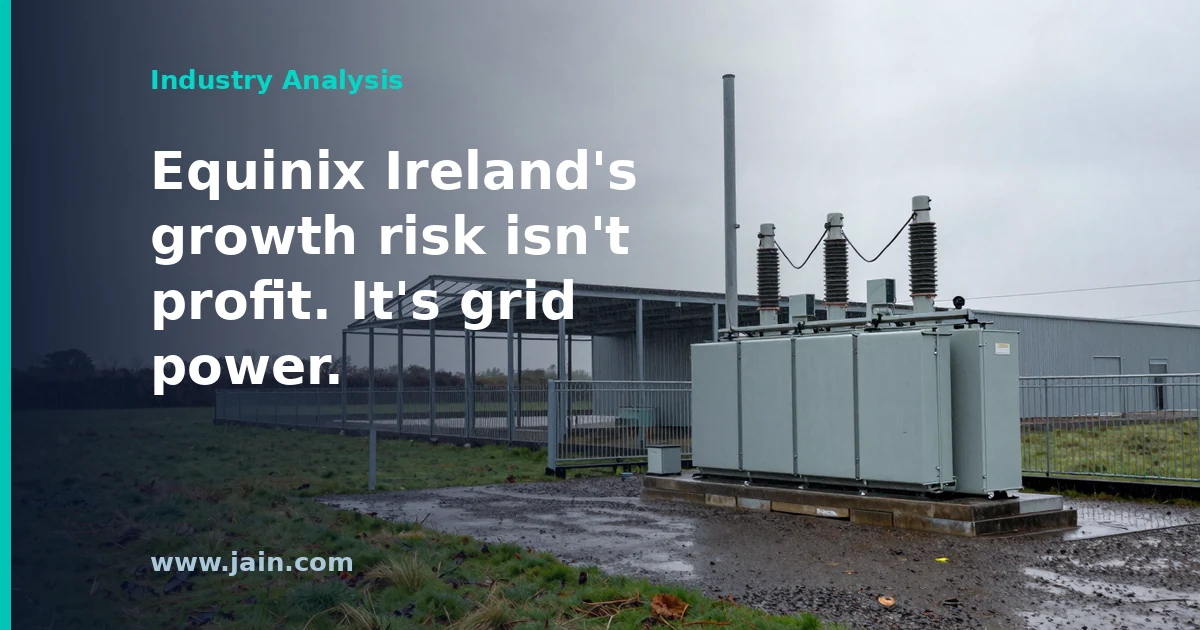
The real worry is electricity. The company’s own directors warn that power suppliers may not be able to give it more in the places it wants to grow.
In Ireland, where these computer buildings already lean heavily on the national grid, power may decide how fast they can expand.
RTÉ reported that newly published accounts for Equinix (Ireland) Ltd, the Irish arm of the California-based data centre operator, show pre-tax profit fell 36% to €4.4m in 2025, even as revenue rose 9% from €75.3m to €82.4m. The decline was due mainly to €2.9m of dividend income booked in 2024 that did not recur. Operating profit fell 6% to €5.43m, gross margin rose from 23% to 25%, and EBITDA (earnings before interest, tax, depreciation and amortisation) came to €13.2m.
During the year, Equinix bought BT Group’s Irish data centre business, including facilities in Citywest and Ballycoolin, Dublin, for €61.27m, a deal the Competition and Consumer Protection Commission cleared in August 2025. Headcount rose from 101 to 110, and the directors flagged the risk that electricity providers may not be able to supply further capacity where the company expects to expand.
Executive Summary
Equinix’s Irish subsidiary reported a sharp fall in pre-tax profit for 2025, to €4.4m from the prior year, on revenue that grew 9% to €82.4m. The directors attribute the fall mainly to a €2.9m dividend received in 2024 that was not repeated. The operating business tells a steadier story: gross margin improved to 25% on growth in recurring colocation and interconnection revenue, and operating profit slipped only 6% to €5.43m.
That steadier story carries a cost signal. Staff costs rose by about a quarter, from €14.18m to €17.8m, while headcount grew 9%, absorbing roughly half the year’s €7.1m revenue gain and thinning the operating margin even as gross margin widened. The company also added capacity through its €61.27m purchase of BT’s Irish data centre business.
The most consequential line in the accounts is not a number. The directors say they intend to keep increasing capacity, and they name electricity supply as the risk to doing so. In Dublin, where grid connections for new data centres have been restricted for years, that makes power availability, not customer demand, the variable to watch for Equinix, its customers and anyone pricing data centre capacity in Ireland.
A Dividend Explains the Headline, Not the Business
The 36% headline compares two years that are not like for like. In 2024, Equinix (Ireland) Ltd booked €2.9m of dividend income, money received rather than earned by running data centres, and that income did not recur in 2025. The directors identify it as the main reason for the fall. Measured on operations alone, the business held up: operating profit fell 6% to €5.43m, and after €1m of net interest the company reported pre-tax profit of €4.4m.
The cash-generation picture is firmer still. EBITDA, a rough proxy for the cash the operations throw off before financing and accounting write-downs, was €13.2m. The gap between that figure and operating profit is mostly €7.7m of depreciation, the non-cash charge that spreads the cost of buildings, generators and cooling plant over their working lives. Heavy depreciation is normal in a capital-intensive asset class like data centres and says little about demand, which the directors describe as having “remained solid.”
Wider Gross Margins, Thinner Operating Margins
Gross margin rose from 23% to 25%, which the directors credit to growth in recurring interconnection and colocation revenue. Colocation, renting space, power and cooling so customers can house their own servers, brought in €67.25m, more than four-fifths of revenue. Interconnection, directly linking customers to networks, clouds and each other inside the same building, contributed €9.44m, about 11%. Managed infrastructure added €3.6m and non-recurring revenue €1.85m, so nearly all income is recurring. Interconnection is valued in the colocation model because each new link adds revenue while using little extra floor space or power.
Below the gross line, costs grew faster than sales. Revenue rose by about €7.1m, while staff costs rose by €3.6m, roughly 25%, against a 9% rise in headcount, from 101 to 110 people (79 engineering and technical, 29 sales and administration, two directors). On the reported figures, operating margin fell from roughly 7.7% to about 6.6%. The accounts do not break down the staff cost increase; the year also included the integration of BT’s Irish data centre business, but the company has not linked the two.
Power, Not Demand, Sets the Pace of Expansion
The 9% revenue growth matters less than what it takes to repeat it. The directors say the company “intends to continue to increase its capacity,” and in the same accounts they name the risk that electricity providers may not be able to provide further capacity in locations where it expects to expand. In Dublin that is a live constraint: Ireland’s grid operator, EirGrid, has for several years restricted new data centre connections in the region, and the energy regulator has moved toward requiring new large energy users to bring their own generation or storage. For an operator that wants to grow, a grid connection, not a customer contract, is the scarce input.
The link to the AI buildout runs through power density. Equinix markets its 282 data centres worldwide as “AI-ready,” and the Irish directors list rising “requirements for power and cooling” among the market’s growth drivers. Denser computing, of which AI training and inference are the leading example, draws more electricity per rack, so customer growth consumes grid capacity faster than it consumes floor space. The Irish directors do not attribute demand to AI specifically; they cite internet traffic, financial services computing, cloud and software-as-a-service. But whatever the workload, more compute per site pushes power to the front of the queue.
Two consequences follow for the people who buy and finance this capacity. First, capacity that is already connected and powered becomes more valuable, which is consistent with the directors calling theirs “premium” and with the widening gross margin; buying BT’s operating Citywest and Ballycoolin facilities added capacity without waiting on a new connection, though the company has not framed the deal that way. Second, energy costs are moving toward customers: the directors say price increases are embedded in the budget and partly hedged, that “communication has started towards the customers,” and that a task force is looking for ways to cut primary energy use. Dublin tenants should expect power terms, not just space, to drive renewals.
Background
Equinix Inc., headquartered in California and listed under the ticker EQIX, owns and operates 282 data centres in 75 locations worldwide. Its model centres on colocation, renting secure, powered and cooled space for customers’ servers, and interconnection, which lets those customers link directly to networks, cloud platforms and one another inside the same facility. Its client list includes Oracle, Nvidia, Google Cloud, Microsoft, Dell Technologies and Amazon Web Services.
Dublin is one of Europe’s main data centre hubs, home to large cloud and technology operations, and also one of its most power-constrained. Ireland’s grid operator has restricted new data centre connections in the Dublin region for several years, making existing grid capacity a strategic asset. Equinix’s Irish subsidiary runs five Dublin sites and, in 2025, added BT Group’s Irish data centre business, including facilities in Citywest and Ballycoolin.
Equinix, one of the world’s largest renters of data center space (the buildings full of computers that run websites and apps), is testing new electrical equipment from Schneider Electric inside a working facility.
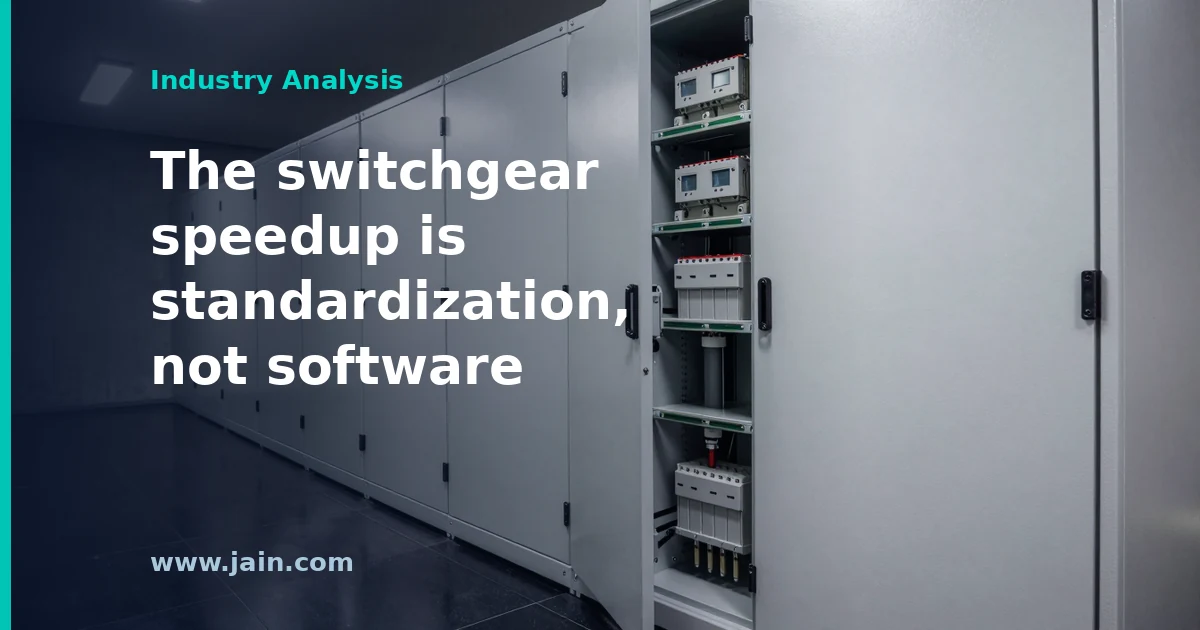
The equipment is the heavy-duty switching gear that takes power from the grid and routes it safely into a building. Today it is usually custom-built for each site, which is slow. Schneider says its version uses one standard design controlled by software, and can be ordered and built up to three times faster.
The catch is timing. Most buyers will not be able to get it until 2028.
Equinix is piloting Schneider Electric’s newly launched software-defined medium-voltage (MV) switchgear inside a live colocation data center, Data Centre Magazine reported on September 29, 2026. Schneider unveiled the system at its YOTTA 2026 event in Las Vegas, running September 28-30, and describes it as the world’s first fully software-defined MV switchgear.
Schneider says the design allows up to three times faster ordering and manufacturing, up to two times faster commissioning and onsite acceptance testing, and upgrades with zero operational downtime. Pilot programs will continue through 2027, with broader availability expected from 2028.
Executive Summary
Medium-voltage switchgear is the equipment that receives power from the utility side and distributes and protects it before it is stepped down for use inside a building. It is typically engineered to order, meaning each lineup is designed for a specific site. Schneider Electric’s new product replaces that bespoke approach with standardized hardware whose functions are set and updated in software, including over-the-air updates that add features without physical modification.
Equinix’s role is to prove the concept where it counts: in an operating colocation facility, where multiple customers share infrastructure and reliability expectations leave little room for experimentation. Greg Metcalf, Equinix’s Senior Director of Global Data Center Design and Innovation, framed the value around standardization “for multiple use cases.”
The significance is less the software itself than what it enables. If power distribution gear can be ordered as a standard product rather than designed per site, one of the slower steps in bringing data center capacity online could shorten. That benefit, however, is on a 2028 horizon for most buyers.
The Speedup Comes From Standardization
Schneider’s own explanation of the problem points to the mechanism. Traditional MV systems are engineered to order, which the company says leads to long lead times, complex procurement and limited scalability. The first change it lists is that standardized hardware platforms replace bespoke designs. Software is the tool that makes this possible: if protection settings, logic and features live in configurable software, one physical platform can serve configurations that previously needed distinct engineering. The claimed result is up to three times faster ordering and manufacturing.
That is why the headline claim is best read as a bet on off-the-shelf power equipment. An engineered-to-order product cannot be meaningfully ordered until a site’s electrical design is settled. A standardized one can, in principle, be ordered earlier, built in larger runs and configured closer to installation. For operators, that turns switchgear selection from a line item into a schedule decision: the lead time on this equipment helps determine when a data hall can be energized and sold.
Both executives emphasized this point. Metcalf cited “increased standardisation for multiple use cases,” while Melton Chang, Executive Vice President of Schneider’s Power Systems Division, said customers can “standardise across regions.” For a multi-market operator such as Equinix, a single qualified design deployable in many countries is a procurement advantage that compounds with every new build.
Why a Live Colocation Site Matters
Colocation facilities rent space, power and cooling to many tenants under one roof, so shared electrical infrastructure is difficult to take offline. That context gives Schneider’s “zero operational downtime” upgrade claim practical weight. Changes to conventional switchgear often require planned outages or physical work; changes delivered through software, if they work as described, avoid negotiating maintenance windows across many customers.
Chang put the broader pressure plainly: “Data centres are being asked to build faster than traditional power infrastructure can move.” The current construction wave, much of it tied to AI workloads, has made power equipment timing a visible constraint. A pilot in a working facility is the credible way to show that a new approach to critical power does not trade reliability for speed.
Software in the Power Path Raises New Questions
Moving function into software also moves risk. Switchgear performs protection: it detects faults and interrupts current to keep equipment and people safe. Over-the-air updates to devices in that role require rigorous change control, validation and cybersecurity, and the announcement does not describe how Schneider addresses them. The lifecycle layer adds further connectivity, with embedded analytics and AI-powered predictive maintenance through Schneider’s EcoCare Services.
The performance claims also need context. “Up to” three times faster ordering and “up to” two times faster commissioning are ceilings, not averages, and no baseline lead time accompanies them. Buyers will want to know how those figures translate into weeks saved on an actual project.
2028 Is the Date That Counts
Pilots run through 2027 and broader availability is expected from 2028, so near-term data center builds will largely rely on conventional gear. Schneider’s plan to extend the architecture across its MV portfolio, including PremSet and the AirSeT range (GM, RM and SM AirSeT), signals a portfolio-wide shift rather than a single product. For operators planning capacity for the later part of the decade, the Equinix pilot is an early reference point worth watching; for projects breaking ground now, it is not yet an option.
Background
Equinix is a global colocation operator, renting data center space, power and cooling to many customers in shared facilities and connecting them to networks and cloud providers. Because it builds in many markets, repeatable designs that can be deployed across regions are central to how it expands capacity.
Schneider Electric makes power distribution and energy management equipment, including medium-voltage switchgear lines such as PremSet and AirSeT. Its Software Defined Energy strategy aims to separate system intelligence from hardware so that power infrastructure can be updated through software rather than rebuilt. The software-defined MV switchgear, launched at YOTTA 2026 in Las Vegas, is the first product under that approach to be tested in a live data center.
Equinix rents out space, electricity and network connections inside the buildings where companies keep their computers. It says it now plans to spend 5 to 7 billion dollars every year building more of them, because demand for artificial intelligence computing is climbing.
That is bridge-and-power-plant money, not server-room money. And the hard part is no longer pouring concrete. It is finding enough electricity, the heavy gear that delivers it, and the cooling for machines that run far hotter than the ones they replace.
Yahoo Finance reported that Equinix plans an annual data center buildout of $5 billion to $7 billion, citing accelerating artificial intelligence demand as the driver. Equinix is one of the largest operators of carrier-neutral data centers worldwide, and the figure describes a sustained annual rate of construction spending rather than a single project.
No individual site, market, customer or completion date accompanied the spending range. The disclosure sets a capital pace; it does not yet say where the capital lands.
Executive Summary
A $5 billion to $7 billion annual construction budget is a statement about build rate, not about any one building. For a company whose historical identity is retail colocation — selling cabinets and cross-connects to thousands of enterprises, carriers and cloud on-ramps inside dense interconnection hubs — spending at that tempo implies a different physical product: fewer, larger, denser halls built for accelerated computing.
That matters because retail colocation and artificial-intelligence-scale capacity consume capital in opposite ways. Retail capacity is built incrementally and monetised through recurring interconnection revenue that compounds as ecosystems thicken. AI-scale capacity is built in large power blocks with long lead items and is monetised mainly through space and power. Committing this much annually pushes the mix toward the second without abandoning the first.
For the rest of the market, the number functions as a pace-setter. Interconnection density is a cumulative advantage: the value of being inside a hub rises with how many networks and clouds are already there. An operator that builds through the AI cycle at this rate is also defending that density. Competitors that build more slowly risk seeing new ecosystems form somewhere else.
The Bottleneck Moves From Cabinets to Megawatts
Colocation growth used to be gated by commercial motion: sales cycles, fit-out of cabinets, provisioning of cross-connects — the short patch cables that link one tenant to another inside a facility and generate high-margin recurring revenue. Those constraints scale with people and process. At a $5 billion to $7 billion annual spend, they are no longer the binding limit. The limits become physical and external: grid interconnection, where a site waits in a utility queue for the right to draw large loads; long-lead electrical equipment such as transformers, switchgear and generators; land that already has power or a credible path to it; and the plumbing, heat-rejection and manufacturing capacity behind liquid cooling, which accelerated servers increasingly require because air cannot carry the heat away fast enough.
The mechanism is straightforward. Capital converts into revenue only when a hall is energised. If a company can deploy several billion dollars a year but its sites cannot be energised on that schedule, the money queues rather than compounds. That is why a spending number of this size is best read as a procurement commitment: to sustain it, an operator has to be placing equipment orders and power arrangements well in advance of demand it has not yet contracted.
The people affected sit downstream. Utilities and grid operators see a customer asking for large, firm, long-duration load. Electrical-equipment manufacturers and engineering and construction firms see order books extended. Cooling vendors see demand shift from air handling toward liquid distribution. And enterprise buyers of ordinary colocation may find that in the most power-constrained metros, the scarce resource they are competing for is no longer floor space but the megawatts behind it.
What a Build Rate Says That a Project Never Does
Single-project announcements are easy to make and easy to quietly defer. A recurring annual range is a harder statement, because it implies a pipeline of land, power and permits deep enough to absorb that capital every year. It also implies a funding plan that repeats annually rather than once.
This is where structure matters. Equinix operates as a real estate investment trust, a tax structure that requires distributing most taxable income to shareholders. That limits how much cash can simply be retained and recycled into construction, and pushes large sustained programmes toward some combination of debt, equity issuance, asset recycling and joint ventures with institutional partners — the model the industry has used for hyperscale-scale halls, where a partner supplies much of the capital and the operator supplies development and management.
The economics then hinge on the spread between the cost of that capital and the stabilised yield on newly built capacity. AI-scale halls generally sell power at scale with less interconnection revenue attached per megawatt than a mature retail hub produces. Building a lot of them can raise revenue while diluting the blended margin profile, unless the operator uses that capacity to pull more networks and tenants into the same campuses. Whether this spend is accretive is a question about yields and funding mix, not about the headline figure.
Interconnection Density Is the Asset Being Defended
The strategic logic behind spending through an AI cycle is not only that AI capacity is rentable. It is that where compute lands, networks follow, and where networks concentrate, the next tenant has a reason to choose the same campus. Interconnection density compounds: each additional carrier, cloud on-ramp and peering participant makes the location more valuable to the next arrival. It is slow to build and correspondingly slow to erode.
Artificial intelligence workloads complicate that picture because training clusters can sit far from population centres, chasing cheap power rather than low latency. Inference — running trained models for users — behaves more like traditional cloud traffic and rewards proximity to networks and data. An operator with existing dense hubs has a real advantage in the second category, provided it can add power-dense capacity in or near those hubs rather than only in remote, power-rich locations.
For competitors, including other large global platforms and the wholesale developers serving hyperscale demand, the practical consequence is timing. Power in the strongest metros is allocated years in advance. A rival that matches this pace later does not merely arrive late to the same opportunity; it arrives to a smaller pool of available grid capacity in exactly the places where interconnection value is highest.
Background
Equinix is one of the largest carrier-neutral data center operators in the world, with facilities across major metropolitan markets in the Americas, Europe and Asia-Pacific. Carrier-neutral means it is not owned by a telecom operator, so tenants can connect to any network present in the building. That neutrality is the foundation of its interconnection business: over decades, the densest sites accumulated carriers, internet exchanges, cloud on-ramps and enterprise tenants, each arrival making the next one more likely.
The industry’s demand base has shifted repeatedly — from enterprise server consolidation, to cloud, and most recently to accelerated computing for artificial intelligence, which consumes power at densities the previous generations of halls were never designed for. That shift has changed the economics of construction: the scarce inputs are increasingly electricity, long-lead electrical equipment and cooling capacity rather than land or building shell, and capital commitments are being made years ahead of the demand they serve.
A South Korean company called FuriosaAI, which designs computer chips for running artificial intelligence, has installed its equipment in a large rented data center in Lisbon, Portugal.
Almost all artificial intelligence today runs on chips from one American company, Nvidia. FuriosaAI wants to offer European businesses and governments another option, one that keeps their data physically inside Europe.
If challengers like this gain ground, Europeans could get more choice over who powers their artificial intelligence and where their information lives.
BigGo Finance reported that FuriosaAI, a Seoul-based designer of AI accelerator chips, has deployed inference servers at an Equinix data center in Lisbon, Portugal. The company is targeting Europe’s sovereign AI market: organizations that want AI workloads to run on infrastructure located, and legally governed, inside Europe.
No deployment size, power capacity, customer names, launch date or commercial terms have been made public.
Executive Summary
FuriosaAI is placing its own inference hardware inside Equinix, one of the world’s largest colocation providers. Inference is the everyday work of running a trained AI model to answer questions or generate text, as opposed to training the model in the first place. Colocation means renting space, power and network connections in a shared data center rather than building one.
The move matters because it follows a pattern: chip challengers to Nvidia are using neutral, well-connected colocation sites as showrooms and on-ramps to regional markets. For European buyers weighing data residency rules and concerns about dependence on a single supplier, a locally hosted non-Nvidia option is worth watching. How significant this particular deployment is depends on details the companies have not yet disclosed.
Inference Is Where Challengers Can Compete
Training frontier AI models remains overwhelmingly an Nvidia business, anchored by its CUDA software ecosystem and years of developer familiarity. Inference is a different contest. Once a model is trained, operators care most about cost per query, latency and electricity use, and those metrics give specialized chips room to argue their case. FuriosaAI’s pitch, like that of several rivals, centers on running popular open models efficiently rather than matching Nvidia across every workload.
The economics favor that focus. Inference demand grows with every deployed chatbot, search feature and enterprise assistant, and it runs continuously rather than in one-off training runs. A chip that meaningfully lowers power per query can matter more to a data center operator’s bills than raw peak performance. Whether FuriosaAI’s hardware delivers that advantage at production scale is the claim buyers will want to verify with their own models.
Colocation as a Market-Entry Shortcut
For a hardware startup, building data centers across Europe is out of reach. Placing servers in an Equinix facility provides immediate access to power, cooling, security and, crucially, direct network connections to the enterprises, cloud providers and carriers already housed there. Prospective customers can test the hardware with low latency, without shipping equipment to their own sites or committing to a new cloud vendor.
Equinix benefits too. Colocation providers increasingly compete on the ecosystems they host, and a range of accelerator options gives tenants reasons to stay and expand. Chips marketed on power efficiency may also fit more easily into existing data halls than the densest GPU clusters, which increasingly require liquid cooling retrofits. That is a practical advantage if it holds, though no power or rack-density figures have been published for this deployment.
What Sovereign AI Actually Means Here
Sovereign AI has become a broad label covering data residency, legal jurisdiction, operational control and supply-chain independence. European demand is real, shaped by GDPR, the EU AI Act and public-sector reluctance to depend entirely on US platforms. A deployment on Portuguese soil addresses the first of those concerns: data can stay in the EU.
The other dimensions are less clear-cut. The chips come from a South Korean designer, the facility is operated by a US-headquartered company, and advanced chip manufacturing remains concentrated in Asia. None of that disqualifies the offering, since few AI stacks anywhere are fully domestic, but buyers should ask which layer of sovereignty is being delivered. Diversifying away from a single dominant chip supplier is itself a form of resilience that some European buyers value, regardless of where that supplier is based.
Why Lisbon, and What It Signals
Lisbon is not one of Europe’s traditional data center hubs of Frankfurt, London, Amsterdam, Paris and Dublin, where power and land constraints have tightened. Portugal offers a strong renewable electricity mix and sits at a landing point for subsea cables linking Europe with Africa, the Americas and beyond. For AI inference, which benefits from proximity to users but not necessarily to the largest hubs, secondary markets with available power are increasingly attractive.
The choice may also reflect pragmatism: a smaller market can offer faster access to capacity and a less crowded field. The trade-off is a thinner local customer base than in the core hubs, so the deployment’s commercial value will depend on whether it serves as a pan-European access point or mainly a regional one.
Background
FuriosaAI was founded in Seoul in 2017 to design dedicated AI accelerators. It is one of a cohort of chip startups trying to capture part of the fast-growing inference market, where efficiency and cost can matter more than the raw training performance that made Nvidia dominant. Its current product line centers on its RNGD inference chip, marketed for running large language models with lower power consumption.
Equinix is among the largest colocation and interconnection providers globally, operating data centers across dozens of metropolitan areas. Its facilities are valued less for floor space than for the density of networks, clouds and enterprises connected inside them. In Europe, demand for sovereign AI, meaning AI infrastructure kept within European jurisdiction, has grown alongside regulation and concerns about dependence on non-European technology providers.
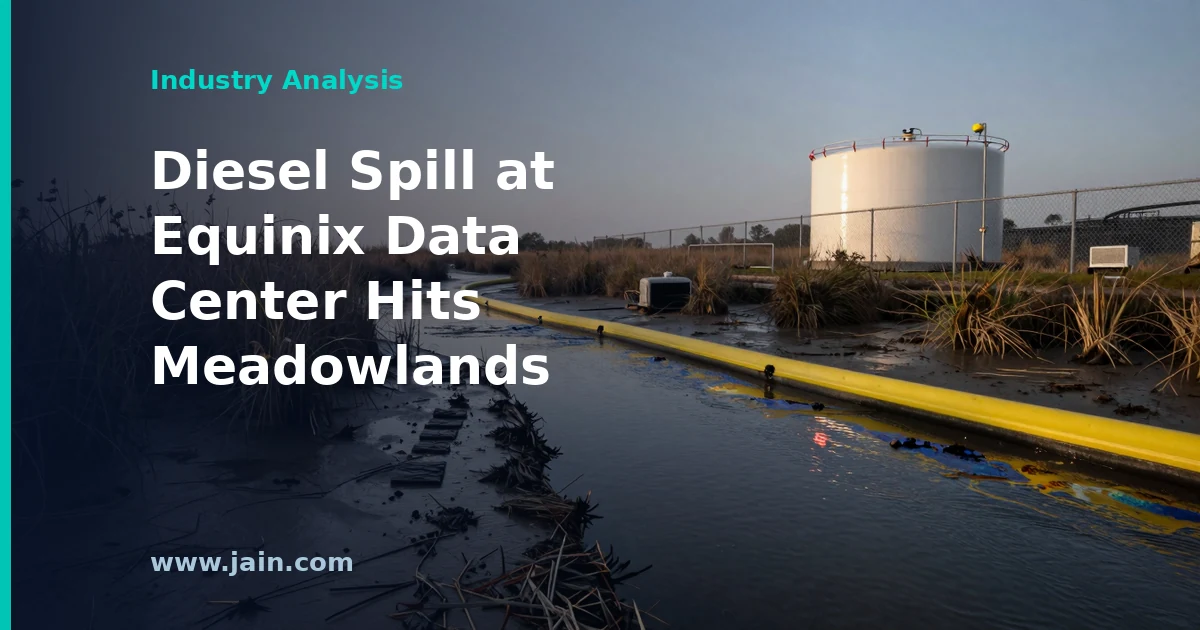
About 5,000 gallons of diesel fuel leaked from a storage tank at a large computer facility in Secaucus, New Jersey. That is roughly half of what a fuel tanker truck carries. It ran into a small creek that feeds the Hackensack River.
The facility belongs to Equinix, which rents space to companies that run websites and online services. Cleanup crews are vacuuming fuel out of the water. State officials say the fuel did not reach the river.
It matters because buildings like this often store large amounts of fuel for emergency generators, and nearly 100 New Jersey towns have already banned new ones.
About 5,000 gallons of diesel fuel spilled from a storage tank at the Equinix data center in Secaucus, New Jersey, and flowed into Anderson Creek, a tributary of the Hackensack River, Gothamist reported on September 14, 2026. That figure comes from the New Jersey Department of Environmental Protection (DEP). Equinix said the leak was detected on Friday evening, September 11. It has hired the environmental services contractor Clean Harbors to handle remediation.
DEP spokesperson Larry Hajna said the creek is small and narrow where the spill occurred and that the fuel was contained before it reached the river. Crews are expected to work at the site for several days. Hackensack Riverkeeper Bill Sheehan and Secaucus Mayor Michael Gonnelli have both called for the state to pursue a natural resource damages claim against the company.
Executive Summary
A fuel-tank leak at one of the New York metro area’s long-established data center sites has become an environmental cleanup and a political flashpoint. Contractors placed a boom (a floating barrier) across Anderson Creek to hold the diesel in place, and vacuum trucks have been pulling a fuel-and-water mixture out for treatment and disposal offsite. Equinix said it will conduct a full investigation and is committed to resolving the situation quickly.
The incident matters beyond Secaucus for two reasons. First, it shows a physical risk that rarely comes up in discussions of data center growth. Many facilities keep large volumes of diesel on site so that emergency generators can run during grid outages. As power availability tightens and operators lean harder on on-site backup, that fuel is a real environmental liability. Second, the spill lands in a state where close to 100 municipalities have enacted local bans on new data centers and activists are pressing the governor for a statewide moratorium.
Local officials were measured about the facility’s history. Gonnelli said the Secaucus site had operated for 25 years without issues, and Sheehan acknowledged that data centers have been in the Meadowlands for decades without causing problems. The open questions are what caused this failure, how much fuel is recovered, and whether the state seeks penalties or restoration funding.
The Diesel Behind the Cloud
Data centers are usually described in terms of servers, fiber and electricity. Their resilience also depends on something far older: fuel. To stay online through a utility outage, most large facilities keep diesel generators, along with on-site storage tanks sized to run them for hours or days. Equinix has not said what the leaking tank supplied, but backup generation is the most common reason a data center stores diesel in quantity.
That fuel is normally managed under spill-prevention rules. Typical safeguards include double-walled tanks, secondary containment berms, leak detection and regular inspections. Because roughly 5,000 gallons reached a creek, at least one of those layers did not hold. Whether the cause was a tank failure, a fueling or transfer error, damaged piping or a containment gap will determine whether this was an isolated equipment problem or a warning about practices across a fleet of aging sites.
Grid Stress Raises the Stakes on Backup Power
The industry’s appetite for power has grown quickly with AI workloads, and utilities in several regions have warned about constrained capacity. Generators exist to cover emergencies. But when grids run tight, operators may test them more often, keep larger fuel reserves, or run them during demand-response events, when utilities ask big users to cut grid consumption. Each of these puts more diesel on site and increases handling.
Nothing reported so far ties this spill to increased generator use or to AI demand, and it would be unfair to draw that link without evidence. The broader point still holds for buyers and investors. The environmental risk in data center portfolios is not just carbon emissions or water use. It also includes the ordinary, local hazard of storing and moving large volumes of fuel near waterways, and that exposure grows as backup power becomes more central to operations.
What a Damages Claim Could Mean
Sheehan wants New Jersey to pursue a natural resource damages claim. That is a legal mechanism under which a polluter pays to restore harmed ecosystems, separate from cleanup costs or fines. He pointed to a 1994 barge spill that put 310,000 gallons of caustic soda into the Hackensack River, which he said led to dedicated funding for the restoration of Lincoln Park in Jersey City. Mayor Gonnelli said he supports that push. The DEP said it did not yet have information on potential fines or enforcement.
Timing makes this more sensitive than a typical industrial spill. The Hackensack River was placed on the federal Superfund list, the program for the country’s most contaminated sites, in 2022, and a major cleanup is approaching. For Equinix, the direct financial exposure from remediating a contained spill is likely modest for a company of its size. The reputational and regulatory cost in a state actively debating limits on data centers could be harder to quantify.
A Flashpoint in New Jersey’s Data Center Debate
Opponents of data center expansion quickly cited the spill. Ben Dziobek of Climate Revolution Action Network argued that data center problems, including pollution, grid strain and higher electric bills, do not stop at municipal borders and warrant state action. Governor Mikie Sherrill’s office declined to comment and referred questions to the DEP.
Every side’s claims deserve a fair test. This single incident, at a site local officials say ran cleanly for a quarter century, does not by itself show that data centers are environmentally unsafe. Nor does it settle the argument over electricity prices, which the spill does not bear on. At the same time, the industry’s assurances that its facilities are low-impact neighbors depend on safeguards like fuel containment actually working. Equinix’s investigation findings, and whether it shares them, will matter for more than one creek.
Background
Equinix is one of the world’s largest colocation data center operators. It rents secure space, power, cooling and network interconnection to enterprises, cloud providers and network carriers, and it trades on Nasdaq under the ticker EQIX. Its Secaucus facility sits in the New Jersey Meadowlands, a longtime hub for data centers serving the New York financial and media markets. Local officials say the site has operated there for about 25 years.
The Meadowlands are a network of wetlands, creeks and tidal waterways feeding the Hackensack River, which was designated a federal Superfund site in 2022 after decades of industrial pollution. New Jersey has become a battleground over data center growth. Close to 100 municipalities have enacted local bans on new facilities, and advocacy groups are pressing for a statewide moratorium, citing pollution, grid strain and electricity costs.
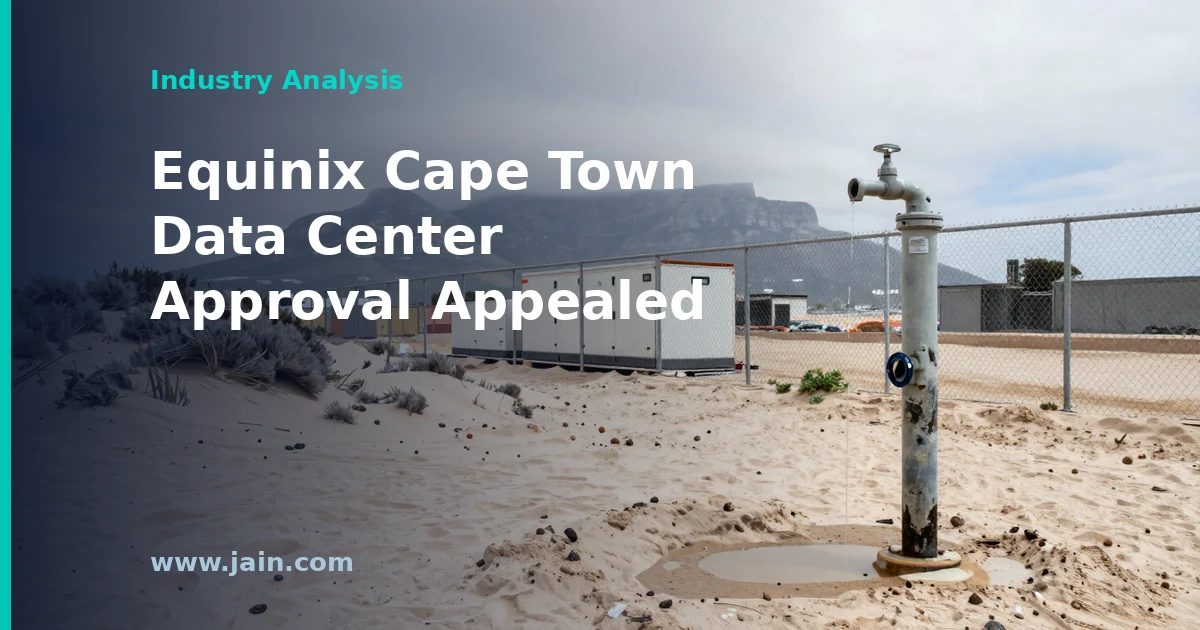
Two campaign groups are trying to overturn Cape Town’s approval of two very large Equinix data centers near the city’s airport. Data centers are warehouse-sized buildings full of computers that run cloud storage, websites and artificial intelligence.
The site could draw about 170 megawatts of electricity, comparable to the round-the-clock demand of a sizeable town. Critics say the approval came without clear figures on water and power use, in a city that nearly ran out of water in 2018.
Equinix says it owns the land but has not yet filed detailed building plans.
Housing Assembly and the UK-based organization Foxglove have appealed a municipal approval for two large Equinix data centers planned for the King Air Industria industrial area near Cape Town International Airport, Benin Web TV reported, citing the Financial Times. The project is estimated at roughly 170 megawatts (MW) of capacity on a site of about 122,500 square meters. Cape Town’s municipal planning tribunal approved it in July despite objections.
The appellants say the approval rested on insufficient detail about water consumption, electricity demand, backup diesel generators, emissions and noise, and they want a new assessment before the project proceeds. Equinix confirmed it has acquired the land. It said no detailed development plan has been submitted yet and that it will continue talking with stakeholders if the project moves forward.
Executive Summary
The appeal puts one of the largest publicly discussed data center proposals in Africa’s most developed data center market under formal review. The objection does not claim the campus is inherently unacceptable. It argues that the city approved the project before anyone had quantified the resources it would consume. If the appeal succeeds, developers may have to submit a new application or provide more information before development continues.
The case matters beyond one site. South Africa holds about 70% of Africa’s data center capacity, according to Financial Times estimates, and that growth is driven by cloud services and artificial intelligence workloads. The South African Human Rights Commission told the Associated Press it has received more than 250 submissions in a consultation on how data centers affect water, electricity, land and communities. For operators, the Cape Town appeal is an early test of how much resource disclosure regulators and communities will expect, and at what stage of a project they will expect it.
An Approval Granted Before the Blueprint
The dispute contains a timing tension. The planning tribunal approved two data centers in July, but Equinix says no detailed development plan has been submitted. Large developments often move through stages: land-use or zoning consent first, then detailed site and building plans. At those later stages, designs for cooling, power connections and backup generation become concrete. An early-stage approval can be legitimate while still leaving the resource questions unanswered.
That is the gap the appellants are targeting. Their argument is essentially about sequencing: the water, electricity, diesel and noise numbers should be on the table before the city commits, not after. Equinix’s position points the other way. It says it is not yet at the detailed-plan stage and would continue engaging stakeholders if the project advances. The appeal will likely turn on which standard the municipal process requires at the approval stage.
Water, Power and Diesel in a City That Remembers Day Zero
Each resource concern maps to a real engineering choice. Data centers shed heat. Evaporative cooling uses less electricity but consumes water, while closed-loop and air-based systems use little water but more power. In Cape Town, where the 2018 “Day Zero” scare brought the city close to turning off municipal taps, the water side of that trade-off is politically sensitive. The electricity side is sensitive too, in a country whose national grid has long struggled with supply.
Backup diesel generators are the less-discussed issue. Operators install them so servers keep running during grid outages. Where the grid is unreliable, generators may run more often than in markets where they are rarely used, which raises the emissions and noise questions the appellants cite. The site sits in an industrial area near an airport, which may shape how noise is assessed. Emissions and fuel storage still need their own analysis.
Scrutiny Is Becoming a Market-Wide Cost
The Human Rights Commission’s consultation shows that the debate in South Africa is broadening from individual permits to how the whole sector is regulated. For developers, that raises the likely cost of permitting: more studies, more disclosure, longer timelines and more exposure to appeal. Operators that can document low-water cooling, credible power sourcing and limited generator use may find approvals easier to defend. Those that cannot may face delays.
Customers have a stake too. Cloud providers, enterprises and network operators that rely on South Africa as the continent’s main data center hub need capacity to arrive on schedule. A longer, more contested approval path in Cape Town could shift demand toward sites with clearer permits or delay the capacity growth the market expects.
Fair Questions for Both Sides
The appellants’ core request, quantified resource data before final commitment, is a reasonable planning principle. Their case would be stronger with specifics: which thresholds or disclosures would satisfy them, and whether full data can realistically exist before detailed designs do. Calling for a new assessment is different from showing that the project’s impacts would be unacceptable, and the reported objections so far focus on missing information rather than demonstrated harm.
Equinix’s statement is also limited. Saying no detailed plan has been filed explains the absence of numbers but does not provide any. The 170 MW estimate has not been confirmed as the company’s own figure, and it has not described cooling technology, power sourcing or backup arrangements for the site. Early voluntary disclosure of design intentions would give the tribunal, the appellants and the public a factual basis for the debate.
Background
Equinix is a US-based, publicly traded digital infrastructure company that operates data centers and interconnection hubs worldwide, where networks, cloud providers and enterprises connect directly to each other. It entered African markets through its 2022 acquisition of West African operator MainOne and has since expanded its presence on the continent, including in South Africa.
South Africa is Africa’s largest data center market. Cape Town and Johannesburg host most of the continent’s capacity, alongside major cloud regions. The country’s growth has come with resource concerns: Cape Town’s near-miss with running out of municipal water in 2018 and the national grid’s long-running supply problems have made water and electricity central to public debate over large new energy users.
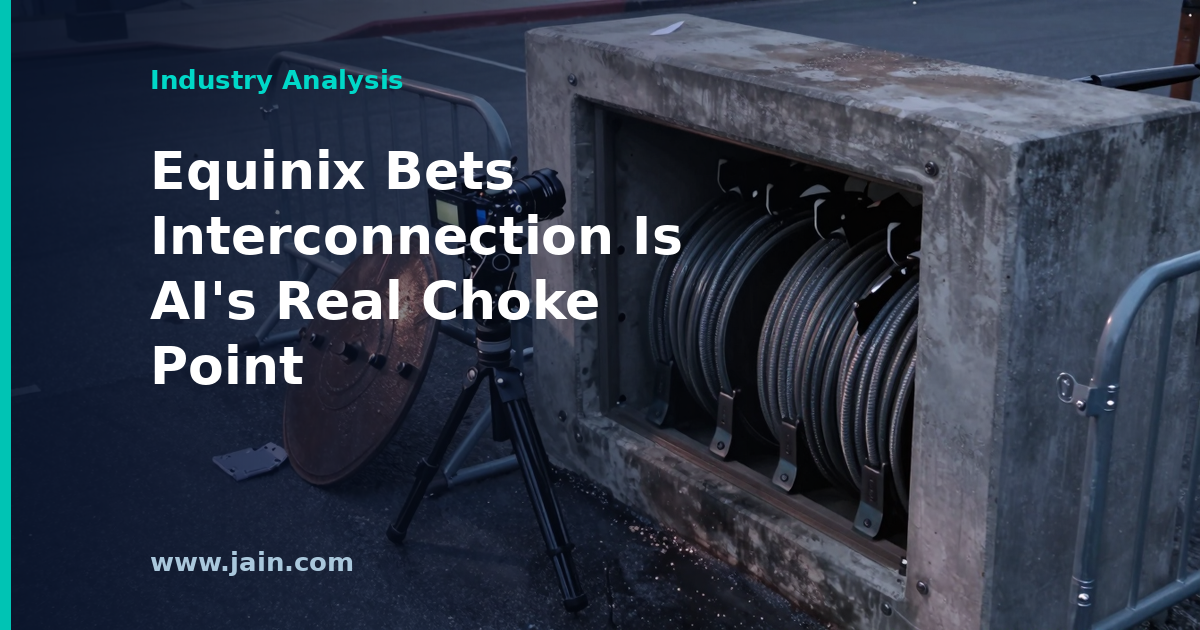
The scarce ingredient in artificial intelligence may not turn out to be powerful chips. It may be the wiring.
Equinix runs the buildings where networks, cloud providers and companies physically plug into one another. It has announced a service built for the moment an artificial intelligence program answers a question, rather than the months it spends learning — and has attached early quantum computing to the same offering.
Fast answers need computers close to the people asking. Equinix is betting that the connection points it already owns, not sheer computing horsepower, become the thing everyone competes for.
Simply Wall St reported that Equinix has introduced an AI and quantum inference fabric, a productised way for customers to run inference workloads — the stage at which a trained model actually answers queries — across the company’s interconnection footprint, with quantum computing named alongside it. Yahoo Finance separately framed the move as Equinix doubling down on AI data centers, and posed it as a question for holders of EQIX, the company’s Nasdaq-listed shares.
Equinix has not published capacity figures, launch metros, pricing, availability dates or named customers for the offering. What is on the record at this stage is the strategic direction and the product name, not the commercial scale behind either.
Executive Summary
The announcement matters less for what it adds to Equinix’s estate than for where it points. Almost every headline in AI infrastructure over the past two years has been about training capacity: gigawatt campuses, accelerator supply, power procurement in remote counties where electricity is cheap and land is plentiful. An inference fabric is an argument that the next constraint sits somewhere else entirely — in dense, network-rich metro facilities where the distance between a model and its user is measured in milliseconds rather than megawatts.
That argument plays to Equinix’s structural strength. The company’s durable advantage has never been raw square footage; it has been the density of networks, clouds and enterprises inside the same buildings, and the cross-connects between them. If inference does migrate toward metro edges, interconnection-rich colocation becomes a choke point that is genuinely difficult to replicate, because it is built from accumulated tenancy rather than capital alone.
The caution is that a strategic thesis and a revenue line are different things. Bundling quantum into an inference product is a forward-looking positioning move, and the offering has been described without the contracted capacity, customer names or economics that would let buyers or investors size it. The thesis is credible; the evidence that it is already converting into demand has not yet been put on the table.
Inference Rewrites the Map That Training Drew
Training a large model is a batch job. It can happen anywhere the power is cheap and abundant, because nobody is waiting on the other end of the wire. Inference is the opposite: it is a live transaction, and every network hop between the user and the model shows up as lag. That single difference pulls compute back toward population centres, toward the metro facilities where carriers, cloud on-ramps and enterprise networks already terminate — precisely the sites carrier-neutral colocation providers have spent decades assembling.
This is why an inference-oriented fabric is a more interesting signal than another announcement of remote megawatts. It implies a view that AI capacity will bifurcate: enormous, power-hungry training campuses in the hinterland, and a distributed layer of smaller, latency-sensitive inference footprints in cities. The second layer is smaller in energy terms but far more valuable per square foot, because what customers are buying is proximity and connectivity rather than bulk.
For enterprise buyers, the practical consequence is that AI deployment starts to look like a network design problem rather than a procurement problem. Where the model sits relative to the data it consumes, and how many private connections separate the two, determines both response time and egress cost. That is a familiar conversation for anyone who has architected hybrid cloud — which is, not coincidentally, the conversation Equinix is best positioned to have.
The Choke Point Argument, and Its Limits
The strongest version of Equinix’s case is that interconnection is a compounding asset. A cross-connect — a physical cable between two tenants in the same facility — is cheap to provision and expensive to leave behind, because the value of being in a building rises with everyone else already in it. Accelerator supply, by contrast, is a commodity that reprices with each hardware generation. If inference genuinely disperses to the metro edge, the party controlling the meeting points captures a toll that does not depreciate on a chip cycle.
The weaker version is the assumption that no one else can occupy that position. Hyperscalers have been extending their own edge and local-zone footprints for years. Carriers own metro real estate and fibre routes. A cohort of specialist GPU cloud operators is building latency-sensitive capacity of its own, and content delivery networks already run inference at points of presence closer to users than most colocation halls. Interconnection density is a real moat, but it is a moat around a market whose boundaries several well-capitalised competitors are actively redrawing.
There is also a power question that no product announcement dissolves. Metro data centres are the hardest places to add electrical capacity and the slowest to get through utility interconnection queues — the waiting list for a new grid connection, which in constrained markets can run for years. High-density inference racks draw far more per cabinet than the legacy network gear that defines many urban facilities, and retrofitting for that density involves cooling and electrical work, not just a new commercial wrapper.
Quantum in the Product Name: Option Value or Optics?
Pairing quantum with inference is the part of this announcement that deserves the most careful reading, and the fairest way to read it is as positioning rather than deception. Providing network-adjacent access to quantum hardware is a coherent thing for an interconnection operator to do: quantum processors are scarce, physically finicky and best consumed as a remote service, which makes a neutral facility with dense connectivity a sensible place to reach them from. Several operators have hosted quantum systems on exactly that logic.
What is not established by the product name is any claim about quantum performing inference at commercial scale. Today’s quantum machines are experimental instruments, and the phrase invites a parsing question the company has not resolved in public: whether inference is meant to attach to both AI and quantum, or whether quantum access simply sits alongside an AI inference service under one banner. Those are materially different propositions, and buyers evaluating the offering should ask which one they are being sold.
Treated as option value, the inclusion is defensible and cheap. Treated as evidence of near-term demand, it is unsupported. The honest assessment is that Equinix has claimed a category label early — a familiar and often rational move in infrastructure — and that the label will be worth something only if hardware partners and workloads eventually arrive behind it.
What the Stock Framing Tends to Miss
Equinix is structured as a real estate investment trust, meaning it distributes most of its taxable income to shareholders and therefore funds growth largely from debt and equity issuance rather than retained earnings. That structure shapes how any AI build-out must be judged: the relevant question is not whether AI demand exists, but whether the returns on capital deployed into denser, more power-intensive facilities clear a cost of capital that has risen materially since the last data centre cycle.
An inference fabric is, in that light, an attractive kind of AI exposure precisely because it is capital-light relative to greenfield gigawatt campuses. Selling connectivity and dense colocation into existing buildings monetises assets already on the balance sheet. But it is also a smaller prize than the training build-out, and describing a product without disclosing contracted capacity or pricing leaves investors unable to distinguish a new revenue engine from a repackaging of services the platform already sells.
The reasonable posture for both buyers and shareholders is interest without recalibration. The strategic logic — that interconnection becomes scarce as inference decentralises — is sound and consistent with how this company has made money for two decades. Whether this specific offering is the vehicle that captures it is a question the disclosed facts do not yet answer.
Background
Equinix was founded in 1998 as a carrier-neutral interconnection business: a place where competing networks could meet on neutral ground and exchange traffic directly, rather than paying an intermediary to carry it. That model expanded into a global platform of colocation facilities in which internet exchanges, cloud on-ramps and enterprise infrastructure sit side by side, connected by cross-connects between tenants. The company converted to a real estate investment trust structure in 2015 and trades on the Nasdaq as EQIX.
The AI build-out has so far favoured a different asset class — very large, power-intensive campuses in locations chosen for cheap electricity and available land, purpose-built for model training. Metro colocation providers have consequently faced a strategic question about where they fit. An inference-oriented offering is one answer: the argument that as models move from being built to being used at scale, the value shifts back toward the network-dense urban facilities that were the industry’s original franchise.
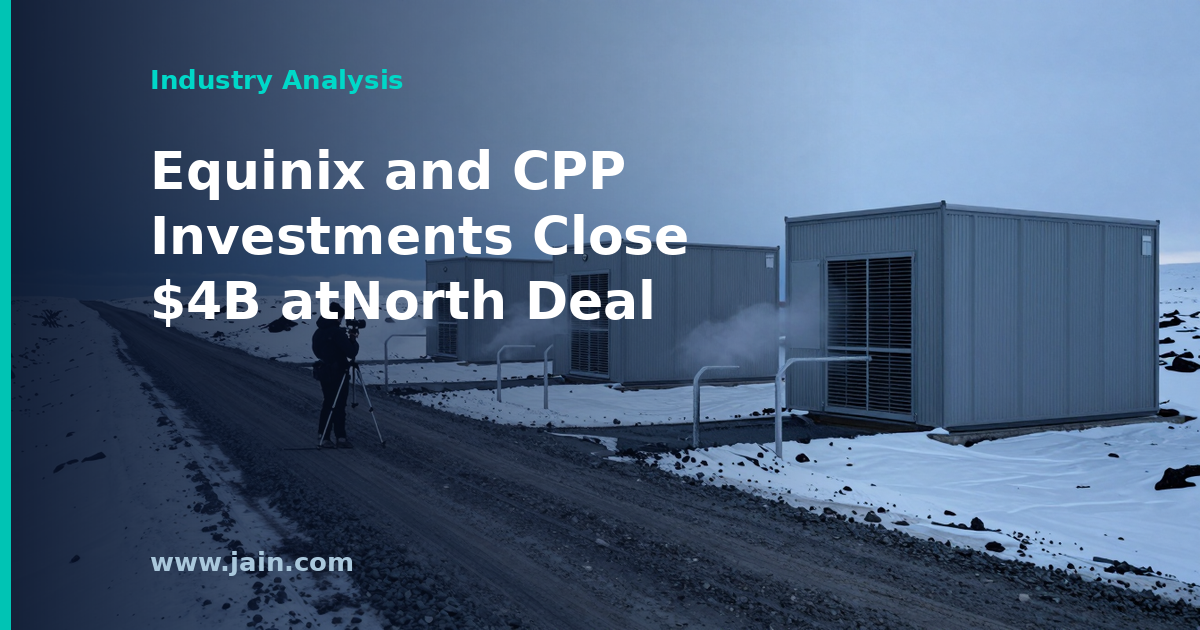
Two of the world’s largest infrastructure investors have paid about four billion US dollars for a company that runs eight warehouse-sized buildings full of computers in Iceland, Norway, Sweden, Denmark and Finland.
The appeal is simple. The far north has cheap renewable electricity and air cold enough to cool thousands of hot machines without running expensive air conditioning. Everywhere else, both are getting scarce and costly.
Those buildings are where artificial intelligence systems are trained. Where they get built decides who can afford to run them.
Data Centre Magazine reported on 3 September 2026 that Canada Pension Plan Investment Board (CPP Investments) and Equinix have completed their acquisition of Nordic data centre operator atNorth in a transaction valuing the company at US$4 billion. CPP Investments takes an approximately 51% controlling equity stake for US$1.3 billion, Equinix an approximately 34% minority stake for US$895 million, and Partners Group — atNorth’s owner since 2022 — reinvests for roughly 10% at US$260 million. atNorth’s internal stakeholders retain the balance through an equity rollover.
The transaction is supported by a US$4.1 billion debt facility underwritten by European and Canadian institutional lenders, sized to fund both the purchase and future construction. atNorth operates eight data centres across Denmark, Finland, Iceland, Norway and Sweden, with further sites in development; the company said earlier in 2026 that it had secured more than 1GW of power capacity across operational and pipeline sites. Chief executive Eyjólfur Magnús Kristinsson said atNorth will continue to operate independently under its own brand.
Executive Summary
This is a purchase of inputs, not of buildings. The binding constraints on AI training capacity today are electricity and heat rejection — getting power connected at a price that works, and getting the heat back out of racks drawing far more per square metre than a conventional server hall. The Nordics have an unusual concentration of both: hydro and geothermal generation, and an ambient climate cold enough that operators can cool much of the year with outside air or water rather than mechanical chillers, an approach the industry calls free cooling. atNorth’s stated position of more than 1GW secured across live and pipeline sites is the asset being bought.
The ownership structure is as informative as the price. CPP Investments takes control and the largest cheque; Equinix takes roughly a third and no control. For a company that has built its business on owning and operating its own interconnected facilities, buying a minority position in someone else’s platform — one that will keep its own brand and management — is a deliberate choice to gain exposure to Nordic high-density capacity without absorbing the full construction risk or capital load onto its own balance sheet.
The three disclosed equity commitments total roughly US$2.46 billion for about 95% of the company, against a US$4 billion valuation and a separate US$4.1 billion debt facility. Borrowed capital, in other words, is doing at least as much work as equity here, and a material portion of it is earmarked for construction that has not yet happened. That makes delivery — sites energised, halls filled, contracts signed — the variable that determines whether US$4 billion looks like a full price or a cheap one in three years.
Buying the Two Things AI Capacity Is Actually Short Of
Land and steel are not the bottleneck in data centre development. Power is. Across most of Europe and North America, connecting a large new load to the grid means joining a queue measured in years, and paying industrial electricity prices that have become one of the largest single line items in the cost of running AI hardware. Cooling is the second constraint: racks built for AI training draw many times the power of traditional enterprise kit, and the heat has to go somewhere. atNorth’s portfolio addresses both structurally rather than incrementally — renewable power contracts in markets with hydro and geothermal generation, direct liquid cooling that moves coolant to the chips instead of chilling the whole room, and district heat reuse that pipes waste warmth into local heating networks rather than dumping it into the air.
Set against that, US$4 billion for eight facilities and a development pipeline is a bet that secured power is the scarce commodity and everything else is commodity. The stated position of more than 1GW across operational and pipeline sites is the number that matters, because a gigawatt of connected capacity is significantly harder to assemble today than a gigawatt of building shell. What the companies have not broken out is how much of that gigawatt is energised and earning revenue versus reserved or queued — a distinction that separates an operating platform from an option on one.
A Minority Stake, a Majority Cheque, and a Lot of Debt
Equinix’s 34% is the structurally interesting part of this deal. Equinix’s core business is interconnection — dense, network-rich facilities in metropolitan markets where the value lies in who else is in the building. Nordic hyperscale campuses built for training runs are a different asset class with different economics: fewer, larger customers, longer leases, thinner margins per megawatt, far heavier capital intensity. Taking a minority position lets Equinix participate in that growth, and offer its customers access to it, without consolidating the construction programme or the leverage that funds it. It is a pattern the industry has used repeatedly to add wholesale-scale capacity alongside a retail colocation core.
The trade-off is control. atNorth will continue to operate independently under its own brand and management, with CPP Investments holding the controlling stake. Whatever commercial integration Equinix envisages — routing customers north, linking Nordic compute to its interconnection fabric — rests on a commercial relationship and shareholder influence rather than ownership. For customers, the practical question is whether that translates into something contractually real, such as network on-ramps and cross-connect arrangements between the two estates, or remains a statement of intent. Neither company has yet described what the operating relationship looks like in practice.
The Distance Problem the Nordic Thesis Still Has to Answer
Equinix Nordics managing director Regina Dahlström framed the acquisition around organisations needing infrastructure that brings together “data, clouds, networks and inference services” and around building interconnected hubs. That language is worth reading closely, because inference — running a trained model to answer a user’s query — is latency-sensitive in a way that training is not. Training is a batch workload; it can happen a thousand miles from the customer and nobody notices. Inference serving European end users generally wants to sit close to them.
The Nordic proposition is exceptionally strong for the first category and harder for the second, particularly at the Icelandic end of the footprint, where the physics of distance sets a floor on round-trip times regardless of how much fibre is lit. That does not undermine the deal; training, fine-tuning and high-performance computing represent enormous and growing demand, and heat reuse and cheap renewable power are genuine structural advantages. But it does mean the inference and interconnection framing is the claim to test over the next few years, not the one to assume. Kristinsson’s disclosure that atNorth has secured new hyperscale contracts since signing, and added a development site in Norway, points to where demand is actually landing — though the companies have not identified the customers, the capacity involved, or the contract terms.
Background
atNorth grew out of the Icelandic data centre sector, where geothermal and hydroelectric generation made it possible to run compute-intensive workloads at electricity prices and carbon intensities unavailable in most of Europe. Partners Group acquired the business in 2022 and expanded it into a five-country, eight-facility Nordic platform aimed squarely at enterprise and hyperscale demand for AI, cloud and high-performance computing. The company’s positioning depends on high-density engineering — liquid cooling, heat reuse, sites designed from the outset for power-hungry racks rather than retrofitted from conventional colocation.
Equinix is a global operator of interconnected data centres, historically strongest in metropolitan facilities where the commercial value comes from the density of networks, clouds and enterprises present in the same building. The Nordics have drawn sustained investment from operators and institutional capital over the past decade, precisely because the combination of renewable generation, cold ambient conditions and stable regulation addresses the constraints that limit development in more crowded European markets. CPP Investments, which manages assets for the Canada Pension Plan, has been an active allocator to digital infrastructure as an asset class with utility-like duration.
Sources
Source: Why Equinix & CPP Investments Have Acquired AtNorth — Data Centre Magazine’s report on the completed US$4 billion acquisition, including the equity split, the US$4.1 billion financing package and comments from Equinix, CPP Investments and atNorth executives.
Equinix rents out the buildings where companies keep their computers and where the world’s networks plug into each other. Now it wants to sell the computing itself.
With the chipmaker NVIDIA and a startup called Together AI, Equinix has launched a service that runs artificial-intelligence models inside those buildings, close to the businesses using them. The pitch: faster answers, and your data stays where you put it.
What it costs, how much of it exists, and who has signed up have not been made public.
Equinix has launched Inference Exchange, a distributed artificial-intelligence inference platform developed with NVIDIA and Together AI, W.Media and Telecompaper reported this week, alongside a new connectivity service. The offering is intended to let enterprises run trained AI models inside Equinix’s metro data centers rather than in a distant public cloud region.
The companies have not published the platform’s scale. There is no disclosed figure for dedicated capacity, no list of launch metros, no pricing model and no named customers, and Equinix did not accompany the announcement with a material filing to the U.S. Securities and Exchange Commission.
Executive Summary
The announcement is a move up the value chain. Equinix’s core business is selling space, power and cross-connects — the physical patch cables that let a bank’s network meet a cloud provider’s network inside the same building. Inference Exchange proposes selling the workload instead: NVIDIA accelerators and Together AI’s serving software, operated in Equinix facilities and reachable over the interconnection fabric its customers already buy.
The timing tracks the industry’s center of gravity. NVIDIA’s second-quarter fiscal 2027 results, filed with the SEC on August 26, reported revenue of $96.2 billion, up 106% from a year earlier, with data center revenue of $89.0 billion, up 117%. Founder and CEO Jensen Huang framed the quarter around consumption rather than construction: “AI has reached its inflection point. It’s doing useful work. Its tokens are productive and profitable. Now, compute is revenue.” Inference — running models in production — is where that revenue is generated, and unlike training it has to happen near users and near data.
What matters for buyers and investors is that the strategic logic is clearer than the commercial substance. A partnership among three named companies is real; a contracted, revenue-generating utility is not the same thing, and neither Equinix nor its partners has yet put a number, a date or a customer against it.
Why Metro Colocation Is the Natural Home for Inference
Training and inference want different real estate. Training a frontier model is a batch job: it can run anywhere power is cheap and abundant, which is why the largest commitments in the market point at greenfield megasites. NVIDIA’s own CFO commentary describes credit support for roughly 4.25 gigawatts at SB Energy’s PORTS-Pike campus in Ohio — a gigawatt being roughly the output of a large power station — under twenty-year leases to OpenAI. Nobody puts that in a city center.
Inference is the opposite. It is interactive, it runs continuously, and its latency budget is measured in the tens of milliseconds a user will tolerate before an assistant feels sluggish. It also carries regulatory weight, because the prompts and documents flowing into a model are frequently the customer data a bank or hospital is not permitted to move across a border. Equinix’s asset is precisely metro adjacency plus interconnection density: its facilities are where carriers, clouds and enterprises already meet, so an inference endpoint sited there is a private hop away from a customer’s own network rather than a trip across the public internet.
The economics of the shift are less settled than the logic. Colocation is a rent business — long leases, predictable yields, capital spent on shells, power and cooling that depreciate over decades. Accelerated computing is not: graphics processing units are expensive, they depreciate fast, and their returns depend on high utilization. Whether Inference Exchange is a capital-intensity story for Equinix or a channel arrangement depends entirely on who buys and owns the hardware, and that has not been stated.
What NVIDIA’s Record Quarter Says About the Timing
NVIDIA’s August 26 results give the backdrop unusual clarity. Data center revenue of $89.0 billion grew 117% year over year, and the company guided to $108.0 billion in total revenue for the current quarter while assuming no data center compute revenue from China. The quarter’s own highlights lean hard toward inference: the company said its Groq 3 LPX interactive inference accelerator has entered full production, and disclosed that NVIDIA GPUs with confidential computing are used for confidential inference in Apple’s Private Cloud Compute — a design in which the operator cannot see the data being processed.
Read together, those signals describe a distribution problem more than a silicon problem. Frontier labs already buy directly and at scale. The next tranche of demand is thousands of enterprises that will never operate a GPU cluster and want inference delivered as a service, in a location they can name, with a contract their compliance team recognizes. Equinix supplies the geography and the enterprise relationships; Together AI supplies the serving layer; NVIDIA supplies the silicon and, critically, keeps those workloads inside its software ecosystem rather than migrating to a rival accelerator.
The quarter closed on July 26, before this launch, so its silence on Equinix is chronological rather than meaningful. It does, however, set the scale against which the partnership should be read: an arrangement neither party has sized is unlikely to be financially material to NVIDIA in the near term. Its value to NVIDIA is positional. Its value to Equinix, whose revenue base is far smaller than NVIDIA’s data center line, could be proportionally much larger — if it converts.
Who Gains, Who Gets Squeezed
Together AI is arguably the clearest beneficiary. An independent AI cloud can win developers on price and model breadth but struggles to reach regulated enterprises that require a named facility, an auditable network path and a counterparty with a balance sheet. Distribution through Equinix’s footprint addresses all three without Together AI building data centers.
The pressure lands on operators selling undifferentiated GPU hours. If enterprise inference migrates toward venues chosen for latency, data residency and network adjacency, then raw capacity in a remote low-cost region competes on price alone — a difficult position when supply is expanding. Content delivery and edge networking vendors, which have marketed proximity as their advantage, now face a colocation incumbent making the same argument with more power per site. Hyperscale clouds are less exposed: their hold on enterprise inference rests on data gravity, identity systems and developer tooling, none of which a colocation platform replicates. But they are also Equinix tenants, which makes this a partner-adjacent product and raises a channel question Equinix has not addressed publicly.
Wholesale developers building megawatt campuses are not the losers here. They serve a different workload. The genuine contest is over which layer captures enterprise inference margin — the landlord, the model-serving vendor, or the cloud — and this launch is Equinix’s claim that the landlord can move up rather than be disintermediated.
What the Launch Substantiates, and What It Doesn’t
Substantiated: three named companies, a named product, and a second connectivity service announced alongside it. Equinix has the metro sites, the interconnection fabric and the enterprise account base to make the concept credible, and NVIDIA’s disclosed financials confirm that inference demand is real and growing rather than aspirational.
Not substantiated: everything a buyer would need to price the thing. No capacity figure, no availability date, no commercial model, no customer, no statement of who funds the hardware. That is a common shape for infrastructure platform announcements, where logos typically precede contracted revenue by several quarters, and it is a fair criticism of the disclosure rather than of the strategy.
One further piece of context deserves attention without overreach. NVIDIA’s filings show an ecosystem in which vendor financial support has become structural: supply commitments rose from $119 billion in the prior quarter to $279 billion; the company disclosed partnerships with Apollo, BlackRock, Blackstone, Brookfield, Goldman Sachs and KKR intended to mobilize over $500 billion of third-party capital over time, subject to definitive agreements; and it reported a maximum gross exposure of $3.5 billion under guarantees for AI cloud partners’ lease obligations, plus the separately capped $105 billion Ohio guarantee. None of that is stated to apply to this partnership. But investors evaluating any NVIDIA-adjacent infrastructure announcement in 2026 are entitled to ask whether hardware is being sold, financed, consigned or revenue-shared — and here, no one has said.
Background
Equinix, founded in 1998 and structured as a real estate investment trust since 2015, built its business on carrier-neutral colocation: buildings where any network can connect to any other without favoring an owner’s own transit. That neutrality made its facilities natural meeting points for carriers, cloud providers and enterprises, and interconnection — the cross-connects and virtual links between tenants — became the high-margin core of the model rather than the floor space itself.
The AI buildout initially looked like a threat to that positioning, because training clusters favor vast, remote, power-rich campuses of a kind Equinix does not principally build. The counter-argument, which this launch embodies, is that once models move into production the workload shifts toward inference, and inference rewards exactly what Equinix already owns: presence in dozens of business metros, dense network adjacency and existing enterprise contracts. NVIDIA’s most recent quarterly disclosures show both halves of that market running at once — gigawatt-scale campus commitments for training on one side, and production-grade inference accelerators and confidential inference deployments on the other.
Four strands of coverage circulating in late August 2026 point at the same bottleneck. MarketScale reports that GE Vernova is adding HVDC (high-voltage direct current) capacity as grids work to serve data center demand. The Motley Fool notes that GE Vernova’s electrification revenue jumped 68% in a single quarter on data center deals, then asks why the stock sold off anyway. Benzinga frames a federal grid-security executive order as a reason to watch power-equipment ETFs, naming Eaton among the exposures. Yahoo Finance argues that Equinix’s AI power-grid push may reshape the investment case for the colocation operator.
None of these are primary company announcements. The material available here is headline-and-summary level aggregation, so specifics such as project sites, contract values, capital commitments and delivery dates are not established. The 68% electrification figure and the existence of the grid-security order are the two concrete claims carried by the reporting.
Executive Summary
Taken together, the four items describe a shift in where AI capacity is actually rationed. For three years the scarce input was the accelerator chip. The reporting here suggests the scarce input is now the ability to energize a site: transmission capacity, interconnection approval, transformers, switchgear and the long-lead grid hardware that sits between a substation and a server hall.
That matters commercially because the two constraints run on different clocks. Silicon supply responds to fab allocation and can loosen in quarters. Transmission responds to permitting, right-of-way acquisition, utility study queues and heavy-equipment manufacturing, which run in years. A market that can buy chips faster than it can buy amperes will reprice both — upward for anyone holding secured power, downward for anyone holding only land and capital.
The caveat is equally important. A 68% revenue jump paired with a share-price decline is a reminder that a demand narrative and a shareholder return are separate things. Growth priced in advance is not growth delivered, and a policy order is not a purchase order.
Why HVDC Suddenly Belongs in a Data Center Conversation
High-voltage direct current is unglamorous infrastructure that most data center buyers have never had to think about. Conventional grids move alternating current, which is easy to step up and down in voltage but loses meaningful energy over long distances and struggles to link grids that are not synchronized. HVDC converts power to direct current for the long haul, moves it with lower losses, and converts it back at the far end. The converter stations are expensive; the line is efficient. That trade-off only pays when you need to move a large block of power a long way.
AI campuses have made that trade-off pay more often. The cheapest and most available generation is frequently not where the fiber, the land and the tax abatements are. When local grid headroom is already committed, the choice narrows to building generation on site, waiting in an interconnection queue, or importing power from somewhere with surplus. HVDC is the third option’s enabling technology, which is why a grid-equipment vendor’s converter capacity has become a data center story rather than a utility-engineering story.
The reporting does not tell us how much capacity GE Vernova is adding, where, or on what schedule. Readers should hold that gap open. Announced capacity in heavy electrical manufacturing is a multi-year commitment, and the difference between a stated expansion and a commissioned production line is the part that determines whether 2028 projects get energized on time.
A 68% Jump and a Stock That Fell
The most quantified claim in the set is the 68% single-quarter increase in GE Vernova’s electrification revenue, attributed to data center deals. That is a large number for a business selling physical grid hardware, and it is the clearest available evidence that AI demand has genuinely reached the equipment layer rather than remaining a slide in a keynote.
The share-price reaction is the more instructive part. Equity markets price the delta against expectations, not the absolute level, so a headline growth rate can coexist with disappointment on gross margin, order intake, backlog conversion, guidance or free cash flow. Heavy electrical equipment is a business where revenue recognized today reflects orders taken years ago, and where growth funded by capacity expansion consumes cash before it produces it. A selloff on a strong revenue print is a legitimate signal that investors are asking about the quality and durability of that growth, not merely its speed.
The even-handed read is that the coverage poses the question and does not resolve it. Without segment margin, book-to-bill and guidance detail, neither the bullish framing (structural demand shift) nor the bearish framing (peak expectations) is settled by what is on the page.
Equinix and the Move From Grid Customer to Grid Participant
The Equinix item describes a colocation operator pushing further up the power stack. Colocation providers have historically bought power as an input and sold space, cooling and interconnection as a product. If power access becomes the genuinely scarce good, then procurement strategy, grid relationships and the ability to bring energized megawatts to market become the differentiator rather than a back-office function.
That is a plausible strategic logic, and the Yahoo Finance framing is appropriately conditional about it. It also cuts both ways for investors. Moving upstream raises capital intensity, lengthens payback, and imports execution risk from a domain — utility-scale power development — with a different risk profile than leasing cabinets. A REIT-like cash flow profile and a developer-like capital profile are not the same investment, and shifting between them deserves scrutiny rather than applause.
For enterprise buyers, the practical implication is simpler and more immediate. If your provider is competing on secured power, then power terms belong in the contract discussion alongside space, cross-connects and SLAs.
Policy as a Demand Signal, Not a Booked Order
The Benzinga piece reads a federal grid-security executive order as a reason to watch power-equipment ETFs, with Eaton cited among the exposures. Policy attention to grid security is a reasonable thing for the sector to track: reliability and security mandates historically pull forward spending on protection, monitoring, transformers and switchgear, and they can shift permitting posture.
The claim deserves the same scrutiny as any vendor claim. An executive order sets direction; it does not by itself appropriate money, complete a rate case, or sign a contract. Utility capital spending is approved by regulators on multi-year cycles, and equipment revenue follows funded, permitted projects. The gap between a policy signal and a delivered order is measured in quarters at best. We have not reviewed the order’s text here, so its scope, funding mechanism and enforceability remain unverified in this analysis.
Framed carefully, the four items are consistent with a real structural story — grid capacity is the gating factor on AI buildout — while none of them individually establishes its magnitude. That distinction is worth preserving as the narrative gets repeated.
Background
GE Vernova was separated from General Electric in 2024 as a standalone energy company covering power generation, wind and electrification equipment. Its electrification segment sells the physical apparatus of the grid: transformers, switchgear, protection systems and HVDC converter technology. HVDC itself is decades-old utility technology, long used for subsea links and cross-region transfers, and supplied globally by a small group of manufacturers. What is new is the demand source. Grid hardware has historically tracked slow-moving utility capital cycles rather than the compressed schedules of technology buildouts.
Equinix is one of the world’s largest colocation and interconnection operators, running data centers where enterprises, cloud providers and networks exchange traffic. Its traditional business sells space, power, cooling and connections between tenants. As AI training and inference clusters have pushed campus power requirements upward, the industry’s binding constraint has migrated from real estate and fiber toward electricity delivery, which is why colocation operators, equipment vendors and policymakers now appear in the same story.