TL;DR · 30-second read
The Short Version
Palantir, a company that sells data-analysis software to large organizations, has picked Nebius, a company that rents out powerful computers for artificial intelligence, as its preferred partner for running that work.
The pitch: businesses can train their own artificial intelligence on their own private data, using machines they control, instead of handing that data to a big tech provider.
Nebius’s stock jumped on the news. Neither company has said how much money is involved or exactly when it starts.
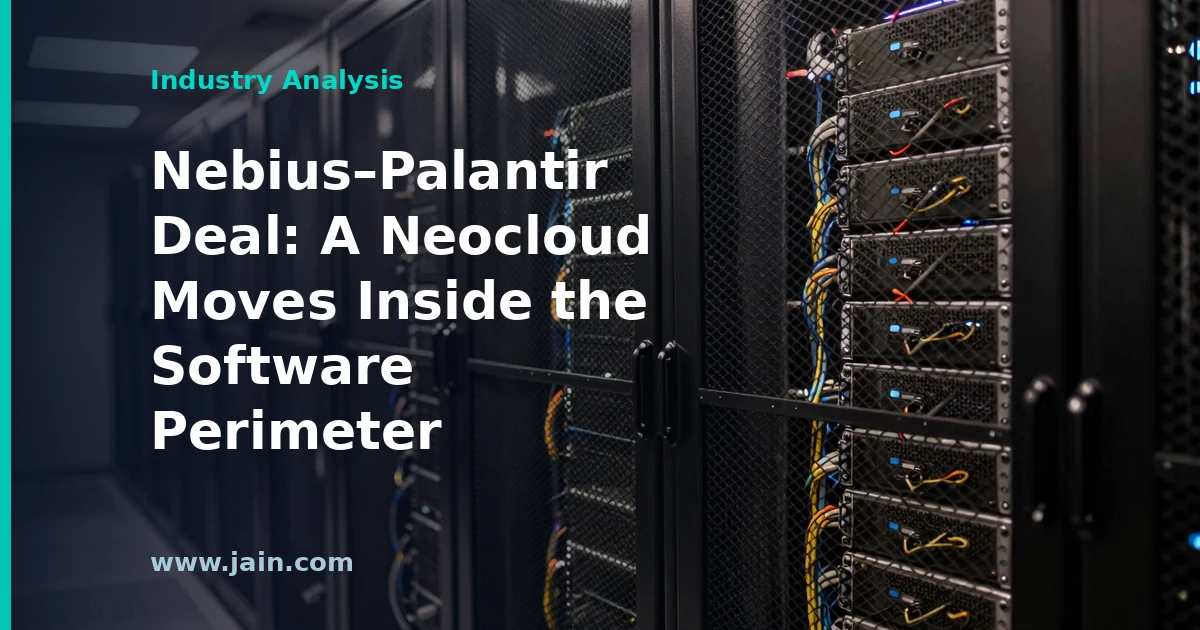
On September 8, 2026, Palantir Technologies and Nebius Group announced a strategic partnership under which Palantir named Nebius its preferred sovereign AI infrastructure partner. According to the joint press release, which Nebius furnished to the SEC in a Form 6-K the same day, Palantir will bring Nebius compute and inference endpoints inside the Palantir enterprise perimeter after an integration period. Eligible Palantir commercial customers will then be able to run and adapt open AI models on Nebius infrastructure. The companies also said they will work together to deploy new compute capacity for Palantir customers, including modular data centers at sites where power is already available.
Seeking Alpha reported that Nebius shares rose about 8% following the announcement, bringing their year-to-date gain to roughly 175%. Neither company disclosed financial terms, capacity commitments, or a timeline.
Executive Summary
The Nebius–Palantir partnership pairs a neocloud with an enterprise software platform. A neocloud is a newer cloud provider built mainly to rent out GPU capacity for AI. The deal gives Nebius something pure infrastructure providers often lack: a direct channel into large commercial organizations that already run Palantir’s Foundry and AIP software. For Palantir, it adds a named compute layer to what it calls its Sovereign AI Operating System. That system is pitched to customers who want to train models on proprietary data without giving up control of the data, the models, or the hardware they run on.
The announcement matters because it tests a central question for GPU capacity providers: can they move beyond selling compute by the hour and capture a share of the higher-margin software relationship? The release answers only part of that question. Nebius gains preferred status and placement inside Palantir’s environment. Palantir, however, keeps the authorization, isolation, and data layer, which is the part customers interact with day to day. How revenue is split, and how much capacity is involved, has not been disclosed.
Distribution, Not Just Capacity
Most neoclouds compete on how quickly they can bring GPUs online and how cheaply they can rent them. That is a hard business to differentiate. Hardware is largely sourced from the same supplier, and large AI labs negotiate aggressively on price. The Palantir arrangement gives Nebius a different kind of asset: placement inside a software platform that enterprise buyers have already approved, integrated, and budgeted for. In enterprise IT, getting onto an approved-vendor list can take longer than building a data center. Being embedded in a platform the customer already trusts shortens that path considerably.
The joint release frames Palantir’s choice around Nebius being built for AI from the ground up, with infrastructure and software designed together, rather than adapted from general-purpose computing. That claim reflects how the partners describe their choice. It is not an independent benchmark. It does, however, match the positioning neoclouds have used against the large hyperscalers (Amazon Web Services, Microsoft Azure, Google Cloud), whose AI offerings sit alongside broad general-purpose cloud businesses.
Who Captures the Software Value?
The editorial question is whether this deal moves Nebius up the stack. The honest answer is: partially. Under the announced structure, Palantir’s AIP, Ontology, Foundry, and Apollo provide what the release calls the authorization and isolation layer. That is the governance and data-modeling software that decides who can see what and how models are applied to business operations. Nebius supplies the compute and inference endpoints underneath. Inference endpoints are the services that run a trained model and return its answers. In that arrangement, Palantir owns the customer-facing software relationship, and Nebius becomes a preferred engine inside it.
That still has value for Nebius. Inference is recurring, usage-driven demand. It tends to be more durable than one-off training runs, and enterprise customers who fine-tune open models on their own data will need to keep running them. But the term used is “preferred,” not “exclusive.” Nothing in the release prevents Palantir from adding other infrastructure partners later. The release also does not indicate whether Nebius bills customers directly or is paid through Palantir. That distinction largely determines how much of the economics Nebius actually captures.
Sovereignty as a Commercial Product
“Sovereign AI” has typically meant national governments wanting AI infrastructure under domestic control. This announcement applies the idea to companies instead. The release describes offering commercial organizations that have not previously had a sovereign option a way to run their own models on trusted infrastructure. In practice, that means an enterprise can take an open model, whose weights are publicly available, adapt it with proprietary data, and keep both the data and the resulting model. The alternative is sending that data to a closed model hosted by a third party.
The release explicitly targets Palantir’s commercial customers. It does not mention government or defense workloads, even though Palantir has deep roots in government. Any expansion into public-sector use would likely require separate security accreditations. Palantir CEO Alex Karp said Palantir’s ontology and Nebius’s infrastructure “will undergird the sovereignty our partners are demanding.” Nebius CEO Arkady Volozh said organizations need “both the performance of large-scale AI infrastructure and control over their data and models.” The release also claims that domain-adapted open models can outperform general-purpose closed models for specific uses. That is plausible for narrow tasks, but it is an assertion rather than a demonstrated result.
Modular Builds and the Power Question
The most operationally concrete line in the announcement concerns speed to capacity. The companies said they will use modular data-center deployments at sites where power is already available. Modular data centers are prefabricated units that can be installed far faster than a conventional purpose-built facility. The emphasis on existing power reflects a constraint across the industry: grid connections for large new loads can take years to secure. Sites with power already in place are among the scarcest assets in AI infrastructure.
This approach reduces some risks and introduces others. Modular deployments can serve customers faster, but they are typically smaller than campus-scale builds. They also depend on securing GPUs, cooling, and network connectivity at each location. The release names no sites, megawatt figures, or deployment schedule. Until those details appear, the capacity commitment is best read as a stated intention, not a quantified plan.
Background
Nebius Group N.V. is an Amsterdam-headquartered AI cloud company listed on Nasdaq under the ticker NBIS. It emerged from the 2024 restructuring of Yandex N.V. after that company divested its Russia-based businesses. Founder and CEO Arkady Volozh co-founded Yandex. Nebius describes itself as building a full-stack platform for AI development, from data and model training to production deployment. It is part of the neocloud cohort of GPU-focused providers that has grown rapidly alongside demand for AI compute. As a foreign private issuer, it reports material events to the SEC on Form 6-K.
Palantir Technologies, listed on Nasdaq as PLTR, built its reputation on data-integration software for government and defense agencies and has since expanded into commercial markets. Its Foundry, Ontology, Apollo, and AIP products let organizations model their operations, manage data access, and apply AI to business workflows. The Nebius partnership extends that software into a named compute layer that Palantir markets as sovereign AI. Source: Nebius And Palantir: Implications Of The New Partnership (NASDAQ:NBIS) — Seeking Alpha, analysis of the Nebius–Palantir AI infrastructure partnership and the market reaction. Primary sources: Nebius Group N.V. Form 6-K filed September 8, 2026 (SEC EDGAR); Exhibit 99.1: Palantir and Nebius partner to deliver a complete sovereign AI stack to Palantir customers (September 8, 2026).Sources