Tag: Entergy

  • Louisiana’s $1.8B Plant Fight Shows Who Really Decides AI Data Center Power Costs

    Louisiana’s $1.8B Plant Fight Shows Who Really Decides AI Data Center Power Costs

    TL;DR · 30-second read

    The Short Version

    Louisiana is competing hard for data centers, the giant computer warehouses that run artificial intelligence and use enormous amounts of electricity.

    Governor Jeff Landry signed an order saying such projects should lose a state tax break if they push up everyone else’s power bills.

    The catch: the biggest bill on the table is a $1.8 billion Texas power plant that the state’s largest utility wants to buy, largely to serve a Meta data center. The order does not touch it. The state’s elected utility regulators decide that one, and they are leaning toward no.

    Louisiana Gov. Jeff Landry signed an executive order on June 25, 2026, directing Louisiana Economic Development Secretary Susan Bourgeois to write, within 90 days, new requirements that data centers must meet to claim the state’s Data Center Sales and Use Tax Exemption, the Louisiana Illuminator reported. Under the order, data centers that cause electricity prices to rise across the grid should not qualify for the break unless other benefits outweigh the higher prices.

    The order arrives amid a dispute over Entergy Louisiana’s proposed $1.8 billion purchase of the Cottonwood power plant in Newton County, Texas, a price more than three times what the plant sold for in 2024. A consultant to the Louisiana Public Service Commission attributed that increase predominantly to the power needs of Meta’s Hyperion data center in Northeast Louisiana. The order explicitly does not apply to Entergy’s generation plans.

    Executive Summary

    Landry’s order puts Louisiana in the group of states trying to court hyperscale data centers (the very large campuses built by major cloud and AI companies) while promising that households will not subsidize their electricity. It does this through an economic development lever: a sales tax exemption that projects must now earn by showing they will not raise grid-wide power prices, or that their benefits outweigh any increase.

    The order’s reach, however, stops short of the decision that currently matters most to ratepayers. Entergy Louisiana’s plan to buy the Cottonwood plant, which consultant Lane Sisung projected would significantly raise monthly bills for the utility’s 1.1 million customers, is before the Public Service Commission, and the order states it does not limit the commission’s authority. That split between the tax lever and the rate lever is the story’s central point for anyone building, financing or siting AI infrastructure in the state.

    The Order Polices a Tax Break, Not a Power Plant

    The mechanism in Landry’s order is a condition on a tax incentive. Secretary Bourgeois has 90 days to set requirements for the Data Center Sales and Use Tax Exemption that balance investor interests with residents’ electricity costs. A project that raises prices across the grid is meant to lose eligibility unless its other benefits outweigh that effect. That is a gate for future incentive claims, administered by the state’s economic development agency.

    The largest cost item currently in view runs through a different gate. Entergy Louisiana’s proposed $1.8 billion purchase of the Cottonwood plant in Texas, more than triple its 2024 sale price, is a generation decision regulated by the Public Service Commission. Sisung’s analysis for the commission said the price increase is predominantly attributable to power demand from Meta’s Hyperion data center, and projected significant monthly bill increases for Entergy Louisiana’s 1.1 million ratepayers if the deal proceeds. The order says it does not apply to Entergy’s generation plans and does not impair the commission’s constitutional or statutory authority.

    So whether those 1.1 million customers absorb costs tied to Hyperion’s load will be settled by five elected commissioners, not by the executive order. Republicans hold a 3-2 majority on the commission and have said they are inclined to follow Sisung’s advice against approving the purchase. For developers and utilities, the practical reading is that Louisiana now has two venues for data center cost questions, and the one with direct control over rates is the commission.

    Why an Incentive Condition Is Useful but Indirect

    Tying a tax break to grid effects is not empty. Incentives are negotiated before a site is chosen, so a cost test attached to them can shape project terms early, for example by encouraging developers to fund their own generation or accept tariffs that assign new-capacity costs to them. That is leverage a governor has and a commission does not.

    The limits are equally clear. Generation needed to serve a large new customer is typically committed through utility agreements and regulatory approvals that the incentive does not govern. Whether a project “causes energy prices to rise across the grid” is also a modeling question, and the order’s balancing test, which allows other benefits to outweigh higher prices, leaves room for judgment. How strict the rule proves to be depends on requirements that have not yet been written.

    Every Side’s Claims Deserve the Same Scrutiny

    Entergy and Meta have said they disagree with Sisung’s assessment, and Landry has said the Cottonwood proposal would breach promises both companies made not to shift electricity costs to ratepayers. The companies’ disagreement is a claim that needs the same testing as the consultant’s conclusion; the commission’s proceeding is where that evidence should be weighed. Entergy Louisiana CEO Phillip May attended the signing and accepted a copy of the order, while the governor said he had not changed his view on Cottonwood.

    The critics’ claims also warrant scrutiny. Commissioner Davante Lewis called the event a “PR stunt” and criticized closed-door data center deals. Jackson Voss of the Alliance for Affordable Energy supported the goal but said Landry pressed the commission last year to shorten its review of Entergy’s power agreement with Meta under the governor’s Lightning Speed Initiative. The Sierra Club called the order “hollow.” The Lightning Speed critique goes to how the current cost question arose; the “hollow” charge is a prediction about rules not yet published, and it can be tested against them once they are.

    What It Signals for Hyperscale Siting

    For companies evaluating Louisiana, the order adds a cost-allocation test to a financial incentive that matters in site selection. Developers should expect to document grid effects when claiming the exemption, and should treat utility and commission proceedings as the place where their power costs, and who pays them, are ultimately fixed.

    The episode also shows the tension facing any state pursuing AI buildout: the order describes data centers as a once-in-a-generation opportunity for rural growth while acknowledging that their power demand can raise costs for existing customers. Louisiana’s answer so far splits that problem between two institutions, and the commission’s Cottonwood decision will be the first real test.

    Background

    Louisiana has actively recruited large data center projects, most prominently Meta’s Hyperion campus in Northeast Louisiana, which Entergy Louisiana has agreed to supply with power. Gov. Jeff Landry’s Lightning Speed Initiative was created to accelerate permitting for Big Tech and AI investments, and the state offers a Data Center Sales and Use Tax Exemption as an incentive.

    Electricity rates for Entergy Louisiana’s 1.1 million customers are set by the Louisiana Public Service Commission, an elected five-member body with constitutional authority over utilities. The commission is now reviewing Entergy’s proposed $1.8 billion Cottonwood plant purchase, the first major test of whether costs tied to data center demand will reach household bills.

    Sources

    Source: Landry signs order to protect utility customers as he promotes more data center development — Louisiana Illuminator report on Gov. Jeff Landry’s June 25, 2026 executive order tying the state’s data center tax exemption to electricity costs.

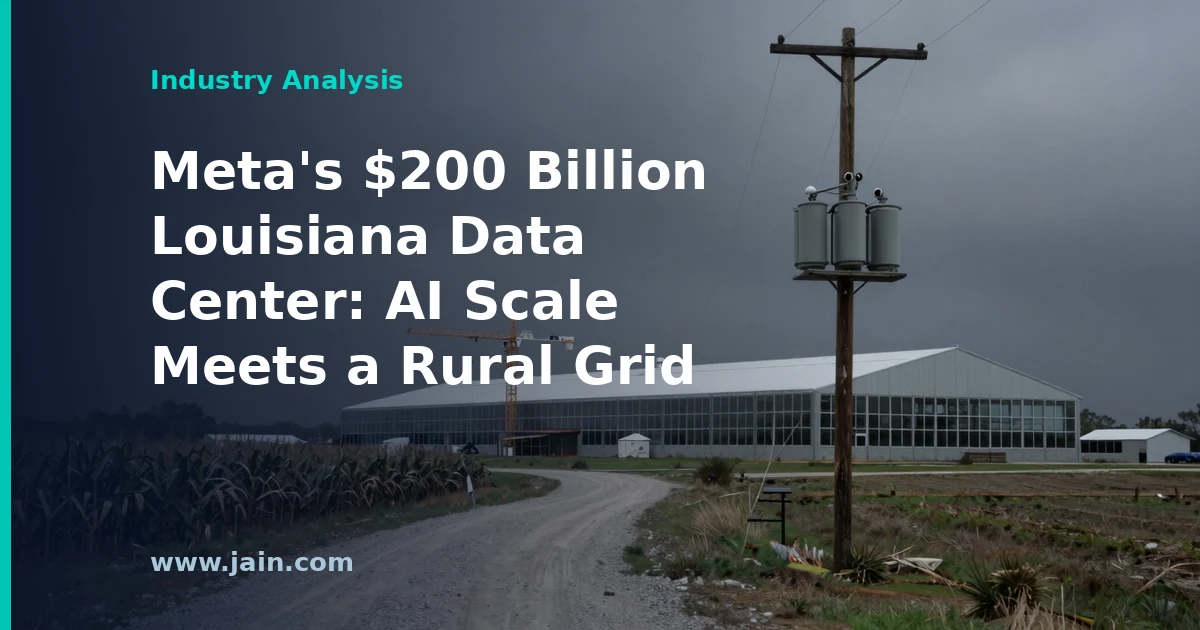
  • Meta’s $200 Billion Louisiana Data Center: AI Scale Meets a Rural Grid

    Meta’s $200 Billion Louisiana Data Center: AI Scale Meets a Rural Grid

    Bloomberg reports that Meta’s data center campus in rural Louisiana — the AI supercomputing site the company calls Hyperion — now represents a commitment on the order of $200 billion, a figure that would make it the largest single data-center investment ever reported. The project, located in Richland Parish in northeast Louisiana, began as a $10 billion announcement in December 2024 and has grown alongside Meta’s escalating artificial-intelligence ambitions.

    The May 17 report frames the build as transformative for the surrounding rural region, where a campus designed to scale toward multiple gigawatts of computing power is reshaping the local economy, the electric grid, and the land itself.

    Executive Summary

    The headline number is staggering even by hyperscale standards. When Meta first announced the Richland Parish project, its roughly $10 billion price tag and four-million-square-foot footprint already made it the company’s largest data center. A $200 billion figure — twenty times the original commitment — reflects how quickly the economics of frontier AI have escalated: the cost of a leading AI campus is no longer set by buildings and land but by the accelerator chips, networking, and power infrastructure packed inside them, refreshed on a fast cycle.

    Why it matters: a single company concentrating that much capital at a single rural site is a new phenomenon in American infrastructure. It tests the capacity of a regional utility (Entergy Louisiana is building new gas-fired generation to serve the load), the absorptive capacity of a small rural parish, and the balance sheets of even the world’s most profitable companies. Meta has already turned to outside capital for this site, including a reported joint-venture financing arrangement with Blue Owl Capital — a sign that AI infrastructure at this scale is becoming its own asset class.

    The caveat: the source is a single report, and it does not spell out what the $200 billion covers — committed construction capital, cumulative spending including chips over the site’s life, or a long-range projection. Those distinctions matter enormously, and we flag them below.

    From $10 Billion to $200 Billion in Eighteen Months

    Meta announced the Richland Parish campus in December 2024 as a $10 billion, four-million-square-foot facility — at the time, the largest in its fleet. By mid-2025, CEO Mark Zuckerberg had rebranded the site as Hyperion and described plans to scale it toward five gigawatts of computing capacity, part of a stated intent to spend hundreds of billions of dollars on AI infrastructure. A $200 billion characterization of the site is therefore less a sudden announcement than the visible endpoint of a steady escalation.

    The driver is the changed composition of data-center cost. In a conventional facility, the building and electrical plant dominate. In an AI campus, the servers and GPUs (the specialized chips that train and run AI models) can represent the large majority of total investment — and unlike the building, they are replaced every few years. That is how a single site’s lifetime cost can plausibly reach twelve figures, and it is also why headline totals for AI campuses should be read carefully: they often blend one-time construction with years of recurring hardware spending.

    What a Gigawatt-Class Campus Asks of a Rural Grid

    Richland Parish is farm country in one of the poorer corners of Louisiana. A campus targeting multiple gigawatts — a gigawatt is roughly the output of a large power plant, enough for hundreds of thousands of homes — cannot draw on spare capacity, because rural grids do not carry spare capacity at that scale. Entergy Louisiana’s answer has been new natural-gas generation built substantially to serve this one customer, an arrangement approved by state regulators.

    That model raises questions every state hosting hyperscale AI now faces. Who bears the cost if the load does not materialize or the customer leaves early — the company, or ratepayers? What happens to local reliability while multi-year grid upgrades catch up to the load? And how does a build dependent on new gas plants square with Meta’s long-standing renewable-energy commitments? These are not gotcha questions; they are the standard underwriting questions for single-customer generation, and the answers sit in regulatory filings and contract terms that headline coverage rarely reaches.

    The Economics of Concentrating $200 Billion at One Site

    Even for Meta, which generates tens of billions of dollars in annual free cash flow, this scale of spending strains a corporate balance sheet. The company’s reported use of joint-venture and private-credit financing for Hyperion — bringing in outside investors such as Blue Owl to own and fund data-center assets Meta then uses — signals a broader industry shift: AI infrastructure is being financed like power plants and pipelines, with long-lived structures and external capital, rather than expensed casually from operating profits.

    Concentration is the risk that comes with it. A single-site bet of this magnitude assumes AI demand keeps compounding, that the chips installed are not stranded by faster successors, and that power arrives on schedule. The winners if it works: Meta, which gets training capacity rivals must match; Louisiana, which collects taxes and jobs; and the contractors, utilities, and lenders in the build chain. The losers if it doesn’t are harder to name in advance — which is precisely why the financing structures, and who holds which risk, deserve as much attention as the square footage.

    Rural Transformation Cuts Both Ways

    For Richland Parish, the project brings thousands of construction workers, a permanent operational workforce Meta originally described in the hundreds of jobs, and a tax base transformation few rural counties ever see. It also brings housing pressure, road and water demands, and a local economy newly tethered to one company’s AI strategy — a dependency small communities historically know from mills and plants, with mixed long-term results.

    The fair reading is that both the boosters and the skeptics have real evidence. The investment, employment, and utility upgrades are concrete. So are the open questions about what the region retains if AI economics shift. Communities negotiating with hyperscalers elsewhere will study Louisiana’s terms closely — which makes transparency about those terms a matter of more than local interest.

    Background

    Meta operates one of the world’s largest data-center fleets, built over two decades to serve Facebook, Instagram, and WhatsApp. The generative-AI race changed the shape of that fleet: training frontier AI models requires enormous clusters of GPU chips concentrated at single sites with gigawatt-scale power. In 2025 Meta reorganized its AI efforts around ‘superintelligence’ and announced titan-scale campuses — Hyperion in Louisiana and Prometheus in Ohio — while raising capital spending to historic levels and signaling that hundreds of billions of dollars would follow.

    The December 2024 Louisiana announcement landed in Richland Parish, a rural farming area, accompanied by state incentives and an Entergy plan for new gas-fired generation. The project has since become a national reference case for how AI infrastructure interacts with rural grids, utility regulation, and small-town economies.

    Source: Meta Is Transforming Rural Louisiana With a $200 Billion Data Center — Bloomberg report, May 17, 2026, on the scale and local impact of Meta’s Hyperion data-center campus in Richland Parish, Louisiana.