Tag: energy storage

  • Surplus Interconnection: 800 GW Waiting on Existing Grid Ties

    Surplus Interconnection: 800 GW Waiting on Existing Grid Ties

    In a Utility Dive opinion piece published Feb. 21, 2025, GridLab technical education director Cassady Craighill argued that the United States is sitting on a near-term fix for its interconnection backlog: reusing the grid connections that already exist at aging power plants. Citing research from GridLab and the University of California, Berkeley, the piece says about 800 GW of clean energy projects could be plugged into the interconnection infrastructure at more than 1,000 existing thermal plants, with roughly another 200 GW available by 2030 — a combined figure the author describes as roughly equivalent to today’s total US installed generating capacity.

    The piece points to regulatory movement already underway: FERC approved a PJM Interconnection proposal to update its surplus interconnection rules, the Southwest Power Pool expanded its surplus interconnection service, MISO is cited as having roughly 4,000 MW in its queue tied to the approach, and Xcel Energy and PacifiCorp have used it to deploy solar and storage in the Western Interconnection. The author estimates the approach could avoid about $200 billion in new infrastructure spending.

    Executive Summary

    Interconnection — the process of getting a new power plant physically and contractually attached to the transmission grid — has become the binding constraint on US electricity supply. Queues run years long, and the network upgrades assigned to new projects can cost more than the projects themselves. Surplus interconnection sidesteps much of that by letting a new resource share the interconnection rights of a generator that is already connected but rarely runs. The op-ed’s analogy is a mall leasing out floor space it is not using.

    The economics are straightforward and, on their face, hard to argue with. The op-ed states that thermal plants around the country operate at less than 20% capacity factor — meaning their transformers, substations and transmission ties sit idle most of the year while fully paid for. Adding solar or batteries behind that same connection point uses an asset ratepayers have already funded, and it puts new supply on sites that have land, water rights, roads and a local workforce.

    What makes this worth tracking rather than simply celebrating is the gap between a tariff change and an energized megawatt. FERC has approved rule updates and several RTOs have created surplus interconnection products, but surplus service is typically subordinate to the host generator’s rights — which raises real questions about how bankable it is. The measure that matters over the next two years is not technical potential; it is signed interconnection agreements and steel in the ground.

    Reusing the Wire Is Cheaper Than Building the Wire

    When a developer requests interconnection the conventional way, the grid operator studies what the addition does to power flows across the network and assigns the developer a share of any upgrades required — new transformers, reconductored lines, sometimes entirely new substations. Those studies take years, the cost estimates move as neighboring projects drop out, and the resulting bill routinely kills otherwise viable projects. Surplus interconnection changes the question being asked. Instead of “what does the network need in order to accept this plant,” the question becomes “can the connection already built at this site accommodate another resource behind it.” That is a far narrower study.

    The physical logic rests on capacity factor — the share of the year a plant actually generates versus its theoretical maximum. A gas peaker rated at 500 MW that runs a few hundred hours a year still holds a 500 MW connection to the grid for all 8,760 of them. The op-ed’s claim that US thermal plants collectively operate below 20% capacity factor is the entire basis of the opportunity: the wire is the scarce asset, and it is mostly empty. Pairing an underused thermal plant with solar or storage also has a seasonal complementarity argument in its favor, since gas units are most exposed during extreme winter conditions.

    The winners here are specific and identifiable. Owners of aging coal and gas plants hold something the market now prices very highly — a permitted site with an existing grid connection — and surplus interconnection lets them monetize it without retiring the host unit first. Developers who can strike site deals with incumbents get to skip the queue. Ratepayers benefit if new low-marginal-cost output displaces expensive thermal running hours. The parties with less to gain are developers holding greenfield land with no interconnection position, who now compete against rivals with a structural head start.

    The Capacity Number Deserves an Asterisk

    The article’s framing moves between two different units in a way readers should catch. It says surplus interconnection “could nearly double the generation in the United States by 2030,” then notes that 1,000 GW “is roughly equivalent to the installed generating capacity in the United States today.” Those are not the same claim. Capacity is how much a fleet can produce at one instant; generation is how much energy it delivers over a year. A gigawatt of solar produces materially less annual energy than a gigawatt of combined-cycle gas, so 1,000 GW of predominantly solar and storage nameplate would not double US electricity output. The technical potential figure may well be sound; the doubling-of-generation phrasing overstates what it means.

    A second asterisk applies to the nature of the interconnection right itself. Surplus interconnection generally gives the new resource conditional access that is subordinate to the host generator — if the existing plant dispatches, the newcomer may have to back down. That is exactly what makes the study process fast, because nothing new is being promised to the network. But conditional output is harder to finance than firm output. Lenders and offtakers price curtailment risk, and how each RTO defines the sharing arrangement will determine whether these projects clear investment committees or stall at the term-sheet stage.

    None of this is a reason to dismiss the analysis, and it is worth being explicit that this is an advocacy piece from an organization that works on clean energy deployment. The underlying mechanism has been endorsed by a notably broad coalition — the op-ed notes the PJM proposal was backed by utilities, clean energy advocates, environmental groups and independent power producers alike, and frames the concept as consistent with Energy Secretary Chris Wright’s “energy addition” order and his stated aim to “expand energy production and reduce energy costs.” Broad support is meaningful evidence. It is not the same as evidence about deliverable megawatt-hours, and the op-ed does not publish the methodology behind either the 800 GW estimate or the roughly $200 billion in avoided infrastructure costs.

    Why Data Center Developers Should Be Paying Attention

    The load growth story running through the entire US power sector — data centers, electrification, reshored manufacturing — is currently gated by interconnection, not by the availability of generating equipment on paper. The op-ed puts the tension plainly: clean electricity sits in queues waiting for new interconnection while utilities turn away technology companies seeking power for new data centers. Both problems have the same root cause, and surplus interconnection addresses it from the supply side without requiring a new transmission corridor to be sited, permitted and built.

    Timing is what makes this relevant to infrastructure buyers right now. Utility Dive has separately reported that GE Vernova’s gas turbine backlog reached 116 GW with reservations being taken for 2031 deliveries — a queue of its own, and one that no regulatory filing can shorten. Against that, a solar-plus-storage installation behind an existing interconnection point is one of the few supply options with a realistic path to energization inside a typical data center construction cycle. Sites with existing grid rights have become a category of real estate in their own right.

    Demand-side discipline is tightening at the same time, which cuts both ways. Exelon has told investors there is a “high probability” its data center load pipeline falls about 40%, to 11 GW, as transmission security agreements screen out speculative projects; and PJM’s market monitor found data center load accounted for 9% of PJM wholesale costs so far in 2026. For operators, the message is that speculative queue positions are losing value while genuinely deliverable power is gaining it — which is precisely the arbitrage surplus interconnection targets.

    From Tariff Language to Energized Megawatts

    The real test of this proposal is administrative, and it is already running. FERC’s approval of PJM’s updated surplus rules, SPP’s expanded service, MISO’s cited pipeline and the Xcel and PacifiCorp deployments are the input side of the ledger. The output side — interconnection agreements executed, projects financed, capacity energized — is what will show whether surplus interconnection is a structural unlock or a niche product used by a handful of vertically integrated utilities that happen to own both the host plant and the new resource.

    Three implementation details will decide it. First, whether host plant owners have any incentive to lease their surplus to a third party that would compete against them in the same market, or whether uptake concentrates among owners developing on their own sites. Second, how curtailment and cost allocation are written into each RTO’s tariff, since that determines financeability. Third, how the process interacts with queue reform generally — a fast lane only stays fast if it does not fill up with the same volume of speculative requests that clogged the main queue.

    There is also an honest limitation worth stating: surplus interconnection reuses capacity at fixed points on the network. It does not move power between regions, relieve congestion between load pockets and generation, or serve load that happens to be nowhere near a retiring coal plant. It is a complement to transmission expansion, not a substitute for it, and the strongest version of the argument is the modest one — that it is among the very few levers that can add meaningful supply inside a few years rather than a decade.

    Background

    Interconnection is the regulated process by which a new generator joins the transmission grid. In most of the country it is administered by regional transmission organizations — PJM in the mid-Atlantic, MISO across the Midwest, SPP in the central plains — under rules set by the Federal Energy Regulatory Commission. Over the past decade those queues have swelled with far more proposed projects than can be studied, and the network upgrade costs assigned to individual developers have grown large enough to cancel projects outright. Queue reform has been a central FERC preoccupation as a result.

    Surplus interconnection service is a tool within that framework rather than a workaround of it: it allows an existing interconnection customer to make unused portions of its connection rights available to another resource at the same point. GridLab, a nonprofit that provides technical analysis on grid and clean energy questions, has advocated for wider use of the mechanism alongside researchers at the University of California, Berkeley. The urgency behind that advocacy is the load growth now arriving from data centers, electrification and manufacturing — the first sustained increase in US electricity demand in roughly two decades.

    Source: Leveraging surplus interconnection could unleash 800 GW of energy the US needs today — a Utility Dive opinion piece by GridLab’s Cassady Craighill, published Feb. 21, 2025, citing GridLab and UC Berkeley research on reusing existing grid connections at underused thermal plants.

  • Tesla’s ‘Megapod’ Reportedly Turns AI Data Centers Into a Turnkey Product

    Tesla’s ‘Megapod’ Reportedly Turns AI Data Centers Into a Turnkey Product

    According to a June 20, 2026 report from Electrek, Tesla plans to sell modular AI data center hardware under the name ‘Megapod’ — a productized, containerized package that would bundle power infrastructure and AI compute into a turnkey unit customers can buy, rather than a facility they must design and build. The report identifies the plan and the product name; specifications, pricing, capacity, and launch timing were not disclosed.

    Executive Summary

    The reported move would take Tesla from building AI infrastructure for itself to selling it as a product. Tesla already manufactures grid-scale battery systems (the Megapack, a factory-built container of batteries and power electronics that utilities buy by the unit) and has built large GPU clusters for its own self-driving and robotics programs. A ‘Megapod’ — the name deliberately echoes Megapack — would apply that same factory-built, buy-by-the-unit model to AI computing itself.

    Why it matters: the hardest part of deploying AI compute today is not buying chips, it is securing power and building the facility around them — a process that routinely takes years. A credible turnkey product that arrives with power conversion, cooling, and compute pre-integrated would compress that timeline and create a new class of competitor to traditional data center developers. That said, the report is thin: it establishes intent and a name, not a spec sheet, and the concept’s viability rests entirely on details Tesla has not yet made public.

    From Megapack to Megapod: Selling the Bottleneck

    Tesla’s energy business grew by productizing something that used to be a construction project. Before Megapack, grid-scale battery storage meant custom engineering on every site; Megapack turned it into a manufactured unit with a price, a lead time, and an order page. The reported Megapod applies the same logic to AI infrastructure, where the analogous pain is acute: demand for AI compute has outrun the industry’s ability to build the powered, cooled buildings that house it.

    If the product is what its name and the report’s framing suggest, the pitch writes itself — skip years of design-build and receive integrated capacity as freight. Tesla is plausibly positioned to attempt this because it already manufactures most of the non-chip ingredients at scale: battery storage, power electronics, thermal management, and high-volume factory assembly. It has also been its own first customer, having built large GPU clusters for training its driver-assistance and robotics models, which is where lessons about powering and cooling dense compute tend to be learned.

    The Market It Would Land In

    Modular and containerized data centers are not new — vendors have sold prefabricated modules for over a decade, and hyperscalers use prefabrication internally. What has changed is the customer base. AI demand has created buyers — enterprises, sovereign AI programs, GPU cloud startups — who need substantial compute quickly but lack the in-house expertise of a hyperscaler. That is the natural audience for a turnkey unit, and it is the same audience today served by colocation providers and data center developers.

    The competitive question is where such a product would sit relative to the existing stack. A Megapod would presumably still need land, grid interconnection or on-site generation, network connectivity, and operations — things a box does not include. That suggests the more likely outcome is complement rather than replacement: developers and colocation operators could themselves become customers, using prefabricated units to shorten construction. The disruptive scenario — buyers bypassing traditional facilities entirely — depends on how much of the surrounding problem Tesla actually packages, which the report does not say.

    What Would Have to Be True

    The economics of an integrated power-plus-compute product are unforgiving in one specific way: compute depreciates on a different clock than power infrastructure. GPUs turn over on a two-to-three-year cadence as new generations arrive, while switchgear, batteries, and cooling plant are fifteen-to-twenty-year assets. A well-designed modular product has to let the fast-aging part be swapped without stranding the slow-aging part; whether Megapod is architected that way is unknown.

    There is also a supply question the report leaves untouched: whose compute goes inside? Tesla has designed its own AI chips for in-house use, but a commercial product would more plausibly need to accommodate the accelerators customers actually want — which puts Tesla in the position of reselling scarce third-party silicon inside its own enclosure. And there is a focus question that applies to any company entering an adjacent market: manufacturing, selling, and supporting mission-critical infrastructure for enterprise customers is a service-heavy business with uptime obligations, a different muscle from selling vehicles or even utility batteries. None of this makes the product implausible — it defines the checklist the eventual announcement should be judged against.

    Background

    Tesla, founded in 2003 and best known for electric vehicles, has spent two decades building an energy division alongside its car business. Its Megapack — a shipping-container-scale battery system for utilities — became one of the company’s fastest-growing product lines, manufactured at dedicated ‘Megafactory’ plants. In parallel, Tesla became a major AI infrastructure operator in its own right, building large GPU training clusters and designing custom chips to train the neural networks behind its driver-assistance software and humanoid robot program.

    The reported Megapod arrives amid an industry-wide scramble: AI demand has made powered data center capacity one of the scarcest commodities in technology, with grid connections and construction — not chips alone — as the binding constraints. That scarcity has drawn manufacturers, utilities, and startups toward prefabricated and power-integrated designs, the space a Megapod would enter.

    Source: Tesla plans to sell modular AI data center hardware called ‘Megapod’ (Electrek) — June 20, 2026 report that Tesla intends to offer packaged power-plus-compute AI data center units as a product.

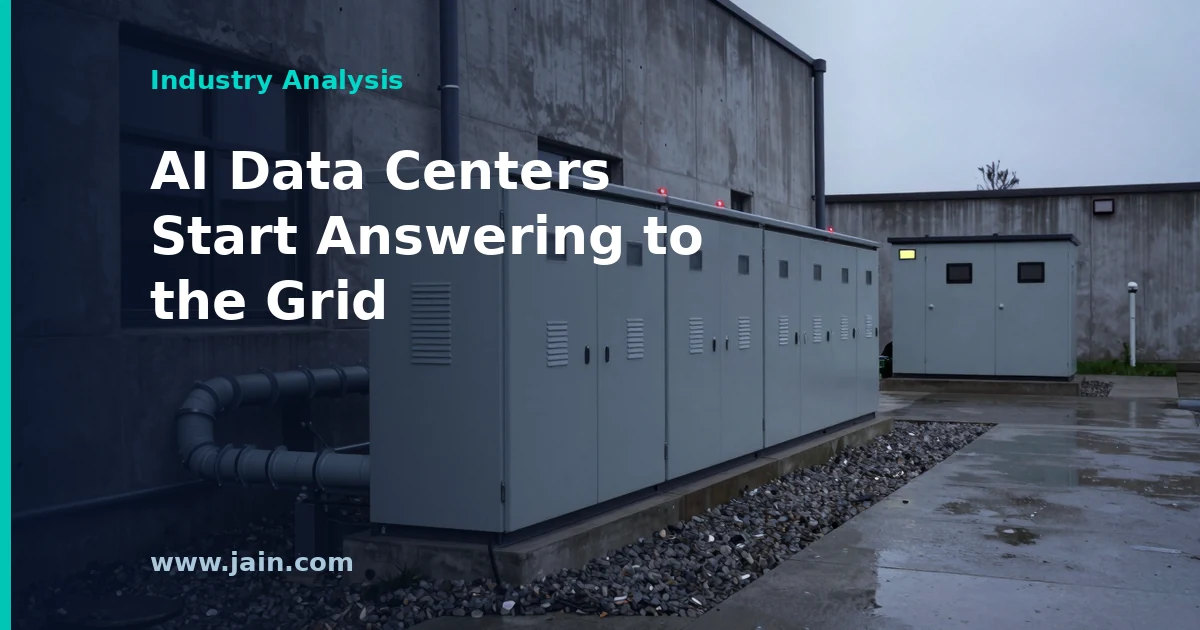
  • Smart Buffers Could Make AI Data Centers Better Grid Citizens

    Smart Buffers Could Make AI Data Centers Better Grid Citizens

    IEEE Spectrum reported on April 29, 2026 that AI data center operators are adopting “smart buffer” technologies — on-site energy storage and power-management systems that sit between the utility grid and racks of GPUs — to smooth the sharp swings in electricity demand that large AI workloads create. The framing is notable: rather than another story about AI’s appetite for power, this one covers an emerging engineering fix that could make AI facilities “better grid citizens.”

    Executive Summary

    The problem being solved is real and increasingly well documented. When thousands of GPUs start or pause a synchronized AI training run, a facility’s power draw can swing by tens of megawatts in seconds — behavior that looks, to a utility, less like a steady industrial customer and more like a giant load that lurches unpredictably. Grid operators plan around stable, forecastable demand; loads that spike and sag rapidly can stress local equipment, complicate frequency regulation, and slow interconnection approvals.

    Smart buffering attacks the problem at the meter. By placing fast-responding energy storage and intelligent power electronics between the grid connection and the compute floor, an operator can present the utility with a flattened, predictable demand profile while the GPUs behind the buffer surge and idle as the workload demands. If the approach matures, it addresses one of the sharpest objections utilities and communities raise against new AI capacity — and could shorten the interconnection waits that have become the industry’s biggest bottleneck.

    Why AI Loads Misbehave on the Grid

    Traditional data centers — the kind running websites, databases, and enterprise applications — are prized utility customers precisely because their demand is boringly flat. AI training clusters break that model. A large training job synchronizes thousands of accelerators: they compute in lockstep, pause together to exchange data, and can drop to a fraction of peak power in an instant if a job checkpoints or fails. The result is a load that oscillates on timescales of seconds to minutes, at magnitudes utilities historically associated with arc furnaces or industrial motors starting up.

    Utilities engineer their networks — transformers, voltage regulation, frequency response — around expected load behavior. A customer whose demand swings violently forces conservative planning: bigger margins, more spinning reserve, longer studies before a connection is approved. That conservatism shows up for data center developers as multi-year interconnection queues, which today gate AI buildouts more tightly than chips or capital do.

    Buffering as a Peace Treaty With Utilities

    The smart-buffer concept is conceptually simple: put a shock absorber between the grid and the GPUs. Batteries, ultracapacitors, or other fast storage charge when the compute load dips and discharge when it spikes, so the grid sees a smooth draw while the cluster behind the buffer does whatever the workload requires. Layer in intelligent controls, and the same hardware can go further — capping peak demand, riding through brief grid disturbances, or even reducing draw on request when the grid is stressed, a capability utilities call demand response.

    The business logic is compelling on paper. An operator that can credibly promise a flat or flexible load profile becomes a customer utilities want rather than one they study for years. That can translate into faster interconnection, access to sites previously deemed grid-constrained, and lower demand charges — the fees utilities levy based on a customer’s peak draw. In a market where time-to-power is the dominant competitive variable, anything that compresses the utility approval cycle has direct commercial value.

    The Economics Cut Both Ways

    Buffering is not free. Batteries sized to absorb tens of megawatts of swing add meaningful capital cost, consume space and cooling, introduce their own fire-safety and permitting considerations, and degrade with heavy cycling — and the rapid charge-discharge duty cycle of load smoothing is exactly the kind of use that ages battery cells fastest. Operators will weigh those costs against the value of faster grid access and lower peak charges, and the answer will differ by site: buffering pencils out most clearly where the grid is congested and interconnection is the binding constraint.

    There is also a partial software alternative. Some of the same smoothing can be achieved by scheduling workloads intelligently — staggering job starts, injecting dummy computation to prevent sudden power drops, or throttling training slightly during grid stress. Software costs less than batteries but sacrifices some compute efficiency and cannot deliver the instantaneous response hardware can. The likely end state is hybrid: firmware and schedulers doing coarse smoothing, with electrical buffers handling the fast transients. Vendors of batteries, power electronics, and data-center power-management software all stand to gain if buffering becomes a standard requirement rather than an exotic add-on.

    A Narrative Shift Worth Watching

    Coverage of AI and electricity over the past two years has been dominated by alarm: rising demand forecasts, delayed fossil-plant retirements, and disputes over who pays for grid upgrades. A story centered on data centers becoming better grid citizens signals a maturing conversation — one where the industry is expected not merely to consume power but to actively support grid stability. Regulators are already moving in this direction; several jurisdictions have proposed requiring large new loads to be curtailable or to bring their own flexibility.

    The strategic implication for operators is that grid behavior is becoming a design specification, not an afterthought. Facilities engineered from day one to present flexible, well-mannered load profiles will find friendlier utilities, faster approvals, and possibly favorable tariff treatment. Those that show up asking for hundreds of firm megawatts with volatile draw will increasingly wait at the back of the queue. Buffering technology, in that light, is less a gadget than an admission ticket.

    Background

    The collision between AI computing and the electric grid became one of the defining infrastructure stories of the mid-2020s. Data centers historically earned reputations as ideal utility customers — large but remarkably steady loads. Generative AI changed both variables at once: individual campuses grew from tens to hundreds of megawatts, and the synchronized nature of GPU training made demand volatile in ways the grid had rarely seen from digital infrastructure. Utilities responded with longer interconnection studies, and communities with growing skepticism about hosting new facilities.

    IEEE Spectrum, the flagship publication of the IEEE (the world’s largest technical professional organization for engineering), has covered this tension extensively. Its April 2026 report on smart buffering reflects the industry’s response phase: rather than simply requesting ever more firm power, operators are investing in storage, power electronics, and workload-management techniques that make AI facilities easier for grids to accommodate — a shift from consuming grid capacity to actively managing their footprint on it.

    Source: AI Data Centers Learn to Be Better Grid Citizens With Smart Buffers — IEEE Spectrum report on power-buffering technology that smooths AI data centers’ volatile electricity demand, published April 29, 2026.