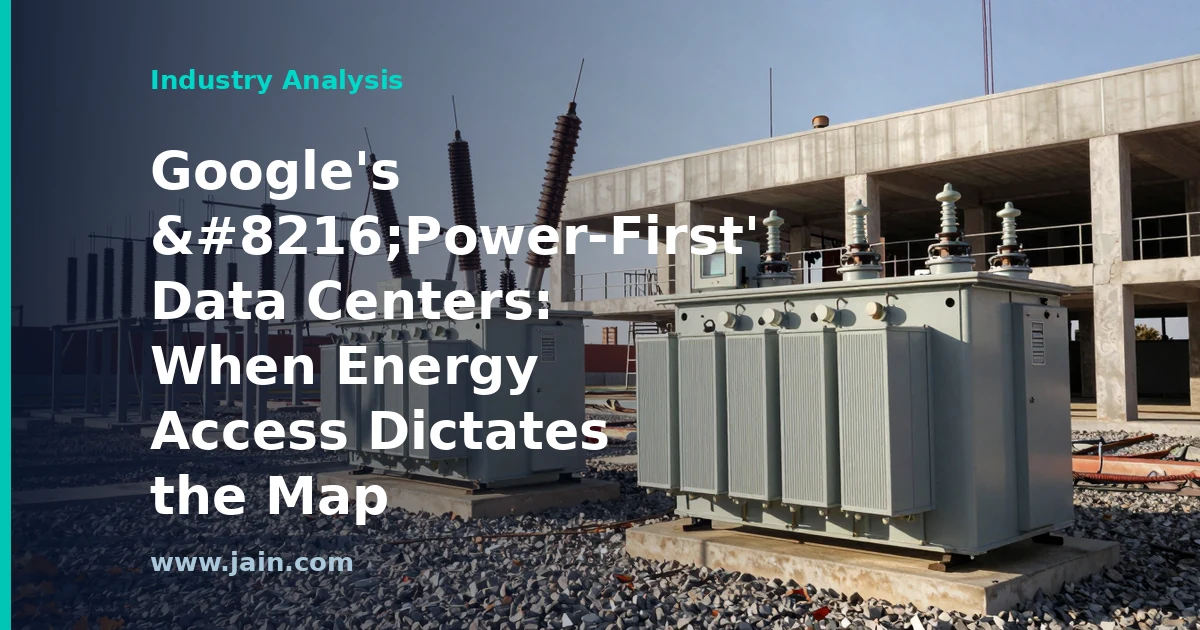
Data Center Knowledge reported on June 5, 2026, that Google is pursuing what it frames as a ‘power-first’ data center model — an approach in which access to electricity, rather than proximity to fiber routes, land, or customers, becomes the primary factor deciding where and how new facilities get built. The framing positions the model as a potential template for an industry now defined by energy scarcity.
Executive Summary
The report’s headline poses power-first siting as ‘a new model for energy scarcity’ — and that question mark matters. What is being described is less a single project announcement than a strategic posture: when grid interconnection queues stretch for years and utilities cannot promise large blocks of firm capacity, the rational response for a hyperscaler (a company operating cloud infrastructure at global scale, such as Google) is to start the site-selection process with the question ‘where can we actually get megawatts?’ and let everything else follow.
If that is genuinely how Google is now sequencing its development decisions, it inverts decades of data center orthodoxy. Historically, operators picked locations for network latency, tax incentives, land cost, and workforce, then asked the local utility to deliver power — which utilities, until recently, could almost always do. The reported shift is a public acknowledgment that electricity has become the scarce input around which everything else in digital infrastructure must now be designed.
From Location, Location, Location to Megawatts, Megawatts, Megawatts
Site selection used to treat power as a utility in the literal sense: always there when you flipped the switch. The AI buildout broke that assumption. Training clusters demand campus-scale power draws that rival heavy industry, and in many popular data center markets the local grid simply cannot add that load quickly. A power-first model responds by making energy availability the first filter — screening geographies by generation capacity, transmission headroom, and interconnection timelines before considering the traditional criteria at all.
For laypeople, the analogy is a factory town: the plant goes where the resource is, and the rest of the operation organizes itself around that fact. The strategic consequence is a likely redrawing of the data center map away from saturated hubs toward regions with surplus generation or the ability to build it — a shift with real winners (energy-rich regions, utilities with spare capacity, landowners near transmission) and real losers (constrained legacy markets that can no longer trade on their connectivity advantages alone).
What Power-First Implies for Design, Not Just Siting
The editorial angle here is worth taking seriously: if energy is the binding constraint, it shapes design as much as geography. A facility conceived power-first tends to be engineered around its energy reality — sized to the block of capacity actually secured, potentially paired with on-site or contracted generation, and optimized to extract maximum compute per watt because every watt was hard-won. Efficiency stops being a sustainability talking point and becomes the core economic lever.
That logic also favors operators with the balance sheet to participate in energy development itself — funding new generation, signing long-duration power purchase agreements (contracts to buy a plant’s output for years in advance), or co-developing sites with utilities. Hyperscalers can play that game. Smaller operators and enterprises largely cannot, which suggests power scarcity could further concentrate AI-scale infrastructure among a handful of companies with the ability to originate their own electricity supply.
A Question Mark Doing Honest Work
It is equally important to note what this coverage is and is not. The available material is a report framing a strategic concept, with a headline that explicitly asks whether this constitutes a new model rather than declaring it one. From the source available to us, there are no disclosed site lists, capacity figures, investment commitments, or timelines to evaluate. ‘Power-first’ is a compelling frame, and it is consistent with pressures the whole industry acknowledges — but as presented, it remains a thesis about Google’s approach rather than a verifiable program with published specifics. Readers should hold both things at once: the underlying constraint is real and well-documented across the sector, while the specific contours of Google’s response are, on this evidence, still thinly detailed.
Background
Google was among the earliest builders of hyperscale data centers and has long treated energy procurement as a strategic discipline, including years of large-scale renewable purchasing and a stated goal of running on carbon-free energy around the clock. That history makes it a bellwether: when Google changes how it sequences power and siting decisions, the rest of the industry pays attention.
The broader context is the AI infrastructure boom that accelerated from 2023 onward, which pushed data center power demand up sharply and collided with a grid whose generation and transmission additions move on multi-year regulatory timelines. By 2026, power availability — not land, capital, or chips alone — had become the most commonly cited bottleneck for new capacity across the sector, setting the stage for strategies like the one described here.