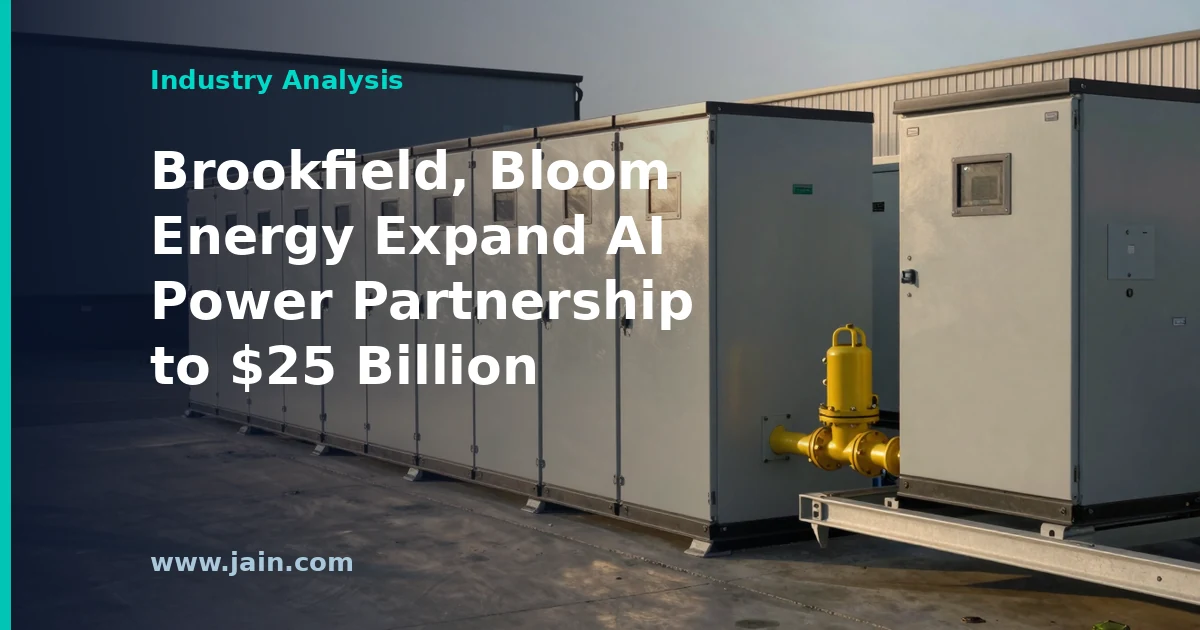
Brookfield and Bloom Energy announced on June 29, 2026 that they are expanding their AI infrastructure partnership to $25 billion — a fivefold increase over the original framework — to build and finance rapid power deployment for AI data centers. The expanded arrangement pairs Bloom’s solid oxide fuel-cell technology with Brookfield’s infrastructure capital.
Executive Summary
Bloom Energy, the fuel-cell manufacturer, and Brookfield, one of the world’s largest infrastructure investors, have scaled their partnership from an original framework — implied by the announcement’s “fivefold” language to have been on the order of $5 billion — to $25 billion. The stated purpose is to build and finance “rapid power” for AI infrastructure: on-site electricity generation that can be deployed faster than utility grid connections.
The announcement matters because electricity availability, not chips or land, has become the binding constraint on AI data-center construction. A $25 billion commitment of this shape signals that major infrastructure capital now treats on-site fuel-cell generation as a bankable asset class rather than a niche backup option. That said, the release as reported gives a headline dollar figure without megawatt targets, named customers, or deployment timelines — so the scale of actual near-term power delivery remains to be demonstrated.
Why Fuel Cells Are Jumping the Grid Queue
The core problem this partnership targets is speed. In many major data-center markets, a new facility requesting a large grid connection can wait years for utilities to build the transmission and generation needed to serve it — a delay measured in lost AI product cycles. On-site generation sidesteps that queue. Bloom’s solid oxide fuel cells convert fuel, typically natural gas, into electricity through an electrochemical reaction rather than combustion, and they arrive as factory-built modules that can be installed in months rather than the multi-year timelines of large power plants or grid upgrades.
That “speed-to-power” pitch has become the dominant selling point across the AI power market — gas turbines, batteries, and behind-the-meter deals all compete on the same axis. Fuel cells’ specific claim is modularity and siting flexibility: they are quiet, produce no combustion emissions like NOx at the point of generation, and can be permitted in places where a turbine plant could not. The trade-off is cost per megawatt-hour and dependence on fuel supply, which is why financing structure matters as much as technology.
The Capital Stack Behind the Megawatts
The division of labor is the interesting part. Bloom manufactures and services the equipment; Brookfield brings the balance sheet. In a typical arrangement of this kind, the infrastructure investor owns the generating assets and sells power or capacity to data-center operators under long-term contracts, so the data-center customer avoids a large upfront capital outlay. For Bloom, a deep-pocketed financing partner converts its technology into an offering that can compete for hyperscale-sized deals it could never finance from its own balance sheet.
For Brookfield, fuel-cell fleets serving AI campuses look like classic infrastructure: long-lived assets, contracted revenue, and a customer base — AI compute operators — currently willing to pay a premium for firm power delivered quickly. Growing the framework fivefold within roughly a year of the original announcement suggests the partners believe demand from AI builders exceeds what the initial commitment could serve. It is a strong demand signal, though announced frameworks and deployed megawatts are different things.
What a Fivefold Scale-Up Signals — and What It Doesn’t
A $25 billion figure invites careful reading. Partnership frameworks of this kind typically describe a ceiling — capital the partners intend to deploy if projects materialize — rather than contracted orders. The announcement as reported does not specify how much is committed versus targeted, how much power it represents, or over what period. Until customer contracts and megawatt figures are disclosed, the number is best understood as a statement of ambition backed by a credible financier, not a backlog.
Competitively, the deal sharpens the contest to power AI. Utilities and grid operators risk losing their largest new customers to behind-the-meter generation; gas-turbine suppliers, battery vendors, and small modular reactor developers are chasing the same load. For data-center operators, more credible power options mean more negotiating leverage — and for the industry’s critics, more scrutiny of what fuels that power. Fuel cells running on natural gas still emit carbon dioxide, so the climate profile of this buildout will depend on fuel sourcing choices the announcement does not detail.
Background
Bloom Energy, founded in 2001 and headquartered in California, went public in 2018 and built its business selling solid oxide fuel-cell “Energy Servers” to commercial, industrial, and utility customers seeking reliable on-site power. Brookfield is a global asset manager with hundreds of billions of dollars across infrastructure, renewable power, and real estate, and has been among the most aggressive institutional investors in AI-related infrastructure. The two first announced an AI-focused partnership in late 2025, part of a wider industry wave in which data-center developers turned to behind-the-meter generation — fuel cells, gas turbines, and eventually nuclear — as utility interconnection queues stretched to multiple years in key markets.
Bloomberg reported on May 19, 2026 that shares of power companies rallied after PJM Interconnection — the largest electricity grid operator in the United States — laid out a timeline governing how data centers will be connected to its system. PJM coordinates the wholesale power grid across 13 states and the District of Columbia, a footprint that includes Northern Virginia, the densest data-center market in the world.
The market reaction, as captured in the report’s headline, was immediate: investors treated a clearer connection schedule as bullish for the generators and utilities that will serve that load. Details of the timeline itself were not spelled out in the source material available to us.
Executive Summary
The announcement matters less for any single date on a calendar than for what it represents: the grid operator sitting atop the epicenter of American data-center growth telling the market, in effect, when and how new AI-scale electricity demand will be allowed onto the system. Interconnection — the regulated process by which a large new customer or power plant gets physically and contractually attached to the grid — has become the single biggest bottleneck in data-center development. A published timeline converts an open-ended uncertainty into something developers, utilities, and investors can plan around.
The equity-market response tells its own story. Power producers in PJM territory have already benefited from tightening supply-demand conditions, and a defined path for connecting new data-center load reinforces the thesis that electricity demand growth is durable rather than speculative. When the referee publishes the game schedule, everyone who profits from the game gets marked up.
That said, the source available for this article is a headline-level report. The substance of the timeline — its dates, its conditions, and which projects it covers — is not detailed in the material we can verify, and our analysis below is careful to separate what is established from what is inference.
Why an Interconnection Timeline Moves Stock Prices
To a layperson, a grid operator publishing a schedule sounds like administrative housekeeping. In today’s power market it is closer to a supply announcement. Hyperscale data centers can each demand as much electricity as a mid-sized city, and the queue of projects seeking connection in PJM territory has grown far faster than the grid’s ability to study and absorb them. Every month of ambiguity in that queue is a month in which developers cannot commit capital, utilities cannot plan transmission, and generators cannot forecast demand.
A defined timeline collapses that ambiguity. For independent power producers and utilities, it firms up the demand outlook that underpins investment in new generation and grid upgrades. Investors bidding up power firms on the news are, in effect, pricing in a higher-confidence stream of future electricity sales. The rally is a bet that the load is real and now has a schedule.
PJM Is the Test Case for Absorbing AI Load
PJM is not just the biggest US grid — it is the one under the most acute data-center pressure. Its footprint includes Northern Virginia’s “Data Center Alley,” the largest concentration of such facilities anywhere, and its recent capacity auctions have cleared at sharply elevated prices as reserve margins tightened. How PJM sequences data-center connections will effectively set the template other US grid operators follow, because every region courting AI infrastructure faces the same collision between hyperscale demand growth and a grid built for a flatter era.
The economics cut both ways. Faster, clearer interconnection is good for data-center developers and for the power companies that serve them. But absorbing city-sized new loads onto a constrained system can raise wholesale prices for everyone else — a tension that has already made data-center cost allocation a live political issue in several PJM states. A timeline answers “when”; it does not by itself answer “who pays for the upgrades.”
Winners, Losers, and the Discipline Question
The most direct beneficiaries of a credible connection schedule are generators with existing capacity in PJM territory, whose output becomes more valuable as firm new demand arrives, and transmission owners, who earn regulated returns on the grid buildout that big loads require. Data-center operators gain planning certainty, though a timeline can constrain as well as enable — a schedule implies that projects outside it wait.
The open risk is whether demand forecasts hold. Utilities and grid operators are planning around data-center projections that include some double-counting, as developers file duplicate requests across multiple jurisdictions to hedge their siting options. If a meaningful share of queued projects never materializes, capacity built against a published timeline could be left looking for customers. That is precisely why the details of PJM’s approach — how it validates that a proposed data center is real and financially committed — matter more than the headline.
Background
PJM Interconnection, founded as a utility power pool in 1927 and now the largest competitive wholesale electricity market in the United States, coordinates the grid across a region stretching from the Mid-Atlantic into the Midwest. For most of the 2010s its challenge was flat demand; that reversed abruptly as cloud computing and then AI training drove explosive data-center growth, concentrated in Northern Virginia within its footprint. Tightening supply pushed PJM’s capacity auctions — the mechanism that pays power plants to be available — to record levels, turning grid policy decisions into market-moving events.
Against that backdrop, the rules and pace of interconnection have become the industry’s central battleground: data-center developers want speed and certainty, utilities want cost recovery, consumer advocates want protection from rate increases, and the grid operator must keep the lights on for everyone. PJM’s data-center timeline is the latest move in that negotiation.
Individual AI data center campuses in the United States have crossed the 1-gigawatt power threshold, according to a May 15, 2026 report from Quartz — a scale at which a single computing facility draws as much electricity as roughly a large power plant produces. The report frames these sites as an emerging strain on the U.S. power grid.
The milestone matters less as a round number than as a signal: the binding constraint on AI infrastructure buildout has shifted from chips and capital to electricity itself.
Executive Summary
For most of the data center industry’s history, a large facility drew tens of megawatts, and a 100-megawatt campus was considered enormous. The reporting highlighted here marks a step change: single AI training and inference campuses now demanding 1 gigawatt or more — a thousand megawatts — concentrated at one grid interconnection point. That is a load comparable to a mid-sized city, arriving on the grid in a fraction of the time it takes to permit and build the generation and transmission to serve it.
Why it matters: electricity supply, not silicon supply, is now the gating factor for AI capacity growth in the United States. Utilities plan generation and transmission on decade-long horizons; hyperscale AI developers want power in two to four years. That mismatch shapes where data centers get built, how fast AI capacity can scale, who pays for grid upgrades, and which operators — those with secured power — hold the scarcest asset in the industry.
The source is a brief news report rather than a detailed study, so the specific sites, operators, and grid regions involved are not enumerated. But the direction of travel it describes is consistent with what grid operators and utilities have been signaling: unprecedented load-growth forecasts driven overwhelmingly by data centers.
From Megawatts to Gigawatts: A Different Kind of Customer
A gigawatt-scale data center is not a bigger version of a traditional one; it is a different category of grid customer. A gigawatt is roughly the output of a large nuclear reactor, and connecting that much load at a single substation requires high-voltage transmission capacity that most locations simply do not have spare. Traditional data centers could slot into existing industrial corridors. Gigawatt campuses force utilities to build new transmission lines, upgrade substations, and in some cases procure or build new generation — projects that routinely take five to ten years to permit and construct.
This inverts the historical relationship between data centers and utilities. Data centers used to be desirable, quiet, high-load-factor customers that utilities courted. Now the largest projects arrive as planning problems: loads so large that a utility must ask whether serving one customer degrades reliability or raises costs for everyone else. Several of the practical consequences — long interconnection queues, large-load tariffs, and demands for financial guarantees from developers — follow directly from that inversion.
Power as the Scarce Asset — and the New Competitive Moat
When electricity is the bottleneck, secured power becomes the most valuable asset in the AI infrastructure stack. A developer holding an executed interconnection agreement for hundreds of megawatts, or land adjacent to underused generation, holds something that cannot be quickly replicated at any price. That favors incumbent data center operators with existing utility relationships, energy companies entering the data center business, and sites near retired or underutilized industrial load where grid capacity already exists.
It also reshapes geography. Buildout gravitates toward regions with available generation, faster permitting, and willing utilities — which can pull AI infrastructure away from traditional hubs toward areas that historically saw little data center investment. For buyers of AI capacity, the practical implication is that delivery timelines increasingly depend on a provider’s power position, not its ability to procure GPUs — graphics processing units, the specialized chips that do the computational work of AI.
Who Bears the Cost of the Strain?
“Straining the grid” is ultimately a question about allocation: of capacity, of reliability risk, and of cost. If a utility builds transmission and generation to serve gigawatt loads and spreads the cost across its rate base, ordinary ratepayers can end up subsidizing AI infrastructure. If it charges data center developers the full incremental cost, projects become more expensive but the burden lands where the demand originates. Regulators across multiple states are actively working through exactly this question, and the outcome will materially affect both AI economics and household electricity bills.
There is also a reliability dimension. Grid operators plan around peak demand, and very large, fast-growing loads compress the margin between available supply and consumption. The fair reading is that gigawatt data centers do not create grid fragility by themselves — decades of underinvestment in transmission predate the AI boom — but they arrive fast enough to expose it. How operators respond, through on-site generation, flexible operation during grid stress, or long-term power purchase agreements that fund new supply, will determine whether AI load becomes a grid liability or a financing engine for new generation.
Background
Data centers are the physical home of the internet and, increasingly, of artificial intelligence: warehouse-scale buildings full of servers, networking, and cooling equipment. For decades they were a modest and predictable slice of U.S. electricity demand, and overall U.S. power consumption was roughly flat, allowing utilities to plan conservatively. The generative-AI boom that began in late 2022 broke that pattern: training and running large AI models requires vastly more computing — and therefore more electricity and cooling — than conventional workloads.
Since then, hyperscale operators and AI developers have announced successively larger campuses, with facility sizes climbing from tens of megawatts toward the gigawatt class this report describes. Grid operators and utilities across the country have responded with sharply raised load-growth forecasts, and questions of interconnection timelines, cost allocation, and reliability have moved from utility back offices to the center of both energy policy and AI strategy.
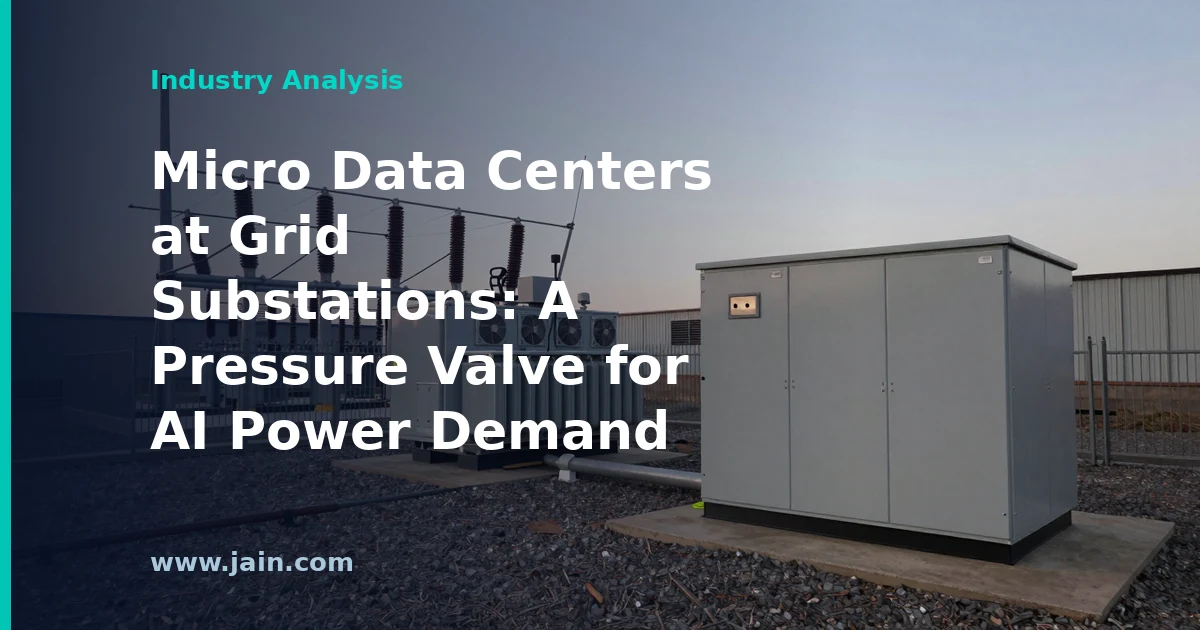
IEEE Spectrum reported on May 13, 2026 on an emerging infrastructure concept: placing small, modular data centers directly at electric-grid substations as a way to keep surging AI power usage in check. Rather than concentrating hundreds of megawatts of computing at a single campus and forcing utilities to build new transmission to serve it, the approach distributes compute in small increments at points where the grid already has capacity, interconnection equipment, and land.
Executive Summary
The idea IEEE Spectrum describes inverts the dominant pattern of the AI buildout. Instead of asking the grid to come to the data center — often a multi-year, multi-billion-dollar transmission and generation exercise — micro data centers go to the grid, occupying the underused margins of existing substations. A substation is the node where high-voltage transmission is stepped down for local distribution; many have spare transformer capacity for part of the day or year, plus fenced land and existing utility interconnection.
Why it matters: interconnection queues and transmission constraints, not chips, have become the binding constraint on AI capacity growth in many U.S. markets. Any credible mechanism that adds compute without triggering new large-load interconnection studies deserves attention from utilities, hyperscalers, and colocation operators alike. The open question — which the source coverage frames but cannot yet settle — is whether compute measured in hundreds of kilowatts to a few megawatts per site can meaningfully offset demand measured in gigawatts.
Why the Substation Is Suddenly Prime Real Estate
The scarce resource in the AI era is not land or servers — it is grid interconnection. Large data center campuses in major markets face waits that can stretch for years while utilities study whether the transmission system can absorb a new load of 100 MW or more. A substation-sited micro facility sidesteps much of that: the interconnection already exists, the utility already owns and monitors the site, and the incremental load can be sized to fit whatever headroom the local transformer bank actually has.
There is also a load-shaping logic. Substation loading varies by hour and season; a data center that can throttle or shift its work — as some AI training and batch-inference workloads can — could soak up capacity when the neighborhood demand is low and back off at peak. In that framing, the micro data center is less a tenant than a grid instrument: a flexible load that improves utilization of assets ratepayers have already paid for.
The Economics Cut Both Ways
Distributing compute forfeits the economies of scale that made the hyperscale model dominant. A 200 MW campus amortizes security, staffing, cooling plant, and network backbone across a vast footprint; a 1 MW pod at a substation must be nearly autonomous — remotely operated, prefabricated, and cheap to service — or its cost per kilowatt will not compete. The viability of the model rests heavily on modular manufacturing driving unit costs down, something the industry has promised for a decade with mixed results.
On the revenue side, however, distributed sites have an asset central campuses lack: proximity. Inference — the serving of trained AI models to users — benefits from being near population centers, and substations are by definition embedded where people and businesses are. If AI demand shifts from training-dominated to inference-dominated, as most industry roadmaps assume, the value of many small, close-in sites rises relative to a few remote giants.
Utilities as Gatekeepers — and Potential Partners
Nothing in this model works without the utility, which controls the substation, the interconnection, and the tariff. That is both the model’s strength and its fragility. Utilities gain a new class of revenue-generating, potentially flexible load and a better story for regulators worried about data centers driving up residential rates. But utilities are conservative by design and by regulation: hosting third-party commercial equipment inside the substation fence raises questions of liability, security, union work rules, and whether ratepayer-funded assets can be leveraged for private gain.
Expect the regulatory treatment to vary sharply by state and by whether the market is vertically integrated or restructured. Pilots with a single cooperative or municipal utility are one thing; scaling across investor-owned utilities under public-utility-commission oversight is a much longer road, and the source coverage does not indicate that road has been mapped.
A Complement, Not a Substitute
It is worth being precise about scale. AI’s incremental power demand is commonly discussed in gigawatts per year in the U.S. alone; substation-sited pods of a megawatt or less would need to be deployed by the thousands to absorb even a modest share. That does not make the idea a gimmick — grid-edge flexibility has outsized value precisely at the margins where systems break — but it does mean micro data centers are best understood as a pressure valve, as the framing suggests, rather than a replacement for large campuses, new generation, and transmission expansion. The realistic outcome is a layered market: hyperscale for training, regional colocation for enterprise, and grid-embedded micro sites for latency-sensitive inference and load balancing.
Background
The idea of the micro or edge data center predates the AI boom — telecoms and content networks have long placed small compute nodes near users — but it struggled commercially because most cloud workloads tolerated centralization. Two forces revived it: the AI buildout’s collision with grid interconnection queues, and the rise of latency-sensitive inference. By 2026, utilities, regulators, and hyperscalers were all publicly wrestling with how to add gigawatts of data center load without destabilizing rates or reliability, making grid-aware siting concepts — flexible loads, curtailable contracts, and now substation-sited compute — a mainstream topic of industry discussion rather than a fringe experiment.
E&E News by POLITICO reported on May 4, 2026 that the AI boom has prompted a rare formal warning of “significant risks” to the electric grid. The warning, attributed to grid operators, centers on the reliability challenges created by rapid AI data-center load growth — the surge in electricity demand from facilities built to train and run artificial-intelligence models.
Executive Summary
According to the report, the organizations responsible for keeping the lights on have moved beyond quiet concern to an explicit, on-the-record caution: the pace and scale of AI-driven data-center demand now pose “significant risks” to grid reliability. In the deliberately understated language of the power sector, where public warnings are infrequent and carefully worded, a formal statement of this kind is a notable escalation.
Why it matters: grid operators and reliability bodies are the institutions that decide whether new large loads can connect, how much generation and transmission must be built, and what margins the system must hold in reserve. When they formally flag a risk, that assessment flows into planning studies, interconnection decisions, and regulatory proceedings. For data-center developers, utilities, and the AI companies driving demand, the message is that electricity availability — not land, chips, or capital — may be the binding constraint on the buildout, and that the institutions controlling that constraint are now on notice.
Why a Formal Warning Is a Turning Point
Grid reliability institutions are structurally conservative communicators. Their public assessments are consensus documents, reviewed by member utilities and regulators, and they rarely single out a demand-side trend as a named risk. That is what makes the reported warning newsworthy: the characterization of AI data-center load growth as posing “significant risks” is the kind of language that, once issued, becomes a reference point in rate cases, interconnection disputes, and legislative hearings.
The practical effect of such warnings is less about any single blackout scenario and more about institutional permission. Utilities that want to slow-walk large interconnection requests, regulators that want to impose cost-allocation conditions on data centers, and states weighing incentives for the industry can all now cite an authoritative reliability finding. In power planning, the paper trail matters.
The Mismatch Behind the Alarm
The underlying tension is one of timescales. A large data center can be designed, financed, and built in roughly two to three years, and AI developers are announcing capacity at an unprecedented cadence. The grid assets needed to serve that load — high-voltage transmission lines, large generators, transformers — routinely take far longer to permit and construct. When demand arrives faster than supply infrastructure can, the system’s cushion shrinks, and reliability planners see exactly the kind of risk the reported warning describes.
Compounding the problem is forecasting uncertainty. Utilities plan around load forecasts, and data-center demand is uniquely hard to forecast: projects are speculative, developers often file duplicate interconnection requests in multiple territories while shopping for power, and a single hyperscale campus can rival the demand of a small city. Planners face risk in both directions — underbuilding invites shortfalls, while overbuilding for phantom load can leave other customers paying for stranded infrastructure.
Winners, Losers, and the New Power Calculus
If reliability concerns harden into policy, the advantage shifts to data-center operators who bring solutions rather than just load: projects with secured long-term power contracts, on-site or co-located generation, meaningful backup capacity, or genuinely flexible demand that can reduce consumption during grid stress. Flexibility is emerging as a currency — a data center that can curtail (temporarily reduce) its draw during peak hours is a far easier interconnection decision than one requiring firm power around the clock.
The losers in a constrained environment are late-arriving projects in saturated markets, and potentially ordinary ratepayers if the costs of grid expansion are not allocated cleanly to the loads driving it. For utilities, the moment cuts both ways: data centers represent the largest load-growth opportunity in decades — and therefore revenue — but also a source of operational and political risk if reliability suffers. How regulators referee that tension will shape power planning for the rest of the decade.
Background
For roughly two decades before the AI boom, electricity demand in the United States was essentially flat, and grid planning settled into a routine of modest, predictable adjustments. That era ended when the generative-AI wave set off a race to build data centers at unprecedented scale, pushing utilities to revise load forecasts sharply upward and filling interconnection queues — the waiting lists for connecting new facilities to the grid — across multiple regions.
Grid reliability in North America is overseen by a layered system: regional grid operators run the transmission network day to day, while reliability organizations set standards and publish periodic assessments of whether the system can meet projected demand. Those assessments had grown increasingly pointed about surging data-center load in the years before this reported warning, making the May 2026 statement the continuation — and apparent sharpening — of a trend the power sector has watched closely.
PJM Interconnection, the grid operator serving the largest electricity market in the United States, has reopened its interconnection queue — the formal waiting line new power plants must join before they can connect to the grid — and gas-fired generation leads the intake at 106 gigawatts (GW), according to an April 30, 2026 report by Utility Dive. The queue had been closed to new entrants for years while PJM worked through a massive backlog under reformed study rules.
Executive Summary
The reopening of PJM’s queue is one of the most consequential grid events of the decade for the data-center industry. PJM’s territory — spanning 13 states and the District of Columbia, including the Northern Virginia corridor that hosts the world’s densest concentration of data centers — has been the epicenter of the load-growth crunch. For years, developers of new generation could not even get in line, while demand forecasts climbed relentlessly on the back of AI and cloud expansion.
That 106 GW of gas-fired capacity leads the new intake is the headline signal: developers are betting that dispatchable, fuel-based generation is what the market will pay for. For context, 106 GW of proposed gas alone approaches the scale of PJM’s entire historical peak load — a striking statement of intent, even acknowledging that interconnection requests are proposals, not power plants, and that historically only a fraction of queued projects reach commercial operation.
The Queue Reopens Into a Seller’s Market
An interconnection queue is the study pipeline through which a grid operator evaluates whether a proposed generator can connect safely and what network upgrades it must fund. PJM froze new entries while it transitioned from a first-come, first-served process — which had become clogged with speculative projects — to a clustered, first-ready, first-served model. The reopening is therefore a pressure release: years of pent-up development interest arriving all at once.
The market these projects are entering is unusually favorable to generators. PJM’s recent capacity auctions have cleared at elevated prices, reflecting tightening reserve margins as older coal and gas plants retire faster than replacements arrive and as data-center load grows. High capacity prices are precisely the signal designed to attract new steel in the ground — and 106 GW of gas proposals suggests the signal is being heard.
Why Gas Leads — Economics, Not Ideology
Gas-fired turbines dominate this intake for practical reasons. They are dispatchable — able to run on demand rather than when the weather cooperates — which is what capacity markets and 24/7 data-center loads reward most. They site on relatively small footprints near existing gas pipelines and transmission. And developers can point to a revenue stack (capacity payments, energy sales, and potentially direct contracts with large loads) that pencils today.
But the gas wave faces its own bottlenecks. Turbine manufacturers are reporting multi-year order backlogs industry-wide, EPC (engineering, procurement, and construction) labor is scarce, and gas pipeline expansion in parts of PJM’s eastern footprint has historically faced permitting resistance. Proposing 106 GW is easy; procuring turbines, pipe, and crews for even a fifth of it is the hard part. The queue position is now arguably the cheapest asset in the whole development chain.
What This Means for Data-Center Developers
For hyperscalers and colocation operators stuck in multi-year utility interconnection waits, a generation-heavy queue is cautiously good news: more supply eventually means faster load interconnection and less severe capacity-price escalation. It also strengthens the case for co-location deals, in which a data center sites directly alongside a new plant and contracts for its output — a structure regulators in PJM have been actively wrestling with.
The timing mismatch remains the industry’s core problem. Data centers can be built in 18–24 months; a new combined-cycle gas plant typically takes four or more years from queue entry through studies, permitting, and construction. Even under PJM’s reformed process, the bulk of this 106 GW cannot plausibly serve load until late this decade. Buyers planning capacity for 2027–2028 should not count on this queue cycle to bail them out.
The Decarbonization Tension Nobody Should Ignore
A gas-led buildout sits uneasily beside the carbon-neutrality pledges of the very customers driving the demand. Most major cloud providers maintain public net-zero or carbon-free-energy targets, and a decade of gas additions in PJM would make those targets harder to reconcile with grid reality — unless paired with offsets, carbon capture, or an eventual nuclear and storage wave. The honest framing is that the market is prioritizing reliability and speed-to-power first and emissions second. Whether that ordering persists will depend on state policy in PJM’s footprint, federal rules, and how loudly corporate energy buyers push back through their procurement.
Background
PJM Interconnection grew out of a 1927 power pool among Pennsylvania and New Jersey utilities and today operates the largest wholesale electricity market in the United States. Its territory contains Northern Virginia’s “Data Center Alley,” which by itself consumes more data-center power than most countries. Over the past several years PJM became the poster child for the interconnection bottleneck: thousands of proposed projects — predominantly renewables in earlier cycles — languished in multi-year study backlogs, prompting a federally approved overhaul of its queue process and a temporary halt to new applications.
The reopening lands amid record demand forecasts, plant retirements, and capacity prices that have drawn political scrutiny across PJM’s member states. The resource mix of this new intake — and how much of it survives to construction — will shape the region’s reliability, emissions trajectory, and data-center growth capacity into the 2030s.