
Tag: energy efficiency

  • Copper Cold Plates and the 90% Cooling-Energy Claim: What Is Actually Shown

    Copper Cold Plates and the 90% Cooling-Energy Claim: What Is Actually Shown

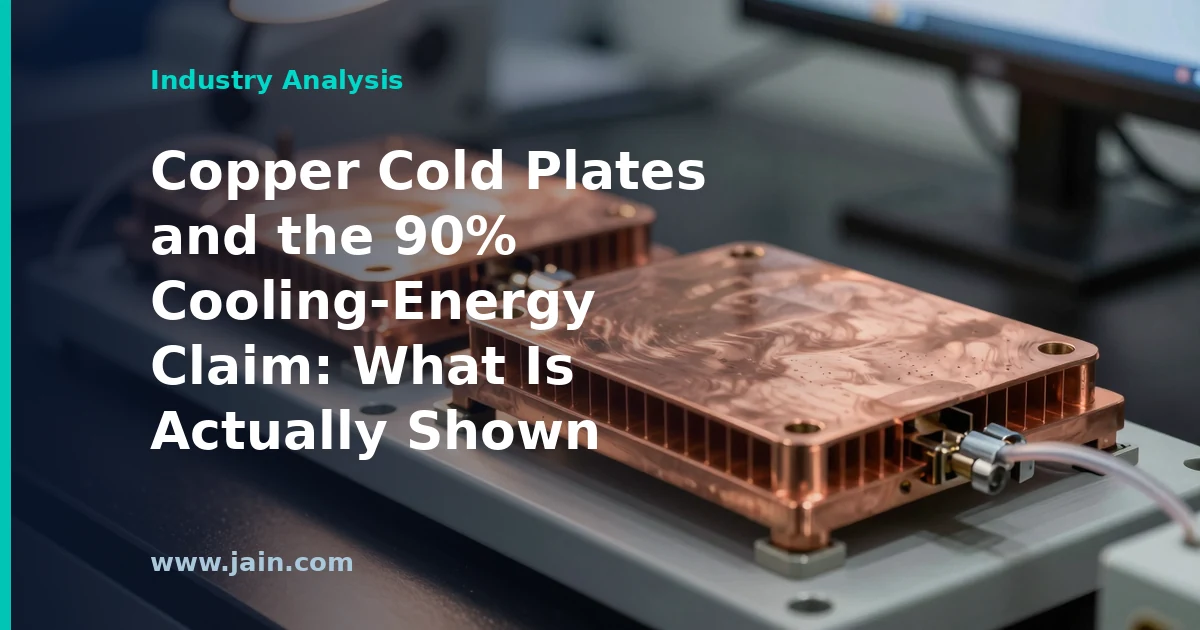
    A report published May 19, 2026 by New Atlas describes a copper cold-plate cooling design that, its developers say, could slash data-center cooling energy use by as much as 90%. Cold plates are metal blocks that sit directly on hot chips and carry heat away in circulating liquid, and they are already the workhorse of liquid cooling for AI servers.

    The syndicated listing carries the headline claim but few technical specifics, so the central question for operators is what baseline the 90% figure is measured against and how far the design is from production racks.

    Executive Summary

    The announcement lands in the middle of the data-center industry’s most pressing operational problem: heat. As AI accelerators push individual chips past the point where moving air can cool them, operators are converting to direct liquid cooling, in which coolant is piped to a copper plate mounted on each processor. Cooling can consume a substantial share of a facility’s total power, so a design that meaningfully cuts that overhead would translate directly into more of a site’s grid connection being available for compute — the scarcest resource in the industry right now.

    That is why a 90% reduction claim deserves attention, and also why it deserves scrutiny. Laboratory cooling advances routinely post dramatic percentage improvements against narrow baselines — often legacy air cooling rather than the modern liquid systems they would actually compete with. The report as syndicated does not settle which comparison is being made, what workloads were tested, or what the path to manufacturing looks like.

    Our read: the direction of the work is squarely aligned with where the industry is going, but the headline number should be treated as a research claim pending the details — test conditions, baseline, and durability data — that determine whether it survives contact with a production rack.

    Why Cooling Energy Is the Prize

    Every watt a data center spends on cooling is a watt it cannot sell as compute. The industry measures this with PUE (power usage effectiveness), the ratio of total facility power to IT power; cooling is typically the largest contributor to the overhead above 1.0. With utilities quoting multi-year waits for large new grid connections, reducing cooling energy is one of the few ways an operator can add sellable capacity inside an existing power envelope.

    AI has sharpened the problem. Modern accelerators dissipate far more heat per chip than the servers most air-cooled facilities were designed around, and rack densities have climbed to the point where liquid cooling is no longer optional for leading-edge deployments. Any credible improvement in how efficiently heat moves from silicon to the outside world therefore has a direct, monetizable value — which is exactly why cooling claims also attract inflated framing.

    What a Cold Plate Does, and Where 90% Could Come From

    A cold plate is conceptually simple: a copper block with internal channels, clamped to a chip, with liquid flowing through it. Copper is used because it conducts heat exceptionally well. The engineering is in the internal geometry — how the channels are shaped determines how much heat the plate extracts per unit of coolant flow, and how much pumping energy is needed to push liquid through it.

    Large system-level energy savings in cooling generally come from one of a few places: extracting heat more effectively so pumps and fans work less; running coolant at warmer temperatures so facilities need little or no energy-hungry mechanical chilling; or exploiting phase change, where evaporating liquid absorbs far more heat than warming it does. The report does not specify which mechanisms this design relies on, and the answer matters — a plate that enables warm-water operation saves energy at the facility level, while one that merely improves plate-level performance saves much less in practice.

    The Baseline Question

    The most important unstated detail is what the 90% figure is measured against. Compared with a legacy air-cooled facility using mechanical chillers, a well-executed modern liquid-cooling system can already cut cooling energy dramatically — so a new design showing 90% savings against air cooling would be roughly matching the state of the art, not leapfrogging it. A 90% saving against current cold-plate systems would be a genuinely major result, but a far more demanding claim requiring correspondingly strong evidence.

    This is not a criticism unique to this announcement; it is the standard failure mode of cooling-technology communication. Percentage claims are only as meaningful as their denominators, and syndicated coverage frequently drops the denominator. Buyers evaluating any such technology should ask for the comparison system, the coolant supply temperature, the heat load tested, and the pumping power included in the accounting.

    From Lab Bench to Production Rack

    Even a validated design faces a long road to deployment. Cold plates must be manufactured at volume and consistent quality, qualified against leaks over multi-year lifetimes, integrated with server vendors’ thermal designs, and supported by the manifolds, coolant-distribution units, and facility water loops that make up a complete cooling chain. Hyperscale operators typically require extended reliability testing before new thermal hardware touches revenue-generating silicon.

    The realistic near-term significance of research like this is therefore directional: it signals continued headroom in cold-plate engineering at exactly the moment the market is standardizing on the technology. Incumbent cooling suppliers, server OEMs, and chipmakers all have active cold-plate programs, so novel designs tend to reach the market through licensing or acquisition rather than as standalone products. For operators, the practical takeaway is that cooling efficiency is still improving quickly enough to factor into facility designs with multi-decade lifetimes.

    Background

    Data-center cooling has moved through distinct eras: raised-floor air cooling with room-scale chillers, then contained hot/cold aisles and free-air economization, and now direct liquid cooling as AI chips exceed what air can handle. Cold plates — liquid-cooled copper blocks on each processor — have shifted in just a few years from a niche high-performance-computing technique to the default for new AI capacity, alongside alternatives such as immersion cooling, which submerges entire servers in dielectric fluid.

    Because cooling is the largest controllable overhead in facility power, and because grid capacity has become the binding constraint on data-center growth, cooling-efficiency research now attracts intense industry and investor attention — along with a steady stream of dramatic percentage claims that reward careful reading of their baselines.

    Source: Cooling copper plates could slash data center energy use by 90% — New Atlas, a May 19, 2026 report on a copper cold-plate design claimed to sharply reduce data-center cooling energy.
  • EIA: Data Center Server Energy Use Grows Across US Commercial Buildings

    EIA: Data Center Server Energy Use Grows Across US Commercial Buildings

    On May 19, 2026, the U.S. Energy Information Administration (EIA) — the federal government’s independent energy statistics agency — published new commercial-buildings data showing that energy consumed by data center servers is growing across the nationwide commercial building stock. The finding lands in the middle of an intense public debate over how much electricity the AI build-out actually consumes.

    The release matters less for any single number than for its source: this is federal survey data, not a vendor forecast, quantifying how server energy use has expanded within America’s offices, dedicated data centers, and the server rooms tucked inside ordinary commercial buildings.

    Executive Summary

    EIA’s announcement extends its commercial-buildings statistical program — best known through the Commercial Buildings Energy Consumption Survey (CBECS), the government’s long-running census-style study of how U.S. commercial buildings use energy — to document rising server energy consumption across the building stock. In plain terms: the computers doing the computing inside commercial buildings are drawing a growing share of those buildings’ electricity.

    Why it matters: nearly every claim about the ‘AI power crunch’ to date has rested on private-sector estimates from consultancies, utilities, and technology vendors, each with its own methodology and, in some cases, its own commercial interest in the answer. A federal statistical agency measuring the same trend from building-level survey data gives regulators, utilities, and investors a common, disinterested baseline — the kind of number that ends up cited in rate cases, siting decisions, and congressional testimony.

    For infrastructure operators, the direction of the data is unsurprising. The significance is that the growth is now visible across the commercial building stock — not only in purpose-built hyperscale campuses, but in the broader population of buildings that house servers.

    Federal Numbers Change the Power Debate

    Until now, the data center energy conversation has been dominated by projections — analyst decks, utility interconnection queues, and corporate sustainability reports. Projections are arguments; survey data is evidence. EIA’s commercial-buildings program measures what buildings actually consumed, which makes it the closest thing the industry has to a scoreboard. When a .gov dataset says server energy use is growing across the building stock, it becomes much harder for any side of the debate — boosters or critics — to dismiss the trend as hype or alarmism.

    That cuts both ways. Utilities seeking rate recovery for grid upgrades, developers seeking permits, and efficiency advocates seeking standards will all now cite the same federal source. Expect this data to surface in state utility commission filings and local zoning fights, where the credibility of the underlying numbers is often the whole battle.

    The Hidden Data Center Problem

    The phrase ‘commercial building stock’ is doing important work in EIA’s framing. Public attention fixates on gigawatt-scale AI campuses, but a substantial slice of America’s server fleet has historically lived in less visible places: server rooms in office buildings, hospital basements, university closets, and small enterprise data centers. These embedded loads are dispersed, often inefficient, and poorly captured by headline hyperscale statistics.

    Growth measured across the whole stock suggests the compute boom is not just a story of a few hundred giant facilities — it is diffused through the built environment. For the efficiency industry, that is a market signal: dispersed, aging server rooms are prime candidates for consolidation into professionally run colocation facilities, which typically achieve far better power usage effectiveness (PUE — the ratio of total facility power to the power that actually reaches computing equipment).

    Winners, Losers, and the Grid in Between

    The beneficiaries of officially documented demand growth are the companies positioned to serve it: colocation and cloud operators with contracted power in hand, transmission developers, and equipment suppliers across the cooling and electrical chain. Utilities gain justification for capital programs, though they also inherit the political risk of rising rates being blamed on data centers.

    The exposed parties are energy buyers competing for the same electrons — manufacturers, electrified transport, and ordinary ratepayers — and any data center developer whose business case assumes cheap, quickly available power. Federal confirmation of demand growth strengthens the hand of grid planners who argue for building ahead of load, but it equally strengthens critics who ask whether that growth should pay its own way. The honest reading of EIA’s data is that it quantifies the trend without settling the policy argument.

    Background

    EIA has surveyed U.S. commercial buildings for decades through CBECS, producing the government’s authoritative picture of how offices, schools, hospitals, and other non-residential buildings consume energy. Data centers historically registered as a small but disproportionately energy-intensive slice of that stock — buildings that consume many times more electricity per square foot than a typical office.

    The context shifted sharply after 2023, when large-scale AI training and inference drove a wave of data center construction and record utility interconnection requests, making data center electricity demand a national policy issue. Against that backdrop, federal measurement of server energy use across the building stock arrives as a reference point both industry and its critics have lacked.

    Source: Data center server energy use grows across the commercial building stock — U.S. Energy Information Administration announcement of new commercial-buildings energy data, published May 19, 2026.

  • ABB Takes UPS to 34.5kV to Cut AI Data Center Losses

    ABB Takes UPS to 34.5kV to Cut AI Data Center Losses

    ABB has introduced a 34.5kV version of its HiPerGuard medium-voltage uninterruptible power supply, announced on 22 April 2026. The company positions the product as connecting directly to a medium-voltage grid feed, eliminating conversion steps between the utility connection and the data center’s power train, and says the result is lower power costs for AI data centers.

    At 34.5kV, the unit sits at the top of the medium-voltage distribution class commonly used by North American utilities. The announcement is a product-capability disclosure rather than a customer deployment: the material published alongside the headline does not name sites, buyers, delivery dates or measured efficiency gains.

    Executive Summary

    An uninterruptible power supply is the equipment that keeps a data center’s servers running through a grid disturbance, bridging the seconds or minutes until generators take over. Conventionally, that equipment lives at low voltage — typically a few hundred volts — which means utility power arriving at medium voltage must first be stepped down through transformers, then protected, then distributed. Every one of those stages costs a percentage of the power passing through it, and each percentage becomes heat that must itself be cooled.

    ABB’s claim with the 34.5kV HiPerGuard is that the UPS can sit further upstream, taking the medium-voltage feed directly and removing conversion stages from the chain. The commercial argument is straightforward: fewer stages mean fewer losses, less transformer and switchgear capacity to buy, and less floor space consumed by electrical rooms that could otherwise hold revenue-generating IT equipment.

    The timing matters more than the voltage number. AI training and inference racks have moved from tens of kilowatts to the hundreds, with megawatt-scale racks on vendor roadmaps. At those densities the electrical distribution system, not the building shell, becomes the constraint. Medium-voltage UPS is one of several architectural responses to that constraint — and this announcement is a claim about a direction of travel that the released material does not yet quantify.

    Voltage Is the New Density Lever

    Power density in data centers has historically been solved by moving air and water more cleverly. That era is ending. When a single rack draws hundreds of kilowatts, the limiting factor shifts to how much current the distribution system can carry without unmanageable conductor sizes, losses and fault energy. Physics is unhelpful here: for a given amount of power, halving current requires doubling voltage, and copper cost and resistive loss scale with current, not with power.

    Raising the voltage at which protected power is handled is therefore one of the few structural levers available. Doing it at the UPS means the medium-voltage feed can travel deeper into the facility before being stepped down close to the load, shortening the low-voltage runs that dominate conductor spend. It also compresses the equipment chain: each transformation stage carries its own footprint, maintenance regime, failure modes and efficiency penalty. Removing stages removes all four at once.

    The counterpoint worth stating plainly is that this is a re-architecture, not a component swap. Medium-voltage equipment brings different clearance requirements, different arc-flash considerations, different qualification standards for the technicians who work on it, and a smaller pool of contractors able to commission it. Operators who adopt it are trading one set of engineering problems for another, and the trade only pays at scale.

    Where the Savings Actually Come From

    The headline frames the benefit as lower power costs. In a data center’s cost structure, electrical losses are compounded rather than linear: a watt lost in a transformer or rectifier is a watt bought from the utility and also a watt of heat that the cooling plant must remove, at further energy cost. Small efficiency percentages at the front of the power chain therefore multiply through the operating budget over a facility life measured in decades.

    The capital side may matter as much. Eliminating conversion stages means fewer step-down transformers, less associated switchgear, and less electrical room area — space that, in a market where construction timelines and grid connections are the binding constraints, converts directly into deployable IT capacity per site. For operators who cannot get more megawatts from their utility, extracting more usable compute from the megawatts already contracted is the highest-value optimization available.

    None of that is quantified in the material accompanying this announcement. There is no published efficiency figure, no comparison baseline, no total-cost-of-ownership model and no pricing. The mechanism ABB describes is sound engineering and widely understood in the industry; the specific magnitude of the benefit is, on the evidence released so far, an assertion rather than a demonstrated result. Buyers should treat it accordingly and ask for the numbers.

    A Crowded Answer to a Real Problem

    ABB is not alone in reading the AI power problem this way. Medium-voltage UPS lines, solid-state transformer research, and the broader industry push toward higher-voltage direct-current distribution inside the rack are all attacking the same bottleneck from different points in the chain. Chip and system vendors have been pushing rack-level power architectures upward in voltage for similar reasons. These approaches are complementary rather than mutually exclusive — a facility could plausibly take medium voltage deep into the hall and then distribute at high-voltage DC to the racks.

    The likely winners are hyperscale and large colocation operators building new capacity, where greenfield design allows the electrical architecture to be chosen rather than retrofitted, and where volume justifies training staff on medium-voltage practice. The likely losers are smaller enterprise sites and retrofit projects, which carry the complexity without the scale to amortize it. For ABB, the strategic value is defending a position in the electrification supply chain against competitors selling into the same buildings.

    The risk to watch is supply chain rather than technology. Medium-voltage switchgear, transformers and related equipment have been in constrained supply across the electrical industry, with lead times that already shape data center schedules. A product that reduces the count of such components could ease that pressure; one that simply relocates demand to a differently scarce component would not. The announcement does not address lead times or manufacturing capacity.

    Background

    ABB is a long-established electrification and automation supplier whose portfolio spans switchgear, transformers, drives and power protection. Its HiPerGuard line is a medium-voltage UPS family aimed at large industrial and data center loads, positioned against the conventional approach of stepping utility power down to low voltage before it reaches protection equipment.

    The market context is the rapid escalation of data center power requirements driven by AI workloads. As rack densities climb, operators face constrained utility connections, long grid interconnection queues and shortages of electrical equipment. That has pushed power architecture — historically a settled part of data center design — back into active competition among vendors, with voltage levels, conversion topologies and distribution schemes all under reconsideration.

    Source: New 34.5kV HiPerGuard UPS: direct grid connection cuts AI data center power costs – ABB — ABB’s 22 April 2026 announcement of a 34.5kV medium-voltage UPS positioned to remove conversion stages between the grid and AI data center loads.