Tag: energy efficiency

  • LONGWELL’s FanWall Claim: 38% Less CRAH Fan Energy

    LONGWELL’s FanWall Claim: 38% Less CRAH Fan Energy

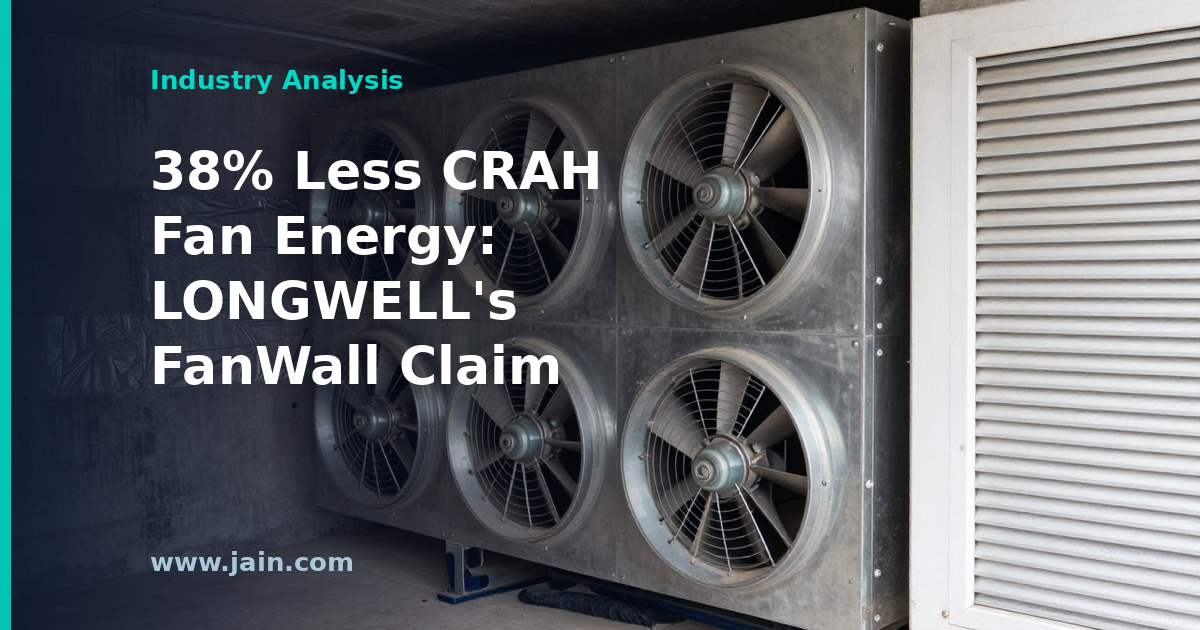
    Ningbo Longwell Electric Technology Co., Ltd. (LONGWELL), a Chinese fan and motor manufacturer founded in 1990, announced on 31 August 2026 an AI-era data center cooling line built around its LWBE3G EC plug-fan platform. Deployed as a FanWall array — a bank of smaller fans replacing one large fan — the company reports a 38% reduction in CRAH fan energy consumption, a 6.5 dB(A) noise reduction, and no field failures on the project cited.

    The work was done with what LONGWELL describes as one of the world’s top three precision-cooling OEMs, which it does not name. LONGWELL says it delivered 12 engineering samples in 35 days, passed DV/PV testing 100% on the first attempt, and went from specification validation to mass production in 90 days. The first customer order was 1,500 units; 2025 deliveries exceeded 80,000 units under a 2025–2027 framework agreement with a stated annual minimum of 60,000 units.

    Executive Summary

    The headline number is a 38% cut in the electricity drawn by the fans inside CRAH units — the computer-room air handlers that push cold air through a data hall. LONGWELL also reports that the CRAH system’s contribution to the facility energy-efficiency metric improved from a 1.42 baseline to 1.28 on the project in question. Fan power is one of the largest non-IT loads in an air-cooled hall, so a double-digit percentage cut there is economically meaningful even though it changes nothing about the servers themselves.

    The second, arguably more consequential claim is about speed. LONGWELL states that the incumbent European supplier on the same program had scheduled 14 months of development plus six months of production ramp, while LONGWELL completed spec-validation-to-mass-production in 90 days. If that comparison holds up, it says something about how quickly the precision-cooling supply chain can be re-sourced when AI buildouts compress every schedule — and about competitive pressure on established European fan vendors.

    The context is thermal density. LONGWELL cites rack loads moving from 15–20 kW to 60–100 kW in two years, with next-generation platforms exceeding 100 kW. That trajectory is usually cited as the argument for liquid cooling. This announcement makes the opposite-facing point: the air side of the plant still exists, still consumes power, and still has efficiency headroom that operators can capture without re-plumbing a building.

    Fan Power Is the Quiet Line Item in Data Center Energy

    In an air-cooled data hall, electricity splits between the IT equipment and everything that supports it: chillers, pumps, power conversion losses, and air movement. The air-movement share is easy to overlook because no single fan looks expensive, but CRAH fans run continuously, at every hour of every day, for the life of the facility. That duty cycle is what turns a percentage into money. A 38% reduction on a load that never switches off compounds differently from a 38% reduction on something that runs during business hours.

    The physics behind FanWall designs is not exotic and is worth stating plainly for non-specialists: fan power rises steeply with speed, so several smaller fans each running slower can move the same air volume for less power than one large fan running hard. EC — electronically commutated — motors, which use electronic control rather than mechanical brushes, make that easier by allowing precise, continuous speed modulation instead of on-off cycling. The array also degrades gracefully; LONGWELL cites automatic N+1 failover, meaning the array carries a spare fan’s worth of capacity so a single failure does not force a shutdown.

    None of that is unique to LONGWELL. FanWall architectures and EC motors are established practice across precision cooling, which is precisely why the interesting question in this release is not whether the approach works but what specifically LONGWELL’s platform was replacing, and at what operating point. The release’s own footnote says the comparative energy data refer to the equipment displaced on that project.

    Ninety Days Versus Twenty Months: The Real Competitive Story

    Component qualification is normally the slowest, least glamorous part of building cooling equipment. An OEM cannot simply swap a fan; it must re-run design verification and production validation testing, requalify acoustics and vibration, and re-certify the assembled unit. That is why the incumbent’s quoted 14-month development plus six-month ramp is not obviously unreasonable — it is roughly the industry’s normal cadence. LONGWELL’s claim is that it collapsed the same sequence to 90 days, with 12 engineering samples inside 35 days and a first-pass DV/PV result.

    For buyers, first-pass DV/PV is the detail worth noticing. Test cycles fail routinely, and each failure costs weeks. A supplier that passes on the first attempt is signalling that its engineering samples already matched the specification, which is a manufacturing-maturity claim as much as a design one. For the precision-cooling OEMs racing to fill AI-driven order books, a supplier who can compress twenty months into three is solving a scheduling problem, not just a component-cost problem.

    The competitive read is straightforward and should be stated without overreach: European fan suppliers have long held strong positions in HVAC and data center air movement on the strength of engineering depth and long qualification relationships. Speed of response is now being priced alongside that. The release does not claim the incumbent’s product was technically inferior — only that its timeline was longer on this program — and it explicitly disclaims any affiliation or endorsement.

    What the 38% Establishes, and What It Does Not

    LONGWELL is unusually candid in its own disclaimer: the performance data correspond to a specific project and a specific operating point, and final selection must be confirmed against operating point, voltage and control scheme, mounting arrangement, and project validation. That caveat is doing real work. Fan performance is highly sensitive to the pressure the fan works against, and a figure measured in one CRAH cabinet at one airflow does not transfer automatically to another.

    The 1.42-to-1.28 figure deserves particular care. Those numbers are in the numerical range of PUE — power usage effectiveness, the ratio of total facility power to IT power, where 1.0 is theoretically perfect — but the release describes this as the CRAH system’s contribution to the efficiency metric on this project, not a whole-facility PUE for a named site. Read as a subsystem-level improvement it is a coherent result; read as a facility PUE it would be a much larger claim than the release supports. The distinction matters for anyone modelling savings.

    The commercial figures are the most independently checkable part of the announcement, in the sense that they describe behaviour rather than test conditions. A first order of 1,500 units expanding to more than 80,000 units delivered in 2025, under a 2025–2027 framework with a 60,000-unit annual minimum, is a customer voting with volume. It is not third-party verification of 38%, but repeat purchasing at that scale is a stronger signal than a datasheet.

    Air Cooling Does Not Disappear Because Liquid Arrives

    The prevailing narrative says racks above roughly 60–100 kW must go to liquid cooling, and for the densest AI training clusters that is broadly where the industry is heading. But the transition is neither instant nor total. Direct-to-chip liquid cooling typically removes most, not all, of a rack’s heat; the remainder still leaves via air. Storage, networking, and general-purpose compute remain air-cooled. Retrofit halls with existing CRAH fleets will keep running for years on depreciation schedules that do not care about GPU roadmaps. Condensers and cooling towers — LONGWELL’s LWAE3G axial fan line targets these — are needed in liquid-cooled plants too.

    That is the strongest version of this announcement’s editorial premise: air-side efficiency has remaining headroom precisely because it is being treated as legacy. Capital and attention are flowing toward liquid, which leaves ordinary optimisation of the air path comparatively under-exploited. Operators who cannot re-plumb a building this year can still change fans.

    The counter-risk for a supplier in this position is that it is selling into a segment whose long-run share of new-build capacity may shrink even as its absolute installed base stays large. LONGWELL’s stated data center fan capacity of more than 120,000 units annually against a 60,000-unit contractual minimum suggests it has built for growth beyond this one customer; whether that growth comes from new AI halls, retrofits of existing ones, or the condenser and cooling-tower side of liquid-cooled plants is not something the release addresses.

    Background

    Precision cooling — the equipment class covering CRAC and CRAH units that hold data halls at controlled temperature and humidity — has historically been dominated by a small group of global OEMs, which in turn buy fans and motors from a specialist supply chain long anchored by European manufacturers. Fans are qualified rather than simply purchased: each one must pass verification testing inside the OEM’s cabinet, so incumbency has been durable and switching slow.

    The AI compute buildout has strained that arrangement. As per-rack heat loads climbed from the 15–20 kW typical of general-purpose servers toward 60–100 kW and beyond for accelerated computing, OEMs have needed higher-performance air movement on schedules far shorter than the industry’s traditional multi-year qualification cadence. LONGWELL, a Ningbo-area manufacturer founded in 1990 and long active in HVAC-R and industrial fans, is one of several Asian suppliers positioning against that compressed timeline — an announcement that is as much about procurement velocity as about thermodynamics.

    Source: La technologie FanWall de LONGWELL EC permet de réduire de 38 % la consommation énergétique des ventilateurs CRAH des centres de données IA de nouvelle génération — PR Newswire release, dated 31 August 2026 from Ningbo, China, detailing LONGWELL’s LWBE3G EC plug-fan platform, its reported CRAH fan energy and acoustic results, and the volumes shipped under a 2025–2027 framework agreement.

  • MHI Reports Field-Verified Efficiency Gains From AI Cooling Optimization

    MHI Reports Field-Verified Efficiency Gains From AI Cooling Optimization

    Mitsubishi Heavy Industries (MHI) announced on July 9, 2026 that it has demonstrated energy-efficiency improvements through cooling optimization in an operational data center. Rather than a lab simulation or a controlled test bed, the demonstration ran in a live facility — the setting where cooling systems must respond to real, fluctuating IT loads.

    Executive Summary

    MHI, the Japanese heavy-industry group whose portfolio spans power generation, HVAC and thermal systems, says it has shown measurable energy-efficiency improvements by optimizing cooling in a data center that was actively serving production workloads. The approach centers on smarter control of cooling equipment — adjusting how chillers, air handlers and airflow respond to actual conditions rather than running at conservative fixed settings.

    The announcement matters for a simple reason: cooling is one of the largest non-IT consumers of electricity in a data center, and it is one of the few places where efficiency gains can be captured without touching the servers themselves. With AI workloads pushing rack power densities sharply higher, operators are looking hard at control-layer optimization as a way to cut operating costs and free up power capacity. A field demonstration in a live facility — as opposed to vendor modeling — is the kind of evidence buyers increasingly demand, though the syndicated version of this release does not carry the underlying figures, which readers should verify against MHI’s full publication.

    Why a Live-Facility Demonstration Matters

    Cooling-optimization claims are easy to make in simulation and hard to prove in production. A real data center has messy thermal behavior: IT load rises and falls with customer demand, outside temperatures swing by season and hour, and no operator will tolerate a control experiment that risks overheating servers. Demonstrating gains in an operational facility means the system had to deliver savings while respecting those constraints — which is why field verification is the credibility bar for this product category.

    That said, a single-site demonstration is evidence, not proof of general applicability. Results depend heavily on the baseline: a facility with poorly tuned cooling will show dramatic improvement from almost any optimization, while a well-run site will show far less. The commercial question is not whether MHI improved one building, but how transferable the method is across climates, cooling architectures and load profiles — something only multi-site data can answer.

    Cooling Is the Biggest Efficiency Lever Left

    In most data centers, cooling is the largest energy consumer after the IT equipment itself, which is why the industry’s standard efficiency metric — PUE, or power usage effectiveness, the ratio of total facility power to IT power — is largely a measure of cooling overhead. Servers get more efficient with every silicon generation, but the facility side improves only when operators invest in it. Control-layer optimization is attractive because it can often be applied to existing equipment: the chillers stay, the software running them gets smarter.

    The economics have sharpened as AI infrastructure scales. Grid connections are constrained in many markets, so every kilowatt not spent on cooling is a kilowatt available for revenue-generating compute. For operators facing multi-year waits for new power capacity, efficiency gains at the cooling layer function as found capacity — frequently at a fraction of the cost of new construction.

    MHI Enters a Crowding Field

    MHI is not alone here. AI-assisted cooling control has been pursued by hyperscalers internally and by facility-equipment and building-management vendors for several years, and the space now includes established cooling manufacturers, controls specialists and software startups. MHI’s differentiation, if it holds, comes from owning the equipment side: a company that builds chillers and thermal systems can integrate control optimization more deeply than a software-only vendor, and can stand behind the combined result.

    For MHI, the strategic logic is also defensive. As liquid cooling, heat reuse and AI-driven operations reshape data center thermal design, equipment makers that offer only hardware risk being commoditized while the value migrates to the control and services layer. A demonstrated optimization capability positions MHI to sell outcomes — efficiency, capacity headroom — rather than just machines. Whether that translates into a commercial product with published pricing and guarantees is the next thing to watch.

    Background

    Mitsubishi Heavy Industries is a diversified Japanese engineering group whose thermal-systems businesses build chillers, HVAC and industrial cooling equipment — the physical machinery that data center cooling optimization software ultimately controls. Like other established equipment makers, MHI has been extending from hardware into the control and services layer as data center operators demand measurable efficiency outcomes rather than standalone machines.

    The push comes amid a broader industry squeeze: AI-driven demand has data center construction booming while grid power in major markets is scarce, making energy efficiency both a cost issue and a capacity issue. Cooling, as the largest non-IT energy consumer in most facilities, has become the primary battleground, with hyperscalers, controls vendors and equipment manufacturers all pursuing AI-assisted optimization of the thermal plant.

    Source: MHI Demonstrates Energy Efficiency Improvements through Cooling Optimization in Operational Data Center — Mitsubishi Heavy Industries announcement, July 9, 2026, via Google News.

  • China Switches On the First Commercial Underwater Data Center

    China Switches On the First Commercial Underwater Data Center

    China has brought online what is being described as the world’s first commercial underwater data center, according to a report published July 4, 2026 by the Spanish outlet OkDiario. The facility submerges sealed server modules in the ocean and uses the surrounding seawater as its cooling medium, an approach the report says sharply reduces the energy the facility consumes.

    The report frames the launch as a template other coastal regions could adopt, naming Cartagena, Spain as the kind of Mediterranean port city where the model might be replicated. It does not disclose the operator, the facility’s capacity, or its precise location.

    Executive Summary

    The announcement matters because it moves underwater data centers from experiment to product. Submerging servers has been tested before — most famously by Microsoft — but a commercial deployment means paying customers are expected to run real workloads on seabed infrastructure, and that changes the questions from “does it work?” to “does it pencil out?”

    The core appeal is cooling. Keeping servers from overheating is one of the largest energy costs in any data center, and the deep ocean offers a vast, stable heat sink at no mechanical-chilling cost. If seawater cooling delivers the efficiency the concept promises at commercial scale, it would arrive at a moment when AI-driven demand has made power and cooling the industry’s tightest constraints.

    That said, the source report is brief and light on specifics. It attributes no capacity figures, energy metrics, customer names, or operator details. The launch is a genuine milestone in cooling infrastructure if the commercial framing holds — but the evidence available in this report is a claim of a first, not a documented performance record.

    Why Put Servers on the Seabed?

    Data centers spend an enormous share of their electricity not on computing but on removing the heat that computing generates. The industry measures this with PUE — power usage effectiveness, the ratio of total facility power to the power that actually reaches IT equipment. Conventional air-cooled facilities need chillers, fans, and often large volumes of water to hold safe temperatures, and in hot climates that overhead climbs steeply.

    The ocean solves the problem passively. Below the surface, water temperature is low and remarkably stable year-round, and water conducts heat far better than air. A sealed capsule on the seabed can reject heat directly into an effectively unlimited sink, eliminating most mechanical cooling. Subsea deployment also removes evaporative water consumption — a growing point of friction between data centers and the communities that host them — and seabed real estate near dense coastal cities is not competing with housing or industry the way urban land is.

    From Microsoft’s Experiment to Chinese Commercialization

    The concept is not new; the commercial claim is. Microsoft’s Project Natick sank a sealed server vessel off Scotland’s Orkney Islands from 2018 to 2020 and reported that the submerged servers failed at a fraction of the rate of an equivalent land-based control group — likely because the nitrogen-filled, human-free capsule eliminated oxygen corrosion, humidity swings, and accidental knocks. Microsoft judged the experiment a technical success but never turned it into a product. China, meanwhile, has been running underwater data center pilots off its own coast for several years, so a progression from pilot to commercial service there is consistent with the trajectory — even though this report does not name the company involved.

    If the commercial characterization is accurate, China would be first to market with a technology a US hyperscaler proved and shelved. That is a familiar pattern in infrastructure: the economics that don’t fit one company’s portfolio can fit another market’s constraints, particularly where coastal land, grid capacity, and water for cooling are all scarce at once.

    The Hard Economics of Subsea Capacity

    The obstacles are as real as the appeal. A submerged module cannot be serviced by a technician; a failed component stays failed until the entire vessel is raised, which pushes operators toward redundant hardware and infrequent, expensive retrieval cycles. Marine engineering, corrosion-resistant housings, subsea power and fiber connections, and specialized deployment vessels all add capital cost that the cooling savings must repay. Insurance, uptime guarantees, and repair logistics for seabed assets are largely uncharted territory for enterprise customers used to walking their auditors through a facility.

    Environmental questions also need honest accounting. Rejecting heat into the ocean is thermodynamically unavoidable here, and while small-scale trials such as Natick reported minimal localized warming, the effect of dense clusters of commercial modules on marine ecosystems is site-specific and largely unstudied. Coastal permitting regimes — fisheries, shipping lanes, protected habitats — will shape where this model can actually go, and the report offers no detail on how the Chinese deployment cleared those hurdles.

    Could Cartagena Be Next?

    The report’s suggestion that coastal cities like Cartagena could follow is speculation, not an announced project, and it is worth being clear about that distinction. Still, the logic of the shortlist is sound: Mediterranean port cities combine dense populations that want low-latency services, constrained urban land and grids, warm climates that make conventional cooling expensive, and immediate deep water. Those are precisely the conditions under which subsea capacity is most competitive against land-based builds.

    For European adoption, the gating factors would be EU environmental review, marine-spatial-planning approvals, and — not least — the geopolitics of importing a Chinese-proven infrastructure model into European digital sovereignty debates. Any operator pursuing it would more likely license the concept or develop it independently than deploy Chinese-operated modules in EU waters.

    Background

    Underwater data centers trace to Microsoft’s Project Natick, which began with a proof-of-concept in 2015 and culminated in a sealed vessel of several hundred servers operating off Scotland from 2018 to 2020. The retrieved servers had failed at a small fraction of the rate of an identical land-based group, validating the reliability case — but Microsoft ended the program without a commercial product. China picked up the thread with coastal pilot deployments in the years that followed, pursuing subsea capacity as an answer to scarce coastal land, strained grids, and the water consumption of conventional cooling.

    The timing is not incidental. By 2026, explosive AI demand had made electricity and cooling the data center industry’s defining bottlenecks worldwide, pushing operators toward liquid cooling, novel sites, and any design that cuts overhead energy. A commercial subsea launch is China staking a claim to one of those frontiers first.

    Source: China just switched on the first underwater data center, cooling servers with the ocean to slash energy use, and coastal cities like Cartagena could be next — OkDiario report, July 4, 2026, on China’s launch of the first commercial seawater-cooled underwater data center.

  • Aquifer ‘Thermal Batteries’ Could Cut AI Data Center Cooling Energy and Water Use

    Aquifer ‘Thermal Batteries’ Could Cut AI Data Center Cooling Energy and Water Use

    Research publicized June 29, 2026 via Tech Xplore suggests that aquifers — naturally occurring layers of water-bearing rock underground — could serve as ‘thermal batteries’ for data centers, storing heat and cold across seasons. According to the report, the approach may reduce the cooling energy AI data centers consume and cut their water use, two of the industry’s fastest-growing environmental pressure points.

    Executive Summary

    The announcement is a research finding, not a product launch: scientists propose using aquifer thermal energy storage — pumping water underground to bank cold in one season and withdraw it in another — as a way to offset the enormous cooling loads created by AI computing. The headline claim is twofold: lower cooling energy demand and reduced water consumption compared with conventional approaches such as evaporative cooling, which loses large volumes of water to the atmosphere by design.

    Why it matters: cooling is one of the largest non-compute energy costs in a data center, and water use has become a siting and permitting flashpoint in drought-prone regions. AI accelerators run hotter and denser than traditional servers, magnifying both problems. A storage-based approach that shifts cooling work to underground reservoirs — rather than burning electricity on chillers or evaporating potable water in real time — would attack both constraints at once. The open question, which the source headline’s own careful ‘may cut’ phrasing acknowledges, is whether the technique scales from research findings to the round-the-clock, high-density heat loads of production AI facilities.

    Why Cooling Is the Quiet Crisis of the AI Buildout

    Every watt a server consumes becomes heat that must be removed, and AI hardware has pushed rack power densities far beyond what legacy air-cooling systems were built for. Operators today choose among imperfect options: mechanical chillers, which are reliable but electricity-hungry; evaporative cooling, which trades electricity for significant water consumption; and liquid cooling, which moves heat efficiently at the rack but still needs somewhere to reject it. Cooling efficiency is captured in metrics like PUE (power usage effectiveness — total facility power divided by computing power), and shaving it has direct economic value at AI campus scale.

    Water has arguably become the more politically sensitive constraint. Data center water consumption has drawn scrutiny from communities and regulators in water-stressed regions, and several jurisdictions now weigh water impact in permitting decisions. A cooling architecture that credibly reduces both energy and water use addresses the industry’s two most visible externalities simultaneously — which explains why a research result, rather than a commercial deployment, is drawing attention.

    How an Aquifer Becomes a Battery

    Aquifer thermal energy storage, often abbreviated ATES, is conceptually simple: use paired wells to circulate groundwater, storing thermal energy in the aquifer itself. In winter, cheap ambient cold is banked underground; in summer, that stored cold is withdrawn to absorb data center heat, with the warmed water returned to a separate zone of the aquifer for later use or dissipation. The ‘battery’ framing is apt — the aquifer shifts cooling capacity across time, much as an electrical battery shifts energy from cheap hours to expensive ones.

    The underlying technique is not new. ATES has been deployed for decades in district heating and cooling systems, particularly in the Netherlands, where favorable geology and supportive regulation made it routine for buildings. What the new research explores is its application to a much harder customer: data centers, whose heat output is continuous, dense, and growing. Because the water circulates in a closed loop underground rather than evaporating into the air, the approach could sidestep the consumptive water losses that make evaporative cooling controversial.

    Who Wins If It Works — and What Stands in the Way

    The clearest beneficiaries would be operators in regions with suitable aquifer geology and strong seasonal temperature swings, where winter cold can be banked cheaply. Utilities and grid planners would welcome anything that flattens data center cooling load, since peak cooling demand coincides with summer grid stress. Drilling, geothermal, and groundwater engineering firms would gain a new market adjacent to the booming data center construction sector.

    The obstacles are equally concrete. ATES only works where the geology cooperates — the right aquifer depth, permeability, and low natural groundwater flow — which makes it a siting-dependent solution, not a universal one. Groundwater is heavily regulated nearly everywhere, and injecting warmed water underground raises legitimate environmental review questions about thermal plumes and water chemistry. And AI’s heat load is continuous rather than seasonal, so an aquifer system would likely supplement, not replace, conventional cooling. None of these hurdles is disqualifying, but each stands between a promising research finding and a bankable design that a hyperscaler would commit to.

    Background

    Data center cooling has evolved through waves of pressure: from raised-floor air cooling, to hot/cold aisle containment, to economizers and evaporative systems, and most recently to direct liquid cooling as AI accelerators pushed rack densities beyond what air can handle. Each wave traded among the same three currencies — electricity, water, and capital — and the AI buildout has sharpened all three constraints at once, with water use in particular becoming a community and permitting issue in water-stressed markets.

    Aquifer thermal energy storage sits within a broader family of underground thermal techniques, alongside borehole storage and geothermal heat pumps. ATES matured in northern Europe over several decades as a building heating-and-cooling technology; the research reported here represents an attempt to carry that mature concept into the much more demanding environment of AI computing infrastructure.

    Source: Aquifer ‘thermal batteries’ may cut AI data center cooling demand and save water — Tech Xplore report, June 29, 2026, on research into using aquifer thermal energy storage to reduce data center cooling energy and water consumption.

  • Rising Heat and Humidity Are Shrinking the Free-Cooling Window for Data Centers

    Rising Heat and Humidity Are Shrinking the Free-Cooling Window for Data Centers

    Research highlighted by Phys.org on June 26, 2026 warns that rising global temperatures and humidity are undermining one of the data center industry’s most important energy-efficiency strategies: free cooling, the practice of using cool outside air or water to remove server heat instead of running energy-hungry mechanical chillers. As more hours of the year become too hot or too humid for outside air to do the job, facilities worldwide face growing cooling energy demand.

    The finding lands at a sensitive moment. Data center construction is accelerating to serve AI workloads, and cooling is typically the largest energy consumer in a facility after the IT equipment itself — so any climate-driven loss of free-cooling hours compounds an already steep power challenge.

    Executive Summary

    The core claim is straightforward: free cooling only works when the outside environment is cooler and drier than the conditions servers require, and climate change is steadily reducing the number of hours per year when that is true. Heat is only half the story — humidity matters just as much, because evaporative cooling systems, which cool air by evaporating water, lose effectiveness as the air becomes more saturated. Regions that were designed around thousands of free-cooling hours a year are watching that budget shrink.

    Why it matters: efficiency assumptions made at design time are baked into a data center for decades. A facility engineered in a climate that no longer exists will either consume more energy than its models promised, lean harder on water, or require retrofit investment. For an industry under scrutiny over electricity and water consumption, the research reframes climate not as a sustainability talking point but as an engineering input — one that belongs in site selection, cooling-system choice, and capacity planning from day one.

    Free Cooling Was the Industry’s Efficiency Workhorse

    For the past fifteen years, the biggest gains in data center efficiency — reflected in falling PUE, the ratio of total facility power to IT power — came largely from using the outdoors as a heat sink. Air-side economizers pull in filtered outside air; water-side economizers and evaporative systems use cooling towers to shed heat with modest energy input. Hyperscale operators famously sited facilities in cool climates precisely to maximize these hours.

    The research reported by Phys.org attacks the durability of that playbook. If the number of hours cool and dry enough for economization declines, chillers run more, and the efficiency gap between a well-sited facility and a poorly sited one narrows in the wrong direction. The gains of the last decade were real, but they were partly a loan from a stable climate — and the terms of that loan are changing.

    Humidity Is the Underappreciated Variable

    Public discussion of data center cooling fixates on temperature, but wet-bulb temperature — a combined measure of heat and humidity that sets the floor for evaporative cooling — is the more binding constraint. When wet-bulb temperatures rise, evaporative systems must work harder and consume more water for less cooling effect, and in extreme conditions they cannot reach the setpoints servers need at all. That pushes operators back toward mechanical refrigeration exactly when grid demand for air conditioning also peaks.

    This has a second-order consequence: the trade-off between energy and water gets sharper. Evaporative cooling saves electricity but consumes water; dry coolers and chillers save water but consume electricity. Rising humidity degrades the attractiveness of the water-based option in many regions, forcing a choice between two increasingly expensive resources — often in communities already contesting data center water use.

    Winners: Liquid Cooling, Cool Geographies, and Honest Modeling

    If outside air can carry less of the load, the premium shifts to technologies that tolerate warmer heat rejection. Direct-to-chip liquid cooling and immersion cooling move heat in water or fluid rather than air, allowing higher operating temperatures and, in many designs, year-round heat rejection without compressors even in warm climates. The AI build-out was already pushing the industry toward liquid cooling for density reasons; climate trends add an efficiency rationale.

    Geography gains value too. Sites in cool, dry, or high-latitude regions — the Nordics, parts of Canada, high-altitude locations — become relatively more attractive, though they bring their own constraints in connectivity, latency, and power availability. And engineering firms that model cooling against forward-looking climate projections rather than historical weather files gain a real advantage: a 25-year asset should be designed for the climate of 2040, not 2010.

    Risks: Stranded Efficiency and Rising Operating Costs

    The losers in this shift are facilities whose economics depend on free-cooling assumptions that no longer hold — particularly older air-cooled sites in regions warming fastest. Their operating costs drift upward without any change in workload, and their sustainability reporting deteriorates through no operational fault. For colocation providers, whose customers increasingly scrutinize PUE and water metrics in procurement, that drift is a competitive problem, not just an engineering one.

    There is also a grid-level risk. The hours when data centers lose free cooling are the same hot hours when regional grids are most stressed. Climate-driven cooling demand is therefore correlated demand — it arrives when power is scarcest and most carbon-intensive, which is precisely the scenario utilities and regulators planning for data center growth need to model.

    Background

    Data center cooling has evolved through distinct eras. Early facilities ran cold and relied almost entirely on mechanical chillers. From roughly 2010 onward, hyperscale operators drove a revolution in economization — siting in cool climates, using outside air and evaporative systems, and widening acceptable server temperature ranges — which pushed the best facilities’ PUE from around 2.0 toward 1.1. That efficiency story became central to the industry’s answer to critics of its energy footprint.

    The current AI build-out is testing every part of that model: rack power densities have jumped severalfold, cooling loads are climbing, and communities are scrutinizing both electricity and water consumption. Research showing that climate change is eroding free cooling adds a structural pressure on top of a cyclical boom — and helps explain the industry’s accelerating shift toward liquid cooling and climate-aware site selection.

    Source: Rising heat and humidity challenge energy-efficient data center cooling worldwide — Phys.org report, June 26, 2026, on research into climate-driven erosion of data center free-cooling potential.

  • Nvidia’s Hot-Water Cooling Claims Up to 100% Water-Use Reduction for AI Data Centers

    Nvidia’s Hot-Water Cooling Claims Up to 100% Water-Use Reduction for AI Data Centers

    Nvidia has announced a liquid cooling system for AI data centers that circulates water described as running “hotter than a hot tub,” a design the company says can reduce electricity consumption and cut water use by up to 100%. The announcement, reported June 24, 2026 by Tom’s Hardware, targets one of the AI build-out’s most scrutinized side effects: the enormous water and energy appetite of the facilities that host Nvidia’s chips. The same report notes that sustainability challenges remain despite the headline claims.

    Executive Summary

    Nvidia, the dominant supplier of AI accelerators, is moving further down the stack — from chips and rack-scale systems into the cooling infrastructure that keeps them running. The newly announced system uses hot-water liquid cooling: instead of chilling coolant to low temperatures before it reaches the hardware, the loop runs deliberately warm, hotter than the roughly 40°C (104°F) at which a typical hot tub is kept, which is the comparison Nvidia’s framing invites.

    Why does that matter? Warmer coolant is the key that unlocks both of the claimed benefits. If the water returning from the chips is already hot, a facility can often reject that heat to the outside air with simple dry coolers rather than energy-hungry chillers — cutting electricity — and without evaporative cooling towers, which consume water by design. That is the engineering logic behind the “up to 100%” water-reduction figure. The claim is significant if it holds up at scale, but as reported it is a vendor claim with important qualifiers, and the source coverage itself flags that sustainability challenges remain.

    Water Is Becoming AI’s Second Resource Fight

    Electricity has dominated the AI infrastructure debate, but water is close behind. Many conventional data centers cool themselves with evaporative systems: they literally evaporate water to carry heat away, because evaporation is cheap and effective. As hyperscale and AI campuses have multiplied, their water draw has become a flashpoint in drought-prone regions and a recurring obstacle in permitting and community relations.

    Nvidia has a direct commercial stake in defusing that fight. Its rack-scale AI systems concentrate so much heat that air cooling is no longer practical, which already pushed the industry toward liquid cooling. If the company can also credibly claim its reference designs eliminate on-site cooling water, it removes an objection that slows down the very data center projects that buy its chips. In that sense this is as much a market-access play as an engineering one.

    The Counterintuitive Physics of Cooling with Hot Water

    “Hot-water cooling” sounds like a contradiction, but it rests on straightforward thermodynamics. A chip does not need cold coolant; it needs coolant that is cooler than the chip and flowing fast enough to carry heat away. Liquid is far denser than air as a heat-transfer medium, so even warm water can hold chip temperatures within limits.

    The payoff comes at the other end of the loop. Cold-water systems need chillers — essentially industrial refrigerators — whose compressors are among the largest energy consumers in a data center. Evaporative towers avoid some of that electricity but spend water instead. A loop that returns water hotter than the outdoor air can shed its heat through dry coolers, closed radiators that use neither compressors nor evaporation. That is the mechanism behind both claims in the announcement: less electricity because chillers shrink or disappear, and less water because nothing is evaporated. Hotter return water is also more useful for heat reuse, such as district heating, though the reporting here does not say whether Nvidia is claiming that benefit.

    Reading the “Up to 100%” Claim Carefully

    “Up to 100%” is a ceiling, not a promise. Real-world results will depend on climate — dry cooling gets harder on very hot days, when some designs fall back on water assist — as well as on facility design and how much of a site’s load actually sits on the new system. The reported claim does not, on its face, distinguish between a best-case new build in a favorable climate and a typical deployment.

    There is also a boundary question. Eliminating on-site cooling water does not eliminate a data center’s water footprint, because the power plants that generate its electricity often consume water themselves. Reduced electricity consumption helps on that front too, but “water-free” at the fence line is not the same as water-free end to end. The source’s own caveat — that sustainability challenges remain — is best read in this light: the announcement addresses a real problem without dissolving it.

    Who Feels This Announcement

    Cooling incumbents and the liquid-cooling supply chain feel it first. When the dominant chip vendor blesses a particular thermal architecture, it tends to become the default for new AI capacity, shaping demand for cold plates, coolant distribution units, and dry coolers, and putting pressure on vendors invested in evaporative or chilled-water designs. Operators, meanwhile, gain a potential permitting and siting advantage: a campus that can credibly promise near-zero cooling-water draw is an easier sell to water-stressed municipalities.

    The open competitive question is whether this arrives as an open reference design others can build on or as another layer of the Nvidia-specified stack. The reporting available here does not say. Either way, buyers should expect warm-water readiness — higher allowable coolant temperatures across IT hardware — to show up in procurement requirements, because the economics above only materialize if the whole rack tolerates the heat.

    Background

    Nvidia is the world’s leading supplier of the GPUs (graphics processing units) that train and run modern AI models, and its data center business has grown into one of the largest in the technology industry. As its systems evolved from individual chips into full pre-integrated racks drawing unprecedented power, the company has taken an increasingly active role in specifying the surrounding infrastructure — power delivery and cooling included — because its hardware roadmap now depends on facilities that can handle the heat.

    Data center cooling has historically split between air cooling, chilled-water systems, and evaporative designs that trade water for electricity. AI’s density has pushed the industry rapidly toward direct liquid cooling, and water consumption has become a headline issue in siting battles. Warm-water liquid cooling — long used in some high-performance computing installations — is the established engineering idea this announcement scales up and brands for the AI era.

    Source: Nvidia announces liquid cooling system that runs ‘hotter than a hot tub’ — promises to reduce electricity consumption and cut water use by up to 100%, but sustainability challenges remain — Tom’s Hardware coverage, June 24, 2026, of Nvidia’s hot-water liquid cooling announcement for AI data centers.

  • Tensordyne Bets Logarithmic Math Can Beat Nvidia at AI Inference Efficiency

    Tensordyne Bets Logarithmic Math Can Beat Nvidia at AI Inference Efficiency

    Chip startup Tensordyne is claiming that its processors, built around logarithmic arithmetic rather than conventional floating-point math, can run AI inference workloads with order-of-magnitude efficiency gains over Nvidia’s GPUs, according to a report published by IEEE Spectrum on June 15, 2026. The company is positioning its architecture as an answer to the power and cost crunch facing AI data centers.

    Executive Summary

    The core of Tensordyne’s pitch is a mathematical substitution. In a logarithmic number system, the multiplication operations that dominate AI computation can be replaced with far simpler addition, which in silicon translates to smaller circuits, less energy per operation, and less heat. Tensordyne argues that applying this technique at scale lets its chips serve AI models — the inference side of AI, where a trained model answers queries — at a fraction of the energy Nvidia’s general-purpose GPUs require.

    Why it matters: inference, not training, is becoming the dominant AI workload as deployed models serve billions of queries, and the electricity to run it is the scarcest resource in the data center industry. If any challenger can credibly deliver a step-change in performance per watt, it changes the economics of AI capacity planning. The critical caveat is that these are vendor claims reported around the company’s own comparisons; the coverage available does not include independent, standardized benchmark results, and history counsels patience — many architecturally clever chips have failed to dent Nvidia’s position for reasons that had little to do with arithmetic.

    Why Inference Efficiency Is the New Battleground

    The AI hardware market is bifurcating. Training frontier models remains a game of massive GPU clusters, but the recurring cost of AI is inference — every chatbot reply, every copilot suggestion, every recommendation is an inference call. As deployment scales, operators discover that their limiting factor is rarely chip supply alone; it is megawatts. Utilities are quoting multi-year waits for new grid connections, and data center operators increasingly evaluate silicon in terms of tokens per joule rather than raw speed.

    That reframing is precisely the opening challengers like Tensordyne are targeting. A chip that does the same inference work in a tenth of the power does not just cut the electricity bill; it multiplies how much AI capacity fits inside an existing power envelope, an existing cooling plant, and an existing building. For colocation and cloud providers, efficiency gains at the chip level cascade through the entire facility design.

    How Logarithmic Math Changes the Arithmetic

    The idea exploits a property taught in every algebra class: in the logarithmic domain, multiplication becomes addition. Neural networks are, computationally, mostly enormous grids of multiply-accumulate operations. Hardware multipliers are among the largest, most power-hungry blocks on an AI chip, while adders are small and cheap. Represent numbers as logarithms, and the expensive multiplications collapse into inexpensive additions — the transistor count and energy per operation drop substantially.

    The catch, and the reason this decades-old idea has not already taken over, is that addition becomes the hard operation in the log domain, and converting between representations can introduce accuracy loss. Any practical logarithmic chip lives or dies on how cleverly it handles those two problems without degrading model output quality. Tensordyne’s claim is essentially that it has engineered around them well enough for production AI models; the available reporting frames this as the company’s differentiating bet rather than an independently settled result.

    The Moat Is Software, Not Just Silicon

    Even granting the hardware claims, Nvidia’s dominance rests as much on its CUDA software ecosystem as on its chips. Every mainstream AI framework, serving stack, and optimization library targets Nvidia first. A challenger must make thousands of existing models run correctly and performantly on a novel number format — a compiler and tooling problem that has humbled well-funded rivals. Buyers evaluating alternative silicon consistently report that porting friction, not peak benchmark numbers, decides deployments.

    Tensordyne also enters a crowded field. Inference-focused challengers such as Groq and Cerebras, hyperscalers’ in-house chips like Google’s TPUs and Amazon’s Inferentia, and Nvidia’s own rapid cadence of more efficient GPU generations all compete for the same efficiency narrative. An order-of-magnitude claim is measured against a moving target: by the time a startup’s silicon ships in volume, Nvidia’s comparison point has usually advanced. That does not invalidate the approach, but it compresses the window in which a static advantage stays compelling.

    Background

    Tensordyne is one of a wave of semiconductor startups attacking the AI inference market with specialized architectures, betting that purpose-built silicon can undercut general-purpose GPUs on cost and power. The logarithmic-arithmetic approach it champions has a long academic history in signal processing but has rarely reached commercial AI silicon, largely because of accuracy and conversion challenges.

    The market context is stark: Nvidia holds a commanding share of AI accelerators, and AI’s growth has collided with electricity availability, making performance per watt the industry’s defining metric. Prior challengers have found that unseating an incumbent requires not just better hardware but a mature software stack, manufacturing scale, and customers willing to port their models — hurdles that have proven higher than the silicon itself.

    Source: Tensordyne’s Wild Log Math Aims to Leave Nvidia’s AI Chips In the Dust — IEEE Spectrum report on Tensordyne’s logarithmic-arithmetic chips and their claimed efficiency advantage over Nvidia GPUs for AI inference.

  • Elemental Impact Commits Up to $5M for Data Center Cooling That Saves Energy and Water

    Elemental Impact Commits Up to $5M for Data Center Cooling That Saves Energy and Water

    Elemental Impact, a nonprofit climate-technology investor, has launched a Data Center Innovation Initiative that will provide up to $5 million in funding for cooling technologies that reduce energy and water consumption in data centers. The announcement, reported June 15, 2026 by the trade publication Natural Refrigerants, positions the initiative squarely at the intersection of the AI-driven data center boom and growing scrutiny of the industry’s resource footprint.

    Executive Summary

    The headline commitment is modest by data center standards — up to $5 million — but the target is one of the industry’s most consequential engineering problems. Cooling is typically among the largest energy loads in a data center after the IT equipment itself, and many facilities also rely on evaporative systems that consume significant volumes of water. Technologies that cut both at once address the two resource concerns that most often put data center projects in conflict with host communities and utilities.

    The initiative’s framing in a natural-refrigerants publication is itself a signal: it suggests interest in cooling approaches built on refrigerants such as CO2, ammonia, or hydrocarbons, which avoid the high-global-warming-potential fluorinated gases (HFCs) that regulators in the U.S. and elsewhere are phasing down. For a nonprofit investor like Elemental Impact, the play is catalytic — using relatively small, early money to help promising cooling technologies reach commercial deployment faster than conventional venture or infrastructure capital would carry them.

    Cooling Is Where Efficiency Gains Are Still on the Table

    A data center’s power draw splits between the computing hardware and the overhead needed to keep it running — chiefly cooling and power distribution. Operators measure this with power usage effectiveness (PUE), the ratio of total facility power to IT power, and the gap between an average facility and a best-in-class one is largely a cooling story. As AI accelerators push rack densities far beyond what traditional air cooling was designed for, the industry is being forced toward liquid cooling, advanced heat rejection, and smarter refrigeration cycles anyway. Funding aimed at this transition arrives with the market already moving in its direction.

    Water is the quieter half of the problem. Evaporative cooling saves electricity precisely by consuming water, so operators often face a trade-off between energy efficiency and water efficiency. Technologies that genuinely reduce both — rather than shifting the burden from one resource to the other — are the harder engineering target, and the initiative’s dual framing suggests that is the bar Elemental Impact intends to set.

    What $5 Million Can and Cannot Do

    Five million dollars does not build data center infrastructure; a single large facility can represent hundreds of millions or billions in capital expenditure. But that comparison misses how catalytic capital works. Early-stage cooling hardware faces a well-known commercialization gap: pilots are expensive, data center operators are conservative buyers who rarely gamble uptime on unproven equipment, and the revenue that would fund a first deployment depends on having done a first deployment. Philanthropic and nonprofit capital is one of the few tools designed to absorb exactly that risk.

    The realistic measure of success for an initiative this size is not megawatts cooled but proof points created — field data, reference customers, and validated performance claims that let follow-on investors and buyers commit with confidence. That leverage effect is the standard theory of change for organizations like Elemental Impact, which has spent years funding climate technologies through the awkward stage between lab and market.

    The Regulatory Tailwind Behind Natural Refrigerants

    The venue for the announcement matters. Conventional cooling systems have long depended on fluorinated refrigerants with high global warming potential, and those chemicals are now being phased down under the international Kigali Amendment and, in the United States, the AIM Act. Natural refrigerants — carbon dioxide, ammonia, propane, and similar substances — sidestep that regulatory curve entirely, but they bring their own engineering challenges around pressure, toxicity, or flammability that have slowed adoption in data centers.

    If the initiative channels money toward natural-refrigerant cooling for data centers specifically, it is betting that regulatory pressure plus AI-era density demands will finally pull these systems into a market that has historically been cautious about them. That is a defensible bet, though the announcement as reported does not detail how prescriptive the initiative will be about refrigerant choice.

    Winners, Losers, and Who Should Pay Attention

    The most direct beneficiaries are early-stage cooling companies that need pilot funding and credibility. Data center operators benefit indirectly: a broader menu of proven, efficient cooling options lowers operating costs and eases the permitting and community-relations friction that increasingly delays projects over power and water concerns. Utilities and water authorities in data center markets gain, too, if efficiency gains materialize at scale.

    The competitive question is whether small, mission-driven funding can move faster than the incumbents. Major cooling vendors and hyperscale operators are investing heavily in their own thermal management roadmaps. A $5 million initiative will not outspend them — but it can back approaches those incumbents consider too early or too unconventional, which is historically where nonprofit climate capital has earned its keep.

    Background

    Elemental Impact, previously known as Elemental Excelerator, is a nonprofit investing platform that has spent more than a decade funding climate technologies across energy, transportation, water, and industry, with an emphasis on getting first deployments into the ground alongside community partners. The data center initiative extends that model into digital infrastructure at a moment when the sector’s growth has made its energy and water footprint a mainstream policy issue.

    Data center cooling itself is in the middle of a generational transition: AI accelerators are pushing power densities beyond what conventional air cooling handles economically, while refrigerant regulations and water scarcity are constraining the traditional fixes. That convergence has turned thermal management — long a back-of-house discipline — into one of the most actively funded corners of data center technology.

    Source: Elemental Impact’s Data Center Innovation Initiative Will Provide Up to $5 Million in Funding for Cooling Tech That Reduces Energy and Water Use — Natural Refrigerants trade publication report, June 15, 2026, on the nonprofit’s new funding program for efficient data center cooling.

  • Copper Cold Plates and the 90% Cooling-Energy Claim: What Is Actually Shown

    Copper Cold Plates and the 90% Cooling-Energy Claim: What Is Actually Shown

    A report published May 19, 2026 by New Atlas describes a copper cold-plate cooling design that, its developers say, could slash data-center cooling energy use by as much as 90%. Cold plates are metal blocks that sit directly on hot chips and carry heat away in circulating liquid, and they are already the workhorse of liquid cooling for AI servers.

    The syndicated listing carries the headline claim but few technical specifics, so the central question for operators is what baseline the 90% figure is measured against and how far the design is from production racks.

    Executive Summary

    The announcement lands in the middle of the data-center industry’s most pressing operational problem: heat. As AI accelerators push individual chips past the point where moving air can cool them, operators are converting to direct liquid cooling, in which coolant is piped to a copper plate mounted on each processor. Cooling can consume a substantial share of a facility’s total power, so a design that meaningfully cuts that overhead would translate directly into more of a site’s grid connection being available for compute — the scarcest resource in the industry right now.

    That is why a 90% reduction claim deserves attention, and also why it deserves scrutiny. Laboratory cooling advances routinely post dramatic percentage improvements against narrow baselines — often legacy air cooling rather than the modern liquid systems they would actually compete with. The report as syndicated does not settle which comparison is being made, what workloads were tested, or what the path to manufacturing looks like.

    Our read: the direction of the work is squarely aligned with where the industry is going, but the headline number should be treated as a research claim pending the details — test conditions, baseline, and durability data — that determine whether it survives contact with a production rack.

    Why Cooling Energy Is the Prize

    Every watt a data center spends on cooling is a watt it cannot sell as compute. The industry measures this with PUE (power usage effectiveness), the ratio of total facility power to IT power; cooling is typically the largest contributor to the overhead above 1.0. With utilities quoting multi-year waits for large new grid connections, reducing cooling energy is one of the few ways an operator can add sellable capacity inside an existing power envelope.

    AI has sharpened the problem. Modern accelerators dissipate far more heat per chip than the servers most air-cooled facilities were designed around, and rack densities have climbed to the point where liquid cooling is no longer optional for leading-edge deployments. Any credible improvement in how efficiently heat moves from silicon to the outside world therefore has a direct, monetizable value — which is exactly why cooling claims also attract inflated framing.

    What a Cold Plate Does, and Where 90% Could Come From

    A cold plate is conceptually simple: a copper block with internal channels, clamped to a chip, with liquid flowing through it. Copper is used because it conducts heat exceptionally well. The engineering is in the internal geometry — how the channels are shaped determines how much heat the plate extracts per unit of coolant flow, and how much pumping energy is needed to push liquid through it.

    Large system-level energy savings in cooling generally come from one of a few places: extracting heat more effectively so pumps and fans work less; running coolant at warmer temperatures so facilities need little or no energy-hungry mechanical chilling; or exploiting phase change, where evaporating liquid absorbs far more heat than warming it does. The report does not specify which mechanisms this design relies on, and the answer matters — a plate that enables warm-water operation saves energy at the facility level, while one that merely improves plate-level performance saves much less in practice.

    The Baseline Question

    The most important unstated detail is what the 90% figure is measured against. Compared with a legacy air-cooled facility using mechanical chillers, a well-executed modern liquid-cooling system can already cut cooling energy dramatically — so a new design showing 90% savings against air cooling would be roughly matching the state of the art, not leapfrogging it. A 90% saving against current cold-plate systems would be a genuinely major result, but a far more demanding claim requiring correspondingly strong evidence.

    This is not a criticism unique to this announcement; it is the standard failure mode of cooling-technology communication. Percentage claims are only as meaningful as their denominators, and syndicated coverage frequently drops the denominator. Buyers evaluating any such technology should ask for the comparison system, the coolant supply temperature, the heat load tested, and the pumping power included in the accounting.

    From Lab Bench to Production Rack

    Even a validated design faces a long road to deployment. Cold plates must be manufactured at volume and consistent quality, qualified against leaks over multi-year lifetimes, integrated with server vendors’ thermal designs, and supported by the manifolds, coolant-distribution units, and facility water loops that make up a complete cooling chain. Hyperscale operators typically require extended reliability testing before new thermal hardware touches revenue-generating silicon.

    The realistic near-term significance of research like this is therefore directional: it signals continued headroom in cold-plate engineering at exactly the moment the market is standardizing on the technology. Incumbent cooling suppliers, server OEMs, and chipmakers all have active cold-plate programs, so novel designs tend to reach the market through licensing or acquisition rather than as standalone products. For operators, the practical takeaway is that cooling efficiency is still improving quickly enough to factor into facility designs with multi-decade lifetimes.

    Background

    Data-center cooling has moved through distinct eras: raised-floor air cooling with room-scale chillers, then contained hot/cold aisles and free-air economization, and now direct liquid cooling as AI chips exceed what air can handle. Cold plates — liquid-cooled copper blocks on each processor — have shifted in just a few years from a niche high-performance-computing technique to the default for new AI capacity, alongside alternatives such as immersion cooling, which submerges entire servers in dielectric fluid.

    Because cooling is the largest controllable overhead in facility power, and because grid capacity has become the binding constraint on data-center growth, cooling-efficiency research now attracts intense industry and investor attention — along with a steady stream of dramatic percentage claims that reward careful reading of their baselines.

    Source: Cooling copper plates could slash data center energy use by 90% — New Atlas, a May 19, 2026 report on a copper cold-plate design claimed to sharply reduce data-center cooling energy.

  • EIA: Data Center Server Energy Use Grows Across US Commercial Buildings

    EIA: Data Center Server Energy Use Grows Across US Commercial Buildings

    On May 19, 2026, the U.S. Energy Information Administration (EIA) — the federal government’s independent energy statistics agency — published new commercial-buildings data showing that energy consumed by data center servers is growing across the nationwide commercial building stock. The finding lands in the middle of an intense public debate over how much electricity the AI build-out actually consumes.

    The release matters less for any single number than for its source: this is federal survey data, not a vendor forecast, quantifying how server energy use has expanded within America’s offices, dedicated data centers, and the server rooms tucked inside ordinary commercial buildings.

    Executive Summary

    EIA’s announcement extends its commercial-buildings statistical program — best known through the Commercial Buildings Energy Consumption Survey (CBECS), the government’s long-running census-style study of how U.S. commercial buildings use energy — to document rising server energy consumption across the building stock. In plain terms: the computers doing the computing inside commercial buildings are drawing a growing share of those buildings’ electricity.

    Why it matters: nearly every claim about the ‘AI power crunch’ to date has rested on private-sector estimates from consultancies, utilities, and technology vendors, each with its own methodology and, in some cases, its own commercial interest in the answer. A federal statistical agency measuring the same trend from building-level survey data gives regulators, utilities, and investors a common, disinterested baseline — the kind of number that ends up cited in rate cases, siting decisions, and congressional testimony.

    For infrastructure operators, the direction of the data is unsurprising. The significance is that the growth is now visible across the commercial building stock — not only in purpose-built hyperscale campuses, but in the broader population of buildings that house servers.

    Federal Numbers Change the Power Debate

    Until now, the data center energy conversation has been dominated by projections — analyst decks, utility interconnection queues, and corporate sustainability reports. Projections are arguments; survey data is evidence. EIA’s commercial-buildings program measures what buildings actually consumed, which makes it the closest thing the industry has to a scoreboard. When a .gov dataset says server energy use is growing across the building stock, it becomes much harder for any side of the debate — boosters or critics — to dismiss the trend as hype or alarmism.

    That cuts both ways. Utilities seeking rate recovery for grid upgrades, developers seeking permits, and efficiency advocates seeking standards will all now cite the same federal source. Expect this data to surface in state utility commission filings and local zoning fights, where the credibility of the underlying numbers is often the whole battle.

    The Hidden Data Center Problem

    The phrase ‘commercial building stock’ is doing important work in EIA’s framing. Public attention fixates on gigawatt-scale AI campuses, but a substantial slice of America’s server fleet has historically lived in less visible places: server rooms in office buildings, hospital basements, university closets, and small enterprise data centers. These embedded loads are dispersed, often inefficient, and poorly captured by headline hyperscale statistics.

    Growth measured across the whole stock suggests the compute boom is not just a story of a few hundred giant facilities — it is diffused through the built environment. For the efficiency industry, that is a market signal: dispersed, aging server rooms are prime candidates for consolidation into professionally run colocation facilities, which typically achieve far better power usage effectiveness (PUE — the ratio of total facility power to the power that actually reaches computing equipment).

    Winners, Losers, and the Grid in Between

    The beneficiaries of officially documented demand growth are the companies positioned to serve it: colocation and cloud operators with contracted power in hand, transmission developers, and equipment suppliers across the cooling and electrical chain. Utilities gain justification for capital programs, though they also inherit the political risk of rising rates being blamed on data centers.

    The exposed parties are energy buyers competing for the same electrons — manufacturers, electrified transport, and ordinary ratepayers — and any data center developer whose business case assumes cheap, quickly available power. Federal confirmation of demand growth strengthens the hand of grid planners who argue for building ahead of load, but it equally strengthens critics who ask whether that growth should pay its own way. The honest reading of EIA’s data is that it quantifies the trend without settling the policy argument.

    Background

    EIA has surveyed U.S. commercial buildings for decades through CBECS, producing the government’s authoritative picture of how offices, schools, hospitals, and other non-residential buildings consume energy. Data centers historically registered as a small but disproportionately energy-intensive slice of that stock — buildings that consume many times more electricity per square foot than a typical office.

    The context shifted sharply after 2023, when large-scale AI training and inference drove a wave of data center construction and record utility interconnection requests, making data center electricity demand a national policy issue. Against that backdrop, federal measurement of server energy use across the building stock arrives as a reference point both industry and its critics have lacked.

    Source: Data center server energy use grows across the commercial building stock — U.S. Energy Information Administration announcement of new commercial-buildings energy data, published May 19, 2026.