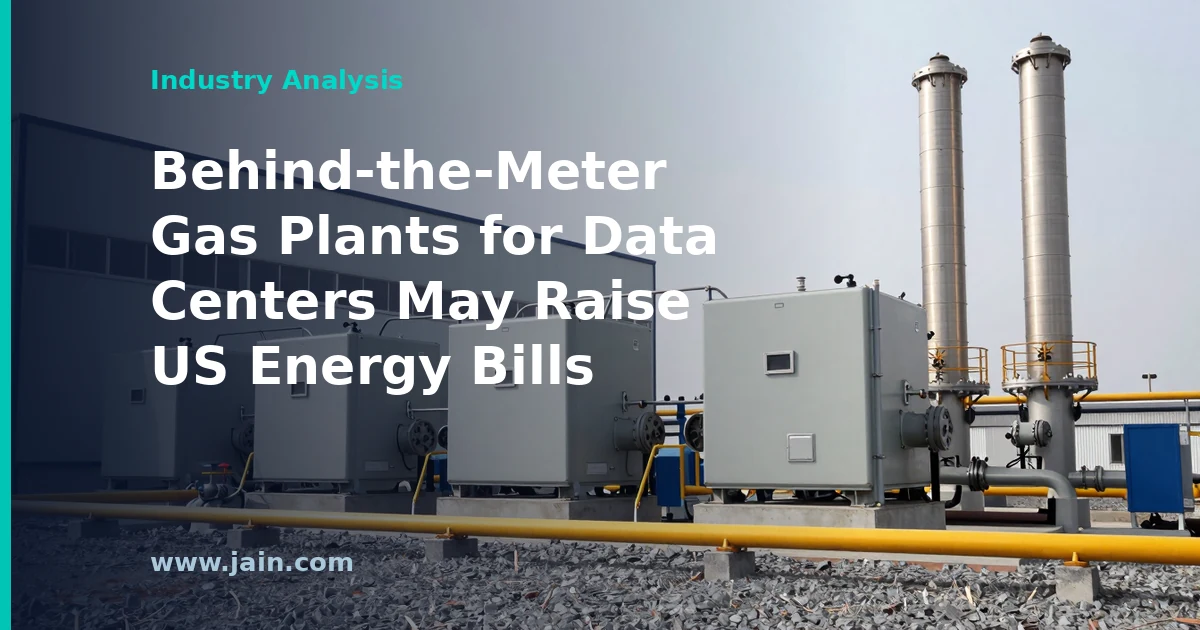
Utility Dive reported on June 7, 2026 that behind-the-meter gas plants — power generation built on a data center’s own site, outside the utility’s meter — will raise US energy bills. The finding lands as AI data center developers increasingly turn to on-site gas turbines to sidestep multi-year grid interconnection queues, raising the question of who ultimately pays for the workaround.
Executive Summary
The report’s headline claim is direct: the wave of behind-the-meter (BTM) gas generation being planned for US data centers will not insulate ordinary consumers from AI’s power demand — it will add to their bills. “Behind the meter” means the plant serves the facility directly, bypassing the utility grid for most or all of its supply, and often bypassing the retail rates, transmission charges, and regulatory review that grid-served customers face.
Why it matters: BTM gas has been marketed as the pressure-release valve for the AI boom — a way for hyperscalers to get hundreds of megawatts energized in two or three years instead of waiting five or more for grid interconnection, without burdening other customers. If independent analysis concludes the opposite — that these plants raise systemwide costs anyway — it undercuts a central argument utilities, developers, and some policymakers have used to wave the projects through, and it strengthens the hand of regulators pushing for special large-load tariffs and cost-allocation rules.
Why Data Centers Are Building Their Own Power Plants
The context for this report is the collision between AI-driven load growth and a grid that cannot connect large customers quickly. Interconnection queues in major US markets stretch years, and transmission upgrades longer still. For a hyperscaler racing to deploy GPUs, a gas turbine on-site — behind the meter — converts an electricity problem into a procurement problem: buy the turbine, permit the plant, burn the fuel, skip the queue. That speed premium is why BTM gas has moved from a niche arrangement to a defining feature of the current data center buildout.
The pitch to regulators has been that this is self-contained: the data center pays for its own generation, so other ratepayers are held harmless. The Utility Dive report’s conclusion — that these plants will raise US energy bills — challenges that framing at its core.
How a Private Power Plant Can Raise Everyone Else’s Bill
With only the headline finding available, the report’s specific modeling cannot be evaluated here, but the mechanisms by which BTM generation can raise systemwide costs are well understood in utility economics. First, natural gas markets are shared: a fleet of new gas plants competing for fuel, pipeline capacity, and turbines can push up gas prices, and because gas units set the marginal price of electricity in much of the country, higher gas costs flow into wholesale power prices for everyone. Second, BTM facilities typically still rely on the grid for backup and startup power while contributing little to the fixed costs of the wires — costs that get spread across remaining customers. Third, if BTM load later converts to grid service, the system must absorb a large customer it never planned for.
Each of these is a cost-shifting channel, not a conspiracy: individually rational decisions by data center developers can still produce a collectively expensive outcome. That is precisely the kind of externality utility regulation exists to police.
Winners, Losers, and the Regulatory Stakes
The near-term winners of the BTM boom are clear regardless of the report’s conclusion: gas turbine manufacturers with multi-year order books, gas producers and pipeline owners, and developers who can monetize speed-to-power. The contested question is who bears the residual cost. If the report’s finding holds, the losers include residential and small-business ratepayers — and, notably, utilities’ own political capital, since public backlash over rising bills tends to land on the regulated utility whether or not it caused the increase.
For the data center industry, the strategic risk is regulatory: findings like this one give state commissions ammunition to impose standby charges, minimum-take tariffs, exit fees, or cost-allocation rules on large loads. Several states were already moving in that direction before this report. Operators that get ahead of the issue — structuring deals that demonstrably cover their grid costs — will face less friction than those that treat BTM as a permanent regulatory bypass.
Background
The US data center industry entered a period of unprecedented power demand growth in the mid-2020s, driven by AI training and inference workloads. After two decades of roughly flat US electricity consumption, utilities began forecasting sustained load growth, with data centers the largest single driver. Grid interconnection processes designed for a slower era became the bottleneck, and “speed to power” replaced land and fiber as the industry’s scarcest resource.
Behind-the-meter generation — long a niche arrangement for industrial plants with steam needs or reliability concerns — was repurposed as the fast lane: developers began pairing data center campuses with dedicated on-site gas turbines, sometimes at gigawatt scale. Utility Dive, a trade publication covering the US electric power sector, has tracked the resulting policy fight over who pays for AI’s power appetite; this report is part of that running debate.