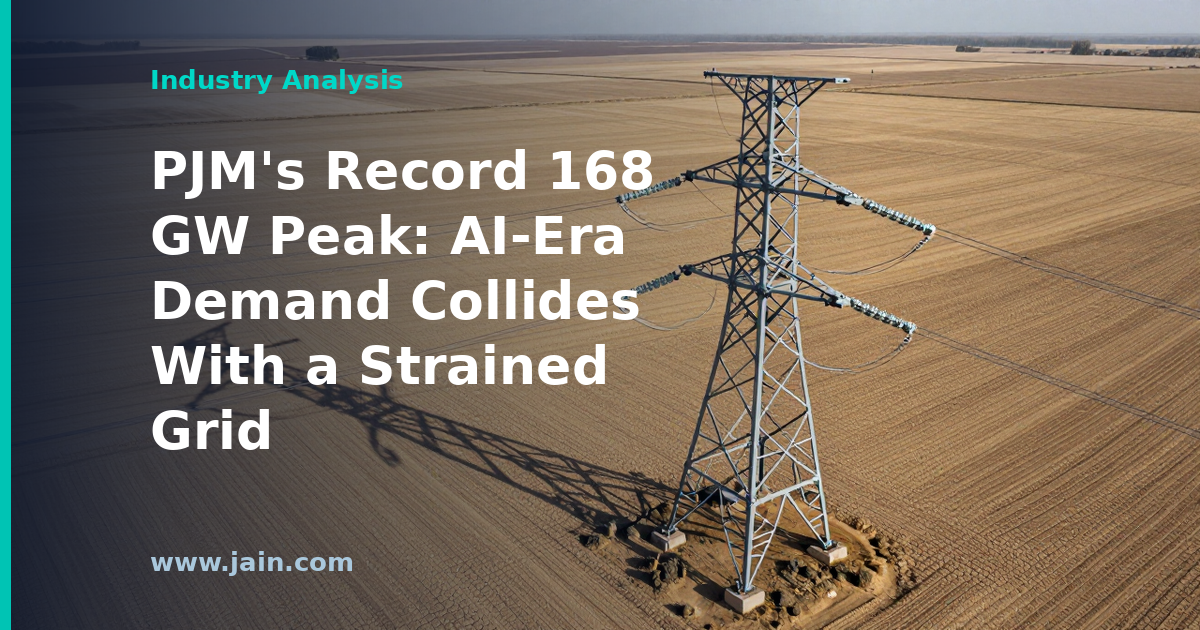
PJM Interconnection, the largest electric grid operator in North America, set a new all-time peak-load record of 168.158 gigawatts (GW) during a heat wave, S&P Global reported on July 9, 2026. Peak load is the highest instantaneous electricity demand a grid must serve, and PJM’s footprint spans 13 states and the District of Columbia — including Northern Virginia, the densest data center market in the world.
Executive Summary
The number itself is the story: 168.158 GW is an all-time record for a grid that has operated since 1927, exceeding the prior widely cited all-time mark of roughly 165.6 GW set in the summer of 2006. Grid demand in mature economies was assumed for years to be flat or declining as efficiency gains offset growth; a new absolute record — set during a heat wave, when air conditioning load stacks on top of everything else — signals that assumption no longer holds in PJM territory.
Why it matters: PJM is where the AI infrastructure boom and the physical grid meet most directly. The region hosts the largest concentration of data centers on earth, and PJM’s own planning processes, capacity auctions, and interconnection queue have all been reshaped by projected data center growth. A record peak turns those projections into observed, metered reality — with consequences for power prices, data center siting decisions, and the pace of generation and transmission construction.
The End of Flat Demand
For roughly two decades, U.S. grid planners could count on a comfortable pattern: efficiency improvements (LED lighting, better HVAC, industrial offshoring) absorbed most economic growth, so peak demand crept along or even fell. That the previous PJM record dated to 2006 illustrates the point — the grid went nearly twenty years without needing to serve a bigger hour. A new record, driven by weather layered on structural load growth, marks a regime change. Data centers, electrification of heating and transport, and reshored manufacturing are all pushing the same direction, and data centers are the fastest-moving of the three because a single large AI campus can draw hundreds of megawatts continuously, day and night.
Heat Waves Are the Stress Test
Records like this are set when a heat wave pushes air-conditioning demand to its maximum at the same time that always-on loads — including data centers — are running flat out. Unlike residential cooling, data center load does not relent in the evening or on weekends, which raises the floor beneath every weather-driven spike. For grid operators, that changes the risk calculus: reserve margins (the buffer of spare generating capacity above expected peak) get consumed from both ends, by rising peaks and by the retirement of older coal and gas plants. PJM has publicly warned for several years that retirements were outpacing new entry; a record peak is exactly the scenario those warnings anticipated.
The Economics: Someone Pays for the Peak
Grids are built for their single highest hour, so peaks are expensive. In PJM, the cost shows up through capacity auctions — payments to generators for being available when demand spikes — and recent PJM capacity auctions have cleared at record-high prices, driven in large part by demand forecasts that data center growth dominates. Those costs flow to ratepayers across the footprint, which is why data center load growth has become a live political issue in states like Virginia, Ohio, and Pennsylvania. A verified record peak strengthens the case of utilities and generators seeking to build; it also sharpens questions from consumer advocates about who should bear the cost of infrastructure that primarily serves new industrial customers.
Winners, Losers, and the Siting Chessboard
Owners of existing dispatchable generation — gas, nuclear, and remaining coal in the PJM footprint — are clear near-term beneficiaries, since scarcity raises the value of every megawatt that can run on command. Data center developers face a more complicated picture: record peaks validate the demand they are bringing, but also lengthen interconnection timelines, raise power costs, and invite regulatory scrutiny. Expect continued interest in behind-the-meter and co-located generation, long-term nuclear power purchase agreements, and siting in less-constrained regions. For the connectivity and colocation industry broadly, grid capacity — not land, not fiber — is now the binding constraint on where digital infrastructure gets built.
Background
PJM Interconnection began in 1927 as a power pool among Pennsylvania and New Jersey utilities and grew into the largest regional transmission organization in North America, coordinating the grid and wholesale markets for 13 states and Washington, D.C. Its territory includes Northern Virginia’s “Data Center Alley,” the densest concentration of data centers in the world, which has made PJM the front line where AI-driven electricity demand meets grid reality.
For most of the 2010s, PJM demand was flat as efficiency gains offset growth, and its 2006-era peak record went unchallenged. That changed as data center construction accelerated, power plant retirements thinned reserve margins, and PJM’s capacity auctions began clearing at record prices — a trajectory that made a new all-time peak a question of when, not if.
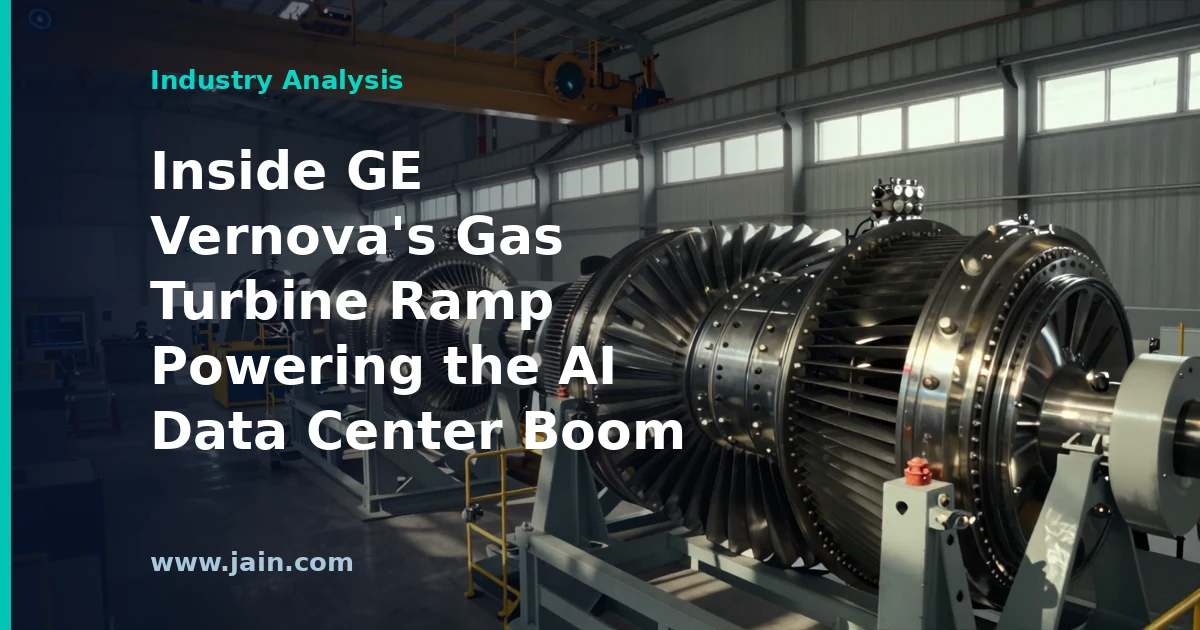
CNBC published a feature on June 28, 2026 examining how GE Vernova builds its massive heavy-duty gas turbines — the machines increasingly ordered to supply electricity for AI data centers. The piece spotlights the manufacturer at the center of one of the power industry’s sharpest demand upswings, as hyperscalers and data center developers scramble for generation capacity that the grid alone cannot deliver on their timelines.
Executive Summary
The story here is less a single announcement than a snapshot of a structural shift: gas turbines — large rotating machines that burn natural gas to spin a generator — have moved from a mature, slow-growth product line to some of the most sought-after industrial hardware in the world, and GE Vernova is one of a small handful of companies that can build the largest ones. CNBC’s look inside the company’s manufacturing operation underscores how AI data center demand has redrawn the order books of the turbine industry.
Why it matters: AI training and inference clusters need firm, around-the-clock power at scales measured in hundreds of megawatts per campus. Interconnection queues — the waiting lines to plug new loads and generators into the transmission grid — stretch for years in many U.S. markets. That mismatch has pushed utilities and data center developers toward dedicated gas-fired generation, and the turbines themselves have become the bottleneck. Whoever controls turbine manufacturing slots now holds real leverage over where and when AI capacity gets built.
The Turbine Is the New Bottleneck
For most of the past decade, the constraint on building a data center was land, fiber, or chips. In 2025 and 2026 it has increasingly been electricity — and behind electricity, the physical equipment that generates and delivers it. Heavy-duty gas turbines sit at the top of that equipment stack: they are enormous precision machines, built in specialized factories by a global oligopoly of manufacturers, and they cannot be scaled up quickly. Casting, machining, and testing the hot-section components that survive combustion temperatures is skilled, capital-intensive work with deep supplier chains.
That is why a factory tour of a turbine plant is now business news. When manufacturing slots for major power equipment are scarce, the production line itself becomes strategic infrastructure. Data center developers who once treated power generation as someone else’s problem — the utility’s — are now tracking turbine lead times the way they track GPU allocations.
Why Gas, and Why Now
Gas turbines occupy a specific niche in the AI power story: they are dispatchable (they run when you need them, unlike weather-dependent wind and solar), they can be sited close to load, and they can be permitted and built faster than nuclear. For hyperscalers facing multi-year grid interconnection queues, gas-fired plants — whether utility-built or behind-the-meter on the data center campus itself — are often the only firm-power option available on an AI-relevant timeline. Combined-cycle configurations, which recycle exhaust heat to generate additional electricity, improve the economics for facilities that run flat-out around the clock, which is exactly the load profile of an AI campus.
The trade-offs are real. Gas plants lock in decades of fuel exposure and carbon emissions at the same moment many data center operators carry public net-zero commitments. Expect continued tension between the near-term physics of AI power demand and long-term decarbonization pledges — and expect operators to pair gas with renewable procurement, carbon-capture ambitions, or framing gas as a “bridge” technology. Readers should evaluate those framings project by project rather than accepting or dismissing them wholesale.
Winners, Losers, and the Queue
The clearest winners in a turbine-constrained market are the manufacturers — GE Vernova and its few global peers — along with their component suppliers and the engineering-and-construction firms that install the machines. Utilities in data center-heavy regions gain a growth story they have not had in decades. On the other side of the ledger, smaller data center developers and enterprises without hyperscaler purchasing power risk being priced or queued out of firm generation capacity, which could concentrate AI infrastructure further among the largest players.
There is also a cyclical risk worth naming evenly: the gas turbine industry has been through boom-and-bust before, most notably when a late-1990s ordering surge was followed by a painful capacity glut. Manufacturers appear to be expanding cautiously partly because of that memory. If AI power demand forecasts prove overstated — a live debate — today’s scarcity could look different in five years. If the forecasts hold, the constraint persists and lead times stay long. Either way, the ordering decisions being made now will shape the power landscape well into the 2030s.
Background
GE Vernova became an independent public company in April 2024, when General Electric completed its split into three businesses and placed its energy operations — gas power, wind, nuclear services, and grid electrification — under the new name. The gas turbine franchise it inherited is one of the oldest and largest in the world, with an installed fleet spanning utilities and industrial operators across the globe.
The company’s independence coincided almost exactly with the generative AI infrastructure boom, which transformed electricity demand forecasts that had been flat in the U.S. for roughly two decades. That timing turned a business once viewed as a mature, declining fossil-fuel franchise into a strategic asset at the center of the AI build-out — the shift CNBC’s factory-floor feature captures.
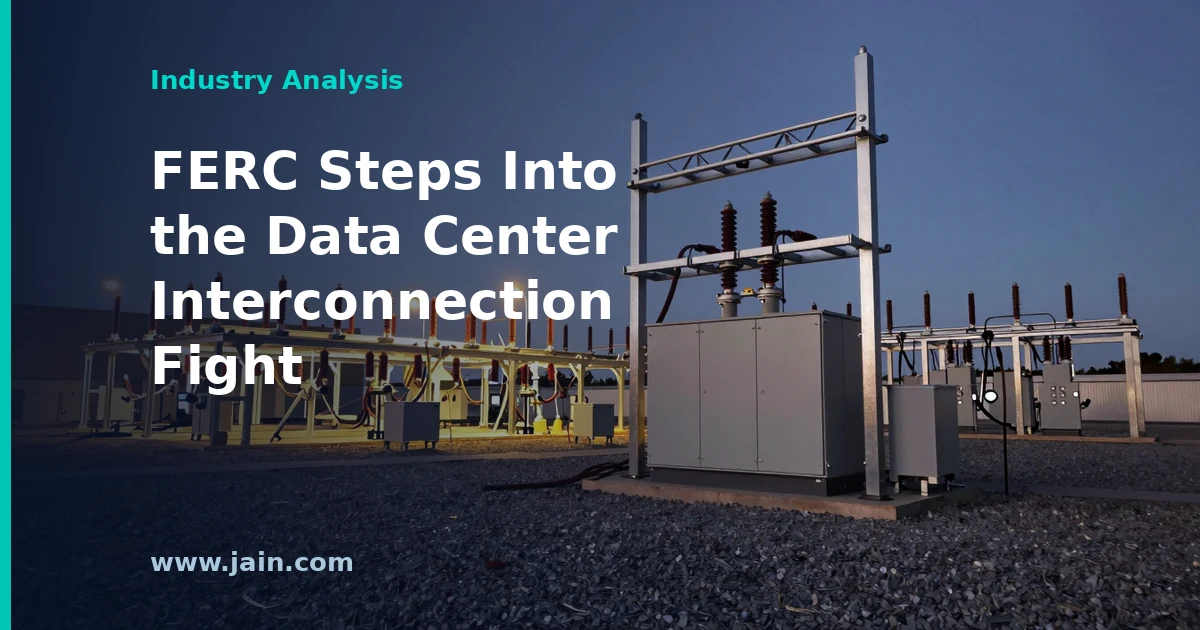
Politico reported on June 18, 2026 that the Federal Energy Regulatory Commission (FERC) — characterized in the piece as “not the old sleepy agency” — is diving into the escalating fight over how data centers connect to the U.S. power grid. The report frames the once low-profile regulator as an increasingly active and decisive player in disputes over data-center interconnection, the process by which large new electricity loads are studied, approved, and physically wired into the grid.
Executive Summary
The headline itself is the story: a Washington energy regulator that historically operated far from public attention is now central to one of the most consequential infrastructure questions of the decade — how, where, and on what terms the data centers powering artificial intelligence get their electricity. Politico’s framing, that FERC is no longer “the old sleepy agency,” signals that the commission is taking an assertive posture in interconnection disputes rather than leaving them to utilities, regional grid operators, and states to sort out.
For the data-center industry, this matters because grid access — not land, capital, or chips — has become the binding constraint on new capacity in many U.S. markets. Whatever rules FERC shapes for connecting very large loads will influence project timelines, cost allocation, and site selection across the country. The report we are working from is a headline-level summary rather than a full text, so the specific proceedings, orders, or disputes Politico describes are not detailed here; our analysis focuses on why FERC’s posture matters and what remains to be confirmed.
Why the Grid Regulator Suddenly Matters to AI
FERC regulates interstate electricity transmission and wholesale power markets — the high-voltage backbone of the grid — and oversees the regional transmission organizations that run much of it. For decades that made it consequential mainly to utilities and power traders. The AI buildout changed the audience. Data centers are now proposing loads measured in the hundreds of megawatts and even gigawatts, on par with heavy industry or small cities, and connecting loads of that size raises exactly the questions FERC referees: who gets studied first, what upgrades are required, and who pays for them.
The “sleepy agency” framing in Politico’s headline captures a real shift in stakes. When interconnection was routine, the rules governing it were obscure. When interconnection becomes the gating item for a multi-hundred-billion-dollar industry, the same rules become front-page policy — and the body that writes them becomes a power broker whether it seeks the role or not.
The Interconnection Bottleneck Is the Business Story
Interconnection — the engineering and contractual process of plugging a new generator or large customer into the grid — has become notorious for multi-year queues in many U.S. regions. For data-center developers, an interconnection timeline is effectively a revenue timeline: a site that cannot energize cannot sell capacity. That is why disputes over queue rules, study procedures, and arrangements such as co-locating data centers directly at power plants (sometimes called behind-the-meter siting, where the load connects at the plant rather than through the wider grid) have turned into hard-fought regulatory battles.
How FERC resolves these fights will shape winners and losers. Clear, faster federal rules would favor developers with strong utility relationships and sites near existing capacity. Restrictive or unsettled rules push projects toward states and utilities perceived as easier to work with, toward on-site generation, or toward markets abroad. Utilities and existing ratepayers, meanwhile, have a direct stake in ensuring that grid upgrades driven by data-center demand are paid for by the companies that cause them rather than spread across household bills — a cost-allocation question that sits squarely in FERC’s lane.
An Assertive FERC Cuts Both Ways
An engaged regulator is not automatically good or bad news for the industry. On one hand, federal clarity could standardize how very large loads are treated, reducing the state-by-state and utility-by-utility uncertainty that currently complicates siting decisions. On the other, active federal scrutiny can slow novel deal structures — such as dedicated supply arrangements between power plants and data centers — while the commission works out reliability and fairness implications for everyone else on the grid.
It is also worth noting what FERC does not control. Siting of the data centers themselves, retail electricity rates, and most generation permitting remain state matters. So even a maximally assertive FERC is one decisive player among several, and the practical outcome for any given project will depend on how federal interconnection policy interacts with state regulation and utility planning. The Politico headline tells us the referee has taken the field; the source available to us does not detail which specific calls it is making.
Background
FERC traces its lineage to the Federal Power Commission, created in 1920, and has long operated as a technical regulator of interstate power transmission, wholesale electricity markets, and natural-gas infrastructure. Its rules govern the regional transmission organizations — such as PJM in the mid-Atlantic — that manage the grid across much of the country, and its interconnection procedures determine how new generators and, increasingly, very large customers plug in.
The agency’s rising profile tracks the AI-driven surge in electricity demand. After roughly two decades of flat U.S. power consumption, forecasts turned sharply upward in the mid-2020s as hyperscale data centers multiplied, and disputes over connecting them — including high-profile fights over siting data centers directly at power plants — began landing at FERC’s door. The June 2026 Politico report captures the resulting role reversal: an agency once known mainly to energy lawyers is now a decisive venue for the infrastructure economics of AI.
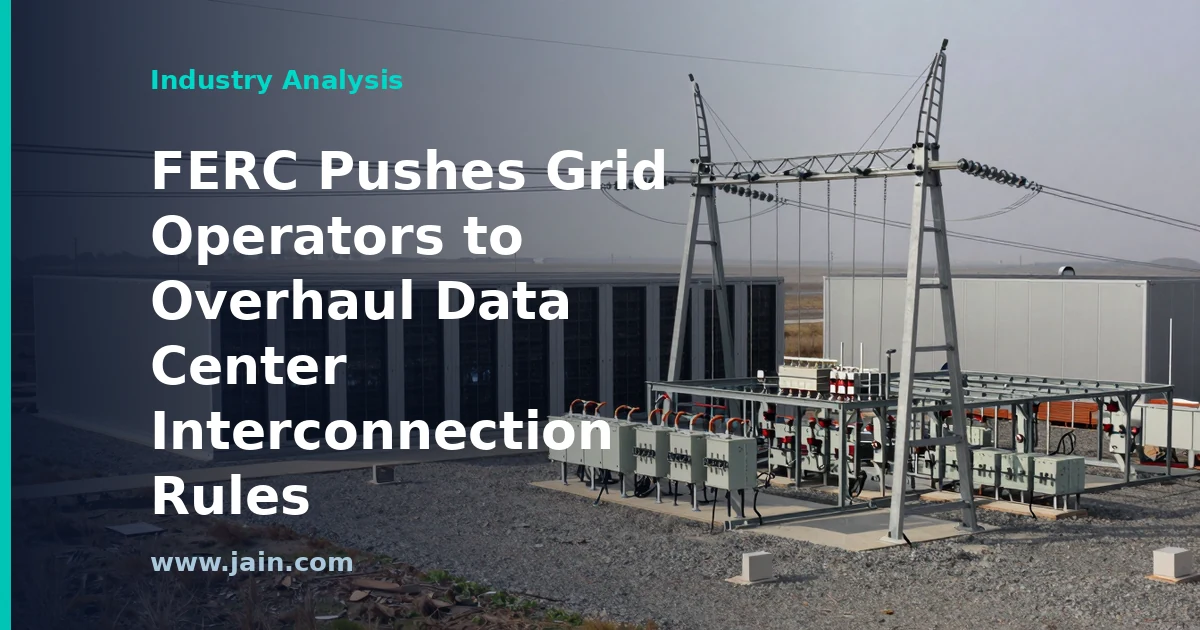
The Federal Energy Regulatory Commission (FERC), the top US energy regulator, is pressing the nation’s grid operators to overhaul the rules governing how large data centers connect to and draw power from the electric grid, according to a Reuters report dated June 17, 2026. The push targets the regional transmission organizations that manage most of the US high-voltage grid, and lands in the middle of an unprecedented wave of AI-driven electricity demand.
Executive Summary
According to Reuters, FERC is urging grid operators to rewrite their rules for connecting large data center loads — the procedures, studies, and cost arrangements that determine how quickly a gigawatt-scale computing facility can plug into the transmission system and on what terms. The report frames this as a directive from the regulator to the regional grid operators rather than a finished rule, which means the substance will be worked out in filings, stakeholder processes, and likely litigation over the months ahead.
Why it matters: interconnection has become the single biggest bottleneck in the AI infrastructure buildout. Chips can be bought and buildings can be raised in quarters; grid connections for very large loads are quoted in years. Whoever writes the rules for large-load interconnection — how costs are allocated, whether data centers can co-locate with power plants, and what reliability obligations big loads must accept — will effectively set the pace and geography of AI data center construction in the United States. A FERC push to standardize those rules is therefore one of the most consequential regulatory developments the industry has seen this cycle, even before its details are settled.
Interconnection Is Now the Gating Factor for AI Capacity
For most of the grid’s history, the hard problem was connecting new generators; large customer loads arrived gradually and were absorbed through routine utility planning. AI has inverted that. Individual data center campuses now request hundreds of megawatts — in some cases more than a gigawatt, roughly the draw of a mid-sized city — and they request it on construction timelines the traditional load-forecasting process was never designed to handle. Grid operators have responded with a patchwork: some regions created special large-load study tracks, others applied generator-style queue rules to loads, and others negotiated case by case. A federal push to overhaul and presumably harmonize these rules is a recognition that the patchwork itself has become a source of delay and dispute.
For data center developers and their tenants, the near-term effect of any rule rewrite is uncertainty, but the medium-term prize is predictability. A standardized process — with defined study timelines, transparent cost estimates, and clear rules on what a large load must commit to — would let operators of digital infrastructure make siting decisions on engineering and economics rather than on which utility territory offers the friendliest ad hoc deal.
The Fights Underneath: Co-Location, Cost Allocation, and Curtailment
Three unresolved disputes sit beneath any large-load rule overhaul. First, co-location — siting a data center directly beside a power plant and buying its output behind the meter. The arrangement can bypass years of transmission upgrades, but regulators and utilities have questioned whether such configurations pay their fair share for the grid that still backs them up; FERC itself has been wrestling publicly with co-location frameworks since high-profile disputes over data centers sited at nuclear plants in the PJM region. Second, cost allocation: when a multi-hundred-megawatt load triggers new transmission lines or substations, someone pays — the developer, the utility’s general ratepayer base, or some blend. Consumer advocates in several states have argued that ordinary households risk subsidizing AI growth; developers counter that they routinely fund dedicated upgrades. Third, flexibility and curtailment: grid operators increasingly want large loads to accept interruption or demand-response obligations during system stress in exchange for faster connection. Each of these is a genuine economic contest between reasonable positions, and the Reuters report does not indicate which way FERC is leaning on any of them.
Winners, Losers, and the Federal–State Seam
If the overhaul produces faster, standardized large-load interconnection, the clearest winners are hyperscale cloud and AI companies with capital ready to deploy, and the transmission-rich regions able to absorb them. Utilities gain too, if the rules convert speculative or duplicative connection requests — a real problem, since developers often file in multiple territories for the same project — into firm, financially committed ones. The pressure lands on grid operators, which must rewrite tariffs under regulatory deadline while managing record demand growth, and potentially on smaller data center operators, if new rules impose financial-commitment thresholds sized for hyperscalers.
There is also a jurisdictional seam worth watching. FERC governs wholesale markets and the interstate transmission system, but retail electric service and most siting decisions belong to the states, and Texas’s ERCOT grid sits largely outside FERC’s reach altogether. A federal overhaul can standardize how regional operators study and connect big loads, but it cannot by itself resolve state-level fights over who pays or where facilities are built. Buyers should expect a more legible federal process layered over a still-fragmented state landscape, not a single national rulebook.
Background
FERC, created in its modern form in 1977, oversees the interstate transmission system and the wholesale power markets run by regional grid operators. Its interconnection rules historically focused on generators — culminating in a 2023 queue-reform order aimed at the enormous backlog of power plants awaiting connection. Large customer loads, by contrast, were left mostly to individual utilities and states, an arrangement that held until AI demand broke it.
From roughly 2024 onward, gigawatt-scale data center requests, contested co-location deals at nuclear plants in the PJM region, and warnings from grid operators about record demand growth pushed large-load interconnection onto FERC’s docket. The June 2026 push reported by Reuters is the continuation of that arc: the federal regulator moving from case-by-case dispute resolution toward pressing for systematic rules on how the grid absorbs the AI buildout.
Research and advisory firm Gartner has published a forecast projecting that data-center electricity consumption will grow 26% in 2026. The figure, released in June 2026, puts a number on what utilities, grid operators, and data-center builders have been experiencing on the ground: power — not land, capital, or chips — has become the binding constraint on digital-infrastructure growth.
Executive Summary
Gartner’s headline claim is simple: the electricity consumed by data centers will rise 26% in 2026. For context, most mature electricity systems in developed economies have spent two decades planning around annual demand growth in the low single digits. A single customer class growing 26% in one year is the kind of step-change that utility resource plans — documents typically written on five-to-fifteen-year horizons — were not designed to absorb.
The forecast matters less as a precise number than as a planning signal. If even a substantial fraction of that growth materializes, it shapes generation procurement, transmission buildout, interconnection queues, and electricity rates for every other customer sharing the grid. For data-center operators and their customers, it also signals that access to secured, deliverable power will continue to separate projects that get built from projects that wait.
A 26% Jump Is a Planning Problem, Not Just a Number
Electric utilities plan in decades. Building a new gas plant, a transmission line, or a large substation typically takes years of permitting, procurement, and construction. Demand that grows 26% in a single year — even within one customer segment — compresses those timelines past what traditional integrated resource planning can handle. The practical consequence is already visible across the industry: multi-year interconnection queues (the waiting list to connect large new loads or generators to the grid), utilities demanding long-term take-or-pay commitments from data-center customers, and regulators debating who bears the cost if forecast demand fails to show up.
The forecast, in other words, is best read as a statement about mismatch: digital infrastructure now moves at software-industry speed, while the electricity system that feeds it still moves at heavy-civil-engineering speed. Closing that gap — through faster permitting, on-site generation, or demand flexibility — is the defining infrastructure challenge the number points to.
AI Is Rewriting the Load Curve
Growth of this magnitude is not organic expansion of traditional enterprise computing. Conventional data-center workloads — web serving, databases, storage — grew steadily for years while efficiency gains (better chips, better cooling, higher utilization) kept electricity demand roughly flat. What changed is accelerated computing: AI training and inference run on dense GPU racks that can draw several times the power of traditional server racks and tend to run at sustained high utilization rather than in daily peaks and troughs.
That load profile is a mixed blessing for utilities. Flat, predictable, around-the-clock demand is easier to serve than spiky demand and can improve grid economics by spreading fixed costs over more kilowatt-hours. But it also removes slack: a grid serving large always-on loads has less headroom for extreme weather events and less tolerance for generation shortfalls. How much of Gartner’s projected growth is firm, flexible, or interruptible will matter as much as the total.
Winners, Losers, and the Power Value Chain
If the forecast is directionally right, the beneficiaries extend well beyond data-center operators. Makers of transformers, switchgear, generators, and cooling equipment — many already quoting extended lead times — see demand visibility measured in years. Generation developers, from gas turbines to nuclear restarts to utility-scale renewables paired with storage, gain a creditworthy customer class willing to sign long-dated contracts. Utilities in data-center-heavy regions gain load growth after decades of stagnation, though with real execution and rate-design risk.
The squeezed parties are those competing for the same electrons and equipment: other large industrial loads, smaller colocation players without utility relationships, and — if cost allocation is handled poorly — residential ratepayers. For data-center operators themselves, the forecast reinforces an emerging hierarchy: companies holding contracted, deliverable power capacity own an appreciating asset, while those still in interconnection queues hold an option of uncertain value.
Treat the Number as a Signal, Not a Certainty
A forecast is a model, and this one — as syndicated — arrives without its assumptions attached. Projections of AI-driven power demand have varied widely across analysts, and history urges caution: early-2000s forecasts of runaway internet power consumption overshot badly because they underestimated efficiency gains. Chip-level performance-per-watt improvements, smarter model architectures, and rising inference efficiency could all bend the curve; conversely, faster-than-expected enterprise AI adoption could steepen it.
The even-handed reading is that Gartner’s 26% figure is a credible-sounding midpoint from an established research house, but its value depends on methodology the public headline does not disclose — baseline year, geographic scope, and workload assumptions among them. Planners should treat it as one scenario input, not a settled fact.
Background
Data-center electricity demand was, for roughly a decade before the AI era, a story of successful restraint: workloads migrated into ever-more-efficient hyperscale facilities, and total consumption grew far more slowly than computing output. That equilibrium broke with the generative-AI buildout that began in earnest in 2023, as operators raced to deploy GPU clusters whose power density and utilization patterns overwhelmed the old efficiency offsets. Since then, power availability has displaced real estate as the industry’s primary constraint, and forecasts from analysts, utilities, and government agencies have been repeatedly revised upward.
Gartner, a research and advisory firm whose projections are widely used in enterprise technology planning, publishes recurring forecasts on data-center spending and infrastructure. Its June 2026 electricity-consumption forecast lands amid active debate among utilities, regulators, and operators over how much of the projected AI load will actually materialize — and who should pay to serve it.
Individual AI data center campuses in the United States have crossed the 1-gigawatt power threshold, according to a May 15, 2026 report from Quartz — a scale at which a single computing facility draws as much electricity as roughly a large power plant produces. The report frames these sites as an emerging strain on the U.S. power grid.
The milestone matters less as a round number than as a signal: the binding constraint on AI infrastructure buildout has shifted from chips and capital to electricity itself.
Executive Summary
For most of the data center industry’s history, a large facility drew tens of megawatts, and a 100-megawatt campus was considered enormous. The reporting highlighted here marks a step change: single AI training and inference campuses now demanding 1 gigawatt or more — a thousand megawatts — concentrated at one grid interconnection point. That is a load comparable to a mid-sized city, arriving on the grid in a fraction of the time it takes to permit and build the generation and transmission to serve it.
Why it matters: electricity supply, not silicon supply, is now the gating factor for AI capacity growth in the United States. Utilities plan generation and transmission on decade-long horizons; hyperscale AI developers want power in two to four years. That mismatch shapes where data centers get built, how fast AI capacity can scale, who pays for grid upgrades, and which operators — those with secured power — hold the scarcest asset in the industry.
The source is a brief news report rather than a detailed study, so the specific sites, operators, and grid regions involved are not enumerated. But the direction of travel it describes is consistent with what grid operators and utilities have been signaling: unprecedented load-growth forecasts driven overwhelmingly by data centers.
From Megawatts to Gigawatts: A Different Kind of Customer
A gigawatt-scale data center is not a bigger version of a traditional one; it is a different category of grid customer. A gigawatt is roughly the output of a large nuclear reactor, and connecting that much load at a single substation requires high-voltage transmission capacity that most locations simply do not have spare. Traditional data centers could slot into existing industrial corridors. Gigawatt campuses force utilities to build new transmission lines, upgrade substations, and in some cases procure or build new generation — projects that routinely take five to ten years to permit and construct.
This inverts the historical relationship between data centers and utilities. Data centers used to be desirable, quiet, high-load-factor customers that utilities courted. Now the largest projects arrive as planning problems: loads so large that a utility must ask whether serving one customer degrades reliability or raises costs for everyone else. Several of the practical consequences — long interconnection queues, large-load tariffs, and demands for financial guarantees from developers — follow directly from that inversion.
Power as the Scarce Asset — and the New Competitive Moat
When electricity is the bottleneck, secured power becomes the most valuable asset in the AI infrastructure stack. A developer holding an executed interconnection agreement for hundreds of megawatts, or land adjacent to underused generation, holds something that cannot be quickly replicated at any price. That favors incumbent data center operators with existing utility relationships, energy companies entering the data center business, and sites near retired or underutilized industrial load where grid capacity already exists.
It also reshapes geography. Buildout gravitates toward regions with available generation, faster permitting, and willing utilities — which can pull AI infrastructure away from traditional hubs toward areas that historically saw little data center investment. For buyers of AI capacity, the practical implication is that delivery timelines increasingly depend on a provider’s power position, not its ability to procure GPUs — graphics processing units, the specialized chips that do the computational work of AI.
Who Bears the Cost of the Strain?
“Straining the grid” is ultimately a question about allocation: of capacity, of reliability risk, and of cost. If a utility builds transmission and generation to serve gigawatt loads and spreads the cost across its rate base, ordinary ratepayers can end up subsidizing AI infrastructure. If it charges data center developers the full incremental cost, projects become more expensive but the burden lands where the demand originates. Regulators across multiple states are actively working through exactly this question, and the outcome will materially affect both AI economics and household electricity bills.
There is also a reliability dimension. Grid operators plan around peak demand, and very large, fast-growing loads compress the margin between available supply and consumption. The fair reading is that gigawatt data centers do not create grid fragility by themselves — decades of underinvestment in transmission predate the AI boom — but they arrive fast enough to expose it. How operators respond, through on-site generation, flexible operation during grid stress, or long-term power purchase agreements that fund new supply, will determine whether AI load becomes a grid liability or a financing engine for new generation.
Background
Data centers are the physical home of the internet and, increasingly, of artificial intelligence: warehouse-scale buildings full of servers, networking, and cooling equipment. For decades they were a modest and predictable slice of U.S. electricity demand, and overall U.S. power consumption was roughly flat, allowing utilities to plan conservatively. The generative-AI boom that began in late 2022 broke that pattern: training and running large AI models requires vastly more computing — and therefore more electricity and cooling — than conventional workloads.
Since then, hyperscale operators and AI developers have announced successively larger campuses, with facility sizes climbing from tens of megawatts toward the gigawatt class this report describes. Grid operators and utilities across the country have responded with sharply raised load-growth forecasts, and questions of interconnection timelines, cost allocation, and reliability have moved from utility back offices to the center of both energy policy and AI strategy.
E&E News by POLITICO reported on May 4, 2026 that the AI boom has prompted a rare formal warning of “significant risks” to the electric grid. The warning, attributed to grid operators, centers on the reliability challenges created by rapid AI data-center load growth — the surge in electricity demand from facilities built to train and run artificial-intelligence models.
Executive Summary
According to the report, the organizations responsible for keeping the lights on have moved beyond quiet concern to an explicit, on-the-record caution: the pace and scale of AI-driven data-center demand now pose “significant risks” to grid reliability. In the deliberately understated language of the power sector, where public warnings are infrequent and carefully worded, a formal statement of this kind is a notable escalation.
Why it matters: grid operators and reliability bodies are the institutions that decide whether new large loads can connect, how much generation and transmission must be built, and what margins the system must hold in reserve. When they formally flag a risk, that assessment flows into planning studies, interconnection decisions, and regulatory proceedings. For data-center developers, utilities, and the AI companies driving demand, the message is that electricity availability — not land, chips, or capital — may be the binding constraint on the buildout, and that the institutions controlling that constraint are now on notice.
Why a Formal Warning Is a Turning Point
Grid reliability institutions are structurally conservative communicators. Their public assessments are consensus documents, reviewed by member utilities and regulators, and they rarely single out a demand-side trend as a named risk. That is what makes the reported warning newsworthy: the characterization of AI data-center load growth as posing “significant risks” is the kind of language that, once issued, becomes a reference point in rate cases, interconnection disputes, and legislative hearings.
The practical effect of such warnings is less about any single blackout scenario and more about institutional permission. Utilities that want to slow-walk large interconnection requests, regulators that want to impose cost-allocation conditions on data centers, and states weighing incentives for the industry can all now cite an authoritative reliability finding. In power planning, the paper trail matters.
The Mismatch Behind the Alarm
The underlying tension is one of timescales. A large data center can be designed, financed, and built in roughly two to three years, and AI developers are announcing capacity at an unprecedented cadence. The grid assets needed to serve that load — high-voltage transmission lines, large generators, transformers — routinely take far longer to permit and construct. When demand arrives faster than supply infrastructure can, the system’s cushion shrinks, and reliability planners see exactly the kind of risk the reported warning describes.
Compounding the problem is forecasting uncertainty. Utilities plan around load forecasts, and data-center demand is uniquely hard to forecast: projects are speculative, developers often file duplicate interconnection requests in multiple territories while shopping for power, and a single hyperscale campus can rival the demand of a small city. Planners face risk in both directions — underbuilding invites shortfalls, while overbuilding for phantom load can leave other customers paying for stranded infrastructure.
Winners, Losers, and the New Power Calculus
If reliability concerns harden into policy, the advantage shifts to data-center operators who bring solutions rather than just load: projects with secured long-term power contracts, on-site or co-located generation, meaningful backup capacity, or genuinely flexible demand that can reduce consumption during grid stress. Flexibility is emerging as a currency — a data center that can curtail (temporarily reduce) its draw during peak hours is a far easier interconnection decision than one requiring firm power around the clock.
The losers in a constrained environment are late-arriving projects in saturated markets, and potentially ordinary ratepayers if the costs of grid expansion are not allocated cleanly to the loads driving it. For utilities, the moment cuts both ways: data centers represent the largest load-growth opportunity in decades — and therefore revenue — but also a source of operational and political risk if reliability suffers. How regulators referee that tension will shape power planning for the rest of the decade.
Background
For roughly two decades before the AI boom, electricity demand in the United States was essentially flat, and grid planning settled into a routine of modest, predictable adjustments. That era ended when the generative-AI wave set off a race to build data centers at unprecedented scale, pushing utilities to revise load forecasts sharply upward and filling interconnection queues — the waiting lists for connecting new facilities to the grid — across multiple regions.
Grid reliability in North America is overseen by a layered system: regional grid operators run the transmission network day to day, while reliability organizations set standards and publish periodic assessments of whether the system can meet projected demand. Those assessments had grown increasingly pointed about surging data-center load in the years before this reported warning, making the May 2026 statement the continuation — and apparent sharpening — of a trend the power sector has watched closely.
The North American Electric Reliability Corporation (NERC) — the regulatory body responsible for the reliability of the bulk power system in the United States and Canada — has issued a warning that the rapid growth of data-center electricity demand risks overtaxing the grid, according to reporting by Latitude Media published May 3, 2026. The alert places the AI-driven data-center build-out squarely among the leading reliability risks facing the North American power system.
Executive Summary
NERC is not a trade group or an advocacy organization: it is the FERC-certified Electric Reliability Organization whose standards are mandatory and enforceable for grid operators across North America. When NERC elevates a risk, utilities, regional transmission organizations, and regulators are expected to respond. The reported warning frames unchecked data-center load growth — the wave of large, concentrated electricity demand from AI and cloud facilities — as a material threat to grid reliability, not merely a planning challenge.
The significance lies less in the observation itself, which grid planners have discussed for several years, than in the messenger and the framing. Reliability warnings from NERC historically precede changes in interconnection rules, resource-adequacy requirements, and planning standards. For data-center developers and their customers, that means the era of assuming the grid will simply absorb new campus-scale loads is closing, and the terms of grid access are likely to tighten.
Why the Messenger Matters More Than the Message
Grid strain from data centers is not a new story — utilities in Virginia, Texas, Georgia, and elsewhere have reported unprecedented interconnection queues for years, and NERC’s own long-term reliability assessments have repeatedly flagged accelerating demand growth after two decades of roughly flat US electricity consumption. What changes when NERC issues a pointed warning is the institutional weight behind it. NERC’s assessments feed directly into how utilities justify infrastructure spending before state regulators and how regional grid operators set reserve requirements — the buffer of spare generating capacity kept available for peak conditions.
A reliability warning of this kind typically functions as a forcing mechanism. It gives utilities cover to demand stricter commitments from large-load customers, gives regulators grounds to scrutinize speculative interconnection requests, and gives grid operators justification to slow or condition approvals. The practical effect is that a NERC alarm tends to translate, over the following quarters, into new rules rather than remaining rhetoric.
The Core Problem: Speed, Scale, and Concentration
Data-center load is difficult for grid planners for three compounding reasons. First is speed: a large data-center campus can be built in two to three years, while new high-voltage transmission lines and large power plants routinely take seven to ten years to permit and construct. Second is scale: modern AI campuses request power in the hundreds of megawatts — a single facility can draw as much electricity as a mid-sized city. Third is concentration: developers cluster where fiber, land, and power intersect, so the demand lands on a handful of regional grids rather than spreading evenly across the country.
There is also a planning-data problem that reliability bodies have wrestled with publicly: developers frequently submit interconnection requests to multiple utilities for the same project, a practice sometimes called phantom load. Grid planners cannot easily distinguish which requests represent real, committed demand, which makes forecasting — the foundation of reliability planning — genuinely harder. A warning about “unchecked” growth is, in part, a warning about growth that planners cannot see clearly.
Winners, Losers, and the Coming Rule Changes
If NERC’s warning hardens into policy, the likely instruments are familiar: stricter financial commitments and deposits for interconnection requests, minimum-take or ramp-schedule contracts for large loads, requirements for on-site or contracted generation, and curtailment provisions that let grid operators reduce a data center’s draw during system emergencies. Each of these shifts risk from ratepayers and the grid back onto the load itself.
The relative winners in that world are developers who already control their power story — those with signed long-term supply agreements, on-site generation, flexible-load capability, or sites in regions with surplus capacity. Speculative developers banking on cheap, unconditional grid access face longer timelines and higher costs. Utilities gain leverage but also face a genuine dilemma: overbuild for demand that may not materialize and ratepayers foot the bill, or underbuild and reliability suffers. That asymmetry is precisely why an independent reliability body raising the flag matters — it pushes the debate from utility earnings calls into the formal reliability-standards process.
What a Reliability Warning Does Not Say
It is worth being precise about what a warning like this does and does not establish. It does not mean blackouts are imminent, and it does not assign blame to any individual company or project. Reliability risk is probabilistic: it means the margin between available supply and projected peak demand is narrowing faster than infrastructure is being added, raising the odds of emergency measures during extreme conditions. Nor does the warning settle the policy question of who should pay for grid upgrades — that fight is playing out state by state in rate cases and large-load tariff proceedings, and NERC’s role is to describe the risk, not to allocate its costs.
Background
NERC was formed in 1968 after the 1965 Northeast blackout and became the enforceable Electric Reliability Organization for the United States under the Energy Policy Act of 2005, with the Federal Energy Regulatory Commission (FERC) as its overseer. It publishes seasonal and long-term reliability assessments that grid operators and utilities treat as authoritative, and in recent years those assessments have tracked a historic shift: after two decades of essentially flat US electricity demand, consumption is rising again, driven by AI and cloud data centers, manufacturing reshoring, and electrification.
Data centers sit at the center of that shift because their demand is large, fast-arriving, and geographically concentrated, while the transmission and generation needed to serve them move on much slower permitting and construction timelines. The May 2026 warning reported by Latitude Media extends a line of increasingly direct statements from reliability authorities that the gap between load growth and infrastructure build-out is itself becoming a systemic risk.
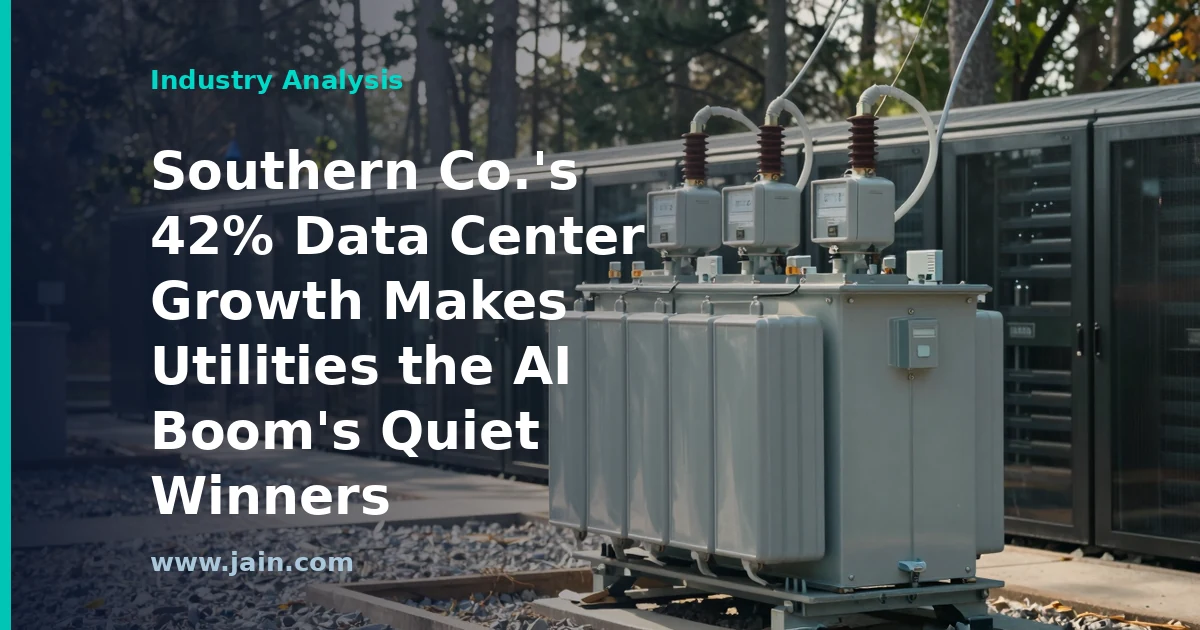
Southern Company, the Atlanta-based utility holding company whose subsidiaries include Georgia Power, Alabama Power, and Mississippi Power, reported soaring electricity sales driven by 42% growth in its data center segment, according to a May 1, 2026 report from Utility Dive. The figure stands out because it converts years of talked-about AI demand projections into a number showing up in an actual utility’s actual sales.
Executive Summary
For two years, the electricity industry has debated whether the enormous data center load forecasts attached to the AI build-out would materialize or evaporate. Southern Company’s reported 42% growth in data center electricity sales is one of the clearest signals yet that, at least in the Southeast, the demand is real, metered, and being billed. Electricity sales — as opposed to interconnection requests or load forecasts — represent power actually delivered to operating facilities.
The announcement matters beyond Southern’s own territory. Utilities have quietly become one of the most durable beneficiaries of the AI infrastructure cycle: unlike chipmakers or cloud providers, they sell a regulated, contracted product to customers who cannot easily relocate once a facility is energized. A 42% jump in one demand segment, if sustained, reshapes how regulators, investors, and data center developers should read utility growth plans across the Sun Belt.
From Forecast to Booked Revenue
The data center power story has been dogged by a credibility gap: interconnection queues across the United States are stuffed with speculative and duplicate requests, as developers file with multiple utilities for the same project. Skeptics have reasonably asked how much of the forecast load is real. Sales figures cut through that noise. When a utility reports 42% growth in data center electricity sales, it is describing megawatt-hours delivered to energized buildings and invoiced to customers — not letters of intent.
That distinction matters for how the market prices the AI build-out. Forecasts can be revised down quietly; delivered sales cannot. Southern’s number suggests that in its Southeast footprint, the pipeline of announced hyperscale and colocation projects is converting into operating load at pace. It also implies that the facilities energized in recent quarters are ramping utilization, since sales growth reflects consumption, not just connection.
Why Utilities Are the AI Build-Out’s Quiet Winners
The AI investment narrative has centered on GPU vendors and hyperscalers, but the utility position in the value chain is structurally attractive in a different way. Data centers are among the most creditworthy, longest-duration customers a utility can sign, and once built they are effectively immobile — a facility with hundreds of millions of dollars in the ground does not switch power providers. For a vertically integrated, rate-regulated utility like Southern’s subsidiaries, growing load also supports the case for new generation and transmission investment, on which regulated utilities earn an authorized return.
Southern is also unusually well positioned on supply. Its Georgia Power subsidiary completed Vogtle Units 3 and 4 — the first newly constructed nuclear reactors in the U.S. in decades — giving it firm, carbon-free baseload capacity precisely as large-load customers began demanding both reliability and clean-energy attributes. The Southeast’s combination of available land, water, fiber routes, and historically constructive regulation has made Georgia in particular one of the fastest-growing data center markets in the country.
The Ratepayer and Capacity Question
Rapid large-load growth is not an unalloyed good, and regulators know it. The central policy question is cost allocation: who pays for the new generation and grid capacity that data centers require? If a hyperscaler’s load justifies a new gas plant or transmission line and that customer later scales back, ordinary households and small businesses could be left carrying the cost. Several states, including Georgia, have been developing special rate structures and minimum-take contract terms for very large customers to insulate other ratepayers from exactly this risk.
There is also a physical question. A 42% growth rate in any demand segment tests reserve margins — the cushion of spare generating capacity utilities maintain for peak conditions. Sustained growth at anything like this pace forces choices among new gas capacity, renewables paired with storage, nuclear uprates, and demand flexibility, each with different cost, carbon, and timeline profiles. How Southern and its regulators sequence that build will determine whether today’s sales growth becomes tomorrow’s reliability headline.
What It Signals for the Data Center Market
For data center developers and tenants, the signal is double-edged. Confirmation that Southeast load is materializing validates the region’s status as a top-tier market — but it also means the easy capacity is being absorbed. As delivered load climbs, utilities gain leverage: expect longer interconnection timelines for new requests, stricter contract terms, larger upfront commitments, and less tolerance for speculative reservations. Power availability, not land or fiber, remains the binding constraint on where the next wave of AI capacity gets built.
For investors, the takeaway is that utility exposure to AI is no longer hypothetical. The sector’s traditional appeal was stability rather than growth; a demand segment compounding at double-digit rates changes that math for the handful of utilities sitting under major data center clusters — while raising the stakes on execution, since regulated returns depend on building capacity on time and on budget.
Background
Southern Company traces its roots to the early twentieth-century electrification of the American Southeast and today ranks among the largest U.S. utility holding companies, operating primarily through state-regulated subsidiaries Georgia Power, Alabama Power, and Mississippi Power. Its highest-profile recent undertaking was the expansion of Plant Vogtle in Georgia, where Units 3 and 4 — the first newly constructed nuclear reactors completed in the United States in a generation — entered service after years of delays and cost overruns, ultimately giving the company scarce firm, carbon-free capacity.
That capacity arrived just as the generative-AI boom transformed electricity demand. After roughly two decades of flat U.S. load growth, utilities began reporting surging interconnection requests from hyperscale data center developers around 2023, with Georgia emerging as a leading destination. The open question has been how much of that forecast demand would become real consumption — which is what makes delivered-sales figures like this one significant.
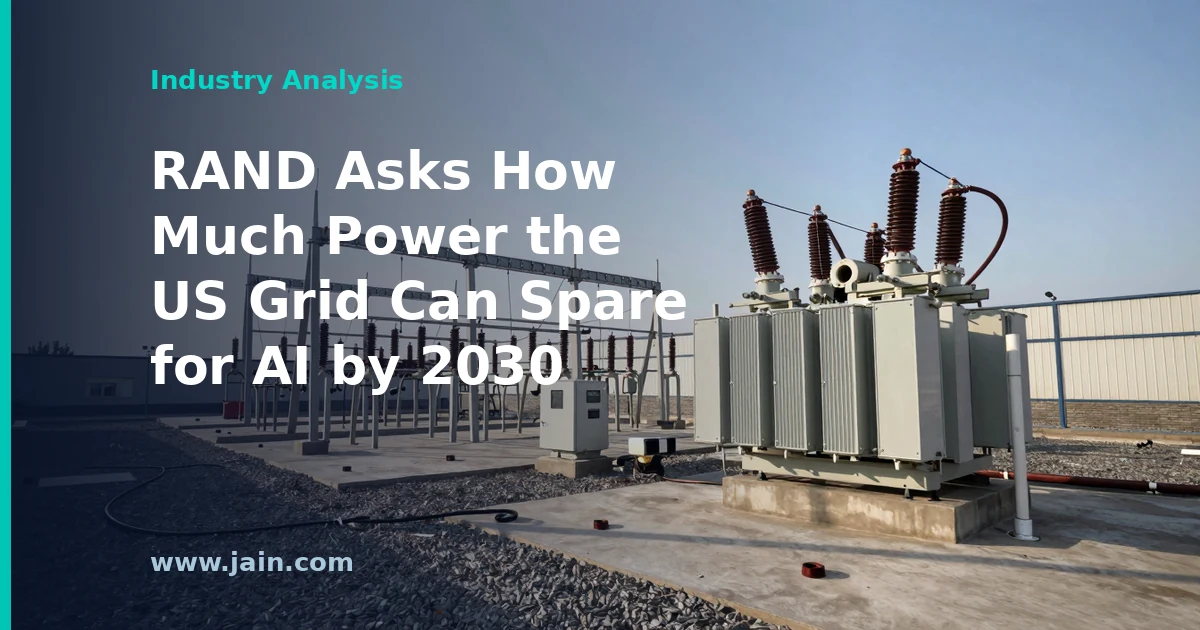
On April 28, 2026, RAND — the nonprofit, nonpartisan policy research institution — published an analysis titled “How Much More Power Can the U.S. Grid Provide for AI? Projections and Policy Implications for 2030.” The work models the gap between surging AI-driven electricity demand and the grid’s realistic ability to serve it this decade, and maps the policy choices that will widen or narrow that gap.
Executive Summary
The question in RAND’s title is arguably the central resource question of the AI buildout. Data centers running artificial-intelligence workloads have become one of the fastest-growing sources of new electricity demand in the United States, and every hyperscale campus announcement ultimately depends on an answer to the same question: can the grid actually deliver the power, and by when?
What makes a RAND treatment notable is the framing. Rather than starting from what AI developers say they need — the demand-side forecasts that dominate industry discourse — the title starts from what the grid can provide, a supply-side constraint analysis. Pairing “projections” with “policy implications” signals that the answer is not a fixed number but a range whose outcome depends on decisions about generation, transmission, and interconnection that federal and state policymakers are making right now.
Because our source is the publication listing rather than the full report, this article analyzes the question RAND is posing and the market context around it, and flags below what the listing alone does not tell us about the report’s specific findings.
Why the Supply-Side Framing Matters
Most public numbers in the AI-power debate come from the demand side: forecasts of how many gigawatts AI data centers will request. Those forecasts are genuinely uncertain — utilities have reported that the same prospective data center project often applies for service in multiple territories, which can inflate aggregate demand figures if requests are summed naively. A supply-side analysis flips the question to the binding constraint: how much new load the existing fleet of power plants, transmission lines, and distribution infrastructure can absorb by 2030 under realistic buildout assumptions.
That reframing matters commercially. If credible headroom estimates exist region by region, they become a de facto siting map — telling developers where power is available and telling investors which announced projects face energization risk. It also disciplines the conversation: a project announcement is not capacity until a utility can serve it.
The Bottleneck Is Delivery, Not Just Generation
For readers new to the topic: connecting a large new power plant or a large new customer to the grid requires an engineering study process called interconnection, and in much of the country those study queues have stretched to multiple years. High-voltage transmission lines — the long-distance wires that move bulk power — routinely take the better part of a decade from proposal to operation because they cross many permitting jurisdictions. Meanwhile, a modern AI campus can be requesting hundreds of megawatts, the scale of a small city, on a two-to-three-year construction schedule.
That timing mismatch, not any absolute shortage of energy resources, is the crux of the 2030 question. It explains why data center operators are increasingly pursuing workarounds: siting at retired industrial locations with existing grid connections, contracting directly with power plants, adding on-site generation, and offering demand flexibility — agreeing to reduce draw during grid stress in exchange for faster hookups.
The Policy Levers on the Table
The “policy implications” half of RAND’s title points at a live agenda. The levers most commonly debated in this space include: reforming interconnection queues so viable projects move faster; accelerating transmission permitting and cost allocation; deciding who pays for grid upgrades triggered by large loads, a question with direct consequences for other ratepayers’ bills; and setting rules for large flexible loads and behind-the-meter generation. Each lever sits with a different actor — federal regulators, regional grid operators, state commissions — which is why national demand projections translate so unevenly into local reality.
For the infrastructure industry, the stakes cut both ways. Faster interconnection and transmission buildout expands the addressable market for data center development. But cost-allocation decisions that shift upgrade costs onto large loads change project economics, and jurisdictions that move slowly will simply watch capacity — and the tax base that comes with it — land elsewhere. An evenhanded, nonpartisan modeling effort that quantifies these tradeoffs is useful precisely because most numbers in circulation come from parties with a commercial or advocacy position.
Background
US electricity demand was roughly flat for about two decades before data centers — accelerated sharply by the generative AI boom that began in late 2022 — joined electrification and reshored manufacturing in pushing load growth back onto utility planning agendas. Since then, hyperscale campus announcements measured in the hundreds of megawatts or more have become routine, and access to power has displaced land and fiber as the primary siting constraint for the data center industry.
RAND, founded in 1948, is a nonprofit research institution known for quantitative analysis of defense, infrastructure, and technology policy. Its entry into the AI-and-grid debate adds an independent modeling voice to a discussion otherwise dominated by utilities, developers, and advocacy groups, each with a stake in how big the numbers are said to be.