
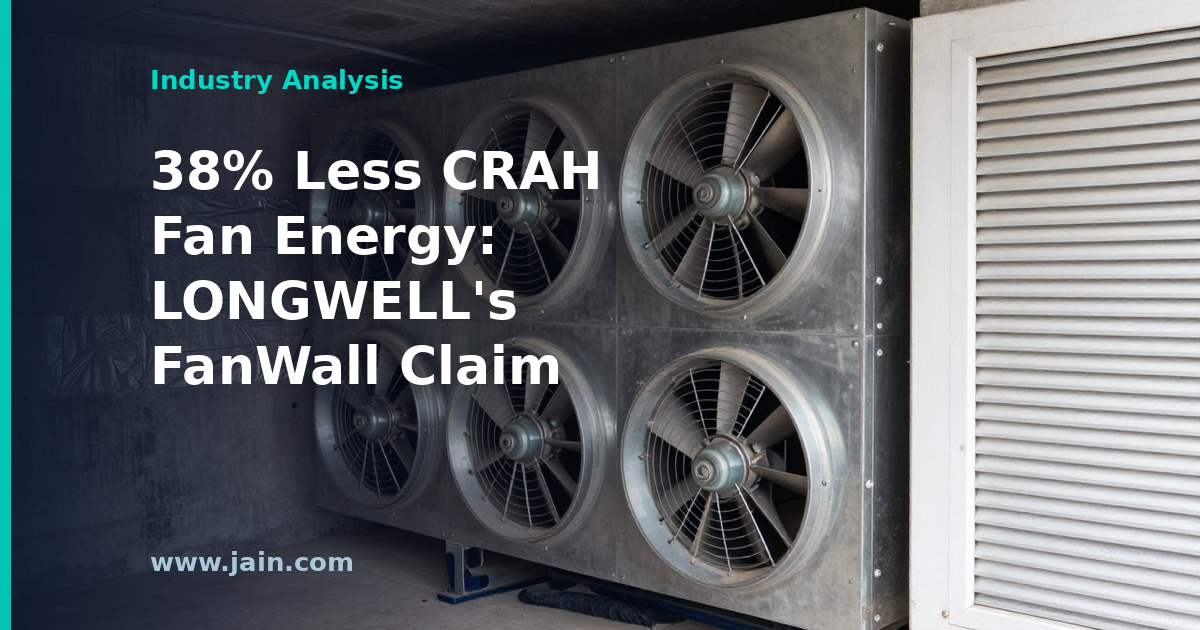
Ningbo Longwell Electric Technology Co., Ltd. (LONGWELL), a Chinese fan and motor manufacturer founded in 1990, announced on 31 August 2026 an AI-era data center cooling line built around its LWBE3G EC plug-fan platform. Deployed as a FanWall array — a bank of smaller fans replacing one large fan — the company reports a 38% reduction in CRAH fan energy consumption, a 6.5 dB(A) noise reduction, and no field failures on the project cited.
The work was done with what LONGWELL describes as one of the world’s top three precision-cooling OEMs, which it does not name. LONGWELL says it delivered 12 engineering samples in 35 days, passed DV/PV testing 100% on the first attempt, and went from specification validation to mass production in 90 days. The first customer order was 1,500 units; 2025 deliveries exceeded 80,000 units under a 2025–2027 framework agreement with a stated annual minimum of 60,000 units.
Executive Summary
The headline number is a 38% cut in the electricity drawn by the fans inside CRAH units — the computer-room air handlers that push cold air through a data hall. LONGWELL also reports that the CRAH system’s contribution to the facility energy-efficiency metric improved from a 1.42 baseline to 1.28 on the project in question. Fan power is one of the largest non-IT loads in an air-cooled hall, so a double-digit percentage cut there is economically meaningful even though it changes nothing about the servers themselves.
The second, arguably more consequential claim is about speed. LONGWELL states that the incumbent European supplier on the same program had scheduled 14 months of development plus six months of production ramp, while LONGWELL completed spec-validation-to-mass-production in 90 days. If that comparison holds up, it says something about how quickly the precision-cooling supply chain can be re-sourced when AI buildouts compress every schedule — and about competitive pressure on established European fan vendors.
The context is thermal density. LONGWELL cites rack loads moving from 15–20 kW to 60–100 kW in two years, with next-generation platforms exceeding 100 kW. That trajectory is usually cited as the argument for liquid cooling. This announcement makes the opposite-facing point: the air side of the plant still exists, still consumes power, and still has efficiency headroom that operators can capture without re-plumbing a building.
Fan Power Is the Quiet Line Item in Data Center Energy
In an air-cooled data hall, electricity splits between the IT equipment and everything that supports it: chillers, pumps, power conversion losses, and air movement. The air-movement share is easy to overlook because no single fan looks expensive, but CRAH fans run continuously, at every hour of every day, for the life of the facility. That duty cycle is what turns a percentage into money. A 38% reduction on a load that never switches off compounds differently from a 38% reduction on something that runs during business hours.
The physics behind FanWall designs is not exotic and is worth stating plainly for non-specialists: fan power rises steeply with speed, so several smaller fans each running slower can move the same air volume for less power than one large fan running hard. EC — electronically commutated — motors, which use electronic control rather than mechanical brushes, make that easier by allowing precise, continuous speed modulation instead of on-off cycling. The array also degrades gracefully; LONGWELL cites automatic N+1 failover, meaning the array carries a spare fan’s worth of capacity so a single failure does not force a shutdown.
None of that is unique to LONGWELL. FanWall architectures and EC motors are established practice across precision cooling, which is precisely why the interesting question in this release is not whether the approach works but what specifically LONGWELL’s platform was replacing, and at what operating point. The release’s own footnote says the comparative energy data refer to the equipment displaced on that project.
Ninety Days Versus Twenty Months: The Real Competitive Story
Component qualification is normally the slowest, least glamorous part of building cooling equipment. An OEM cannot simply swap a fan; it must re-run design verification and production validation testing, requalify acoustics and vibration, and re-certify the assembled unit. That is why the incumbent’s quoted 14-month development plus six-month ramp is not obviously unreasonable — it is roughly the industry’s normal cadence. LONGWELL’s claim is that it collapsed the same sequence to 90 days, with 12 engineering samples inside 35 days and a first-pass DV/PV result.
For buyers, first-pass DV/PV is the detail worth noticing. Test cycles fail routinely, and each failure costs weeks. A supplier that passes on the first attempt is signalling that its engineering samples already matched the specification, which is a manufacturing-maturity claim as much as a design one. For the precision-cooling OEMs racing to fill AI-driven order books, a supplier who can compress twenty months into three is solving a scheduling problem, not just a component-cost problem.
The competitive read is straightforward and should be stated without overreach: European fan suppliers have long held strong positions in HVAC and data center air movement on the strength of engineering depth and long qualification relationships. Speed of response is now being priced alongside that. The release does not claim the incumbent’s product was technically inferior — only that its timeline was longer on this program — and it explicitly disclaims any affiliation or endorsement.
What the 38% Establishes, and What It Does Not
LONGWELL is unusually candid in its own disclaimer: the performance data correspond to a specific project and a specific operating point, and final selection must be confirmed against operating point, voltage and control scheme, mounting arrangement, and project validation. That caveat is doing real work. Fan performance is highly sensitive to the pressure the fan works against, and a figure measured in one CRAH cabinet at one airflow does not transfer automatically to another.
The 1.42-to-1.28 figure deserves particular care. Those numbers are in the numerical range of PUE — power usage effectiveness, the ratio of total facility power to IT power, where 1.0 is theoretically perfect — but the release describes this as the CRAH system’s contribution to the efficiency metric on this project, not a whole-facility PUE for a named site. Read as a subsystem-level improvement it is a coherent result; read as a facility PUE it would be a much larger claim than the release supports. The distinction matters for anyone modelling savings.
The commercial figures are the most independently checkable part of the announcement, in the sense that they describe behaviour rather than test conditions. A first order of 1,500 units expanding to more than 80,000 units delivered in 2025, under a 2025–2027 framework with a 60,000-unit annual minimum, is a customer voting with volume. It is not third-party verification of 38%, but repeat purchasing at that scale is a stronger signal than a datasheet.
Air Cooling Does Not Disappear Because Liquid Arrives
The prevailing narrative says racks above roughly 60–100 kW must go to liquid cooling, and for the densest AI training clusters that is broadly where the industry is heading. But the transition is neither instant nor total. Direct-to-chip liquid cooling typically removes most, not all, of a rack’s heat; the remainder still leaves via air. Storage, networking, and general-purpose compute remain air-cooled. Retrofit halls with existing CRAH fleets will keep running for years on depreciation schedules that do not care about GPU roadmaps. Condensers and cooling towers — LONGWELL’s LWAE3G axial fan line targets these — are needed in liquid-cooled plants too.
That is the strongest version of this announcement’s editorial premise: air-side efficiency has remaining headroom precisely because it is being treated as legacy. Capital and attention are flowing toward liquid, which leaves ordinary optimisation of the air path comparatively under-exploited. Operators who cannot re-plumb a building this year can still change fans.
The counter-risk for a supplier in this position is that it is selling into a segment whose long-run share of new-build capacity may shrink even as its absolute installed base stays large. LONGWELL’s stated data center fan capacity of more than 120,000 units annually against a 60,000-unit contractual minimum suggests it has built for growth beyond this one customer; whether that growth comes from new AI halls, retrofits of existing ones, or the condenser and cooling-tower side of liquid-cooled plants is not something the release addresses.
Background
Precision cooling — the equipment class covering CRAC and CRAH units that hold data halls at controlled temperature and humidity — has historically been dominated by a small group of global OEMs, which in turn buy fans and motors from a specialist supply chain long anchored by European manufacturers. Fans are qualified rather than simply purchased: each one must pass verification testing inside the OEM’s cabinet, so incumbency has been durable and switching slow.
The AI compute buildout has strained that arrangement. As per-rack heat loads climbed from the 15–20 kW typical of general-purpose servers toward 60–100 kW and beyond for accelerated computing, OEMs have needed higher-performance air movement on schedules far shorter than the industry’s traditional multi-year qualification cadence. LONGWELL, a Ningbo-area manufacturer founded in 1990 and long active in HVAC-R and industrial fans, is one of several Asian suppliers positioning against that compressed timeline — an announcement that is as much about procurement velocity as about thermodynamics.
Source: La technologie FanWall de LONGWELL EC permet de réduire de 38 % la consommation énergétique des ventilateurs CRAH des centres de données IA de nouvelle génération — PR Newswire release, dated 31 August 2026 from Ningbo, China, detailing LONGWELL’s LWBE3G EC plug-fan platform, its reported CRAH fan energy and acoustic results, and the volumes shipped under a 2025–2027 framework agreement.