Eaton, one of the world’s biggest makers of electrical equipment, has finished enlarging its factory in Schrems, Austria. It added floor space nearly the size of an American football field in under ten months.
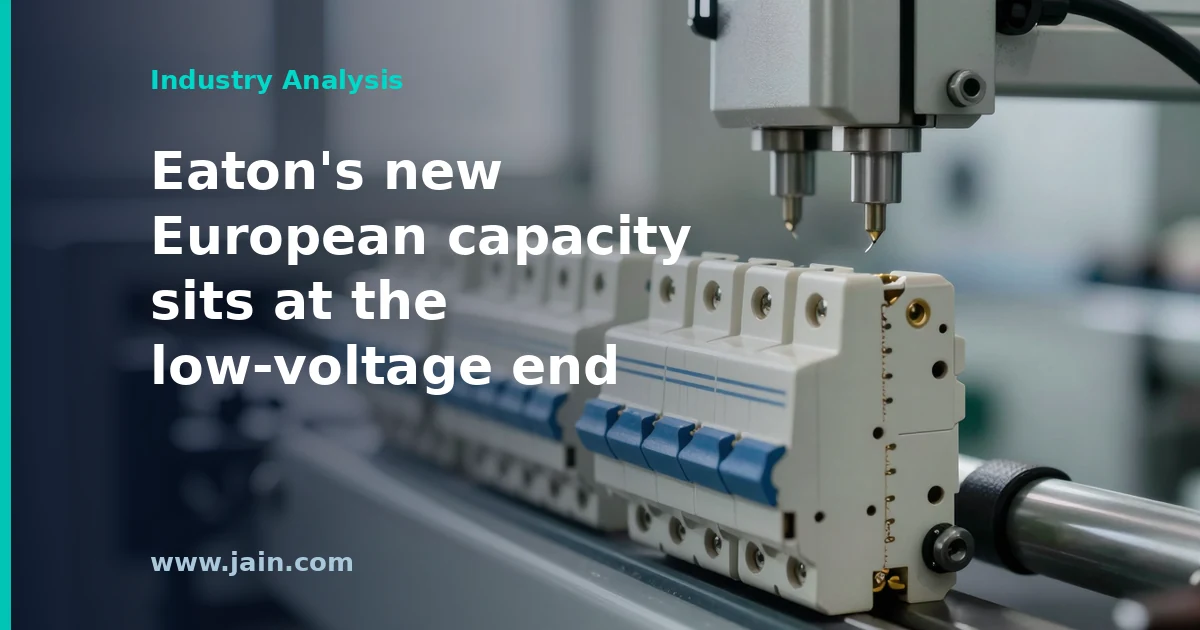
The new space makes small circuit breakers, the switches in a fuse box that cut power when something goes wrong, on fully automated lines. It also builds more of the larger equipment that spreads power around a building.
Why it matters: the computer warehouses behind artificial intelligence need large amounts of this gear. Eaton has not said how much more it will make.
Eaton is marking the completion of a 5,000-square-metre expansion of its manufacturing site in Schrems, Austria, on 1 October 2026, according to a company announcement published by the Financial Times. The new space houses fully automated production of miniature circuit breakers (the small protective devices that sit in electrical distribution panels and trip when a circuit overloads or faults) and expanded assembly capacity for low-voltage systems.
Eaton says the project was completed in less than ten months and ties it to rising European demand from electrification, digitalisation and critical infrastructure that depends on highly available electrical power. The company did not disclose the investment amount, production volumes or headcount.
Executive Summary
Eaton, which reported $27.4 billion in 2025 revenue, has added 5,000 m² of manufacturing space at its Schrems plant in Austria. The expansion combines fully automated miniature circuit breaker production with a manufacturing execution system, software that links machines, internal logistics and enterprise systems in real time, and end-to-end traceability for every product that leaves the line.
The announcement matters to data center builders because of where the capacity sits. Miniature circuit breakers and low-voltage systems form the downstream end of a facility’s electrical chain, the layer that distributes and protects power close to racks, cooling and building systems. Large AI facilities use this equipment in volume, and Eaton names data centers among its core markets.
The announcement covers less ground than a headline about European power capacity might suggest. It says nothing about medium-voltage switchgear or transformers, and Eaton has not quantified the added output. The expansion adds European supply at the breaker and panel level. Eaton has not shown that it relieves the larger, grid-side equipment queues.
Capacity at the Low-Voltage End of the Power Chain
To see where this expansion matters for AI data centers, follow electricity from the grid to a server. Power arrives at high voltage and is stepped down by transformers. It then passes through medium-voltage switchgear, the heavy equipment that switches and protects large feeders, and into low-voltage switchboards and distribution panels. Finally, individual circuit breakers protect each circuit feeding racks, cooling units and building systems. Eaton’s Schrems expansion adds fully automated miniature circuit breaker production and more low-voltage systems assembly, which places it at the downstream end of that chain.
That placement shapes how buyers should read the news. A large data center contains a great many protected circuits, so breakers and distribution equipment are consumed in volume. More European output at this layer is relevant to electrical contractors and developers who source panels and protective devices regionally. The announcement does not mention medium-voltage switchgear or transformers. Those are the larger, more engineered items that tend to dominate discussions of power-equipment lead times on AI projects.
The practical read is that any easing this expansion brings will show up at the breaker and panel level. Projects whose schedules depend on grid-side equipment should not treat it as relief on that front. The same product families also serve Eaton’s residential, commercial, industrial and utility customers. Data center demand therefore competes for this output with every other electrification project in Europe.
Ten Months to Build, With Software Coordinating the Floor
Eaton says the expansion was completed in less than ten months. How fast a supplier can add capacity is one of the few supply-side variables it controls directly. A short build suggests Eaton can respond within a single planning cycle when it decides a product line needs more output.
The more distinctive element is the factory’s digital layer. A manufacturing execution system (MES) is the software that tells machines what to make, tracks work in progress and connects production to inventory and ordering systems. Eaton describes Schrems’ MES as linking manufacturing, intralogistics and enterprise systems in real time. Combined with end-to-end traceability, meaning each unit’s production history can be followed, this addresses what the company calls increasingly demanding performance and compliance requirements. Operators of critical facilities typically need documentation of exactly what was installed and how it was made.
Full automation also fits the product. Miniature circuit breakers are high-volume, standardised devices, the kind of item where automated lines can raise output without a proportional increase in labour. Eaton has not said what output the new lines deliver. The economic logic is sound, but its effect on supply cannot yet be measured.
Regional Manufacturing as a Supply-Chain Argument
Eaton makes its case in supply-chain terms: faster response to changing customer needs, lower logistics costs, a smaller carbon footprint from proximity to European markets, and greater resilience in critical supply chains. For European data center developers, regionally made equipment can mean shorter shipping legs and less exposure to cross-border disruption. Those advantages matter most when construction schedules are tight.
Scale needs perspective. Eaton operates across 180 countries with $27.4 billion in 2025 revenue, so a 5,000 m² addition at a single site is incremental relative to the whole company. What the expansion offers is a signal of direction. Eaton is adding European capacity in product lines that data centers consume, and it has done so quickly. That is not the same as a step change in regional supply.
The workforce element addresses a quieter constraint. Eaton points to partnerships with local schools and its Connected Learning Center, opened in 2024, as ways of building the automation and digital-manufacturing skills the site needs. Those skills determine whether new capacity can be staffed and sustained as well as installed.
Background
Eaton is a Dublin-based power management company founded in 1911. It makes electrical protection and distribution equipment for data center, utility, industrial, commercial and institutional, residential, machine building, aerospace and mobility customers. It reported $27.4 billion in revenue in 2025 and serves customers in 180 countries.
Inside a data center, power flows from the grid through transformers and medium-voltage switchgear, then into low-voltage switchboards, distribution panels and circuit breakers that protect individual circuits. Every layer must be delivered before a facility can energise. Supply of this equipment has therefore become a planning concern for AI builds, and capacity additions by major manufacturers are watched closely.
Eaton, a large electrical-equipment company, is buying COL Group, an Italian company that builds equipment for the power grid, for about 923 million dollars.
That equipment includes the heavy machinery that turns high-voltage electricity into power a building can use. It is often one of the slowest things to get when building the giant computer warehouses behind artificial intelligence.
Instead of spending years building new factories in Europe, Eaton is buying factories that already run. That could speed up supply there, but it also leaves buyers with one fewer independent supplier.
Eaton Corporation has agreed to acquire COL Group, an Italian manufacturer of electrical grid equipment, for €810 million, Reuters reported. Yahoo Finance put the price at about $923 million. Eaton describes the deal as a way to expand its footprint in Europe.
Executive Summary
Eaton, one of the largest suppliers of power-distribution equipment to data centers, utilities and commercial buildings, is paying €810 million (about $923 million) for COL Group, an Italian maker of grid equipment. The stated purpose is European expansion. Eaton has not disclosed financing, an expected closing date or COL’s revenue.
The transaction matters beyond Eaton’s own geography because of what it acquires: working production. Grid equipment such as transformers and switchgear is heavy, largely built to order and slow to scale, and the rising power demands of AI data centers, electrification and renewable connections all compete for it. Buying an operating manufacturer gives Eaton plants, trained workers and qualified products at once. Building from scratch would mean waiting years for all three.
For developers, utilities and operators in Europe, the practical question is whether this adds effective supply or mainly moves existing supply under a new owner. Eaton’s answer will show up in what it does with COL’s plants after closing.
Buying a Factory Is Buying Time
The core logic of this deal is sequencing. A new plant for electrical grid equipment has to move through site selection, permitting, construction, tooling, hiring and training. Its products then have to be tested and qualified before utilities and large customers will accept them. Each step mostly waits on the one before it. An acquired manufacturer arrives with every one of those steps already done: the buildings stand, the workforce knows the processes, and the products already carry the approvals customers require.
Seen that way, the €810 million is partly a payment for time. Eaton gets European production capacity immediately, not at the end of a multi-year greenfield program (‘greenfield’ meaning built new on an empty site). The deal does not say how much capacity that is, and Eaton has not published COL’s output or revenue. The direction of the trade-off is still clear. When customers are waiting on equipment, a supplier that already has capacity in hand can capture orders that a supplier still pouring concrete cannot.
The people most affected are European data-center developers and utilities. Their project schedules depend on when electrical equipment arrives. Eaton’s competitors in the region are affected too, because they now face a rival with more local production and a broader portfolio.
Why Grid Gear Sits Upstream of Every AI Data Hall
Before a single AI server can switch on, power has to travel from the high-voltage grid into the building. Transformers step that voltage down to usable levels. Switchgear (the assemblies of breakers and switches that route and protect electrical circuits) directs it safely to each part of the facility. AI data centers need far more power per site than conventional ones, so they need more of this equipment, and they often need larger units.
Eaton already sells much of the power-distribution chain inside data centers. Adding a grid-equipment maker extends its reach toward the utility side of the connection, where equipment is heavier, more customized and typically slower to deliver. That upstream position is attractive when the binding constraint on a project is the electrical connection, not the building or the chips.
A caution applies to that thesis. The companies have framed this as European expansion, not as an AI or data-center move. Eaton has not said what share of COL’s business serves data centers versus utilities, industry or renewable projects. The AI demand case explains why grid-equipment capacity is valuable right now. It does not by itself establish that COL’s output will go to data centers.
What European Equipment Buyers Should Watch
Consolidation cuts two ways for buyers. An integrated supplier that can deliver equipment from the grid connection through to the server rack may simplify procurement and coordination on large projects. The same deal also leaves one fewer independent supplier in the market. That can weaken buyers’ negotiating position and concentrate supply risk with a single vendor.
Allocation is the other open issue. If COL’s existing customers are mainly utilities and industrial firms, they will want to know whether their orders keep their place in the queue once the plants belong to a company with heavy data-center exposure. A clear statement from Eaton on capacity expansion at COL’s sites, as opposed to reprioritizing existing output, would settle much of that uncertainty.
The Price and the Proof
The €810 million figure is the only hard number in the announcement. Without COL’s revenue, earnings or production volumes, outside observers cannot judge whether Eaton paid a premium for scarcity or a conventional industrial multiple (the price expressed as a multiple of the target’s earnings). The European-expansion claim is supported by the act of buying a European manufacturer. The larger claim, that this adds meaningful grid-equipment supply where AI and electrification projects need it, remains to be shown.
The evidence will come in stages. First is regulatory clearance. Then comes any announced investment in expanding COL’s plants. Last is whether Eaton begins quoting shorter European delivery times for the product lines COL makes. Until then, the deal is best read as a bet that owning production capacity now is worth more than building it later.
Background
Eaton is a diversified power-management manufacturer whose electrical segment supplies utilities, buildings, industrial sites and data centers. Its data-center products include power-distribution units, uninterruptible power supplies (backup systems that keep servers running through outages) and switchgear. The company has long used acquisitions to add product lines and regional manufacturing.
Europe’s grid is under pressure from several directions at once. Renewable generation needs new connections. Electrification of heating and transport raises demand. AI data centers compete for scarce connection capacity and for the equipment that makes those connections possible. That combined demand has made established grid-equipment makers valuable acquisition targets for suppliers that want production capacity quickly.
Eaton, a long-established maker of the equipment that moves electricity safely through buildings, says its best years are still ahead.
The reason is data centers: the giant warehouses of computers behind apps, online search and chatbots. Each one needs enormous amounts of electricity switched, routed and backed up in case the power fails, and Eaton sells much of that equipment.
The companies supplying the wiring behind the artificial intelligence boom can profit no matter which tech giant wins. The big open question is how long the building spree lasts.
Yahoo Finance reported that Eaton Corporation (NYSE: ETN), the power management company, sees its best years ahead, with demand from data centers powering its growth. The outlook ties Eaton’s trajectory directly to the electrical infrastructure needed by the facilities that run cloud computing and artificial intelligence (AI) workloads.
Executive Summary
Eaton is signaling confidence that data center construction will drive growth beyond anything in its recent history. The company makes the electrical backbone of these facilities: switchgear that routes and protects high-voltage power, uninterruptible power supplies (UPS) that keep servers running through outages, and power distribution units that deliver electricity to server racks.
The outlook matters because it points to where AI spending ultimately lands. Chips and cloud platforms get most of the attention, but every new data center hall needs power equipment before a single server can be switched on. That puts electrical suppliers among the most direct beneficiaries of the buildout, whichever chipmaker or cloud provider comes out ahead.
A forward-looking claim is not a result, though. A “best years ahead” view depends on data center spending staying strong, on Eaton’s ability to manufacture enough equipment, and on customers securing the grid power they need to finish their projects.
Selling Picks and Shovels for the AI Power Crunch
A data center is, at its core, a building that turns electricity into computation. Power arrives from the utility at high voltage, then passes through transformers, switchgear, backup systems and distribution equipment before it reaches the servers. Each stage is a purchase, and Eaton competes in many of them.
This is the classic picks-and-shovels position. Eaton does not need to predict which AI model, chip architecture or cloud provider will dominate. It needs data centers to keep getting built, and it needs those facilities to keep drawing more power. The industry trend toward denser server racks, where more computing and more electricity are packed into the same floor space, tends to raise the amount of electrical equipment each facility requires.
That makes the claim structurally credible. Unlike speculative software revenue, electrical infrastructure is a physical requirement: a facility cannot operate without it, and none of it can be skipped to save money.
Why Electrical Gear Holds Its Value
Power distribution equipment is often engineered to order, has to meet strict safety and reliability standards, and must be qualified by operators before it goes into a live facility. Large data center operators tend to standardize designs across many sites, so a supplier that wins a place in a reference design can see repeat orders as the design is rolled out.
Those features give incumbents such as Eaton real advantages over new entrants. They also help explain why established rivals, including Schneider Electric, Vertiv, ABB and Siemens, are chasing the same demand. The market is large enough to lift several suppliers, but competition over pricing, delivery slots and new designs will likely sharpen as manufacturing capacity catches up.
For data center developers, the practical result has been a supplier’s market for critical electrical equipment. Buyers who reserve manufacturing capacity early are generally better placed than those who order once a site is ready to build.
The Risks Beneath a Bullish Outlook
The most obvious risk is concentration. If much of Eaton’s growth depends on a few very large buyers of data center capacity, a slowdown in their capital spending would show up quickly in new orders. Infrastructure booms have historically been followed by periods of digestion, when customers pause to absorb capacity they have already built.
A less obvious risk is power itself. In many markets, data centers are limited less by equipment than by how quickly utilities can connect them to the grid. If projects stall while waiting for electricity, orders for the gear that distributes that electricity can slip too. Eaton’s fortunes are therefore tied partly to utility and grid timelines it does not control.
Execution matters as well. Meeting surging demand requires factory expansion, skilled labor and reliable component supply. Growth that outpaces manufacturing capacity can lead to delivery delays that push customers toward competitors.
What It Means for Buyers and Investors
For data center operators and developers, a supplier this confident in demand is a signal to lock in procurement early and to qualify more than one vendor for critical equipment. Lead times and pricing are likely to remain a negotiation shaped by how tight the market stays.
For investors, Eaton’s outlook reinforces the view that power infrastructure is one of the more direct ways to gain exposure to the AI buildout. The durability of that thesis rests on the questions below: how much demand is actually contracted, and how long it lasts.
Background
Eaton Corporation is a long-established industrial company that has repositioned itself around power management. Its electrical business makes the equipment that carries electricity from the utility connection to the point of use, including switchgear, uninterruptible power supplies, power distribution units and related controls. The company also serves the aerospace, vehicle and industrial markets, and it trades on the New York Stock Exchange as ETN.
Data centers have become one of the most important markets for electrical equipment suppliers. The spread of cloud computing, and more recently the rapid growth of AI, has driven large technology companies and data center developers to build bigger, more power-hungry facilities. That has strained both equipment supply chains and utility grids, turning electrical infrastructure from a background purchase into a strategic bottleneck.
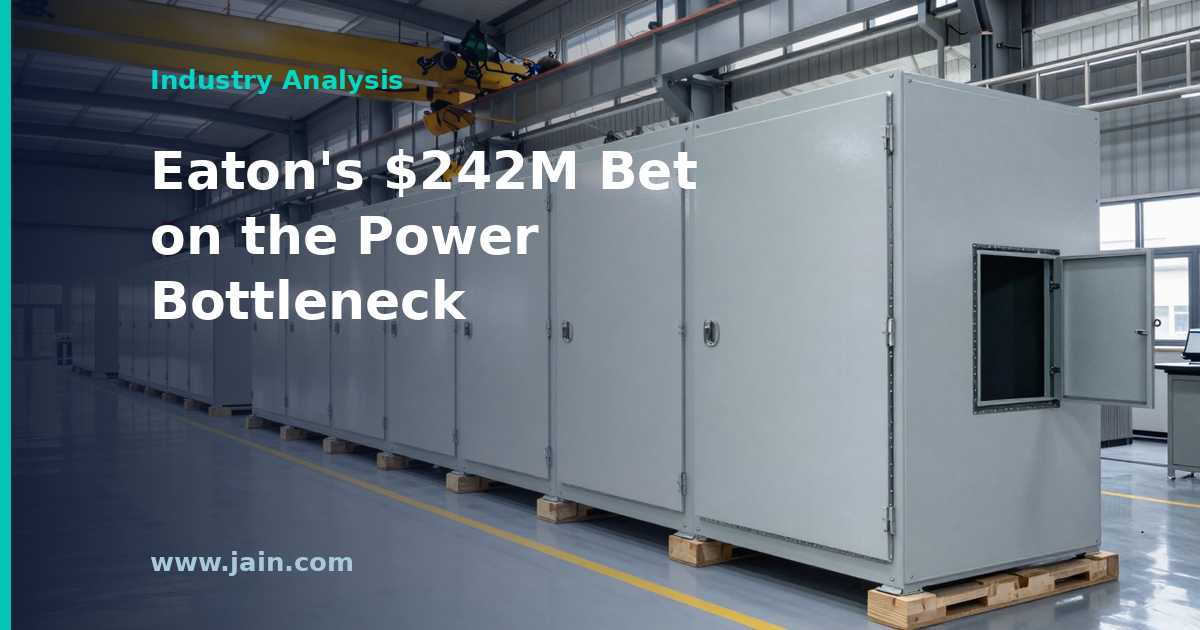
Eaton, a maker of electrical equipment, is spending more than $242 million on a new factory in North Little Rock, Arkansas. It will build the electrical rooms that feed power into data centers — assembled indoors on a production line and trucked to the site, the way a prefabricated house is.
The plant covers a million square feet, roughly seventeen football fields, and Eaton expects it to employ more than 1,200 people.
Why it matters: the thing slowing artificial intelligence down right now is not computer chips. It is getting electricity into the building.
Eaton (NYSE: ETN) announced on September 2, 2026 that it will invest more than $242 million in a new one-million-square-foot manufacturing facility in North Little Rock, Arkansas, which the company expects will double its U.S. capacity to build customized modular electrical enclosures and create more than 1,200 manufacturing, electrical and operations jobs. The plant will produce for Eaton’s Fibrebond business, which the company acquired in April 2025 and which has operated in Minden, Louisiana for more than 40 years.
Eaton says the added capacity is aimed at demand across data center, utility, industrial and digital communications markets. Arkansas Governor Sarah Huckabee Sanders, the Arkansas Economic Development Commission, the City of North Little Rock and the Metro Little Rock Alliance are named as partners on workforce development and technical-skills training tied to the site. Eaton did not announce a construction start date, a production timeline, or the value of any state or local incentives.
Executive Summary
An enclosure is the box the power gear lives in. A modular electrical enclosure is that box built in a factory — walls, switchgear, transformers, wiring, terminations — tested as a unit and shipped to site on a truck, so that work which would otherwise be done by electricians in a muddy field is instead done indoors on a production line. Eaton is committing $242 million to build more of them, and says the Arkansas plant will double what it can produce in the United States.
The scale of the check is worth keeping in proportion. Eaton reported $27.4 billion of revenue and $4.1 billion of net income in 2025; $242 million is under one percent of a single year’s sales. This is not a bet-the-company move. It is a capacity decision, and capacity decisions from component vendors are among the more honest signals available about where a supply chain is actually jammed — a factory takes years to pay back and cannot be quietly cancelled the way a press-release partnership can.
The signal here is specific: Eaton is not adding generation, or chips, or land. It is adding the ability to prefabricate the electrical middle of a data center. That points at a constraint that has migrated downstream, away from megawatts on paper and toward the physical equipment and skilled labor needed to move power the last few hundred feet into a building.
The Bottleneck Moved Downstream
For most of the current AI buildout, the public conversation about power has been about supply: whether utilities can generate enough electricity, whether gas turbines and grid interconnections can be secured, whether a region has spare capacity at all. Those constraints are real. But they are upstream constraints, and a project that clears them still has to solve a second problem — getting that power from the substation fence line into thousands of racks, through switchgear, transformers, breakers, busway and distribution equipment, all of it engineered to the specific site.
That downstream layer has become its own queue. The equipment is heavy, custom, subject to long lead times, and installed by a trade — industrial electricians — that is in short supply across the country and cannot be scaled on the schedule a hyperscale campus wants. Eaton’s own commentary points in this direction: the company said in July that it delivered record second-quarter 2026 results with accelerating orders and a growing backlog, and raised its organic growth guidance. A backlog is unshipped demand. Adding a factory is the response to a backlog you expect to persist.
Eaton’s framing supports a broad read rather than a purely AI one. The release names data center, utility, industrial and digital communications markets, and the company did not break out how much of the new capacity is earmarked for any of them. Utilities are replacing aging distribution equipment and telecom operators are densifying networks; both compete for the same factory hours. The honest statement is that Eaton sees enough aggregate demand across electrification end markets to double a product line’s U.S. footprint — with data centers as the loudest, but not the only, driver.
Why a Factory Beats a Field
The economic case for modular enclosures is a labor-arbitrage and schedule-certainty case, not a materials one. The same switchgear costs roughly the same whether it is installed on site or in a plant. What changes is who installs it, under what conditions, and when the schedule risk lands. In a factory, work is repeatable, weather-independent, inspected under controlled conditions, and performed by a trained workforce that stays put between jobs. On site, the same work is sequential, exposed to trade stacking and rain delays, and dependent on scarce electricians who must be hired into whatever county the campus was built in.
That is why Eaton’s chosen phrasing — customers wanting to deploy power infrastructure “faster, with greater certainty and less complexity” — maps onto something buyers can actually price. Certainty is the product. For an operator whose revenue starts the day the racks energize, compressing field electrical work and de-risking the commissioning date is worth paying a premium for, and it is measurable in a way that generic capacity claims are not.
The Fibrebond history explains why Eaton is doubling down rather than experimenting. Eaton bought the business in April 2025, and it had already been building enclosures in Minden, Louisiana for over 40 years; Eaton says Minden’s capacity has itself doubled over the past three years and continues to receive investment. Arkansas is therefore a second node, not a replacement — geographic diversification of a proven line, plus a labor pool in a metro area that a single small-town plant could not reach. It also fits a broader Eaton pattern of pushing toward integrated, pre-engineered data center solutions, including a reference design announced with Trane Technologies in August aimed at AI data center efficiency and installation cost.
What $242 Million Buys — and What It Doesn’t
Two arithmetic points deserve stating plainly. First, $242 million across one million square feet works out to roughly $242 per square foot of building — consistent with heavy industrial construction plus tooling, and a reminder that a meaningful share of this money is concrete and cranes, not incremental production equipment. Second, “doubles U.S. capacity” is a ratio without a denominator. Eaton has not published Minden’s current output in units, megawatts served, or dollars, so the doubling cannot be converted into how many data center halls per year the industry actually gains. Directionally credible; quantitatively opaque.
There is also a limit to what an enclosure plant can unclog. The enclosure is the wrapper; the constrained contents — large power transformers, medium-voltage switchgear, breakers, and the copper and steel behind them — have their own lead times and their own factories. Doubling enclosure assembly capacity relieves the integration and field-labor step. It does not by itself shorten the wait for a transformer. Buyers evaluating this announcement should ask which specific lead time in their own schedule it compresses.
On winners and losers: the clearest beneficiaries are large data center developers with repeatable designs, who can put standardized modular power blocks into a queue and take delivery on a predictable cadence. Regional electrical contractors lose some scope as work migrates from the field into the plant, though the field commissioning and interconnection work remains. Central Arkansas gains an anchor industrial employer and, per the release, a structured technical-training pipeline — genuinely valuable, and also the part of any plant announcement most exposed to slippage, since job counts are expectations rather than commitments and typically ramp over years. Competing enclosure and integrated-power vendors now face a rival with roughly twice the domestic assembly capacity, which is a durable competitive fact in a market where the scarce good is a delivery slot.
Background
Eaton, founded in 1911 and headquartered for operational purposes in Cleveland with legal domicile in Dublin, sells electrical and industrial power equipment into data center, utility, commercial, residential, aerospace and mobility markets. Its electrical business has been the primary beneficiary of two long-running trends the company calls electrification and digitalization — more of the economy running on electricity, and more of that electricity flowing into compute. It reported $27.4 billion of revenue in 2025 and serves customers in 180 countries.
The modular power segment it is expanding here sits at a specific choke point in data center construction. As campuses grew from tens to hundreds of megawatts, the electrical scope outgrew what could be reliably built in the field on the schedules operators demanded, and prefabrication moved from a niche option to a default for large repeatable designs. Eaton’s April 2025 purchase of Fibrebond bought it a four-decade-old position in that segment; the Arkansas plant is the first major capacity expansion announced under Eaton’s ownership, and it follows other moves toward pre-engineered data center offerings, including a reference design developed with Trane Technologies announced in August 2026.
Financial media reports in August 2026 highlight that GE Vernova’s orders for AI data-center equipment in the first half of the year have already doubled the total it booked in all of 2025, according to coverage from The Motley Fool syndicated across Yahoo Finance and The Globe and Mail. In parallel, Yahoo Finance analysis asks whether Eaton Corporation and Trane Technologies — suppliers of electrical distribution gear and cooling systems, respectively — can emerge as major winners from the same AI data-center boom.
None of the items is a company press release; they are investor-focused analyses built around the order-growth headline. But taken together, they point at a consistent industry story: the equipment that powers and cools AI facilities, not the chips inside them, is where demand is now outrunning supply.
Executive Summary
The headline claim is striking: in one half-year, GE Vernova — the energy-equipment company spun out of General Electric — booked more AI data-center orders than in the entire previous year. The coverage frames this as evidence that hyperscalers and data-center developers are racing to lock in turbines, grid equipment, and electrical infrastructure years ahead of need. The companion piece extends the thesis to Eaton, which makes the switchgear, transformers, and power-distribution systems inside data centers, and Trane, whose chillers and thermal-management systems remove the enormous heat that AI server racks generate.
Why it matters: for the past two years, the constraint on AI capacity was widely assumed to be GPU supply. These reports suggest the constraint is migrating downstream — to megawatts and cooling tons. A data center without secured power generation, electrical distribution, and heat rejection cannot deploy a single chip, no matter how many accelerators its owner has purchased. If order books at the equipment makers are filling this fast, delivery lead times become a strategic variable for everyone building AI infrastructure.
A caveat up front: the source material is investment commentary, not audited disclosure. The doubling claim originates in stock-analysis coverage, and the articles supply no dollar figures, customer names, or delivery schedules that we can independently verify from the release text alone. The direction of the signal is consistent across outlets; the precision of it is not something this coverage establishes.
The Bottleneck Has Moved Downstream from Chips to Electrons
Every AI data center is, functionally, a machine for converting electricity into computation and heat. The industry spent 2023–2025 focused on the computation side — who could get GPUs, and how many. But GPUs are a fast-cycle product: fabs can expand output on a timescale of quarters. Heavy electrical equipment is not. Gas turbines, large power transformers, and high-capacity switchgear are engineered-to-order products with lead times measured in years, built in a small number of factories worldwide. When demand doubles, capacity cannot.
That asymmetry is what makes the reported GE Vernova order surge significant beyond one company’s income statement. If AI data-center orders in six months exceeded all of last year’s, buyers are effectively queueing — paying now for delivery slots later. In infrastructure markets, a lengthening queue is the classic signature of a bottleneck: the constraint on how fast the AI buildout can proceed stops being capital or chips and becomes the physical delivery calendar of the equipment supply chain.
Three Companies, Three Layers of the Same Stack
The coverage bundles GE Vernova, Eaton, and Trane together for a reason: they occupy successive layers of the same value chain. GE Vernova sits upstream, supplying power generation and grid-scale equipment — the megawatts themselves. Eaton sits in the middle, making the electrical distribution gear — switchgear, uninterruptible power supplies, transformers — that moves power safely from the substation to the server rack. Trane sits at the end of the energy journey, providing the chillers and cooling systems that reject the heat those racks produce. In a conventional data center, cooling can consume a substantial share of total power; AI racks, which run far denser than traditional IT loads, intensify that thermal problem.
The strategic implication is that AI demand does not create one winner but a chain of them — and a chain of potential choke points. An operator who secures generation but not switchgear, or switchgear but not chillers, still cannot open. That is why the market is asking the Trane-and-Eaton question at all: if the upstream layer (GE Vernova) is visibly capacity-constrained, the same dynamic plausibly applies to the layers behind it. Plausibly — the coverage poses the question about Eaton and Trane rather than documenting equivalent order data for them, and that distinction matters.
Reading Order Books Honestly: Signal, Not Revenue
Orders are a forward indicator, not money in the bank. An order becomes backlog, backlog becomes revenue only upon delivery, and the coverage here does not disclose the dollar value of the orders, their delivery timeline, cancellation terms, or margin profile. History counsels some humility: capital-equipment cycles have seen order books swell during booms and thin out when customers re-time projects. If AI capital spending decelerates — because model economics disappoint, power prices spike, or financing tightens — equipment orders placed years ahead of need are among the first things large buyers revisit.
There is also a framing question worth noting even-handedly. All three source articles are investor commentary keyed to stock tickers, published across financial outlets asking “is the stock still a buy?” That genre rewards dramatic framing of growth statistics. The underlying fact pattern — surging demand for power and cooling equipment from AI builders — is consistent with what the broader industry has been experiencing, and nothing in the coverage appears contrived. But readers should distinguish between the well-supported directional claim (demand is heavily outrunning historical levels) and the precise multiples in headlines, which the articles as syndicated do not source to specific filings in the material available here.
What This Means for Anyone Building or Buying Capacity
For data-center operators and enterprise buyers, the practical takeaway is that procurement of electrical and thermal equipment has become a competitive discipline, not a back-office function. When lead times stretch, operators who ordered early hold an asset — a delivery slot — that late movers cannot buy at any price in the short run. Expect that advantage to show up in which projects actually energize on schedule, and in the pricing power of colocation providers who already hold contracted power and installed cooling.
For the equipment makers, the boom is an opportunity wrapped in a capacity-planning dilemma: expand factories aggressively and risk overcapacity if AI spending normalizes, or expand cautiously and cede share. How GE Vernova, Eaton, and Trane each answer that question — none of which this coverage addresses — will shape the supply side of the AI buildout for the rest of the decade.
Background
GE Vernova became an independent company in 2024 when General Electric split into separate aviation, healthcare, and energy businesses, giving the energy unit a standalone identity spanning power generation, wind, and grid electrification. Eaton is a long-established power-management company whose electrical segment supplies the distribution and backup-power equipment inside commercial facilities and data centers. Trane Technologies, formed from the 2020 separation of Ingersoll-Rand’s climate businesses, is one of the world’s largest suppliers of commercial HVAC and chiller systems.
The market context is the AI infrastructure buildout that accelerated from 2023 onward, as hyperscale cloud providers and specialized developers began constructing data centers of unprecedented power density to train and run large AI models. That expansion has pushed demand for generation capacity, grid interconnection, electrical gear, and industrial cooling well beyond historical data-center norms — turning previously unglamorous equipment categories into strategically contested supply.