Tag: earnings

  • Nvidia Revenue Jumps 85% as AI Infrastructure Demand Strains the Compute Supply Chain

    Nvidia Revenue Jumps 85% as AI Infrastructure Demand Strains the Compute Supply Chain

    Nvidia’s revenue grew 85% on the strength of AI infrastructure demand, according to a CIO Dive report published May 22, 2026. The figure — the only quantified data point in the report as surfaced — points to enterprises and cloud providers continuing to buy AI compute at a pace few hardware markets have ever sustained.

    Executive Summary

    An 85% revenue jump at a company already among the world’s largest chipmakers is not a startup doubling off a small base. At Nvidia’s scale, that percentage implies tens of billions of dollars in incremental sales, driven — per the report — by demand for AI infrastructure: the GPUs (graphics processing units repurposed as AI accelerators), networking gear, and integrated systems used to train and run artificial-intelligence models.

    The number matters beyond Nvidia’s shareholders because Nvidia sits at the front of the AI build-out pipeline. Every accelerator it ships must eventually land in a rack, draw power, be cooled, and be connected. A growth rate like this is therefore a leading indicator for data center construction, electricity demand, and colocation absorption — the downstream industries that turn chips into working AI capacity.

    That said, the source is a headline-level report with a single figure. It does not, as surfaced, disclose absolute revenue, the fiscal period covered, segment mix, margins, or guidance — all of which determine whether this print signals accelerating demand or the tail end of a catch-up cycle. Our analysis works within those limits.

    Growth at This Scale Is a Demand Signal, Not a Rounding Error

    The law of large numbers says percentage growth should fall as a company gets bigger. Nvidia posting 85% growth despite already dominating the AI accelerator market suggests the pull from AI infrastructure buyers remains intense: cloud providers, model developers, and increasingly mainstream enterprises are still racing to secure training capacity (the compute used to build AI models) and inference capacity (the compute used to run them for users).

    What a single growth rate cannot tell you is trajectory. Without the absolute figures or prior-quarter comparisons, an 85% jump could represent acceleration, steady state, or deceleration from even hotter periods earlier in the AI cycle. It also cannot distinguish broad-based enterprise adoption from a handful of hyperscale customers placing enormous orders — a distinction that matters greatly for how durable the demand is. The honest reading of this report is directional: demand remains strong enough to move one of the world’s largest revenue bases by nearly half again.

    The Squeeze Moves Downstream: Power, Cooling, and Floor Space

    Chips are only the first link in the AI supply chain. Each generation of AI accelerators draws more power per rack than the last, pushing many deployments beyond what traditional air cooling handles and toward liquid cooling. When Nvidia’s revenue grows 85%, the practical consequence is a wave of hardware that needs megawatts of grid capacity, high-density data center space, and dense fiber connectivity — resources that take years, not quarters, to build.

    For the infrastructure industry, that makes this print quietly bullish: data center operators, power-infrastructure providers, cooling vendors, and network carriers all sit downstream of Nvidia’s shipments. It also relocates the bottleneck. In the early AI boom the constraint was chip supply; increasingly, the constraint is where to plug the chips in. Buyers evaluating AI deployments should read Nvidia’s growth as a warning that competition for powered, cooled capacity is intensifying alongside competition for the silicon itself.

    Concentration Cuts Both Ways

    Nvidia’s position rests heavily on its CUDA software ecosystem — the programming platform that most AI frameworks target — which raises switching costs even when rival hardware is competitive on paper. But 85% growth is also the kind of number that motivates alternatives: rival merchant chipmakers, and the custom accelerators that large cloud providers design in-house to reduce dependence on a single supplier. The bigger the prize, the harder others will work to claim a share of it.

    Concentration on the buyer side deserves equal scrutiny. Industry-wide, a large share of AI infrastructure spending flows from a small set of hyperscale companies, and order patterns from a few buyers can swing a supplier’s results sharply in either direction. The report offers no customer breakdown, so neither the bullish case (broadening enterprise demand) nor the cautious one (dependence on a few giant purchasers) can be confirmed from this source. Both remain fair questions to hold open.

    Background

    Nvidia, founded in 1993, spent its first decades known mainly for gaming graphics cards. Its parallel-processing GPUs proved ideal for the deep-learning techniques that took off in the 2010s, and its CUDA software platform became the default foundation for AI development. When generative AI demand exploded after 2022, Nvidia’s data center business became its dominant revenue driver and the company rose into the ranks of the world’s most valuable firms, with successive accelerator generations selling out to cloud providers and AI developers.

    The broader market context is a global AI infrastructure build-out in which chip purchases, data center construction, and power procurement have become tightly linked: chip revenue at Nvidia today generally foreshadows demand for space, megawatts, and cooling across the data center industry tomorrow.

    Source: Nvidia revenue jumps 85% on AI infrastructure demand — CIO Dive report, May 22, 2026, on Nvidia’s revenue surge driven by AI infrastructure buying.

  • NVIDIA Q1 Beat on Blackwell Ramp Keeps Data Centers at the Core of AI Spending

    NVIDIA Q1 Beat on Blackwell Ramp Keeps Data Centers at the Core of AI Spending

    NVIDIA reported fiscal first-quarter results that beat Wall Street expectations, according to a May 20, 2026 report from Yahoo Finance, with the ramp of its Blackwell GPU platform and continued strength in its data center business cited as the drivers. The data center segment — the chips, systems, and networking sold to cloud providers and enterprises building AI capacity — remains the company’s growth engine.

    Executive Summary

    The headline is short but the signal is clear: as of mid-2026, demand for AI compute has not slowed enough to dent the results of the industry’s dominant supplier. NVIDIA’s quarterly reports have become a de facto barometer for the entire AI infrastructure economy, because nearly every hyperscaler, cloud provider, and AI lab routes a large share of its capital spending through NVIDIA’s data center products. A beat attributed to the Blackwell ramp means the newest generation of accelerators is shipping in volume and being absorbed by buyers.

    For the infrastructure industry — data center operators, power providers, network carriers, and cooling vendors — this matters more than the stock move. Every Blackwell system that ships needs a rack to sit in, megawatts to run on, liquid cooling to survive, and high-bandwidth connectivity to be useful. Strong GPU shipments today are a leading indicator of facility demand for the next several quarters.

    Why One Company’s Earnings Read as an Industry Health Check

    NVIDIA occupies an unusual position: it supplies the scarcest input in the AI buildout, so its revenue is effectively a meter on how much money the world’s largest technology companies are actually spending — not merely announcing — on AI capacity. Press releases about future data center campuses can slip or shrink; recognized GPU revenue cannot. When the data center segment beats expectations, it means purchase orders were placed, systems were built, and customers took delivery.

    That is why analysts treat these reports as a proxy for hyperscaler capital expenditure. The persistent worry in this cycle has been a gap between announced AI ambitions and realized spending. A quarter driven by Blackwell — the successor architecture to Hopper, designed for large-scale AI training and inference — suggests buyers are not just sustaining spend but migrating to the newest, most power-dense generation.

    The Blackwell Ramp Is a Facilities Story, Not Just a Chip Story

    Each GPU generation raises the bar on what a data center must provide. Blackwell-class systems are typically deployed in dense racks that draw far more power than traditional enterprise IT and generally require liquid cooling rather than air. A successful ramp therefore implies a parallel ramp in facilities engineered for high-density, liquid-cooled deployments — and it pressures older facilities that cannot economically retrofit.

    The winners in that shift extend well beyond NVIDIA: colocation and wholesale data center operators with available power, utilities and on-site generation providers, cooling-equipment manufacturers, and the optical and electrical networking suppliers that stitch GPU clusters together. The constraint has increasingly moved from chip supply to megawatts and grid interconnection queues — meaning the bottleneck NVIDIA’s customers face next is often land, power, and time, not silicon.

    What a Beat Does and Does Not Prove

    A single quarter’s beat confirms present demand; it does not settle the debate about durability. Skeptics of the AI buildout argue that spending is concentrated among a handful of hyperscalers and well-funded AI labs, and that returns on AI investment must eventually justify the capital outlay. Supporters counter that inference — running AI models in production, not just training them — is broadening the buyer base. The headline alone does not adjudicate this; it tells us the engine was still pulling as of the April-ending quarter.

    It is also worth remembering that expectations themselves are a moving target. “Beat” means results exceeded analyst consensus, and consensus for NVIDIA has been recalibrated upward repeatedly for over two years. The more durable takeaway for infrastructure planners is directional: the newest platform is ramping, and buyers are absorbing it.

    Background

    NVIDIA began as a graphics-chip company for PC gaming, but its GPUs proved ideal for the parallel math behind modern AI, and since late 2022 the generative-AI boom has transformed it into the central supplier of the AI buildout and one of the world’s most valuable companies. Its data center segment now dwarfs its original gaming business, and its quarterly reports are watched as a barometer for AI capital spending across the technology industry.

    The Blackwell platform, announced in 2024 as the successor to the Hopper generation, is deployed in dense, liquid-cooled rack systems by cloud providers and AI companies. Each generational transition raises the power and cooling requirements on the data centers that host these systems, tying NVIDIA’s product cycle directly to the fortunes of the facilities, power, and connectivity industries.

    Source: NVIDIA Q1 Earnings Beat on Blackwell Ramp-Up, Data Center Strength — Yahoo Finance report, May 20, 2026, on NVIDIA’s fiscal first-quarter results exceeding analyst expectations.

  • Akamai’s $1.8 Billion AI Deal: The Edge Muscles Into AI Inference

    Akamai’s $1.8 Billion AI Deal: The Edge Muscles Into AI Inference

    On May 7, 2026, CNBC reported that shares of Akamai Technologies surged roughly 20% after the company posted quarterly earnings and disclosed a $1.8 billion AI infrastructure deal. The headline pairing — an earnings beat narrative and a large AI-branded contract — was enough to produce one of the stock’s sharpest single-day moves in years.

    Details of the deal itself, including the customer, the contract length, and how the $1.8 billion figure is measured, were not spelled out in the report summary, making the market reaction as notable as the disclosed facts.

    Executive Summary

    Akamai, best known as the company that pioneered the content delivery network (CDN) — the globally distributed layer of servers that speeds up websites and video by caching content close to users — is now being valued, at least for a day, as an AI infrastructure company. A $1.8 billion deal figure attached to AI infrastructure is large by Akamai’s historical contract standards, and the ~20% share-price response suggests investors see it as evidence of a genuine second act rather than a one-off.

    The strategic significance is bigger than one contract. AI ‘inference’ — the work of running an already-trained model to answer queries, as opposed to the massive centralized job of training it — is widely expected to become the dominant, recurring cost of AI. Inference rewards low latency and proximity to users, which is precisely the asset CDN operators have spent decades building. This deal is an early, dollar-denominated data point for the thesis that edge networks can capture a meaningful slice of AI spending long dominated by hyperscale cloud providers and GPU ‘neocloud’ specialists.

    That said, the public record here is thin: a headline number, a stock move, and an earnings print. What the deal actually obligates, over what period, and at what margin remains unstated — and those details determine whether this is a turning point or a well-timed press moment.

    From Cache to Compute: A Second Act Decades in the Making

    Akamai has reinvented itself before. Founded in 1998 out of MIT to solve web congestion, it built one of the world’s most distributed server networks, then layered a substantial security business on top of it, and in 2022 acquired cloud provider Linode to add general-purpose computing. The through-line is a single physical asset: thousands of points of presence wired close to end users. An AI inference business is the logical next tenant for that real estate — the servers change from caching video to running models, but the geographic advantage is the same.

    The strategic question has always been whether that advantage is monetizable at scale, or whether AI spending would remain concentrated in a handful of giant centralized data centers. A $1.8 billion figure — if it represents committed customer revenue — would be the strongest public evidence yet that at least one large buyer believes distributed inference is worth paying for. The market’s 20% re-rating says investors are willing to extend that belief to the whole franchise.

    Why Inference Economics Could Favor Distributed Networks

    Training a frontier AI model is a centralized, power-hungry project measured in gigawatts and months. Inference is the opposite: billions of small, latency-sensitive requests arriving from everywhere, all day, forever. For chatbots, voice agents, translation, fraud scoring, and video analysis, shaving tens of milliseconds by serving the request near the user materially improves the product. That is the same physics that made CDNs valuable, and it is why edge operators argue the inference market will fragment geographically even as training consolidates.

    There is also a cost argument. Inference does not always need the newest, scarcest GPUs; a distributed fleet of mid-range accelerators running close to demand can undercut centralized capacity that carries hyperscaler margins and long-haul network costs. If Akamai can fill its existing footprint with inference workloads, the incremental economics could be attractive — the network, facilities, and customer relationships are already paid for. The unproven part is utilization: an inference fleet only earns those economics if demand actually shows up across hundreds of locations rather than pooling in a few metros.

    What $1.8 Billion Does — and Does Not — Tell Us

    Headline contract values in infrastructure deserve scrutiny regardless of who announces them. A $1.8 billion deal could be a multi-year total contract value recognized over five or more years, a capacity reservation with usage-based true-ups, or something structured differently — each implies a very different annual revenue impact for a company of Akamai’s size. The reporting available at publication does not say which, nor does it identify the customer, and a deal this large is by definition concentrated: one counterparty’s fortunes and renewal decision matter enormously.

    The same even-handedness applies to the skeptics’ case. A 20% single-day move on a deal without disclosed terms can look like AI-headline enthusiasm — but it coincided with an earnings report, so the market was plausibly repricing the whole business, not just one contract. The honest reading as of May 7, 2026: the deal is a substantiated, material fact; the interpretation that edge players are now structural winners in AI is a reasonable thesis this deal supports but does not yet prove.

    Competitive Ripples: Hyperscalers, Neoclouds, and the Rest of the Edge

    If distributed inference contracts of this size become repeatable, several markets shift. Hyperscale clouds (AWS, Microsoft Azure, Google Cloud) would face price and latency competition at the edge of the network they largely ceded to CDNs. GPU neoclouds — specialists that rent raw AI compute — would face a rival that bundles compute with a global delivery and security network. And Akamai’s CDN peers, along with data center operators with many small regional facilities, gain a template: the deal implicitly re-prices every well-distributed footprint as potential AI infrastructure.

    For enterprise buyers, more credible suppliers is straightforwardly good news — inference pricing has been set in a sellers’ market. The caveat is execution risk: operating AI infrastructure at the edge means securing accelerator supply, power, and cooling across many sites, disciplines where hyperscalers have a decade of hard-won scar tissue. Winning the deal is the beginning of that test, not the end.

    Background

    Akamai Technologies was founded in 1998 by MIT researchers to solve early-web congestion and grew into the archetypal content delivery network, at one point carrying a substantial share of global web traffic across tens of thousands of distributed servers. As CDN pricing commoditized through the 2010s, Akamai diversified into web and API security, which became a major revenue pillar, and then into cloud computing with its 2022 acquisition of developer-favorite Linode.

    The AI boom initially concentrated infrastructure spending in massive centralized training campuses built by hyperscalers and GPU specialists. By 2025–2026, attention was shifting toward inference — the ongoing cost of actually serving AI to users — reopening the question of whether distributed, latency-optimized networks would claim a structural role in AI economics. Akamai’s May 2026 deal disclosure landed squarely in that debate.

    Source: Akamai stock soars 20% on earnings, $1.8 billion AI infrastructure deal — CNBC, May 7, 2026, reporting Akamai’s share-price surge following its earnings release and AI infrastructure deal disclosure.

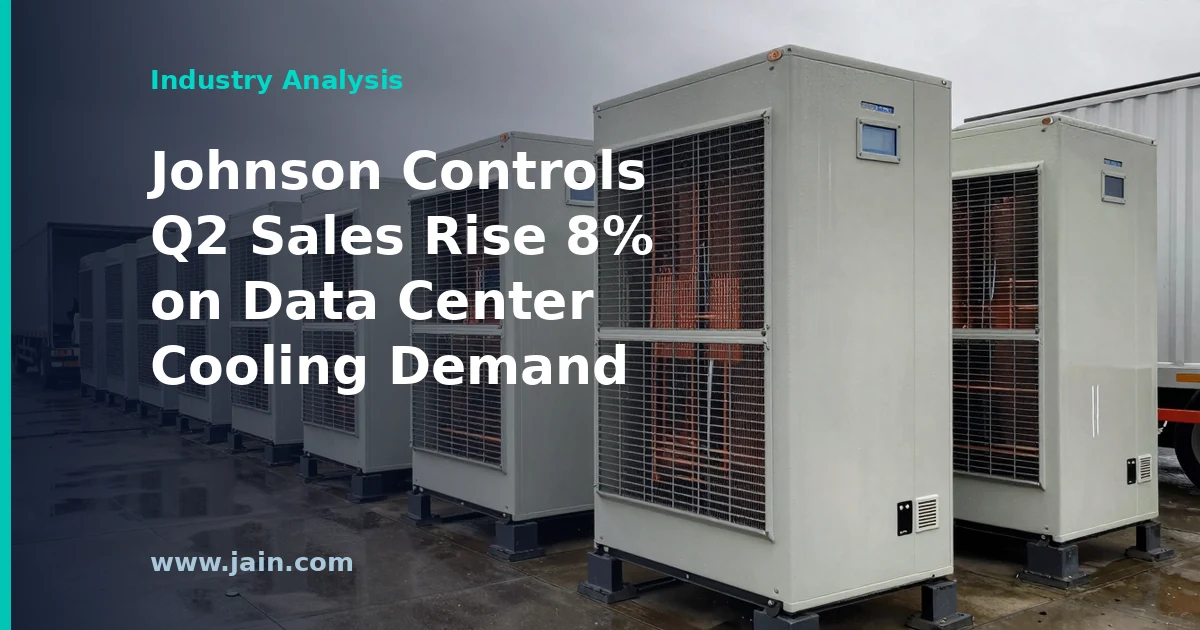
  • Johnson Controls Q2 Sales Rise 8% on Data Center Cooling Demand

    Johnson Controls Q2 Sales Rise 8% on Data Center Cooling Demand

    Johnson Controls, one of the world’s largest building-technology and HVAC companies, reported an 8% year-over-year increase in sales for its fiscal second quarter, with data center cooling demand cited as a principal driver, according to a May 7, 2026 report by Facilities Dive. Because Johnson Controls’ fiscal year ends in September, its second quarter covers roughly January through March 2026.

    Executive Summary

    The headline number — 8% sales growth at a company of Johnson Controls’ scale — is notable less for its size than for its attribution. When a diversified industrial that sells everything from fire-suppression systems to building controls credits data center cooling as the engine of a quarter, it quantifies something the industry has sensed for two years: AI-driven data center construction has become a primary demand source for the industrial HVAC sector, not a niche vertical.

    Cooling is the second-largest consumer of power and capital in a data center after the IT equipment itself, because nearly every watt a server draws becomes heat that must be removed. As hyperscale operators — the companies running the largest cloud and AI facilities — race to add capacity, the vendors who make chillers, air handlers, and thermal-management systems are seeing that race show up directly in their revenue lines. Johnson Controls’ quarter is one of the cleaner public data points yet on how large that effect has become.

    From Building Controls to AI Infrastructure Supplier

    Johnson Controls has spent recent years narrowing its portfolio toward commercial buildings and applied HVAC — the large, engineered cooling systems used in campuses, hospitals, and data centers — including divesting its residential and light-commercial HVAC business to Bosch and acquiring Silent-Aire, a maker of modular cooling and hyperscale data center equipment, in 2021. A quarter in which data center cooling is called out as the growth driver suggests that repositioning is doing what it was designed to do: concentrate the company’s exposure where capital spending is heaviest.

    That matters for how investors and customers should read the company. Johnson Controls is increasingly priced and evaluated not as a building-products conglomerate but as a supplier to AI infrastructure buildouts — a category that commands different growth expectations, and different scrutiny, than traditional construction-linked HVAC.

    The Economics of the Cooling Boom

    Data center cooling is attractive business for industrial vendors for structural reasons. The equipment is large, engineered-to-order, and often sold with long-term service contracts — chillers (machines that produce chilled water to absorb heat from server halls) run continuously for decades and require ongoing maintenance. Hyperscale projects are also ordered in fleets rather than units, which fills factory backlogs years ahead and gives manufacturers unusual visibility and pricing power compared with the one-building-at-a-time commercial construction cycle.

    The industry is simultaneously navigating a technology transition. As AI chips grow denser, air cooling reaches physical limits, and liquid cooling — circulating coolant directly to the chips or their racks — is taking a growing share of new deployments. That transition is an opportunity for incumbents with liquid-capable portfolios and a risk for anyone whose installed strength is concentrated in legacy air-based systems. The source report does not break down how much of Johnson Controls’ growth came from which technology, a distinction that matters for judging how durable the growth is.

    A Rising Tide Across the Vendor Field

    Johnson Controls is not alone in reporting data-center-driven strength; the same demand wave has lifted results across thermal-management and power-equipment vendors, and competitors such as Vertiv, Carrier, Trane Technologies, Schneider Electric, Munters, and Daikin all compete for slices of the same buildouts. The significance of this quarter is corroborative: each vendor that attributes measurable growth to data centers adds evidence that hyperscale capital spending is flowing through to the industrial supply chain broadly, rather than pooling with one or two specialists.

    For data center operators and enterprises planning capacity, the flip side of vendor prosperity is procurement reality: strong vendor demand typically means longer lead times and firmer pricing for large cooling equipment. Buyers who plan orders early, standardize designs, and lock delivery slots hold the advantage in a seller’s market.

    The Concentration Question

    The risk embedded in an 8% quarter driven by one end market is the same as its appeal: concentration. Data center demand is ultimately a derivative of a handful of hyperscalers’ AI capital-expenditure decisions. If AI infrastructure spending decelerates — because of monetization pressure, power-availability constraints, or efficiency gains that reduce cooling intensity per unit of compute — the vendors that re-oriented toward this vertical would feel it quickly. Nothing in the source report suggests that is imminent, but a growth story built on one customer class deserves to be monitored as one.

    The even-handed reading: this quarter substantiates real, current demand flowing to a major HVAC vendor. It does not, by itself, establish how long the cycle runs, and the headline-level detail available leaves the durability question open.

    Background

    Johnson Controls traces its roots to 1885, when Warren S. Johnson commercialized the electric room thermostat, and grew over the following century into one of the world’s largest building-technology companies, spanning HVAC equipment (including the York chiller brand), building automation, and fire and security systems after its 2016 merger with Tyco. In recent years the company has deliberately narrowed toward commercial and engineered building systems, selling its residential and light-commercial HVAC business to Bosch and investing in data center capabilities, most visibly through the 2021 acquisition of hyperscale cooling specialist Silent-Aire.

    That repositioning coincided with the AI infrastructure boom, in which data center construction — and the power and cooling systems it requires — became one of the fastest-growing capital-spending categories in the global economy, reshaping demand for the entire industrial HVAC sector.

    Source: Data center cooling drives Johnson Controls’ Q2 sales up 8% — Facilities Dive report (May 7, 2026) on Johnson Controls’ fiscal second-quarter results and the role of data center cooling demand.