Tag: Dominion Energy

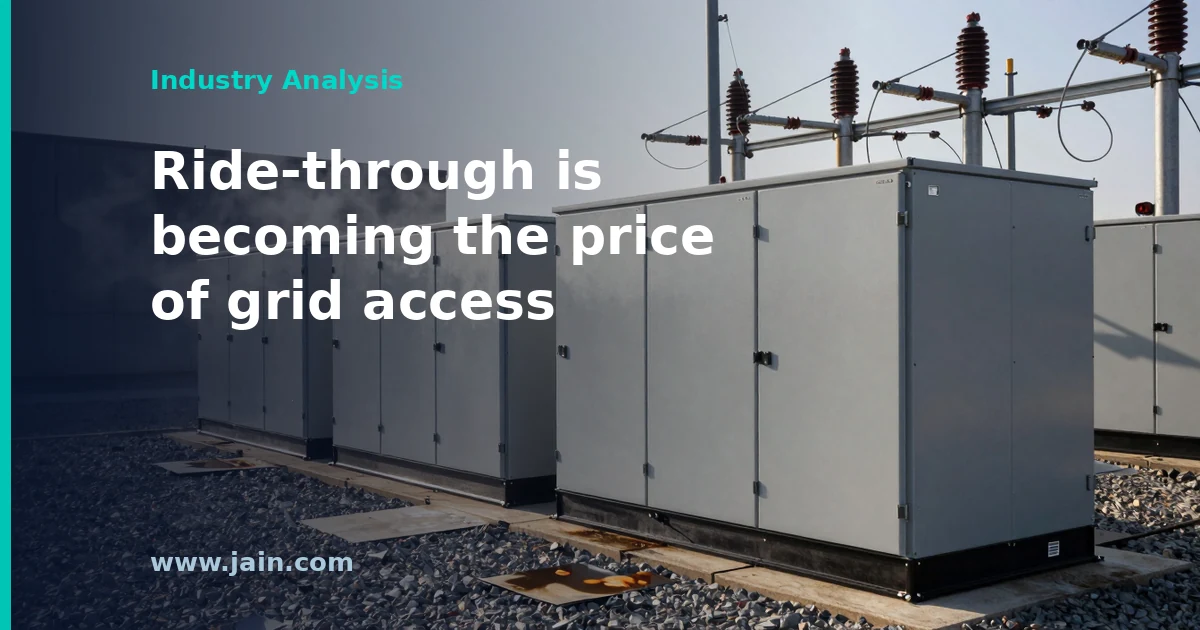
  • Virginia’s 3.8 GW Data Center Trip Shows Why Ride-Through Is Becoming a Grid-Access Test

    Virginia’s 3.8 GW Data Center Trip Shows Why Ride-Through Is Becoming a Grid-Access Test

    TL;DR · 30-second read

    The Short Version

    On July 22, an ordinary electrical fault on a power line in northern Virginia caused a cluster of data centers, the buildings full of computers that run the internet, to disconnect from the grid almost at once.

    In minutes, about 4% of all the electricity being used across 13 states and Washington, D.C. vanished from the system.

    The organization that runs that grid says the data centers were too jumpy. It is now considering rules requiring them to stay connected through brief power glitches. If those rules arrive, how a data center reacts to a glitch could decide whether it gets connected at all.

    Utility Dive reported that PJM Interconnection, the grid operator for 13 Mid-Atlantic and Midwest states and the District of Columbia, is considering new interconnection reliability requirements for “computational loads” such as data centers and crypto-mining facilities. The requirements under consideration include “ride-through” standards, which require equipment to stay connected through brief voltage and frequency disturbances rather than disconnecting.

    The trigger was a July 22 event in which about 3,800 MW of data center load in northern Virginia tripped offline in two waves after a fault on a 230-kV transmission line in Dominion Energy’s zone. PJM’s total load fell about 3.8%, from 99,984 MW to 96,205 MW. PJM called it the largest such event in its history.

    Executive Summary

    PJM is evaluating whether to expand its reliability requirements for large computing loads after data centers disconnected from the grid in response to what its Operating Committee chair called “a normally cleared fault.” In other words, the grid did what it was supposed to do, and the data centers dropped off anyway. PJM staff told an August 6 Operating Committee meeting that the facilities appear to be disconnecting too early.

    This matters because it shifts part of the grid-reliability burden onto the load side. Until now, the obligation to stay online through disturbances has fallen mainly on power plants. PJM’s position is that a data center cluster large enough to remove nearly 4% of system demand in minutes now needs the same kind of behavioral rules. As David Souder, PJM’s executive director of system operations, put it, those requirements need to be “in place before the load comes on the system.”

    The timing also matters. The North American Electric Reliability Corp. (NERC) is building national standards for computational loads under a Federal Energy Regulatory Commission directive. PJM said, however, that NERC will not address voltage and frequency ride-through until sometime next year. That leaves PJM weighing whether to act in the meantime.

    How a Routine Fault Became a 3,800 MW Problem

    Transmission faults happen constantly. A line gets struck by lightning or contacts a tree, protective relays isolate it within a fraction of a second, and voltage briefly sags on nearby parts of the network before recovering. Power plants are expected to “ride through” that sag, meaning they stay connected and keep producing. Data centers are generally built with the opposite instinct. Their electrical systems are designed to protect servers from bad power, so when voltage moves outside a set tolerance window, they switch to batteries and on-site generators and stop drawing from the grid.

    For a single facility, that is sensible engineering. For a cluster, it becomes a system event. When thousands of megawatts of demand leave the grid at the same moment while generation keeps running, supply suddenly exceeds demand. Frequency and voltage swing, and the operator has to rebalance quickly. PJM said the July 22 event caused “a high imbalance between generation and load” and large swings in both voltage and frequency, and that it dispatched reactive power resources to bring system voltage down. PJM’s Operating Committee chair, Emanuel Bernabeu, described the data centers as “too sensitive to the kind of voltage that they like.”

    The Event Sizes Are Growing Faster Than the Rules

    PJM listed two earlier events in the same Dominion zone. Each caused a sudden load transfer of about 1,500 MW, one in 2024 and one in 2025. The July 22 event was roughly two and a half times that size. Three incidents in one region do not make a statistical trend, but the direction is consistent with how northern Virginia is building out: more and larger facilities, clustered on the same transmission network and often reacting to the same disturbance at once. For scale, 3,800 MW is on the order of the output of three large nuclear reactors.

    The grid handled it. PJM said it brought its Area Control Error, the running measure of the mismatch between supply and demand, back within limits in nine minutes, against a NERC standard of 30 minutes. That is a good operational result, and it should not be read as a near miss. The concern PJM raised is forward-looking: each new facility connected under current practice adds to the amount of demand that could disappear in a single disturbance. At some point the operator has to either hold more balancing capacity in reserve or require the load to behave differently. PJM’s move signals it prefers the second option.

    Ride-Through Moves From Design Choice to Condition of Connection

    This is the substance behind the headline. PJM is framing the fix as an interconnection reliability requirement, a condition attached to connecting to the grid, rather than a best-practice guideline. Souder’s remark that requirements must be in place “before the load comes on the system” points to the interconnection queue as the enforcement point. If PJM follows through, projects now in development would need to show that their electrical design keeps them connected through a normally cleared fault. Retrofitting that behavior after energization is harder and more contested.

    The practical effects would be felt in specific places. Developers and colocation operators would need to revisit the voltage and frequency tolerance settings on their uninterruptible power supplies and switchgear, and possibly the hardware itself. Hyperscale tenants would need to accept that their facilities ride out disturbances their servers were previously shielded from. Equipment vendors whose systems can demonstrate grid-friendly behavior would gain a selling point. Utilities such as Dominion, whose zone hosts the world’s largest data center cluster, would gain a clearer technical basis for connection studies. The rules would cover crypto miners too, because PJM used the broader category of “computational loads.” Mining loads are generally more flexible about interruption, but they are no less able to trip off in a block.

    There is a real engineering tradeoff, and it deserves an even-handed hearing. Data center operators set tight tolerances to protect equipment and meet uptime commitments to customers, and loosening them carries risk for the operator. PJM’s argument is that the risk of undisciplined load, which falls on everyone connected to the grid, now outweighs the private risk. Where the thresholds land, and whether PJM offers alternatives such as coordinated or staggered transfer settings, will determine how costly the change becomes.

    A Gap Between Regional Urgency and National Standards

    NERC is scheduled to finalize registry criteria and initial reliability standards for computational loads by December 31, and to produce a plan by March for additional standards. According to PJM, ride-through for minimum voltage and frequency will not be addressed until sometime next year. Meanwhile, Northern Virginia continues to add capacity. That leaves PJM choosing between acting regionally now and risking a mismatch with a later national standard, or waiting and connecting more load under today’s practices. Wharton’s reference to “existing and future industry ride-through standards and practices” suggests PJM intends to align with NERC where it can, without waiting for NERC to finish.

    Background

    Northern Virginia, largely within Dominion Energy’s service zone, hosts the largest concentration of data centers in the world. Rapid growth in data center demand there and elsewhere in PJM’s 13-state footprint has made large computing loads a central grid-planning issue. PJM has reported sudden data center load transfers of about 1,500 MW in both 2024 and 2025, and NERC issued alerts on sudden data center load losses earlier in 2026, including a Level 3 alert in May calling for mandated actions.

    Grid reliability rules in North America are set by NERC and approved by the Federal Energy Regulatory Commission. Regional operators such as PJM can add their own interconnection requirements. Historically those rules focused on generators. The rise of very large, clustered loads has prompted FERC to direct NERC to develop registry criteria and reliability standards specifically for computational loads.

    Sources

    Source: PJM eyes data center, crypto reliability requirements after 3.8 GW of load trips offline (Utility Dive, August 12, 2026), covering PJM’s response to the July 22 northern Virginia load-loss event.

  • Vantage’s 95-Ton NOx Permit Shows AI Self-Power Is Judged by Ceiling, Not Output

    Vantage’s 95-Ton NOx Permit Shows AI Self-Power Is Judged by Ceiling, Not Output

    TL;DR · 30-second read

    The Short Version

    A data center in Virginia makes its own electricity with eight gas-burning turbines, each about the size of a bus, close to people’s homes.

    A Harvard researcher estimated its air pollution could cause tens of millions of dollars a year in health harm. Virginia’s environmental regulator moved quickly to challenge that estimate, even though one of its own experts said judging health effects was outside his training.

    Why it matters: more of the buildings that run artificial intelligence want their own power plants, and fights like this one will decide where they can be built.

    Politico reported on July 25 that internal emails, obtained through a public records request, show Virginia’s Department of Environmental Quality (DEQ) organized a rebuttal to a health analysis of Vantage Data Centers’ self-powered facility in Sterling, Loudoun County, before that analysis was published. DEQ Director Michael Rolband forwarded the Piedmont Environmental Council’s report to seven air-permitting staff within five minutes of receiving it in early March. He asked for “a defensible critique that will stand the test of public and critical review.”

    The Piedmont-commissioned study estimated that soot from the facility’s eight natural gas turbines could cause $53 million to $99 million a year in health costs, and 3.4 to 6.5 premature deaths, if the site emitted the maximum its permit allows. DEQ’s own report, released in late April, said actual emissions were 28 to 69 percent of permitted levels. The agency has said its staff “did not collaborate with PEC, Vantage or any other external participants” in its assessment.

    Executive Summary

    This dispute centers on the only data center in Virginia that generates its own electricity. Its on-site power system combines eight bus-sized natural gas turbines with dozens of backup diesel generators, and it sits in a residential area. DEQ’s 2023 permits allow up to 95 tons a year of nitrogen oxides (gases that help form smog) and more than 56 tons of soot, meaning fine particles that lodge in the lungs. Both pollutants are linked to asthma and heart attacks. Those limits are typical for a minor pollution source. The dispute arose because of where the facility sits, not because of how large the limits are.

    It matters beyond one building because self-generation is becoming the industry’s answer to grid congestion. Dominion Energy disclosed in February that it receives about 10 new connection requests a month from large-load customers. It also disclosed that dozens of projects requesting a combined 70 gigawatts are waiting to connect, three times the utility’s all-time peak load. Vantage itself described its turbines to DEQ as “a temporary solution given the current power constraints of the grid.”

    The episode shows how the health case against on-site generation gets built. Critics model the legal ceiling in the permit, not the meter reading. Even when actual emissions come in well below that ceiling, the permit keeps the higher figure in play.

    The Permit Ceiling Is the Number That Gets Modeled

    Michael Cork, a biostatistics research fellow at Harvard’s T.H. Chan School of Public Health, did not have Vantage’s operating data when Piedmont hired him. He used the only public figures available, which were the permitted maximums. That produced the headline range of $53 million to $99 million in annual health costs. Vantage objected that this was a “worst case scenario,” and DEQ’s report made the same point: measured emissions of soot, volatile organic compounds and nitrogen oxides ran at 28 to 69 percent of what the permit allows.

    The correction lowered the estimate but did not end the argument. Cork reran his model with DEQ’s actual-emissions figures and arrived at $33 million to $63 million a year and two to four premature deaths. He also noted that nothing in the permit prevents the facility from increasing output back toward its ceiling. That is the mechanism the headline refers to. A permit is a legal right to emit, so outside analysts can reasonably treat it as the facility’s potential footprint, whatever the current meter shows.

    This matters for developers planning on-site generation. Operators often seek permit headroom so they can run harder when the grid is strained or when load grows. That headroom has operational value. It is also, in effect, a published number that critics can model. A project that wants its real-world performance to count in public debate may need to make that performance binding, through enforceable limits closer to expected output or regular public reporting of actual emissions, rather than relying on a regulator to vouch for it after the fact.

    Why Self-Power Keeps Spreading Anyway

    The economics pushing data centers toward their own power plants are not easing. A 70-gigawatt connection backlog at a single utility means many projects face long waits for grid power. On-site gas turbines offer a way to start operating sooner. They also answer the political charge that data centers raise household electricity bills. The federal government has encouraged the model too: President Donald Trump promoted a wave of power plants for new data centers at a White House meeting with technology companies in early March.

    The Vantage case shows the trade-off. Self-generation moves the power question off the utility’s books and onto the local air-permit docket. The cost stops appearing in rate cases and starts appearing in health-damage estimates for the neighborhood downwind. The more facilities follow this path, the more often permitting agencies will be asked to rule on disputes that go beyond their traditional remit.

    A Regulator’s Rebuttal Is Not a Health Finding

    The emails show disagreement inside DEQ about how far the agency should go. Michael Kiss, a manager in the Office of Air Quality Assessments, wrote that the magnitude of impacts was “relatively low” and not surprising. He also said he had “absolutely no comments on the health study” because “we aren’t qualified to do that review.” Robert Burnley, who led DEQ from 2002 to 2006, said the conventional defense of a permit is narrower: that the emissions do not cause a violation of air quality standards.

    Several claims in DEQ’s final report are open to challenge on their own terms. The report said health impacts were “unlikely” because Loudoun County soot levels are below EPA standards. Health experts, including former EPA air quality official Michael Koerber, said soot can harm health even at EPA-approved levels, and the World Health Organization’s guideline is nearly half the EPA figure. The report also cited 2023 state health data, collected before Vantage began operating, to describe Loudoun as one of Virginia’s healthiest localities. That data says little about the facility’s effect.

    For the industry, the lesson is practical rather than partisan. The Data Center Coalition circulated DEQ’s report to reporters and lawmakers as evidence that the Piedmont analysis was wrong. A rebuttal whose health reasoning is contested gives less protection than it appears to. The most useful thing DEQ published was arguably the actual-emissions data. It narrowed the dispute to a real number, even though that number still produced a substantial estimate.

    Siting Near Homes Is Where the Costs Land

    DEQ’s permits for Vantage are in line with other minor-source permits in the state. The concern stems from the facility’s location in a residential area. Neighbors report constant noise as well as air pollution. Vantage says it has taken steps to reduce the noise. Health-cost models of the kind Cork used scale with the number of people in a plume’s path, so the same turbines sited away from housing would generate a very different estimate.

    Virginia has more than 600 data centers, and many future self-powered sites will compete for land in areas that are already developed. Where generation sits relative to homes is likely to be as consequential for permitting risk as how many tons it is allowed to emit.

    Background

    Northern Virginia, and Loudoun County in particular, hosts the world’s largest concentration of data centers, and Virginia is home to more than 600 of them. Dominion Energy, the region’s largest utility, has struggled to keep pace with demand. Large projects now wait in a queue that is far larger than anything the utility has ever served. In response, developers have begun planning facilities that generate their own electricity on site, usually with natural gas turbines.

    Vantage Data Centers’ Sterling facility came before that trend. DEQ issued its air permits in 2023. The Piedmont Environmental Council, a Virginia conservation group, has been active on data center land-use and environmental impacts. The Data Center Coalition is the industry’s trade group.

    Sources

    Source: Emails show how Virginia regulators downplayed data center health concerns — Politico’s report on internal DEQ emails concerning Vantage’s self-powered Loudoun County data center.

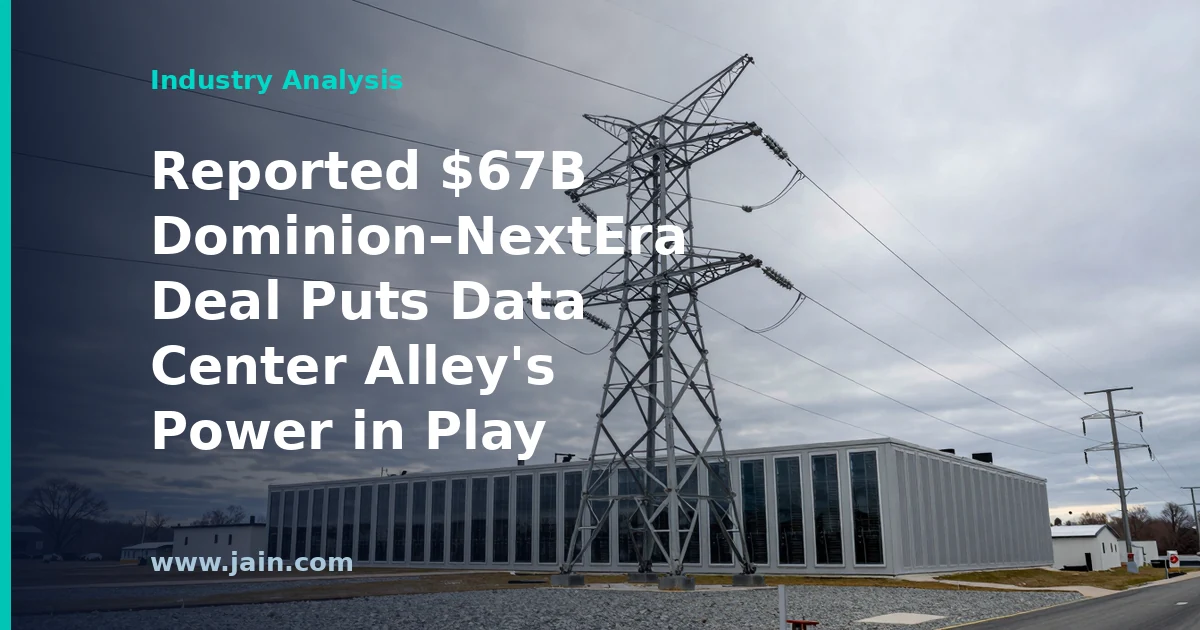
  • Reported $67B Dominion–NextEra Deal Puts Data Center Alley’s Power in Play

    Reported $67B Dominion–NextEra Deal Puts Data Center Alley’s Power in Play

    Technical.ly reported on May 17, 2026 that a $67 billion deal between Dominion Energy and NextEra Energy could reshape Northern Virginia’s data center economy — the largest concentration of data center capacity in the world. At that price, the transaction would rank among the biggest utility deals in U.S. history.

    The report frames the deal around Northern Virginia’s “Data Center Alley,” the Loudoun County–centered corridor whose electricity is supplied largely by Dominion, and whose AI-driven load growth has become the defining challenge for the regional grid.

    Executive Summary

    According to the report, Dominion Energy — the regulated utility serving most of Virginia, including the Northern Virginia data center corridor — and NextEra Energy, the Florida-based utility holding company that is also the largest developer of wind and solar generation in the United States, are parties to a transaction valued at roughly $67 billion. The headline figure alone signals a bet that serving data center load is now the most valuable franchise in the American power sector.

    Why it matters: whoever owns the wires and generation feeding Data Center Alley effectively controls the throttle on the region’s — and arguably the industry’s — AI buildout. Dominion has publicly described a contracted and requested data center pipeline measured in tens of gigawatts, an order of magnitude beyond historical utility growth rates. Pairing that captive demand with NextEra’s generation development machine is the strategic logic the market will read into a combination of this size, whatever the final structure proves to be.

    A caution up front: the source available at publication is a single news headline. The deal’s structure — acquisition, merger, asset purchase, or joint venture — its financing, and its regulatory path are not described in the material we can verify, and we treat them accordingly below.

    Why a Utility Deal Is Really a Data Center Deal

    Northern Virginia is not just another service territory. Loudoun County and its neighbors host tens of millions of square feet of data center space, and Dominion has for years been the region’s essential supplier — its interconnection queue, transmission buildout, and rate design decisions directly set the pace at which hyperscalers and colocation providers can energize new capacity. A $67 billion transaction touching this territory is therefore less a conventional utility consolidation story than a claim on the single most concentrated pool of AI-era electricity demand on the planet.

    For readers outside the power business: regulated utilities like Dominion earn a state-approved return on the infrastructure they build, which means guaranteed-growth demand — like contracted data center load — translates almost mechanically into earnings growth. That is why data center demand has turned sleepy utility stocks into growth assets, and why a buyer or partner would pay a historic premium to be attached to it.

    The NextEra Logic: Generation Meets Load

    NextEra brings the other half of the equation. Through NextEra Energy Resources it has built more wind, solar, and battery capacity than any other U.S. developer, and its regulated arm, Florida Power & Light, is among the country’s largest utilities. The structural problem in Northern Virginia has never been demand — it is that generation and transmission cannot be added fast enough. Marrying the nation’s most aggressive generation developer to the nation’s most demand-rich territory is a coherent industrial thesis, and it tracks the broader pattern of power and compute vertically converging: hyperscalers signing nuclear offtakes, developers co-locating generation with campuses, and utilities racing to finance multi-decade capital plans.

    It also concentrates risk. AI demand forecasts are contested; utilities and grid operators have acknowledged that interconnection queues contain speculative and duplicate requests. A $67 billion valuation built on tens of gigawatts of projected load is exposed if even a fraction of that pipeline evaporates, gets self-supplied behind the meter, or migrates to cheaper-power regions.

    Who Feels This: Ratepayers, Regulators, and Tenants

    Any transaction involving Dominion’s Virginia franchise runs through the State Corporation Commission, and likely federal reviews as well, at a moment when data center cost allocation is already politically charged in Richmond. Virginia regulators have been actively weighing how to keep large-load infrastructure costs from spilling onto residential bills; a mega-deal gives them maximum leverage to extract commitments on rates, reliability, and clean energy timelines as conditions of approval. Expect the approval process, not the announcement, to determine what this deal actually does.

    For data center operators and tenants, the practical questions are concrete: does consolidation speed up interconnection by unifying generation and delivery under deeper-pocketed ownership, or does it reduce competitive pressure and harden pricing power over a customer base with nowhere else to plug in at scale? Both outcomes are plausible, and the answer will likely be written into regulatory conditions rather than the merger agreement.

    The Consolidation Signal

    Step back and the deal — if consummated — marks a phase change: AI power demand is no longer being met by incremental utility capital plans but by restructuring the ownership of the grid itself. Other demand-heavy territories (Georgia, Texas, Ohio, Arizona) and the utilities that serve them become obvious candidates for similar combinations, and every hyperscaler’s site-selection calculus now has to price in who will own their utility in five years. The financing of the AI buildout is migrating from tech balance sheets and project finance into the regulated-utility capital model — with all the ratepayer politics that entails.

    Background

    Northern Virginia became the internet’s landlord over three decades, as early network exchange points around Ashburn attracted carriers, then cloud providers, then AI training campuses. Dominion Energy grew into the indispensable supplier of that boom, and by the mid-2020s was publicly describing data center demand — measured in tens of gigawatts of contracted and requested capacity — as the dominant driver of its capital plans, while Virginia lawmakers and regulators debated who should pay for the grid expansion it requires.

    NextEra Energy took a different route to power-sector prominence: alongside its Florida utility franchise, it built the nation’s largest renewable generation fleet and has consistently argued that electricity demand from AI and electrification marks the sector’s biggest growth era in decades. A combination with Dominion, as reported, would fuse the industry’s largest generation developer with its most demand-rich territory.

    Source: $67B Dominion-NextEra deal could reshape Northern Virginia’s data center economy — Technical.ly’s May 17, 2026 report on a reported $67 billion transaction between the two utilities.