TL;DR · 30-second read
The Short Version
LG, best known for televisions and fridges, just won approval from Nvidia, the company whose chips run most artificial intelligence systems, to supply equipment that keeps those chips cool.
One cabinet of Nvidia’s newest chips uses roughly as much electricity as a hundred homes. That makes it far too hot for fans, so liquid has to be pumped right up against the chips.
LG is the first Korean company approved for this. The approval matters because buyers rarely risk a leak next to millions of dollars of hardware.
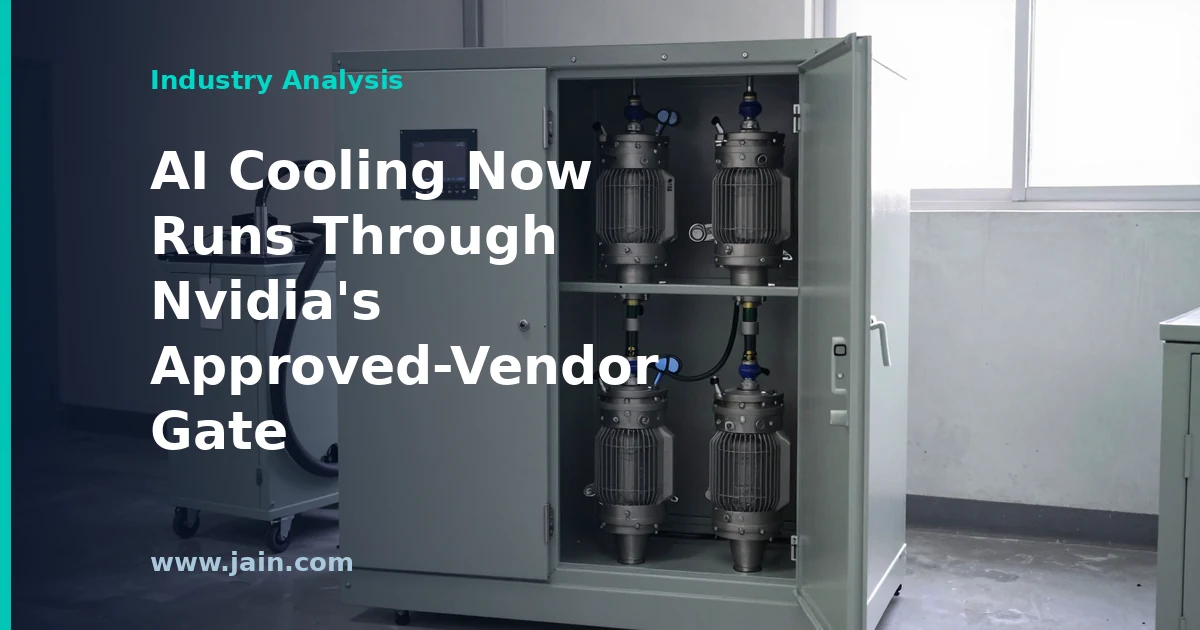
Startup Fortune reported that LG Electronics’ 600kW-class coolant distribution unit (CDU) has passed Nvidia’s final quality certification. That makes LG the first Korean company approved in this category of liquid cooling equipment for Nvidia-based AI server racks. LG announced the approval in late July 2026.
LG says it will next seek certification for 1MW, 2.5MW and 4MW CDU models. It sells the unit as part of a ‘Chip to Chiller’ package spanning server-level cold plates through building-scale chillers.
Executive Summary
A coolant distribution unit is the pump-and-heat-exchanger that moves liquid between a data center’s cooling plant and the cold plates mounted on GPUs and CPUs. LG’s 600kW unit is now on Nvidia’s approved list. LG says it holds coolant temperature within ±0.25°C, runs redundant pumps and power supplies, and includes virtual sensors and leak detection.
The approval matters because of rack density. Nvidia’s DGX GB200 NVL72 system draws about 120kW per rack, roughly four times the level at which air cooling alone stops working. At that density, liquid cooling is mandatory. It also sits millimetres from very expensive silicon, so buyers screen suppliers before any price is discussed.
For LG, the certification also serves its shift toward business customers. It gets LG into the running for Nvidia-based deployments. It does not yet deliver orders: LG has named affiliate projects and earlier regional references, but no large external cloud contract.
At 120kW a Rack, Air Is Out of the Picture
Data Center Engineering puts the practical limit for air handling at roughly 30kW per rack. Above that, heat removal has to move closer to the chip. Nvidia’s own DGX GB200 system guide describes the NVL72 rack at approximately 120kW, with 72 Blackwell GPUs and 36 Grace CPUs in a single rack-scale design. For operators, liquid cooling at that density is a requirement, not a design choice.
The CDU is the working heart of that liquid loop. It takes heat from coolant returning off the chips’ cold plates and passes it to the facility’s water system, while holding flow and temperature steady. On paper, a 600kW unit covers the heat of about five 120kW racks. That is a row-level building block, not a whole-hall system.
Why Approval Comes Before Price
This is the mechanism behind the headline. When the equipment being cooled costs millions of dollars per rack, a coolant leak or pump failure is a business interruption plus a large hardware bill, not a routine repair. Buyers therefore lean on Nvidia’s qualification as a first screen. The approved list narrows the field before bidding starts, so a cooling vendor’s first hurdle is getting qualified, and competing on price comes after.
LG’s stated specifications match what that screen looks for: tight temperature control (±0.25°C), redundant pumps and power so cooling continues through a component failure, and leak detection. None of this is novel on its own. Together, with Nvidia’s approval attached, it lets LG compete for business it previously could not bid on.
The effects run in several directions. Established cooling vendors gain a large, well-capitalised new competitor. Hyperscalers, the largest cloud operators, and other data center builders gain another qualified source at a time when liquid cooling demand is rising fast. Uncertified suppliers face a clearer barrier. One certification does not prove the whole market works this way, but it shows plainly where the entry gate for Nvidia-based cooling sits.
From 600kW to 4MW: The Roadmap Is the Real Test
LG plans to seek certification for 1MW, 2.5MW and 4MW CDUs next. The scale jump is significant: a 4MW unit could, in principle, serve the heat of more than thirty NVL72-class racks. That is the size at which large AI campuses buy cooling. The 600kW approval gets LG into the running. The megawatt-class approvals will decide whether LG can supply those campuses.
LG frames the opportunity with a market forecast of about 26 percent annual growth, reaching roughly $133.5 billion (about 185 trillion won) by 2034. This is LG’s own projection, and it has not published the underlying methodology. Readers should treat it as the company’s view of market size, not an independent estimate. The direction is less in doubt than the number: Nvidia’s published rack power figures already require liquid cooling at the top end.
An Appliance Maker’s Business-Customer Arithmetic
The certification also fits LG’s broader repositioning. At a January 7 briefing, LG said business lines including B2B, webOS and direct-to-consumer grew from about 29 percent of revenue in 2021 to 45 percent in the second half of 2025. Their share of operating profit rose from 21 percent to about 90 percent. Data center cooling draws on work LG already does: HVAC, heat transfer and precision temperature control.
The execution risk is real. LG’s stated pipeline includes AI data centers for group affiliate LG CNS, along with earlier cooling references in North America and Indonesia. These are credible starting points. They do not show that global cloud buyers, who usually demand worldwide service coverage and proven delivery at volume, will commit to LG for large deployments.
Background
LG Electronics built its brand on televisions, refrigerators and washing machines. For several years it has been shifting its growth strategy toward business customers, including commercial HVAC, and this year it said those business lines generate most of its operating profit. Precision cooling for data centers is a natural extension of that heat-transfer engineering.
Nvidia’s Blackwell-generation rack-scale systems have made liquid cooling routine at the high end of AI infrastructure. The GB200 NVL72 combines 72 GPUs and 36 CPUs in one rack drawing about 120kW, far above the roughly 30kW at which air cooling reaches its limit. That has created fast-growing demand for direct-to-chip cooling components such as cold plates and coolant distribution units. Nvidia’s supplier qualification acts as the main gate into that supply chain. Source: LG Electronics wins Korea’s first Nvidia liquid cooling certification as AI data centers hit a heat wall (Startup Fortune): LG’s 600kW coolant distribution unit clears Nvidia’s quality certification.Sources