TL;DR · 30-second read
The Short Version
The giant computer warehouses being built for artificial intelligence need armies of electricians, pipefitters and steelworkers. The companies that supply them are signing jobs faster than they can finish them.
EMCOR, one of the biggest, has about $17 billion of signed work waiting. That is up 44% in a year, while its sales grew about 20%.
A smaller rival, IES Holdings, just spent $691 million, mostly borrowed, to buy a steel builder with about 4,000 workers. In this boom, the hard part is not winning work. It is having the people and workshops to do it.
IES Holdings (NASDAQ: IESC) closed its acquisition of DBM Global on October 5, 2026, for total consideration of about $691 million: roughly $545 million in cash and 430,974 IES shares valued at about $146 million. In an 8-K filed October 6, IES said it funded the cash with cash on hand and $525 million of borrowings under a credit agreement it amended the same day to raise borrowing capacity to $700 million. DBM, a structural steel fabricator and erector with about 4,000 employees, generated about $1.5 billion of revenue in the twelve months ended June 30, 2026.
The deal lands as data center construction drives growth across specialty contracting. Insider Monkey reported that EMCOR Group (NYSE: EME), in its July 30 second-quarter results, posted revenue of $5.15 billion, up 19.8%, while its remaining performance obligations—signed work not yet performed—rose 43.9% to $17.14 billion. IES’s fiscal third-quarter revenue rose 40% to $1.24 billion, led by a 51% jump in its data center–driven Communications segment.
Executive Summary
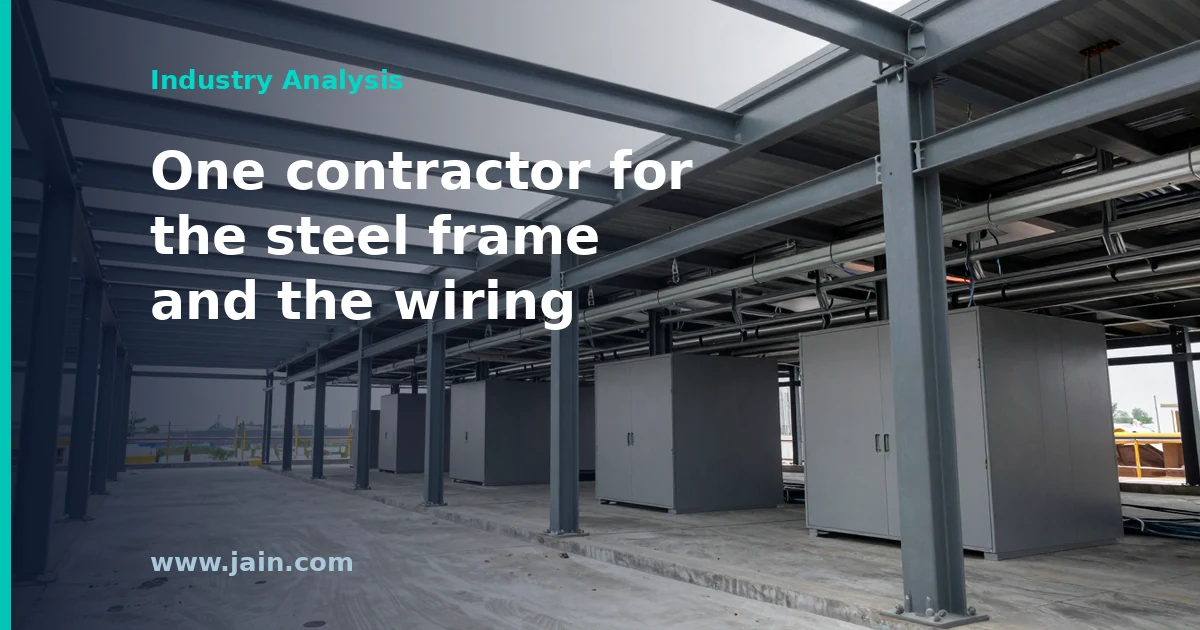
IES Holdings has made its largest acquisition to date, paying about $691 million for DBM Global, which IES describes as one of the largest independent structural steel fabrication and erection platforms in the US. The deal turns an electrical and technology-systems contractor into one that can also engineer, fabricate and erect a building’s steel frame, and IES says it will offer the combination to data center, industrial and infrastructure customers.
The timing matters because the sector’s order books are expanding faster than its output. EMCOR, the larger rival, grew its backlog 43.9% against 19.8% revenue growth. When signed work outpaces completed work, the pace of data center construction depends increasingly on the contractor side—the skilled crews, fabrication shops and project managers who turn contracts into finished buildings. IES’s purchase brings in about 4,000 employees and more than 2 million square feet of facilities, financed largely with $525 million of bank borrowing.
For investors, the two companies now frame a choice: EMCOR’s demonstrated conversion of demand into profit at a lower earnings multiple, or IES’s faster growth, which now carries integration and debt-repayment tests.
EMCOR’s Order Book Is Growing Twice as Fast as Its Revenue
In EMCOR’s July 30 results, quarterly revenue rose 19.8% to $5.15 billion, while remaining performance obligations rose 43.9% to $17.14 billion. For a contractor, revenue largely reflects work actually put in place during the period; remaining performance obligations are contracted work still to be done. When the second grows more than twice as fast as the first, signed work is accumulating faster than crews, shops and project teams are converting it. The arithmetic makes the point concrete: at the second-quarter pace, $17.14 billion equals about 3.3 quarters of revenue. The year-earlier figures implied by those growth rates put the ratio near 2.8 quarters.
There are two fair readings of that gap. Larger, multi-year campus contracts naturally lengthen a backlog, and the $17.14 billion is a company-wide figure spanning all of EMCOR’s markets, not data centers alone. But both readings lead to the same operational conclusion: once work is booked well ahead of output, the speed at which buildings get finished is set by contractor throughput—skilled labor, procurement and project management—rather than by the availability of contracts. EMCOR has so far converted efficiently. Earnings per share rose 34.8% to $9.06, faster than revenue, operating income reached $547.3 million at a 10.6% margin, and management raised full-year guidance to $32–$33.25 per share.
The consequences run in several directions. For data center developers and cloud operators, the contractor’s calendar becomes part of the project timeline alongside power and equipment. For contractors, a backlog becomes profit only if costs stay within contract assumptions, and a larger book carried by the same workforce raises execution risk. For investors, the number to watch is conversion—margin on work completed—rather than the volume booked.
What IES’s $691 Million Actually Buys
Read against that backdrop, the DBM Global acquisition is a purchase of delivery capacity. IES’s announcement lists about 4,000 employees, more than 2 million square feet of fabrication and operating facilities, and brands including Schuff Steel, Banker Steel, GrayWolf, DBM Vircon and Aitken. On the disclosed figures, IES paid roughly 0.46 times DBM’s trailing $1.5 billion of revenue, or about $173,000 per employee. What that buys is an operating platform—trained crews, shops and customer relationships that DBM CEO Rustin Roach says in many cases go back decades—that cannot be assembled quickly from scratch.
The strategic logic is a second trade on the same job site. A data center needs a structural steel frame and dense electrical systems, and IES CEO Matt Simmes said the combined company will offer a broader range of products and services, particularly in data center, industrial and infrastructure markets. A contractor that can deliver both can compete for a larger share of each project’s construction budget. Whether customers prefer to buy the two trades as a bundle is not yet demonstrated, and that is the commercial test the acquisition sets.
The financing is equally telling. A Wells Fargo-led bank group expanded IES’s facility to $700 million—a $200 million term loan and a $500 million revolver—and $525 million of borrowings covered most of the cash. In this deal, credit was the readily available input. The scarcer one was a structural steel business already operating at scale, and IES paid a full price, in cash and shares, to own it rather than build it.
Two Ways to Price the Same Build-Out
At October 5 prices, consensus forward earnings multiples were about 22 times for EMCOR and 27 times for IES—a forward multiple being the share price divided by expected earnings per share. At about $779, EMCOR traded near 24 times the midpoint of its raised guidance. The case for EMCOR rests on operating leverage: earnings growing faster than revenue suggests added work is lifting profitability, not just volume.
The case for IES rests on its data center exposure. Communications revenue, supported primarily by data centers, rose 51% to $453.1 million with $83.6 million of operating income—a segment margin of about 18%. Consolidated growth is less clean: Infrastructure Solutions benefited from the addition of Gulf Island, and Residential revenue fell 6%. DBM now adds roughly $1.5 billion of structural steel revenue whose margins IES has yet to report, and the company has moved from a debt-free balance sheet in June to $525 million of acquisition borrowing. Executive Chairman Jeff Gendell said IES expects substantial cash flow from both businesses to allow it to rapidly repay those borrowings.
The risks are mirror images. EMCOR’s is extrapolating unusually favorable execution across a backlog that is growing faster than its revenue. IES’s is integration plus leverage, layered on the same execution demands. Both ultimately depend on the variable the backlog numbers highlight: the ability to deliver the work already won.
Background
EMCOR Group is a large US specialty contractor whose electrical and mechanical work—power distribution, cooling and piping—sits inside the buildings it serves, including data centers. Specialty contractors are hired by developers and general contractors to install the systems that make a building function. In AI data centers, more powerful computing racks change not just the equipment bill but the electrical and mechanical installation work surrounding them, which is why these firms have become direct beneficiaries of the build-out.
IES Holdings, based in the Houston area, designs and installs integrated electrical and technology systems and provides infrastructure services; with DBM it now also engineers, fabricates and erects structural steel, and it has more than 16,000 employees. DBM Global was majority-owned by INNOVATE Corp. before the sale. IES signed the transaction agreement on August 7, 2026, and closed on October 5. Source: EMCOR vs. IES Holdings: Does a $691 Million Deal Change the Better Buy? (Insider Monkey) — a comparison of the two contractors’ data center-driven growth, backlog and valuations after IES closed its DBM Global acquisition. Primary sources: IES Holdings Form 8-K filed October 6, 2026; IES Holdings press release, “IES Holdings Completes Acquisition of DBM Global” (Exhibit 99.1).Sources