Digital Realty, one of the world’s biggest landlords for the warehouse-sized buildings that run the internet, is teaming up with a partner to build them in Türkiye (Turkey).
These buildings, called data centers, hold the computers behind online banking, streaming, shopping and artificial intelligence tools. Building them inside a country makes apps faster for local users. It also helps companies follow local laws about where personal information must be stored.
The companies have not yet said who the partner is, how much they will spend, or when the first building will open.
MarketScreener reported that Digital Realty Trust (NYSE: DLR), the US-based data center real estate investment trust, has formed a joint venture to develop data centers in Türkiye. The move would take one of the world’s largest data center operators into a country that sits between Europe, the Middle East and Central Asia.
The partner’s identity, the planned capacity, the size of the investment, the ownership split and the construction timeline have not been made public.
Executive Summary
Digital Realty is setting up a joint venture, a jointly owned company shared with a partner, to build data centers in Türkiye. For a company whose footprint is concentrated in North America, Europe and selected emerging markets, this is a new country entry rather than an expansion of an existing campus.
The strategic logic is easy to see. Türkiye has a large domestic economy, a strong financial sector, and laws that push some personal and regulated data to be stored inside the country. Istanbul also sits on land and subsea fiber routes that link Europe with the Middle East. Those factors make local capacity attractive to cloud providers, banks, telecom carriers and, increasingly, companies deploying artificial intelligence.
What the announcement does not yet establish is scale. Without figures on megawatts (the unit used to measure how much electricity a data center can supply to its servers), investment or anchor customers, it is too early to say whether this will be a modest colocation foothold or a hyperscale-grade platform built for large cloud and AI deployments.
A Bridge Market, Not Just a New Flag
Türkiye’s appeal to data center operators rests on two things: domestic demand and geography. The country has a population of roughly 85 million people and a sizeable banking, retail and telecom sector, all of which generate data that must be stored and processed somewhere. Serving those users from inside the country cuts latency, the delay between a user’s action and a server’s response, which matters for payments, gaming, streaming and real-time applications.
Geography adds a second layer. Istanbul straddles Europe and Asia, and operators have long pitched it as a potential interconnection point for traffic moving between Europe, the Caucasus and the Middle East. Whether that promise turns into real traffic depends on carriers, internet exchanges and cloud on-ramps choosing to meet inside the new facilities. Digital Realty’s business model has leaned heavily on exactly this kind of interconnection density, so the value of a Türkiye entry will depend on its ability to attract networks, not just tenants.
Why Build With a Partner
Digital Realty has used joint ventures before when entering markets where local knowledge matters, including Brazil and India. The pattern is familiar across the industry. A local partner can bring land, relationships with power utilities and regulators, and familiarity with permitting, while the global operator brings design standards, a customer roster of multinational cloud and enterprise clients, and access to capital.
A joint venture also shares financial risk. Large data center campuses require heavy up-front spending long before rent arrives, and a partner that contributes equity reduces the capital Digital Realty must commit from its own balance sheet. The trade-off is control and economics: the parent books only a share of the returns, and governance terms such as who decides on expansion, pricing and exit can shape how the venture performs. None of those terms have been disclosed.
Power, Fiber and Fault Lines
Every modern data center project now lives or dies on electricity. AI servers draw far more power per rack than traditional enterprise equipment, and they often require liquid cooling rather than air. A Türkiye campus aimed at AI workloads would need both a large, reliable grid connection and a path to add more capacity over time. The availability and price of that power, and how much of it can be sourced from renewables to meet customer sustainability targets, will be central to its competitiveness.
Two further risks are specific to the market. Türkiye has experienced high inflation and sharp currency swings in recent years, which complicates long-term pricing; operators in such markets commonly seek contracts indexed to or denominated in hard currencies, but local customers may resist. The country is also seismically active, so site selection, structural engineering and geographic redundancy between facilities will be part of any serious customer’s due diligence.
Sovereignty Rules Could Decide the AI Question
Data sovereignty, the principle that data is subject to the laws of the country where it is collected or stored, is a strong driver of in-country capacity. Türkiye’s personal data protection law restricts how personal information can leave the country, and the rules governing cross-border transfers were revised in 2024. Sector regulations, particularly in banking, have long required certain systems to be kept inside Türkiye.
Those rules create steady demand from regulated industries regardless of AI. The open question is whether large-scale AI training and inference follows. Training frontier models tends to concentrate in places with abundant, cheap power, while inference, the day-to-day running of AI applications for users, benefits from being close to those users and inside their legal jurisdiction. A Türkiye platform is better positioned for the second category, and its success with AI is likely to hinge on whether global cloud providers and local enterprises choose to run AI services in-country rather than serving Turkish users from European hubs.
Background
Digital Realty Trust, founded in 2004 and headquartered in Austin, Texas, is one of the largest data center owners in the world. Its 2020 acquisition of Interxion significantly expanded its European footprint, and it has entered other markets through joint ventures and acquisitions, including Brazil, India and South Africa. The company earns revenue by leasing data center space, power and interconnection to cloud providers, network carriers and enterprises.
Türkiye’s data center market has historically centered on Istanbul, serving domestic banks, telecom operators and enterprises. Demand for in-country capacity has been supported by the country’s personal data protection law and sector rules that require certain data and systems to remain in Türkiye, alongside growing use of cloud services and, more recently, artificial intelligence.
Iron Mountain, a company best known for storing paper records in secure warehouses, has signed a deal with a Saudi state-run bank that lends to small businesses and families.
The bank will use Iron Mountain’s artificial intelligence software to read and sort the paperwork behind small-business loans. That is the forms and statements a loan officer would otherwise check by hand.
It shows a records company trying to become a technology company. It also shows banks handing sensitive customer files to automated systems. The price and length of the deal were not announced.
Iron Mountain (NYSE: IRM) has signed an agreement with Saudi Arabia’s Social Development Bank. Under the deal, Iron Mountain’s InSight DXP platform, which uses artificial intelligence to process documents, will sit at the center of the bank’s lending workflows for small and medium-sized enterprises (SMEs), Simply Wall St reported on September 13, 2026.
No contract value, duration, or deployment timeline was given. The announcement comes after a weak stretch for the stock. Shares fell 11.01% over the past 30 days and 8.79% over 90 days, but are still up 38.37% year to date.
Executive Summary
This is a software and services agreement, not a data center lease. InSight DXP is Iron Mountain’s platform for ingesting, classifying and extracting information from documents. In lending, that means applications, financial statements, identity records and supporting paperwork. The bank has made this platform central to how it handles SME loan processing, which is a document-heavy workflow in any market.
The deal matters for two reasons. First, it is a concrete example of a Gulf financial institution putting AI into a core, regulated process rather than a pilot or back-office experiment. Second, it supports Iron Mountain’s effort to be valued as a digital and infrastructure business rather than a traditional records-storage company. Investors are already pricing in much of that shift. The stock trades at 81.9 times earnings, against a 25.5x average for North American specialized real estate investment trusts (REITs).
What has not been disclosed matters as much as what has. Nobody has said where the bank’s data will be processed, how large the engagement is, or whether any Iron Mountain data center capacity is part of it.
A Software Deal, Not a Data Hall
Iron Mountain operates both a physical data center business and a digital solutions business, so the difference is worth stating clearly. As reported, this agreement concerns InSight DXP, an intelligent document processing platform. It is not a lease of power, space or cooling in an Iron Mountain facility. Intelligent document processing combines optical character recognition (turning scans into text) with machine-learning models that classify documents and pull out fields such as names, income figures or registration numbers. The goal is to cut the manual review that slows loan approvals.
That makes the deal a different kind of revenue from a wholesale data center contract. Software and processing agreements tend to be smaller in headline value than multi-megawatt leases. They can, however, be stickier: once a lender rebuilds its loan workflow around a platform, switching costs rise. The commercial significance therefore depends on details not yet disclosed, including volumes, pricing model and term.
Gulf Lenders Are Buying AI With Data Control in Mind
Saudi Arabia has been pushing to expand SME lending and to digitize government services. A development lender automating loan paperwork fits that direction. Loan files are among the most sensitive data a bank holds, though. Saudi Arabia’s personal data protection regime and banking supervision set expectations for how such data is stored and transferred. For any foreign technology provider, where processing happens and who can access it are central commercial questions, not afterthoughts.
This is where Iron Mountain’s hybrid profile could be an advantage. A vendor that offers both document processing and physical, secure infrastructure can in principle offer in-country or tightly controlled deployments. Neither company has said how this deployment is architected, however. It would be premature to describe the deal as sovereign AI capacity. The fair reading is narrower: it shows regulated Gulf institutions are willing to put AI tooling into core workflows, and a buyer with those priorities may well want local hosting options.
From Boxes to Bytes: The Repositioning Bet
Iron Mountain says it serves more than 240,000 customers in 61 countries, including about 95% of the Fortune 1000. That installed base, built on physical records storage, is the foundation of its digital strategy. Customers whose paper archives it already holds are natural prospects for digitization, AI extraction and, eventually, data center services. The most-followed investor narrative on the stock credits robust double-digit growth in the Data Center and Digital Solutions segments, driven by AI, cloud and unstructured data management.
A single development-bank contract does not change the company’s revenue mix. What it does is give the digital pitch a named international reference customer in financial services, a sector where proof points carry weight. Competitors in document AI range from large cloud platforms to specialist automation vendors. Iron Mountain’s argument has to rest on trust, compliance and chain of custody, not on the models alone.
The Valuation Already Assumes the Pivot Works
The market has rewarded the repositioning. Total shareholder return is 23.18% over one year and 100.14% over three years. The recent pullback, however, suggests announcements like this one are no longer lifting the shares on their own. Estimates vary widely: the popular narrative puts fair value at $146.10 versus a last close of $115.18, implying the stock is 21.2% undervalued, while an earnings-multiple view points to a fair P/E ratio of 42.4x, roughly half the current 81.9x.
Both views can hold at once. If digital and data center growth compounds as bulls expect, today’s multiple may compress as earnings catch up. If data center competition intensifies or refinancing costs rise on a leveraged balance sheet, the multiple could carry most of the downside. Deals like the Social Development Bank agreement are useful evidence, but only once their scale is visible.
Background
Iron Mountain built its business on storing physical records, including paper files, backup tapes and archives, for corporations and governments. Over the past decade it has expanded into data centers and digital services, arguing that its existing relationships with records-heavy customers give it a head start in digitizing and managing their information. It operates as a real estate investment trust, a structure that typically requires paying out most taxable income as dividends and tends to rely on debt to fund growth.
In Saudi Arabia, the government has made small-business growth and digital public services priorities of its economic diversification agenda. Development lenders such as the Social Development Bank play a central role in financing entrepreneurs and small firms. That makes loan processing efficiency, and the secure handling of applicant data, a practical concern for these institutions.
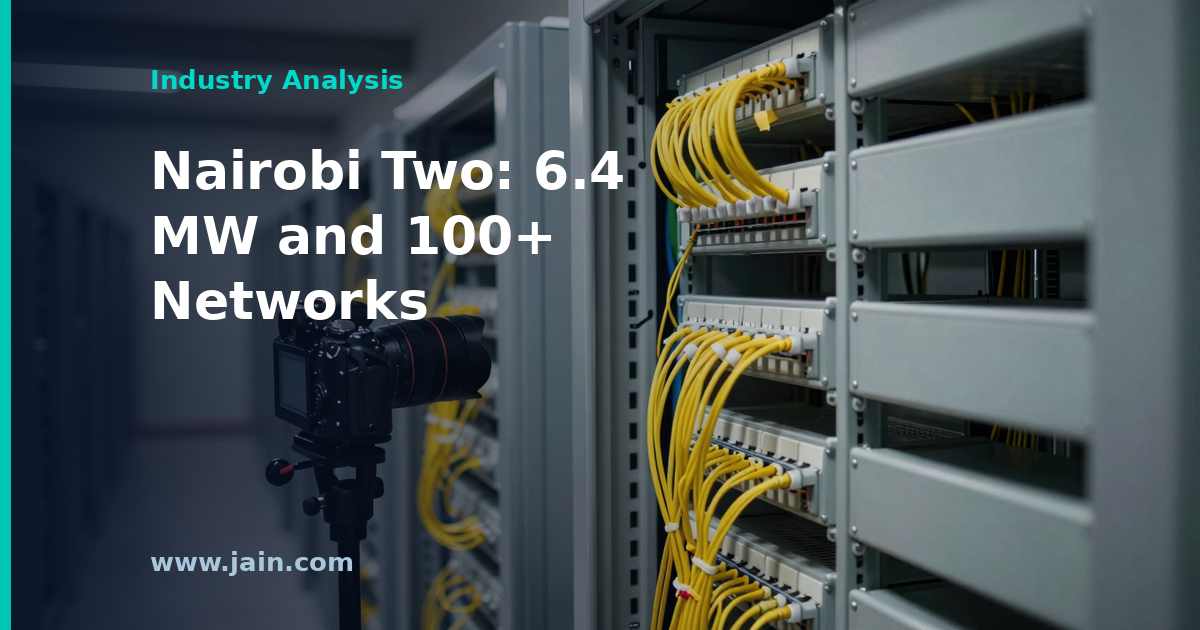
Digital Realty, a global company that builds the warehouses full of computers that run the internet, has opened its second data center in Nairobi, Kenya.
The interesting part is not its size — it is small — but who is already inside: more than 100 phone and internet carriers that customers can plug straight into, plus a dish link to satellites for places cables do not reach.
For Kenyan businesses, that means their data can stay in the country and still reach the rest of the world quickly.
Digital Realty (NYSE: DLR) announced on September 7 that it has opened Nairobi Two (NBO2), a 6.4-megawatt data center built alongside its existing Nairobi One (NBO1) facility, expanding the company’s Nairobi campus. According to the company’s announcement, customers on the campus can connect to more than 100 networks, two internet exchange points and a satellite teleport — a ground station that routes traffic via satellite where terrestrial fibre is limited.
The opening coincides with iColo, Digital Realty’s East African operation, transitioning to the Digital Realty brand in Kenya and Mozambique and folding its local ecosystem into PlatformDIGITAL, the company’s global data center platform. Digital Realty describes its footprint as more than 300 facilities across 55-plus metros in over 30 countries.
Executive Summary
The headline number — 6.4 megawatts, a measure of the electrical capacity available to customers’ servers — is modest by the standards of Digital Realty’s recent announcements elsewhere. What is being sold in Nairobi is not raw scale but adjacency: the ability to sit in the same building as more than 100 carriers, two internet exchange points and a satellite uplink, and to reach any of them with a short cable rather than a long-haul circuit.
That distinction matters commercially. In colocation, an operator rents space, power and cooling; in interconnection, it monetises the density of parties already present. Interconnection revenue tends to carry higher margins and stickier tenancy, because moving out means severing every connection a customer has built. Nairobi Two extends a campus where that density already exists rather than starting one from scratch.
The simultaneous rebranding of iColo in Kenya and Mozambique is the second half of the story. It converts a respected regional operator into a node on a global platform, which changes how multinational buyers can contract for African capacity — and raises questions, so far unanswered publicly, about pricing, contracted capacity and how much further the company intends to build on the continent.
Interconnection, Not Megawatts, Is the Product Here
A useful way to read any data center announcement is to ask what the operator is actually selling. Some facilities sell power and floor space at scale, aimed at customers who need very large blocks of compute. Others sell proximity to networks. Nairobi Two is plainly the second kind. Digital Realty leads with 100-plus networks, two internet exchange points — neutral switching platforms where networks swap traffic directly instead of paying transit providers to carry it — and a satellite teleport, and treats the 6.4 MW as supporting detail.
The economics behind that emphasis are well understood in the industry. A carrier-neutral campus, meaning one that favours no single telecom provider, becomes more valuable to each tenant as more tenants arrive: content providers want to be near eyeball networks, banks want to be near clouds, carriers want to be near both. Once a customer has provisioned dozens of cross-connects, the switching cost of leaving is high. Interconnection density is, in effect, a moat built by other people’s cabling.
For Kenyan and regional enterprises, the practical benefit is latency and cost. Traffic that can be exchanged locally does not have to transit Europe and back, which shortens round trips and reduces international bandwidth spend. That is a real operational improvement, and it is the most substantiated claim in the announcement — the ecosystem figures are specific and verifiable by any prospective customer touring the site.
What the iColo Rebrand Buys, and What It Costs
Folding iColo’s Kenyan and Mozambican sites into the Digital Realty brand and PlatformDIGITAL is more than signage. For a multinational evaluating African capacity, a global brand means a single master agreement, familiar service-level terms, consistent operational standards and access through a sales channel that already serves the customer elsewhere. That materially lowers the procurement friction that has historically slowed enterprise commitments in frontier markets.
Wanja Muriithi, Digital Realty’s Country General Manager for Kenya, framed the opening and the rebrand as “one story” — local ecosystem plus global platform. Marcel Louw, Managing Director for Africa, positioned the campus as a gateway for customers serving Kenya, Africa or global markets. Both framings are consistent with how platform operators typically integrate regional acquisitions, and neither is quantified in the announcement.
There is a trade-off worth naming without overstating it. Regional operators often win on price flexibility, local relationships and responsiveness to smaller customers; global platforms standardise, which can be a benefit or a constraint depending on the tenant. Whether existing iColo customers see changed commercial terms is not addressed in the announcement, and it is a fair question for buyers to put to the company directly at renewal.
Sovereignty and the Case for a Satellite Route
Digital Realty cites data sovereignty — the requirement, whether legal or contractual, that certain data physically remain within a country’s borders — as one of the forces reshaping infrastructure decisions in East Africa. That demand driver is credible and increasingly common globally: regulated sectors such as banking, health and government are usually the first movers, because their supervisors write the rules. Local capacity paired with dense interconnection is precisely the configuration that lets an organisation keep data in-country while still reaching global cloud platforms.
The satellite teleport is the less conventional element and deserves a plain explanation. It is a ground facility that sends and receives traffic via satellite, offering a path to locations where terrestrial fibre is sparse, and an alternative route when a terrestrial or subsea path is unavailable. In a region where long-haul connectivity concentrates on a limited number of physical routes, having a diverse path inside the same interconnection campus is a genuine resilience feature rather than a marketing flourish — though its usefulness depends on capacity and cost, neither of which the company has disclosed.
Does 6.4 MW Answer the AI Capacity Question?
The stated editorial question — whether African markets can support AI-era capacity — is not settled by this facility, and the announcement does not claim it is. Training large models is a power problem measured in tens to hundreds of megawatts, with rack densities that typically require liquid cooling. Digital Realty’s own recent announcements show where that class of capital is going: the company said in August it had been selected to develop 50 megawatts in Singapore, roughly eight times the capacity of Nairobi Two, and broke ground on a facility in Switzerland.
The more plausible near-term African AI story is inference and delivery rather than training: running already-trained models close to users, serving content locally, and keeping the resulting data resident. That workload profile is far better matched to a dense interconnection campus of this size than to a hyperscale training campus, and building in increments of a few megawatts is a defensible way to follow demand rather than front-run it — capital discipline, not timidity.
The constraint to watch is power. Interconnection density can be assembled through commercial relationships; grid capacity, reliability and cost cannot. Any credible expansion of this campus toward AI-relevant scale would require the company to speak publicly about power procurement, cooling design and rack density, none of which appears in this announcement. Until it does, Nairobi Two is best read as a well-targeted connectivity asset — a gateway play — rather than evidence that the region is ready for AI-era compute at scale.
Background
Digital Realty is a US-listed real estate investment trust (NYSE: DLR) that owns and operates data centers globally, describing itself as the world’s largest cloud- and carrier-neutral data center platform with more than 300 facilities in over 55 metros across 30-plus countries on six continents. Its business combines colocation — renting secure, powered, cooled space for customers’ servers — with interconnection, the higher-margin business of enabling customers to connect directly to the carriers, clouds and content providers sharing the building.
Nairobi has developed as one of East Africa’s principal digital infrastructure markets, and Digital Realty’s campus there operates through iColo, the East African business now taking the Digital Realty brand in Kenya and Mozambique. The campus already housed Nairobi One before this week’s addition of Nairobi Two. The company’s wider 2026 activity has included being selected to develop 50 megawatts in Singapore in August, a groundbreaking in Switzerland, and leadership appointments across regional markets including Iberia.
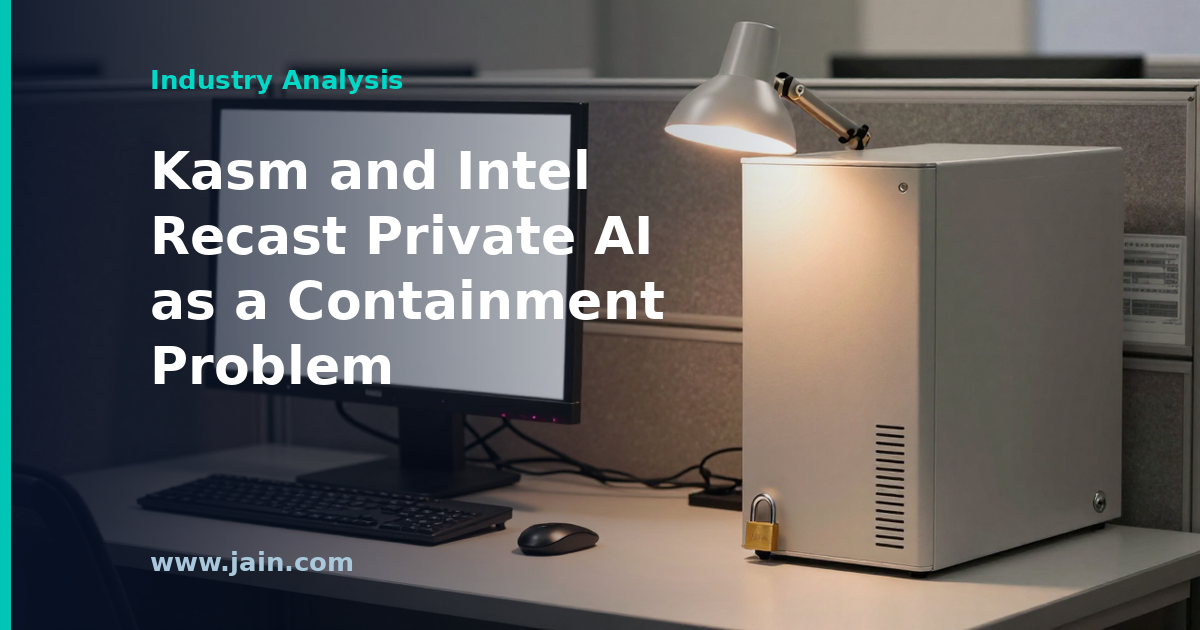
Kasm Technologies, the McLean, Virginia maker of containerized browser and desktop streaming software, announced on August 27, 2026 that it has expanded its partnership with Intel to deliver local large language model inference inside Kasm AI Workspaces running on Intel Xeon 6 processors with Advanced Matrix Extensions (AMX). The company is now listed in the Intel Partner Directory as an Intel technology partner.
The joint architecture pairs Kasm’s ephemeral workspace containers with the Intel Distribution of OpenVINO toolkit to run open-weight models — including mixture-of-experts LLMs such as Qwen3-Coder-30B-A3B — on CPU silicon, with no GPU required and, per Kasm, no data leaving the enterprise perimeter. Kasm cites healthcare, finance, legal, defense and government as early adopters, and says the architecture reaches cost parity with per-seat AI subscriptions at approximately 40 provisioned users per node.
Executive Summary
The announcement is less about model capability than about where inference physically happens. Kasm’s core product streams applications and desktops to a browser inside short-lived, policy-controlled containers — a lighter-weight successor to traditional virtual desktop infrastructure (VDI). Putting an LLM inside that same container means the prompt, the retrieved documents and the model output all stay within a boundary the enterprise already governs, audits and tears down at session end.
That reframes the enterprise AI problem. The blocker in regulated environments has rarely been that hosted models are not good enough; it is that the data those models would need to be useful cannot lawfully or safely be sent to a third-party inference endpoint. Kasm’s argument is that Intel’s AMX instructions — matrix-multiply acceleration built into the Xeon 6 CPU itself — plus OpenVINO’s optimization layer now make mid-sized open-weight models fast enough on general-purpose servers that the containment problem can be solved without buying GPU capacity for every seat.
The commercial claim is the one worth watching: cost parity with per-seat AI subscriptions at roughly 40 provisioned users per node, inverting favorably above that. If that holds under real concurrency, private AI stops being a compliance-driven premium and becomes the cheaper option at scale. The release does not publish the node configuration, throughput figures or utilization assumptions behind the number, so it should be treated as a vendor estimate pending buyer validation.
The Product Is the Boundary, Not the Model
Read carefully, this partnership does not claim to give enterprises a better AI. It claims to give them a defensible place to put one. Kasm’s existing value proposition is isolation: each session is an ephemeral container, provisioned on demand, destroyed on exit, streamed as pixels to a browser so nothing executes on the endpoint. Dropping a local model into that container extends the same guarantee to inference — the prompt never traverses a vendor API, and the working set never leaves the data center.
This is a meaningfully different security posture from the enterprise controls most organizations use today. Data loss prevention tools, AI gateways and contractual no-training clauses all manage risk after data has left the building; they are governance over an external dependency. Containment removes the dependency. For a hospital system, a defense contractor or a law firm handling privileged material, the distinction between “the vendor promises not to retain this” and “this never left” is the entire compliance argument.
The trade-off is that the enterprise now owns everything hosted providers were handling — model selection, updates, evaluation, capacity planning and the security of the weights themselves. Containment converts a vendor-risk problem into an operations problem. That is often the right trade for regulated buyers, but it is a trade, and the release does not frame it as one.
Why CPU Inference Stopped Being a Punchline
For most of the current AI cycle, “run it on CPUs” signalled a compromise. Two shifts undercut that. The first is silicon: AMX is a matrix-math accelerator built directly into Xeon cores, so the dense linear algebra that dominates transformer inference runs on hardware designed for it rather than on general-purpose vector units. OpenVINO, Intel’s inference optimization toolkit, handles the compression and scheduling work — quantization, graph optimization, dispatch across CPU, integrated NPU or discrete GPU — that turns a research checkpoint into something with an interactive response time.
The second shift is architectural. Mixture-of-experts models route each token through a small subset of their total parameters rather than the whole network, so a model with tens of billions of parameters can cost far less per token to run than its size implies. That reshapes the hardware question: the binding constraint moves toward memory capacity and bandwidth, where commodity server platforms are comparatively strong, and away from raw compute density, where accelerators dominate. Kasm’s claim that recent open-weight models “approach the capability of leading frontier models” on chat, retrieval-augmented generation, tool calls and code assistance is plausible directionally for those specific workloads — but it is an assertion in a press release, unaccompanied by benchmarks, and it should be read as such.
Notably, Kasm has not abandoned accelerators. Kasm 1.19 supports SR-IOV bifurcation of Intel Arc Pro cards, a virtualization technique that splits one physical GPU into multiple isolated virtual functions so several workspaces can share it. That is a tacit acknowledgment that CPU inference covers the interactive middle of the workload distribution, not the demanding tail.
The 40-Seat Threshold and Who It Rewards
The most consequential number in the release is the cost-parity claim at approximately 40 provisioned users per node. Per-seat AI subscriptions scale linearly: 4,000 employees cost roughly ten times what 400 cost, forever. A private inference node is capital and operating expense that, once bought, gets cheaper per user as utilization rises. Kasm is arguing that the crossover now sits low enough that mid-sized deployments clear it, and that everything above it favors on-premises economics.
If the threshold survives contact with production, the winners are organizations with large populations of employees who currently get no AI tooling at all because their data disqualifies them — exactly the healthcare, finance, legal, defense and government segments Kasm names. They convert an unbudgetable per-seat line item into a depreciating asset, and they get predictable costs, which matters more to a public-sector CFO than peak model quality. Enterprises already running Intel server fleets and VDI capture the most upside, since the marginal purchase is smaller.
The pressure lands on per-seat AI vendors serving regulated verticals, whose pricing assumes seats scale with value, and on GPU-first inference architectures for routine interactive work. It is worth being precise about the limit: cost parity at 40 seats is not a claim about parity of capability with frontier hosted models, and the release does not make one. Buyers evaluating this should test the two questions separately.
What Could Break the Thesis
The word “provisioned” is doing heavy lifting. Provisioned users are not concurrent users, and inference economics live or die on concurrency ratios — how many of those 40 are actually generating tokens at once, at what context length, at what acceptable latency. Long-context retrieval-augmented generation and autonomous coding agents, both explicitly in scope here, consume dramatically more compute per request than a short chat turn. A node sized for chat will not behave the same way under agentic load.
There is also a governance gap that containment does not close. Keeping data inside the perimeter answers where inference happens; it does not answer whether the output is accurate, whether the model was evaluated for the clinical, legal or financial task it is being used for, or who is accountable when it is wrong. Regulated industries face both obligations, and this architecture addresses one of them. Organizations that treat on-premises deployment as a completed compliance story will find the second obligation still waiting.
Finally, the partnership’s substance is unstated. “Listed Intel technology partner” and inclusion in the Intel Partner Directory are verifiable, real, and also the entry rung of most vendor ecosystems. The release describes no joint engineering commitment, no co-selling arrangement and no financial terms. That does not make the technical architecture less real — OpenVINO on AMX is a well-documented path — but it means the announcement should be evaluated on the product claims, not on the weight implied by Intel’s name.
Background
Kasm Technologies sells containerized workspace streaming: instead of installing applications on a laptop or maintaining persistent virtual desktops, users receive browsers, desktops and applications as short-lived containers rendered into a web browser. The model was built for isolation — a session that never touches the endpoint and is destroyed on exit contains malware, data exfiltration and residual state by design — which is why the company’s early traction came from government agencies and other security-constrained buyers. Kasm has been layering partner integrations onto that base, including a cross-domain access partnership with Everfox and a stealth networking workspace registry with Dispersive released for Kasm 1.19.
The Intel side of this reflects a broader repositioning. As mixture-of-experts architectures reduced compute per token and Intel added matrix acceleration directly into Xeon cores, CPU inference moved from impractical to adequate for a defined band of enterprise workloads — chat, retrieval-augmented generation, tool calls and code assistance. That opened a market segment that GPU-first economics had priced out: organizations that need AI at every desk, cannot send their data outside, and cannot justify accelerator hardware per seat. This announcement targets precisely that intersection.
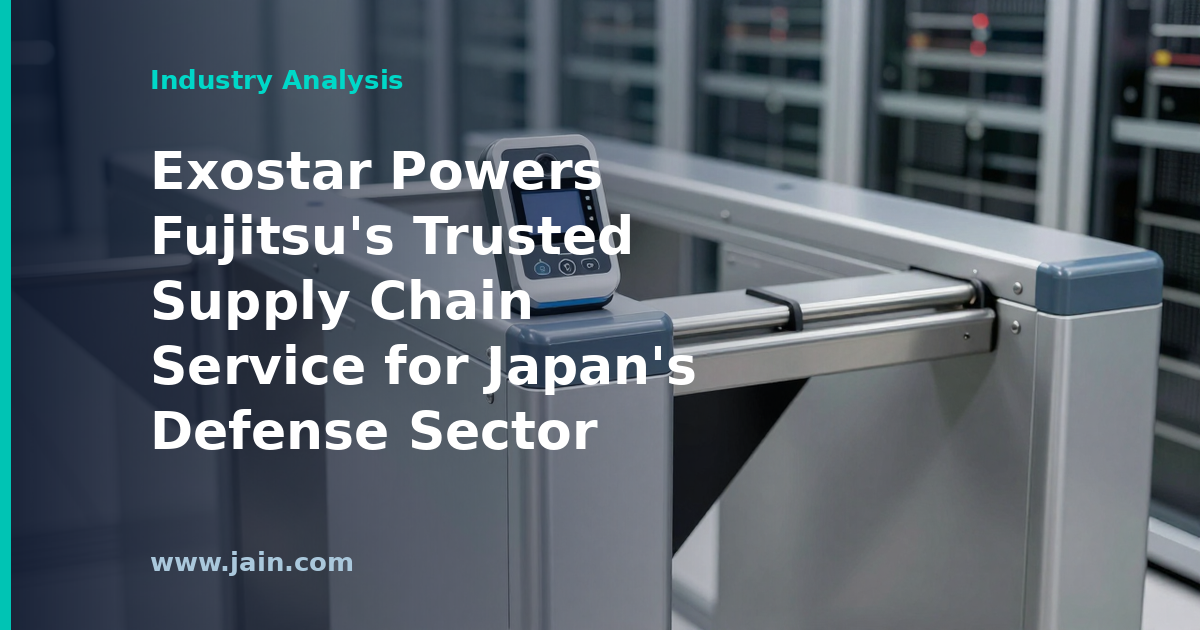
Exostar, the Herndon, Virginia-based secure-collaboration provider, announced on August 20, 2026 that it is supplying its “Exostar Managed on Microsoft 365” environment-building technology for Fujitsu Limited’s new “Fujitsu Trusted Supplychain Service,” which Fujitsu is launching in Japan for the country’s defense and critical-infrastructure sectors.
The service will run on ISMAP-registered infrastructure in Japan — ISMAP being Japan’s government cloud-security assessment program — giving customers in-country data residency while inheriting security controls Exostar has already deployed for the U.S. Defense Industrial Base. The arrangement extends a collaboration between the two companies that began in 2019.
Executive Summary
The announcement is a technology-provision deal: Exostar builds and manages the secure Microsoft 365 environment inside Fujitsu’s service, while Fujitsu operates and sells the offering in Japan. The environment includes a managed enclave — a walled-off cloud workspace where sensitive files stay put rather than scattering across suppliers’ own systems — plus centralized identity and access management, multi-factor authentication, partner onboarding, information-sharing controls, and audit-ready activity logging.
Why it matters: cybersecurity requirements for defense suppliers are converging across allied nations. The U.S. Department of Defense’s Cybersecurity Maturity Model Certification (CMMC) program, built on the NIST SP 800-171 standard, governs contractors that handle controlled unclassified information (CUI). Japan’s Ministry of Defense and its Acquisition, Technology & Logistics Agency (ATLA) have introduced closely aligned requirements, alongside Japan’s Economic Security Promotion Act of 2022. Multinational supply chains increasingly need one trust layer that satisfies both regimes.
For Exostar, the deal exports a platform proven in U.S. defense environments — a Microsoft GCC High enclave with FedRAMP Moderate Equivalency — into a second allied market through a local operator. For Fujitsu, it adds vetted enclave technology to a domestic compliance service without building it from scratch.
Allied Cybersecurity Mandates Are Converging on a Common Standard
The most significant context in this release is regulatory, not technical. NIST SP 800-171 — a U.S. catalog of security controls for protecting sensitive-but-unclassified government information on contractor systems — has become a de facto international baseline. The U.S. enforces it through CMMC; Japan’s defense ministry and ATLA have adopted closely aligned supplier requirements. When two allied procurement regimes converge on the same control set, a vendor that has already operationalized those controls at scale can sell essentially the same capability into both markets.
That is the strategic logic here. Exostar says its platform is used by more than half of the U.S. Defense Industrial Base, including 98 of the top 100 firms — a company-provided figure, but one that, if accurate, represents exactly the kind of installed-base credibility Japanese defense suppliers facing new mandates would want to borrow rather than rebuild. For smaller suppliers especially, achieving NIST 800-171-level security independently is expensive; inheriting controls from a managed enclave is the shortcut the compliance market has been moving toward.
The Shared-Responsibility Enclave Model, and Its Limits
The service uses what the release calls a shared responsibility model: Exostar’s managed environment provides many of the technical controls (encryption, access management, logging), while customers remain responsible for organizational requirements — policies, training, personnel vetting, and physical security. This is an honest framing worth noting, because “compliance in a box” claims in this market often gloss over it. An enclave can dramatically reduce a supplier’s technical burden; it cannot make an organization compliant by itself.
The economics still favor the model. Concentrating sensitive information in one controlled environment, rather than distributing it across dozens of supplier systems of varying maturity, shrinks the attack surface and the audit surface simultaneously. The trade-off is concentration risk and dependency: suppliers’ most sensitive collaboration flows through a single third-party-managed environment, which raises the stakes on that environment’s own security and availability — a question the release, understandably, does not explore.
Data Sovereignty as a Design Requirement, Not an Afterthought
The structure of the deal is itself instructive. Exostar did not simply extend its U.S.-hosted service to Japanese customers; its technology is integrated into a Fujitsu-operated service running on ISMAP-registered infrastructure inside Japan. Data residency — keeping data physically and legally within national borders — and in-country operation are explicit features. This reflects a broader pattern in allied technology cooperation: security capabilities cross borders, but data and operations increasingly do not.
For the infrastructure industry, that pattern has real consequences. Every allied market that mandates in-country operation for sensitive workloads creates demand for sovereign cloud capacity, local data centers, and partnerships pairing a foreign technology provider with a domestic operator. The Exostar–Fujitsu structure — U.S. platform expertise, Japanese infrastructure and go-to-market — is a template likely to recur as other allies formalize supplier-security regimes.
Winners, Losers, and the Competitive Field
The clearest beneficiaries, if the service performs as described, are mid-tier Japanese defense and critical-infrastructure suppliers that face rising security requirements without the IT resources of a prime contractor. Fujitsu gains a differentiated compliance offering; Microsoft benefits indirectly, since the enclave is built on Microsoft 365. The competitive pressure falls on standalone secure-collaboration and governance/risk/compliance vendors targeting Japan, who now face an incumbent domestic integrator paired with the dominant U.S. defense-collaboration platform.
That said, the release is a technology-provision announcement, not a results announcement. It names no customers, no adoption targets, no pricing, and no launch date beyond “launching in Japan.” The 2019-era Fort# Forum collaboration shows the relationship has history, but the market impact of this new service is, at this stage, a projection rather than a demonstrated outcome.
Background
Exostar was built around the U.S. defense supply chain’s need to collaborate on sensitive programs without leaking controlled information. The company says more than half of the U.S. Defense Industrial Base — including 98 of the top 100 defense firms — transacts business over its platform, and that over 25 of the top global biopharmaceutical companies also use it. Its U.S. defense offering runs in a Microsoft GCC High enclave with FedRAMP Moderate Equivalency, the assurance tier used for handling controlled unclassified information.
The Japanese market context has shifted markedly since the companies first partnered in 2019 on Fujitsu’s Fort# Forum offering. Japan’s Economic Security Promotion Act of 2022 and new Ministry of Defense and ATLA supplier requirements — closely modeled on the U.S. NIST SP 800-171 standard — have pushed Japanese defense and critical-infrastructure suppliers toward the same kind of formalized cybersecurity compliance that CMMC now enforces in the United States.