TL;DR · 30-second read
The Short Version
Only about one in three people in Africa used the internet last year. In the rest of the world, it is closer to three in four.
The United States government’s overseas investment arm plans to buy a stake in WIOCC Group, a company that lays internet cables under the sea and across land in more than 30 African countries, and runs the buildings that store and move the data. A pan-African development bank and a Saudi infrastructure investor are backing it too.
The price has not been made public, and lawmakers in Washington must be notified before the deal can close.
WIOCC Group announced on September 22, 2026 that the U.S. International Development Finance Corporation (DFC) intends to join Africa Finance Corporation (AFC) and Vision International Investment Company (Vision Invest) as an investor in the company. The announcement, issued from New York on behalf of AFC, followed a roundtable AFC hosted on the sidelines of the Global Africa Business Initiative’s Unstoppable Africa event, held alongside the UN General Assembly.
The combined investment is earmarked for WIOCC Group’s terrestrial and subsea networks, its data centre capacity and its broader digital infrastructure platform. WIOCC Group operates in more than 30 African countries and has been trading since 2008. No investment amount, ownership percentage or valuation was disclosed, and DFC’s participation remains subject to further steps before commitment and closing, including congressional notification.
Executive Summary
The transaction puts three very different pools of capital on one cap table: a pan-African multilateral investor, a Saudi infrastructure developer, and the investment arm of the United States government. What they are buying into is not compute. It is the layer underneath it — undersea cables, long-haul and metro fibre, and carrier-neutral data centres, meaning facilities that host any operator’s equipment without competing for their customers.
The framing in the announcement is explicitly about artificial intelligence and cloud demand, but the numbers cited describe a access problem rather than a processing one. The International Telecommunication Union figure quoted puts 35.7% of Africa’s population online in 2025 against a 73.6% global average — a gap of nearly 38 percentage points. UNCTAD’s projection of a US$4.8 trillion global AI market by 2033 is paired, in the same announcement, with that body’s warning that AI capability and digital infrastructure remain concentrated in a small number of countries and companies.
What matters for the industry is the reclassification. Fibre, subsea systems and data centres are being underwritten here the way roads, ports and power plants are — as strategic infrastructure with a long payback, rather than as telecom credit. What the announcement does not do is put a figure, a capacity number, a customer or a date against that intent.
Why the Constraint Is Reach, Not Chips
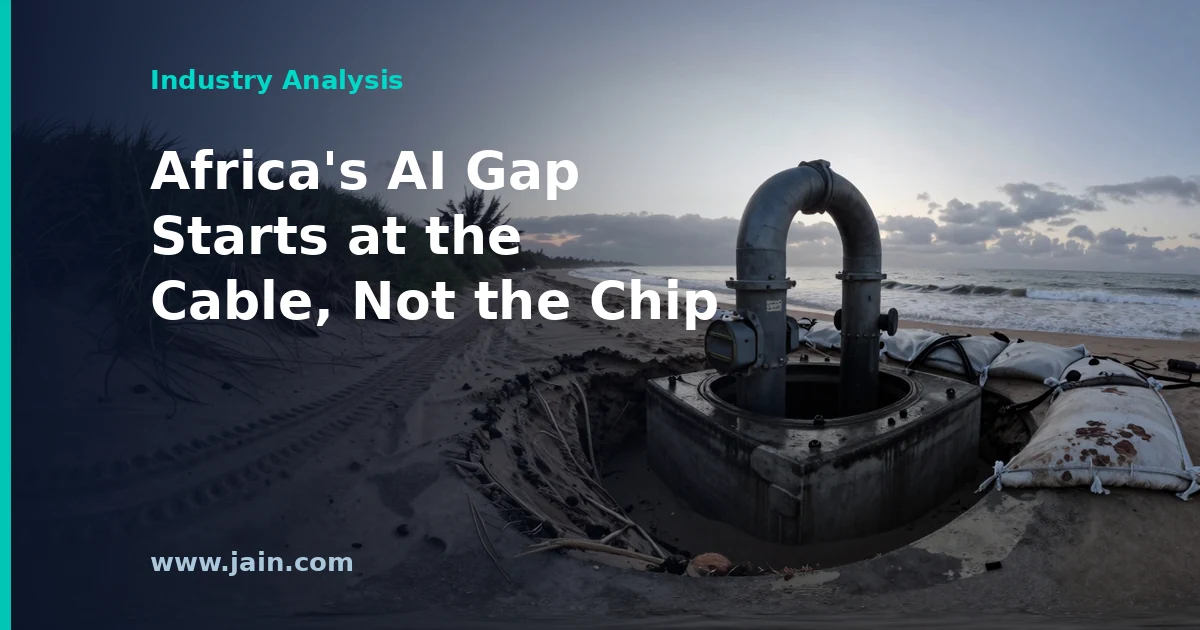
The headline number in this announcement is 35.7%. That is the share of Africa’s population the ITU recorded as using the internet in 2025, against a global average of 73.6%. Hold that next to what the money is actually going toward: terrestrial networks, subsea cables, data centre capacity, and the platform that ties them together. Accelerators, GPUs and compute clusters appear nowhere in the list. That is not an oversight — it is the sequence in which this infrastructure has to be built.
The mechanism is straightforward once you separate the layers. AI capacity is only useful if traffic can reach it cheaply and quickly. A cloud region needs a subsea landing station to reach the rest of the world, long-haul fibre to carry traffic inland, metro fibre to reach the cities where users are, and neutral interconnection points where networks meet and exchange traffic. Where those layers are thin, compute placed on the continent has an expensive route to its users, and users have an expensive route to compute hosted elsewhere. Latency and transit cost, not silicon availability, are what determine whether an African workload runs locally or in Europe.
This is not a claim that chips are irrelevant. It is a claim about where capital binds first, and about who is affected downstream. Carriers buying wholesale capacity, enterprises pricing cloud egress, content and streaming providers weighing whether to cache locally, and hyperscalers deciding whether a market justifies a region all sit behind the same constraint. WIOCC’s own chief executive frames the use of proceeds as accelerating data centre deployment and consolidation, expanding open-access terrestrial fibre, and investing in new subsea assets — three transport-and-hosting moves, no compute commitments among them.
Development Finance Stops Pricing Fibre as Telecom Risk
AFC chief executive Samaila Zubairu made the reclassification explicit: just as transport corridors enable trade and energy networks power industry, fibre, data centres and subsea cables are now essential infrastructure. That is the language of a project finance desk, not a telecom credit committee, and it matters because the two price risk very differently. AFC has invested over US$19 billion across 36 African countries since 2007 in energy, natural resources, heavy industry, transport and telecommunications; this deal moves digital infrastructure firmly into the first category rather than leaving it in the last.
The economics behind that shift are unforgiving and well understood by anyone who has financed a cable. Subsea systems and data centres carry almost all their cost up front and earn it back over fifteen to twenty-five years, and an open-access wholesale model — selling capacity to all comers rather than bundling it into retail service — earns slowly by design, because its margin discipline is the point. Equity from investors who can tolerate that horizon is typically what makes commercial debt behind it financeable at all. An expanded shareholder base of development, sovereign-linked and multilateral capital is therefore a balance sheet event before it is a construction event.
The practical consequence for the market is competitive rather than charitable. Open-access capacity lowers the cost for every other operator to reach the same markets, which compresses wholesale transit pricing and improves the business case for anyone contemplating a landing or a region. That is a benefit to WIOCC’s competitors as much as to WIOCC, and it is the standard argument for why public capital is placed at this layer.
The Hyperscaler Sentence, and What It Does Not Commit To
The most quoted line in the announcement will be DFC’s. Conor Coleman, the agency’s chief of staff and head of investments, said the platform will support American and allied partner companies seeking to grow in the market, including U.S. hyperscalers and the broader American technology ecosystem. DFC describes itself as central to U.S. economic statecraft, with a mandate that includes securing supply chains. Read plainly, that is industrial policy applied to connectivity, and the three-flag investor group — African, Saudi and American — is itself the story the parties want told.
It is worth being precise about what that sentence establishes and what it does not. Substantiated by the announcement: the investor set, the intent, the categories of spend, WIOCC’s presence in more than 30 countries, and the market context the ITU and UNCTAD figures supply. Not substantiated: any hyperscaler customer, contract, anchor tenancy or committed capacity. A stated willingness to serve a class of customer is a demand thesis, not demand.
Nor is this closed. DFC’s participation is explicitly subject to further steps before commitment and closing, including congressional notification. Announced intent from a government investor carries real signalling weight for co-investors and lenders, but it is not funded capital, and the distinction is the one buyers and counterparties should hold onto until a closing is confirmed.
Background
WIOCC has operated in Africa since 2008, building out from wholesale subsea and terrestrial capacity into a group that now spans metro fibre, carrier-neutral data centres and open-access platform services across more than 30 countries. The open-access model it runs — selling capacity to all operators on equal terms rather than reserving it for a retail arm — is the structure most African markets have leaned on to bring down the cost of international bandwidth.
Africa Finance Corporation was established in 2007 as a multilateral infrastructure investor and now counts 48 member countries, with more than US$19 billion invested across 36 African countries in energy, natural resources, heavy industry, transport and telecommunications. Vision Invest is a Saudi infrastructure investment and development company active in energy transition, digital infrastructure, transport and logistics, and social infrastructure, with holdings across five continents. The addition of DFC brings the investment arm of the U.S. government alongside both. Source: WIOCC Group Welcomes U.S. International Development Finance Corporation (DFC) as Investor Alongside Africa Finance Corporation (AFC) and Vision Invest to Accelerate Digital Infrastructure Expansion Across Africa — announcement issued September 22, 2026 on behalf of Africa Finance Corporation, setting out DFC’s intent to invest in WIOCC Group and the planned use of the combined investment.Sources