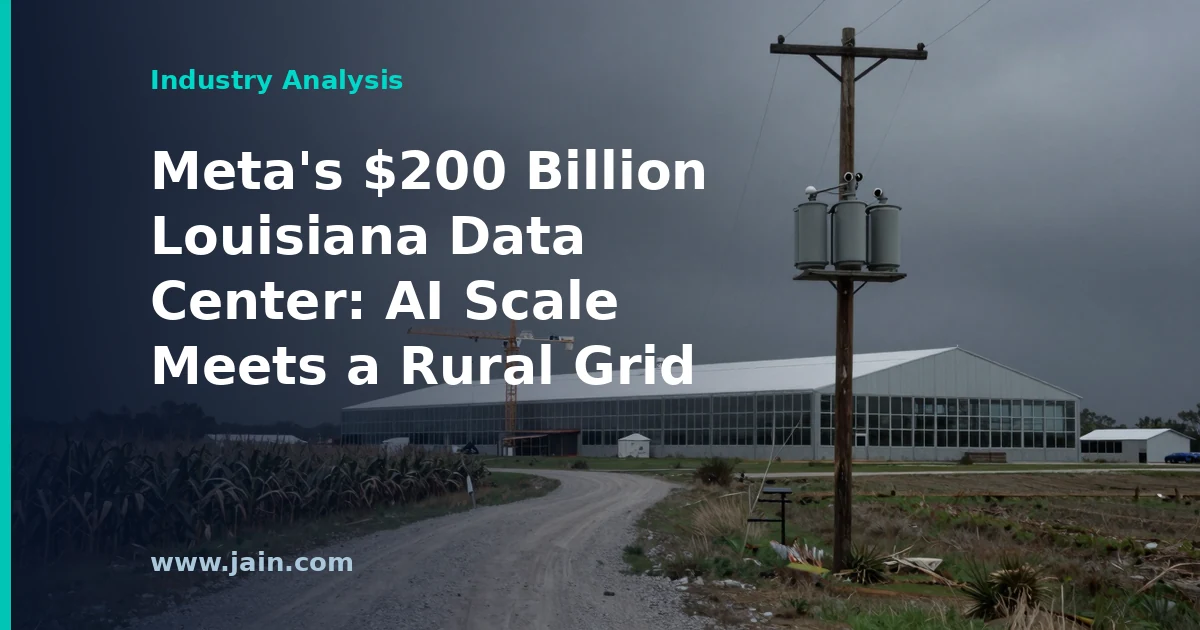
Bloomberg reports that Meta’s data center campus in rural Louisiana — the AI supercomputing site the company calls Hyperion — now represents a commitment on the order of $200 billion, a figure that would make it the largest single data-center investment ever reported. The project, located in Richland Parish in northeast Louisiana, began as a $10 billion announcement in December 2024 and has grown alongside Meta’s escalating artificial-intelligence ambitions.
The May 17 report frames the build as transformative for the surrounding rural region, where a campus designed to scale toward multiple gigawatts of computing power is reshaping the local economy, the electric grid, and the land itself.
Executive Summary
The headline number is staggering even by hyperscale standards. When Meta first announced the Richland Parish project, its roughly $10 billion price tag and four-million-square-foot footprint already made it the company’s largest data center. A $200 billion figure — twenty times the original commitment — reflects how quickly the economics of frontier AI have escalated: the cost of a leading AI campus is no longer set by buildings and land but by the accelerator chips, networking, and power infrastructure packed inside them, refreshed on a fast cycle.
Why it matters: a single company concentrating that much capital at a single rural site is a new phenomenon in American infrastructure. It tests the capacity of a regional utility (Entergy Louisiana is building new gas-fired generation to serve the load), the absorptive capacity of a small rural parish, and the balance sheets of even the world’s most profitable companies. Meta has already turned to outside capital for this site, including a reported joint-venture financing arrangement with Blue Owl Capital — a sign that AI infrastructure at this scale is becoming its own asset class.
The caveat: the source is a single report, and it does not spell out what the $200 billion covers — committed construction capital, cumulative spending including chips over the site’s life, or a long-range projection. Those distinctions matter enormously, and we flag them below.
From $10 Billion to $200 Billion in Eighteen Months
Meta announced the Richland Parish campus in December 2024 as a $10 billion, four-million-square-foot facility — at the time, the largest in its fleet. By mid-2025, CEO Mark Zuckerberg had rebranded the site as Hyperion and described plans to scale it toward five gigawatts of computing capacity, part of a stated intent to spend hundreds of billions of dollars on AI infrastructure. A $200 billion characterization of the site is therefore less a sudden announcement than the visible endpoint of a steady escalation.
The driver is the changed composition of data-center cost. In a conventional facility, the building and electrical plant dominate. In an AI campus, the servers and GPUs (the specialized chips that train and run AI models) can represent the large majority of total investment — and unlike the building, they are replaced every few years. That is how a single site’s lifetime cost can plausibly reach twelve figures, and it is also why headline totals for AI campuses should be read carefully: they often blend one-time construction with years of recurring hardware spending.
What a Gigawatt-Class Campus Asks of a Rural Grid
Richland Parish is farm country in one of the poorer corners of Louisiana. A campus targeting multiple gigawatts — a gigawatt is roughly the output of a large power plant, enough for hundreds of thousands of homes — cannot draw on spare capacity, because rural grids do not carry spare capacity at that scale. Entergy Louisiana’s answer has been new natural-gas generation built substantially to serve this one customer, an arrangement approved by state regulators.
That model raises questions every state hosting hyperscale AI now faces. Who bears the cost if the load does not materialize or the customer leaves early — the company, or ratepayers? What happens to local reliability while multi-year grid upgrades catch up to the load? And how does a build dependent on new gas plants square with Meta’s long-standing renewable-energy commitments? These are not gotcha questions; they are the standard underwriting questions for single-customer generation, and the answers sit in regulatory filings and contract terms that headline coverage rarely reaches.
The Economics of Concentrating $200 Billion at One Site
Even for Meta, which generates tens of billions of dollars in annual free cash flow, this scale of spending strains a corporate balance sheet. The company’s reported use of joint-venture and private-credit financing for Hyperion — bringing in outside investors such as Blue Owl to own and fund data-center assets Meta then uses — signals a broader industry shift: AI infrastructure is being financed like power plants and pipelines, with long-lived structures and external capital, rather than expensed casually from operating profits.
Concentration is the risk that comes with it. A single-site bet of this magnitude assumes AI demand keeps compounding, that the chips installed are not stranded by faster successors, and that power arrives on schedule. The winners if it works: Meta, which gets training capacity rivals must match; Louisiana, which collects taxes and jobs; and the contractors, utilities, and lenders in the build chain. The losers if it doesn’t are harder to name in advance — which is precisely why the financing structures, and who holds which risk, deserve as much attention as the square footage.
Rural Transformation Cuts Both Ways
For Richland Parish, the project brings thousands of construction workers, a permanent operational workforce Meta originally described in the hundreds of jobs, and a tax base transformation few rural counties ever see. It also brings housing pressure, road and water demands, and a local economy newly tethered to one company’s AI strategy — a dependency small communities historically know from mills and plants, with mixed long-term results.
The fair reading is that both the boosters and the skeptics have real evidence. The investment, employment, and utility upgrades are concrete. So are the open questions about what the region retains if AI economics shift. Communities negotiating with hyperscalers elsewhere will study Louisiana’s terms closely — which makes transparency about those terms a matter of more than local interest.
Background
Meta operates one of the world’s largest data-center fleets, built over two decades to serve Facebook, Instagram, and WhatsApp. The generative-AI race changed the shape of that fleet: training frontier AI models requires enormous clusters of GPU chips concentrated at single sites with gigawatt-scale power. In 2025 Meta reorganized its AI efforts around ‘superintelligence’ and announced titan-scale campuses — Hyperion in Louisiana and Prometheus in Ohio — while raising capital spending to historic levels and signaling that hundreds of billions of dollars would follow.
The December 2024 Louisiana announcement landed in Richland Parish, a rural farming area, accompanied by state incentives and an Entergy plan for new gas-fired generation. The project has since become a national reference case for how AI infrastructure interacts with rural grids, utility regulation, and small-town economies.
Capacity prices in PJM Interconnection — the regional transmission organization that operates the largest wholesale electricity market in the United States — have surged 76%, and reporting by E&E News (POLITICO) on May 16, 2026 identifies data center demand as the principal driver. PJM coordinates power across 13 states and the District of Columbia, serving roughly 65 million people, so a price move of this size in its capacity market ripples directly into the electric bills of a substantial share of the American population.
Capacity prices are not the price of energy itself; they are what the market pays generators simply to be available during the hours of highest demand. A 76% jump in that availability premium is the market’s way of saying that spare headroom on the grid is getting scarce — and the reporting attributes that scarcity chiefly to the wave of AI-driven data center construction concentrated in PJM’s footprint.
Executive Summary
The reported 76% surge in PJM capacity prices is arguably the most concrete, dollar-denominated evidence to date that AI infrastructure buildout is stressing the US power system. Forecasts of data center load growth have circulated for two years; a capacity auction result is different. It is a binding market outcome — real money that electricity suppliers must pay, and ultimately recover from customers, because demand is growing faster than dependable supply.
The mechanism matters. PJM procures capacity through auctions held in advance of each delivery year: generators offer their availability, and the auction clears at the price needed to cover forecast peak demand plus a reserve margin. When large new loads such as hyperscale data centers enter the forecast while older power plants retire and new ones queue slowly for interconnection, the supply-demand balance tightens and the clearing price rises. A 76% increase indicates that tightening is now severe, not incremental.
For the infrastructure industry, the signal cuts both ways. It validates the scale of AI demand that data center operators have been describing — but it also raises the operating cost of every facility in the region, hands utilities and consumer advocates a concrete number to organize around, and increases the likelihood of regulatory intervention in how large loads connect to and pay for the grid.
What a Capacity Price Actually Measures
Capacity markets are insurance markets for the grid. Separate from the energy market, where power is bought and sold as it is consumed, a capacity auction pays generators a fixed amount — typically quoted per megawatt-day — to guarantee they will be available when the system hits its peak. The clearing price is therefore a pure scarcity signal: it reflects how much spare, dependable generating capacity exists relative to forecast peak demand, years before that peak arrives.
That is what makes a 76% surge more telling than any demand forecast. Forecasts can be revised; auction results are settled commitments backed by penalties for non-performance. When the availability premium jumps this sharply, it means the market — with real capital at stake — has concluded that the cushion between peak demand and dependable supply in PJM is thinning quickly. Attribution of the surge to data centers puts a name on the demand side of that squeeze.
Why AI Load Lands So Hard on PJM
PJM’s territory includes Northern Virginia, the densest concentration of data centers on Earth, along with fast-growing markets in Ohio, Pennsylvania, and the Chicago area. Data center load has characteristics that stress a capacity market more than most growth: facilities are large — a single AI campus can draw as much power as a mid-sized city — they run near-continuously rather than peaking with the weather, and they arrive in clusters on compressed construction timelines measured in a couple of years.
Supply cannot respond at that speed. New gas turbines face multi-year equipment backlogs, renewable and storage projects sit in long interconnection queues, and coal units continue to retire on schedules set years ago. Capacity auctions exist precisely to signal when this mismatch is forming, and the reported surge suggests the signal has moved from amber to red. In that sense the price is doing its job — the open question is whether investment in new generation can respond before the cost of scarcity compounds.
Who Pays, and Who Benefits
Capacity costs flow through electricity suppliers to virtually all retail customers, spread across households, businesses, and industry regardless of who caused the demand growth. That socialization of costs is the political flashpoint: a homeowner in Baltimore or Columbus pays part of the premium created, in large part, by hyperscale computing facilities they may never see. Expect this number to feature in rate cases, state legislative hearings, and the ongoing debate over whether large loads should face special tariffs or bring-your-own-generation requirements.
On the other side of the ledger, existing generators — particularly gas, nuclear, and other dispatchable plants that can pledge dependable capacity — are clear beneficiaries, and higher capacity revenue is exactly the incentive the market design uses to attract new entry and keep existing plants online. Data center developers face a more nuanced picture: higher power costs raise operating expenses, but a market that rewards firm capacity also strengthens the case for the on-site generation, storage, and long-term supply deals that many operators are already pursuing.
A Price Signal With Policy Consequences
Sharp capacity price increases rarely stay contained within market design circles. When the driver is identifiable — here, data centers — regulators and politicians gain a specific target for cost-allocation reform. Proposals already circulating across US grid regions include dedicated rate classes for very large loads, requirements that new data centers fund transmission upgrades, and co-location arrangements that pair facilities directly with power plants. A 76% surge gives all of those efforts fresh momentum in PJM’s 13 states.
For the broader AI infrastructure economy, the strategic takeaway is that power availability — not land, fiber, or chips — is consolidating as the binding constraint on growth in established markets. Operators that secured capacity, interconnection positions, or generation partnerships early hold an appreciating asset. Those planning new facilities in PJM territory now face higher costs, longer utility timelines, and a more contentious public environment — pressures that are already redirecting some development toward regions with more available headroom.
Background
PJM Interconnection began as a power pool of Pennsylvania, New Jersey, and Maryland utilities and grew into the largest grid operator in the United States, running wholesale energy and capacity markets across 13 states and the District of Columbia. Its capacity construct, the Reliability Pricing Model, procures guaranteed generating capacity through auctions held in advance of each delivery year — a design meant to keep enough dependable supply online as the generation fleet changes.
For most of the 2010s, flat demand and cheap shale gas kept PJM capacity prices low. That era ended as AI and cloud growth transformed data centers into the region’s dominant new load — anchored by Northern Virginia, the world’s largest data center market — while coal retirements and slow interconnection queues constrained supply. Capacity auctions in the mid-2020s began registering that squeeze with sharply higher clearing prices, of which the 76% surge reported in May 2026 is the latest and among the starkest examples.
POWER Magazine published an analysis on May 16, 2026, arguing that so-called phantom data centers — speculative, duplicative, or abandoned requests for grid connections at facilities that may never be built — did not break the U.S. power grid’s planning process. Its headline thesis is blunter: the flood of questionable megawatt requests proved the interconnection system was already broken before the AI-era demand surge arrived to stress it.
Executive Summary
The piece lands in the middle of one of the most consequential debates in energy and digital infrastructure: how much of the enormous projected data center load on utility books is real. Utilities and grid operators across the country have reported unprecedented volumes of large-load interconnection requests — the formal applications a big customer files to connect to the grid — driven by the AI build-out. A meaningful but unquantified share of those requests is widely believed to be speculative: the same project shopped to multiple utilities at once, or land plays filed to reserve capacity cheaply.
POWER Magazine’s framing matters because it shifts the blame from the applicants to the process. If a planning system can be swamped by requests that cost little to file, take years to study, and require little proof of commitment, the vulnerability was structural — phantom load merely exposed it. For an industry whose credibility with regulators and the public increasingly depends on accurate demand forecasts, that distinction shapes what the fix should be.
What a Phantom Megawatt Is — and Why It Ends Up on the Books
An interconnection request is not a binding order for power; in most jurisdictions it has historically been a cheap option. A developer scouting sites can file requests with several utilities for the same prospective campus, keep every option open while negotiating land, chips, and capital, and walk away from all but one — or all of them. Each of those filings, however, can enter a utility’s load forecast and transmission-study pipeline as if it were a real future customer.
The result is a compounding distortion. Study queues lengthen for everyone, including projects that are fully financed and ready to build. Forecasts inflate, which feeds into decisions about new generation, transmission lines, and rate cases. And because utilities cannot easily distinguish a committed hyperscale campus from a land speculator’s placeholder, the honest answer to “how much data center load is coming” becomes genuinely unknowable from the queue alone.
The Queue Was Broken Before AI Showed Up
The article’s central claim — that phantom load revealed rather than caused the breakdown — fits the longer history. Interconnection processes were designed for an era of slow, predictable load growth, with first-come-first-served study sequences, modest deposits, and few readiness screens. Generator interconnection queues showed the same failure mode years earlier, when speculative renewable projects piled up and forced regulators toward cluster studies and stiffer milestone requirements. Large-load interconnection, by contrast, has remained far less standardized, leaving each utility to improvise its own defenses.
Seen that way, data centers are the stress test, not the disease. Any process that prices a multi-hundred-megawatt reservation at close to zero will attract free options in a land rush; AI simply supplied the land rush. The implication is uncomfortable for utilities and developers alike: tightening screens on data centers without reforming the underlying study process would treat the symptom that made the problem visible.
Who Pays When the Forecast Is Wrong in Either Direction
Phantom load creates a two-sided planning risk. If utilities build generation and wires for demand that evaporates, the cost of that overbuild lands in rate base — the pool of investment that ordinary electricity customers repay over decades. If utilities discount the queue too aggressively and real projects materialize, the grid is short, prices spike, and serious data center customers face multi-year connection delays that push investment to other regions or into on-site generation.
That asymmetry explains the emerging middle path many utilities and regulators are pursuing: making the request itself carry real commitment. Larger deposits, demonstrated site control, staged payments tied to milestones, and contractual minimum-take obligations all convert a free option into a priced one. Developers with real projects generally have reason to support such screens, because they clear the queue of competitors who were never going to build — though they also raise the cost of legitimate early-stage flexibility.
Background
The AI infrastructure build-out has made data centers the dominant story in U.S. electricity demand, ending decades of roughly flat load growth. Utilities in many regions now report interconnection requests from prospective data center customers that dwarf their historical planning assumptions, and those figures flow into generation plans, transmission proposals, and rate cases. POWER Magazine, a long-running trade publication covering the power generation and delivery sector, has tracked the resulting tension: grid planners must commit capital years ahead of demand, using a queue that mixes committed hyperscale campuses with speculative placeholders. Generator interconnection went through a similar speculative pile-up in the renewables boom, prompting regulators to overhaul study processes — a precedent now shaping the debate over how to handle large loads.
The Center for Strategic and International Studies (CSIS), a Washington policy think tank, published an analysis titled The Impact of Tariffs on the AI Data Center Buildout: Balancing Supply Chain Security and AI Infrastructure Leadership. The piece frames tariffs as a policy lever that simultaneously shapes national supply chain security and the pace at which the United States can build out AI computing capacity.
The item surfaced on May 14, 2026 via Google News; the underlying CSIS piece is a policy commentary rather than a corporate announcement, and the summary text available in the feed is limited to the headline framing.
Executive Summary
CSIS is putting a name on a tension operators have been living with for the last two years: every dollar of import duty on transformers, switchgear, servers, optics, or steel lands somewhere in the AI buildout stack, and the industry cannot simply absorb it without slipping schedules or raising the price of compute. The think tank frames the debate as balancing supply chain security — reducing dependence on adversary-linked components — against AI infrastructure leadership, which depends on cheap, fast, at-scale construction.
For data center operators, hyperscalers, and their financiers, the analysis matters less for any single recommendation than for how it reframes tariffs as an input cost in AI economics rather than a purely trade-policy story. That reframing is where the interesting business questions start: who pays, who reshores, and whose megawatt timeline slips.
Tariffs Become an AI Infrastructure Input Cost
An AI data center is, in bill-of-materials terms, a stack of tariff-exposed goods: grain-oriented electrical steel for transformers, medium-voltage switchgear, generators, chillers, structural steel, copper busway, fiber optics, and the GPU-laden servers themselves. When tariffs move, they move all of those line items unevenly, and the cost does not stay with the importer — it flows into the price per kilowatt of built capacity and, ultimately, into the price of AI inference and training. CSIS’s contribution is to name that pass-through explicitly, treating tariff policy as industrial policy for compute.
The economics are unforgiving because AI campuses are being sized in gigawatts rather than megawatts. A ten-percent adjustment on a niche component can add tens of millions of dollars to a single site and, more importantly, add months to a schedule if a domestic substitute does not yet exist at the volumes required.
Supply Chain Security Versus Time-to-Power
The security case for tariffs is straightforward: reduce dependence on suppliers in jurisdictions whose interests may diverge from the buyer’s, and rebuild domestic capacity in categories — transformers most visibly — where lead times have already blown out to multiple years. The leadership case cuts the other way: the country that stands up usable AI capacity fastest gets the workloads, the talent, and the downstream services revenue. Tariffs that protect a future domestic supplier can, in the interim, slow the very buildout they are meant to secure.
Operators have limited tools to navigate that gap. They can pre-buy long-lead equipment, sign multi-year framework agreements, qualify additional vendors, or shift build sequencing so that tariff-heavy components sit on the critical path as briefly as possible. None of these are free, and all of them favor the largest balance sheets.
Winners, Losers, and Who Actually Pays
In a tariff-heavy regime, the clearest winners are domestic manufacturers of the constrained categories — transformer makers, switchgear producers, and any server integrator with a qualified US assembly footprint. Hyperscalers with the cash and forecasting horizon to lock in supply years ahead are relative winners too, because scarcity favors those who ordered first. The clearest losers are smaller colocation operators and enterprise buyers who arrive later in the queue and pay both the tariff-inflated price and the scarcity premium on top.
The subtler question is whether tariffs accelerate domestic capacity enough, and fast enough, to matter. Factory build-outs for heavy electrical gear are themselves multi-year projects; a tariff imposed today does not deliver a domestic transformer tomorrow. If demand-side AI growth outruns supply-side reshoring, the net effect is higher costs without the intended security dividend.
Background
The US AI data center buildout has moved from a specialist infrastructure story to a macroeconomic one over the past two years, with hyperscalers and specialty developers committing to gigawatt-scale campuses and long-lead procurement of power equipment. At the same time, US trade policy has expanded the use of tariffs across categories relevant to that buildout, from steel and electrical equipment to semiconductors and finished electronics.
Think tanks including CSIS have increasingly treated data center supply chains as a national-security topic rather than a purely commercial one, arguing that where and how compute capacity is built has strategic consequences comparable to earlier debates over telecom and semiconductor manufacturing.
NVIDIA and IREN Limited announced a strategic partnership on May 7, 2026, aimed at accelerating the deployment of up to 5 gigawatts (GW) of AI infrastructure. IREN, a Nasdaq-listed data center operator that pivoted from Bitcoin mining to AI cloud services, becomes one of the largest publicly named partners in NVIDIA’s growing web of direct infrastructure alliances.
The announcement, issued through NVIDIA’s newsroom, frames the deal as a build-out acceleration pact; the headline figure is capacity — power, not dollars — and the companies did not disclose financial terms in the material reviewed here.
Executive Summary
The world’s dominant AI chipmaker and one of the fastest-rising ‘neocloud’ operators — companies that build GPU-packed data centers and rent the computing power out — have formalized a partnership targeting up to 5GW of AI infrastructure. For scale, 5GW is roughly the output of five large nuclear reactors and exceeds the total data center capacity of most major metropolitan markets today.
Why it matters: NVIDIA has been steadily moving beyond selling chips into shaping who gets to build the facilities that consume them — through investments, supply commitments, and named partnerships with operators like CoreWeave and now IREN. A GPU vendor putting its name directly behind a gigawatt-scale buildout compresses the traditional separation between component supplier and infrastructure developer.
For IREN, NVIDIA’s public endorsement is arguably as valuable as any commercial term: it signals priority access to scarce GPUs, the binding constraint for every AI cloud operator, and validates the company’s multi-year pivot from cryptocurrency mining to AI compute.
The Chipmaker Becomes the Kingmaker
Historically, semiconductor vendors sold components and let customers worry about buildings, power, and financing. That model is inverting. NVIDIA has taken equity stakes in GPU cloud providers, arranged supply priority for favored partners, and now attaches its name to a 5GW deployment target with a single operator. When allocation of the scarcest input in the AI economy — leading-edge GPUs — flows through strategic partnerships, the vendor effectively chooses which infrastructure players scale and which wait in line.
This has real market-structure consequences. Operators inside NVIDIA’s partnership perimeter can raise capital more cheaply, because lenders and investors treat GPU access as the key execution risk. Operators outside it face a harder story. The deal is therefore best read not just as an IREN milestone but as another data point in NVIDIA’s construction of a vertically aligned ecosystem — one that competitors, regulators, and hyperscale customers are all watching closely.
Why IREN: Power First, Chips Second
IREN’s core asset is not silicon — it is secured electrical capacity. The company, which began as Bitcoin miner Iris Energy, spent years assembling large, renewables-oriented power positions, including a multi-gigawatt development hub in West Texas and hydro-powered sites in British Columbia. In today’s market, grid interconnection queues stretch years and available power — not capital or land — is the gating factor for AI data centers. An operator holding contracted gigawatts is holding the scarce complement to NVIDIA’s scarce GPUs.
The partnership logic is symmetrical: NVIDIA needs credible places to deploy the chips it sells in enormous volumes; IREN needs assured chip supply to monetize its power pipeline. IREN’s late-2025 multi-billion-dollar AI cloud contract with Microsoft — reported at roughly $9.7 billion — had already demonstrated hyperscaler demand for its capacity. A named NVIDIA partnership adds the supply-side anchor.
Reading ‘Up to 5 Gigawatts’ Carefully
The phrase ‘up to’ is doing significant work. A 5GW ceiling is an ambition, not a contracted delivery schedule, and the announcement as reviewed does not specify phasing, capital commitments, or who funds what. Building 5GW of AI-grade data centers would plausibly require investment on the order of hundreds of billions of dollars across facilities, chips, and grid upgrades over many years — commitments far beyond what a partnership press release itself establishes.
That is not a criticism unique to this deal; it is the standard grammar of AI infrastructure announcements in this cycle, where headline gigawatt and dollar figures routinely describe multi-year aspirations. The substantiated core here is narrower but still meaningful: NVIDIA has publicly designated IREN a strategic deployment partner at a scale ceiling few operators can claim. Investors and customers should track converted megawatts — energized, GPU-filled capacity under contract — rather than announced ceilings.
Winners, Losers, and the Financing Question
Winners, if the buildout converts: IREN, whose cost of capital and customer pipeline both improve; power-rich regions like West Texas that host the load; and NVIDIA itself, which locks in demand visibility for future GPU generations. Under pressure: mid-tier colocation and cloud players without vendor alignment, and any operator whose business case assumed GPU scarcity would ration competitors’ growth.
The open question is who carries the balance-sheet risk. GPU-backed infrastructure depreciates fast — accelerator generations turn over roughly every one to two years — and neocloud operators fund buildouts with debt secured against chips and customer contracts. If AI compute pricing softens before this capacity earns out, the pain lands on whoever financed the gap between announcement and cash flow. The release, as reviewed, does not say how that risk is allocated between the partners.
Background
IREN began life in 2018 as Iris Energy, an Australian-founded Bitcoin miner that differentiated itself by siting operations on low-cost, renewable-heavy power in British Columbia and later Childress, Texas. It listed on Nasdaq in 2021, and as AI demand exploded it converted its power-first playbook into an AI cloud business, buying NVIDIA GPUs and building high-density data centers — a pivot capped by a reported multi-billion-dollar cloud contract with Microsoft in late 2025.
NVIDIA, meanwhile, has evolved from graphics chipmaker into the central supplier of AI computing and, increasingly, an active architect of the infrastructure layer: investing in cloud partners, steering GPU allocation, and publicly backing large deployments. This partnership sits squarely in that pattern — a chip vendor underwriting, at least reputationally, a gigawatt-scale buildout.
North Carolina legislators have introduced an AI infrastructure bill that would push hyperscale data centers to shoulder the electricity system costs their load creates, according to a 5 May 2026 report from Data Center Knowledge. The measure places North Carolina among a growing set of states moving “large-load” cost allocation out of utility commission dockets and into statute.
The available source is headline-level: it establishes that such a bill has been proposed and that hyperscale cost recovery is its target. It does not, in the material we reviewed, supply a bill number, sponsor list, megawatt threshold, contract terms, or a legislative calendar. This analysis therefore treats the policy direction as reported and the mechanics as open questions.
Executive Summary
The proposal addresses a problem that has moved quickly from technical to political: when a single data center campus requests hundreds of megawatts, the utility must build transmission lines, substations and generation to serve it. Those assets are paid for over decades through rates charged to every customer. If the campus is delayed, downsized or shut down, the bill does not disappear — it shifts to households and existing businesses. “Cost causation,” the regulatory principle that the party creating a cost should bear it, is the framework North Carolina is reportedly trying to codify.
This matters because North Carolina is not a marginal market. Its low industrial power prices, data center sales-tax exemption and existing hyperscale footprint have made it a repeat destination for large campuses. A statutory cost-allocation regime in a top-tier state signals that the era of negotiating each large load quietly with a utility, case by case, is narrowing.
For operators, the practical question is not whether they will pay — large customers already pay substantial demand charges — but how much risk they must pre-commit to and for how long. Minimum-take obligations, multi-year contract terms, collateral and exit fees are the levers that determine whether a state’s rules are a manageable cost of doing business or a reason to site the next campus elsewhere.
Why Cost Causation Became a Statehouse Fight
Regulated electric utilities are, in effect, planning institutions. They forecast demand years out, build generation and wires against that forecast, and recover the capital through rates approved by a state commission. The model works when load grows predictably. AI-era data center requests break that assumption in two directions at once: individual projects are enormous relative to a utility’s existing peak, and the interconnection queue is full of speculative requests that may never be built.
Utilities have responded with “phantom load” screening and large-load tariffs designed to separate serious projects from optionality-shopping. But those instruments are negotiated inside regulatory proceedings that most voters never see. When residential bills rise for any reason — fuel costs, storm recovery, capacity additions — data centers become the visible explanation, whether or not they are the arithmetic one. Legislation is what happens when that political pressure outruns the docket process.
The industry has a serious counterargument that deserves to be stated plainly: large, flat, high-load-factor customers can improve system utilization and spread fixed costs across more kilowatt-hours, which can put downward pressure on everyone’s rates. That is genuinely true when the load materializes and stays. The entire policy question is what happens when it does not — and who is holding the asset.
Three States, Three Instruments
Oregon’s POWER Act is the clearest existing template. It directs that very large energy users — data centers and cryptocurrency operations above a defined megawatt threshold — be placed in their own customer class with dedicated long-term contract terms, so that the costs of serving them are recovered from them rather than blended into general rates. The mechanism is structural: create a separate class, then let the commission set terms for that class.
New Jersey’s approach has centered on a tariff mandate — instructing regulators to establish a distinct rate schedule for high-density load, which leaves more design discretion with the board while fixing the obligation in law. North Carolina’s reported bill sits somewhere in this family, but the reporting available does not specify which instrument it uses. The distinction is not academic. A separate-class statute changes who a customer legally is; a tariff-directive statute changes what a customer pays under rules regulators still write.
Comparing the three exposes the real design variables: the megawatt trigger, whether existing and already-announced projects are grandfathered, the minimum-take percentage, contract duration, credit and collateral requirements, and the exit fee if a customer walks. Two states can adopt the same headline principle and produce very different investment climates depending on where those dials are set.
Who Gains, Who Pays, and Who Hedges
The clearest winners from codified cost allocation are ratepayer advocates and, less obviously, incumbent operators with signed interconnection agreements. Grandfathering provisions — common in this legislation — convert an existing position into a durable cost advantage over a new entrant facing minimum-take obligations and collateral posting. Rules that raise the price of entry protect whoever is already inside.
The clearest losers are speculative developers holding land and queue positions without a committed tenant. A statutory minimum-take regime prices optionality directly, which is arguably the policy’s point. Utilities occupy an ambiguous position: they gain revenue certainty and reduced stranded-asset exposure, but lose flexibility to structure bespoke deals for anchor customers they want to attract.
The predictable hedge is to go around the tariff entirely. Behind-the-meter generation, on-site gas, fuel cells and co-located generation reduce a campus’s exposure to regulated rates — and correspondingly reduce its contribution to the shared system it still relies on for backup and reliability. Whether North Carolina’s bill addresses standby service and backup rates for self-supplied campuses is one of the more consequential details not visible in the source reporting.
The Case For and Against Legislating It
The argument against writing this into statute is real. Utility commissions have staff, evidentiary records and the ability to adjust terms as load forecasts change; legislatures have none of that and revise slowly. A megawatt threshold that is sensible in 2026 may be poorly calibrated by 2030, and statutory language is harder to fix than a tariff sheet.
The argument for it is equally real. Commission proceedings can be captured by the sophistication gap between utilities, hyperscalers and thinly-resourced consumer advocates, and they produce outcomes that are legally reversible in the next rate case. Legislation delivers durability, which is precisely what a developer underwriting a fifteen-year asset wants — even a developer who dislikes the specific terms.
The measured read is that predictability may matter more to capital than stringency. Operators can price a known minimum-take obligation. What they cannot price is a jurisdiction where the rules are relitigated every eighteen months. If North Carolina’s bill produces clear, stable terms, it may prove less damaging to the state’s competitiveness than opponents suggest and less protective of ratepayers than supporters claim.
Background
North Carolina has hosted large data center investment since the late 2000s, when major cloud and platform companies built campuses in the state’s western foothills, drawn by inexpensive power, cool-season climate and a state sales-and-use tax exemption for qualifying facilities. That footprint has since expanded toward the Charlotte region and the Research Triangle. Electricity service across most of the state is provided by vertically integrated regulated utilities whose rates and resource plans are approved by the North Carolina Utilities Commission.
The AI buildout changed the scale of the ask. Individual campus requests now arrive measured in hundreds of megawatts, comparable to serving a mid-sized city, and often on timelines far shorter than the multi-year cycles required to build generation and transmission. Utilities in several states have responded with dedicated large-load tariffs featuring long contract terms and minimum-take provisions. Oregon and New Jersey moved the question into legislation, and North Carolina’s proposed bill would extend that pattern to one of the Southeast’s most active data center markets.
Riot Platforms, one of the largest publicly traded Bitcoin miners in North America, announced on May 5, 2026 a collaboration with advanced-reactor developer Terrestrial Energy to develop nuclear-powered large-scale data center projects. The companies intend to pair Terrestrial Energy’s Integral Molten Salt Reactor (IMSR) technology — a Generation IV design that produces high-temperature heat and electricity — with the kind of gigawatt-class digital infrastructure that AI computing increasingly demands.
The announcement frames the partnership as a development collaboration rather than a completed transaction: no specific sites, capacity figures, financial commitments, or delivery dates were disclosed in the release.
Executive Summary
The announcement matters less for what it commits and more for what it signals. Riot Platforms built its business on Bitcoin mining — an industry whose core competency is acquiring cheap power at enormous scale — and has been publicly repositioning its Texas footprint toward AI and high-performance computing (HPC) tenants, who pay far more per megawatt than mining does. Partnering with a nuclear developer extends that pivot to the supply side of the equation: rather than only competing for scarce grid interconnections, Riot is positioning to help create new firm generation dedicated to its campuses.
Terrestrial Energy, for its part, gains what every advanced-reactor developer needs most: a credible prospective customer with land, transmission access, and an urgent load. Its IMSR is a molten salt reactor — a design that uses liquid fuel dissolved in molten salt rather than solid fuel rods, operating at high temperature and low pressure. Like every small modular reactor (SMR) aimed at the data center market, it has yet to be built commercially, which is the central caveat hanging over this and similar announcements.
For the data center industry, this is another data point in a now-unmistakable trend: the binding constraint on AI infrastructure is no longer chips or capital but firm, around-the-clock power — and operators are reaching further up the energy value chain to secure it.
From Bitcoin Mines to AI Campuses
Bitcoin miners spent a decade solving a problem the AI industry now faces: how to energize hundreds of megawatts of computing quickly and cheaply. Riot’s large Texas operations — including its Rockdale facility and its Corsicana campus, which the company has been evaluating for AI/HPC use — represent exactly the assets hyperscalers and AI cloud providers covet: secured land, existing high-voltage interconnections, and teams experienced in power procurement. That is why miners across the sector have been converting capacity or striking hosting deals with AI tenants, whose revenue per megawatt-hour comfortably exceeds mining economics in most market conditions.
The catch is that AI workloads are far less forgiving than mining. A Bitcoin mine can shut off when power prices spike — Riot has historically earned meaningful revenue from demand-response programs in Texas that pay it to curtail. AI training and inference customers expect the opposite: continuous, high-availability operation. That flips the miner’s ideal power profile from interruptible-and-cheap to firm-and-reliable, which is precisely the niche nuclear generation occupies. Seen through that lens, a nuclear collaboration is the logical endpoint of the AI pivot, not a diversion from it.
Why Molten Salt, and Why Nuclear at All
Data center operators have signed a wave of nuclear arrangements over the past two years — restarts of shuttered plants, power purchase agreements with existing reactors, and development deals with SMR startups — because nuclear is the only carbon-free source that delivers firm baseload power without dependence on weather or long-duration storage. Terrestrial Energy’s IMSR belongs to the Generation IV category: its liquid-fuel, molten-salt design operates at low pressure (reducing certain accident risks associated with conventional pressurized reactors) and at high output temperatures, which improves thermal efficiency and could serve industrial heat applications alongside electricity.
The commercial reality is more sobering. No Generation IV molten salt reactor is in commercial operation today, and the SMR sector as a whole has yet to deliver a grid-connected unit in North America. Licensing pathways through the U.S. Nuclear Regulatory Commission are multi-year undertakings, first-of-a-kind construction costs are notoriously difficult to forecast, and the sector’s most prominent earlier project — NuScale’s Utah plant — was cancelled in 2023 after cost escalation. Any realistic timeline for IMSR-powered data centers extends into the 2030s, while the AI demand driving these deals is being provisioned now.
Reading a Collaboration Agreement Honestly
It is worth being precise about what this announcement is: a collaboration to develop projects, not an order for reactors, a joint venture with committed capital, or a power purchase agreement. In the current market, announcements linking AI data centers to advanced nuclear reliably generate investor enthusiasm for both parties — Riot gets association with the AI-infrastructure narrative beyond mining, and Terrestrial Energy, which came to public markets amid strong investor appetite for nuclear exposure, gets customer validation. None of that makes the collaboration insubstantial, but the distance between a memorandum-style partnership and an energized facility is measured in years, permits, and billions of dollars.
The strategic logic still holds even on a long timeline. If Riot secures AI tenants at Corsicana or elsewhere on grid power in the near term, an eventual on-site or nearby nuclear supply becomes an expansion and hedging story rather than a prerequisite. The risk case is equally clear: if the collaboration produces no siting decisions, filings, or funding milestones over the next several quarters, it will belong to the growing category of AI-era power announcements that signaled intent rather than delivery. Observers should judge it by milestones, not by the press release.
Background
Riot Platforms grew into one of the largest North American Bitcoin miners on the strength of low-cost Texas power, including revenue from grid demand-response programs that pay large loads to curtail during price spikes. As AI demand transformed data center economics, Riot — like peers across the mining sector — began evaluating conversion of its capacity to AI and high-performance computing hosting, where tenants pay substantially more per megawatt than mining yields.
Terrestrial Energy has spent more than a decade developing the IMSR, one of several Generation IV designs competing to commercialize advanced nuclear power. The broader backdrop is a two-year surge of nuclear-data center dealmaking — plant restarts, hyperscaler power purchase agreements, and SMR partnerships — driven by the recognition that firm, carbon-free power has become the scarcest input in AI infrastructure.
CNBC reports that Denmark is confronting a data center reckoning as its electricity grid struggles to keep pace with demand from new and planned compute campuses. The story frames Denmark — long marketed as a cool-climate, renewable-rich destination for hyperscale sites — as an early warning for the wider European market.
Executive Summary
Denmark built its data center pitch on wind power, fiber connectivity, and a stable regulatory climate. According to CNBC’s May 5, 2026 reporting, that pitch has now collided with a physical limit: the grid itself. Surging load from AI training clusters and cloud expansion is arriving faster than transmission and generation can be built to serve it.
The significance is less about one country and more about a pattern. When a small, wealthy, wind-heavy grid begins turning away or slow-walking data center load, it signals that Europe’s compute buildout is entering a capacity-constrained phase where power availability — not land, tax breaks, or fiber — decides who gets to build and when.
From Marketing Advantage to Physical Constraint
For roughly a decade, Nordic countries sold themselves as the natural home for hyperscale compute: cold air for free cooling, abundant wind and hydro, and grids with historically high renewable penetration. Denmark in particular attracted anchor tenants on that narrative. The CNBC framing suggests the narrative has aged faster than the infrastructure. Interconnection — the physical and contractual act of tying a new large load into the transmission system — is now a multi-year exercise in many European jurisdictions, and Denmark appears to be joining that queue-bound club.
The economics shift accordingly. When power is the binding constraint, the value of a permitted, energized site rises sharply relative to a greenfield parcel with only a land option. Developers holding older, already-connected sites gain leverage; newcomers face longer development cycles and more expensive grid upgrades passed through in connection fees.
The AI Load Curve Is Not the Cloud Load Curve
Traditional cloud regions grew in relatively predictable megawatt increments. AI training campuses do not. A single modern training hall can request tens to hundreds of megawatts at a single point of interconnection, with utilization profiles that are peakier and less flexible than a general-purpose cloud zone. Grids planned around gradual electrification of transport and heat were not sized for step-change industrial loads landing in single postcodes.
That mismatch is what turns a growth story into a reckoning. It is not that Denmark lacks renewable generation in aggregate; it is that moving power from where wind blows to where a proposed campus wants to plug in requires transmission that takes years to permit and build. In the interim, either the load waits, the grid operator constrains it, or fossil balancing quietly rises to keep the system stable.
Winners, Losers, and the New Site-Selection Playbook
Operators with existing energized capacity in Denmark and neighboring markets benefit from scarcity pricing on colocation and wholesale power capacity. Hyperscalers with the balance sheet to co-invest in transmission or to sign long-tenor renewable PPAs (power purchase agreements — long-term contracts to buy electricity from a specific generator) can still move forward, but on the utility’s timeline. Smaller enterprises and AI startups without that leverage are pushed toward secondary markets or toward renting capacity rather than building it.
Regulators and policymakers face their own trade-off. Restricting new data center load protects households and existing industry from grid stress and price spikes, but risks ceding a strategically important slice of the AI economy to jurisdictions willing to build faster. The Danish debate, as CNBC frames it, is a preview of choices Ireland, the Netherlands, and parts of Germany have already had to make explicitly.
What Substantiated, What Is Not
The reporting substantiates the direction — grid stress from data center demand in Denmark — more than any specific quantified ceiling. Readers should treat headline claims of “overwhelmed” grids as a description of pipeline pressure and interconnection backlog rather than active blackouts. The useful takeaway is directional: European compute siting is repricing around power, and Denmark is a visible early data point rather than a singular crisis.
Background
Denmark, along with Sweden, Norway, and Finland, spent the 2010s courting hyperscale data center investment on the strength of cool weather, renewable generation, and connectivity to mainland Europe. Anchor projects from major U.S. cloud providers helped establish the region as a credible alternative to the FLAP-D markets (Frankfurt, London, Amsterdam, Paris, Dublin).
By the mid-2020s, that same set of European markets began hitting grid constraints as electrification of transport, heating, and industry collided with a step-change in compute demand from AI. Ireland’s moratorium in the Dublin area and the Netherlands’ national siting restrictions were the first public signals; Denmark’s current situation extends that pattern into the Nordics themselves.
The North American Electric Reliability Corporation (NERC) has issued a Level 3 alert — the highest tier in its alert system, and one it has used only a handful of times in its history — mandating that grid entities take action to address data center load-loss events, as reported by Utility Dive on May 4, 2026. Load-loss events occur when large blocks of data center demand disconnect from the grid suddenly and simultaneously, typically during a voltage disturbance, leaving grid operators to manage an abrupt surplus of generation.
Executive Summary
NERC alerts come in three escalating levels: Level 1 advisories are informational, Level 2 recommendations ask industry to consider actions and report back, and Level 3 “Essential Action” alerts — which require approval by NERC’s board and carry mandatory reporting obligations — direct registered entities to take specific actions. By reaching for its strongest instrument short of a formal reliability standard, NERC is signaling that mass data center disconnections have moved from an academic concern to an operational risk it believes the industry must address now, not after the next major disturbance.
The timing matters. Data centers, driven heavily by AI computing demand, represent the fastest-growing category of large electric load in North America. When a routine transmission fault causes hundreds or thousands of megawatts of that load to transfer to on-site backup power in the same instant, the grid experiences the mirror image of losing a large power plant — and grid protection systems were largely designed around the latter problem, not the former. This alert effectively puts utilities, grid operators, and by extension their data center customers on notice that ride-through behavior is now a reliability obligation, not a private design choice.
Why a Level 3 Alert Is the Grid’s Equivalent of a Fire Alarm
NERC, the FERC-certified reliability organization for the North American bulk power system, issues Level 3 alerts rarely — prior uses have been reserved for systemic threats such as extreme cold weather preparedness after major winter grid failures. Unlike advisories, a Level 3 alert obligates recipients to act and to report what they have done. That distinction matters because the normal path for imposing new grid requirements — drafting and balloting a mandatory reliability standard — can take years. An Essential Action alert is the fastest mechanism NERC has to change industry behavior at scale.
Choosing that mechanism for data center load loss tells us two things. First, NERC’s technical analysis of past disturbance events has evidently convinced it that the risk is material today, at current data center penetration, rather than a projection for the 2030s. Second, it suggests NERC is unwilling to wait for the standards process — or for voluntary industry guidelines — to close the gap. The reasonable inference is that standards work will follow, with the alert serving as the bridge.
The Physics of Losing Load: Why Disconnection Is as Dangerous as a Plant Trip
Grid stability depends on generation and consumption balancing continuously. The industry has spent decades engineering around the sudden loss of a large generator. The inverse problem — sudden loss of a large load — produces the same imbalance in the opposite direction: frequency and voltage rise, and generators must ramp down quickly. Data centers are uniquely prone to causing it because they are designed for near-perfect uptime. When sensors detect a voltage sag from a routine transmission fault, uninterruptible power supply (UPS) systems and transfer switches shift the facility to batteries and generators in milliseconds. Each facility is behaving rationally; the grid experiences hundreds of rational decisions as one massive, uncontrolled event.
This is not hypothetical. NERC’s own disturbance analysis documented a 2024 event in Northern Virginia — the world’s densest data center market — in which dozens of facilities totaling roughly 1,500 MW disconnected simultaneously in response to a fault, an event NERC’s Large Loads Task Force has studied extensively since. As individual campuses grow from tens of megawatts toward gigawatt scale, a single region’s synchronized ride-through failure starts to approach the size of contingencies grids plan for when their largest nuclear units trip offline.
The Compliance Gap: NERC Regulates Utilities, Not Data Centers
There is a structural awkwardness at the heart of this alert: NERC’s authority runs to registered entities — utilities, transmission operators, balancing authorities — not to data center operators, who are simply customers. Generators have long faced mandatory ride-through requirements obliging them to stay connected through routine disturbances; comparable requirements for large loads have not existed. Any action mandated by this alert therefore has to flow through intermediaries, most likely via interconnection agreements, tariff provisions, and operating studies that utilities impose on their large-load customers.
That transmission chain creates both friction and leverage. Friction, because retrofitting ride-through behavior into existing facilities touches UPS configurations, protection settings, and uptime guarantees that operators consider core to their business and, in some cases, to their contractual service-level commitments. Leverage, because data center developers are currently queuing for grid capacity in nearly every major market — utilities negotiating multi-hundred-megawatt interconnections have more bargaining power today than at any point in memory. Expect ride-through specifications to become a standard term of large-load interconnection, and expect equipment vendors who can certify grid-friendly UPS behavior to find a receptive market.
Winners, Losers, and the Cost Question
For hyperscalers and colocation operators, the near-term cost is engineering effort and potentially revised protection settings; the longer-term risk is that ride-through obligations complicate the uptime architectures customers pay premium prices for. Facilities that can demonstrate they stay connected through disturbances may find interconnection approvals faster — a meaningful competitive edge when grid access, not land or capital, is the binding constraint on data center growth. Utilities gain a mandate they can point to when asking sophisticated customers to accept new technical requirements. The clearest beneficiaries may be power-equipment and controls vendors, since grid-aware UPS systems, smarter transfer logic, and monitoring that documents ride-through performance all become salable compliance infrastructure.
The unresolved tension is economic: someone must pay for retrofits, studies, and any incremental risk to uptime. If the costs land on data center operators, expect pushback framed around reliability commitments to their own customers. If they land on utilities, they ultimately reach ratepayers. The alert forces that negotiation to begin; it does not settle it.
Background
Data centers have become the defining load-growth story of the 2020s power sector, with AI training and inference driving interconnection requests measured in gigawatts across markets like Northern Virginia, Texas, and the Midwest. As that load concentrated, grid engineers identified an emergent failure mode: facilities built for maximum uptime disconnect en masse during routine disturbances, creating sudden supply-demand imbalances. NERC — the FERC-certified reliability regulator for the North American bulk power system — began studying the issue through disturbance reports and its Large Loads Task Force after documented multi-facility disconnection events, most prominently a roughly 1,500 MW simultaneous loss in Northern Virginia in 2024.
NERC’s alert system escalates from Level 1 advisories through Level 2 recommendations to Level 3 Essential Actions, which require board approval and mandatory response. Level 3 alerts have historically been reserved for systemic threats — notably extreme cold weather preparedness following major winter grid emergencies — making this application to data center load behavior a notable elevation of the issue.
Data Center Knowledge reports that Google’s compute agreement with AI developer Anthropic has effectively pre-sold AI data-center capacity at gigawatt scale — capacity committed to a single customer before much of it is even energized. The framing builds on the expanded partnership the two companies announced in late 2025, under which Anthropic gained access to as many as one million of Google’s custom TPU chips, with more than a gigawatt of capacity expected to come online during 2026 in a deal reported to be worth tens of billions of dollars.
Executive Summary
The story here is less a new announcement than a milestone in how AI infrastructure gets bought. A gigawatt of data-center capacity — roughly the output of a large nuclear reactor — has historically been the sum of many facilities serving many customers. In this arrangement, that scale of capacity is committed to one AI company, Anthropic, largely in advance of construction and energization. That is what “pre-sold” means: the customer is contracted before the concrete cures.
For the data-center industry, pre-sold capacity at this scale changes the risk equation that governs financing, siting, and power procurement. Developers and hyperscalers no longer build speculatively and lease later; they build against signed demand from a handful of AI labs. That accelerates construction — and concentrates the industry’s fortunes on whether those few customers’ demand forecasts hold.
From Speculative Build to Pre-Sold Order Book
Traditional data-center development resembled commercial real estate: build a shell, energize it, then lease space to tenants over years. Pre-sold capacity inverts that model. When a customer the size of Anthropic commits to a gigawatt before delivery, the developer’s leasing risk largely disappears, and the project starts to look more like contracted infrastructure — closer to a power-purchase agreement or a pipeline than to an office tower.
That shift matters because it unlocks capital. Lenders and infrastructure investors price contracted cash flows far more cheaply than speculative ones, so a pre-sold gigawatt can be financed at scale and speed that merchant builds cannot match. It is a large part of why AI data-center construction has outpaced every prior cycle: the demand is signed before the ground is broken.
The trade-off is concentration. A pre-sold facility is only as sound as its anchor tenant’s commitment. The industry is exchanging many small, diversified tenants for a few very large counterparties whose own revenues depend on continued growth in AI demand.
A Gigawatt Is a Power Deal, Not Just a Chip Deal
For readers outside the industry: a gigawatt is a unit of electrical power, and using it to describe a compute deal is itself telling. AI capacity is now constrained less by chips than by electricity — grid interconnections, substations, transformers, and generation. Committing more than a gigawatt to one customer means Google must line up utility-scale power across multiple sites, a process that routinely takes years and is the industry’s most common source of delay.
This is where pre-selling cuts both ways. Signed demand strengthens the case utilities need to approve large interconnection requests and build transmission. But it also means delivery risk migrates from “will anyone rent this?” to “will the power arrive on schedule?” A pre-sold gigawatt that cannot be energized on time is a contractual problem, not just an opportunity cost.
The Multi-Cloud Chessboard
Anthropic’s position is distinctive: it is one of the few AI labs deliberately spreading frontier-scale compute across providers. Amazon remains a major investor and cloud partner, while the Google agreement gives Anthropic access to TPUs — Google’s in-house AI accelerator chips and the principal large-scale alternative to Nvidia’s GPUs. For Anthropic, diversification is leverage on price and a hedge against any single supplier’s constraints.
For Google, landing a gigawatt-scale anchor customer for TPUs is strategic validation. Every large workload that runs well on TPUs strengthens Google’s case that the AI compute market will not remain a single-vendor story. One caveat deserves even-handed treatment: Google is also an investor in Anthropic, so supplier, customer, and shareholder relationships are intertwined. That structure is common across the AI ecosystem and is not improper, but it does mean headline deal values reflect a mix of commercial demand and strategic positioning, and observers are right to read them with that in mind.
Who Bears the Risk When Capacity Is Sold Before It Exists
Pre-sold capacity redistributes risk rather than eliminating it. The developer sheds leasing risk but takes on delivery risk. The customer secures scarce capacity but commits capital — or long-term obligations — against demand forecasts for products that are evolving quarter to quarter. Utilities and communities commit grid upgrades against load that arrives in step functions.
The systemic question is what happens if AI demand growth moderates. Contracted capacity does not vanish, but the appetite to pre-sell the next gigawatt would cool quickly, and merchant capacity built in the slipstream of these mega-deals would feel it first. For now, the fact that hyperscalers can pre-sell at this scale is the market’s clearest signal that the buyers themselves expect demand to keep compounding — a forecast worth tracking, not taking on faith.
Background
Google was an early investor in Anthropic and has supplied it with cloud infrastructure since the company’s founding era, alongside Anthropic’s deep partnership with Amazon Web Services. The relationship expanded sharply in late 2025 with the TPU agreement referenced here. The broader backdrop is a data-center construction boom driven by AI training and inference demand, in which electricity availability has displaced chip supply as the binding constraint, and in which hyperscalers increasingly sign a small number of very large AI labs as anchor tenants before facilities are built.